Albia Dugger • Miami Dade College
Chapter 3
Motivations for
Drug Use
Reasons for Drug Use
• Experimentation:
• Especially among young people, curiosity is a natural
phenomenon that easily leads to experimentation
• Pleasure/Escape from Boredom:
• An individual who is bored will engage in something
pleasurable to relieve the boredom
• Drugs used to increase pleasure or reduce boredom
provide positive reinforcement
• Drugs taken to alleviate discomfort provide negative
reinforcement
Reasons for Drug Use
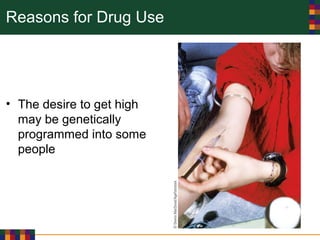
• The desire to get high
may be genetically
programmed into some
people
Reasons for Drug Use
• Peer Influence:
• Many young people use drugs to gain peer acceptance or
approval
• Basic values, life goals, and aspirations still are influenced
more by parents
• Spiritual Purposes:
• People have used drugs to communicate with something
or someone greater than themselves
• Psychoactive plants have roles in many religious and
spiritual practices
Parents who pass on values
can discourage drug use
Reasons for Drug Use
• Self-Discovery:
• Drugs sometimes are used to fill a void in one’s life
• Social Interaction:
• Drugs are used to facilitate interactions with others
• Certain social groups determine how a drug is used
• Rebelliousness:
• Young people rebel against the conventions of society,
including warnings about drugs
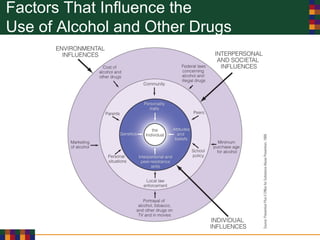
Factors That Influence the
Use of Alcohol and Other Drugs
Drug Dependency vs. Drug Addiction
• Drug dependency:
• Recurring desire for drugs based on a psychic or a
physical need
• Drug addiction:
• Continuing desire for drugs based on a physical need
• Both connote a compulsive need to use a drug and an
inability to cease using it despite serious consequences
Drug Dependency vs. Drug Addiction
• Physical dependency is marked by withdrawal symptoms –
physical symptoms that appear after drug use ceases
• People who are physically dependent on a drug need to take
the drug to ward off withdrawal symptoms.
• Psychological dependency refers to one’s perceived need for
a drug
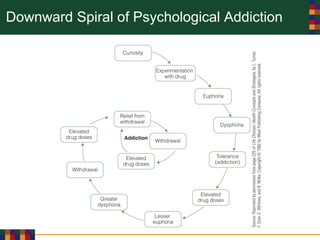
Downward Spiral of Psychological Addiction
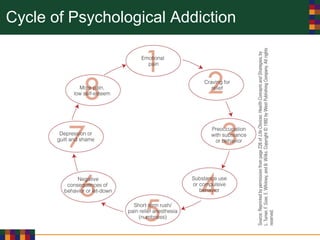
Cycle of Psychological Addiction
Drug Dependency vs. Drug Addiction
• Addiction is “an ingrained habit that undermines your health,
your work, your relationships, your self-respect, but that you
feel you cannot change”
• Dependency encompasses more than drugs: a person can
become dependent on food, religion, love, exercise, or
gambling
Theories of Drug Addiction
• U.S. Department of Health and Human Services: Addiction is
a “chronic, life-threatening condition that has roots in genetic
susceptibility, social circumstance and personal behavior”
• No single theory adequately covers every aspect of drug
addiction – elements of various theories provide insight into
drug addiction
Personality Theory
• Delayed behavioral or emotional development may be a
factor in substance abuse
• Personality characteristics associated with drug abuse:
• Low self-esteem
• Poor interpersonal skills
• Need for immediate gratification
• Defiant feelings toward authority
• Little tolerance for anxiety, frustration, and depression
• Impulsivity
• Risk taking
• Low regard for personal health
Reinforcement Theory
• Reinforcers are stimuli or events that increase the likelihood
of a particular behavior
• Primary reinforcers reduce physiological needs or are
inherently pleasurable; examples are food, water, and sex
• Secondary reinforcers act as signals for the increased
probability of obtaining primary reinforcers; example: money
• Drugs can be primary or secondary reinforcers
Biological Theories
• Biological theory is a view of addiction holding that it is
based on genetics and metabolic imbalances
• Genetic theory: a person is predisposed to drug addiction,
including addiction to alcohol, by hereditary influence
• Metabolic imbalance: Narcotics help addicts stabilize the
metabolic deficiency caused by absence of the drug
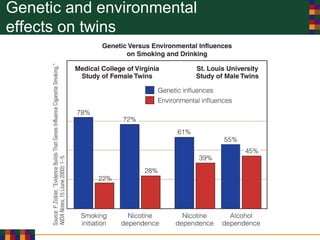
Genetic and environmental
effects on twins
Social Theories
• Social theory is the hypothesis that drug use is determined
by cultural and social influences
• Rewards of drug use may be derived from groups and others
with whom we associate
• Drug abuse may arise from antisocial behavior
• Social theory does not explain drug addiction
Mass Media and Drugs
• The impact of the media on drug use is hard to determine
• Many forms of mass media feature drugs:
• Movies
• Advertisements
• Billboards
• Television
• Music
• Celebrities
Advertisement
• An estimated $25 billion is spent on advertising tobacco,
alcohol, and prescription drugs
• One study of alcohol marketing worldwide showed that young
people are influenced by marketing
• Advertisements for cigarettes play on many themes,
particularly independence
• After cigarette ads were prohibited from television in 1971, the
void was filled with advertisements for smokeless tobacco
Other Mass Media
• Billboards
• Heavily promote alcohol and tobacco
• Television
• Huge influence on American views and behaviors
• Music and music videos
• Illicit drug, tobacco, and alcohol use are common
• Celebrities
• Many have overdosed, been arrested for drug use, or
entered drug treatment programs
Billboards that advertise beer
Billboards that advertise tobacco
Performance-Enhancing Drugs
• Performance-enhancing drugs, also known as ergogenic
aids, are used to gain a competitive advantage
• As early as 300 BC, some Greek athletes ate mushrooms to
enhance their performance
• Drug abuse in sports has become more publicized in the last
few years – e.g. Major League Baseball
• The type of sport and gender of the athlete influence the drug
of choice
Anabolic Steroids
• Anabolic steroids
• Substances used to increase muscle mass
• Related to male sex hormones
• Testosterone during puberty augments muscle mass and
strength, but later in adolescence stunts growth
• Users may engage in stacking – ingesting and injecting
several steroids at the same time
• Users display symptoms of depression, panic, anxiety,
paranoia, mania, and suicidal behavior (roid rage)
Steroid Use by Athletes
Problems with Anabolic Steroids
• Steroid effects on men and women:
• Acne
• Increased susceptibility to infections
• Abrupt mood changes
• Hypertension
• Decreased HDL (good cholesterol)
• Effects on liver
• Stunted growth
Gender-Specific Effects
• Men:
• More frequent
erections
• Atrophied testicles
• Enlarged breasts
• Enlarged prostate
• Infertility
• Baldness
• Women:
• Baldness
• Decreased breast size
• Enlarged clitoris
• Increased facial hair
• Fluid retention
• Menstrual irregularities
• Deepened voice
Human Growth Hormones
and Erythropoietin
• Human growth hormones (HGH)
• Hormones that stimulate protein synthesis
• Used by athletes to enhance performance
• Erythropoietin (EPO)
• Hormone that enhances cardiovascular endurance by
increasing red blood cell production
• Can lead to blood clots, increasing the risk for heart
attacks, stroke, and pulmonary embolism
Creatine Monohydrate
• Creatine monohydrate
• Natural substance used to increase strength and short-
term speed
• Sold over-the-counter as a nutritional supplement
• Believed to increase water content in muscles, adding to
their size and ability to function
• Reduces range of movement
• Reported side effects include muscle cramping,
dehydration, water retention, and kidney problems
• Not regulated by the FDA
Tetrahydrogestrinone (THG)
• Tetrahydrogestrinone (THG)
• Designer drug, closely related to the banned anabolic
steroids gestrinone and trenbolone
• Used by many professional athletes
• Not approved by FDA
• May cause some of the same side effects as steroids
Androstenedione (Andro)
• Androstenedione
• Food supplement used for muscle development
• Precursor molecule, one step away from testosterone
• Banned by NCAA, NFL, and IOC
• Effects are similar to those of anabolic steroids
• In January 2010, the FDA recalled androstenedione
because of its potential side effects
Stimulants
• Cocaine impairs performance requiring hand-eye coordination
and concentration
• Amphetamines have been used in sports to reduce fatigue
and sustain intense exercise
• Caffeine is used to improve endurance, especially short-term
endurance
• Many sports and energy drinks are high in caffeine and
calories
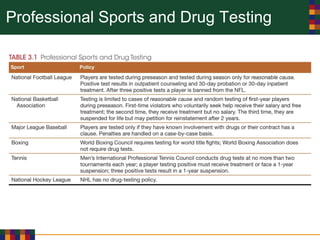
Professional Sports and Drug Testing
Depressants
• Barbiturates inhibit performance
• Benzodiazepines (minor tranquilizers) impair psychomotor
performance
• Alcohol reduces psychomotor skills and aerobic capacity –
also impairs reaction time, fine and complex motor
coordination, balance and steadiness, visual tracking, and
information processing
Sexual Performance
• Many prescribed and over-the-counter drugs alter sexual
functioning
• Drugs such as methamphetamines and alcohol lead to unsafe
sexual practices
• Drugs are commonly used, especially in clubs, to make the
user less sexually inhibited
• Alcohol and narcotics can adversely affect sexual desire,
performance, and satisfaction

Goldberg Chapter 3

  • 1.
    Albia Dugger •Miami Dade College Chapter 3 Motivations for Drug Use
  • 2.
    Reasons for DrugUse • Experimentation: • Especially among young people, curiosity is a natural phenomenon that easily leads to experimentation • Pleasure/Escape from Boredom: • An individual who is bored will engage in something pleasurable to relieve the boredom • Drugs used to increase pleasure or reduce boredom provide positive reinforcement • Drugs taken to alleviate discomfort provide negative reinforcement
  • 3.
    Reasons for DrugUse • The desire to get high may be genetically programmed into some people
  • 4.
    Reasons for DrugUse • Peer Influence: • Many young people use drugs to gain peer acceptance or approval • Basic values, life goals, and aspirations still are influenced more by parents • Spiritual Purposes: • People have used drugs to communicate with something or someone greater than themselves • Psychoactive plants have roles in many religious and spiritual practices
  • 5.
    Parents who passon values can discourage drug use
  • 6.
    Reasons for DrugUse • Self-Discovery: • Drugs sometimes are used to fill a void in one’s life • Social Interaction: • Drugs are used to facilitate interactions with others • Certain social groups determine how a drug is used • Rebelliousness: • Young people rebel against the conventions of society, including warnings about drugs
  • 7.
    Factors That Influencethe Use of Alcohol and Other Drugs
  • 8.
    Drug Dependency vs.Drug Addiction • Drug dependency: • Recurring desire for drugs based on a psychic or a physical need • Drug addiction: • Continuing desire for drugs based on a physical need • Both connote a compulsive need to use a drug and an inability to cease using it despite serious consequences
  • 9.
    Drug Dependency vs.Drug Addiction • Physical dependency is marked by withdrawal symptoms – physical symptoms that appear after drug use ceases • People who are physically dependent on a drug need to take the drug to ward off withdrawal symptoms. • Psychological dependency refers to one’s perceived need for a drug
  • 10.
    Downward Spiral ofPsychological Addiction
  • 11.
  • 12.
    Drug Dependency vs.Drug Addiction • Addiction is “an ingrained habit that undermines your health, your work, your relationships, your self-respect, but that you feel you cannot change” • Dependency encompasses more than drugs: a person can become dependent on food, religion, love, exercise, or gambling
  • 13.
    Theories of DrugAddiction • U.S. Department of Health and Human Services: Addiction is a “chronic, life-threatening condition that has roots in genetic susceptibility, social circumstance and personal behavior” • No single theory adequately covers every aspect of drug addiction – elements of various theories provide insight into drug addiction
  • 14.
    Personality Theory • Delayedbehavioral or emotional development may be a factor in substance abuse • Personality characteristics associated with drug abuse: • Low self-esteem • Poor interpersonal skills • Need for immediate gratification • Defiant feelings toward authority • Little tolerance for anxiety, frustration, and depression • Impulsivity • Risk taking • Low regard for personal health
  • 15.
    Reinforcement Theory • Reinforcersare stimuli or events that increase the likelihood of a particular behavior • Primary reinforcers reduce physiological needs or are inherently pleasurable; examples are food, water, and sex • Secondary reinforcers act as signals for the increased probability of obtaining primary reinforcers; example: money • Drugs can be primary or secondary reinforcers
  • 16.
    Biological Theories • Biologicaltheory is a view of addiction holding that it is based on genetics and metabolic imbalances • Genetic theory: a person is predisposed to drug addiction, including addiction to alcohol, by hereditary influence • Metabolic imbalance: Narcotics help addicts stabilize the metabolic deficiency caused by absence of the drug
  • 17.
  • 18.
    Social Theories • Socialtheory is the hypothesis that drug use is determined by cultural and social influences • Rewards of drug use may be derived from groups and others with whom we associate • Drug abuse may arise from antisocial behavior • Social theory does not explain drug addiction
  • 19.
    Mass Media andDrugs • The impact of the media on drug use is hard to determine • Many forms of mass media feature drugs: • Movies • Advertisements • Billboards • Television • Music • Celebrities
  • 20.
    Advertisement • An estimated$25 billion is spent on advertising tobacco, alcohol, and prescription drugs • One study of alcohol marketing worldwide showed that young people are influenced by marketing • Advertisements for cigarettes play on many themes, particularly independence • After cigarette ads were prohibited from television in 1971, the void was filled with advertisements for smokeless tobacco
  • 21.
    Other Mass Media •Billboards • Heavily promote alcohol and tobacco • Television • Huge influence on American views and behaviors • Music and music videos • Illicit drug, tobacco, and alcohol use are common • Celebrities • Many have overdosed, been arrested for drug use, or entered drug treatment programs
  • 22.
  • 23.
  • 24.
    Performance-Enhancing Drugs • Performance-enhancingdrugs, also known as ergogenic aids, are used to gain a competitive advantage • As early as 300 BC, some Greek athletes ate mushrooms to enhance their performance • Drug abuse in sports has become more publicized in the last few years – e.g. Major League Baseball • The type of sport and gender of the athlete influence the drug of choice
  • 25.
    Anabolic Steroids • Anabolicsteroids • Substances used to increase muscle mass • Related to male sex hormones • Testosterone during puberty augments muscle mass and strength, but later in adolescence stunts growth • Users may engage in stacking – ingesting and injecting several steroids at the same time • Users display symptoms of depression, panic, anxiety, paranoia, mania, and suicidal behavior (roid rage)
  • 26.
  • 27.
    Problems with AnabolicSteroids • Steroid effects on men and women: • Acne • Increased susceptibility to infections • Abrupt mood changes • Hypertension • Decreased HDL (good cholesterol) • Effects on liver • Stunted growth
  • 28.
    Gender-Specific Effects • Men: •More frequent erections • Atrophied testicles • Enlarged breasts • Enlarged prostate • Infertility • Baldness • Women: • Baldness • Decreased breast size • Enlarged clitoris • Increased facial hair • Fluid retention • Menstrual irregularities • Deepened voice
  • 29.
    Human Growth Hormones andErythropoietin • Human growth hormones (HGH) • Hormones that stimulate protein synthesis • Used by athletes to enhance performance • Erythropoietin (EPO) • Hormone that enhances cardiovascular endurance by increasing red blood cell production • Can lead to blood clots, increasing the risk for heart attacks, stroke, and pulmonary embolism
  • 30.
    Creatine Monohydrate • Creatinemonohydrate • Natural substance used to increase strength and short- term speed • Sold over-the-counter as a nutritional supplement • Believed to increase water content in muscles, adding to their size and ability to function • Reduces range of movement • Reported side effects include muscle cramping, dehydration, water retention, and kidney problems • Not regulated by the FDA
  • 31.
    Tetrahydrogestrinone (THG) • Tetrahydrogestrinone(THG) • Designer drug, closely related to the banned anabolic steroids gestrinone and trenbolone • Used by many professional athletes • Not approved by FDA • May cause some of the same side effects as steroids
  • 32.
    Androstenedione (Andro) • Androstenedione •Food supplement used for muscle development • Precursor molecule, one step away from testosterone • Banned by NCAA, NFL, and IOC • Effects are similar to those of anabolic steroids • In January 2010, the FDA recalled androstenedione because of its potential side effects
  • 33.
    Stimulants • Cocaine impairsperformance requiring hand-eye coordination and concentration • Amphetamines have been used in sports to reduce fatigue and sustain intense exercise • Caffeine is used to improve endurance, especially short-term endurance • Many sports and energy drinks are high in caffeine and calories
  • 34.
  • 35.
    Depressants • Barbiturates inhibitperformance • Benzodiazepines (minor tranquilizers) impair psychomotor performance • Alcohol reduces psychomotor skills and aerobic capacity – also impairs reaction time, fine and complex motor coordination, balance and steadiness, visual tracking, and information processing
  • 36.
    Sexual Performance • Manyprescribed and over-the-counter drugs alter sexual functioning • Drugs such as methamphetamines and alcohol lead to unsafe sexual practices • Drugs are commonly used, especially in clubs, to make the user less sexually inhibited • Alcohol and narcotics can adversely affect sexual desire, performance, and satisfaction

Editor's Notes

  • #4 People who inject drugs are more likely to be compulsive drug users.
  • #6 Strong family bonds are important to counter the influence of peers. (left) Communicating with children reduces the risk of drug abuse. (right)
  • #8 Figure 3.1 Factors That Influence the Use of Alcohol and Other Drugs
  • #11 Figure 3.2 Downward Spiral of Psychological Addiction
  • #12 Figure 3.3 Cycle of Psychological Addiction
  • #18 Figure 3.4 A Medical College of Virginia study involving 949 female twin pairs found genetic factors to be more influential than environmental factors in smoking initiation and nicotine dependence. Likewise, a St. Louis University study of 3,356 male twin pairs found genetic factors to be more influential for dependence on nicotine and alcohol.
  • #23 Although beer is widely advertised, the effects of advertisement on behavior are hard to gauge.
  • #24 Billboards that advertise tobacco and alcohol are more likely to be found in poor urban neighborhoods than in this country setting.
  • #27 Steroid abuse often begins with an attempt to increase muscle size or to improve appearance.