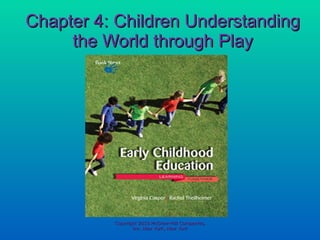
Chapter 4: Children Understanding the World through Play Copyright 2010 McGraw-Hill Companies, Inc. New York, New York
Integrative Play Allows children: To use their imaginations Communicate meaning Transform their thinking Solve problems Copyright 2010 McGraw-Hill Companies, Inc. New York, New York
Symbolic Play Allows children to: To go beyond what is present To add to the attributes of playthings To use their imagination To transcend the limitations of the available playthings Copyright 2010 McGraw-Hill Companies, Inc. New York, New York
Conceptual Parameters Boundaries of child’s thinking What contributes to the creation of these boundaries? Copyright 2010 McGraw-Hill Companies, Inc. New York, New York
Play Symbols Ways to make one thing stand for another List some common play symbols Copyright 2010 McGraw-Hill Companies, Inc. New York, New York
Using Play to Solve Problems While children might have a difficult time “thinking” through their problems, they can use Play as a means to work through their issues and concerns. How did Ana and Michael use Play to alleviate some of their fears? Copyright 2010 McGraw-Hill Companies, Inc. New York, New York
Primary Attachment Relationships Allow children: To experience their environment as safe To feel protected To feel free to express themselves Copyright 2010 McGraw-Hill Companies, Inc. New York, New York
Play as a Social Motivator Encourages children: To interact with one another To negotiate with one another To tolerate frustration To cooperate Copyright 2010 McGraw-Hill Companies, Inc. New York, New York
Spontaneous Play Contains: Fantasy, as well as reality Complex verbal dialogues Many children or just one Copyright 2010 McGraw-Hill Companies, Inc. New York, New York
Play in the Primary Grades Transitions from spontaneous to more rule-based types of play Becomes more competitive Can predict later social competence Can facilitate learning  Copyright 2010 McGraw-Hill Companies, Inc. New York, New York
Characteristics of Play Intrinsically motivating Offers opportunities for pleasure Allows for self-expression Encourages mastery of developmental issues Is a reward by itself Copyright 2010 McGraw-Hill Companies, Inc. New York, New York
Play Symbols and Metaphors Identify the symbols and metaphor in the following scenario: Pablo just moved from the city out to the country. As he plays with his play dough, he creates a snake and then proceeds to “smash” it with his hammer. Copyright 2010 McGraw-Hill Companies, Inc. New York, New York
Categories of Play Unoccupied play : No obvious action Solitary play : Playing alone Onlooker play : Observes others playing  Parallel play : Plays next to but not with another child Associative play : Play with a common focus Cooperative play : Playing together Copyright 2010 McGraw-Hill Companies, Inc. New York, New York
Functional Play Play that involves actions and the body Play that occurs at the sensory level Allows their physical actions to enhance the sensory experience Copyright 2010 McGraw-Hill Companies, Inc. New York, New York
Constructive Play Involves the creation of something new Building a tower Painting a picture Making a quilt Copyright 2010 McGraw-Hill Companies, Inc. New York, New York
Dramatic Play An interactive and open-ended process Uses symbols to represent feelings, ideas, and issues Is not goal-oriented Involves improvisation Copyright 2010 McGraw-Hill Companies, Inc. New York, New York
Self-Regulation Promotes children’s ability to: Modulate impulses Exert Self-Control Delay gratification Follow routines and rules Copyright 2010 McGraw-Hill Companies, Inc. New York, New York
Characteristics of Traumatic Play Occurs in children who have been traumatized Is grim and “business-like” Contains elements of fear, rage, and helplessness Is unusually intense Copyright 2010 McGraw-Hill Companies, Inc. New York, New York
“ Power” Play As children understand their own limitations, they look for ways to feel more powerful or in control Through play, children can become superheroes, dinosaurs, and even parents! Copyright 2010 McGraw-Hill Companies, Inc. New York, New York
Gender and Play Allows children to pursue both stereotypical and atypical behaviors associated with gender Can be troubling for some teachers and parents if gender roles are emphasized too strongly or ignored Copyright 2010 McGraw-Hill Companies, Inc. New York, New York
Culture and Play Children from different cultures can find some types of play intimidating Cultural differences affect how and what children play with Can teach children about cultures different from their own Copyright 2010 McGraw-Hill Companies, Inc. New York, New York
Aspects of Inclusive Play Do the objects we use reflect the language and culture of the children? Do we have objects from diverse cultures? Do the materials respect cultural diversity? Do the materials challenge sex-role stereotypes? Copyright 2010 McGraw-Hill Companies, Inc. New York, New York
Respect for Play Observe play to find its meaning Facilitate play to make it easier Provide scaffolding when needed Validate the child’s play by recognizing its importance Copyright 2010 McGraw-Hill Companies, Inc. New York, New York
Scaffolding Components of Play Social Relating to others Emotional Understanding feelings Conceptual Thinking and problem solving Copyright 2010 McGraw-Hill Companies, Inc. New York, New York
Educational Benefits of Play Increased vocabulary Better story comprehension Better problem solving Higher social competence Copyright 2010 McGraw-Hill Companies, Inc. New York, New York

Chapter 4: Children Understanding the World through Play

  • 1.
    Chapter 4: ChildrenUnderstanding the World through Play Copyright 2010 McGraw-Hill Companies, Inc. New York, New York
  • 2.
    Integrative Play Allowschildren: To use their imaginations Communicate meaning Transform their thinking Solve problems Copyright 2010 McGraw-Hill Companies, Inc. New York, New York
  • 3.
    Symbolic Play Allowschildren to: To go beyond what is present To add to the attributes of playthings To use their imagination To transcend the limitations of the available playthings Copyright 2010 McGraw-Hill Companies, Inc. New York, New York
  • 4.
    Conceptual Parameters Boundariesof child’s thinking What contributes to the creation of these boundaries? Copyright 2010 McGraw-Hill Companies, Inc. New York, New York
  • 5.
    Play Symbols Waysto make one thing stand for another List some common play symbols Copyright 2010 McGraw-Hill Companies, Inc. New York, New York
  • 6.
    Using Play toSolve Problems While children might have a difficult time “thinking” through their problems, they can use Play as a means to work through their issues and concerns. How did Ana and Michael use Play to alleviate some of their fears? Copyright 2010 McGraw-Hill Companies, Inc. New York, New York
  • 7.
    Primary Attachment RelationshipsAllow children: To experience their environment as safe To feel protected To feel free to express themselves Copyright 2010 McGraw-Hill Companies, Inc. New York, New York
  • 8.
    Play as aSocial Motivator Encourages children: To interact with one another To negotiate with one another To tolerate frustration To cooperate Copyright 2010 McGraw-Hill Companies, Inc. New York, New York
  • 9.
    Spontaneous Play Contains:Fantasy, as well as reality Complex verbal dialogues Many children or just one Copyright 2010 McGraw-Hill Companies, Inc. New York, New York
  • 10.
    Play in thePrimary Grades Transitions from spontaneous to more rule-based types of play Becomes more competitive Can predict later social competence Can facilitate learning Copyright 2010 McGraw-Hill Companies, Inc. New York, New York
  • 11.
    Characteristics of PlayIntrinsically motivating Offers opportunities for pleasure Allows for self-expression Encourages mastery of developmental issues Is a reward by itself Copyright 2010 McGraw-Hill Companies, Inc. New York, New York
  • 12.
    Play Symbols andMetaphors Identify the symbols and metaphor in the following scenario: Pablo just moved from the city out to the country. As he plays with his play dough, he creates a snake and then proceeds to “smash” it with his hammer. Copyright 2010 McGraw-Hill Companies, Inc. New York, New York
  • 13.
    Categories of PlayUnoccupied play : No obvious action Solitary play : Playing alone Onlooker play : Observes others playing Parallel play : Plays next to but not with another child Associative play : Play with a common focus Cooperative play : Playing together Copyright 2010 McGraw-Hill Companies, Inc. New York, New York
  • 14.
    Functional Play Playthat involves actions and the body Play that occurs at the sensory level Allows their physical actions to enhance the sensory experience Copyright 2010 McGraw-Hill Companies, Inc. New York, New York
  • 15.
    Constructive Play Involvesthe creation of something new Building a tower Painting a picture Making a quilt Copyright 2010 McGraw-Hill Companies, Inc. New York, New York
  • 16.
    Dramatic Play Aninteractive and open-ended process Uses symbols to represent feelings, ideas, and issues Is not goal-oriented Involves improvisation Copyright 2010 McGraw-Hill Companies, Inc. New York, New York
  • 17.
    Self-Regulation Promotes children’sability to: Modulate impulses Exert Self-Control Delay gratification Follow routines and rules Copyright 2010 McGraw-Hill Companies, Inc. New York, New York
  • 18.
    Characteristics of TraumaticPlay Occurs in children who have been traumatized Is grim and “business-like” Contains elements of fear, rage, and helplessness Is unusually intense Copyright 2010 McGraw-Hill Companies, Inc. New York, New York
  • 19.
    “ Power” PlayAs children understand their own limitations, they look for ways to feel more powerful or in control Through play, children can become superheroes, dinosaurs, and even parents! Copyright 2010 McGraw-Hill Companies, Inc. New York, New York
  • 20.
    Gender and PlayAllows children to pursue both stereotypical and atypical behaviors associated with gender Can be troubling for some teachers and parents if gender roles are emphasized too strongly or ignored Copyright 2010 McGraw-Hill Companies, Inc. New York, New York
  • 21.
    Culture and PlayChildren from different cultures can find some types of play intimidating Cultural differences affect how and what children play with Can teach children about cultures different from their own Copyright 2010 McGraw-Hill Companies, Inc. New York, New York
  • 22.
    Aspects of InclusivePlay Do the objects we use reflect the language and culture of the children? Do we have objects from diverse cultures? Do the materials respect cultural diversity? Do the materials challenge sex-role stereotypes? Copyright 2010 McGraw-Hill Companies, Inc. New York, New York
  • 23.
    Respect for PlayObserve play to find its meaning Facilitate play to make it easier Provide scaffolding when needed Validate the child’s play by recognizing its importance Copyright 2010 McGraw-Hill Companies, Inc. New York, New York
  • 24.
    Scaffolding Components ofPlay Social Relating to others Emotional Understanding feelings Conceptual Thinking and problem solving Copyright 2010 McGraw-Hill Companies, Inc. New York, New York
  • 25.
    Educational Benefits ofPlay Increased vocabulary Better story comprehension Better problem solving Higher social competence Copyright 2010 McGraw-Hill Companies, Inc. New York, New York