Digestion,Digestion,
Absorption, andAbsorption, and
TransportTransport
Chapter 3Chapter 3
DigestionDigestion
• Breaking down foods into nutrients
• Prepare for absorption
• Challenges of digestion
• Tasks of the mouth
• Diaphragm
• Steady movement
• Lubrication of food
• Digestive enzyme functions
• Excretion of waste
Anatomy of the Digestive TractAnatomy of the Digestive Tract
• Gastrointestinal (GI) tract
• Flexible and muscular
• Path
• Mouth → esophagus → stomach → small
intestine → large intestine → rectum → anus
• Lumen
• Continuous
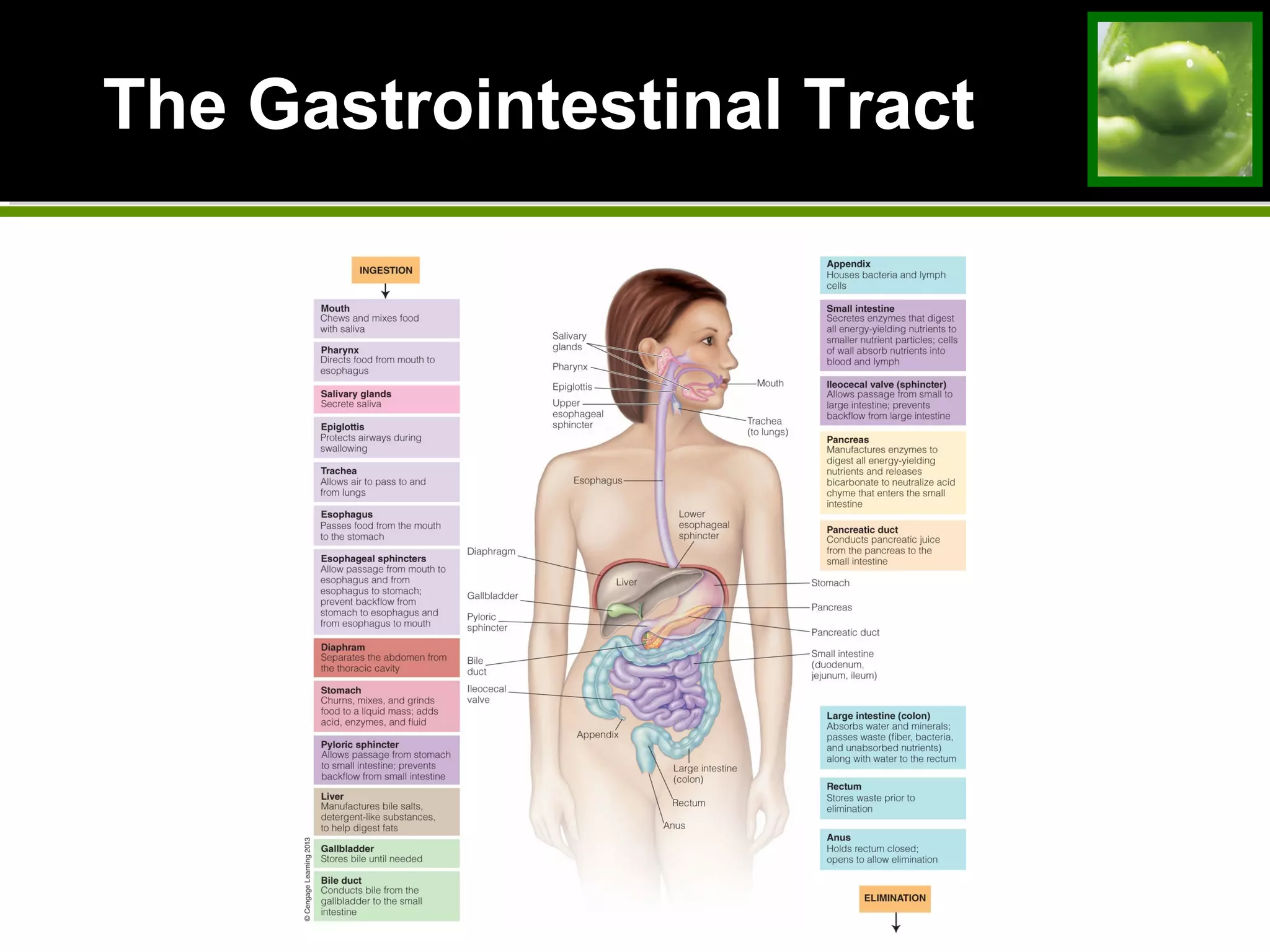
The Gastrointestinal TractThe Gastrointestinal Tract
Anatomy of the Digestive TractAnatomy of the Digestive Tract
• Mouth
• Process of digestion begins
• Mastication
• Four basic taste sensations
• Savory
• Aroma, texture, and temperature
• Pharynx
• Bolus
Anatomy of the Digestive TractAnatomy of the Digestive Tract
• Esophagus
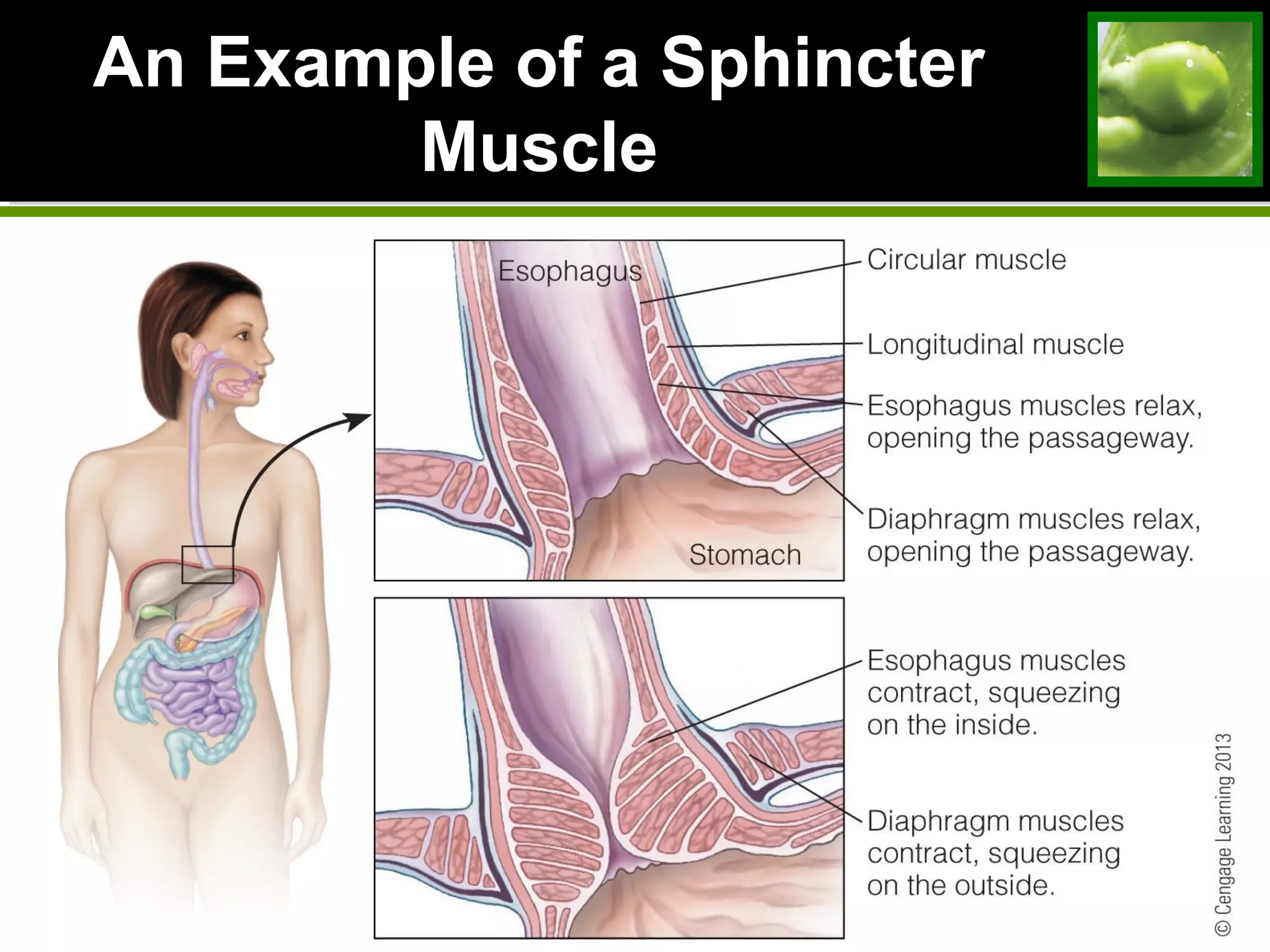
• Two sphincters
• Upper esophageal sphincter
• Lower esophageal sphincter
• Stomach
• Movement of bolus
• Chyme
• Pyloric sphincter
Anatomy of the Digestive TractAnatomy of the Digestive Tract
• Small intestine
• Common bile duct
• Pancreas and gall bladder
• Three segments
• Large intestine (colon)
• Ileocecal valve
• Withdrawal of water
• Rectum and anus
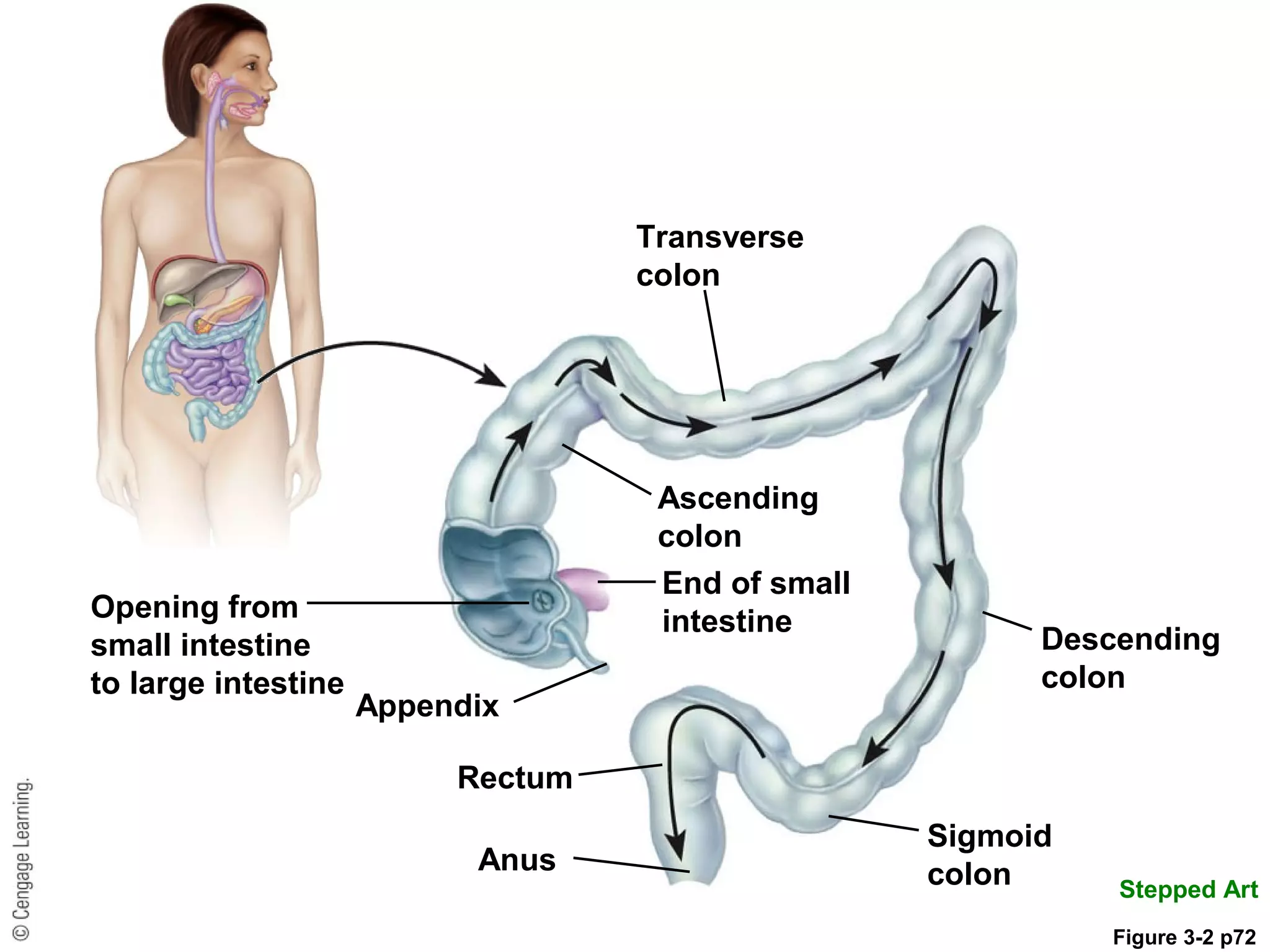
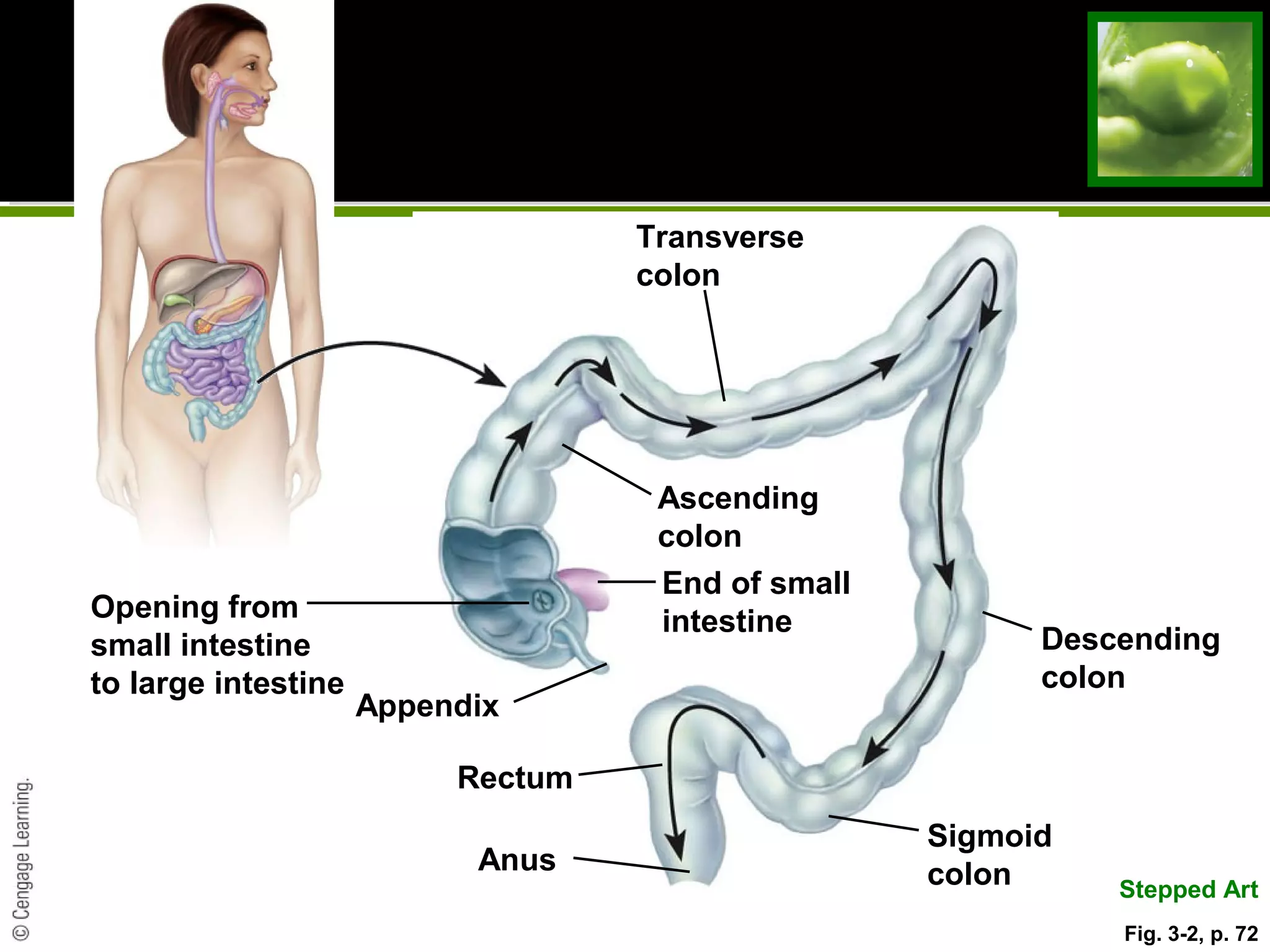
Transverse
colon
Ascending
colon
Descending
colon
Sigmoid
colonAnus
Rectum
Appendix
Opening from
small intestine
to large intestine
End of small
intestine
Stepped Art
Figure 3-2 p72
Transverse
colon
Ascending
colon
Descending
colon
Sigmoid
colonAnus
Rectum
Appendix
Opening from
small intestine
to large intestine
End of small
intestine
Stepped Art
Fig. 3-2, p. 72
Muscular Action of DigestionMuscular Action of Digestion
• Peristalsis
• Circular and longitudinal muscles working
together
• Rate and intensity of contractions vary
• Factors that may interfere with peristalsis
• Stomach action
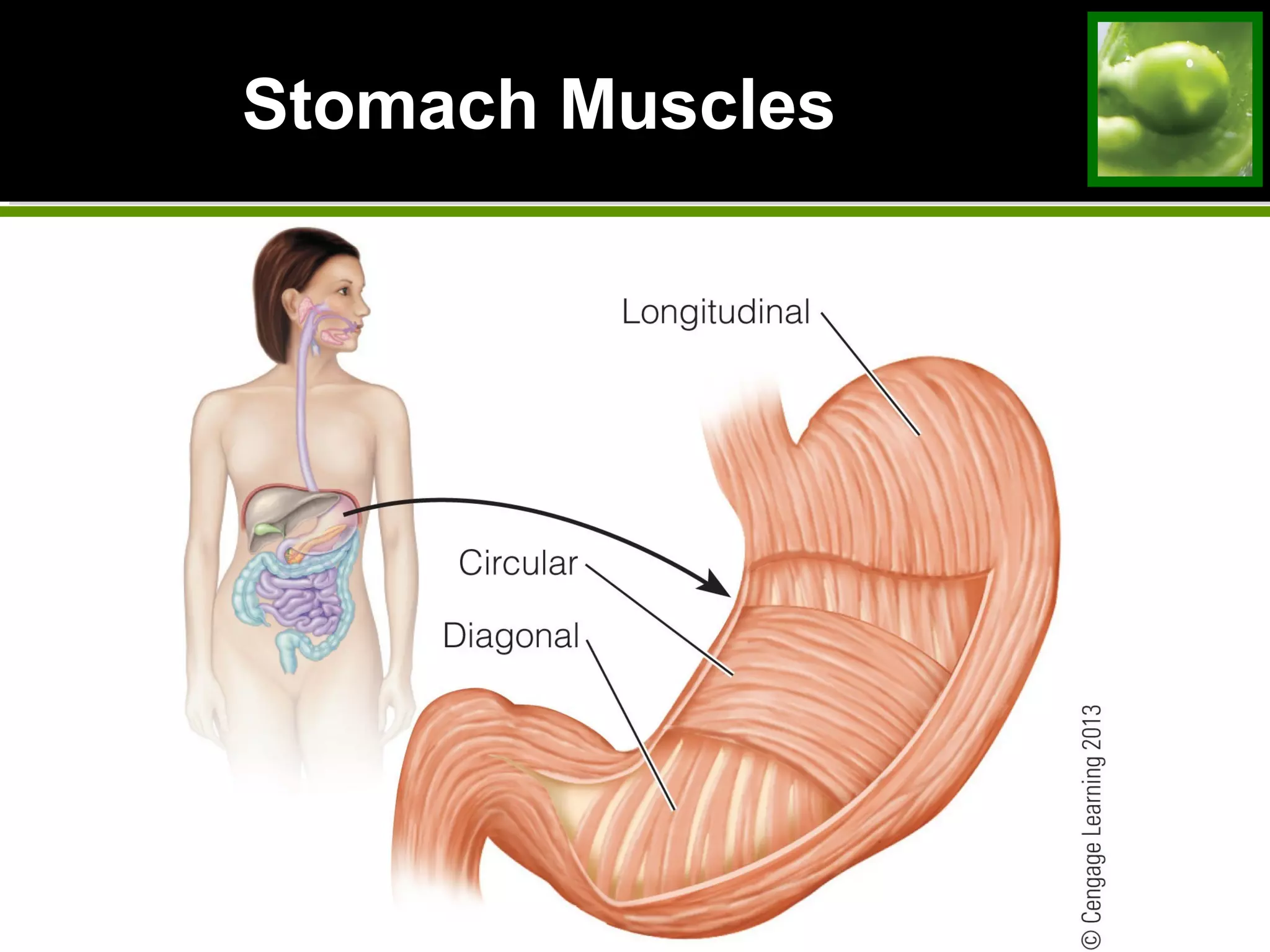
• Circular, longitudinal, and diagonal muscles
• Timing the release of chyme
Stomach MusclesStomach Muscles
Muscular Action of DigestionMuscular Action of Digestion
• Segmentation
• Contraction of circular muscles in small
intestine
• Mix chyme
• Promote contact with absorption cells
• Sphincter contractions
• Periodically open and close
• Control pace of GI tract contents
An Example of a SphincterAn Example of a Sphincter
MuscleMuscle
Secretions of DigestionSecretions of Digestion
• Five organs
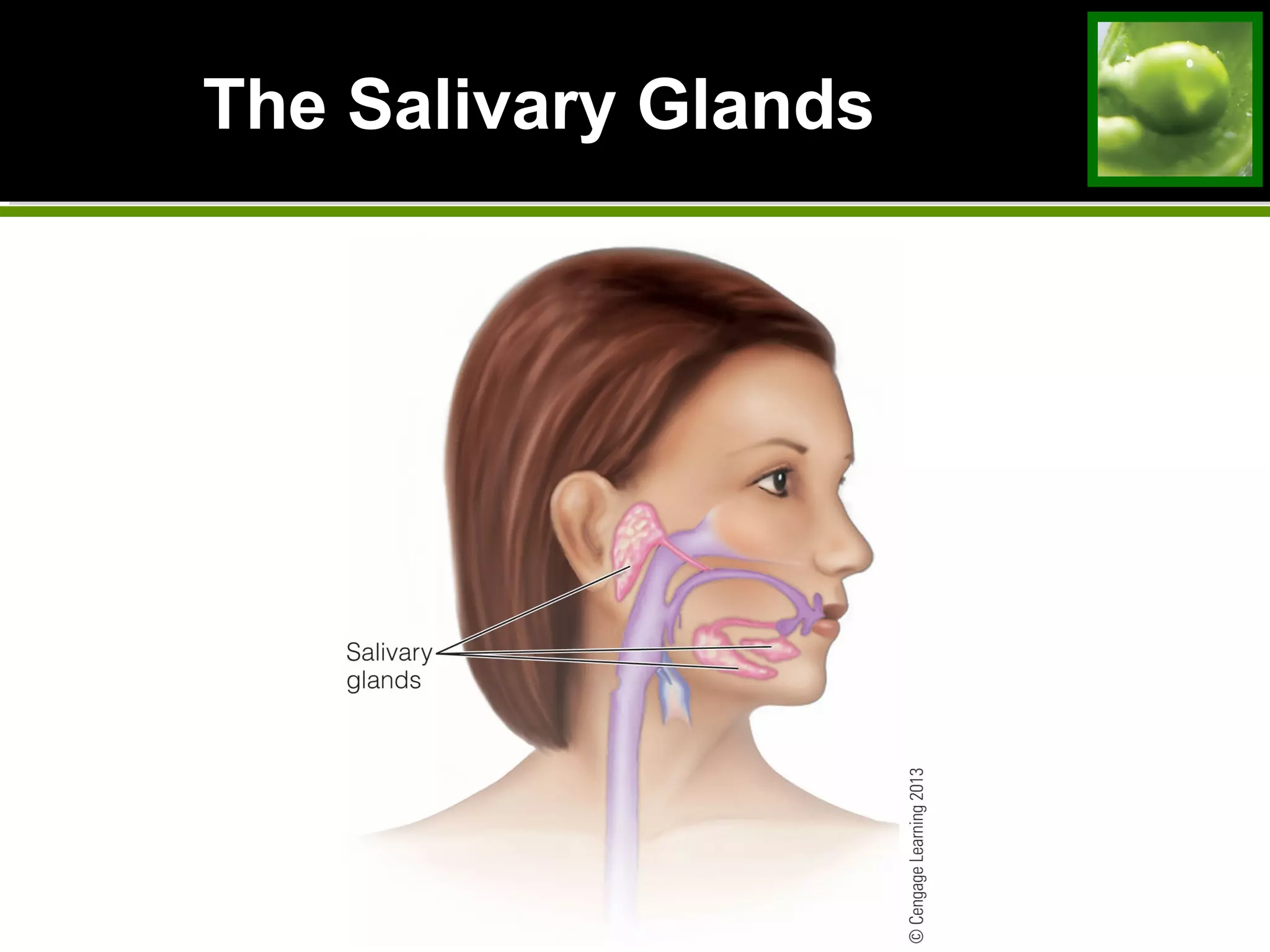
• Salivary glands, stomach, pancreas, liver,
small intestine
• Secretions
• Water
• Enzymes
• Protein facilitator of chemical reactions
• Hydrolysis
Secretions of DigestionSecretions of Digestion
• Saliva
• Moisten food for easy passage
• Protective role
• Carbohydrate digestion
• Gastric juice
• Protein digestion
• Mucus
• pH units
The Salivary Glands
Secretions of DigestionSecretions of Digestion
• Pancreatic juice and intestinal enzymes
• Released via ducts into duodenum
• Enzymes act on all three energy nutrients
• Sodium bicarbonate
• Bile
• Liver
• Gallbladder
Summary of Digestive Secretions
& Their Major Actions
The Final StageThe Final Stage
• Undigested residues
• Exercise intestinal muscles
• Retention of water
• Colon
• Intestinal bacteria
• Recyclable materials
• Water and dissolved salts
AbsorptionAbsorption
• Small intestine
• Majority of absorption
• Ten feet long
• Surface area
• Absorption techniques
• Simple diffusion
• Facilitated diffusion
• Active transport
Carrier loads
nutrient on
outside of cell . . .
Carrier loads
nutrient on
outside of cell . . .
Outside
cell
Cell
membrane
. . . and then
releases it on
inside of cell.
. . . and then
releases it on
inside of cell.
Inside
cell
FACILITATED
DIFFUSION
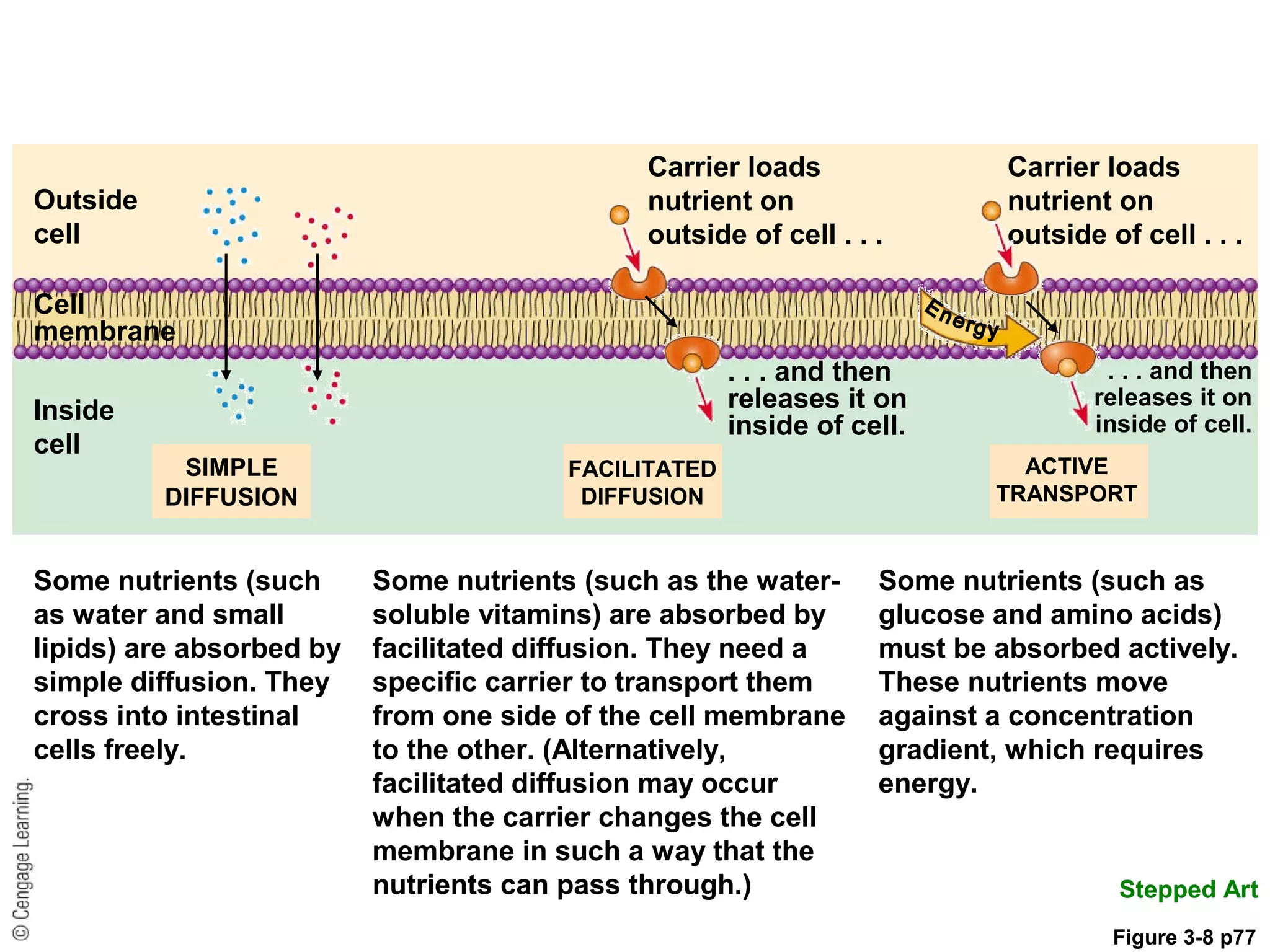
Some nutrients (such as the water-
soluble vitamins) are absorbed by
facilitated diffusion. They need a
specific carrier to transport them
from one side of the cell membrane
to the other. (Alternatively,
facilitated diffusion may occur
when the carrier changes the cell
membrane in such a way that the
nutrients can pass through.)
ACTIVE
TRANSPORT
Some nutrients (such as
glucose and amino acids)
must be absorbed actively.
These nutrients move
against a concentration
gradient, which requires
energy.
Stepped Art
Some nutrients (such
as water and small
lipids) are absorbed by
simple diffusion. They
cross into intestinal
cells freely.
SIMPLE
DIFFUSION
Figure 3-8 p77
Carrier loads
nutrient on
outside of cell . . .
Carrier loads
nutrient on
outside of cell . . .
Outside
cell
Cell
membrane
. . . and then
releases it on
inside of cell.
. . . and then
releases it on
inside of cell.
Inside
cell
FACILITATED
DIFFUSION
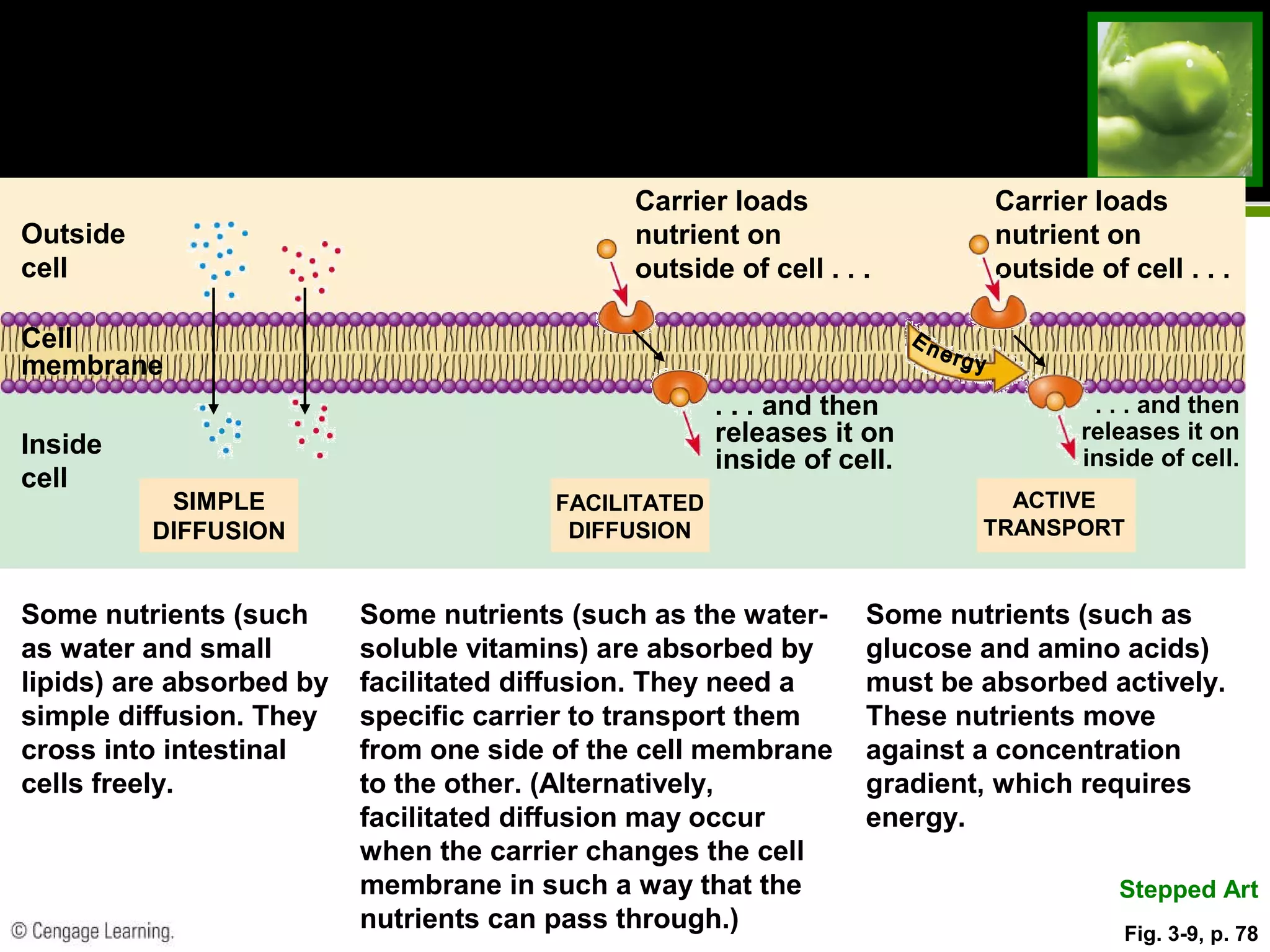
Some nutrients (such as the water-
soluble vitamins) are absorbed by
facilitated diffusion. They need a
specific carrier to transport them
from one side of the cell membrane
to the other. (Alternatively,
facilitated diffusion may occur
when the carrier changes the cell
membrane in such a way that the
nutrients can pass through.)
ACTIVE
TRANSPORT
Some nutrients (such as
glucose and amino acids)
must be absorbed actively.
These nutrients move
against a concentration
gradient, which requires
energy.
Stepped Art
Some nutrients (such
as water and small
lipids) are absorbed by
simple diffusion. They
cross into intestinal
cells freely.
SIMPLE
DIFFUSION
Fig. 3-9, p. 78
Anatomy of the AbsorptiveAnatomy of the Absorptive
SystemSystem
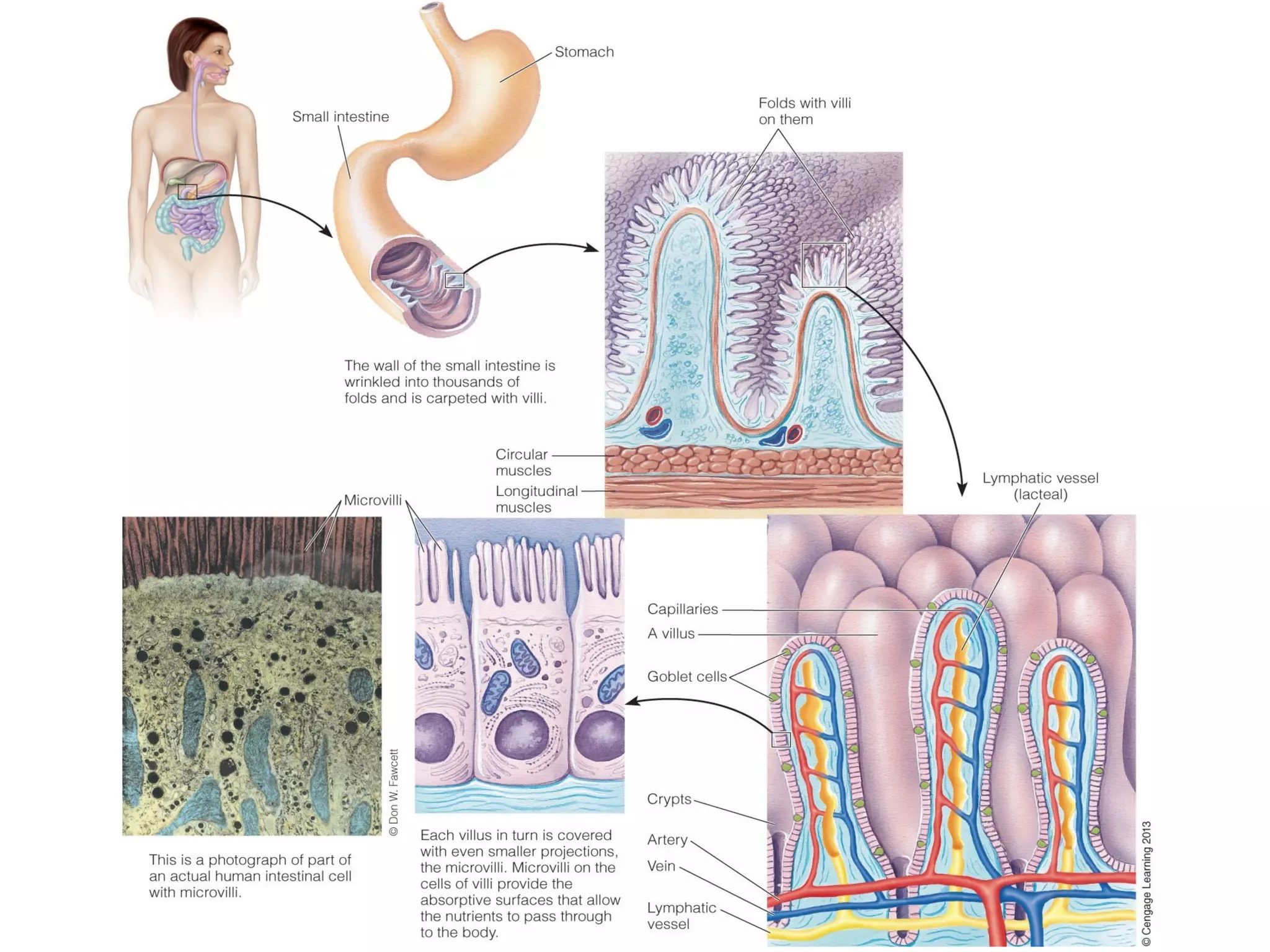
• Villi
• Select and regulate nutrients absorbed
• Microvilli
• Enzymes and “pumps”
• Crypts
• Secretion of intestinal juices
• Goblet cells
• Mucus secretion
A Closer Look at the IntestinalA Closer Look at the Intestinal
CellsCells
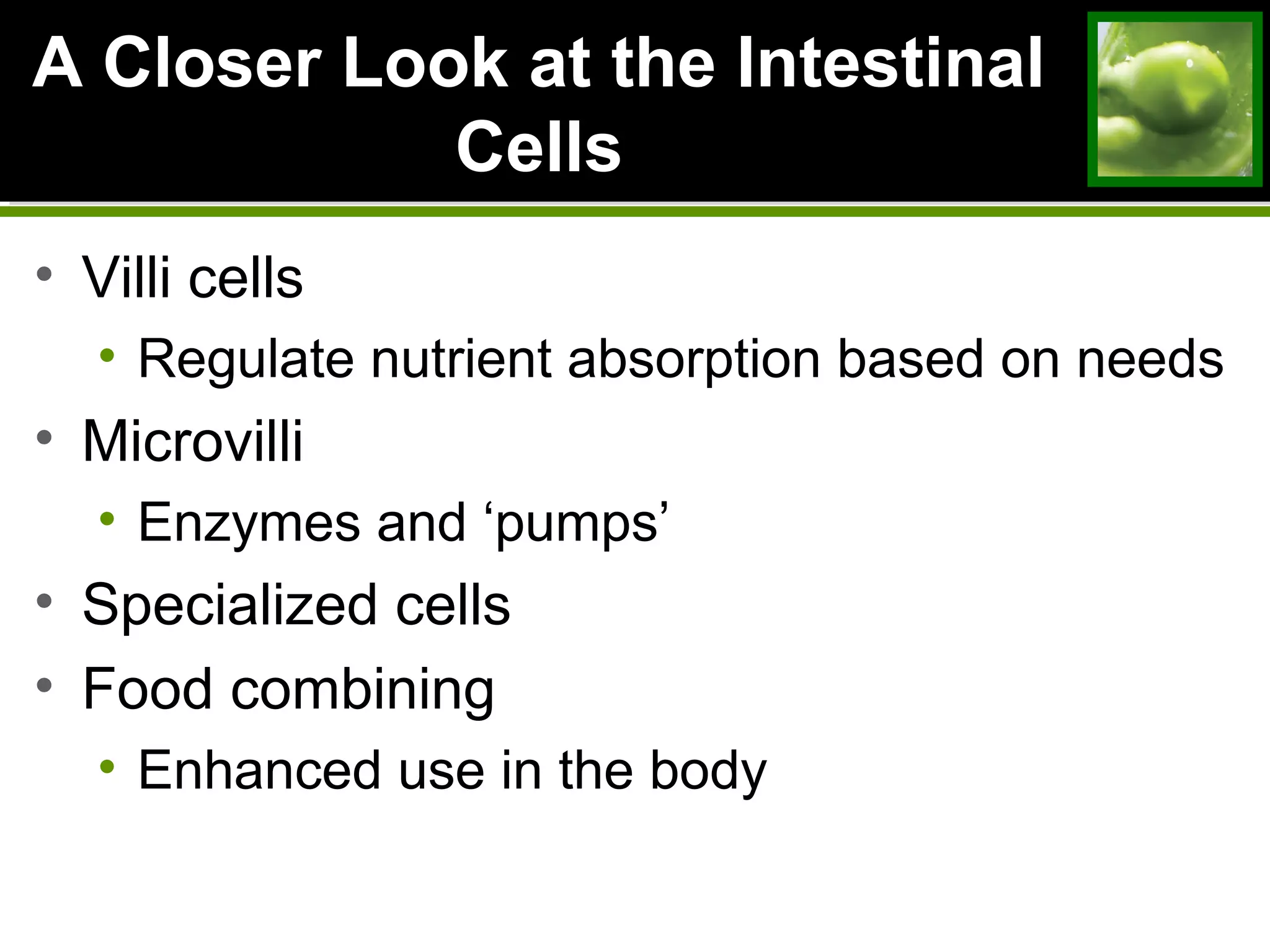
• Villi cells
• Regulate nutrient absorption based on needs
• Microvilli
• Enzymes and ‘pumps’
• Specialized cells
• Food combining
• Enhanced use in the body
A Closer Look at the Intestinal
Cells
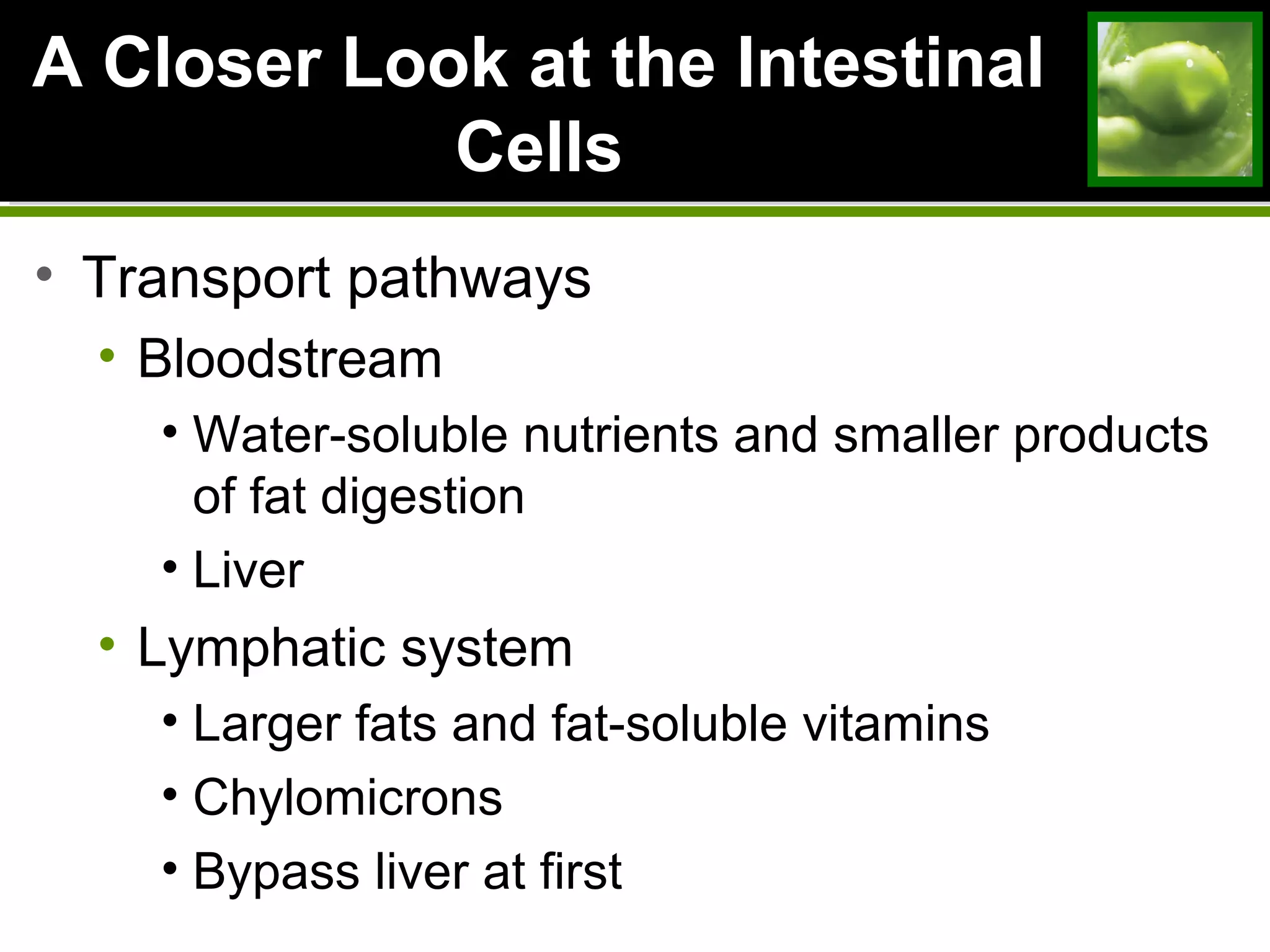
• Transport pathways
• Bloodstream
• Water-soluble nutrients and smaller products
of fat digestion
• Liver
• Lymphatic system
• Larger fats and fat-soluble vitamins
• Chylomicrons
• Bypass liver at first
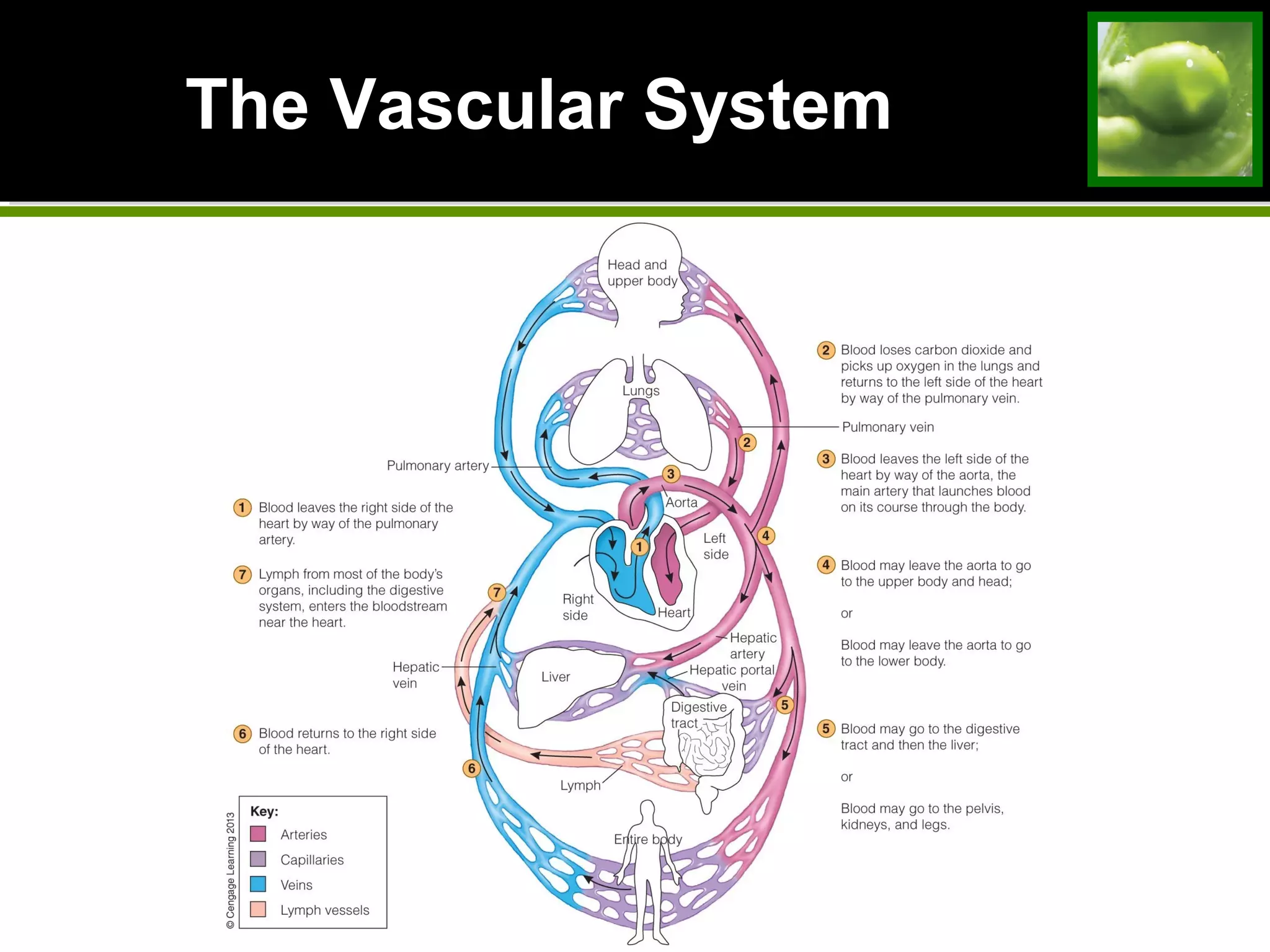
The Vascular SystemThe Vascular System
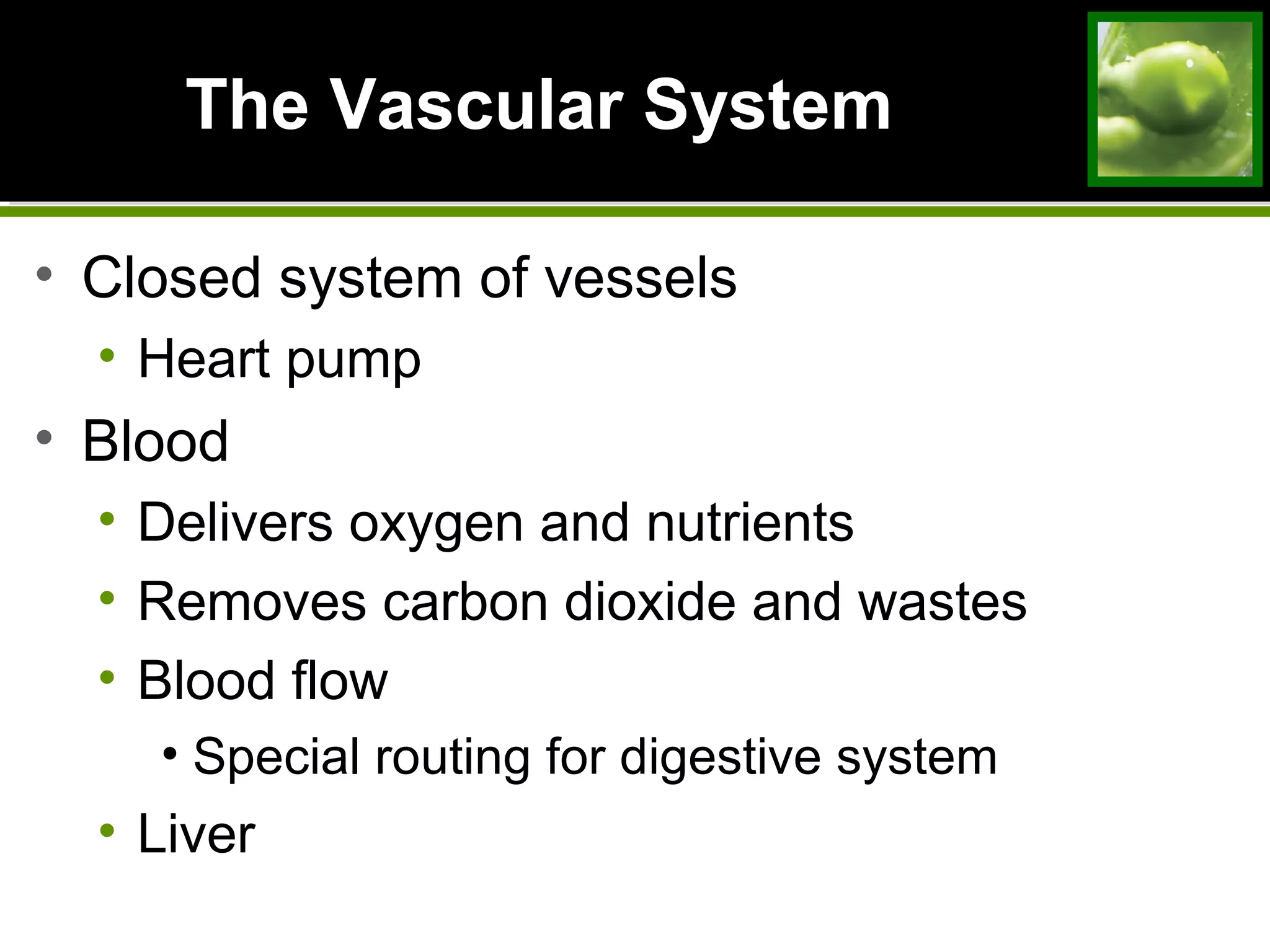
• Closed system of vessels
• Heart pump
• Blood
• Delivers oxygen and nutrients
• Removes carbon dioxide and wastes
• Blood flow
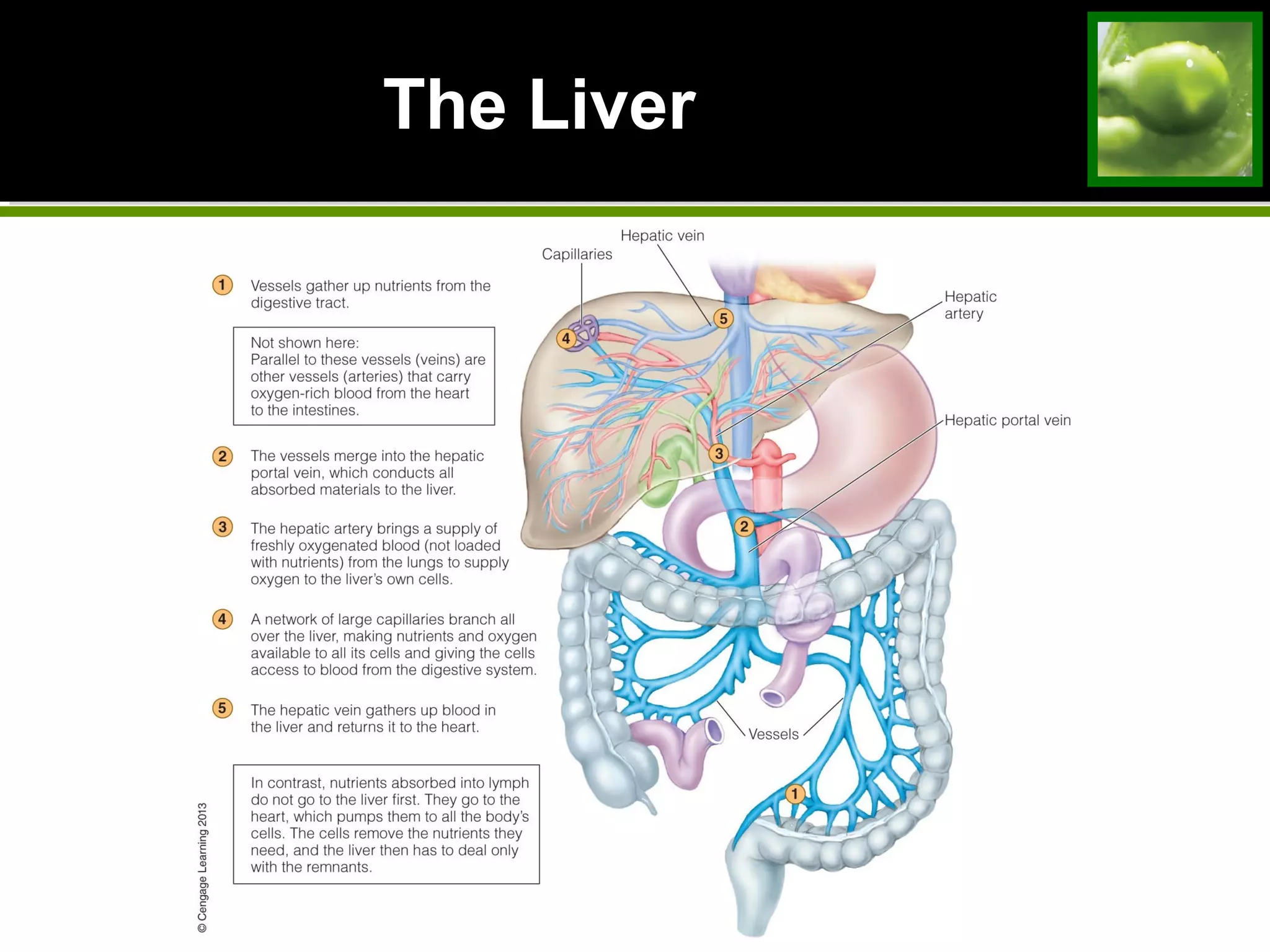
• Special routing for digestive system
• Liver
The Vascular SystemThe Vascular System
The LiverThe Liver
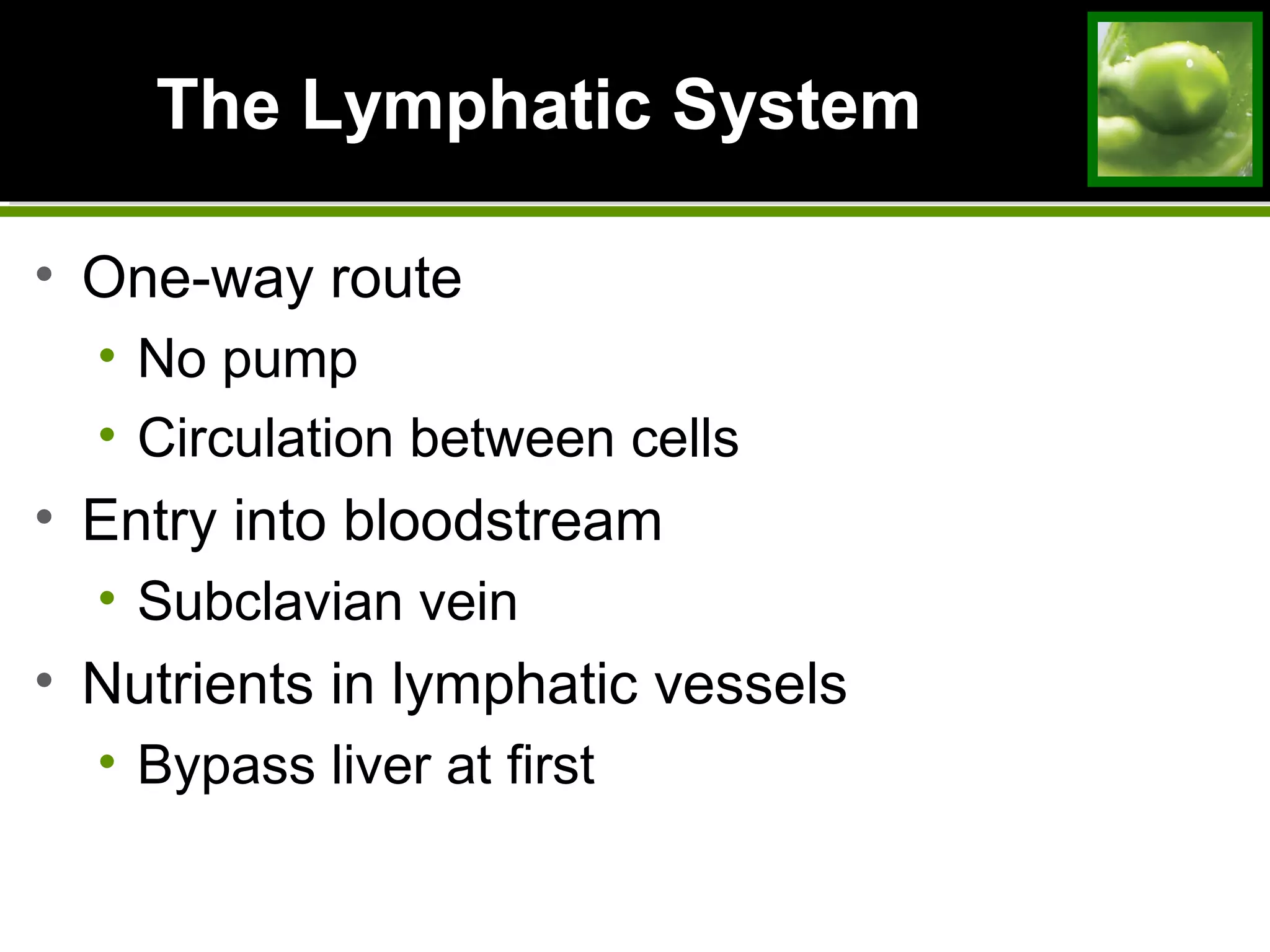
The Lymphatic SystemThe Lymphatic System
• One-way route
• No pump
• Circulation between cells
• Entry into bloodstream
• Subclavian vein
• Nutrients in lymphatic vessels
• Bypass liver at first
Health and Regulation of the GIHealth and Regulation of the GI
TractTract
• Gastrointestinal bacteria – flora
• Most are not harmful
• Benefits of gastrointestinal bacteria
• Factors influencing bacteria presence
• Diet – probiotics
• Prebiotics
• Others
• Digestion of fibers and complex proteins
• Vitamin production
Gastrointestinal Hormones andGastrointestinal Hormones and
Nerve PathwaysNerve Pathways
• Homeostatic regulation
• Endocrine system
• Nervous system
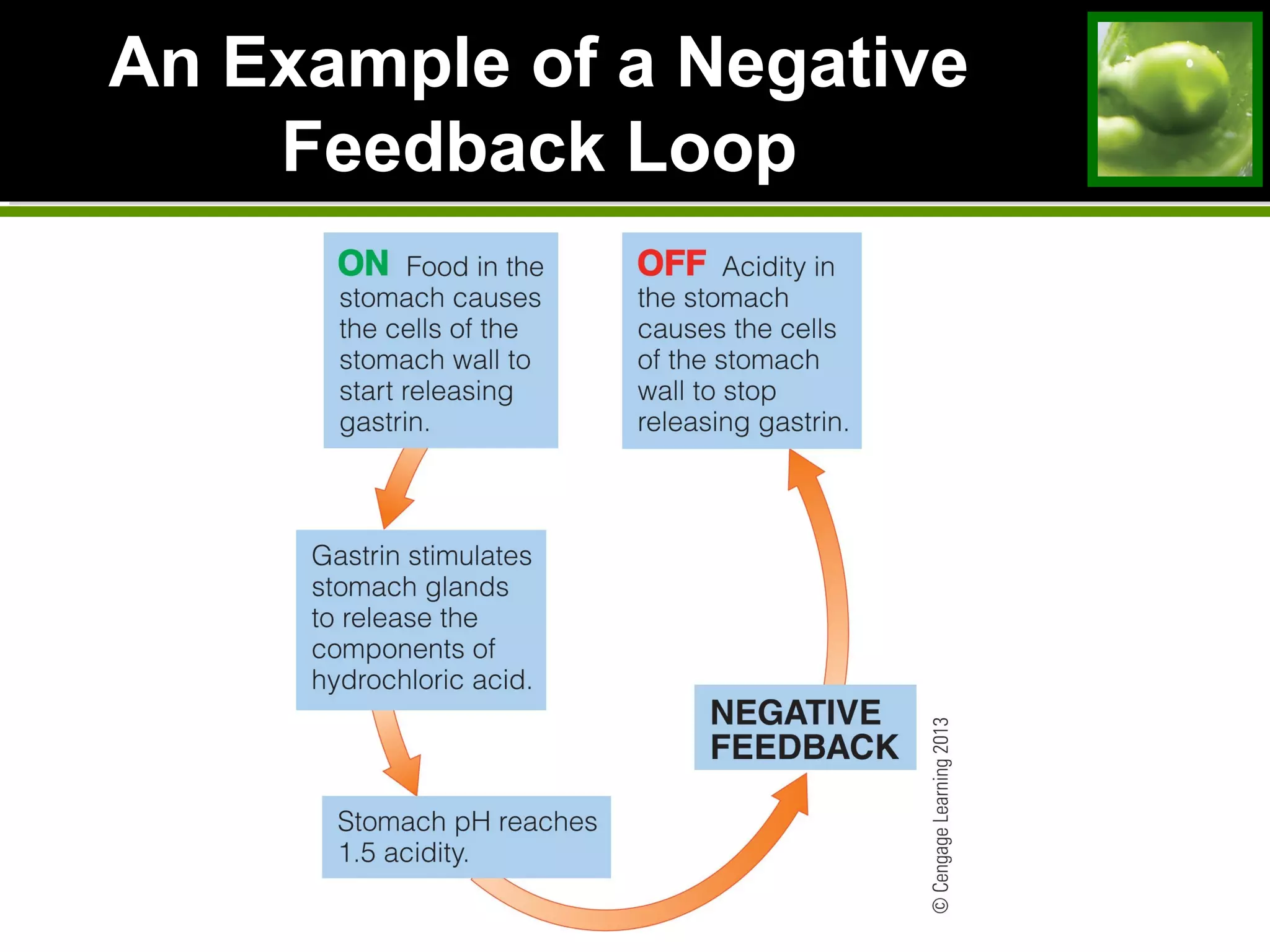
• Feedback mechanisms
• Examples
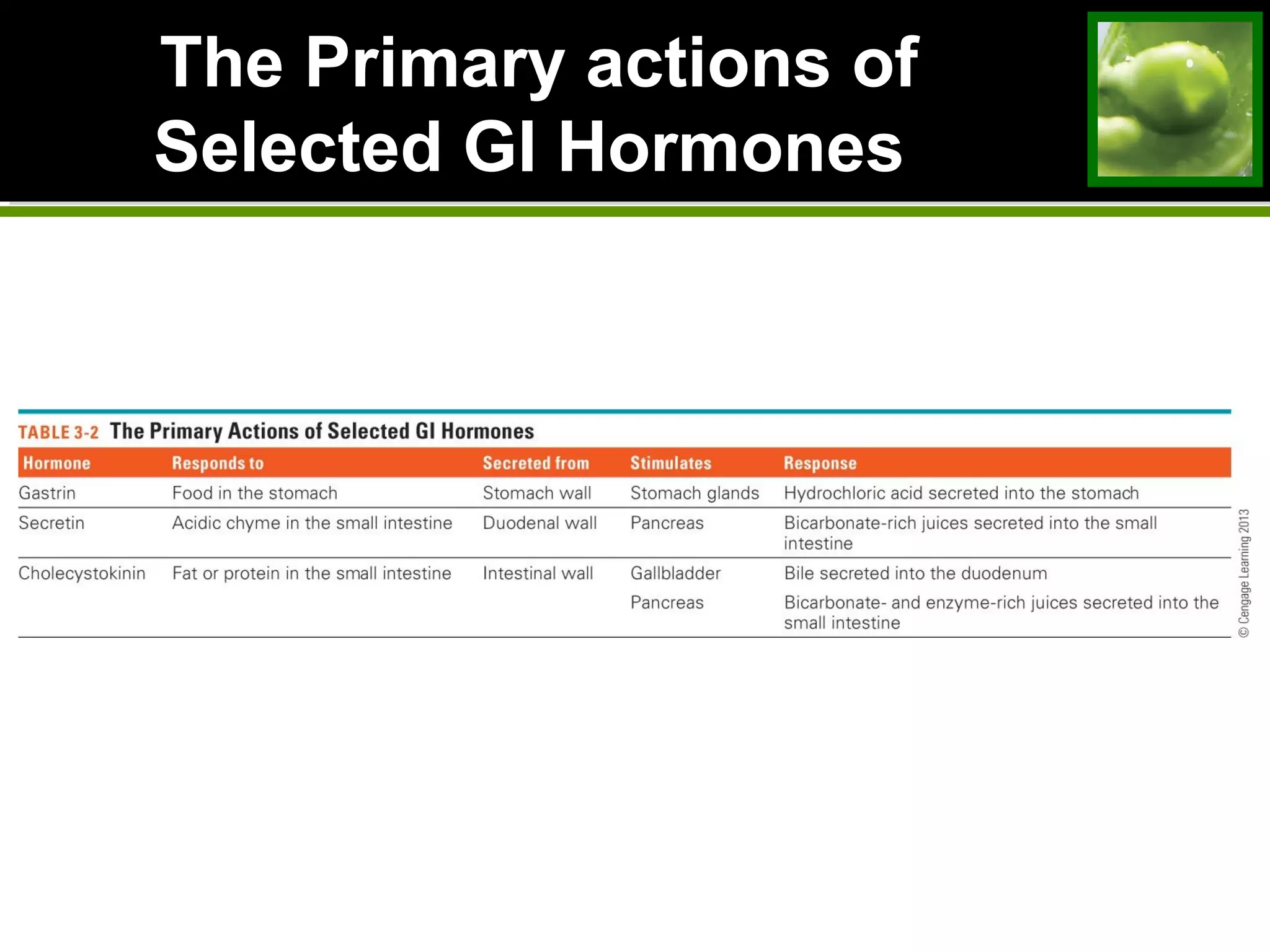
• GI hormones
• Gastrin
• Secretin
• Cholecystokinin (CCK)
An Example of a NegativeAn Example of a Negative
Feedback LoopFeedback Loop
The Primary actions ofThe Primary actions of
Selected GI HormonesSelected GI Hormones
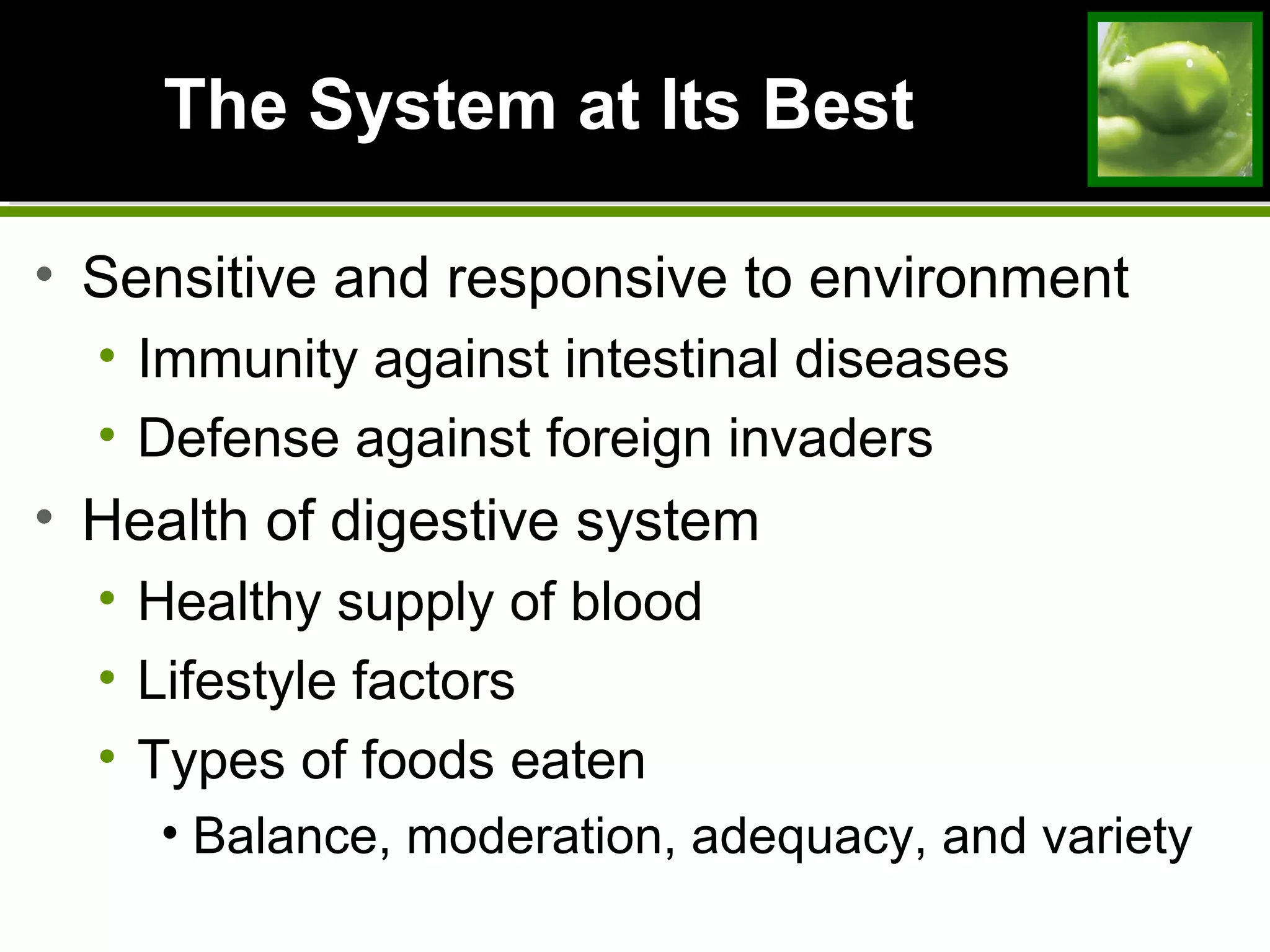
The System at Its BestThe System at Its Best
• Sensitive and responsive to environment
• Immunity against intestinal diseases
• Defense against foreign invaders
• Health of digestive system
• Healthy supply of blood
• Lifestyle factors
• Types of foods eaten
• Balance, moderation, adequacy, and variety
Common DigestiveCommon Digestive
ProblemsProblems
Highlight 3Highlight 3
ChokingChoking
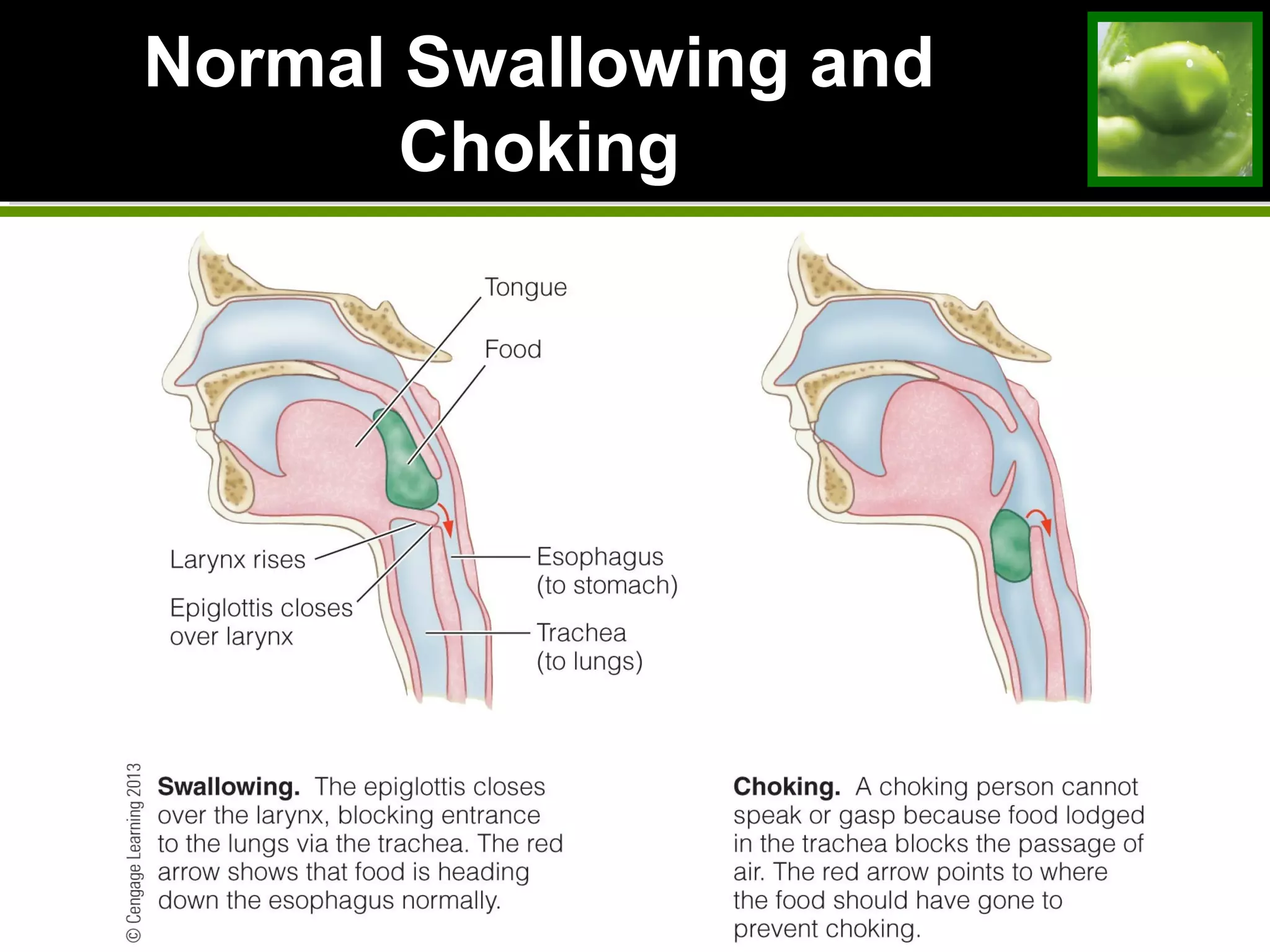
• Food slips into trachea
• Cuts off breathing
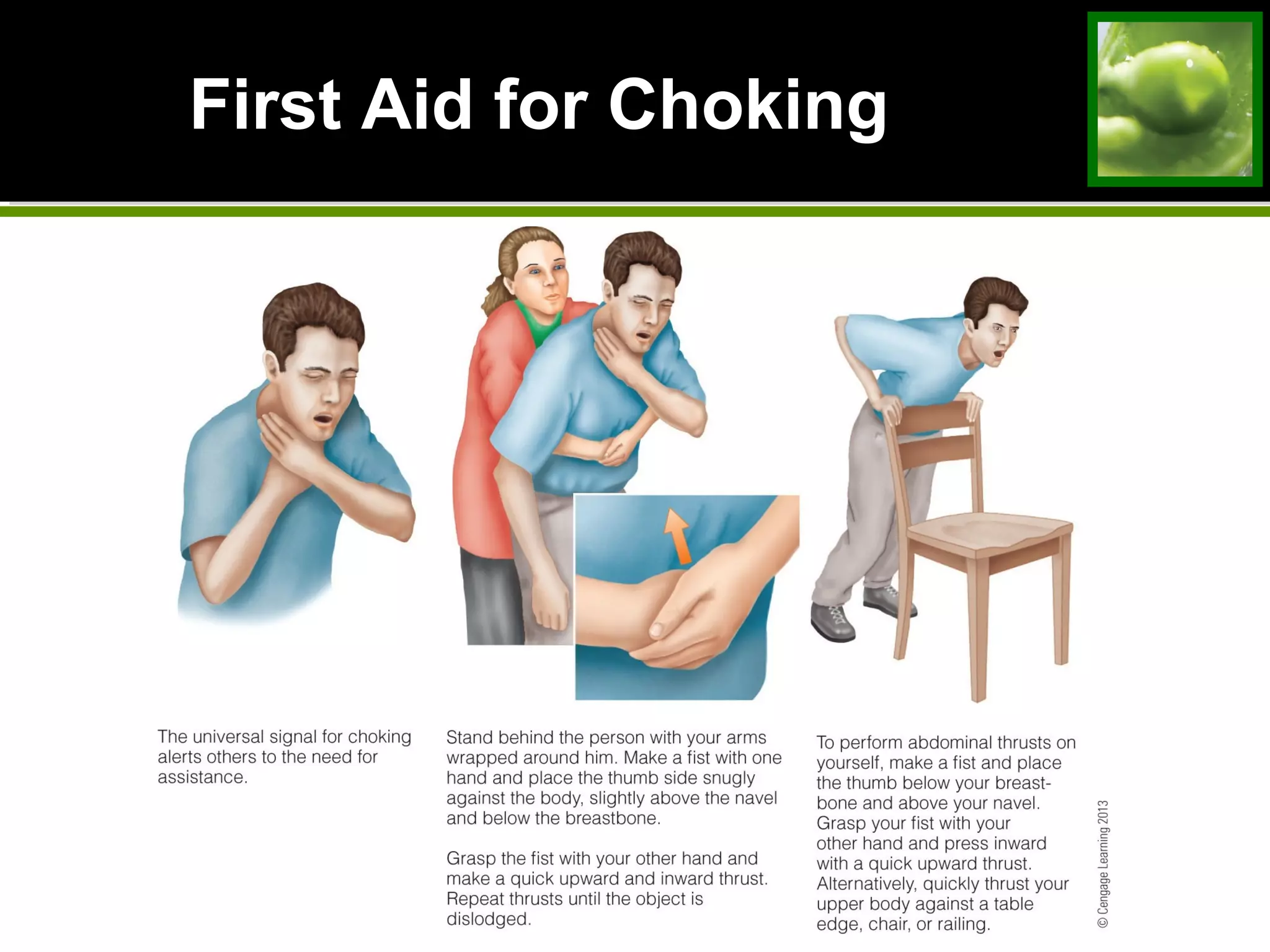
• International sign for choking
• Heimlich maneuver
• Foods commonly associated with choking
• Prevention of choking
Normal Swallowing andNormal Swallowing and
ChokingChoking
First Aid for ChokingFirst Aid for Choking
VomitingVomiting
• Vomiting
• Adaptive mechanism of the body
• Medical treatment
• Dehydration
• Self induced
Diarrhea
• Diarrhea
• Symptom of medical conditions & treatments
• Irritable bowel syndrome (IBS)
• Colitis
• Treatment
Irritable Bowel Syndrome and
Colitis
• Irritable bowel syndrome
• Characterization
• Cause
• Unknown
• Triggers
• Colitis
• Inflammation of large intestine
Celiac Disease
• Autoimmune disease
• Inflammation of small intestine
• Gluten-containing foods
• Symptoms
• Treatment
• Rehydration
ConstipationConstipation
• Not a disease
• Symptoms of constipation
• Causes
• Lifestyle
• Side effect of medications
• Prevention
• Fiber and water
• Physical activity
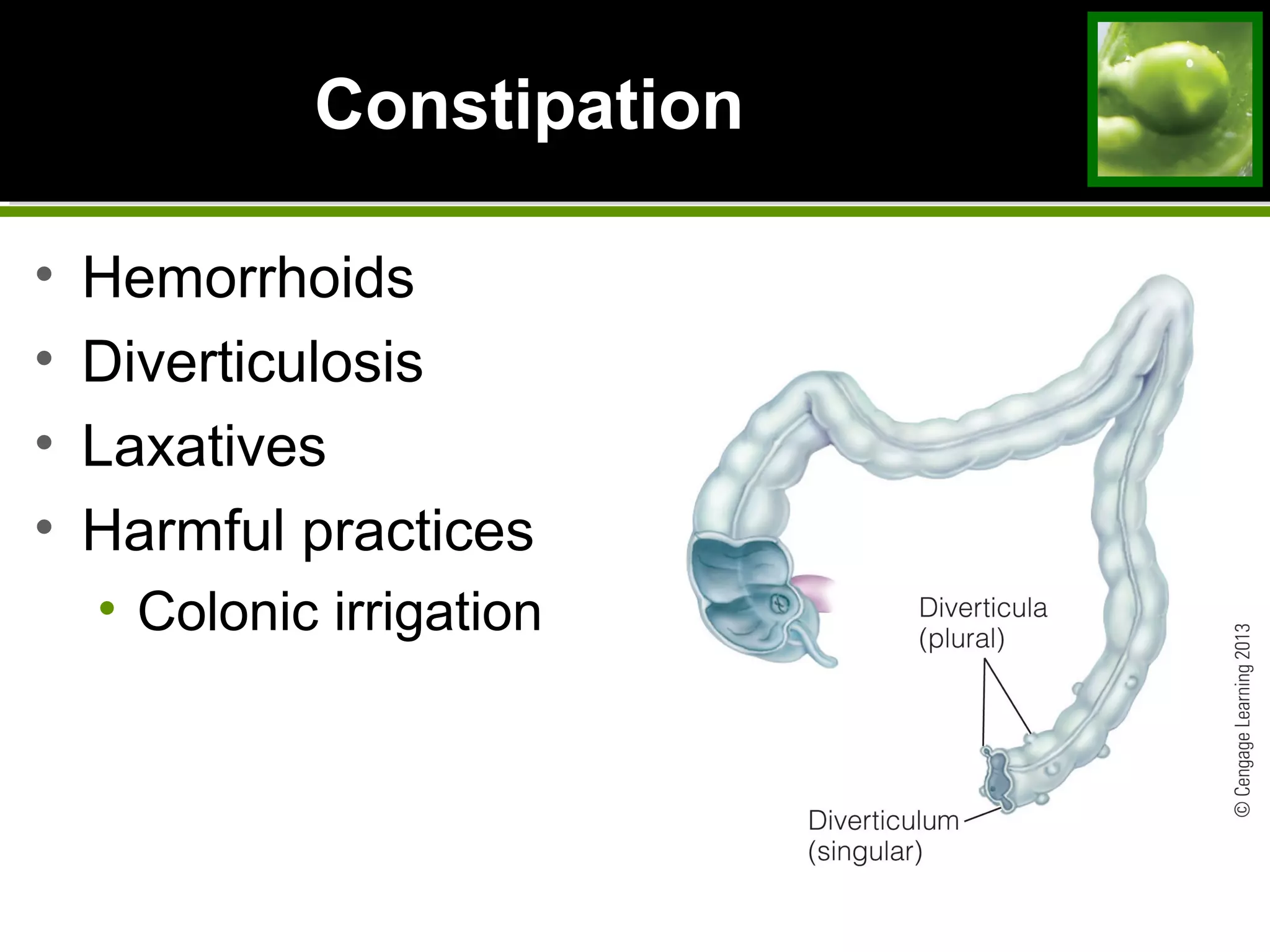
Constipation
• Hemorrhoids
• Diverticulosis
• Laxatives
• Harmful practices
• Colonic irrigation
Belching and GasBelching and Gas
• Belching
• Swallowed air
• Prevention
• Intestinal gas
• Consumption of certain foods
• Individually determined
Heartburn andHeartburn and “Acid“Acid
Indigestion”Indigestion”
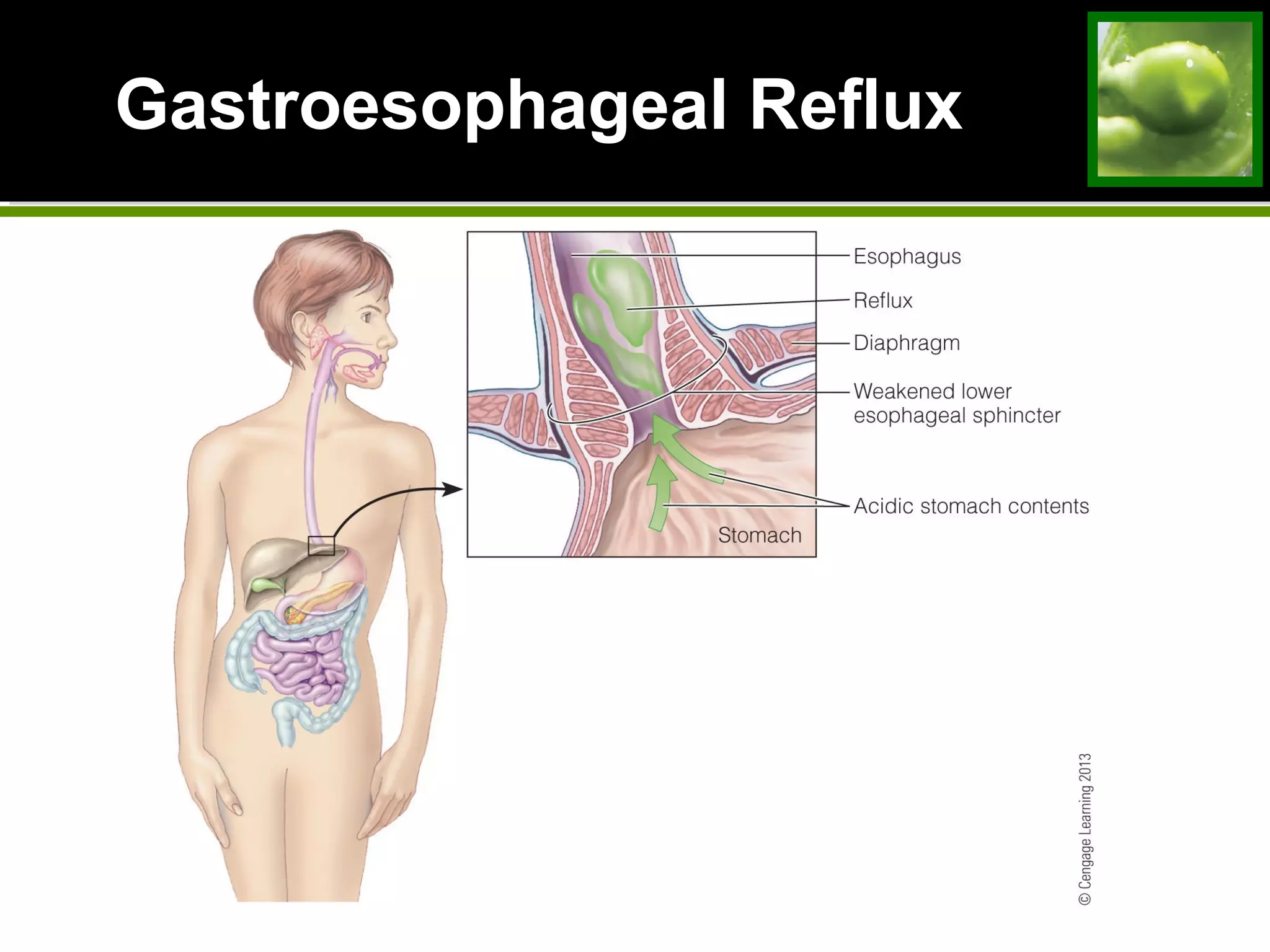
• Gastroesophageal reflux (heartburn)
• Causes
• Prevention
• Indigestion
• Causes
• Antacids and acid controllers
• Damage to esophagus
• Barrett’s esophagus
Gastroesophageal Reflux
UlcersUlcers
• Peptic ulcers
• Gastric ulcers
• Duodenal ulcers
• Causes
• Bacterial infection
• Anti-inflammatory drugs
• Excessive gastric acid secretion
• Ulcer treatment regimen
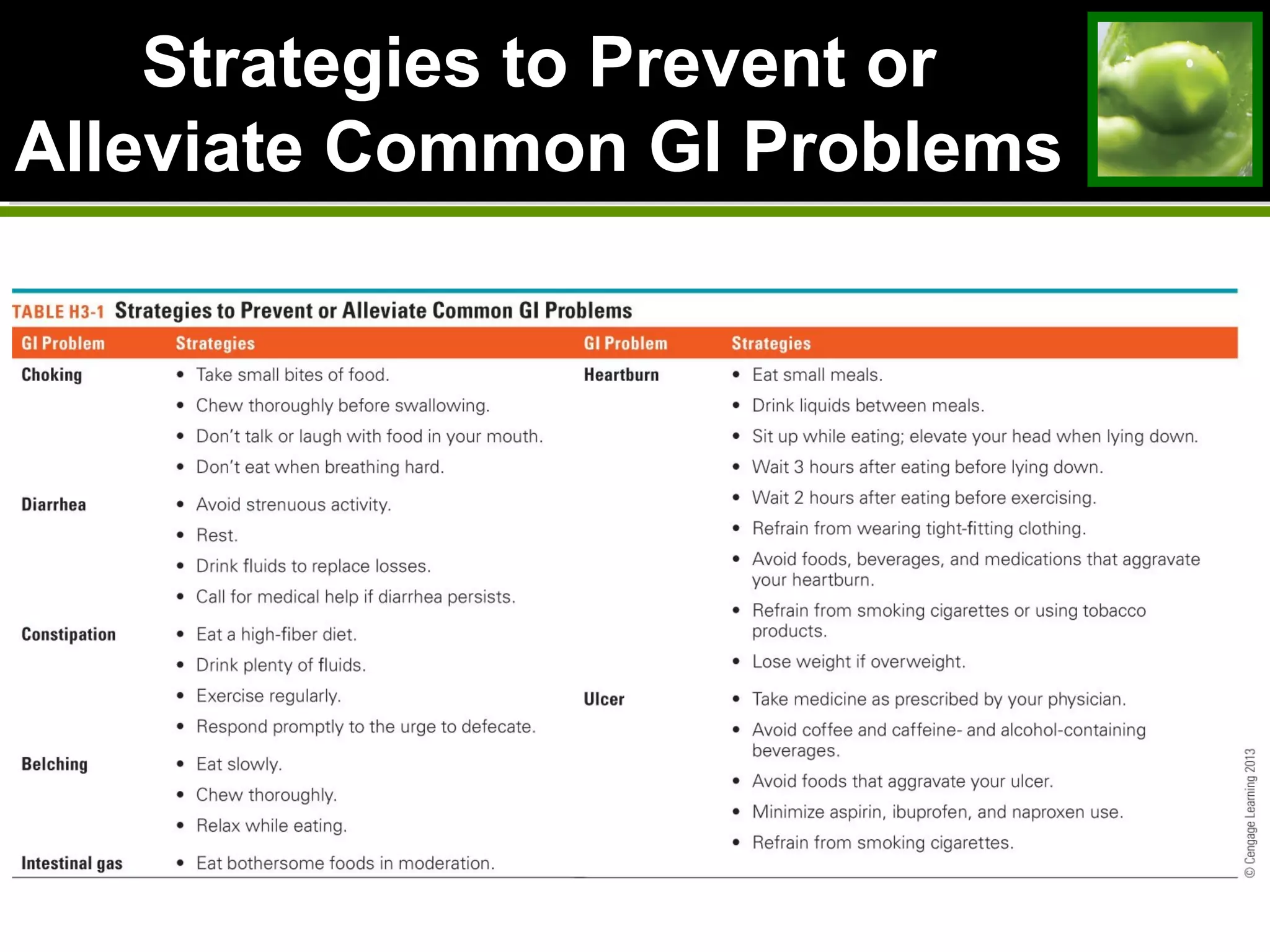
Strategies to Prevent or
Alleviate Common GI Problems

Chapter32012

  • 1.
  • 2.
    DigestionDigestion • Breaking downfoods into nutrients • Prepare for absorption • Challenges of digestion • Tasks of the mouth • Diaphragm • Steady movement • Lubrication of food • Digestive enzyme functions • Excretion of waste
  • 3.
    Anatomy of theDigestive TractAnatomy of the Digestive Tract • Gastrointestinal (GI) tract • Flexible and muscular • Path • Mouth → esophagus → stomach → small intestine → large intestine → rectum → anus • Lumen • Continuous
  • 4.
    The Gastrointestinal TractTheGastrointestinal Tract
  • 5.
    Anatomy of theDigestive TractAnatomy of the Digestive Tract • Mouth • Process of digestion begins • Mastication • Four basic taste sensations • Savory • Aroma, texture, and temperature • Pharynx • Bolus
  • 6.
    Anatomy of theDigestive TractAnatomy of the Digestive Tract • Esophagus • Two sphincters • Upper esophageal sphincter • Lower esophageal sphincter • Stomach • Movement of bolus • Chyme • Pyloric sphincter
  • 7.
    Anatomy of theDigestive TractAnatomy of the Digestive Tract • Small intestine • Common bile duct • Pancreas and gall bladder • Three segments • Large intestine (colon) • Ileocecal valve • Withdrawal of water • Rectum and anus
  • 8.
  • 9.
  • 10.
    Muscular Action ofDigestionMuscular Action of Digestion • Peristalsis • Circular and longitudinal muscles working together • Rate and intensity of contractions vary • Factors that may interfere with peristalsis • Stomach action • Circular, longitudinal, and diagonal muscles • Timing the release of chyme
  • 11.
  • 12.
    Muscular Action ofDigestionMuscular Action of Digestion • Segmentation • Contraction of circular muscles in small intestine • Mix chyme • Promote contact with absorption cells • Sphincter contractions • Periodically open and close • Control pace of GI tract contents
  • 13.
    An Example ofa SphincterAn Example of a Sphincter MuscleMuscle
  • 14.
    Secretions of DigestionSecretionsof Digestion • Five organs • Salivary glands, stomach, pancreas, liver, small intestine • Secretions • Water • Enzymes • Protein facilitator of chemical reactions • Hydrolysis
  • 15.
    Secretions of DigestionSecretionsof Digestion • Saliva • Moisten food for easy passage • Protective role • Carbohydrate digestion • Gastric juice • Protein digestion • Mucus • pH units
  • 16.
  • 17.
    Secretions of DigestionSecretionsof Digestion • Pancreatic juice and intestinal enzymes • Released via ducts into duodenum • Enzymes act on all three energy nutrients • Sodium bicarbonate • Bile • Liver • Gallbladder
  • 18.
    Summary of DigestiveSecretions & Their Major Actions
  • 19.
    The Final StageTheFinal Stage • Undigested residues • Exercise intestinal muscles • Retention of water • Colon • Intestinal bacteria • Recyclable materials • Water and dissolved salts
  • 21.
    AbsorptionAbsorption • Small intestine •Majority of absorption • Ten feet long • Surface area • Absorption techniques • Simple diffusion • Facilitated diffusion • Active transport
  • 22.
    Carrier loads nutrient on outsideof cell . . . Carrier loads nutrient on outside of cell . . . Outside cell Cell membrane . . . and then releases it on inside of cell. . . . and then releases it on inside of cell. Inside cell FACILITATED DIFFUSION Some nutrients (such as the water- soluble vitamins) are absorbed by facilitated diffusion. They need a specific carrier to transport them from one side of the cell membrane to the other. (Alternatively, facilitated diffusion may occur when the carrier changes the cell membrane in such a way that the nutrients can pass through.) ACTIVE TRANSPORT Some nutrients (such as glucose and amino acids) must be absorbed actively. These nutrients move against a concentration gradient, which requires energy. Stepped Art Some nutrients (such as water and small lipids) are absorbed by simple diffusion. They cross into intestinal cells freely. SIMPLE DIFFUSION Figure 3-8 p77
  • 23.
    Carrier loads nutrient on outsideof cell . . . Carrier loads nutrient on outside of cell . . . Outside cell Cell membrane . . . and then releases it on inside of cell. . . . and then releases it on inside of cell. Inside cell FACILITATED DIFFUSION Some nutrients (such as the water- soluble vitamins) are absorbed by facilitated diffusion. They need a specific carrier to transport them from one side of the cell membrane to the other. (Alternatively, facilitated diffusion may occur when the carrier changes the cell membrane in such a way that the nutrients can pass through.) ACTIVE TRANSPORT Some nutrients (such as glucose and amino acids) must be absorbed actively. These nutrients move against a concentration gradient, which requires energy. Stepped Art Some nutrients (such as water and small lipids) are absorbed by simple diffusion. They cross into intestinal cells freely. SIMPLE DIFFUSION Fig. 3-9, p. 78
  • 24.
    Anatomy of theAbsorptiveAnatomy of the Absorptive SystemSystem • Villi • Select and regulate nutrients absorbed • Microvilli • Enzymes and “pumps” • Crypts • Secretion of intestinal juices • Goblet cells • Mucus secretion
  • 26.
    A Closer Lookat the IntestinalA Closer Look at the Intestinal CellsCells • Villi cells • Regulate nutrient absorption based on needs • Microvilli • Enzymes and ‘pumps’ • Specialized cells • Food combining • Enhanced use in the body
  • 27.
    A Closer Lookat the Intestinal Cells • Transport pathways • Bloodstream • Water-soluble nutrients and smaller products of fat digestion • Liver • Lymphatic system • Larger fats and fat-soluble vitamins • Chylomicrons • Bypass liver at first
  • 28.
    The Vascular SystemTheVascular System • Closed system of vessels • Heart pump • Blood • Delivers oxygen and nutrients • Removes carbon dioxide and wastes • Blood flow • Special routing for digestive system • Liver
  • 29.
    The Vascular SystemTheVascular System
  • 30.
  • 31.
    The Lymphatic SystemTheLymphatic System • One-way route • No pump • Circulation between cells • Entry into bloodstream • Subclavian vein • Nutrients in lymphatic vessels • Bypass liver at first
  • 32.
    Health and Regulationof the GIHealth and Regulation of the GI TractTract • Gastrointestinal bacteria – flora • Most are not harmful • Benefits of gastrointestinal bacteria • Factors influencing bacteria presence • Diet – probiotics • Prebiotics • Others • Digestion of fibers and complex proteins • Vitamin production
  • 33.
    Gastrointestinal Hormones andGastrointestinalHormones and Nerve PathwaysNerve Pathways • Homeostatic regulation • Endocrine system • Nervous system • Feedback mechanisms • Examples • GI hormones • Gastrin • Secretin • Cholecystokinin (CCK)
  • 34.
    An Example ofa NegativeAn Example of a Negative Feedback LoopFeedback Loop
  • 35.
    The Primary actionsofThe Primary actions of Selected GI HormonesSelected GI Hormones
  • 36.
    The System atIts BestThe System at Its Best • Sensitive and responsive to environment • Immunity against intestinal diseases • Defense against foreign invaders • Health of digestive system • Healthy supply of blood • Lifestyle factors • Types of foods eaten • Balance, moderation, adequacy, and variety
  • 37.
  • 38.
    ChokingChoking • Food slipsinto trachea • Cuts off breathing • International sign for choking • Heimlich maneuver • Foods commonly associated with choking • Prevention of choking
  • 39.
    Normal Swallowing andNormalSwallowing and ChokingChoking
  • 40.
    First Aid forChokingFirst Aid for Choking
  • 41.
    VomitingVomiting • Vomiting • Adaptivemechanism of the body • Medical treatment • Dehydration • Self induced
  • 42.
    Diarrhea • Diarrhea • Symptomof medical conditions & treatments • Irritable bowel syndrome (IBS) • Colitis • Treatment
  • 43.
    Irritable Bowel Syndromeand Colitis • Irritable bowel syndrome • Characterization • Cause • Unknown • Triggers • Colitis • Inflammation of large intestine
  • 44.
    Celiac Disease • Autoimmunedisease • Inflammation of small intestine • Gluten-containing foods • Symptoms • Treatment • Rehydration
  • 45.
    ConstipationConstipation • Not adisease • Symptoms of constipation • Causes • Lifestyle • Side effect of medications • Prevention • Fiber and water • Physical activity
  • 46.
    Constipation • Hemorrhoids • Diverticulosis •Laxatives • Harmful practices • Colonic irrigation
  • 47.
    Belching and GasBelchingand Gas • Belching • Swallowed air • Prevention • Intestinal gas • Consumption of certain foods • Individually determined
  • 48.
    Heartburn andHeartburn and“Acid“Acid Indigestion”Indigestion” • Gastroesophageal reflux (heartburn) • Causes • Prevention • Indigestion • Causes • Antacids and acid controllers • Damage to esophagus • Barrett’s esophagus
  • 49.
  • 50.
    UlcersUlcers • Peptic ulcers •Gastric ulcers • Duodenal ulcers • Causes • Bacterial infection • Anti-inflammatory drugs • Excessive gastric acid secretion • Ulcer treatment regimen
  • 51.
    Strategies to Preventor Alleviate Common GI Problems

Editor's Notes

  • #9 Figure 3-2 The Colon The colon begins with the ascending colon rising upward toward the liver. It becomes the transverse colon as it turns and crosses the body toward the spleen. The descending colon turns downward and becomes the sigmoid colon, which extends to the rectum. Along the way, the colon mixes the intestinal contents, absorbs water and salts, and forms stools.
  • #10 Figure 3.2: The Colon. The colon begins with the ascending colon rising upward toward the liver. It becomes the transverse colon as it turns and crosses the body toward the spleen. The descending colon turns downward and becomes the sigmoid colon, which extends to the rectum. Along the way, the colon mixes the intestinal contents, absorbs water and salts, and forms stools.
  • #23 Figure 3-8 A bsorption of Nutrients Absorption of nutrients into intestinal cells typically occurs by simple diffusion, facilitated diffusion, or active transport. Occasionally, a large molecule is absorbed by endocytosis — a process in which the cell membrane engulfs the molecule, forming a sac that separates from the membrane and moves into the cell.
  • #24 Figure 3.9: Absorption of Nutrients. Absorption of nutrients into intestinal cells typically occurs by simple diffusion, facilitated diffusion, or active transport. Occasionally, a large molecule is absorbed by endocytosis — a process in which the cell membrane engulfs the molecule, forming a sac that separates from the membrane and moves into the cell.