A CONCEPTUAL FRAMEWORK FOR A NATIONAL POLICY ON
FINANCING WATERSHED MANAGEMENT
IN SRI LANKA
Hemesiri Kotagama
Nimal Gunawardena
Hemesiri Kotagama
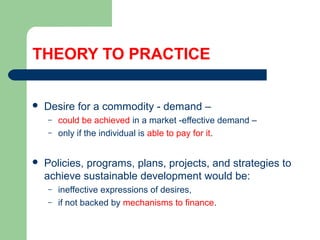
THEORY TO PRACTICE
 Desire for a commodity - demand –
– could be achieved in a market -effective demand –
– only if the individual is able to pay for it.
 Policies, programs, plans, projects, and strategies to
achieve sustainable development would be:
– ineffective expressions of desires,
– if not backed by mechanisms to finance.
Hemesiri Kotagama
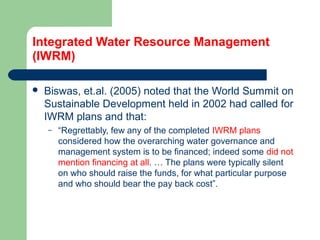
Integrated Water Resource Management
(IWRM)
 Biswas, et.al. (2005) noted that the World Summit on
Sustainable Development held in 2002 had called for
IWRM plans and that:
– “Regrettably, few any of the completed IWRM plans
considered how the overarching water governance and
management system is to be financed; indeed some did not
mention financing at all. … The plans were typically silent
on who should raise the funds, for what particular purpose
and who should bear the pay back cost”.
Hemesiri Kotagama
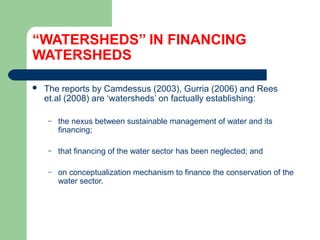
“WATERSHEDS’’ IN FINANCING
WATERSHEDS
 The reports by Camdessus (2003), Gurria (2006) and Rees
et.al (2008) are ‘watersheds’ on factually establishing:
– the nexus between sustainable management of water and its
financing;
– that financing of the water sector has been neglected; and
– on conceptualization mechanism to finance the conservation of the
water sector.
Hemesiri Kotagama
AVAILABLE GUIDANCE
 Camdessus (2003)
– has addressed the supply of finances, to finance
domestic water supply and sanitation;
 Gurria (2006)
– has examined the demand for finances for water
supplies, by local governments’ and
 Rees et.al. (2008)
– has examined, overarching issues of financing
water management and governance.
Hemesiri Kotagama
CONCEPTUAL FRAMEWORK ON
FINANCING IWRM
 An ideal conceptual framework to
comprehensively examine the financing of
the water sector would be,
– to consider the demand and supply aspects of
financing,
– at each functional node (where it interacts with
people and provides a service) of the water cycle.
Hemesiri Kotagama
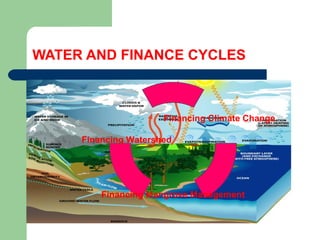
WATER AND FINANCE CYCLES
Financing Climate Change
Financing Mangrove Management
Financing Watershed
Hemesiri Kotagama
OBJECTIVE OF THE CHAPTER
 Propose a logical framework to
conceptualize a policy on financing
watershed management.
 Theoretical ideals of economics, experiences
and opinions are presented and critically
reviewed, as guidance to formulating a
pragmatic policy.
Hemesiri Kotagama
EMPIRICAL AND NORMATIVE
ASPECTS: The Need
 Annual funds required by the water sector
would have to be doubled, to achieve the
millennium development goals by 2015.
 However, global water sector is experiencing
‘decreased, static, or marginal’ changes in
finances.
 Financing has been biased towards capital
investments
Hemesiri Kotagama
EMPIRICAL AND NORMATIVE
ASPECTS: National sovereignty
 Respecting national sovereignty is a prime
requirement of a national policy.
 Water is national resource with national benefits, it is
best that watershed conservation is nationally
financed.
 However, in the short-term, developing countries
with budgetary difficulties, may be required to
depend on foreign finances to overcome cash flow
problems.
Hemesiri Kotagama
EMPIRICAL AND NORMATIVE
ASPECTS: Endogenous financing
 It is ideal if:
– finance for environmental conservation is
– generated within the environmental sector,
– through revenues from resource users.
Hemesiri Kotagama
EMPIRICAL AND NORMATIVE
ASPECTS: Market economics
 IWRM Principle
– ‘water has an economic value in all its competing
uses and should be recognized as an economic
good’
 If the market economic system is used to
allocate water, where it could best be used,
and where market failures are rectified, it
would enable to conserve water.
Hemesiri Kotagama
EMPIRICAL AND NORMATIVE
ASPECTS: Stakeholder participation
 Economic:
– The market economic system, enables stake
holder participation
– participation may be inequitable.
 Political:
– Trend towards decentralization of governance.
– local governments are heavily dependent on
central government finances and often starved for
finances
Hemesiri Kotagama
EMPIRICAL AND NORMATIVE ASPECTS:
Organizational reform
 Neither extremes of combining nor
fragmenting of sub-sectors and organizations
in the water sector is optimal.
– combining organizations may allow cross-
financing.
– fragmenting organizations may lead to
constraining financing options.
Hemesiri Kotagama
EMPIRICAL AND NORMATIVE ASPECTS:
Sources and mechanisms
 3 sources:
– water users,
– tax payers and
– aid donors
 Mechanisms of financing
– user charges, regulatory fees and levies, payments for
ecosystems services, creation of pollution markets, pollution
taxes and abstraction charges etc.
 Payments for Watershed Services (PWS)
 Public funding would remain dominant in water
sector.
Hemesiri Kotagama
THEORY: MARKET FAILURE AND PUBLIC
FINANCING: Case of Watershed
 The theoretical model:
– Explains the market failure to finance watershed
conservation.
– Rationalizes public financing of watershed
conservation.
Hemesiri Kotagama
ECONOMIC SIGNIFICANCE OF WATERSHED CONSERVATION
IN SRI LANKA
 Somarathne (2001)
– Onsite cost due to soil erosion as 953 Rs M/Yr
– Offsite cost due to silting of reservoirs and loss of
hydro-power generation 15 Rs. M/Yr
Hemesiri Kotagama
FINANCING WATERSHED
CONSERVATION IN SRI LANKA
 Mostly foreign financed projects
 Financing is discontinuous
 Need commitment of national financial
allocations
Hemesiri Kotagama
FINANCING WATERSHED MANAGEMENT IN SRI
LANKA: Level of financing
 Only 1% of the GDP has been spent on environmental related
projects,
– a country should spend 2 to 3 % of the GDP on environmental
investments to ensure sustainable development.
 Theoretically, for development to be sustainable, one view is
that investment should be equal to the sum of, rents from
natural resource depletion and the environmental damage
(Hartwick and Olewiler, 1986)
– The level of investment is below the expected levels of investment
for sustainable management of Upper Mahaweli watershed.
Hemesiri Kotagama
FINANCING WATERSHED MANAGEMENT IN SRI
LANKA:
Sources of Financing
 Declining availability of foreign finance
 Possibilities for environmental sector to be
neglected in public finances
– Public financial crisis
– Political process
Hemesiri Kotagama
FINANCING WATERSHED MANAGEMENT IN SRI
LANKA:
Financing Mechanisms
 National Level:
– Rationalising and earmarking allocations
 Provincial Level:
– Allowing to generate own financing
– Strengthening capacity for above
Hemesiri Kotagama
FINANCING WATERSHED MANAGEMENT IN SRI
LANKA:
Financing Options
 Reducing need
 Improving efficiency
 Acquiring finance
Hemesiri Kotagama
FINANCING WATERSHED MANAGEMENT IN SRI
LANKA:
Acquiring finances
– Who should pay?
 Foreign vs National (both).
– National: General vs. specific taxes
– How much to charge?
– How to charge?
Hemesiri Kotagama
FINANCING WATERSHED MANAGEMENT IN SRI
LANKA:
Allocation of Finances
 Who should allocate?
 How much should be allocated.
– Provincial environmental accounting.
Hemesiri Kotagama
CONCLUSION
 The present level of financing watershed management, in Sri Lanka, is sub-
optimal.
 Foreign finances, for watershed management investments, is declining.
 Finances to manage watersheds should be secured nationally.
 Watershed management will have to continue to depend on public financing.
 Earmarking the allocation of public finance, for watershed management, from
the central government to provincial governments and implementing agencies
would be required.
 Provincial governments must be encouraged and conditions created, to
generate finances for watershed management.
Hemesiri Kotagama

Financing watershed

  • 1.
    A CONCEPTUAL FRAMEWORKFOR A NATIONAL POLICY ON FINANCING WATERSHED MANAGEMENT IN SRI LANKA Hemesiri Kotagama Nimal Gunawardena Hemesiri Kotagama
  • 2.
    THEORY TO PRACTICE Desire for a commodity - demand – – could be achieved in a market -effective demand – – only if the individual is able to pay for it.  Policies, programs, plans, projects, and strategies to achieve sustainable development would be: – ineffective expressions of desires, – if not backed by mechanisms to finance. Hemesiri Kotagama
  • 3.
    Integrated Water ResourceManagement (IWRM)  Biswas, et.al. (2005) noted that the World Summit on Sustainable Development held in 2002 had called for IWRM plans and that: – “Regrettably, few any of the completed IWRM plans considered how the overarching water governance and management system is to be financed; indeed some did not mention financing at all. … The plans were typically silent on who should raise the funds, for what particular purpose and who should bear the pay back cost”. Hemesiri Kotagama
  • 4.
    “WATERSHEDS’’ IN FINANCING WATERSHEDS The reports by Camdessus (2003), Gurria (2006) and Rees et.al (2008) are ‘watersheds’ on factually establishing: – the nexus between sustainable management of water and its financing; – that financing of the water sector has been neglected; and – on conceptualization mechanism to finance the conservation of the water sector. Hemesiri Kotagama
  • 5.
    AVAILABLE GUIDANCE  Camdessus(2003) – has addressed the supply of finances, to finance domestic water supply and sanitation;  Gurria (2006) – has examined the demand for finances for water supplies, by local governments’ and  Rees et.al. (2008) – has examined, overarching issues of financing water management and governance. Hemesiri Kotagama
  • 6.
    CONCEPTUAL FRAMEWORK ON FINANCINGIWRM  An ideal conceptual framework to comprehensively examine the financing of the water sector would be, – to consider the demand and supply aspects of financing, – at each functional node (where it interacts with people and provides a service) of the water cycle. Hemesiri Kotagama
  • 7.
    WATER AND FINANCECYCLES Financing Climate Change Financing Mangrove Management Financing Watershed Hemesiri Kotagama
  • 8.
    OBJECTIVE OF THECHAPTER  Propose a logical framework to conceptualize a policy on financing watershed management.  Theoretical ideals of economics, experiences and opinions are presented and critically reviewed, as guidance to formulating a pragmatic policy. Hemesiri Kotagama
  • 9.
    EMPIRICAL AND NORMATIVE ASPECTS:The Need  Annual funds required by the water sector would have to be doubled, to achieve the millennium development goals by 2015.  However, global water sector is experiencing ‘decreased, static, or marginal’ changes in finances.  Financing has been biased towards capital investments Hemesiri Kotagama
  • 10.
    EMPIRICAL AND NORMATIVE ASPECTS:National sovereignty  Respecting national sovereignty is a prime requirement of a national policy.  Water is national resource with national benefits, it is best that watershed conservation is nationally financed.  However, in the short-term, developing countries with budgetary difficulties, may be required to depend on foreign finances to overcome cash flow problems. Hemesiri Kotagama
  • 11.
    EMPIRICAL AND NORMATIVE ASPECTS:Endogenous financing  It is ideal if: – finance for environmental conservation is – generated within the environmental sector, – through revenues from resource users. Hemesiri Kotagama
  • 12.
    EMPIRICAL AND NORMATIVE ASPECTS:Market economics  IWRM Principle – ‘water has an economic value in all its competing uses and should be recognized as an economic good’  If the market economic system is used to allocate water, where it could best be used, and where market failures are rectified, it would enable to conserve water. Hemesiri Kotagama
  • 13.
    EMPIRICAL AND NORMATIVE ASPECTS:Stakeholder participation  Economic: – The market economic system, enables stake holder participation – participation may be inequitable.  Political: – Trend towards decentralization of governance. – local governments are heavily dependent on central government finances and often starved for finances Hemesiri Kotagama
  • 14.
    EMPIRICAL AND NORMATIVEASPECTS: Organizational reform  Neither extremes of combining nor fragmenting of sub-sectors and organizations in the water sector is optimal. – combining organizations may allow cross- financing. – fragmenting organizations may lead to constraining financing options. Hemesiri Kotagama
  • 15.
    EMPIRICAL AND NORMATIVEASPECTS: Sources and mechanisms  3 sources: – water users, – tax payers and – aid donors  Mechanisms of financing – user charges, regulatory fees and levies, payments for ecosystems services, creation of pollution markets, pollution taxes and abstraction charges etc.  Payments for Watershed Services (PWS)  Public funding would remain dominant in water sector. Hemesiri Kotagama
  • 16.
    THEORY: MARKET FAILUREAND PUBLIC FINANCING: Case of Watershed  The theoretical model: – Explains the market failure to finance watershed conservation. – Rationalizes public financing of watershed conservation. Hemesiri Kotagama
  • 17.
    ECONOMIC SIGNIFICANCE OFWATERSHED CONSERVATION IN SRI LANKA  Somarathne (2001) – Onsite cost due to soil erosion as 953 Rs M/Yr – Offsite cost due to silting of reservoirs and loss of hydro-power generation 15 Rs. M/Yr Hemesiri Kotagama
  • 18.
    FINANCING WATERSHED CONSERVATION INSRI LANKA  Mostly foreign financed projects  Financing is discontinuous  Need commitment of national financial allocations Hemesiri Kotagama
  • 19.
    FINANCING WATERSHED MANAGEMENTIN SRI LANKA: Level of financing  Only 1% of the GDP has been spent on environmental related projects, – a country should spend 2 to 3 % of the GDP on environmental investments to ensure sustainable development.  Theoretically, for development to be sustainable, one view is that investment should be equal to the sum of, rents from natural resource depletion and the environmental damage (Hartwick and Olewiler, 1986) – The level of investment is below the expected levels of investment for sustainable management of Upper Mahaweli watershed. Hemesiri Kotagama
  • 20.
    FINANCING WATERSHED MANAGEMENTIN SRI LANKA: Sources of Financing  Declining availability of foreign finance  Possibilities for environmental sector to be neglected in public finances – Public financial crisis – Political process Hemesiri Kotagama
  • 21.
    FINANCING WATERSHED MANAGEMENTIN SRI LANKA: Financing Mechanisms  National Level: – Rationalising and earmarking allocations  Provincial Level: – Allowing to generate own financing – Strengthening capacity for above Hemesiri Kotagama
  • 22.
    FINANCING WATERSHED MANAGEMENTIN SRI LANKA: Financing Options  Reducing need  Improving efficiency  Acquiring finance Hemesiri Kotagama
  • 23.
    FINANCING WATERSHED MANAGEMENTIN SRI LANKA: Acquiring finances – Who should pay?  Foreign vs National (both). – National: General vs. specific taxes – How much to charge? – How to charge? Hemesiri Kotagama
  • 24.
    FINANCING WATERSHED MANAGEMENTIN SRI LANKA: Allocation of Finances  Who should allocate?  How much should be allocated. – Provincial environmental accounting. Hemesiri Kotagama
  • 25.
    CONCLUSION  The presentlevel of financing watershed management, in Sri Lanka, is sub- optimal.  Foreign finances, for watershed management investments, is declining.  Finances to manage watersheds should be secured nationally.  Watershed management will have to continue to depend on public financing.  Earmarking the allocation of public finance, for watershed management, from the central government to provincial governments and implementing agencies would be required.  Provincial governments must be encouraged and conditions created, to generate finances for watershed management. Hemesiri Kotagama