Web 2.0 Overview What makes a product Web 2.0?
Web 2.0 Overview The combination of online social networks, folksonomies, web content, and content hackability / reuseability Buzzwords: Wiki, blogs, RSS, Open / web APIs, perpetual beta, tags, some rights reserved, the long tail, badges, network effects, ratings, OpenID
Definitions Social network – online social structure made of nodes which are individuals Folksonomy - collaboratively generated tags that categorize Web content Hackability / reuseability – content viewed in one online location but created / hosted elsewhere; components of a mashup
Definitions (con’t) Wiki - a website that allows visitors to easily add, remove and edit content Some rights reserved – allow hackability and remixability without allowing pure resale Network effects – the value to a potential customer of the number of customers already using a service
Definitions (con’t) Ratings – Content valuation based on explicit (member provided) and implicit (centrality eigenvector) scores OpenID - a decentralized digital identity system RSS - a simple XML-based system that allows users to subscribe to online content
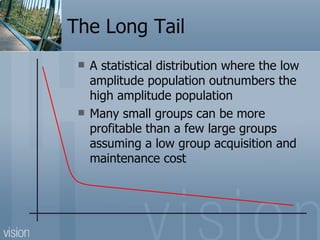
The Long Tail A statistical distribution where the low amplitude population outnumbers the high amplitude population Many small groups can be more profitable than a few large groups assuming a low group acquisition and maintenance cost
Web 2.0 Examples Google Maps, Google Adsense, MySpace, YouTube, Zillow, Zebo, Jobster, Vimeo, Del.icio.us, Digg, Skype, Feedburner, LinkedIn, Frappr, HousingMaps, Odeo, Facebook, Wikipedia
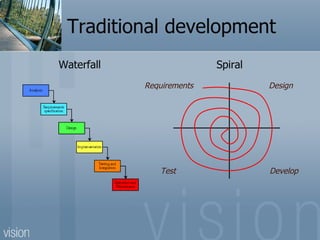
Traditional development Waterfall Spiral Design Develop Test Requirements
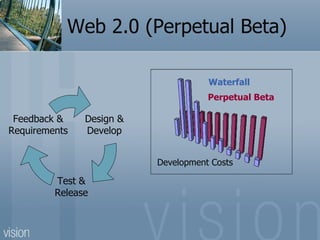
Web 2.0 (Perpetual Beta) Waterfall Perpetual Beta Development Costs Design & Develop Test & Release Feedback & Requirements
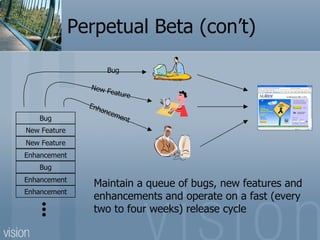
Perpetual Beta (con’t) Bug New Feature New Feature Enhancement Bug Enhancement Enhancement Enhancement New Feature Bug Maintain a queue of bugs, new features and enhancements and operate on a fast (every two to four weeks) release cycle
Typical Systems Software Linux, Apache, MySQL, PHP (LAMP) Alternatives – PostgreSQL, Java
Software Development Offshore Agile development Product management in U.S. Target Platforms - Web, Email, RSS and mobile UIs
Contact Andy Forbes [email_address] 703 201 4269

Web 2.0 - what is it?

  • 1.
    Web 2.0 OverviewWhat makes a product Web 2.0?
  • 2.
    Web 2.0 OverviewThe combination of online social networks, folksonomies, web content, and content hackability / reuseability Buzzwords: Wiki, blogs, RSS, Open / web APIs, perpetual beta, tags, some rights reserved, the long tail, badges, network effects, ratings, OpenID
  • 3.
    Definitions Social network– online social structure made of nodes which are individuals Folksonomy - collaboratively generated tags that categorize Web content Hackability / reuseability – content viewed in one online location but created / hosted elsewhere; components of a mashup
  • 4.
    Definitions (con’t) Wiki- a website that allows visitors to easily add, remove and edit content Some rights reserved – allow hackability and remixability without allowing pure resale Network effects – the value to a potential customer of the number of customers already using a service
  • 5.
    Definitions (con’t) Ratings– Content valuation based on explicit (member provided) and implicit (centrality eigenvector) scores OpenID - a decentralized digital identity system RSS - a simple XML-based system that allows users to subscribe to online content
  • 6.
    The Long TailA statistical distribution where the low amplitude population outnumbers the high amplitude population Many small groups can be more profitable than a few large groups assuming a low group acquisition and maintenance cost
  • 7.
    Web 2.0 ExamplesGoogle Maps, Google Adsense, MySpace, YouTube, Zillow, Zebo, Jobster, Vimeo, Del.icio.us, Digg, Skype, Feedburner, LinkedIn, Frappr, HousingMaps, Odeo, Facebook, Wikipedia
  • 8.
    Traditional development WaterfallSpiral Design Develop Test Requirements
  • 9.
    Web 2.0 (PerpetualBeta) Waterfall Perpetual Beta Development Costs Design & Develop Test & Release Feedback & Requirements
  • 10.
    Perpetual Beta (con’t)Bug New Feature New Feature Enhancement Bug Enhancement Enhancement Enhancement New Feature Bug Maintain a queue of bugs, new features and enhancements and operate on a fast (every two to four weeks) release cycle
  • 11.
    Typical Systems SoftwareLinux, Apache, MySQL, PHP (LAMP) Alternatives – PostgreSQL, Java
  • 12.
    Software Development OffshoreAgile development Product management in U.S. Target Platforms - Web, Email, RSS and mobile UIs
  • 13.
    Contact Andy Forbes[email_address] 703 201 4269