By Claire, Malachi, and Eli
Deism                             Unitarianism
 Reason rather than revelation    God exists in only one
 Science rather than the Bible
                                      person, rather than the
                                      orthodox Trinity.
 Rejected the concept of            Denied the deity of Jesus.
  original sin and denied
                                     Stressed the goodness of
  Christ’s divinity                   human nature over vileness.
 Believed in a Supreme Being        Belief in free will and the
  who created the universe and        possibility of salvation
  mankind.                            through good works
 Helped inspire an important        Pictured God as a loving
  spinoff of Puritanism...            father rather than a stern
                                      creator.
Unitarianism!
 A series of religious revivals swept through the country
  between 1790 and 1830.
 Traveling preachers and “camp meetings” led large
  numbers of people to convert through an enthusiastic style
  of preaching and audience participation.
 Many “saved” went back to their sinful ways, but the
  revivals boosted church membership and stimulated a
  variety of humanitarian reforms such as temperance
  (abstaining from consuming alcoholic
  drinks), abolition, and women’s rights.
 Evangelicalism was at the heart of the Second Great
  Awakening and it favored ordinary people over elites.
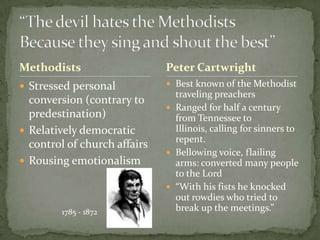
Methodists                    Peter Cartwright
 Stressed personal            Best known of the Methodist
                                traveling preachers
  conversion (contrary to
                               Ranged for half a century
  predestination)               from Tennessee to
 Relatively democratic         Illinois, calling for sinners to
                                repent.
  control of church affairs
                               Bellowing voice, flailing
 Rousing emotionalism          arms: converted many people
                                to the Lord
                               “With his fists he knocked
                                out rowdies who tried to
        1785 - 1872             break up the meetings.”
 By 1770 black preachers had many of their own Baptist and
    Methodist Congregations.
   November 1787, white elders attempted to downgrade
    black worshippers a gallery at St. George’s Methodist
    Church in Philadelphia. That resulted in the founding of
    the black-governed Bethel Church, and in 1816, the African
    Methodist Episcopal Church (AME) was founded.
   Richard Allen was its first bishop.
   Black church membership was predominately female, even
    though men could only serve on the clergy.
   Women led home prayer meetings, and served on
    missionary and Sunday school boards. They were also
    permitted by the AME church to become traveling
    evangelists.
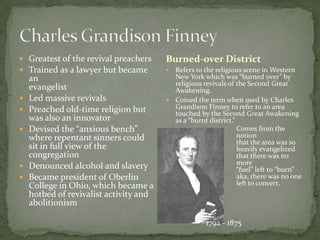
 Greatest of the revival preachers     Burned-over District
 Trained as a lawyer but became         Refers to the religious scene in Western
    an                                    New York which was “burned over” by
                                          religious revivals of the Second Great
    evangelist                            Awakening.
   Led massive revivals                 Coined the term when used by Charles
   Preached old-time religion but        Grandison Finney to refer to an area
                                          touched by the Second Great Awakening
    was also an innovator                 as a “burnt district.”
   Devised the “anxious bench”                               • Comes from the
    where repentant sinners could                                notion
                                                                 that the area was so
    sit in full view of the                                      heavily evangelized
    congregation                                                 that there was no
                                                                 more
   Denounced alcohol and slavery                                “fuel” left to “burn”
   Became president of Oberlin                                  aka, there was no one
    College in Ohio, which became a                              left to convert.
    hotbed of revivalist activity and
    abolitionism

                                                     1792 - 1875
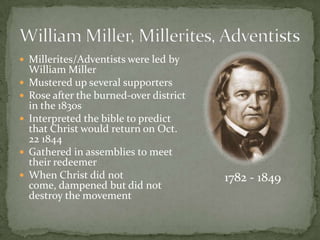
 Millerites/Adventists were led by
    William Miller
   Mustered up several supporters
   Rose after the burned-over district
    in the 1830s
   Interpreted the bible to predict
    that Christ would return on Oct.
    22 1844
   Gathered in assemblies to meet
    their redeemer
   When Christ did not                   1782 - 1849
    come, dampened but did not
    destroy the movement
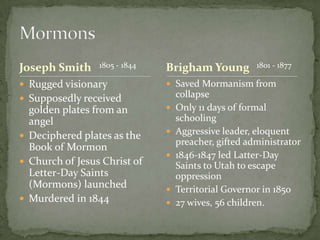
Joseph Smith     1805 - 1844   Brigham Young          1801 - 1877

 Rugged visionary              Saved Mormanism from
 Supposedly received              collapse
  golden plates from an           Only 11 days of formal
  angel                            schooling
 Deciphered plates as the        Aggressive leader, eloquent
                                   preacher, gifted administrator
  Book of Mormon
                                  1846-1847 led Latter-Day
 Church of Jesus Christ of        Saints to Utah to escape
  Letter-Day Saints                oppression
  (Mormons) launched              Territorial Governor in 1850
 Murdered in 1844                27 wives, 56 children.
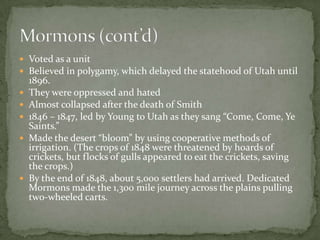
 Voted as a unit
 Believed in polygamy, which delayed the statehood of Utah until
    1896.
   They were oppressed and hated
   Almost collapsed after the death of Smith
   1846 – 1847, led by Young to Utah as they sang “Come, Come, Ye
    Saints.”
   Made the desert “bloom” by using cooperative methods of
    irrigation. (The crops of 1848 were threatened by hoards of
    crickets, but flocks of gulls appeared to eat the crickets, saving
    the crops.)
   By the end of 1848, about 5,000 settlers had arrived. Dedicated
    Mormons made the 1,300 mile journey across the plains pulling
    two-wheeled carts.
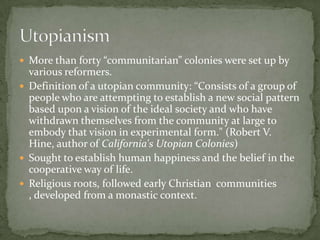
 More than forty “communitarian” colonies were set up by
  various reformers.
 Definition of a utopian community: “Consists of a group of
  people who are attempting to establish a new social pattern
  based upon a vision of the ideal society and who have
  withdrawn themselves from the community at large to
  embody that vision in experimental form." (Robert V.
  Hine, author of California's Utopian Colonies)
 Sought to establish human happiness and the belief in the
  cooperative way of life.
 Religious roots, followed early Christian communities
  , developed from a monastic context.
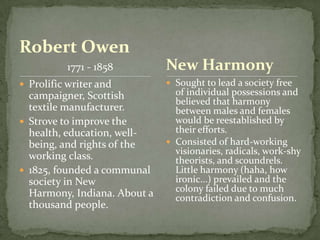
Robert Owen
          1771 - 1858         New Harmony
 Prolific writer and          Sought to lead a society free
  campaigner, Scottish          of individual possessions and
                                believed that harmony
  textile manufacturer.         between males and females
 Strove to improve the         would be reestablished by
  health, education, well-      their efforts.
  being, and rights of the     Consisted of hard-working
                                visionaries, radicals, work-shy
  working class.                theorists, and scoundrels.
 1825, founded a communal      Little harmony (haha, how
  society in New                ironic...) prevailed and the
  Harmony, Indiana. About a     colony failed due to much
                                contradiction and confusion.
  thousand people.
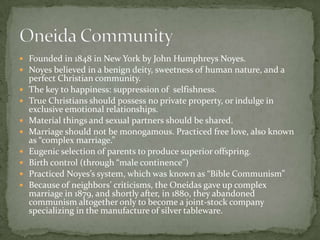
 Founded in 1848 in New York by John Humphreys Noyes.
 Noyes believed in a benign deity, sweetness of human nature, and a
    perfect Christian community.
   The key to happiness: suppression of selfishness.
   True Christians should possess no private property, or indulge in
    exclusive emotional relationships.
   Material things and sexual partners should be shared.
   Marriage should not be monogamous. Practiced free love, also known
    as “complex marriage.”
   Eugenic selection of parents to produce superior offspring.
   Birth control (through “male continence”)
   Practiced Noyes’s system, which was known as “Bible Communism”
   Because of neighbors’ criticisms, the Oneidas gave up complex
    marriage in 1879, and shortly after, in 1880, they abandoned
    communism altogether only to become a joint-stock company
    specializing in the manufacture of silver tableware.
 Formally known as the United Society of Believers in
  Christ’s Second Coming
 Began in the 1770s and were led by Mother Ann Lee.
 Attained membership of about six thousand in
  1840, but since their monastic customs prohibited
  both marriage and sexual relations, they were extinct
  by 1940.
 Included communal living, productive
  labor, celibacy, pacifism, the equality of the sexes, and
  a ritual noted for its dancing and shaking.
 http://www.britannica.com/EBchecked/topic/91087/c
    amp-meeting
   http://www.teachushistory.org/second-great-
    awakening-age-reform
   http://www.u-s-history.com/pages/h3800.html
   http://www.ushistory.org/us/22c.asp
   The American Pageant

Religion and utopianism

  • 1.
  • 2.
    Deism Unitarianism  Reason rather than revelation  God exists in only one  Science rather than the Bible person, rather than the orthodox Trinity.  Rejected the concept of  Denied the deity of Jesus. original sin and denied  Stressed the goodness of Christ’s divinity human nature over vileness.  Believed in a Supreme Being  Belief in free will and the who created the universe and possibility of salvation mankind. through good works  Helped inspire an important  Pictured God as a loving spinoff of Puritanism... father rather than a stern creator. Unitarianism!
  • 3.
     A seriesof religious revivals swept through the country between 1790 and 1830.  Traveling preachers and “camp meetings” led large numbers of people to convert through an enthusiastic style of preaching and audience participation.  Many “saved” went back to their sinful ways, but the revivals boosted church membership and stimulated a variety of humanitarian reforms such as temperance (abstaining from consuming alcoholic drinks), abolition, and women’s rights.  Evangelicalism was at the heart of the Second Great Awakening and it favored ordinary people over elites.
  • 4.
    Methodists Peter Cartwright  Stressed personal  Best known of the Methodist traveling preachers conversion (contrary to  Ranged for half a century predestination) from Tennessee to  Relatively democratic Illinois, calling for sinners to repent. control of church affairs  Bellowing voice, flailing  Rousing emotionalism arms: converted many people to the Lord  “With his fists he knocked out rowdies who tried to 1785 - 1872 break up the meetings.”
  • 5.
     By 1770black preachers had many of their own Baptist and Methodist Congregations.  November 1787, white elders attempted to downgrade black worshippers a gallery at St. George’s Methodist Church in Philadelphia. That resulted in the founding of the black-governed Bethel Church, and in 1816, the African Methodist Episcopal Church (AME) was founded.  Richard Allen was its first bishop.  Black church membership was predominately female, even though men could only serve on the clergy.  Women led home prayer meetings, and served on missionary and Sunday school boards. They were also permitted by the AME church to become traveling evangelists.
  • 6.
     Greatest ofthe revival preachers Burned-over District  Trained as a lawyer but became  Refers to the religious scene in Western an New York which was “burned over” by religious revivals of the Second Great evangelist Awakening.  Led massive revivals  Coined the term when used by Charles  Preached old-time religion but Grandison Finney to refer to an area touched by the Second Great Awakening was also an innovator as a “burnt district.”  Devised the “anxious bench” • Comes from the where repentant sinners could notion that the area was so sit in full view of the heavily evangelized congregation that there was no more  Denounced alcohol and slavery “fuel” left to “burn”  Became president of Oberlin aka, there was no one College in Ohio, which became a left to convert. hotbed of revivalist activity and abolitionism 1792 - 1875
  • 7.
     Millerites/Adventists wereled by William Miller  Mustered up several supporters  Rose after the burned-over district in the 1830s  Interpreted the bible to predict that Christ would return on Oct. 22 1844  Gathered in assemblies to meet their redeemer  When Christ did not 1782 - 1849 come, dampened but did not destroy the movement
  • 8.
    Joseph Smith 1805 - 1844 Brigham Young 1801 - 1877  Rugged visionary  Saved Mormanism from  Supposedly received collapse golden plates from an  Only 11 days of formal angel schooling  Deciphered plates as the  Aggressive leader, eloquent preacher, gifted administrator Book of Mormon  1846-1847 led Latter-Day  Church of Jesus Christ of Saints to Utah to escape Letter-Day Saints oppression (Mormons) launched  Territorial Governor in 1850  Murdered in 1844  27 wives, 56 children.
  • 9.
     Voted asa unit  Believed in polygamy, which delayed the statehood of Utah until 1896.  They were oppressed and hated  Almost collapsed after the death of Smith  1846 – 1847, led by Young to Utah as they sang “Come, Come, Ye Saints.”  Made the desert “bloom” by using cooperative methods of irrigation. (The crops of 1848 were threatened by hoards of crickets, but flocks of gulls appeared to eat the crickets, saving the crops.)  By the end of 1848, about 5,000 settlers had arrived. Dedicated Mormons made the 1,300 mile journey across the plains pulling two-wheeled carts.
  • 10.
     More thanforty “communitarian” colonies were set up by various reformers.  Definition of a utopian community: “Consists of a group of people who are attempting to establish a new social pattern based upon a vision of the ideal society and who have withdrawn themselves from the community at large to embody that vision in experimental form." (Robert V. Hine, author of California's Utopian Colonies)  Sought to establish human happiness and the belief in the cooperative way of life.  Religious roots, followed early Christian communities , developed from a monastic context.
  • 11.
    Robert Owen 1771 - 1858 New Harmony  Prolific writer and  Sought to lead a society free campaigner, Scottish of individual possessions and believed that harmony textile manufacturer. between males and females  Strove to improve the would be reestablished by health, education, well- their efforts. being, and rights of the  Consisted of hard-working visionaries, radicals, work-shy working class. theorists, and scoundrels.  1825, founded a communal Little harmony (haha, how society in New ironic...) prevailed and the Harmony, Indiana. About a colony failed due to much contradiction and confusion. thousand people.
  • 12.
     Founded in1848 in New York by John Humphreys Noyes.  Noyes believed in a benign deity, sweetness of human nature, and a perfect Christian community.  The key to happiness: suppression of selfishness.  True Christians should possess no private property, or indulge in exclusive emotional relationships.  Material things and sexual partners should be shared.  Marriage should not be monogamous. Practiced free love, also known as “complex marriage.”  Eugenic selection of parents to produce superior offspring.  Birth control (through “male continence”)  Practiced Noyes’s system, which was known as “Bible Communism”  Because of neighbors’ criticisms, the Oneidas gave up complex marriage in 1879, and shortly after, in 1880, they abandoned communism altogether only to become a joint-stock company specializing in the manufacture of silver tableware.
  • 13.
     Formally knownas the United Society of Believers in Christ’s Second Coming  Began in the 1770s and were led by Mother Ann Lee.  Attained membership of about six thousand in 1840, but since their monastic customs prohibited both marriage and sexual relations, they were extinct by 1940.  Included communal living, productive labor, celibacy, pacifism, the equality of the sexes, and a ritual noted for its dancing and shaking.
  • 14.
     http://www.britannica.com/EBchecked/topic/91087/c amp-meeting  http://www.teachushistory.org/second-great- awakening-age-reform  http://www.u-s-history.com/pages/h3800.html  http://www.ushistory.org/us/22c.asp  The American Pageant