IDENTITY AND INTERCULTURAL
      COMMUNICATION
    PROSPER YAO TSIKATA
   P.Y. TPpppppsPPpPPPPP
SOME BASICS


   Under standing who we are             Approaches and Concepts

         The Self and the other                   Social Science
 Recall encounter with Dr.Winsome,                 Interpretive
the Jamaican lady who came to speak                  Critical
 with us (mother Jamaican and father
                                                    Dialectical
Indian, grew up in Jamaica). Who do
 people think she is in the US? Is she    Gender, race/ethnicity, class,
     confirmed or disconfirmed?             religion, and nationality
http://www.youtube.com/watch?v=            Stereotype, prejudice, and
           P7nuGpSQUj4                           discrimination
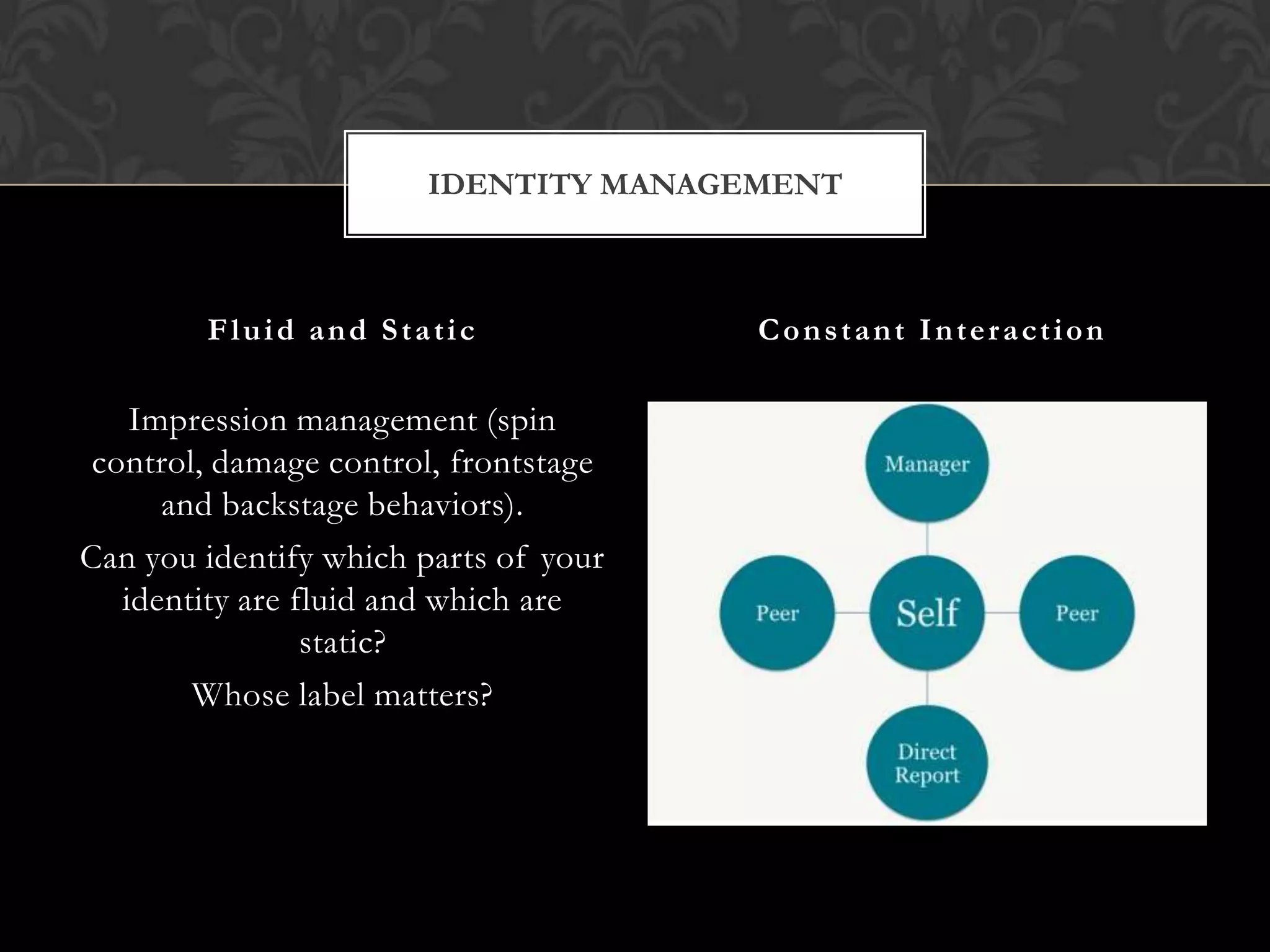
IDENTITY MANAGEMENT


        Fluid and Static               Constant Interaction

    Impression management (spin
 control, damage control, frontstage
      and backstage behaviors).
Can you identify which parts of your
   identity are fluid and which are
                 static?
        Whose label matters?
PERSPECTIVES


             Social Science                                    I n t e r p r e t ive

  nationality, race, ethnicity, religion, gender      Self arises in interaction with others
           constant and unchanging                   Negotiated, co-created, reinforced, and
                                                    challenged through communication with
    self in relation to group membership
                                                                       others
Cross-Cultural: the individualistic verses the
                                                   Avowal and ascription (professor-student
     collectivistic; independence verses           encounter, doctor-patient, and courtship).
interdependence; “I am because you are” or
Ubuntu; Ascribed (ibn) status verse achieved            Core symbols : African America
                      status                        emphasizes sharing, uniqueness, realism;
                                                     while European American emphasizes
Spiritual identity through religious groups, we                    individualism
                  define the self
                                                   Labels – African-American, Latino, White,
Identity negotiation theory – constant tension                          etc.
    between inclusion and differentiation
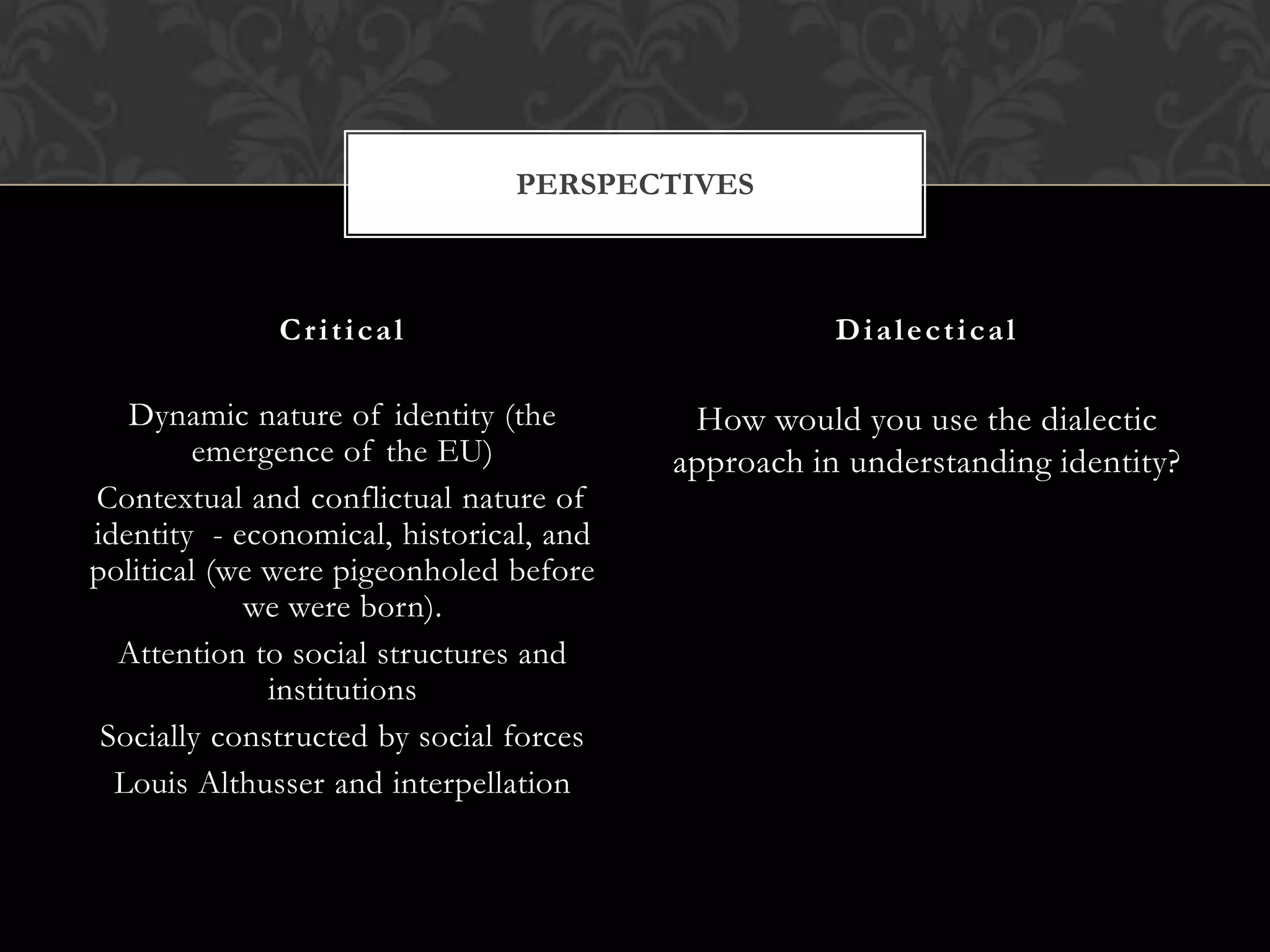
PERSPECTIVES


              Critical                              Dialectical

   Dynamic nature of identity (the        How would you use the dialectic
         emergence of the EU)            approach in understanding identity?
Contextual and conflictual nature of
identity - economical, historical, and
political (we were pigeonholed before
            we were born).
  Attention to social structures and
              institutions
 Socially constructed by social forces
  Louis Althusser and interpellation
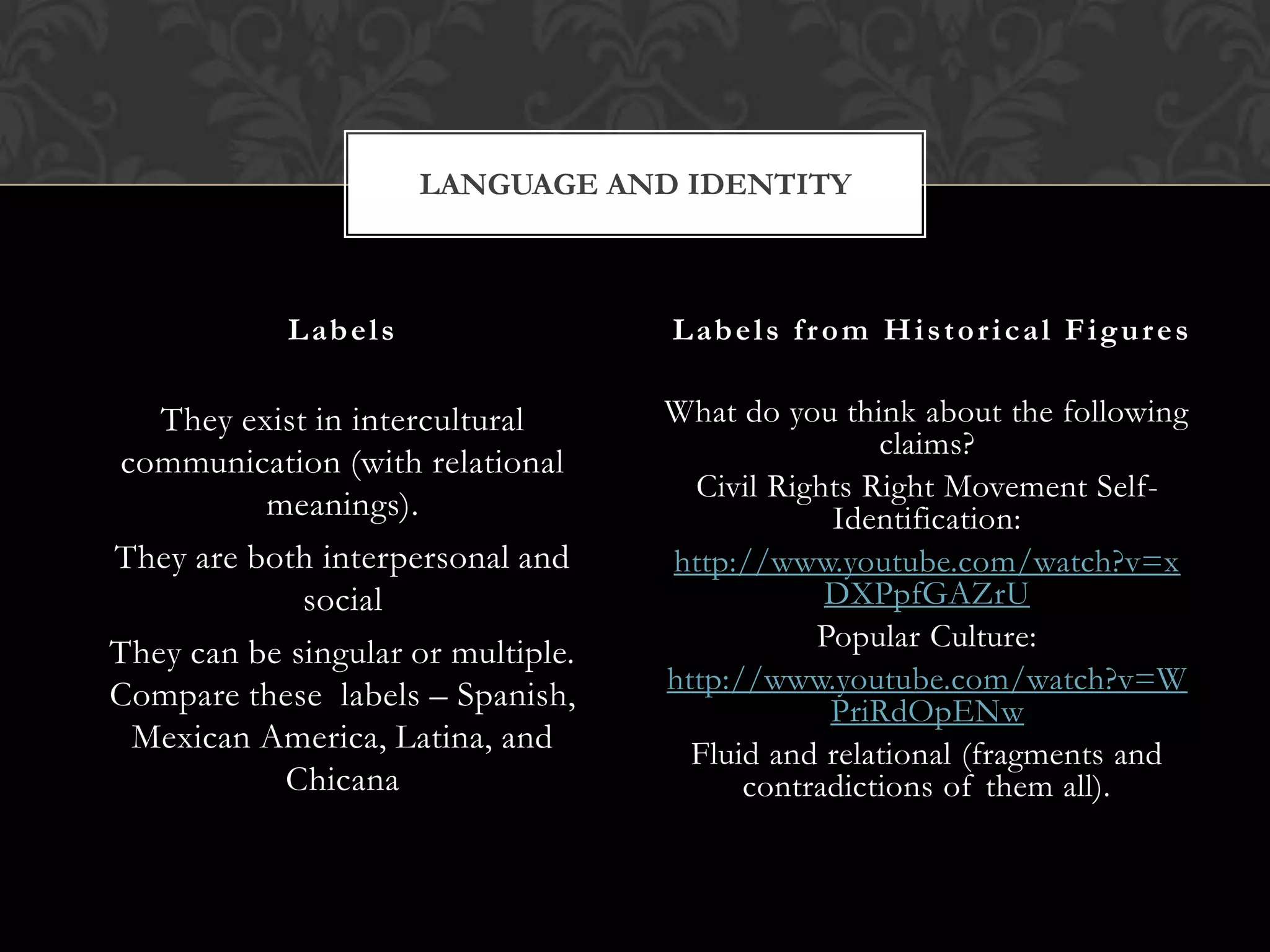
LANGUAGE AND IDENTITY


            L ab e l s               L ab e l s f r o m H i s t o r i c a l F i g u r e s

   They exist in intercultural      What do you think about the following
                                                    claims?
communication (with relational
                                      Civil Rights Right Movement Self-
          meanings).                            Identification:
They are both interpersonal and     http://www.youtube.com/watch?v=x
             social                             DXPpfGAZrU
                                               Popular Culture:
They can be singular or multiple.
Compare these labels – Spanish,     http://www.youtube.com/watch?v=W
                                                PriRdOpENw
 Mexican America, Latina, and         Fluid and relational (fragments and
           Chicana                        contradictions of them all).
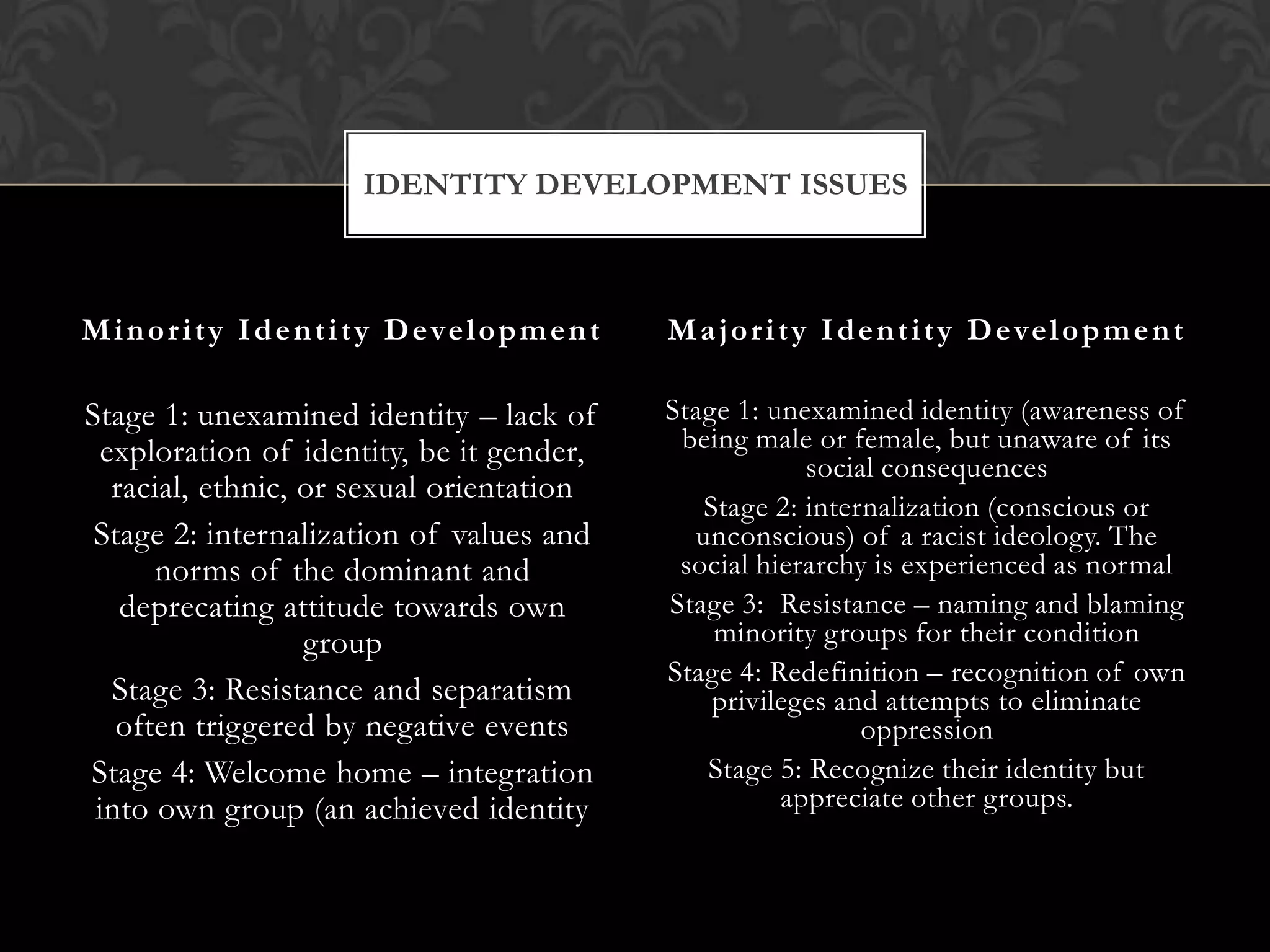
IDENTITY DEVELOPMENT ISSUES


M i n o r i t y I d e n t i t y D e ve l o p m e n t   M a j o r i t y I d e n t i t y D e ve l o p m e n t

Stage 1: unexamined identity – lack of                 Stage 1: unexamined identity (awareness of
  exploration of identity, be it gender,                being male or female, but unaware of its
                                                                   social consequences
   racial, ethnic, or sexual orientation
                                                          Stage 2: internalization (conscious or
 Stage 2: internalization of values and                  unconscious) of a racist ideology. The
      norms of the dominant and                         social hierarchy is experienced as normal
    deprecating attitude towards own                   Stage 3: Resistance – naming and blaming
                   group                                   minority groups for their condition
                                                       Stage 4: Redefinition – recognition of own
   Stage 3: Resistance and separatism                      privileges and attempts to eliminate
   often triggered by negative events                                   oppression
Stage 4: Welcome home – integration                       Stage 5: Recognize their identity but
 into own group (an achieved identity                            appreciate other groups.
QUESTIONS


Who are you – how do you define yourself and how do people define you?
             Are you confirmed or disconfirmed by others?
      Does that influence the way you communicate with others?
You can continue to ponder over these things as you prepare for our next
                             encounter….

Identity and intercultural communication

  • 1.
    IDENTITY AND INTERCULTURAL COMMUNICATION PROSPER YAO TSIKATA P.Y. TPpppppsPPpPPPPP
  • 2.
    SOME BASICS Under standing who we are Approaches and Concepts The Self and the other Social Science Recall encounter with Dr.Winsome, Interpretive the Jamaican lady who came to speak Critical with us (mother Jamaican and father Dialectical Indian, grew up in Jamaica). Who do people think she is in the US? Is she Gender, race/ethnicity, class, confirmed or disconfirmed? religion, and nationality http://www.youtube.com/watch?v= Stereotype, prejudice, and P7nuGpSQUj4 discrimination
  • 3.
    IDENTITY MANAGEMENT Fluid and Static Constant Interaction Impression management (spin control, damage control, frontstage and backstage behaviors). Can you identify which parts of your identity are fluid and which are static? Whose label matters?
  • 4.
    PERSPECTIVES Social Science I n t e r p r e t ive nationality, race, ethnicity, religion, gender Self arises in interaction with others constant and unchanging Negotiated, co-created, reinforced, and challenged through communication with self in relation to group membership others Cross-Cultural: the individualistic verses the Avowal and ascription (professor-student collectivistic; independence verses encounter, doctor-patient, and courtship). interdependence; “I am because you are” or Ubuntu; Ascribed (ibn) status verse achieved Core symbols : African America status emphasizes sharing, uniqueness, realism; while European American emphasizes Spiritual identity through religious groups, we individualism define the self Labels – African-American, Latino, White, Identity negotiation theory – constant tension etc. between inclusion and differentiation
  • 5.
    PERSPECTIVES Critical Dialectical Dynamic nature of identity (the How would you use the dialectic emergence of the EU) approach in understanding identity? Contextual and conflictual nature of identity - economical, historical, and political (we were pigeonholed before we were born). Attention to social structures and institutions Socially constructed by social forces Louis Althusser and interpellation
  • 6.
    LANGUAGE AND IDENTITY L ab e l s L ab e l s f r o m H i s t o r i c a l F i g u r e s They exist in intercultural What do you think about the following claims? communication (with relational Civil Rights Right Movement Self- meanings). Identification: They are both interpersonal and http://www.youtube.com/watch?v=x social DXPpfGAZrU Popular Culture: They can be singular or multiple. Compare these labels – Spanish, http://www.youtube.com/watch?v=W PriRdOpENw Mexican America, Latina, and Fluid and relational (fragments and Chicana contradictions of them all).
  • 7.
    IDENTITY DEVELOPMENT ISSUES Mi n o r i t y I d e n t i t y D e ve l o p m e n t M a j o r i t y I d e n t i t y D e ve l o p m e n t Stage 1: unexamined identity – lack of Stage 1: unexamined identity (awareness of exploration of identity, be it gender, being male or female, but unaware of its social consequences racial, ethnic, or sexual orientation Stage 2: internalization (conscious or Stage 2: internalization of values and unconscious) of a racist ideology. The norms of the dominant and social hierarchy is experienced as normal deprecating attitude towards own Stage 3: Resistance – naming and blaming group minority groups for their condition Stage 4: Redefinition – recognition of own Stage 3: Resistance and separatism privileges and attempts to eliminate often triggered by negative events oppression Stage 4: Welcome home – integration Stage 5: Recognize their identity but into own group (an achieved identity appreciate other groups.
  • 8.
    QUESTIONS Who are you– how do you define yourself and how do people define you? Are you confirmed or disconfirmed by others? Does that influence the way you communicate with others? You can continue to ponder over these things as you prepare for our next encounter….

Editor's Notes

  • #5 my humanity is caught up, is inextricably bound up, in theirs. We belong in a bundle of life. We say, “a person is a person through other people.