Presentation By:
              Donnelle Bivens, Kirsten Bergin, Kellie Childers,
            Kelly Laccinole, Jamie Pursley, and Ashton Walker

ELED 4292 Multicultural Education: Instructing Urban Learners
                                                UNC Charlotte
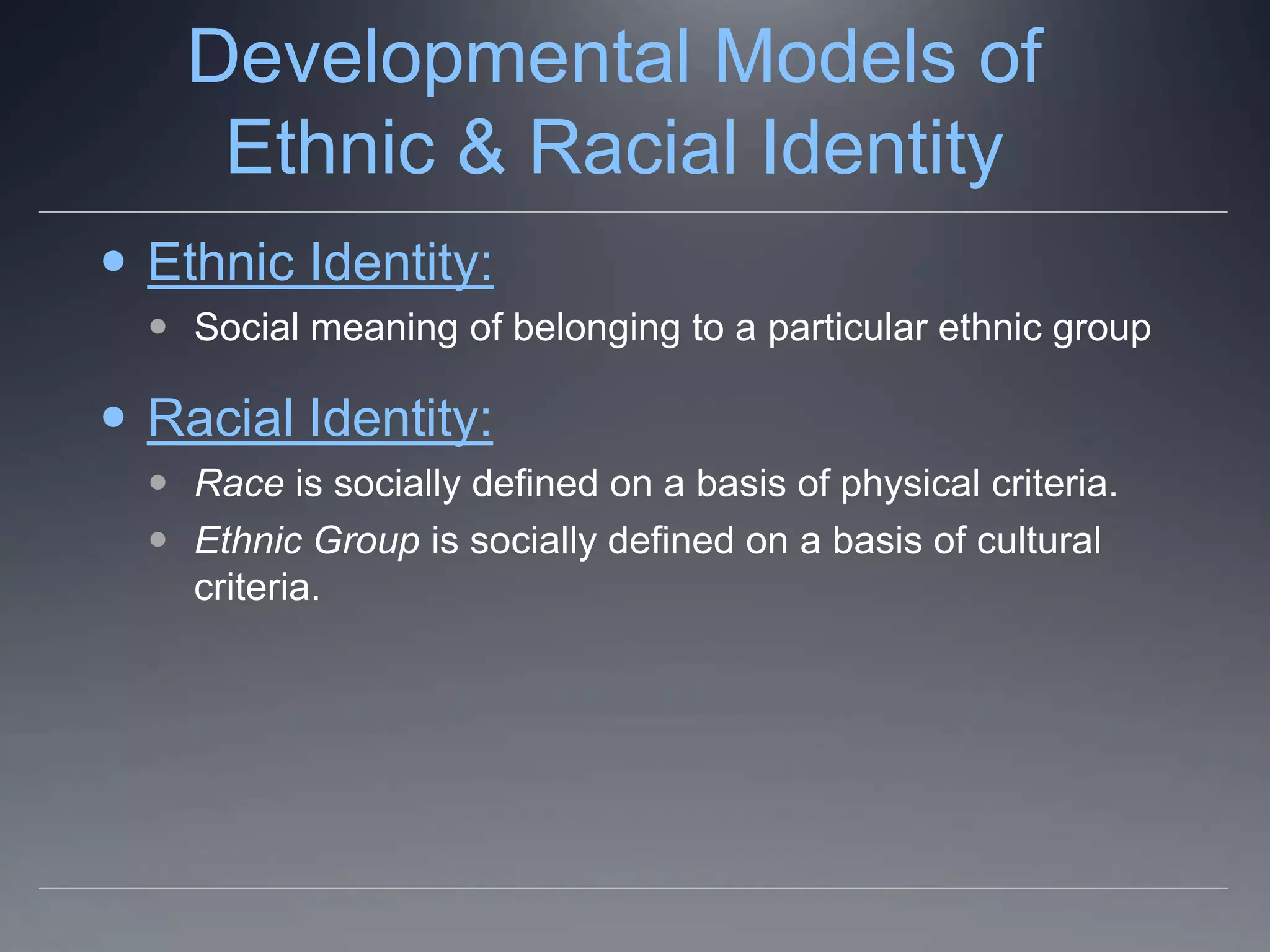
Developmental Models of
     Ethnic & Racial Identity
 Ethnic Identity:
   Social meaning of belonging to a particular ethnic group

 Racial Identity:
   Race is socially defined on a basis of physical criteria.
   Ethnic Group is socially defined on a basis of cultural
    criteria.
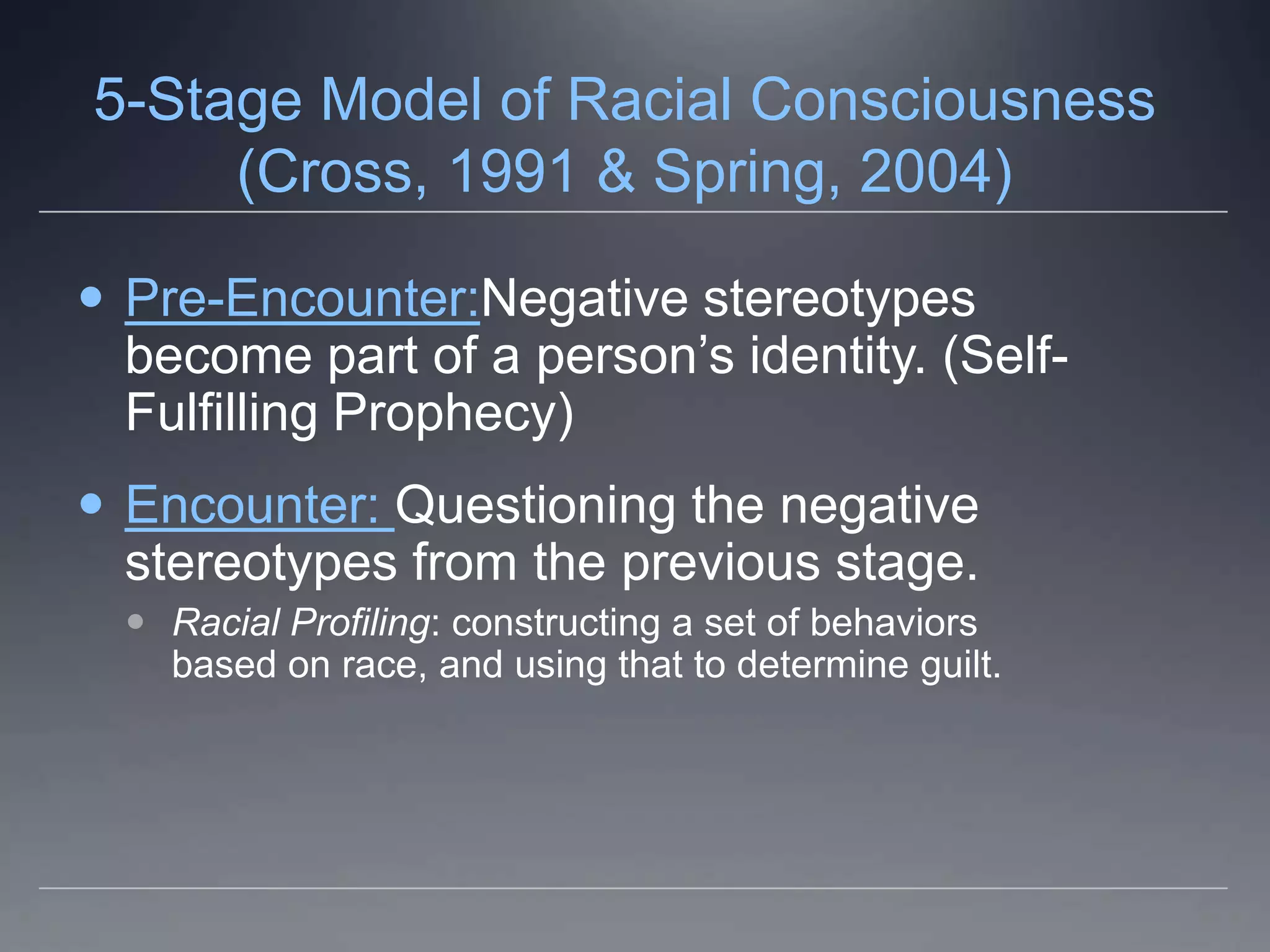
5-Stage Model of Racial Consciousness
     (Cross, 1991 & Spring, 2004)

 Pre-Encounter:Negative stereotypes
  become part of a person’s identity. (Self-
  Fulfilling Prophecy)
 Encounter: Questioning the negative
  stereotypes from the previous stage.
   Racial Profiling: constructing a set of behaviors
    based on race, and using that to determine guilt.
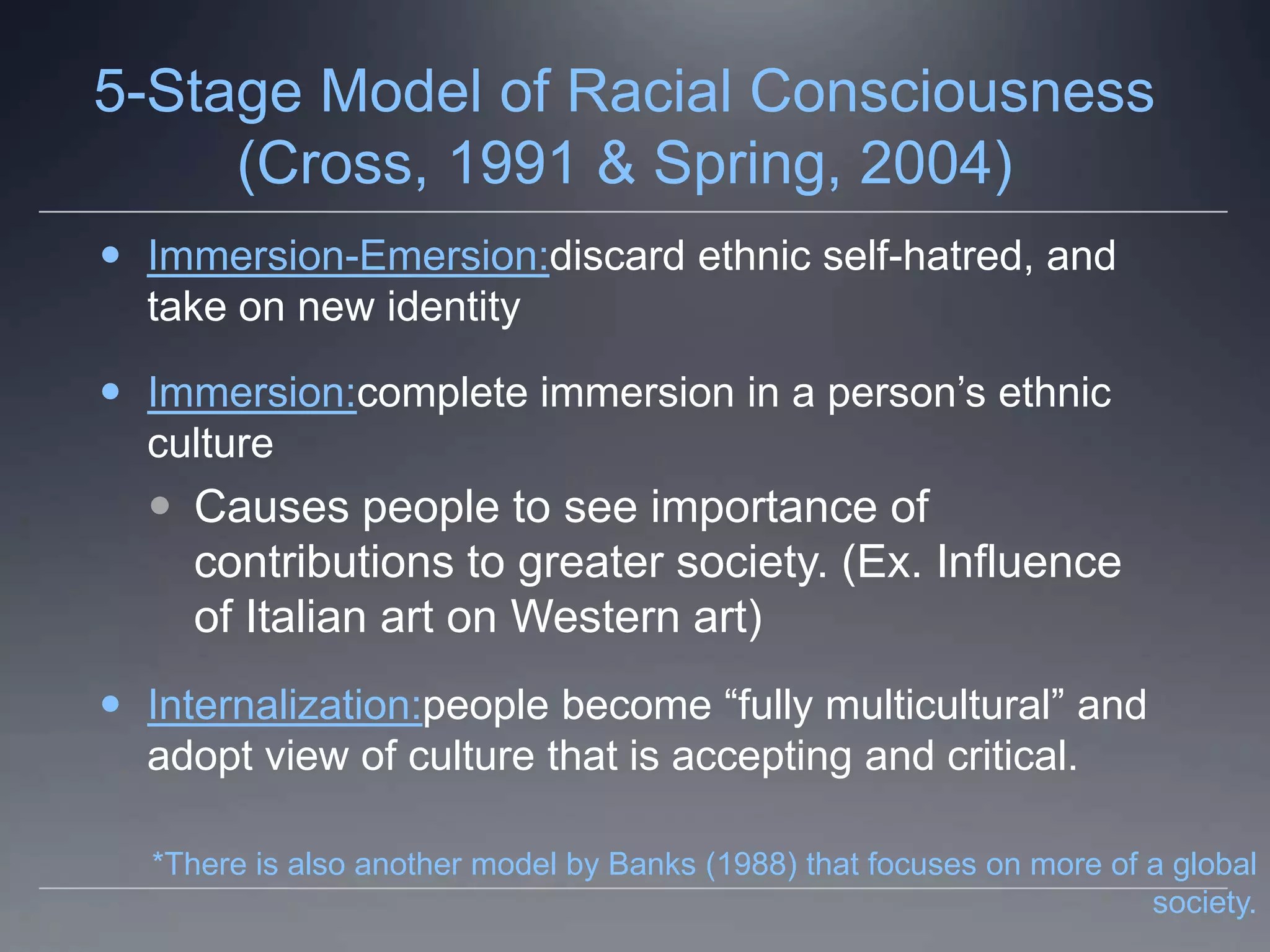
5-Stage Model of Racial Consciousness
     (Cross, 1991 & Spring, 2004)
 Immersion-Emersion:discard ethnic self-hatred, and
  take on new identity

 Immersion:complete immersion in a person’s ethnic
  culture
   Causes people to see importance of
    contributions to greater society. (Ex. Influence
    of Italian art on Western art)
 Internalization:people become “fully multicultural” and
  adopt view of culture that is accepting and critical.

  *There is also another model by Banks (1988) that focuses on more of a global
                                                                       society.
Intercultural Competence
 Interculturally competent people have three things in
  common:
   They are able to manage the psychological stress that
    accompanies most intercultural Interactions
   They are able to communicate effectively across
    cultures-verbally and nonverbally
   They are able to develop and maintain new and
    essential interpersonal relationships
Intercultural Competence
 Interculturally competent individuals are able to:
  • solve problems and take appropriate risks
  • shift their frame of reference as required
  • recognize and respond appropriately to cultural
    differences
  • listen empathically
  • perceive others truthfully
  • maintain nonjudgmental approach to communication
  • gather appropriate information about another culture
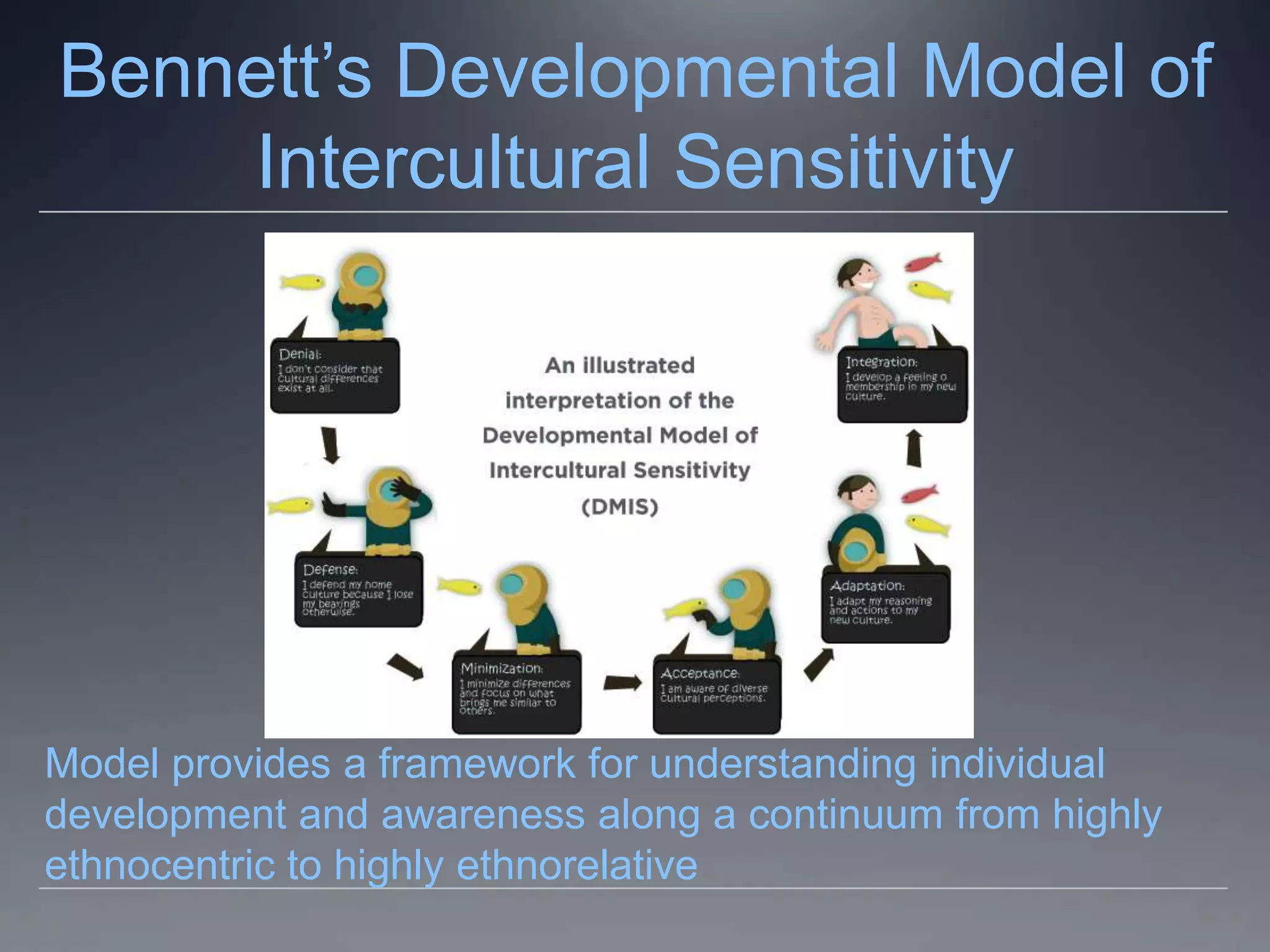
Bennett’s Developmental Model of
    Intercultural Sensitivity


Model provides a framework for understanding individual
development and awareness along a continuum from highly
ethnocentric to highly ethnorelative
Ethnocentric Stages of the DMIS
 Denial
  inability to see cultural differences
  reflective of individuals who isolate or separate
   themselves in homogenous groups
  “stupid questions syndrome” have ideas about
   stereotypic knowledge
  Children are socialized to believe that their view is
   the view of the world, instead of learning that their
   view is only one view of the world
Ethnocentric Stages of the
            DMIS
 Defense
  Recognition of cultural difference coupled with negative
   evaluations of those whose culture is different from
   one’s own
  When forced into contact with others, individuals
   become defensive
  Prefer to separate themselves from others because they
   don’t have categories for dealing with difference
Ethnocentric Stages of the
            DMIS
 Minimization
  Discovery of commonality
  Begin to recognize and accept superficial
   cultural differences (eating customs) but
   continue to believe that all humans are
   essentially the same
  Believe that physical traits do not matter as
   long as they treat everyone the same
  Believe all people have the same needs
   because they ignore influence of culture
Ethnorelative Stages of
             DMIS
 Acceptance
  Ability to recognize and appreciate cultural differences in
   terms of values and behaviors
  Categories of difference are consciously expanded and
   elaborated, with an understanding that others are “not
   good or bad, just different”
  Begin to seek out cultural difference
  May respect and value cultural differences but not
   necessarily agree with all they see
Ethnorelative Stages of
             DMIS
 Adaptation
  More flexible and competent in their ability to
   communicate across cultures
  Driven by a need for action and cognitive empathy
  2 forms of adaption exist
    Cultural
    Behavioral
  Conscious intention with flexible and permeable category
   boundaries
Ethnorelative Stages of
            DMIS
 Integration
   Internalization of bicultural or multicultural frames of
    reference
   Can identify and move freely within more than one
    cultural group
   Able to facilitate constructive cultural contact between
    cultures and tend to become cultural mediators
   Rare and difficult level to achieve
Identifying
 Ethnic Identity               Racial Identity
   You identify yourself as      Physical
    belonging to a social          characteristics identify
    group with whom you            you as belonging to a
    have cultural                  specific group, such
    commonalities                  as:
     Customs                       Skin color
     Shared language               Facial features
Growing Ourselves
 People can grow from being ethnocentric
  to becoming ethnorelative and open
  minded.
 Through these steps and recognizing
  one’s state of mind, we can become the
  culture that we as teachers wish to foster:
  an understanding and welcoming
  community in which cultural differences
  are seen merely as spectrums of the
  same rainbow.
Summary
 “Intercultural development is how they develop
  their ability to understand and interact more
  effectively with people different from themselves.
  The developmental model of intercultural
  sensitivity (DMIS) was introduced as one means
  to understand how people can grow from being
  ethnocentric to becoming more ethnorelative in
  their orientation.”
 Most students and teachers will go through the
  DMIS model and it is important that one is given
  the support to understand what to do in certain
  situations.
References:
 Cushner, K., McClelland, A., & Safford, P.
  (2012). Human diversity in education: An
  intercultural approach. (Seventh ed.). New
  York: McGraw Hill.

Multicultural Education: Intercultural Development

  • 1.
    Presentation By: Donnelle Bivens, Kirsten Bergin, Kellie Childers, Kelly Laccinole, Jamie Pursley, and Ashton Walker ELED 4292 Multicultural Education: Instructing Urban Learners UNC Charlotte
  • 2.
    Developmental Models of Ethnic & Racial Identity  Ethnic Identity:  Social meaning of belonging to a particular ethnic group  Racial Identity:  Race is socially defined on a basis of physical criteria.  Ethnic Group is socially defined on a basis of cultural criteria.
  • 3.
    5-Stage Model ofRacial Consciousness (Cross, 1991 & Spring, 2004)  Pre-Encounter:Negative stereotypes become part of a person’s identity. (Self- Fulfilling Prophecy)  Encounter: Questioning the negative stereotypes from the previous stage.  Racial Profiling: constructing a set of behaviors based on race, and using that to determine guilt.
  • 4.
    5-Stage Model ofRacial Consciousness (Cross, 1991 & Spring, 2004)  Immersion-Emersion:discard ethnic self-hatred, and take on new identity  Immersion:complete immersion in a person’s ethnic culture  Causes people to see importance of contributions to greater society. (Ex. Influence of Italian art on Western art)  Internalization:people become “fully multicultural” and adopt view of culture that is accepting and critical. *There is also another model by Banks (1988) that focuses on more of a global society.
  • 5.
    Intercultural Competence  Interculturallycompetent people have three things in common:  They are able to manage the psychological stress that accompanies most intercultural Interactions  They are able to communicate effectively across cultures-verbally and nonverbally  They are able to develop and maintain new and essential interpersonal relationships
  • 6.
    Intercultural Competence  Interculturallycompetent individuals are able to: • solve problems and take appropriate risks • shift their frame of reference as required • recognize and respond appropriately to cultural differences • listen empathically • perceive others truthfully • maintain nonjudgmental approach to communication • gather appropriate information about another culture
  • 7.
    Bennett’s Developmental Modelof Intercultural Sensitivity Model provides a framework for understanding individual development and awareness along a continuum from highly ethnocentric to highly ethnorelative
  • 8.
    Ethnocentric Stages ofthe DMIS  Denial  inability to see cultural differences  reflective of individuals who isolate or separate themselves in homogenous groups  “stupid questions syndrome” have ideas about stereotypic knowledge  Children are socialized to believe that their view is the view of the world, instead of learning that their view is only one view of the world
  • 9.
    Ethnocentric Stages ofthe DMIS  Defense  Recognition of cultural difference coupled with negative evaluations of those whose culture is different from one’s own  When forced into contact with others, individuals become defensive  Prefer to separate themselves from others because they don’t have categories for dealing with difference
  • 10.
    Ethnocentric Stages ofthe DMIS  Minimization  Discovery of commonality  Begin to recognize and accept superficial cultural differences (eating customs) but continue to believe that all humans are essentially the same  Believe that physical traits do not matter as long as they treat everyone the same  Believe all people have the same needs because they ignore influence of culture
  • 11.
    Ethnorelative Stages of DMIS  Acceptance  Ability to recognize and appreciate cultural differences in terms of values and behaviors  Categories of difference are consciously expanded and elaborated, with an understanding that others are “not good or bad, just different”  Begin to seek out cultural difference  May respect and value cultural differences but not necessarily agree with all they see
  • 12.
    Ethnorelative Stages of DMIS  Adaptation  More flexible and competent in their ability to communicate across cultures  Driven by a need for action and cognitive empathy  2 forms of adaption exist  Cultural  Behavioral  Conscious intention with flexible and permeable category boundaries
  • 13.
    Ethnorelative Stages of DMIS  Integration  Internalization of bicultural or multicultural frames of reference  Can identify and move freely within more than one cultural group  Able to facilitate constructive cultural contact between cultures and tend to become cultural mediators  Rare and difficult level to achieve
  • 15.
    Identifying  Ethnic Identity  Racial Identity  You identify yourself as  Physical belonging to a social characteristics identify group with whom you you as belonging to a have cultural specific group, such commonalities as:  Customs  Skin color  Shared language  Facial features
  • 16.
    Growing Ourselves  Peoplecan grow from being ethnocentric to becoming ethnorelative and open minded.  Through these steps and recognizing one’s state of mind, we can become the culture that we as teachers wish to foster: an understanding and welcoming community in which cultural differences are seen merely as spectrums of the same rainbow.
  • 17.
    Summary  “Intercultural developmentis how they develop their ability to understand and interact more effectively with people different from themselves. The developmental model of intercultural sensitivity (DMIS) was introduced as one means to understand how people can grow from being ethnocentric to becoming more ethnorelative in their orientation.”  Most students and teachers will go through the DMIS model and it is important that one is given the support to understand what to do in certain situations.
  • 18.
    References:  Cushner, K.,McClelland, A., & Safford, P. (2012). Human diversity in education: An intercultural approach. (Seventh ed.). New York: McGraw Hill.