NOZZLES
DEFINITION
• A nozzle (from nose, meaning 'small spout') is a tube of varying cross-
sectional area (usually axisymmetric) aiming at increasing the speed
of an outflow, and controlling its direction and shape.
• Nozzle flow always generates forces associated to the change in flow
momentum, as we can feel by handholding a hose and opening the
tap.
• In the simplest case of a rocket nozzle, relative motion is created by
ejecting mass from a chamber backwards through the nozzle, with
the reaction forces acting mainly on the opposite chamber wall, with
a small contribution from nozzle walls.
• As important as the propeller is to shaft-engine propulsions, so it is
the nozzle to jet propulsion, since it is in the nozzle that thermal
energy (or any other kind of high-pressure energy source) transforms
into kinetic energy of the exhaust, and its associated linear
momentum producing thrust.
• The flow in a nozzle is very rapid (and thus adiabatic to a first
approximation), and with very little frictional loses (because the flow
is nearly one-dimensional, with a favorable pressure gradient except if
shock waves form, and nozzles are relatively short), so that the
isentropic model all along the nozzle is good enough for preliminary
design.
Real nozzle flow departs from ideal
(isentropic) flow on two aspects:
• Non-adiabatic effects. There is a kind of heat addition by non-
equilibrium radical-species recombination, and a heat removal by
cooling the walls to keep the strength of materials in long duration
rockets (e.g. operating temperature of cryogenic SR-25 rockets used
in Space Shuttle is 3250 K, above steel vaporization temperature of
3100 K, not just melting, at 1700 K). Short duration rockets (e.g. solid
rockets) are not actively cooled but rely on ablation; however, the
nozzle-throat diameter cannot let widen too much, and reinforced
materials (e.g. carbon, silica) are used in the throat region
• There is viscous dissipation within the boundary layer, and erosion of
the walls, what can be critical if the erosion widens the throat cross-
section, greatly reducing exit-area ratio and consequently thrust.
• Restricting the analysis to isentropic flows, the minimum set of input
parameters to define the propulsive properties of a nozzle (the thrust
is the mass-flow-rate times the exit speed, F=mve) are:
• Nozzle size, given by the exit area, Ae; the actual area law, provided
the entry area is large enough that the entry speed can be neglected,
only modifies the flow inside the nozzle, but not the exit conditions.
• Type of gas, defined with two independent properties for a perfect-
gas model, that we take as the thermal capacity ratio γ≡cp/cv, and the
gas constant, R≡Rw/M, and with Ru=8.314 J/(mol·K) and M being the
molar mass, which we avoid using, to reserve the symbol M for the
Mach number. If cp is given instead of γ, then we compute it from
γ≡cp/cv=cp/(cp−R), having used Mayer's relation, cp−cv=R.
• Chamber (or entry) conditions: pc and Tc (a relatively large chamber
cross-section, and negligible speed, is assumed at the nozzle entry:
Ac∞, Mc0). Instead of subscript 'c' for chamber conditions, we
will use 't' for total values because the energy conservation implies
that total temperature is invariant along the nozzle flow, and the non-
dissipative assumption implies that total pressure is also invariant, i.e.
Tt=Tc and pt=pc.
• Discharge conditions: p0, i.e. the environmental pressure (or back
pressure), is the only variable of importance (because pressure waves
propagate at the local speed of sound and quickly tend to force
mechanical equilibrium, whereas the environmental temperature T0
propagates by much slower heat-transfer physical mechanisms). Do
not confuse discharge pressure, p0, with exit pressure, pe, explained
below.
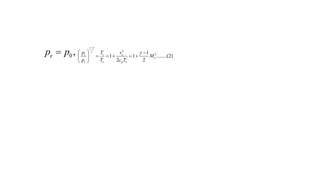
• The objective is to find the flow conditions at the exit [pe,Te,ve] for a
given set of the above parameters [Ae,γ ,R ,p c,Tc,p0], so that
• If the nozzle flow is subsonic, then the exit pressure coincides with
the discharge pressure, pe=p0
• other variables would be obtained from the isentropic relations at
steady state
,
e
e e e e e
e
P
m v A v A
RT

  F ,
e
mv
 ......(1)
e
e
e
v
M
RT


0,
e
p p

1
2
2
1
1 1 ........(2)
2 2
t t e
e
c e p e
p T v
M
p T c T

 

  
    
 
 
Converging nozzles
• Converging nozzles are used to accelerate the fluid in subsonic gas
streams (and in liquid jets), since at low speed density do not vary
much and =ρvA= const can be approximated by vA=const.
• when the flow is supersonic at some stage (even just at the exit),
pe≠p0
• A converging nozzle can only become supersonic at the exit stage; the
speed increases monotonically along the nozzle.
• If a converging nozzle is fed from a constant pressure constant
temperature chamber, the flow rate grows as the discharge pressure
is being reduced, until the flow becomes sonic (choked) and the flow
rate no longer changes with further decreasing in discharge-pressure
m
• Except for old-time turbojets and military fighter aircraft, all commercial jet
engines (after Concorde was retired) use converging nozzles discharging at
subsonic speed (both, the hot core stream and the colder fan stream).
• Several nozzle geometries have been used in propulsion systems
• The classical quasi-one-dimensional Laval nozzle, which has a slender
geometry, with a rapidly converging short entrance, a rounded throat, and
a long conical exhaust of some 15 half-cone Rarely used in modern
rockets.
• Bell-shape nozzles (or parabolic nozzles), which are as efficiency as the
simplest conical nozzle, but shorter and lighter, though more expensive to
manufacture. They are the present standard in rockets;
• Annular and linear nozzles, designed to compensate ambient pressure
variation, like the Aerospike nozzle. They are under development.
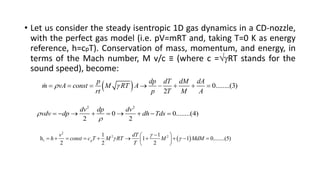
• Let us consider the steady isentropic 1D gas dynamics in a CD-nozzle,
with the perfect gas model (i.e. pV=mRT and, taking T=0 K as energy
reference, h=cpT). Conservation of mass, momentum, and energy, in
terms of the Mach number, M v/c ≡ (where c =RT stands for the
sound speed), become:
  0........(3)
2
p dp dT dM dA
m vA const M RT A
rt p T M A
 
       
2 2
0 0........(4)
2 2
dv dp dv
vdv dp dh Tds


        
 
2
2 2
1
1 1
h 1 1 0........(5)
2 2 2
p
v dT
h const c T M RT M MdM
T

 

 
         
 
 
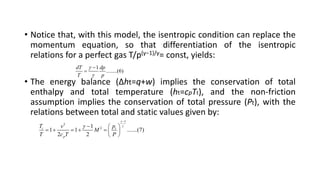
• Notice that, with this model, the isentropic condition can replace the
momentum equation, so that differentiation of the isentropic
relations for a perfect gas T/p(γ−1)/γ= const, yields:
• The energy balance (Δht=q+w) implies the conservation of total
enthalpy and total temperature (ht=cpTt), and the non-friction
assumption implies the conservation of total pressure (Pt), with the
relations between total and static values given by:
1
........(6)
dT dp
T p




1
2
2
1
1 1 .......(7)
2 2
t t
p
T p
v
M
T c T P




  
      
 
• with the perfect gas model, γ remains constant throughout the
expansion process
• However, when the engine flow is composed of hot combustion
products, real gas effects become important, and as the gas expands,
γ shifts as a result of changes in temperature and in chemical
composition.
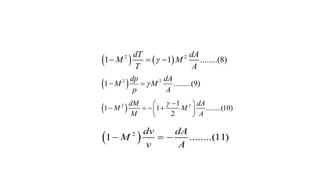
• Choosing the cross-section area of the duct, A, as independent
variable, the variation of the other variables can be explicitly found
   
2 2
1 1 ........(8)
dT dA
M M
T A

  
 
2 2
1 .........(9)
dp dA
M M
p A

 
 
2 2
1
1 1 ........(10)
2
dM dA
M M
M A
 
 
   
 
 
 
2
1 ........(11)
dv dA
M
v A
  
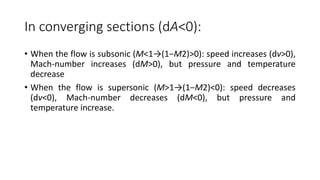
In converging sections (dA<0):
• When the flow is subsonic (M<1→(1−M2)>0): speed increases (dv>0),
Mach-number increases (dM>0), but pressure and temperature
decrease
• When the flow is supersonic (M>1→(1−M2)<0): speed decreases
(dv<0), Mach-number decreases (dM<0), but pressure and
temperature increase.
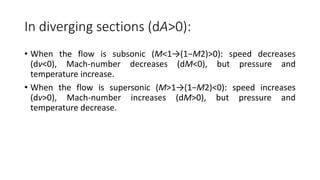
In diverging sections (dA>0):
• When the flow is subsonic (M<1→(1−M2)>0): speed decreases
(dv<0), Mach-number decreases (dM<0), but pressure and
temperature increase.
• When the flow is supersonic (M>1→(1−M2)<0): speed increases
(dv>0), Mach-number increases (dM>0), but pressure and
temperature decrease.
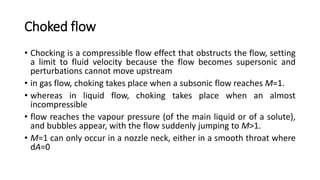
Choked flow
• Chocking is a compressible flow effect that obstructs the flow, setting
a limit to fluid velocity because the flow becomes supersonic and
perturbations cannot move upstream
• in gas flow, choking takes place when a subsonic flow reaches M=1.
• whereas in liquid flow, choking takes place when an almost
incompressible
• flow reaches the vapour pressure (of the main liquid or of a solute),
and bubbles appear, with the flow suddenly jumping to M>1.
• M=1 can only occur in a nozzle neck, either in a smooth throat where
dA=0
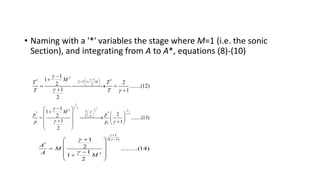
• Naming with a '*' variables the stage where M=1 (i.e. the sonic
Section), and integrating from A to A*, equations (8)-(10)
2
1
* *
1
2
1
1
2
2 ........(12)
1 1
2
t
T T M
M
T T
T T


 

 
 
 
 


 
 
 
1
1
2
* * 1
1
1
2
2 ........(13)
1 1
2
t t
T p
T p
t
M
p p
p p



 


 


 
  
 

 

   
 

   
 
 
 
 
 
1
2 1
*
2
1
2 .........(14)
1
1
2
A
M
A M







 
 
  

 

 
Area ratio
Nozzle area ratio ε (or nozzle expansion ratio) is defined as nozzle exit
area divided by throat area in converging-diverging nozzles, or divided
by entry area in converging nozzles
ε≡Ae/A*
STUDY EXAMPLE
• A steam flow of 1 kg/s expands isentropically in a nozzle from a
chamber at 300 kPa and
• 300 C to an outside atmosphere at 100 kPa. Find:
• a) If the nozzle is converging or converging-diverging, and the exit
Mach number.
• b) Exit area and minimum area.

PET 512 NOZZEL.pptx

  • 1.
  • 2.
    DEFINITION • A nozzle(from nose, meaning 'small spout') is a tube of varying cross- sectional area (usually axisymmetric) aiming at increasing the speed of an outflow, and controlling its direction and shape. • Nozzle flow always generates forces associated to the change in flow momentum, as we can feel by handholding a hose and opening the tap. • In the simplest case of a rocket nozzle, relative motion is created by ejecting mass from a chamber backwards through the nozzle, with the reaction forces acting mainly on the opposite chamber wall, with a small contribution from nozzle walls.
  • 3.
    • As importantas the propeller is to shaft-engine propulsions, so it is the nozzle to jet propulsion, since it is in the nozzle that thermal energy (or any other kind of high-pressure energy source) transforms into kinetic energy of the exhaust, and its associated linear momentum producing thrust. • The flow in a nozzle is very rapid (and thus adiabatic to a first approximation), and with very little frictional loses (because the flow is nearly one-dimensional, with a favorable pressure gradient except if shock waves form, and nozzles are relatively short), so that the isentropic model all along the nozzle is good enough for preliminary design.
  • 4.
    Real nozzle flowdeparts from ideal (isentropic) flow on two aspects: • Non-adiabatic effects. There is a kind of heat addition by non- equilibrium radical-species recombination, and a heat removal by cooling the walls to keep the strength of materials in long duration rockets (e.g. operating temperature of cryogenic SR-25 rockets used in Space Shuttle is 3250 K, above steel vaporization temperature of 3100 K, not just melting, at 1700 K). Short duration rockets (e.g. solid rockets) are not actively cooled but rely on ablation; however, the nozzle-throat diameter cannot let widen too much, and reinforced materials (e.g. carbon, silica) are used in the throat region
  • 5.
    • There isviscous dissipation within the boundary layer, and erosion of the walls, what can be critical if the erosion widens the throat cross- section, greatly reducing exit-area ratio and consequently thrust. • Restricting the analysis to isentropic flows, the minimum set of input parameters to define the propulsive properties of a nozzle (the thrust is the mass-flow-rate times the exit speed, F=mve) are:
  • 6.
    • Nozzle size,given by the exit area, Ae; the actual area law, provided the entry area is large enough that the entry speed can be neglected, only modifies the flow inside the nozzle, but not the exit conditions. • Type of gas, defined with two independent properties for a perfect- gas model, that we take as the thermal capacity ratio γ≡cp/cv, and the gas constant, R≡Rw/M, and with Ru=8.314 J/(mol·K) and M being the molar mass, which we avoid using, to reserve the symbol M for the Mach number. If cp is given instead of γ, then we compute it from γ≡cp/cv=cp/(cp−R), having used Mayer's relation, cp−cv=R.
  • 7.
    • Chamber (orentry) conditions: pc and Tc (a relatively large chamber cross-section, and negligible speed, is assumed at the nozzle entry: Ac∞, Mc0). Instead of subscript 'c' for chamber conditions, we will use 't' for total values because the energy conservation implies that total temperature is invariant along the nozzle flow, and the non- dissipative assumption implies that total pressure is also invariant, i.e. Tt=Tc and pt=pc. • Discharge conditions: p0, i.e. the environmental pressure (or back pressure), is the only variable of importance (because pressure waves propagate at the local speed of sound and quickly tend to force mechanical equilibrium, whereas the environmental temperature T0 propagates by much slower heat-transfer physical mechanisms). Do not confuse discharge pressure, p0, with exit pressure, pe, explained below.
  • 8.
    • The objectiveis to find the flow conditions at the exit [pe,Te,ve] for a given set of the above parameters [Ae,γ ,R ,p c,Tc,p0], so that • If the nozzle flow is subsonic, then the exit pressure coincides with the discharge pressure, pe=p0 • other variables would be obtained from the isentropic relations at steady state , e e e e e e e P m v A v A RT    F , e mv  ......(1) e e e v M RT  
  • 9.
    0, e p p  1 2 2 1 1 1........(2) 2 2 t t e e c e p e p T v M p T c T                
  • 10.
    Converging nozzles • Convergingnozzles are used to accelerate the fluid in subsonic gas streams (and in liquid jets), since at low speed density do not vary much and =ρvA= const can be approximated by vA=const. • when the flow is supersonic at some stage (even just at the exit), pe≠p0 • A converging nozzle can only become supersonic at the exit stage; the speed increases monotonically along the nozzle. • If a converging nozzle is fed from a constant pressure constant temperature chamber, the flow rate grows as the discharge pressure is being reduced, until the flow becomes sonic (choked) and the flow rate no longer changes with further decreasing in discharge-pressure m
  • 11.
    • Except forold-time turbojets and military fighter aircraft, all commercial jet engines (after Concorde was retired) use converging nozzles discharging at subsonic speed (both, the hot core stream and the colder fan stream). • Several nozzle geometries have been used in propulsion systems • The classical quasi-one-dimensional Laval nozzle, which has a slender geometry, with a rapidly converging short entrance, a rounded throat, and a long conical exhaust of some 15 half-cone Rarely used in modern rockets. • Bell-shape nozzles (or parabolic nozzles), which are as efficiency as the simplest conical nozzle, but shorter and lighter, though more expensive to manufacture. They are the present standard in rockets; • Annular and linear nozzles, designed to compensate ambient pressure variation, like the Aerospike nozzle. They are under development.
  • 12.
    • Let usconsider the steady isentropic 1D gas dynamics in a CD-nozzle, with the perfect gas model (i.e. pV=mRT and, taking T=0 K as energy reference, h=cpT). Conservation of mass, momentum, and energy, in terms of the Mach number, M v/c ≡ (where c =RT stands for the sound speed), become:   0........(3) 2 p dp dT dM dA m vA const M RT A rt p T M A           2 2 0 0........(4) 2 2 dv dp dv vdv dp dh Tds              2 2 2 1 1 1 h 1 1 0........(5) 2 2 2 p v dT h const c T M RT M MdM T                    
  • 13.
    • Notice that,with this model, the isentropic condition can replace the momentum equation, so that differentiation of the isentropic relations for a perfect gas T/p(γ−1)/γ= const, yields: • The energy balance (Δht=q+w) implies the conservation of total enthalpy and total temperature (ht=cpTt), and the non-friction assumption implies the conservation of total pressure (Pt), with the relations between total and static values given by: 1 ........(6) dT dp T p     1 2 2 1 1 1 .......(7) 2 2 t t p T p v M T c T P                
  • 14.
    • with theperfect gas model, γ remains constant throughout the expansion process • However, when the engine flow is composed of hot combustion products, real gas effects become important, and as the gas expands, γ shifts as a result of changes in temperature and in chemical composition. • Choosing the cross-section area of the duct, A, as independent variable, the variation of the other variables can be explicitly found
  • 15.
       2 2 1 1 ........(8) dT dA M M T A       2 2 1 .........(9) dp dA M M p A      2 2 1 1 1 ........(10) 2 dM dA M M M A               2 1 ........(11) dv dA M v A   
  • 16.
    In converging sections(dA<0): • When the flow is subsonic (M<1→(1−M2)>0): speed increases (dv>0), Mach-number increases (dM>0), but pressure and temperature decrease • When the flow is supersonic (M>1→(1−M2)<0): speed decreases (dv<0), Mach-number decreases (dM<0), but pressure and temperature increase.
  • 17.
    In diverging sections(dA>0): • When the flow is subsonic (M<1→(1−M2)>0): speed decreases (dv<0), Mach-number decreases (dM<0), but pressure and temperature increase. • When the flow is supersonic (M>1→(1−M2)<0): speed increases (dv>0), Mach-number increases (dM>0), but pressure and temperature decrease.
  • 18.
    Choked flow • Chockingis a compressible flow effect that obstructs the flow, setting a limit to fluid velocity because the flow becomes supersonic and perturbations cannot move upstream • in gas flow, choking takes place when a subsonic flow reaches M=1. • whereas in liquid flow, choking takes place when an almost incompressible • flow reaches the vapour pressure (of the main liquid or of a solute), and bubbles appear, with the flow suddenly jumping to M>1. • M=1 can only occur in a nozzle neck, either in a smooth throat where dA=0
  • 19.
    • Naming witha '*' variables the stage where M=1 (i.e. the sonic Section), and integrating from A to A*, equations (8)-(10) 2 1 * * 1 2 1 1 2 2 ........(12) 1 1 2 t T T M M T T T T                      1 1 2 * * 1 1 1 2 2 ........(13) 1 1 2 t t T p T p t M p p p p                                            1 2 1 * 2 1 2 .........(14) 1 1 2 A M A M                    
  • 20.
    Area ratio Nozzle arearatio ε (or nozzle expansion ratio) is defined as nozzle exit area divided by throat area in converging-diverging nozzles, or divided by entry area in converging nozzles ε≡Ae/A*
  • 21.
    STUDY EXAMPLE • Asteam flow of 1 kg/s expands isentropically in a nozzle from a chamber at 300 kPa and • 300 C to an outside atmosphere at 100 kPa. Find: • a) If the nozzle is converging or converging-diverging, and the exit Mach number. • b) Exit area and minimum area.