1
WALLS
Construction
Works
C O M P I L E D B Y : I N S T R U C TO R TA R I K U D E S S U ( M . S C . )
2
DEFINITION
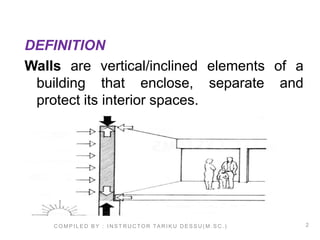
Walls are vertical/inclined elements of a
building that enclose, separate and
protect its interior spaces.
C O M P I L E D B Y : I N S T R U C TO R TA R I K U D E S S U ( M . S C . )
3
PURPOSE
• Provide required level of enclosure and define space
REQUIREMENTS
1. TECHNICAL REQUIREMENTS
i) Strength
 Supporting roofs & their own weight,
 Transfer load on it to beams,
 Resist any lateral loads.
 Retain earth pressure.
ii) Exclude Weather
iii) Insulate sound and temperature
iv) Resist fire transmission
C O M P I L E D B Y : I N S T R U C TO R TAR I K U D E S S U ( M . S C . )
4
2. ARCHITECTURAL REQUIREMENTS
Walls are the most visible form-defining elements & thus
become primary elements that define the aesthetic
character of a building.
 Shape & surface characteristic of walls are
responsible for making visual composition.
 Factors affecting appearance /visual pattern/ are:
TEXTURE, COLOR, FORM & SCALE
 Which in turn affects, choice of materials.
C O M P I L E D B Y : I N S T R U C TO R TA R I K U D E S S U ( M . S C . )
5
C O M P I L E D B Y : I N S T R U C TO R TA R I K U D E S S U ( M . S C . )
6
TYPES
Wall types can be categorized on the bases of:
• Location of The Wall
 External walls
 Internal Partition walls
• Structural Requirement
 Load Bearing walls
 Non Load Bearing walls
C O M P I L E D B Y : I N S T R U C TO R TA R I K U D E S S U ( M . S C . )
7
Types of walls based on:
• Material Used
 Wood
 Brick
 Stone
 Concrete Blocks
 Concrete
 Glass
 Metal …etc.
• Material Composition
 Block Walls
 Monolithic
C O M P I L E D B Y : I N S T R U C TO R TA R I K U D E S S U ( M . S C . )
8
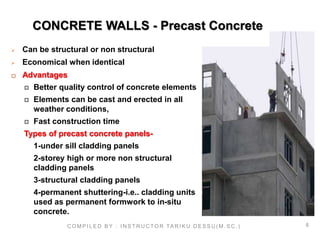
 Can be structural or non structural
 Economical when identical
 Advantages
 Better quality control of concrete elements
 Elements can be cast and erected in all
weather conditions,
 Fast construction time
Types of precast concrete panels-
1-under sill cladding panels
2-storey high or more non structural
cladding panels
3-structural cladding panels
4-permanent shuttering-i.e.. cladding units
used as permanent formwork to in-situ
concrete.
CONCRETE WALLS - Precast Concrete
C O M P I L E D B Y : I N S T R U C TO R TA R I K U D E S S U ( M . S C . )
9
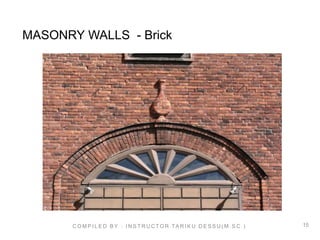
MASONRY WALLS
Masonry is the term used to refer
construction using pieces of construction
materials made in to blocks and stacked
together using different binding
mechanisms.
MORTAR
Used to bind masonry units together. In the early
days masonry was just piled up one on top of
the other to create rubble wall. Later binding
materials such as mud, lime and recently
cement mortar started to be used. Cement
mortar for masonry is made of Portland
cement, hydrated lime, sand and water.
C O M P I L E D B Y : I N S T R U C TO R TA R I K U D E S S U ( M . S C . )
10
 The advantages of using mortar
are:
 Water exclusion: the mortar blocks passage of
water through masonry walls
 Wind exclusion
 Cushions the masonry units, to stand stable
 They also emphasize the pattern in which the
masonry is arranged.
C O M P I L E D B Y : I N S T R U C TO R TA R I K U D E S S U ( M . S C . )
11
MASONRY WALLS
 Strong in compressive strength and weak in tension
loads because of the weak points at the joints between
blocks.
 It is labor intensive and time taking,
 Economical
 It can be shaped in to different forms fairly easily.
 Mostly have naturally rich color and texture
 Most masonry materials are also durable
C O M P I L E D B Y : I N S T R U C TO R TA R I K U D E S S U ( M . S C . )
12
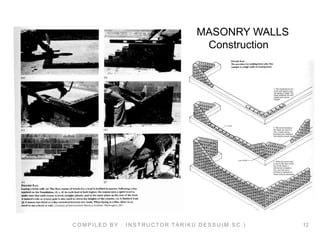
MASONRY WALLS
Construction
C O M P I L E D B Y : I N S T R U C TO R TA R I K U D E S S U ( M . S C . )
13
 General practice during stone
masonry construction:
 Stone should be hard and strong,
free from crack ,fissures, vents or
any other
 Stone should be laid in its natural
bed with proper bond and formation
of vertical joints should be avoided.
 No tensile stress should be
developed
 Masonry work should be raised
uniformly whenever possible so that
non uniform loading on the
foundation occurs
 Stone block should be
soaked in water before use
so that it does not absorb
much water from the mortar.
 Mortar should be strong and
proportion of its ingredients
should be good. Compo
mortar is used for work above
ground.
 Facing and backing stone
should be well bonded by
through stones
C O M P I L E D B Y : I N S T R U C TO R TA R I K U D E S S U ( M . S C . )
14
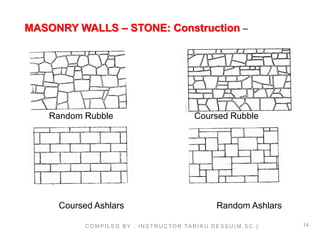
MASONRY WALLS – STONE: Construction –
Random Rubble Coursed Rubble
Coursed Ashlars Random Ashlars
C O M P I L E D B Y : I N S T R U C TO R TA R I K U D E S S U ( M . S C . )
15
MASONRY WALLS - Brick
C O M P I L E D B Y : I N S T R U C TO R TA R I K U D E S S U ( M . S C . )
16
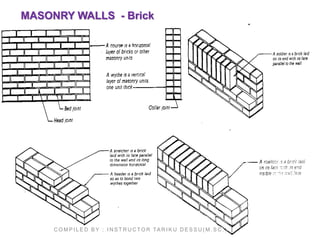
MASONRY WALLS - Brick
C O M P I L E D B Y : I N S T R U C TO R TA R I K U D E S S U ( M . S C . )
17
MASONRY WALLS - Brick Bonds
Stretcher Bond Common Bond
English Bond Flemish Bond
C O M P I L E D B Y : I N S T R U C TO R TA R I K U D E S S U ( M . S C . )
18
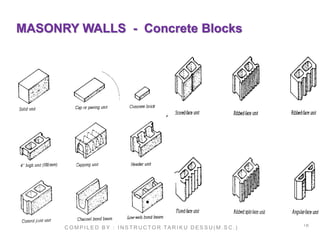
MASONRY WALLS - Concrete Blocks
C O M P I L E D B Y : I N S T R U C TO R TA R I K U D E S S U ( M . S C . )
19
Compare!
C O M P I L E D B Y : I N S T R U C TO R TA R I K U D E S S U ( M . S C . )
20
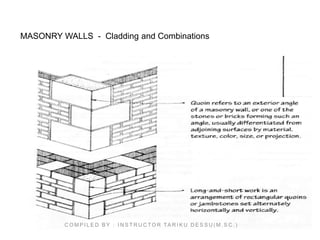
MASONRY WALLS - Cladding and Combinations
C O M P I L E D B Y : I N S T R U C TO R TA R I K U D E S S U ( M . S C . )
21
POINTING
Pointing is the racking out and filling with cement
rich mortar of masonry joints
 Water exclusion: the pointing makes the mortar
water proof exclusion: fills up air holes
 They also emphasize the pattern in which the
masonry is arranged.
C O M P I L E D B Y : I N S T R U C TO R TA R I K U D E S S U ( M . S C . )
22
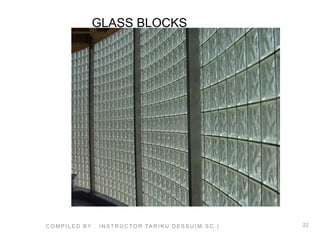
GLASS BLOCKS
C O M P I L E D B Y : I N S T R U C TO R TA R I K U D E S S U ( M . S C . )
23
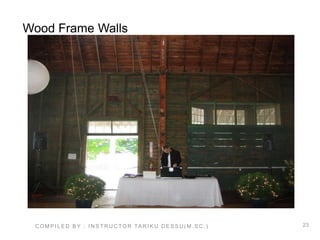
Wood Frame Walls
C O M P I L E D B Y : I N S T R U C TO R TA R I K U D E S S U ( M . S C . )
24
READ MORE
!!!
C O M P I L E D B Y : I N S T R U C TO R TA R I K U D E S S U ( M . S C . )

chapter-2, Wall System.ppt

  • 1.
    1 WALLS Construction Works C O MP I L E D B Y : I N S T R U C TO R TA R I K U D E S S U ( M . S C . )
  • 2.
    2 DEFINITION Walls are vertical/inclinedelements of a building that enclose, separate and protect its interior spaces. C O M P I L E D B Y : I N S T R U C TO R TA R I K U D E S S U ( M . S C . )
  • 3.
    3 PURPOSE • Provide requiredlevel of enclosure and define space REQUIREMENTS 1. TECHNICAL REQUIREMENTS i) Strength  Supporting roofs & their own weight,  Transfer load on it to beams,  Resist any lateral loads.  Retain earth pressure. ii) Exclude Weather iii) Insulate sound and temperature iv) Resist fire transmission C O M P I L E D B Y : I N S T R U C TO R TAR I K U D E S S U ( M . S C . )
  • 4.
    4 2. ARCHITECTURAL REQUIREMENTS Wallsare the most visible form-defining elements & thus become primary elements that define the aesthetic character of a building.  Shape & surface characteristic of walls are responsible for making visual composition.  Factors affecting appearance /visual pattern/ are: TEXTURE, COLOR, FORM & SCALE  Which in turn affects, choice of materials. C O M P I L E D B Y : I N S T R U C TO R TA R I K U D E S S U ( M . S C . )
  • 5.
    5 C O MP I L E D B Y : I N S T R U C TO R TA R I K U D E S S U ( M . S C . )
  • 6.
    6 TYPES Wall types canbe categorized on the bases of: • Location of The Wall  External walls  Internal Partition walls • Structural Requirement  Load Bearing walls  Non Load Bearing walls C O M P I L E D B Y : I N S T R U C TO R TA R I K U D E S S U ( M . S C . )
  • 7.
    7 Types of wallsbased on: • Material Used  Wood  Brick  Stone  Concrete Blocks  Concrete  Glass  Metal …etc. • Material Composition  Block Walls  Monolithic C O M P I L E D B Y : I N S T R U C TO R TA R I K U D E S S U ( M . S C . )
  • 8.
    8  Can bestructural or non structural  Economical when identical  Advantages  Better quality control of concrete elements  Elements can be cast and erected in all weather conditions,  Fast construction time Types of precast concrete panels- 1-under sill cladding panels 2-storey high or more non structural cladding panels 3-structural cladding panels 4-permanent shuttering-i.e.. cladding units used as permanent formwork to in-situ concrete. CONCRETE WALLS - Precast Concrete C O M P I L E D B Y : I N S T R U C TO R TA R I K U D E S S U ( M . S C . )
  • 9.
    9 MASONRY WALLS Masonry isthe term used to refer construction using pieces of construction materials made in to blocks and stacked together using different binding mechanisms. MORTAR Used to bind masonry units together. In the early days masonry was just piled up one on top of the other to create rubble wall. Later binding materials such as mud, lime and recently cement mortar started to be used. Cement mortar for masonry is made of Portland cement, hydrated lime, sand and water. C O M P I L E D B Y : I N S T R U C TO R TA R I K U D E S S U ( M . S C . )
  • 10.
    10  The advantagesof using mortar are:  Water exclusion: the mortar blocks passage of water through masonry walls  Wind exclusion  Cushions the masonry units, to stand stable  They also emphasize the pattern in which the masonry is arranged. C O M P I L E D B Y : I N S T R U C TO R TA R I K U D E S S U ( M . S C . )
  • 11.
    11 MASONRY WALLS  Strongin compressive strength and weak in tension loads because of the weak points at the joints between blocks.  It is labor intensive and time taking,  Economical  It can be shaped in to different forms fairly easily.  Mostly have naturally rich color and texture  Most masonry materials are also durable C O M P I L E D B Y : I N S T R U C TO R TA R I K U D E S S U ( M . S C . )
  • 12.
    12 MASONRY WALLS Construction C OM P I L E D B Y : I N S T R U C TO R TA R I K U D E S S U ( M . S C . )
  • 13.
    13  General practiceduring stone masonry construction:  Stone should be hard and strong, free from crack ,fissures, vents or any other  Stone should be laid in its natural bed with proper bond and formation of vertical joints should be avoided.  No tensile stress should be developed  Masonry work should be raised uniformly whenever possible so that non uniform loading on the foundation occurs  Stone block should be soaked in water before use so that it does not absorb much water from the mortar.  Mortar should be strong and proportion of its ingredients should be good. Compo mortar is used for work above ground.  Facing and backing stone should be well bonded by through stones C O M P I L E D B Y : I N S T R U C TO R TA R I K U D E S S U ( M . S C . )
  • 14.
    14 MASONRY WALLS –STONE: Construction – Random Rubble Coursed Rubble Coursed Ashlars Random Ashlars C O M P I L E D B Y : I N S T R U C TO R TA R I K U D E S S U ( M . S C . )
  • 15.
    15 MASONRY WALLS -Brick C O M P I L E D B Y : I N S T R U C TO R TA R I K U D E S S U ( M . S C . )
  • 16.
    16 MASONRY WALLS -Brick C O M P I L E D B Y : I N S T R U C TO R TA R I K U D E S S U ( M . S C . )
  • 17.
    17 MASONRY WALLS -Brick Bonds Stretcher Bond Common Bond English Bond Flemish Bond C O M P I L E D B Y : I N S T R U C TO R TA R I K U D E S S U ( M . S C . )
  • 18.
    18 MASONRY WALLS -Concrete Blocks C O M P I L E D B Y : I N S T R U C TO R TA R I K U D E S S U ( M . S C . )
  • 19.
    19 Compare! C O MP I L E D B Y : I N S T R U C TO R TA R I K U D E S S U ( M . S C . )
  • 20.
    20 MASONRY WALLS -Cladding and Combinations C O M P I L E D B Y : I N S T R U C TO R TA R I K U D E S S U ( M . S C . )
  • 21.
    21 POINTING Pointing is theracking out and filling with cement rich mortar of masonry joints  Water exclusion: the pointing makes the mortar water proof exclusion: fills up air holes  They also emphasize the pattern in which the masonry is arranged. C O M P I L E D B Y : I N S T R U C TO R TA R I K U D E S S U ( M . S C . )
  • 22.
    22 GLASS BLOCKS C OM P I L E D B Y : I N S T R U C TO R TA R I K U D E S S U ( M . S C . )
  • 23.
    23 Wood Frame Walls CO M P I L E D B Y : I N S T R U C TO R TA R I K U D E S S U ( M . S C . )
  • 24.
    24 READ MORE !!! C OM P I L E D B Y : I N S T R U C TO R TA R I K U D E S S U ( M . S C . )