Math and Dosage Calculations for Health Care   Third Edition Booth & Whaley McGraw-Hill 11- Chapter 11: Special Populations Edited by B. Holmes MSN/Ed, RN
Learning Outcomes 11.1 Explain why dosages for special  populations must be based on the individual patient. 11.2 Identify factors that affect the  absorption, distribution, biotransformation, and elimination of   drugs in special populations. McGraw-Hill 11-
Learning Outcomes  (cont.) 11.3 Determine safe doses for special    populations. 11.4 Calculate patient dosages based   on body weight.  11.5 Find a patient’s body surface area   (BSA). McGraw-Hill 11-
Learning Outcomes  (cont.) 11.6 Describe volume and medication    limitations for special populations. 11.7 Calculate infusion rates based   upon body weight. McGraw-Hill 11-
Introduction Two populations requiring extra consideration when calculating medication dosages Pediatric  (less than 18 years old) Geriatric  (over 65 years old) Risk of harm is far greater due to the way they break down and absorb medications. McGraw-Hill 11-
Introduction  (cont.) Clarify all confusing drug orders Calculate with absolute accuracy Verify that dose is safe Seek assistance from your supervisor McGraw-Hill 11- Do not take short cuts with medication calculations.
Factors That Impact Dosing Standardized doses based on assumptions The patient’s body and age Body systems are fully developed and functioning Assumptions do not hold true for all populations or situations McGraw-Hill 11-
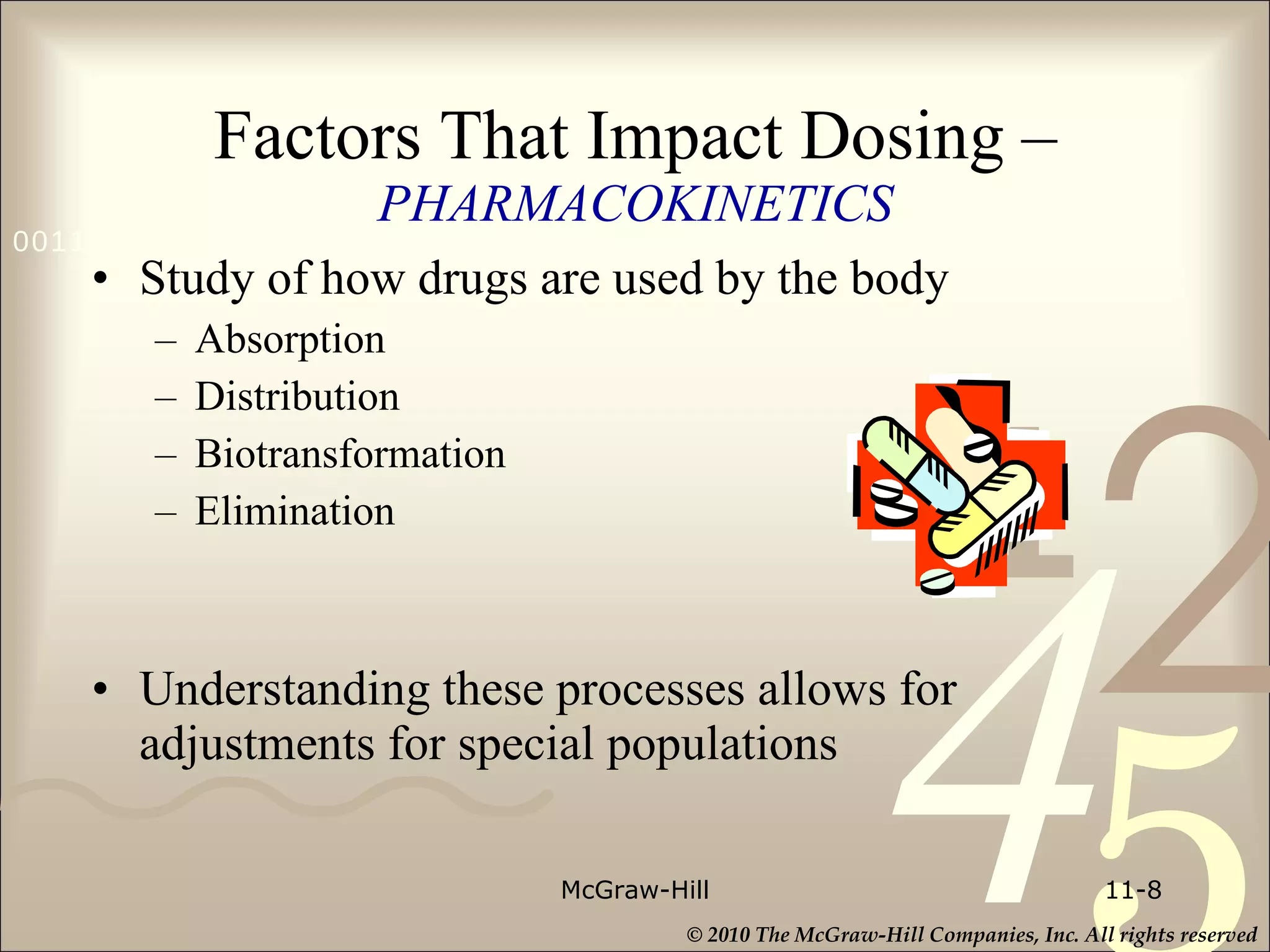
Factors That Impact Dosing –   PHARMACOKINETICS Study of how drugs are used by the body Absorption Distribution Biotransformation Elimination Understanding these processes allows for adjustments for special populations McGraw-Hill 11-
Factors That Impact Dosing –  PHARMACOKINETICS  (cont.) Absorption   Process that moves a drug from the site where it is given into the bloodstream IV medications bypass the absorption process  Oral medications – digestive system Topical – through the skin McGraw-Hill 11-
Factors That Impact Dosing –   PHARMACOKINETICS  (cont.) Distribution Process that moves the drug from the bloodstream to other body compartments  Target site – where the drug produces its desired effect McGraw-Hill 11-
Factors That Impact Dosing –   PHARMACOKINETICS  (cont.) Biotransformation Process that chemically changes the drug in the body Occurs primarily in the liver Helps to protect the  body from foreign  chemicals including drugs McGraw-Hill 11-
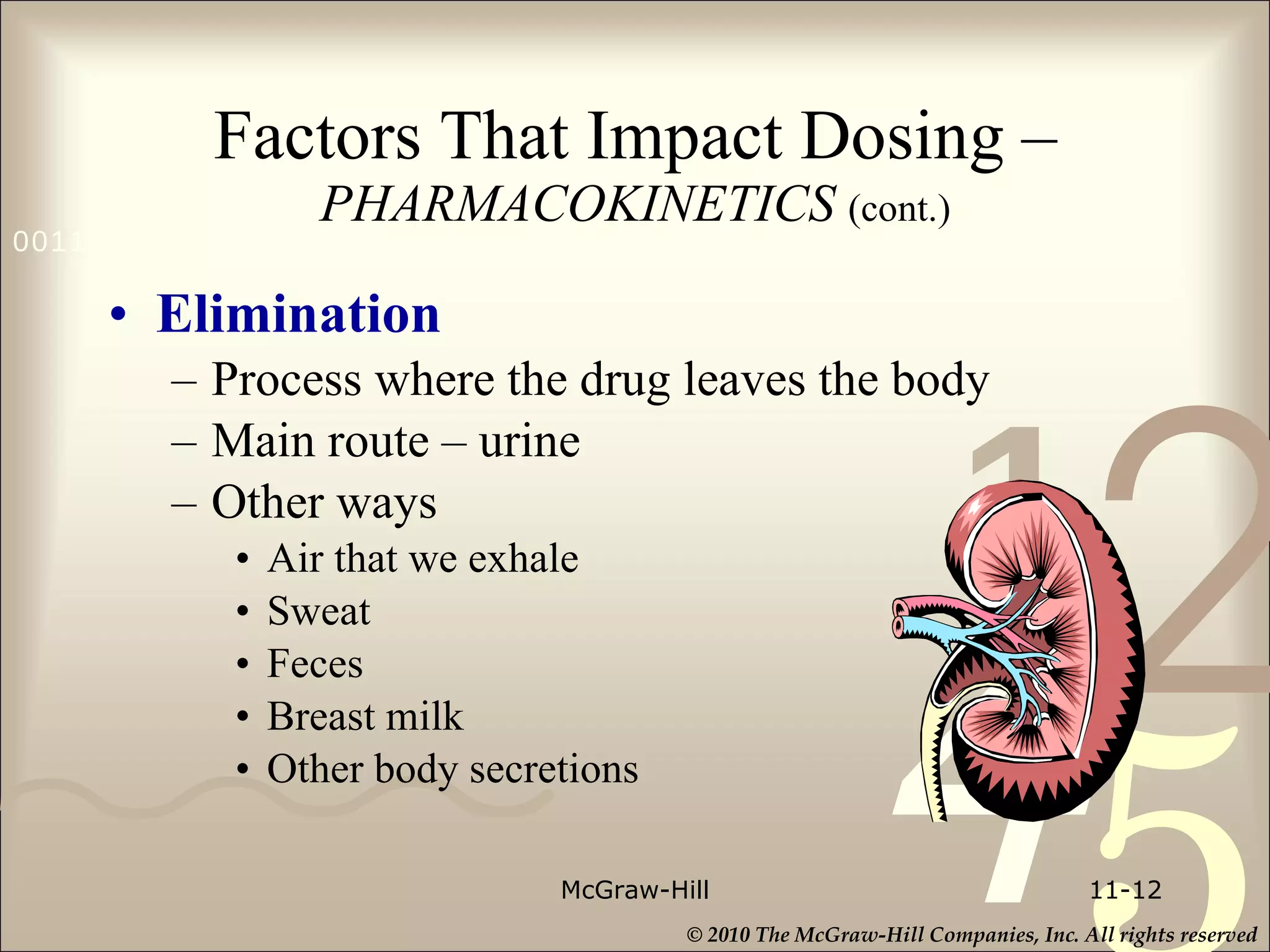
Factors That Impact Dosing –   PHARMACOKINETICS  (cont.) Elimination Process where the drug leaves the body Main route – urine Other ways  Air that we exhale Sweat Feces Breast milk Other body secretions McGraw-Hill 11-
Factors That Impact Dosing –   PHARMACOKINETICS  (cont.) Adjust dose If one of the four processes are not functioning within certain limits Made according to nature and severity of patient’s condition May by higher or lower than standard doses McGraw-Hill 11-
Factors That Impact Dosing  (cont.) Conditions that impact dosing Stomach or intestinal disorders Liver disorders Obesity Kidney disease Functions of body systems change over the life of a person. McGraw-Hill 11-
Factors That Impact Dosing  (cont.) Newborns – systems not fully developed  pH of stomach is lower Thinner skin Liver still developing Less circulation to muscles Geriatrics – systems deteriorate Skin and veins become fragile Decreased liver function Decreased kidney function Poor circulation McGraw-Hill 11-
Working with Special Populations Other Considerations Parent or caretaker may be administering or assisting with medications. Educate regarding medications Geriatric patients may have decreased awareness or understanding. McGraw-Hill 11-
Working with Special Populations –  GERIATRIC PATIENTS Show respect  Listen to their concerns Encourage them to Use the same pharmacy to fill all prescriptions Have one primary care physician to monitor and approve all medications  Keep a list of all medications McGraw-Hill 11-
Special Populations –   GERIATRIC PATIENTS  (cont.) Decreased dexterity  Injections Eye drops Open bottles Difficulty swallowing Drugs that cannot be crushed Foods that can be mixed with drugs McGraw-Hill 11-
Special Populations –   GERIATRIC PATIENTS  (cont.) Hearing loss Do they understand instructions? Have them repeat information back to you Difficulty reading small print Labeling Tablet colors McGraw-Hill 11-
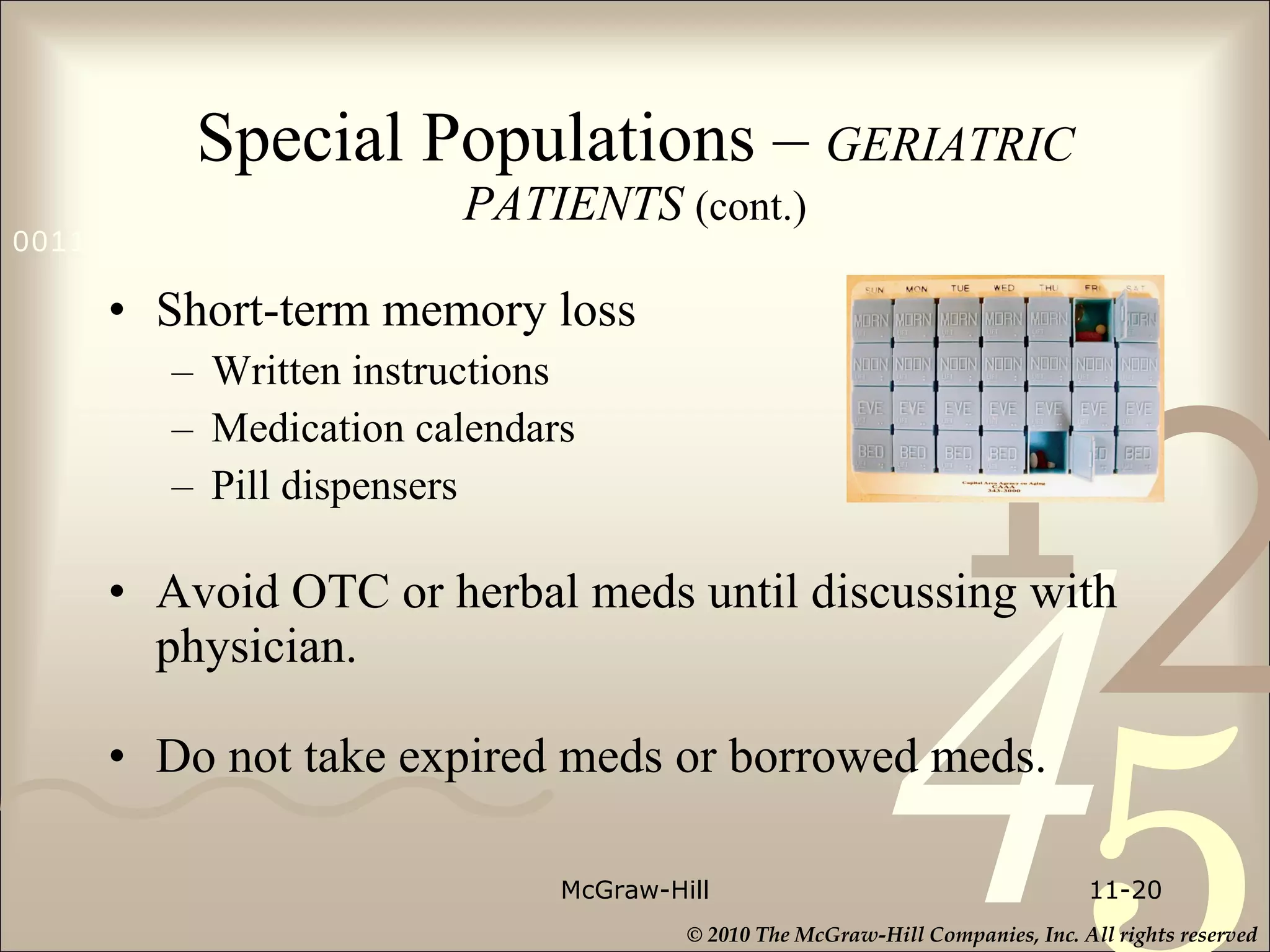
Special Populations –   GERIATRIC PATIENTS  (cont.) Short-term memory loss Written instructions Medication calendars Pill dispensers  Avoid OTC or herbal meds until discussing with physician. Do not take expired meds or borrowed meds.  McGraw-Hill 11-
Teaching Patients About Medications 1. Name of the medication 2. Purpose 3. How to store it 4. How long to take the medication 5. How and when to take it  6. How to know if it is effective McGraw-Hill 11-
Teaching Patients About Medications   (cont.) 7.  Required follow-up tests, doctor  appointments 8.  Possible side effects and what to do 9.  Interactions with other drugs and foods 10. Symptoms to report to the doctor 11. What to do if a dose is missed 12. Keeping a list of all medications McGraw-Hill 11-
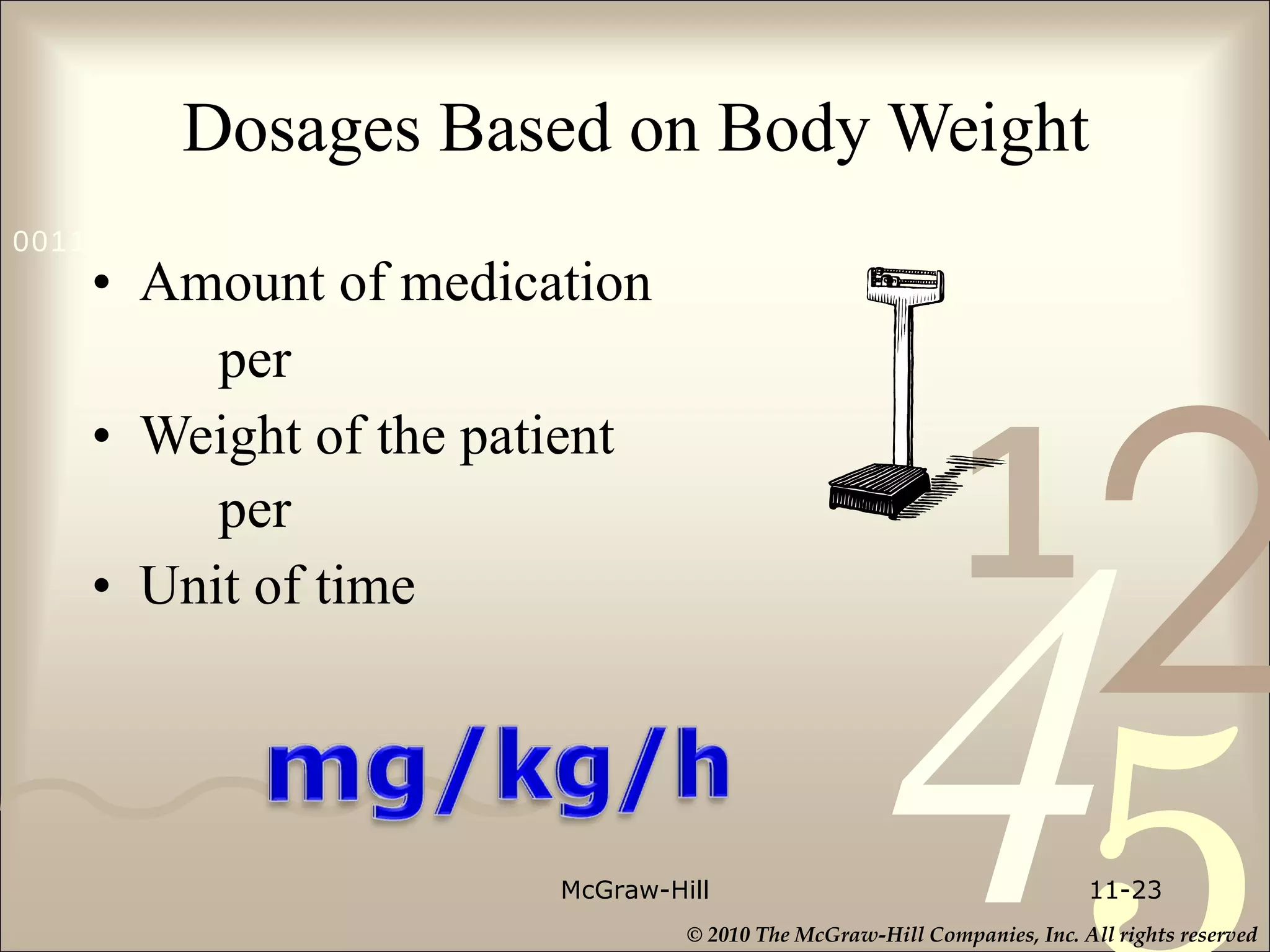
Dosages Based on Body Weight Amount of medication  per Weight of the patient  per   Unit of time McGraw-Hill 11-
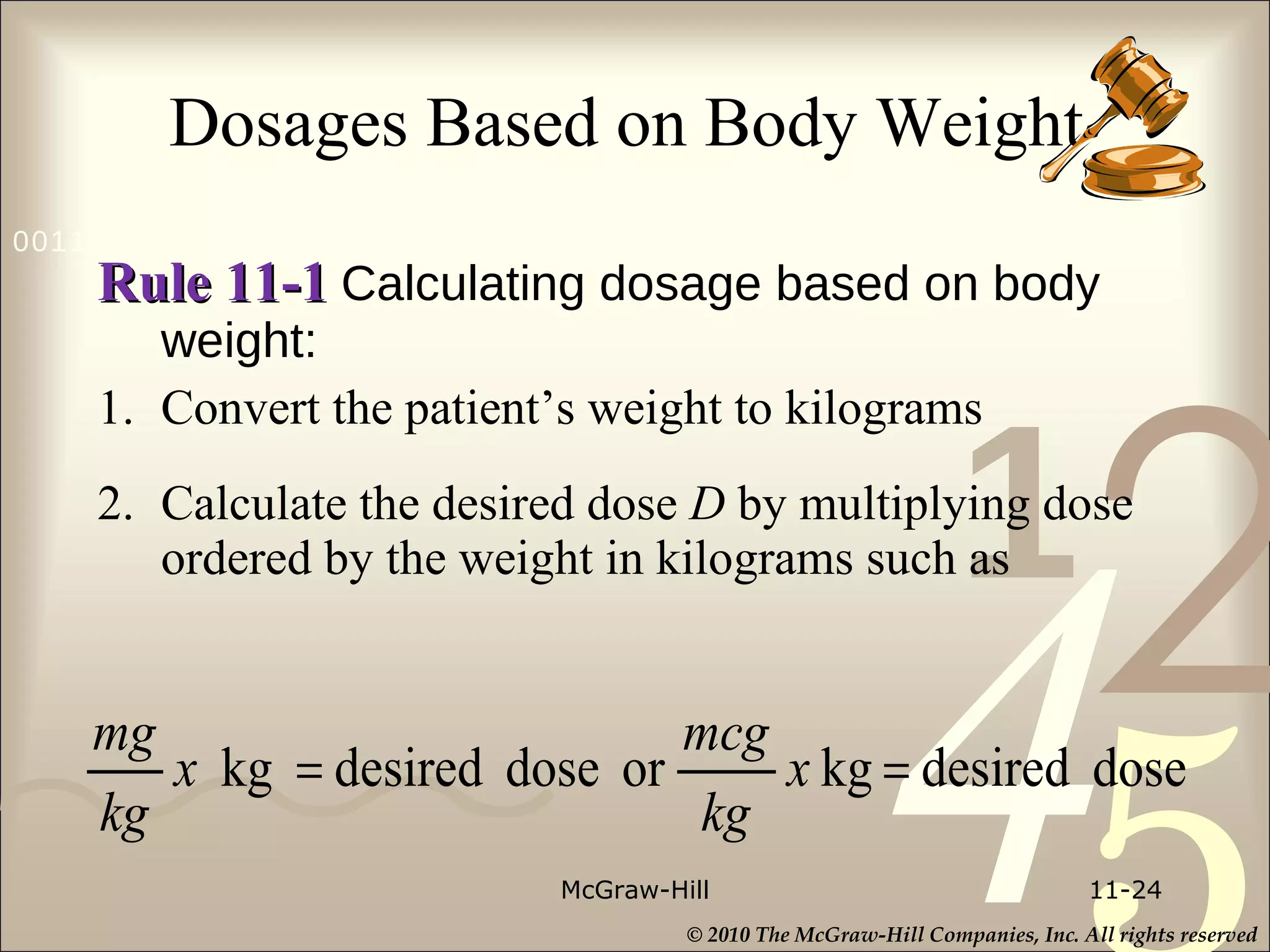
Dosages Based on Body Weight Rule 11-1   Calculating dosage based on body weight: 1. Convert the patient’s weight to kilograms 2. Calculate the desired dose  D  by multiplying dose ordered by the weight in kilograms such as McGraw-Hill 11-
Dosages Based on Body Weight   (cont.) Rule 11-1   (cont.) 3. Confirm whether or not the desired dose is safe by checking the label, package insert, or product literature.  4. Calculate the amount to administer, using fraction proportion, ratio proportion, dimensional analysis, or the formula method. McGraw-Hill 11-
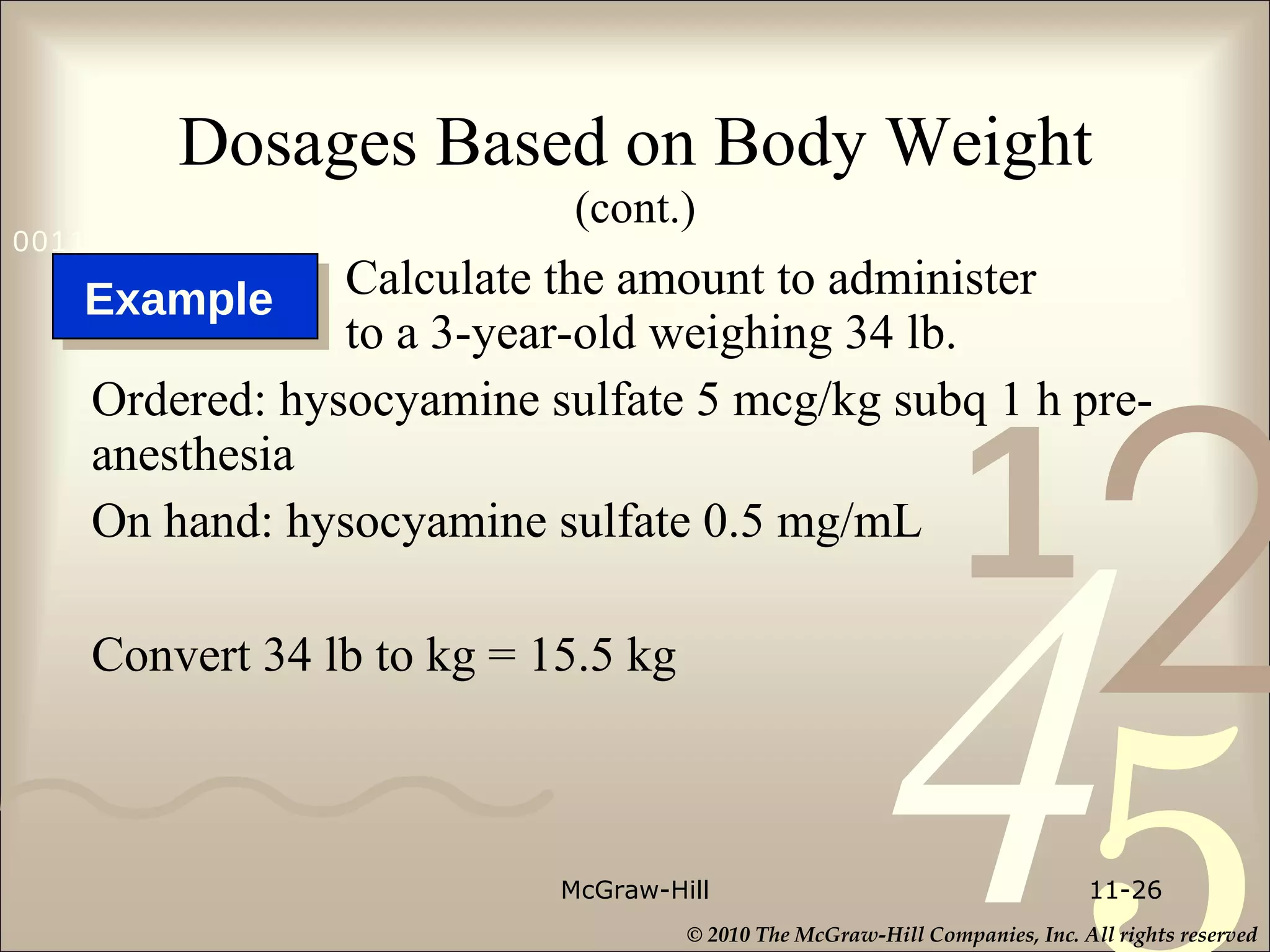
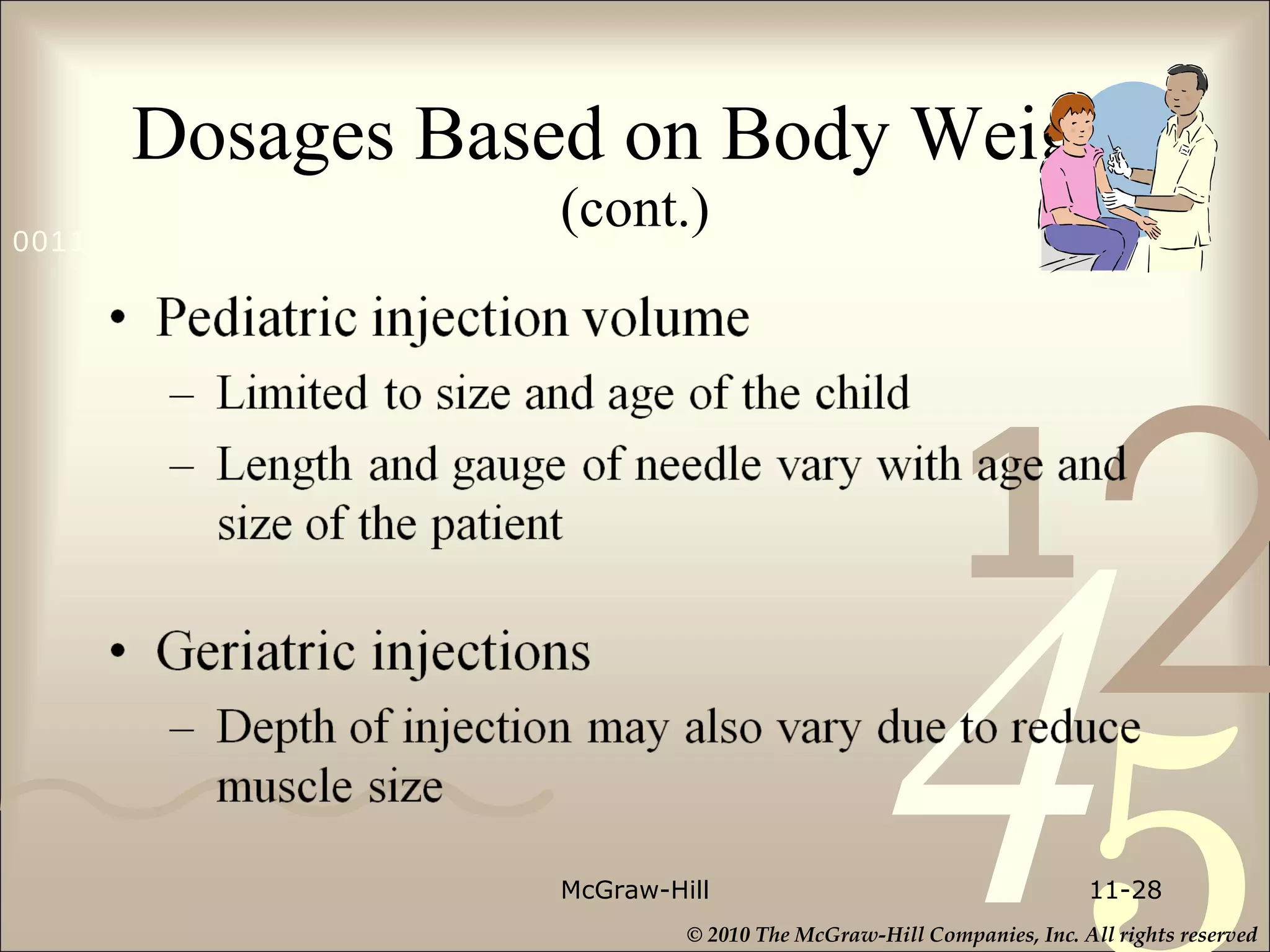
Dosages Based on Body Weight   (cont.) Calculate the amount to administer to a 3-year-old weighing 34 lb.  Ordered: hysocyamine sulfate 5 mcg/kg subq 1 h pre-anesthesia On hand: hysocyamine sulfate 0.5 mg/mL Convert 34 lb to kg = 15.5 kg McGraw-Hill 11- Example
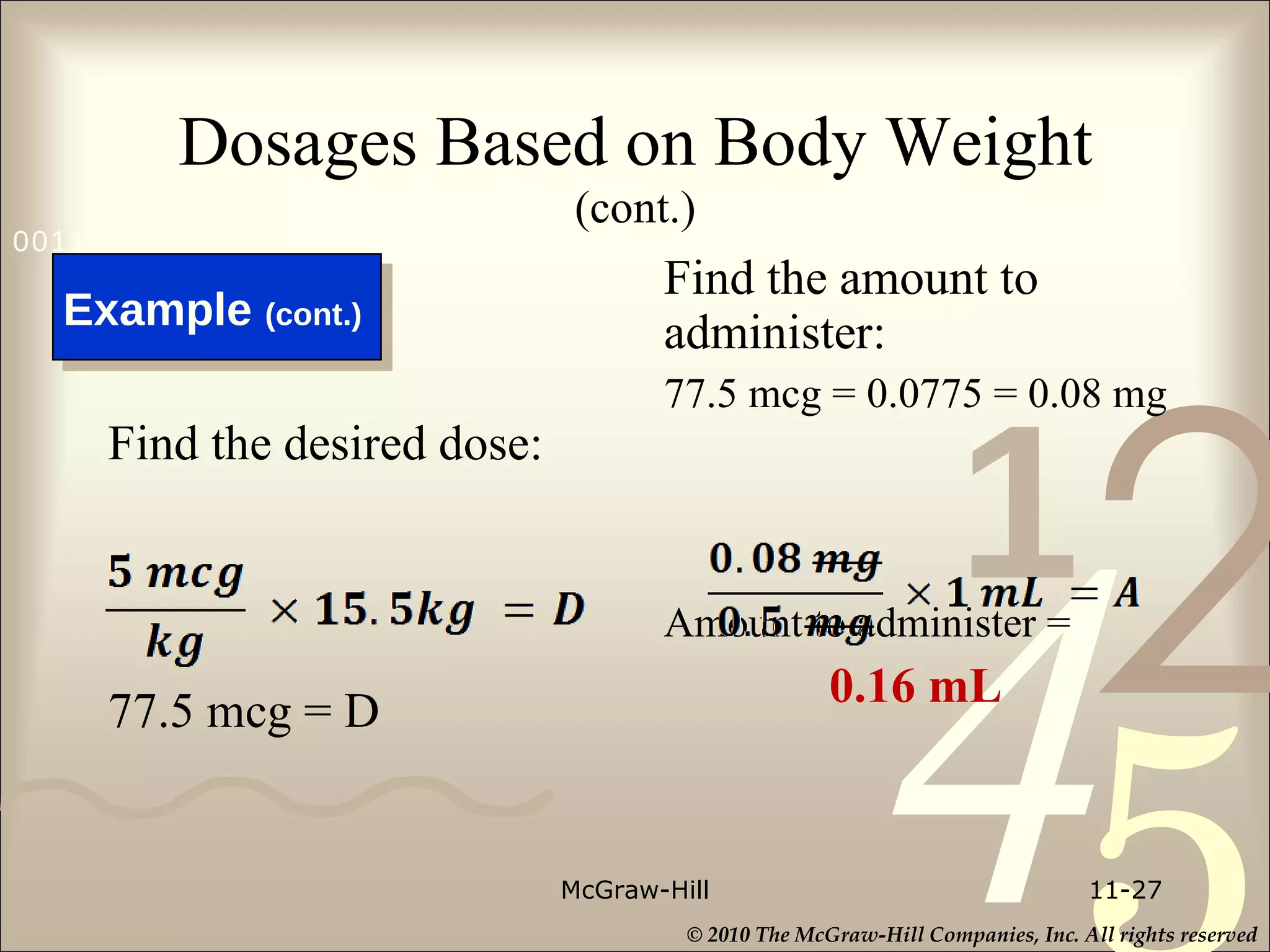
Dosages Based on Body Weight   (cont.) Find the desired dose: 77.5 mcg = D Find the amount to administer: 77.5 mcg = 0.0775 = 0.08 mg Amount to administer = 0.16 mL McGraw-Hill 11- Example  (cont.)
Dosages Based on Body Weight  (cont.) McGraw-Hill 11-
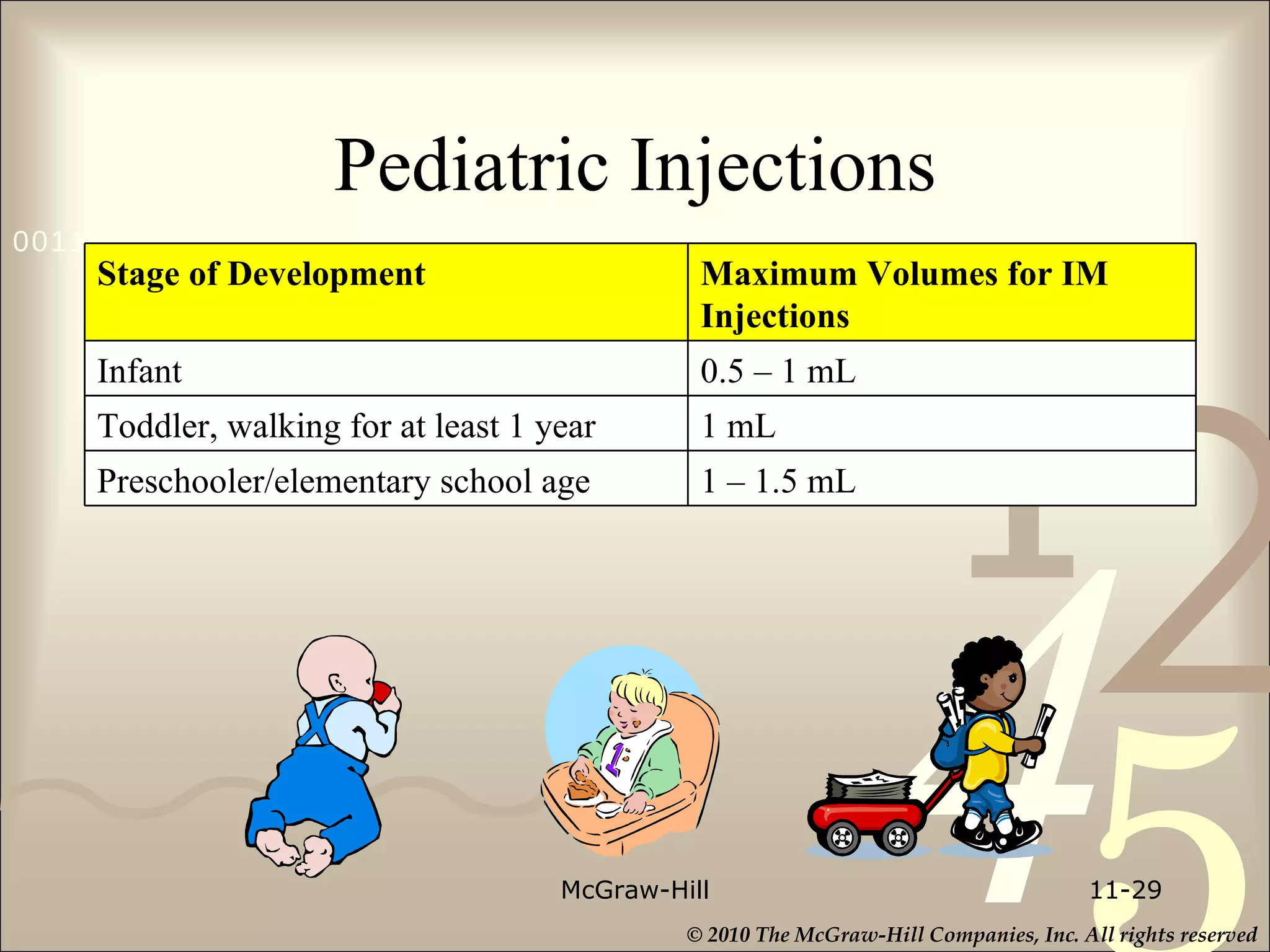
Pediatric Injections McGraw-Hill 11- Stage of Development Maximum Volumes for IM Injections Infant 0.5 – 1 mL Toddler, walking for at least 1 year 1 mL Preschooler/elementary school age 1 – 1.5 mL
Ensuring Safe Dosages McGraw-Hill 11-
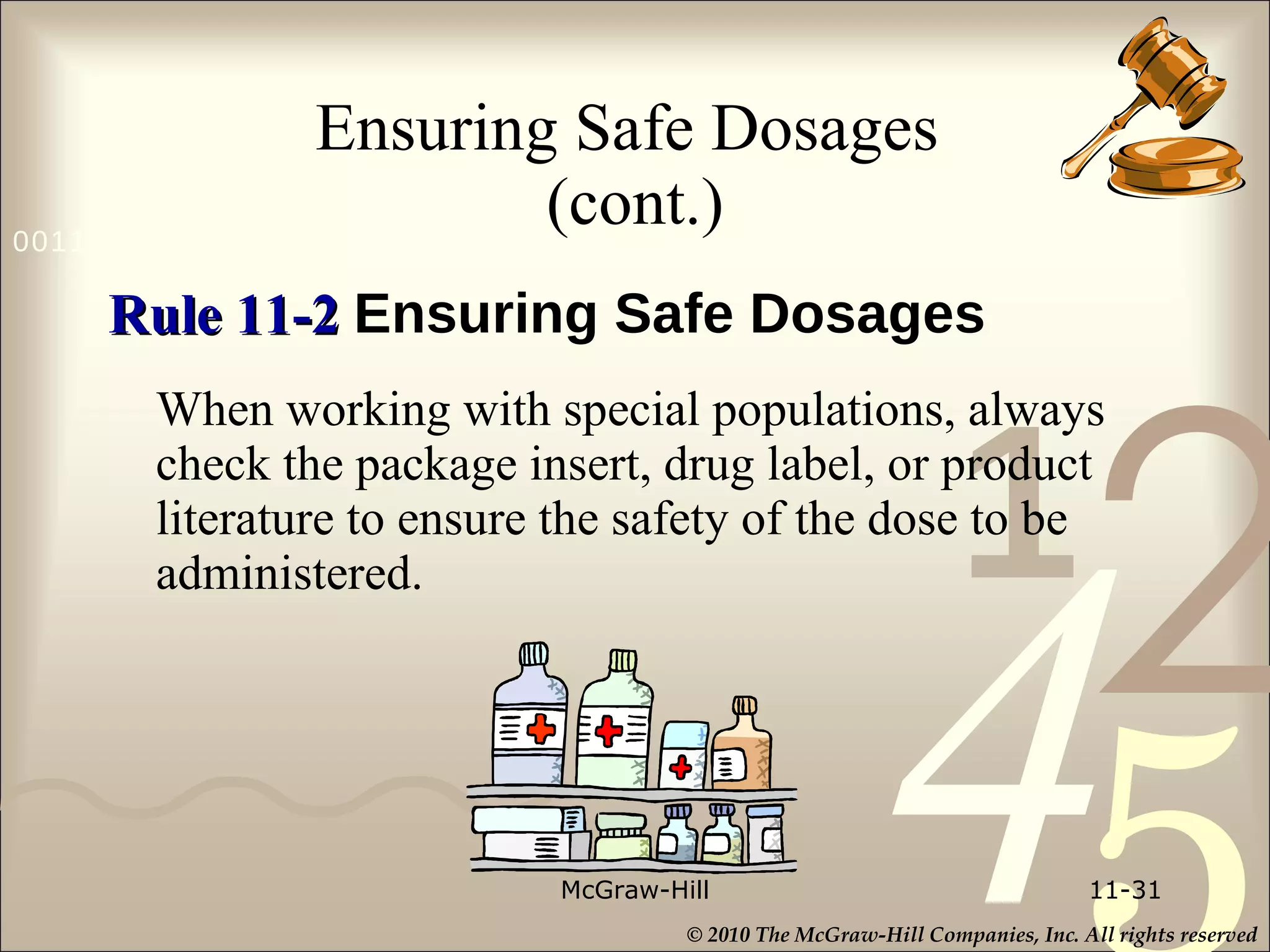
Ensuring Safe Dosages  (cont.) Rule 11-2   Ensuring Safe Dosages When working with special populations, always check the package insert, drug label, or product literature to ensure the safety of the dose to be administered. McGraw-Hill 11-
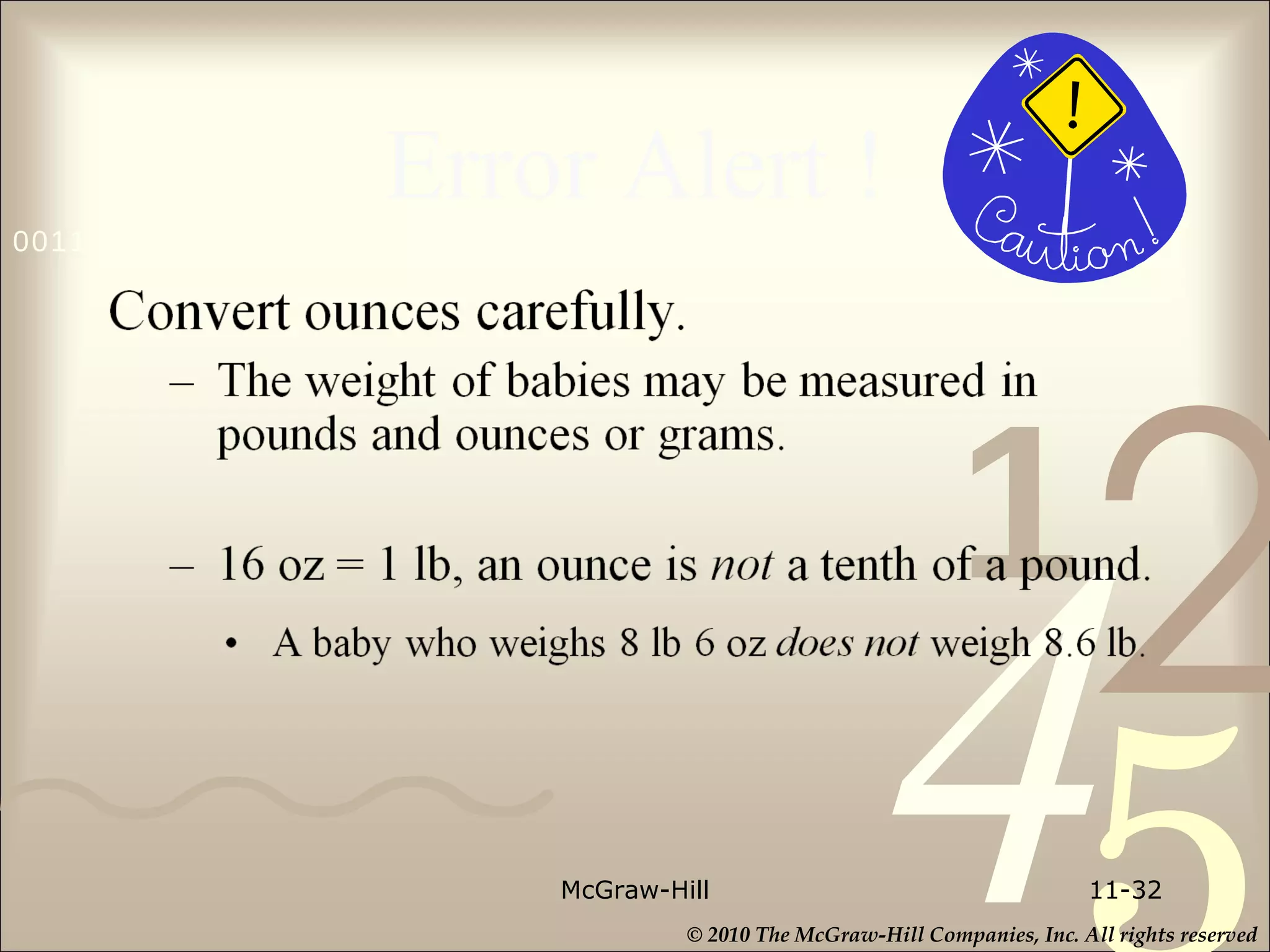
Error Alert ! McGraw-Hill 11-
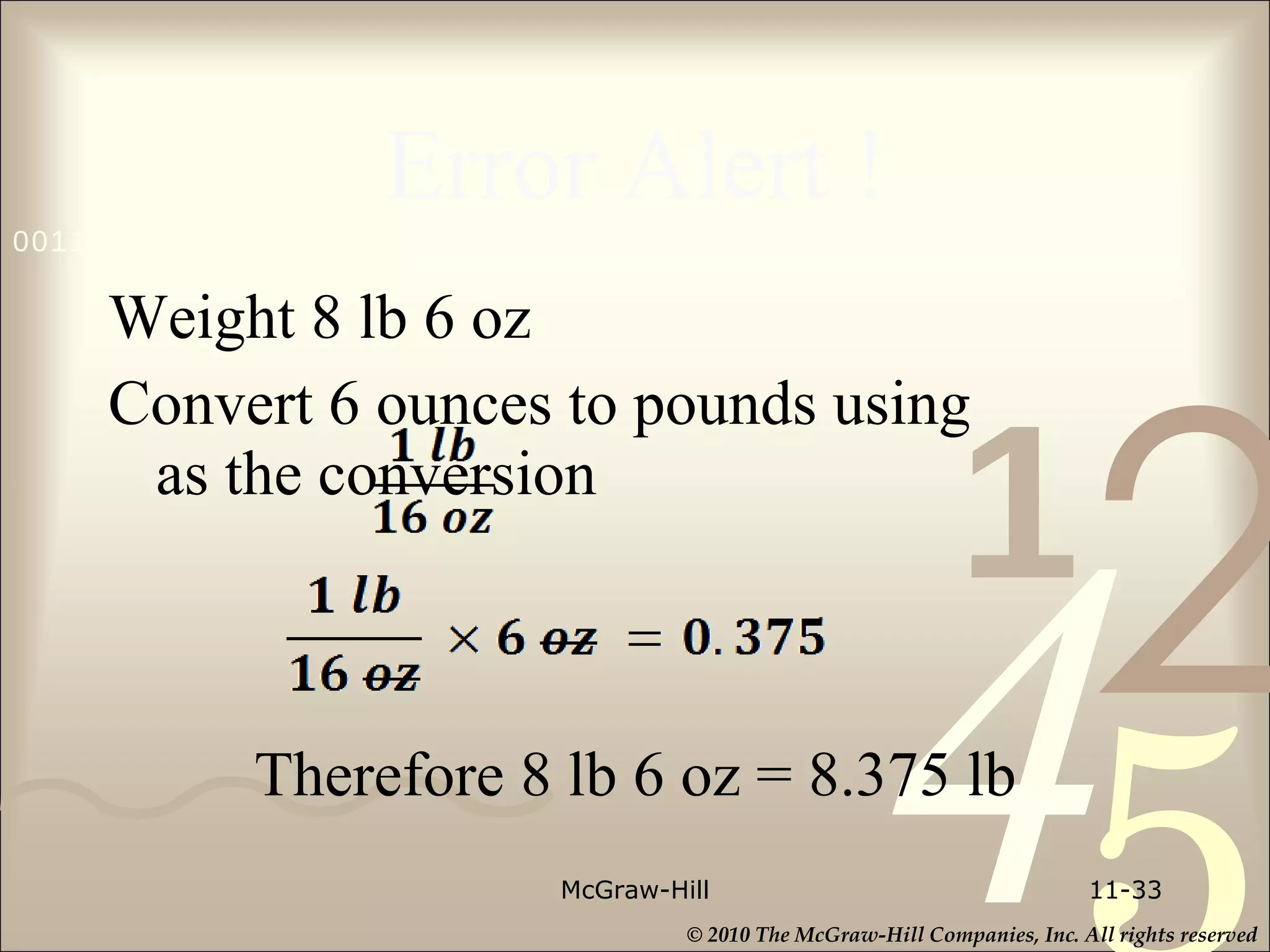
Error Alert ! Weight 8 lb 6 oz  Convert 6 ounces to pounds using    as the conversion Therefore 8 lb 6 oz = 8.375 lb McGraw-Hill 11-
Practice Determine whether the following order is safe. If safe, calculate the amount to administer. McGraw-Hill 11- Patient: Child who weighs 14.5 kg Ordered: Amoxil 75 mg PO q8h On hand: Usual child dose 20-40 mg/kg day q8h Answer  Dosage doesn’t fall within recommended dosage range; contact the physician.
Daily Maintenance Fluid Needs (DMFN) McGraw-Hill 11-
Daily Maintenance Fluid Needs (DMFN) (cont.) McGraw-Hill 11-
Daily Maintenance Fluid Needs (DMFN)   (cont.) McGraw-Hill 11-
Daily Maintenance Fluid Needs (DMFN)   (cont.) Amount of maintenance fluid required varies by weight Replacement fluids Based on patient’s condition Vomiting Diarrhea Fever  McGraw-Hill 11-
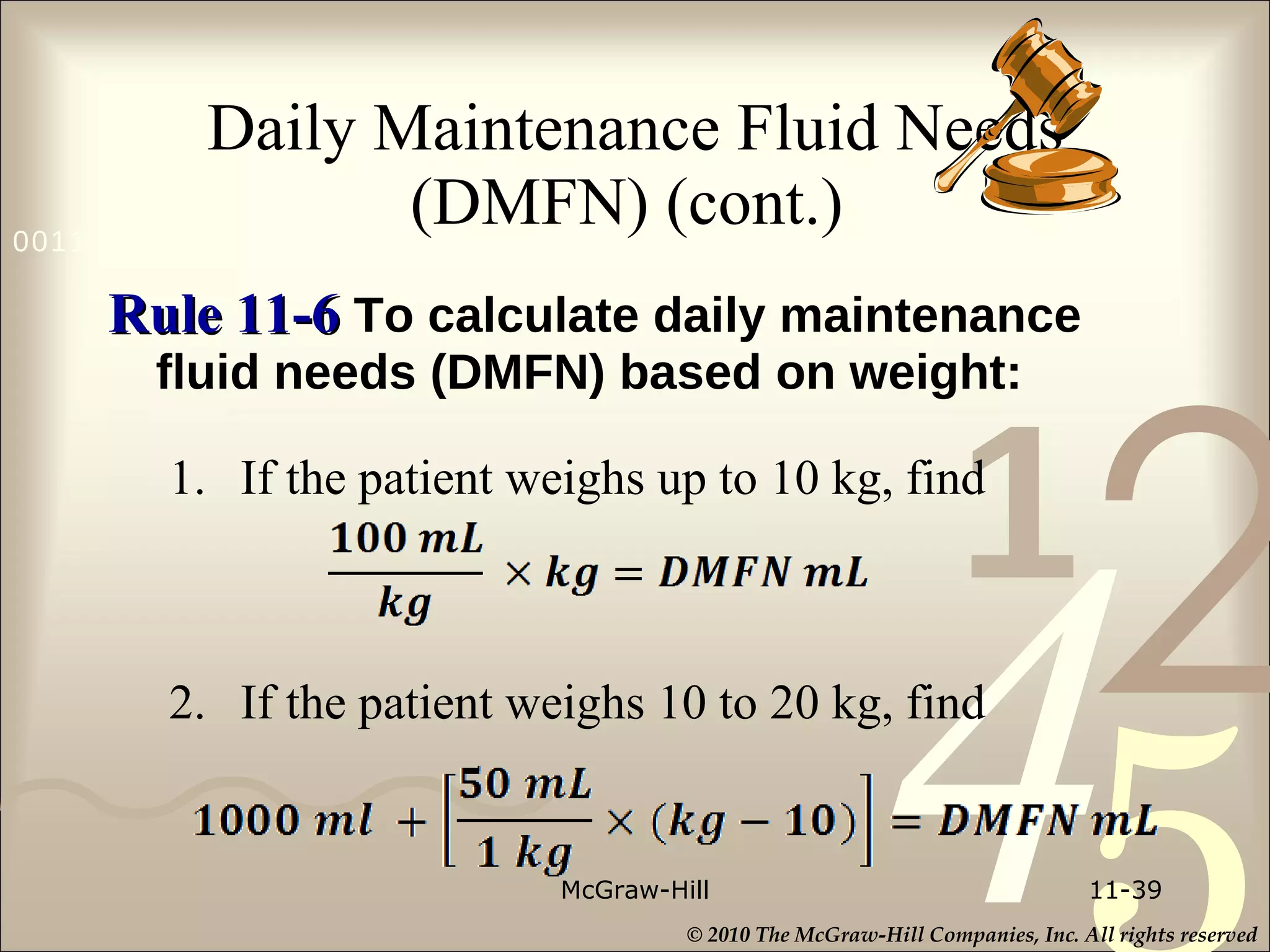
Daily Maintenance Fluid Needs (DMFN) (cont.)  Rule 11-6  To calculate daily maintenance fluid needs (DMFN) based on weight: 1. If the patient weighs up to 10 kg, find 2. If the patient weighs 10 to 20 kg, find McGraw-Hill 11-
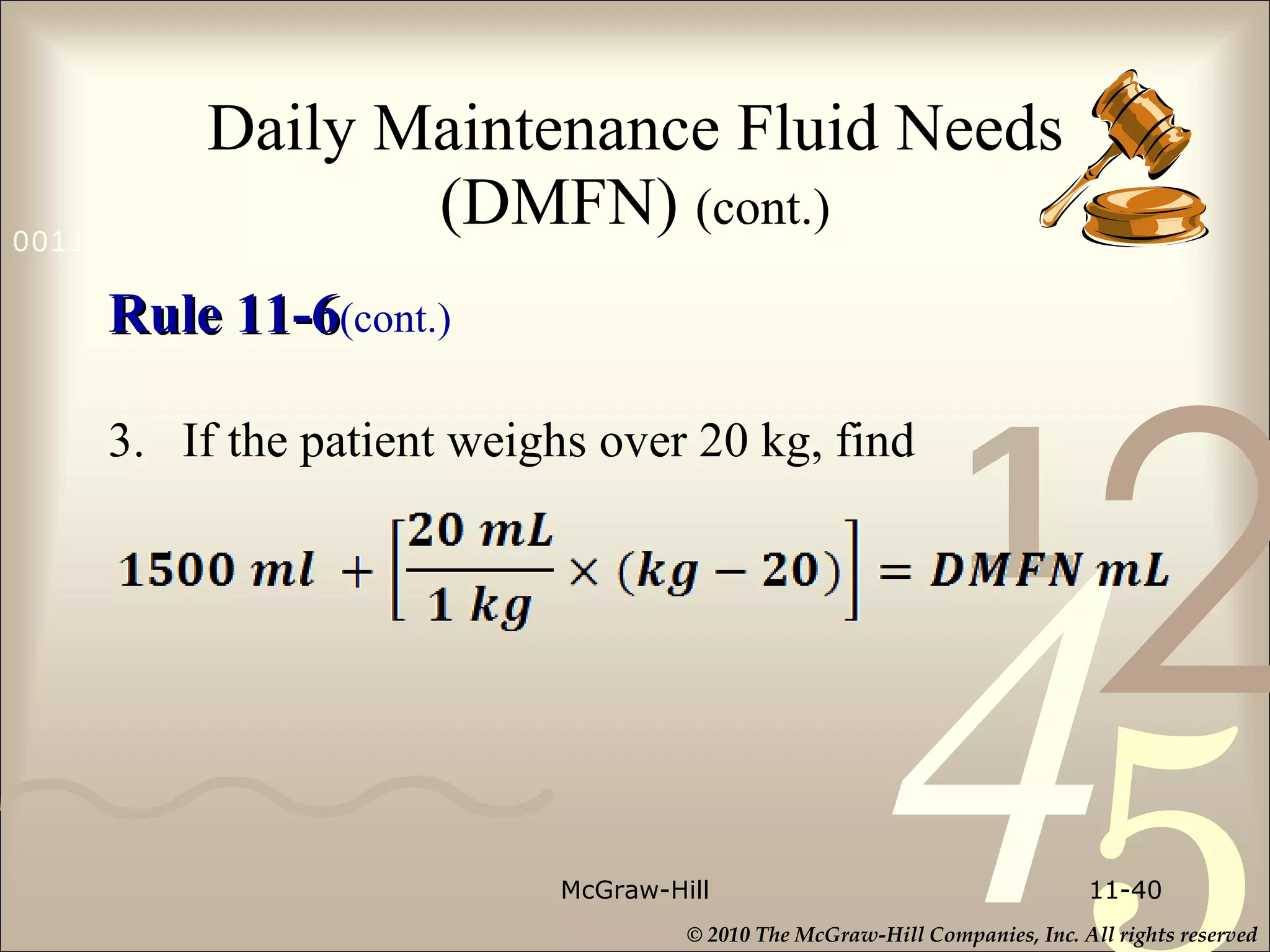
Daily Maintenance Fluid Needs (DMFN)  (cont.) Rule 11-6 (cont.) 3. If the patient weighs over 20 kg, find McGraw-Hill 11-
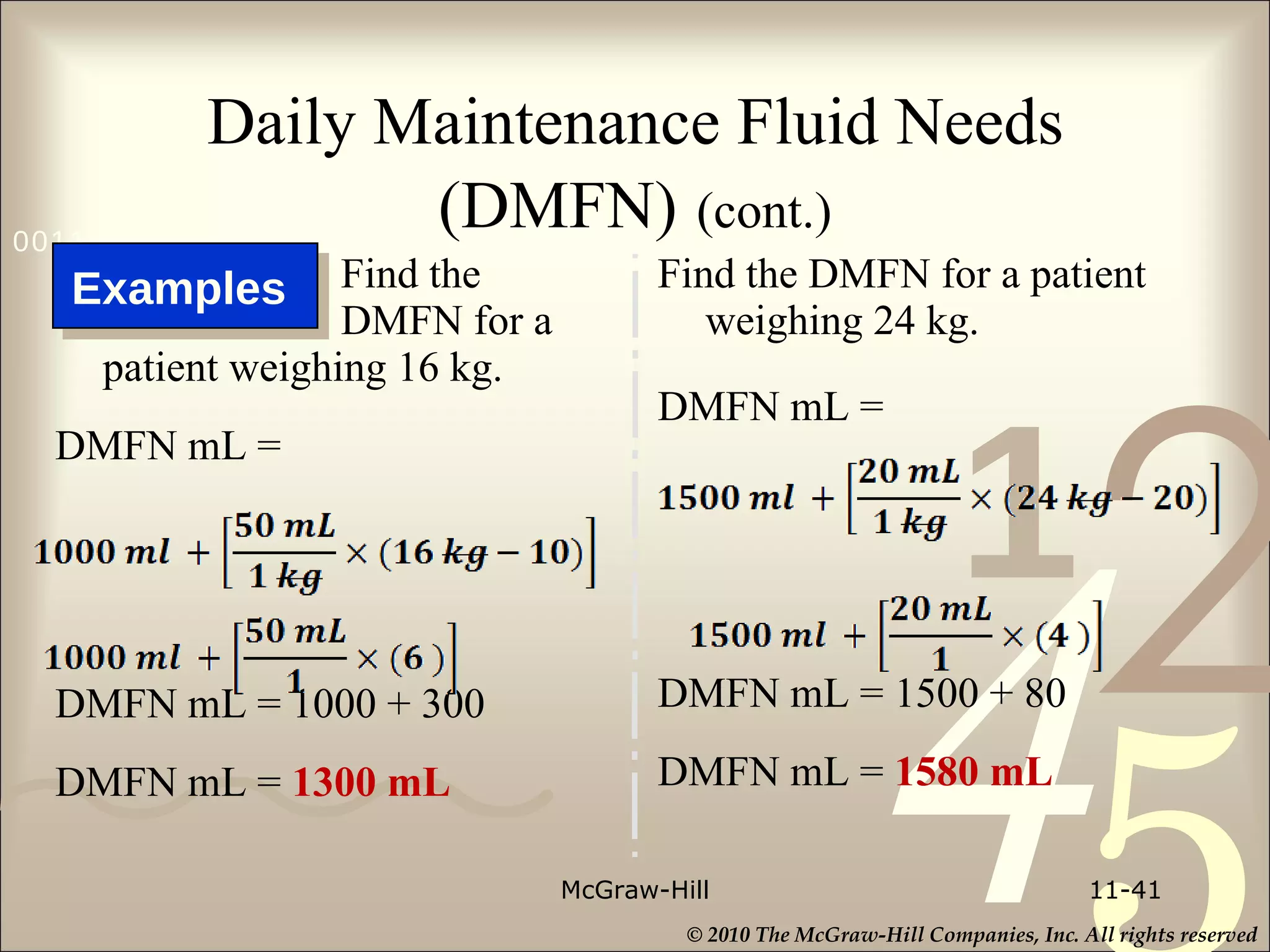
Daily Maintenance Fluid Needs (DMFN)   (cont.)   Find the    DMFN for a patient weighing 16 kg. DMFN mL = DMFN mL = 1000 + 300 DMFN mL =  1300 mL  Find the DMFN for a patient weighing 24 kg. DMFN mL =  DMFN mL = 1500 + 80  DMFN mL =  1580 mL McGraw-Hill 11- Examples
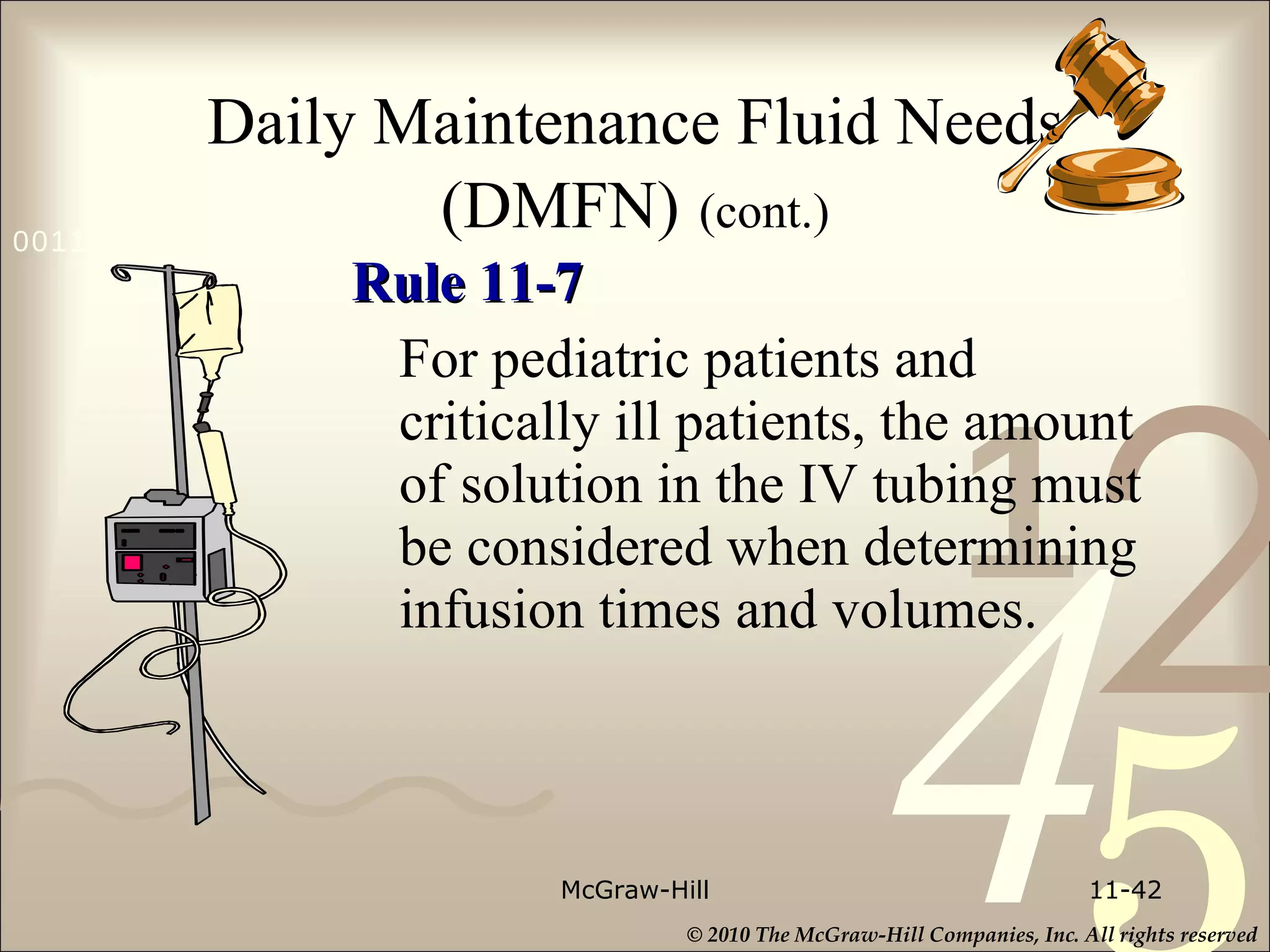
Daily Maintenance Fluid Needs (DMFN)   (cont.) Rule 11-7 For pediatric patients and critically ill patients, the amount of solution in the IV tubing must be considered when determining infusion times and volumes. McGraw-Hill 11-
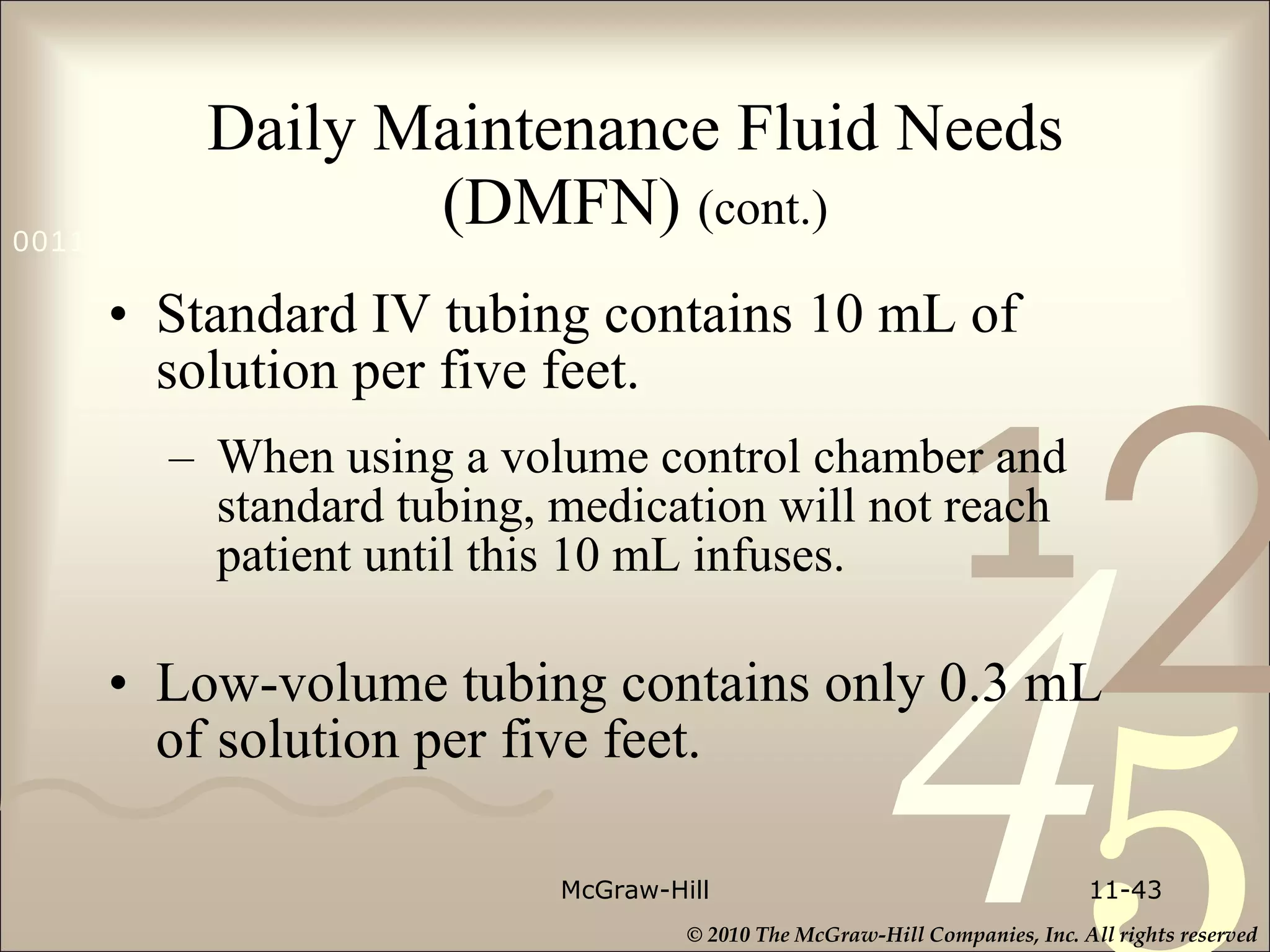
Daily Maintenance Fluid Needs (DMFN)  (cont.) Standard IV tubing contains 10 mL of solution per five feet. When using a volume control chamber and standard tubing, medication will not reach patient until this 10 mL infuses. Low-volume tubing contains only 0.3 mL of solution per five feet. McGraw-Hill 11-
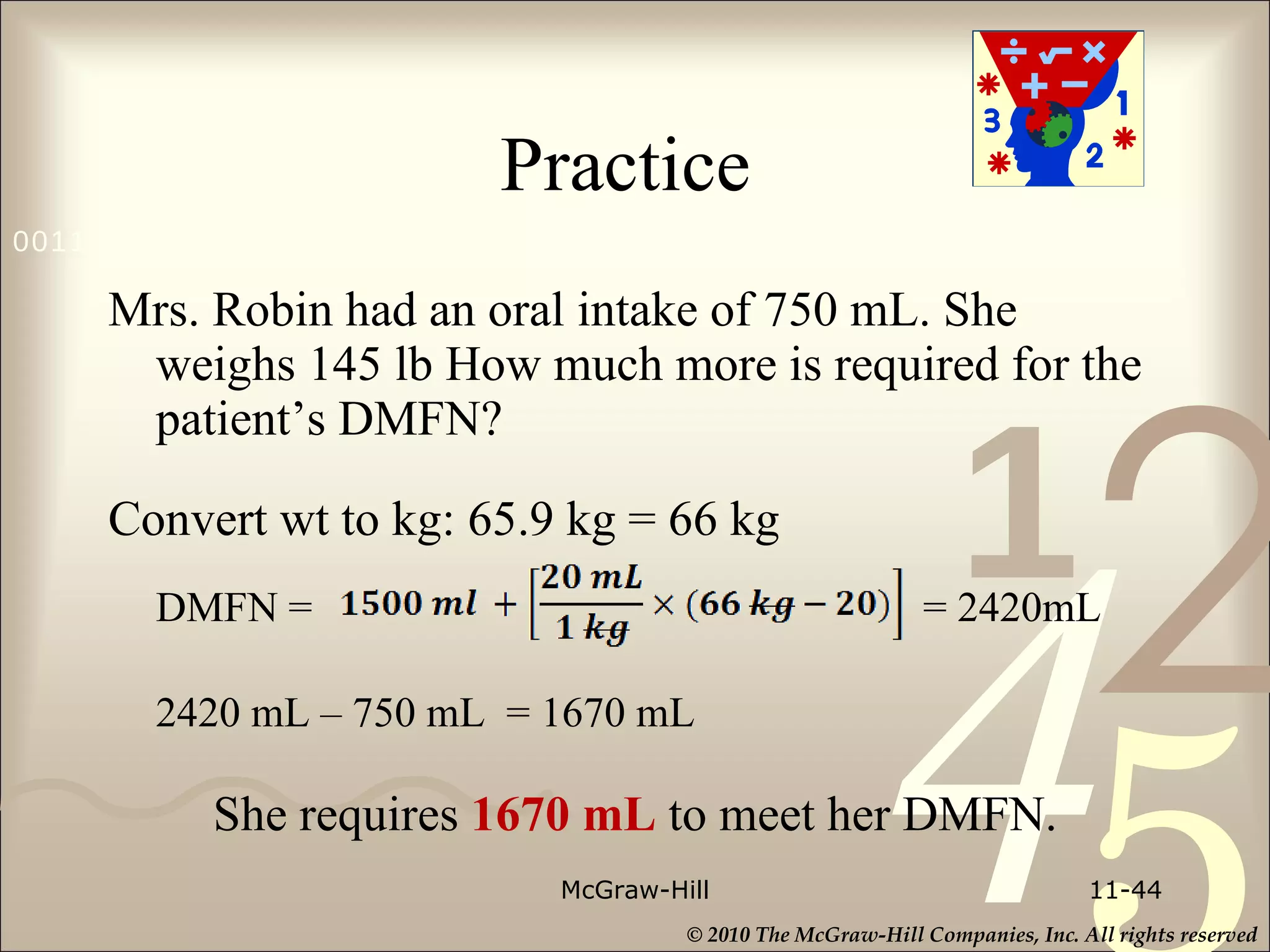
Practice  Mrs. Robin had an oral intake of 750 mL. She weighs 145 lb How much more is required for the patient’s DMFN? Convert wt to kg: 65.9 kg = 66 kg DMFN =   = 2420mL 2420 mL – 750 mL  =  1670 mL She requires  1670 mL  to meet her DMFN. McGraw-Hill 11-
Creatinine Clearance McGraw-Hill 11-
Creatinine Clearance  (cont.) McGraw-Hill 11-
Creatinine Clearance  (cont.) Diseases that can damage kidneys Hypertension Diabetes Congestive heart failure Drugs that alter or change kidney function Lasix Aminoglycoside antibiotics McGraw-Hill 11-
Creatinine Clearance  (cont.) McGraw-Hill 11-
Ideal and Actual Body Weight Geriatric patients – decreased proportion of lean body mass and water Alters distribution of drugs Monitor serum drug levels Some water-soluble drugs strongly bound to lean tissue Fat-soluble drugs distributed to body fat Slower release into circulation Residual effects McGraw-Hill 11-
Ideal and Actual Body Weight  (cont.) Water soluble drug doses for Overweight patients – based on  ideal body weight Underweight patients (below ideal body weight) – based on  actual   weight  McGraw-Hill 11-
Ideal and Actual Body Weight  (cont.) Rule 11-8  Determining safe dosages for geriatric patients Check the package insert or product literature and check if dose ordered is safe based on renal function and ideal or actual patient weight. If the dose is safe, calculate the amount to administer. McGraw-Hill 11-
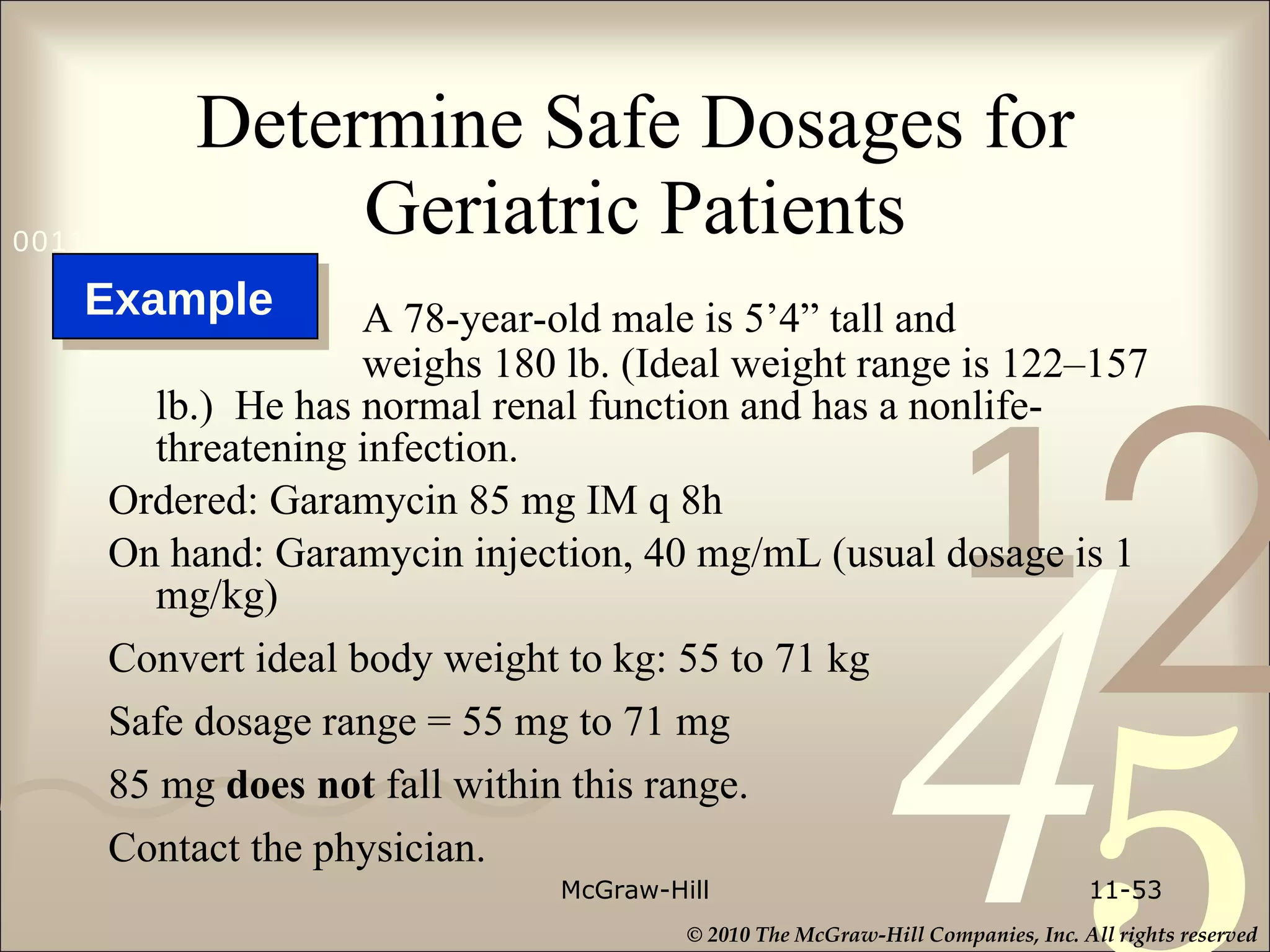
Determine Safe Dosages for Geriatric Patients A 78-year-old male is 5’4” tall and  weighs 180 lb. (Ideal weight range is 122–157 lb.)  He has normal renal function and has a nonlife-threatening infection. Ordered: Garamycin 85 mg IM q 8h On hand: Garamycin injection, 40 mg/mL (usual dosage is 1 mg/kg) Convert ideal body weight to kg: 55 to 71 kg Safe dosage range = 55 mg to 71 mg 85 mg  does not  fall within this range. Contact the physician. McGraw-Hill 11- Example
Error Alert!   For medications that are strongly bound to lean body tissue, calculate an overweight patient’s dose on ideal body weight, not actual weight. McGraw-Hill 11-
Practice Mr. Adams weights 172 lb (at ideal body weight). He is 5 ft, 7 in tall. CL CR  60 mL/min Ordered: Vancocin HCl 150 mg IV q6h Daily recommended dosage for patients with normal renal function 2g in divided doses. Recommended daily dose for patients with creatinine clearance of 60 mL/min is 925 mg/24 h. Is dose ordered safe? Yes  600 mg/24 h, which is less than 925 mg/24 h McGraw-Hill 11-
Polypharmacy McGraw-Hill 11-
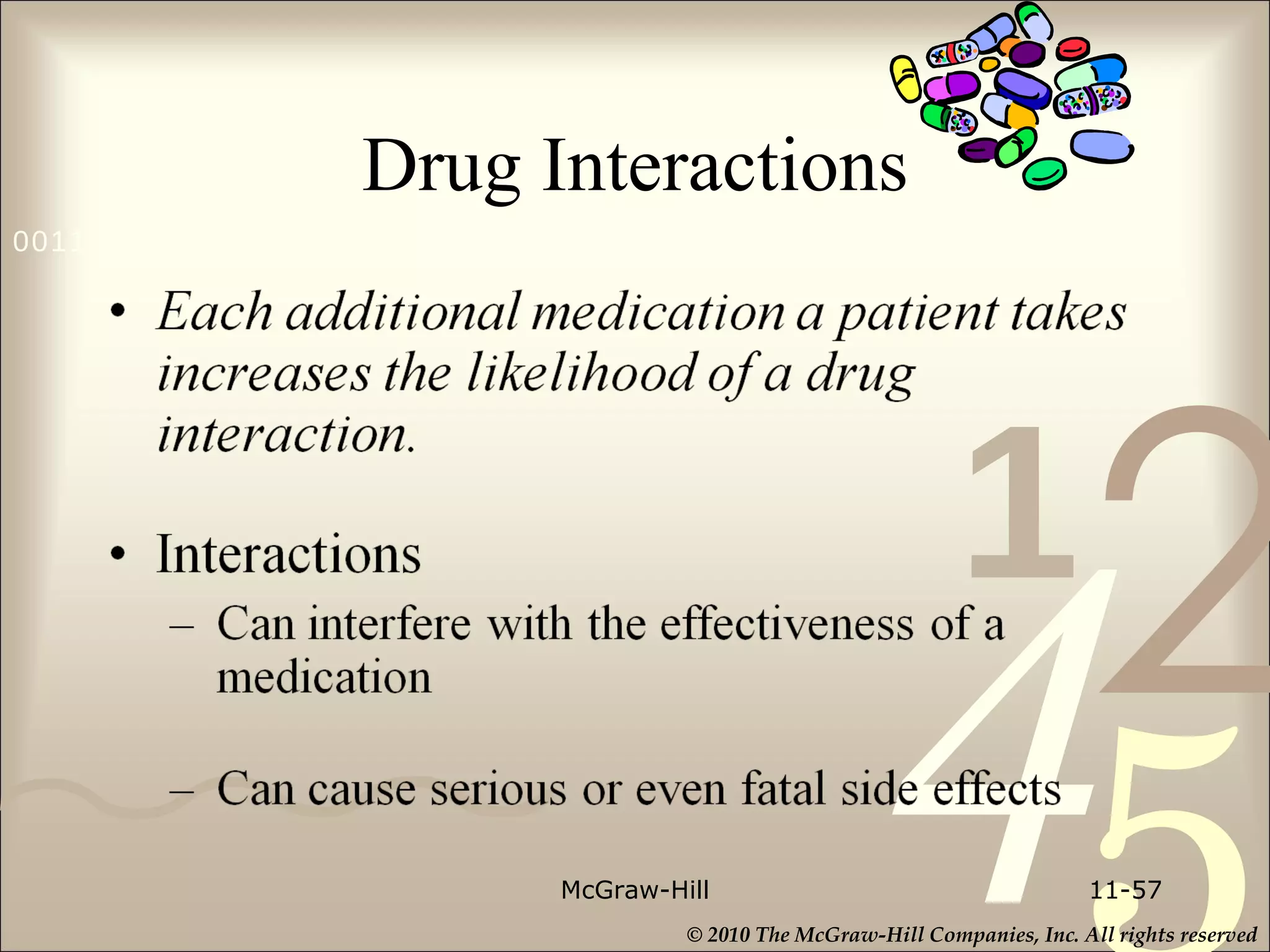
Drug Interactions McGraw-Hill 11-
Drug Interactions  (cont.)   Rule 11-9   To identify cases of polypharmacy and reduce the risk of drug interactions, ask elderly patients about: 1. All medications they take which are prescribed by either their primary physician or specialists 2. Any over-the-counter medications they take 3. Any social drugs which they use McGraw-Hill 11-
Drug Interactions  (cont.) Rule 11-9  (cont.) 4. Medications that they borrow from family and friends 5. Herbal and home remedies that they use 6. Bringing all medications they take to be checked. McGraw-Hill 11-
Drug Interactions  (cont.) Factors causing adverse drug reactions Advanced age Small body size Multiple illnesses Multiple medications Living alone Malnutrition McGraw-Hill 11-
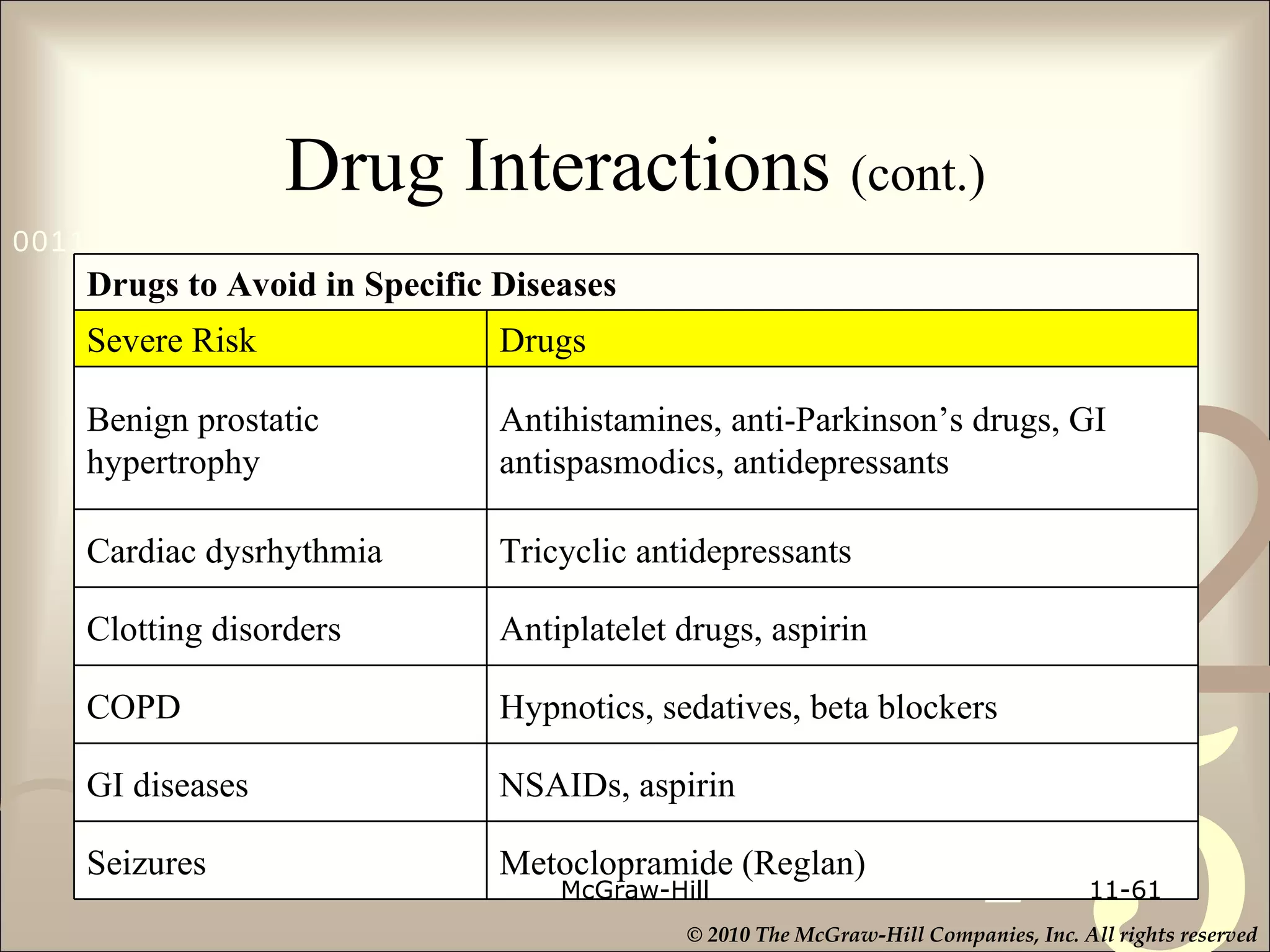
Drug Interactions  (cont.) McGraw-Hill 11- Drugs to Avoid in Specific Diseases Severe Risk Drugs Benign prostatic hypertrophy Antihistamines, anti-Parkinson’s drugs, GI antispasmodics, antidepressants Cardiac dysrhythmia Tricyclic antidepressants Clotting disorders Antiplatelet drugs, aspirin COPD Hypnotics, sedatives, beta blockers GI diseases NSAIDs, aspirin Seizures Metoclopramide (Reglan)
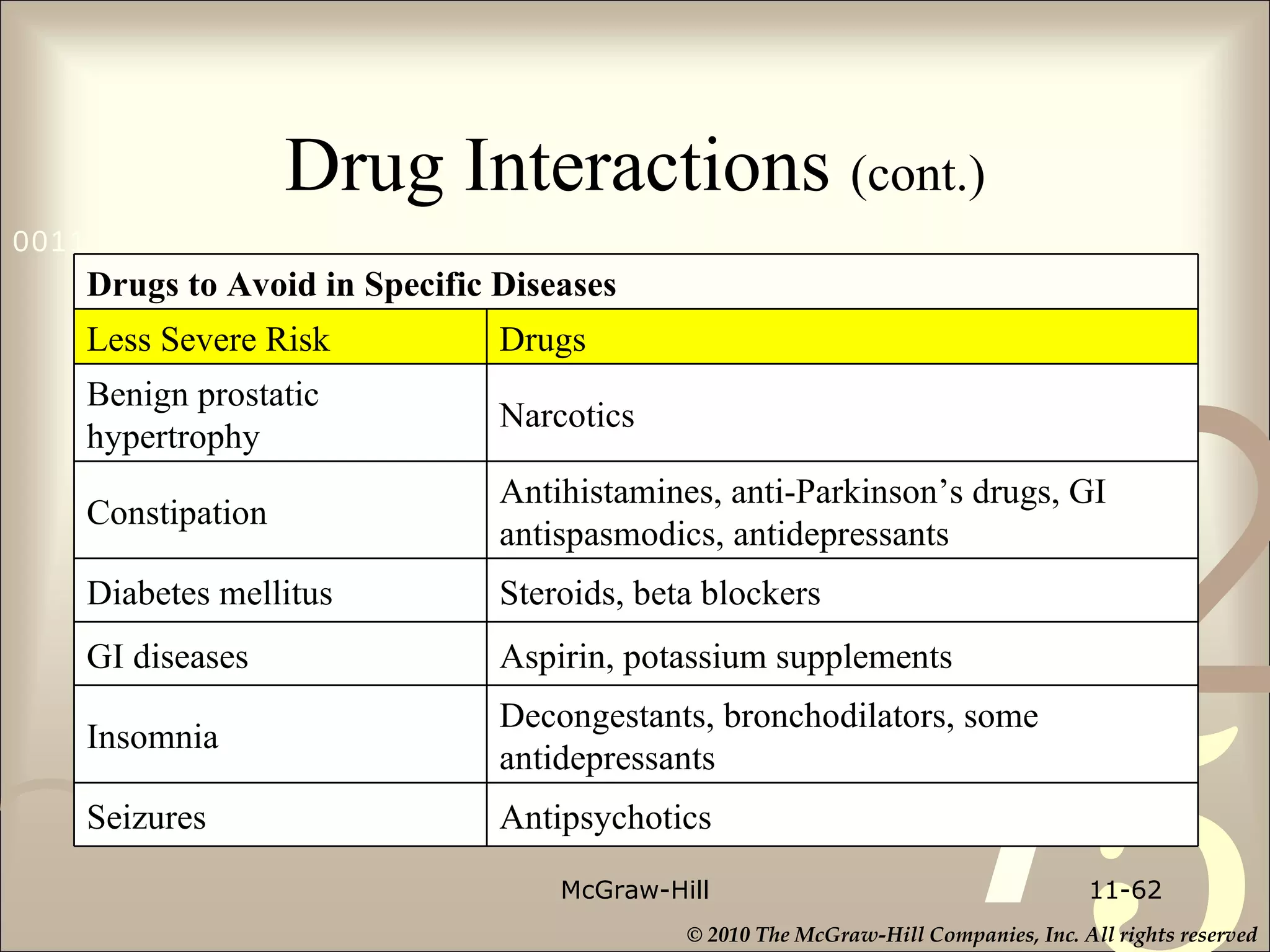
Drug Interactions  (cont.) McGraw-Hill 11- Drugs to Avoid in Specific Diseases Less Severe Risk Drugs Benign prostatic hypertrophy Narcotics  Constipation Antihistamines, anti-Parkinson’s drugs, GI antispasmodics, antidepressants Diabetes mellitus Steroids, beta blockers GI diseases Aspirin, potassium supplements Insomnia  Decongestants, bronchodilators, some antidepressants Seizures Antipsychotics
Apply Your Knowledge True or False A baby who weighs 6 lb 8 oz weighs 6.8 lb. A baby who weighs 9.5 lb weighs 9 lb 8 oz. McGraw-Hill 11- Answer  False Answer  True
Apply Your Knowledge What are three resources you can consult to see if the calculated dose is a safe dose to administer? McGraw-Hill 11- Answer  1.  Drug label 2.  Package insert 3.  Drug literature
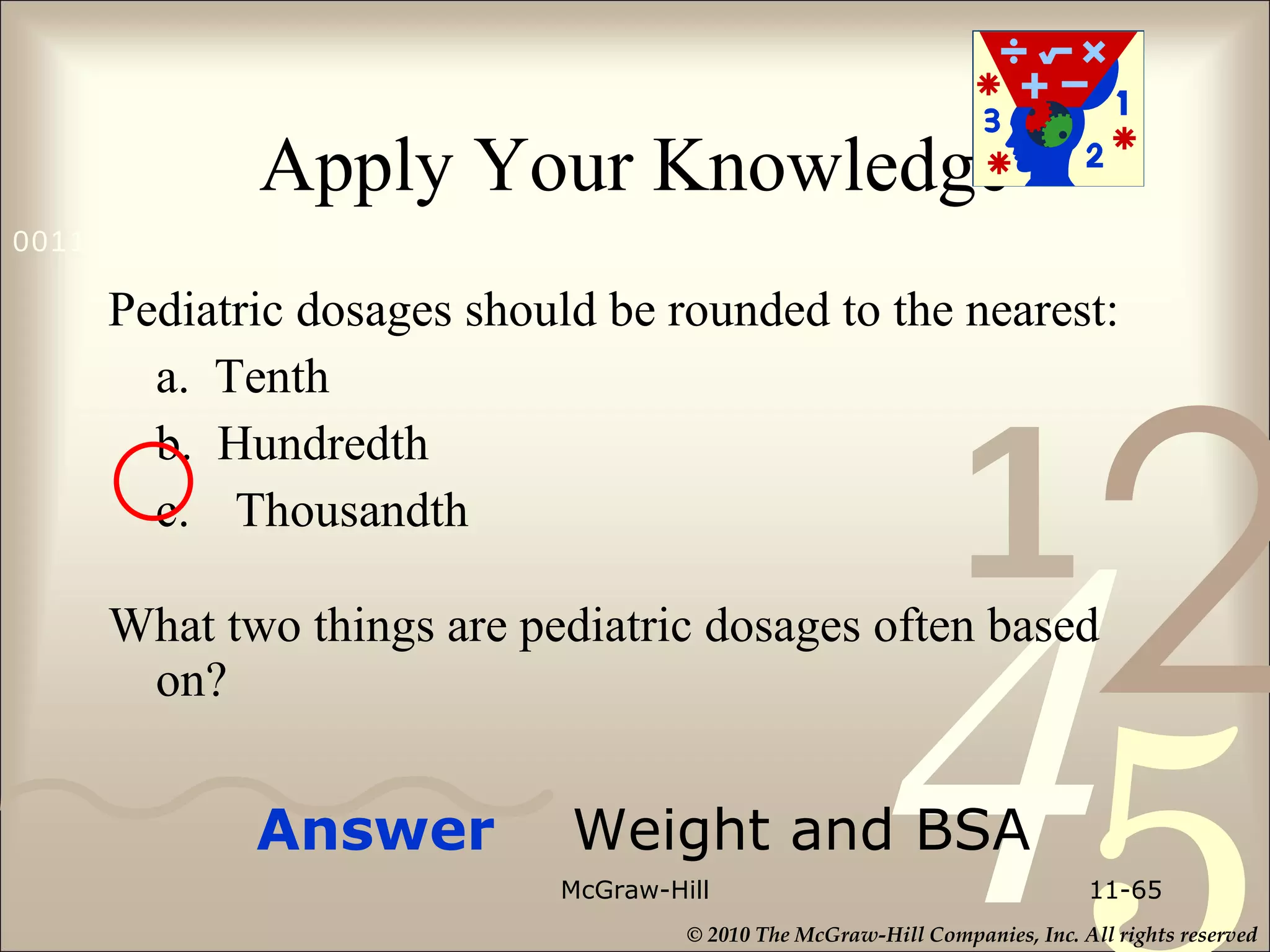
Apply Your Knowledge Pediatric dosages should be rounded to the nearest:  a.  Tenth b.  Hundredth c. Thousandth What two things are pediatric dosages often based on?  McGraw-Hill 11- Answer  Weight and BSA
Apply Your Knowledge McGraw-Hill 11- Answer  Daily maintenance fluid needs (DMFN) What is the amount of fluid the patient needs over a 24-hour period called?
Apply Your Knowledge Which age-related change would indicate a need to consider a smaller needle length for an IM injection? a. thinner, more fragile skin b. loss of subcutaneous tissue c. decreased muscle mass d. difficulty swallowing McGraw-Hill 11-
Apply Your Knowledge The test used to measure the rate at which the kidneys filter the blood is called: a. kidney function test creatinine b. renal function test c.  creatinine d. creatinine clearance McGraw-Hill 11-
Apply Your Knowledge True or False For medications that are strongly bound to lean body tissue, calculate an overweight patient’s dose on the  ideal  weight, not  actual  weight. McGraw-Hill 11- Answer  True
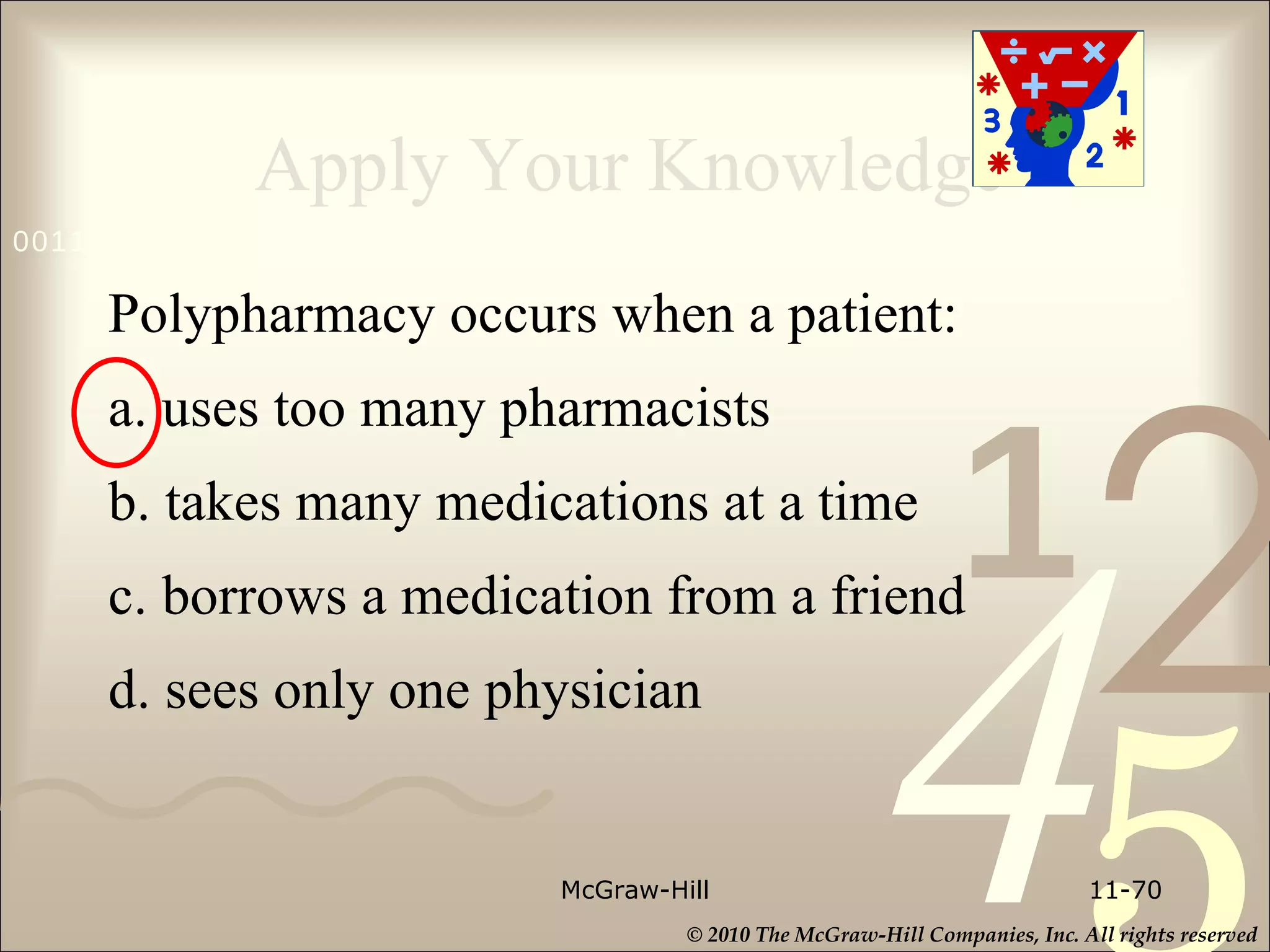
Apply Your Knowledge Polypharmacy occurs when a patient: a. uses too many pharmacists b. takes many medications at a time c. borrows a medication from a friend d. sees only one physician McGraw-Hill 11-
End of Chapter 11 McGraw-Hill 11- Perfection consists not in doing extraordinary things, but in doing ordinary things extraordinarily well.   ~Angelique  Arnauld

Chapter11

  • 1.
    Math and DosageCalculations for Health Care Third Edition Booth & Whaley McGraw-Hill 11- Chapter 11: Special Populations Edited by B. Holmes MSN/Ed, RN
  • 2.
    Learning Outcomes 11.1Explain why dosages for special populations must be based on the individual patient. 11.2 Identify factors that affect the absorption, distribution, biotransformation, and elimination of drugs in special populations. McGraw-Hill 11-
  • 3.
    Learning Outcomes (cont.) 11.3 Determine safe doses for special populations. 11.4 Calculate patient dosages based on body weight. 11.5 Find a patient’s body surface area (BSA). McGraw-Hill 11-
  • 4.
    Learning Outcomes (cont.) 11.6 Describe volume and medication limitations for special populations. 11.7 Calculate infusion rates based upon body weight. McGraw-Hill 11-
  • 5.
    Introduction Two populationsrequiring extra consideration when calculating medication dosages Pediatric (less than 18 years old) Geriatric (over 65 years old) Risk of harm is far greater due to the way they break down and absorb medications. McGraw-Hill 11-
  • 6.
    Introduction (cont.)Clarify all confusing drug orders Calculate with absolute accuracy Verify that dose is safe Seek assistance from your supervisor McGraw-Hill 11- Do not take short cuts with medication calculations.
  • 7.
    Factors That ImpactDosing Standardized doses based on assumptions The patient’s body and age Body systems are fully developed and functioning Assumptions do not hold true for all populations or situations McGraw-Hill 11-
  • 8.
    Factors That ImpactDosing – PHARMACOKINETICS Study of how drugs are used by the body Absorption Distribution Biotransformation Elimination Understanding these processes allows for adjustments for special populations McGraw-Hill 11-
  • 9.
    Factors That ImpactDosing – PHARMACOKINETICS (cont.) Absorption Process that moves a drug from the site where it is given into the bloodstream IV medications bypass the absorption process Oral medications – digestive system Topical – through the skin McGraw-Hill 11-
  • 10.
    Factors That ImpactDosing – PHARMACOKINETICS (cont.) Distribution Process that moves the drug from the bloodstream to other body compartments Target site – where the drug produces its desired effect McGraw-Hill 11-
  • 11.
    Factors That ImpactDosing – PHARMACOKINETICS (cont.) Biotransformation Process that chemically changes the drug in the body Occurs primarily in the liver Helps to protect the body from foreign chemicals including drugs McGraw-Hill 11-
  • 12.
    Factors That ImpactDosing – PHARMACOKINETICS (cont.) Elimination Process where the drug leaves the body Main route – urine Other ways Air that we exhale Sweat Feces Breast milk Other body secretions McGraw-Hill 11-
  • 13.
    Factors That ImpactDosing – PHARMACOKINETICS (cont.) Adjust dose If one of the four processes are not functioning within certain limits Made according to nature and severity of patient’s condition May by higher or lower than standard doses McGraw-Hill 11-
  • 14.
    Factors That ImpactDosing (cont.) Conditions that impact dosing Stomach or intestinal disorders Liver disorders Obesity Kidney disease Functions of body systems change over the life of a person. McGraw-Hill 11-
  • 15.
    Factors That ImpactDosing (cont.) Newborns – systems not fully developed pH of stomach is lower Thinner skin Liver still developing Less circulation to muscles Geriatrics – systems deteriorate Skin and veins become fragile Decreased liver function Decreased kidney function Poor circulation McGraw-Hill 11-
  • 16.
    Working with SpecialPopulations Other Considerations Parent or caretaker may be administering or assisting with medications. Educate regarding medications Geriatric patients may have decreased awareness or understanding. McGraw-Hill 11-
  • 17.
    Working with SpecialPopulations – GERIATRIC PATIENTS Show respect Listen to their concerns Encourage them to Use the same pharmacy to fill all prescriptions Have one primary care physician to monitor and approve all medications Keep a list of all medications McGraw-Hill 11-
  • 18.
    Special Populations – GERIATRIC PATIENTS (cont.) Decreased dexterity Injections Eye drops Open bottles Difficulty swallowing Drugs that cannot be crushed Foods that can be mixed with drugs McGraw-Hill 11-
  • 19.
    Special Populations – GERIATRIC PATIENTS (cont.) Hearing loss Do they understand instructions? Have them repeat information back to you Difficulty reading small print Labeling Tablet colors McGraw-Hill 11-
  • 20.
    Special Populations – GERIATRIC PATIENTS (cont.) Short-term memory loss Written instructions Medication calendars Pill dispensers Avoid OTC or herbal meds until discussing with physician. Do not take expired meds or borrowed meds. McGraw-Hill 11-
  • 21.
    Teaching Patients AboutMedications 1. Name of the medication 2. Purpose 3. How to store it 4. How long to take the medication 5. How and when to take it 6. How to know if it is effective McGraw-Hill 11-
  • 22.
    Teaching Patients AboutMedications (cont.) 7. Required follow-up tests, doctor appointments 8. Possible side effects and what to do 9. Interactions with other drugs and foods 10. Symptoms to report to the doctor 11. What to do if a dose is missed 12. Keeping a list of all medications McGraw-Hill 11-
  • 23.
    Dosages Based onBody Weight Amount of medication per Weight of the patient per Unit of time McGraw-Hill 11-
  • 24.
    Dosages Based onBody Weight Rule 11-1 Calculating dosage based on body weight: 1. Convert the patient’s weight to kilograms 2. Calculate the desired dose D by multiplying dose ordered by the weight in kilograms such as McGraw-Hill 11-
  • 25.
    Dosages Based onBody Weight (cont.) Rule 11-1 (cont.) 3. Confirm whether or not the desired dose is safe by checking the label, package insert, or product literature. 4. Calculate the amount to administer, using fraction proportion, ratio proportion, dimensional analysis, or the formula method. McGraw-Hill 11-
  • 26.
    Dosages Based onBody Weight (cont.) Calculate the amount to administer to a 3-year-old weighing 34 lb. Ordered: hysocyamine sulfate 5 mcg/kg subq 1 h pre-anesthesia On hand: hysocyamine sulfate 0.5 mg/mL Convert 34 lb to kg = 15.5 kg McGraw-Hill 11- Example
  • 27.
    Dosages Based onBody Weight (cont.) Find the desired dose: 77.5 mcg = D Find the amount to administer: 77.5 mcg = 0.0775 = 0.08 mg Amount to administer = 0.16 mL McGraw-Hill 11- Example (cont.)
  • 28.
    Dosages Based onBody Weight (cont.) McGraw-Hill 11-
  • 29.
    Pediatric Injections McGraw-Hill11- Stage of Development Maximum Volumes for IM Injections Infant 0.5 – 1 mL Toddler, walking for at least 1 year 1 mL Preschooler/elementary school age 1 – 1.5 mL
  • 30.
    Ensuring Safe DosagesMcGraw-Hill 11-
  • 31.
    Ensuring Safe Dosages (cont.) Rule 11-2 Ensuring Safe Dosages When working with special populations, always check the package insert, drug label, or product literature to ensure the safety of the dose to be administered. McGraw-Hill 11-
  • 32.
    Error Alert !McGraw-Hill 11-
  • 33.
    Error Alert !Weight 8 lb 6 oz Convert 6 ounces to pounds using as the conversion Therefore 8 lb 6 oz = 8.375 lb McGraw-Hill 11-
  • 34.
    Practice Determine whetherthe following order is safe. If safe, calculate the amount to administer. McGraw-Hill 11- Patient: Child who weighs 14.5 kg Ordered: Amoxil 75 mg PO q8h On hand: Usual child dose 20-40 mg/kg day q8h Answer Dosage doesn’t fall within recommended dosage range; contact the physician.
  • 35.
    Daily Maintenance FluidNeeds (DMFN) McGraw-Hill 11-
  • 36.
    Daily Maintenance FluidNeeds (DMFN) (cont.) McGraw-Hill 11-
  • 37.
    Daily Maintenance FluidNeeds (DMFN) (cont.) McGraw-Hill 11-
  • 38.
    Daily Maintenance FluidNeeds (DMFN) (cont.) Amount of maintenance fluid required varies by weight Replacement fluids Based on patient’s condition Vomiting Diarrhea Fever McGraw-Hill 11-
  • 39.
    Daily Maintenance FluidNeeds (DMFN) (cont.) Rule 11-6 To calculate daily maintenance fluid needs (DMFN) based on weight: 1. If the patient weighs up to 10 kg, find 2. If the patient weighs 10 to 20 kg, find McGraw-Hill 11-
  • 40.
    Daily Maintenance FluidNeeds (DMFN) (cont.) Rule 11-6 (cont.) 3. If the patient weighs over 20 kg, find McGraw-Hill 11-
  • 41.
    Daily Maintenance FluidNeeds (DMFN) (cont.) Find the DMFN for a patient weighing 16 kg. DMFN mL = DMFN mL = 1000 + 300 DMFN mL = 1300 mL Find the DMFN for a patient weighing 24 kg. DMFN mL = DMFN mL = 1500 + 80 DMFN mL = 1580 mL McGraw-Hill 11- Examples
  • 42.
    Daily Maintenance FluidNeeds (DMFN) (cont.) Rule 11-7 For pediatric patients and critically ill patients, the amount of solution in the IV tubing must be considered when determining infusion times and volumes. McGraw-Hill 11-
  • 43.
    Daily Maintenance FluidNeeds (DMFN) (cont.) Standard IV tubing contains 10 mL of solution per five feet. When using a volume control chamber and standard tubing, medication will not reach patient until this 10 mL infuses. Low-volume tubing contains only 0.3 mL of solution per five feet. McGraw-Hill 11-
  • 44.
    Practice Mrs.Robin had an oral intake of 750 mL. She weighs 145 lb How much more is required for the patient’s DMFN? Convert wt to kg: 65.9 kg = 66 kg DMFN = = 2420mL 2420 mL – 750 mL = 1670 mL She requires 1670 mL to meet her DMFN. McGraw-Hill 11-
  • 45.
  • 46.
    Creatinine Clearance (cont.) McGraw-Hill 11-
  • 47.
    Creatinine Clearance (cont.) Diseases that can damage kidneys Hypertension Diabetes Congestive heart failure Drugs that alter or change kidney function Lasix Aminoglycoside antibiotics McGraw-Hill 11-
  • 48.
    Creatinine Clearance (cont.) McGraw-Hill 11-
  • 49.
    Creatinine Clearance (cont.) McGraw-Hill 11-
  • 50.
    Ideal and ActualBody Weight Geriatric patients – decreased proportion of lean body mass and water Alters distribution of drugs Monitor serum drug levels Some water-soluble drugs strongly bound to lean tissue Fat-soluble drugs distributed to body fat Slower release into circulation Residual effects McGraw-Hill 11-
  • 51.
    Ideal and ActualBody Weight (cont.) Water soluble drug doses for Overweight patients – based on ideal body weight Underweight patients (below ideal body weight) – based on actual weight McGraw-Hill 11-
  • 52.
    Ideal and ActualBody Weight (cont.) Rule 11-8 Determining safe dosages for geriatric patients Check the package insert or product literature and check if dose ordered is safe based on renal function and ideal or actual patient weight. If the dose is safe, calculate the amount to administer. McGraw-Hill 11-
  • 53.
    Determine Safe Dosagesfor Geriatric Patients A 78-year-old male is 5’4” tall and weighs 180 lb. (Ideal weight range is 122–157 lb.) He has normal renal function and has a nonlife-threatening infection. Ordered: Garamycin 85 mg IM q 8h On hand: Garamycin injection, 40 mg/mL (usual dosage is 1 mg/kg) Convert ideal body weight to kg: 55 to 71 kg Safe dosage range = 55 mg to 71 mg 85 mg does not fall within this range. Contact the physician. McGraw-Hill 11- Example
  • 54.
    Error Alert! For medications that are strongly bound to lean body tissue, calculate an overweight patient’s dose on ideal body weight, not actual weight. McGraw-Hill 11-
  • 55.
    Practice Mr. Adamsweights 172 lb (at ideal body weight). He is 5 ft, 7 in tall. CL CR 60 mL/min Ordered: Vancocin HCl 150 mg IV q6h Daily recommended dosage for patients with normal renal function 2g in divided doses. Recommended daily dose for patients with creatinine clearance of 60 mL/min is 925 mg/24 h. Is dose ordered safe? Yes 600 mg/24 h, which is less than 925 mg/24 h McGraw-Hill 11-
  • 56.
  • 57.
  • 58.
    Drug Interactions (cont.) Rule 11-9 To identify cases of polypharmacy and reduce the risk of drug interactions, ask elderly patients about: 1. All medications they take which are prescribed by either their primary physician or specialists 2. Any over-the-counter medications they take 3. Any social drugs which they use McGraw-Hill 11-
  • 59.
    Drug Interactions (cont.) Rule 11-9 (cont.) 4. Medications that they borrow from family and friends 5. Herbal and home remedies that they use 6. Bringing all medications they take to be checked. McGraw-Hill 11-
  • 60.
    Drug Interactions (cont.) Factors causing adverse drug reactions Advanced age Small body size Multiple illnesses Multiple medications Living alone Malnutrition McGraw-Hill 11-
  • 61.
    Drug Interactions (cont.) McGraw-Hill 11- Drugs to Avoid in Specific Diseases Severe Risk Drugs Benign prostatic hypertrophy Antihistamines, anti-Parkinson’s drugs, GI antispasmodics, antidepressants Cardiac dysrhythmia Tricyclic antidepressants Clotting disorders Antiplatelet drugs, aspirin COPD Hypnotics, sedatives, beta blockers GI diseases NSAIDs, aspirin Seizures Metoclopramide (Reglan)
  • 62.
    Drug Interactions (cont.) McGraw-Hill 11- Drugs to Avoid in Specific Diseases Less Severe Risk Drugs Benign prostatic hypertrophy Narcotics Constipation Antihistamines, anti-Parkinson’s drugs, GI antispasmodics, antidepressants Diabetes mellitus Steroids, beta blockers GI diseases Aspirin, potassium supplements Insomnia Decongestants, bronchodilators, some antidepressants Seizures Antipsychotics
  • 63.
    Apply Your KnowledgeTrue or False A baby who weighs 6 lb 8 oz weighs 6.8 lb. A baby who weighs 9.5 lb weighs 9 lb 8 oz. McGraw-Hill 11- Answer False Answer True
  • 64.
    Apply Your KnowledgeWhat are three resources you can consult to see if the calculated dose is a safe dose to administer? McGraw-Hill 11- Answer 1. Drug label 2. Package insert 3. Drug literature
  • 65.
    Apply Your KnowledgePediatric dosages should be rounded to the nearest: a. Tenth b. Hundredth c. Thousandth What two things are pediatric dosages often based on? McGraw-Hill 11- Answer Weight and BSA
  • 66.
    Apply Your KnowledgeMcGraw-Hill 11- Answer Daily maintenance fluid needs (DMFN) What is the amount of fluid the patient needs over a 24-hour period called?
  • 67.
    Apply Your KnowledgeWhich age-related change would indicate a need to consider a smaller needle length for an IM injection? a. thinner, more fragile skin b. loss of subcutaneous tissue c. decreased muscle mass d. difficulty swallowing McGraw-Hill 11-
  • 68.
    Apply Your KnowledgeThe test used to measure the rate at which the kidneys filter the blood is called: a. kidney function test creatinine b. renal function test c. creatinine d. creatinine clearance McGraw-Hill 11-
  • 69.
    Apply Your KnowledgeTrue or False For medications that are strongly bound to lean body tissue, calculate an overweight patient’s dose on the ideal weight, not actual weight. McGraw-Hill 11- Answer True
  • 70.
    Apply Your KnowledgePolypharmacy occurs when a patient: a. uses too many pharmacists b. takes many medications at a time c. borrows a medication from a friend d. sees only one physician McGraw-Hill 11-
  • 71.
    End of Chapter11 McGraw-Hill 11- Perfection consists not in doing extraordinary things, but in doing ordinary things extraordinarily well. ~Angelique Arnauld