Module 4
KNOWLEDGE
AND
REASONING
Knowledge based agent
• We design agents that can form representations of the
world
• Agents that use a process of inference to derive new
representations about the world
• and agents that use these new representations to
deduce what to do
• A knowledge-based agent needs to know many
things:
– the current state of the world
– how to infer unseen properties of the world from percepts
– how the world evolves over time
– what it wants to achieve
– what its own actions do in various circumstances
Shiwani Gupta 2
Knowledge Base
(set of representations of facts about the world)
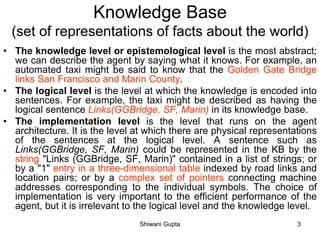
• The knowledge level or epistemological level is the most abstract;
we can describe the agent by saying what it knows. For example, an
automated taxi might be said to know that the Golden Gate Bridge
links San Francisco and Marin County.
• The logical level is the level at which the knowledge is encoded into
sentences. For example, the taxi might be described as having the
logical sentence Links(GGBridge, SF, Marin) in its knowledge base.
• The implementation level is the level that runs on the agent
architecture. It is the level at which there are physical representations
of the sentences at the logical level. A sentence such as
Links(GGBridge, SF, Marin) could be represented in the KB by the
string "Links (GGBridge, SF, Marin)" contained in a list of strings; or
by a "1" entry in a three-dimensional table indexed by road links and
location pairs; or by a complex set of pointers connecting machine
addresses corresponding to the individual symbols. The choice of
implementation is very important to the efficient performance of the
agent, but it is irrelevant to the logical level and the knowledge level.
Shiwani Gupta 3
4
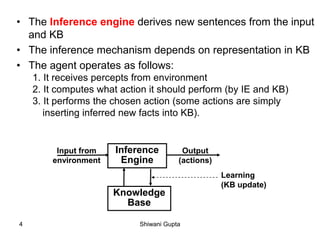
• The Inference engine derives new sentences from the input
and KB
• The inference mechanism depends on representation in KB
• The agent operates as follows:
1. It receives percepts from environment
2. It computes what action it should perform (by IE and KB)
3. It performs the chosen action (some actions are simply
inserting inferred new facts into KB).
Knowledge
Base
Inference
Engine
Input from
environment
Output
(actions)
Learning
(KB update)
Shiwani Gupta
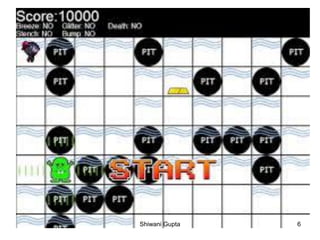
Example – Knowledge Based Agent
• A classical AI problem
• An early computer game
• An agent had to explore a cave made of series of
interconnected rooms
• In one room, there was a Wumpus who would kill agent if it
entered the room
• Some rooms have pits – agent would die if it entered it
• Agent had 1 arrow to kill Wumpus
• Goal – Locate gold and return to start without getting killed.
Shiwani Gupta 5
Shiwani Gupta 6
The Wumpus World
environment
• The Wumpus computer game
• The agent explores a cave consisting of rooms connected by
passageways.
• Lurking somewhere in the cave is the Wumpus, a beast that
eats any agent that enters its room.
• Some rooms contain bottomless pits that trap any agent that
wanders into the room.
• It is safe to enter a square with dead Wumpus.
• Occasionally, there is a heap of gold in a room.
• The goal is:
– to collect the gold and
– exit the world (climb out of cave)
– without being eaten Shiwani Gupta 7
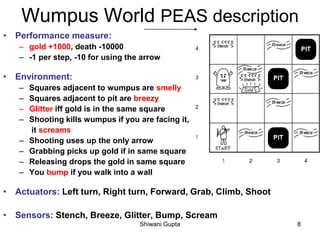
Wumpus World PEAS description
• Performance measure:
– gold +1000, death -10000
– -1 per step, -10 for using the arrow
• Environment:
– Squares adjacent to wumpus are smelly
– Squares adjacent to pit are breezy
– Glitter iff gold is in the same square
– Shooting kills wumpus if you are facing it,
it screams
– Shooting uses up the only arrow
– Grabbing picks up gold if in same square
– Releasing drops the gold in same square
– You bump if you walk into a wall
• Actuators: Left turn, Right turn, Forward, Grab, Climb, Shoot
• Sensors: Stench, Breeze, Glitter, Bump, Scream
Shiwani Gupta 8
Wumpus world characterization
• Fully Observable No – only local perception
• Deterministic Yes – outcomes exactly specified
• Episodic No – since no need to think ahead
• Static Yes – Wumpus and Pits do not move
• Discrete Yes
• Single-agent Yes – Wumpus is essentially a
natural feature
Shiwani Gupta 9
The first step taken by the agent in the wumpus world,
(a)The initial situation, after percept [None, None, None, None, None].
(b)After one move, with percept [None, Breeze, None, None, None].
[ stench,  breeze,  glitter,  bump,  scream] [1,1]
[stench,  breeze,  glitter,  bump,  scream] [1,2]
[ stench, breeze,  glitter,  bump,  scream] [2,1] → Safe cell
Shiwani Gupta 10
Two later stages in the progress of the agent,
(a) After the third move, with percept [Stench, None, None, None, None].
(b) After the fifth move, with percept [Stench, Breeze, Glitter, None, None].
Shiwani Gupta 11
Propositional logic: Syntax
(limited expressiveness)
• Propositional logic is the simplest logic – illustrates basic ideas
• The proposition symbols P1, P2 etc are sentences
– If S is a sentence, S is a sentence (negation)
– If S1 and S2 are sentences, S1  S2 is a sentence
(conjunction)
– If S1 and S2 are sentences, S1  S2 is a sentence
(disjunction)
– If S1 and S2 are sentences, S1  S2 is a sentence
(implication)
– If S1 and S2 are sentences, S1  S2 is a sentence
(biconditional)
Shiwani Gupta 12
Symbols of propositional logic
• Logical constants TRUE and FALSE are sentences
• Proposition symbols P and Q are sentences
• A, V, , , are logical connectives
• parenthesis ( )
Shiwani Gupta 13
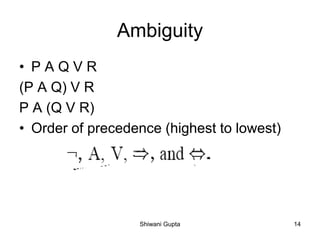
Ambiguity
• P A Q V R
(P A Q) V R
P A (Q V R)
• Order of precedence (highest to lowest)
Shiwani Gupta 14
Propositional logic: Semantics
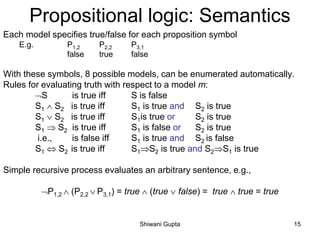
Each model specifies true/false for each proposition symbol
E.g. P1,2 P2,2 P3,1
false true false
With these symbols, 8 possible models, can be enumerated automatically.
Rules for evaluating truth with respect to a model m:
S is true iff S is false
S1  S2 is true iff S1 is true and S2 is true
S1  S2 is true iff S1is true or S2 is true
S1  S2 is true iff S1 is false or S2 is true
i.e., is false iff S1 is true and S2 is false
S1  S2 is true iff S1S2 is true and S2S1 is true
Simple recursive process evaluates an arbitrary sentence, e.g.,
P1,2  (P2,2  P3,1) = true  (true  false) = true  true = true
Shiwani Gupta 15
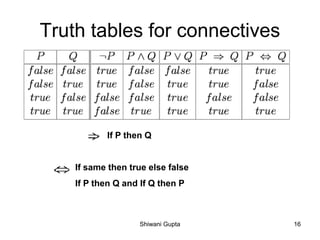
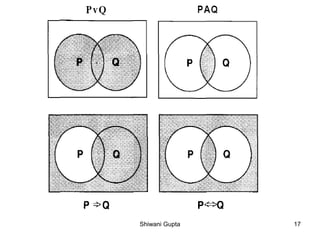
Truth tables for connectives
If P then Q
If same then true else false
If P then Q and If Q then P
Shiwani Gupta 16
Shiwani Gupta 17
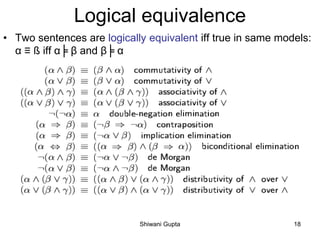
Logical equivalence
• Two sentences are logically equivalent iff true in same models:
α ≡ ß iff α╞ β and β╞ α
Shiwani Gupta 18
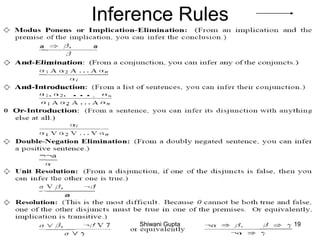
Inference Rules
Shiwani Gupta 19
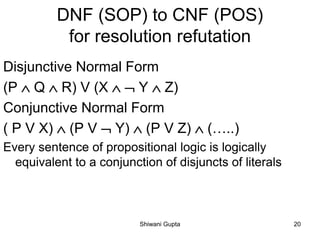
DNF (SOP) to CNF (POS)
for resolution refutation
Disjunctive Normal Form
(P  Q  R) V (X   Y  Z)
Conjunctive Normal Form
( P V X)  (P V  Y)  (P V Z)  (…..)
Every sentence of propositional logic is logically
equivalent to a conjunction of disjuncts of literals
Shiwani Gupta 20
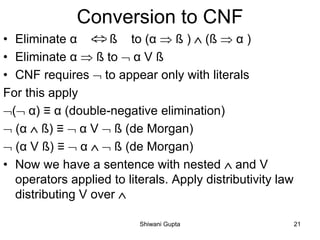
Conversion to CNF
• Eliminate α ß to (α  ß )  (ß  α )
• Eliminate α  ß to  α V ß
• CNF requires  to appear only with literals
For this apply
( α) ≡ α (double-negative elimination)
 (α  ß) ≡  α V  ß (de Morgan)
 (α V ß) ≡  α   ß (de Morgan)
• Now we have a sentence with nested  and V
operators applied to literals. Apply distributivity law
distributing V over 
Shiwani Gupta 21
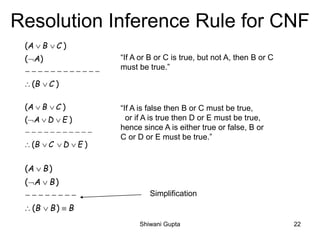
Resolution Inference Rule for CNF
( )
( )
( )
A B C
A
B C
 

− − − − − − − − − − − −
 
“If A or B or C is true, but not A, then B or C
must be true.”
( )
( )
( )
A B C
A D E
B C D E
 
  
− − − − − − − − − − −
   
“If A is false then B or C must be true,
or if A is true then D or E must be true,
hence since A is either true or false, B or
C or D or E must be true.”
( )
( )
( )
A B
A B
B B B

 
− − − − − − − −
  
Simplification
Shiwani Gupta 22
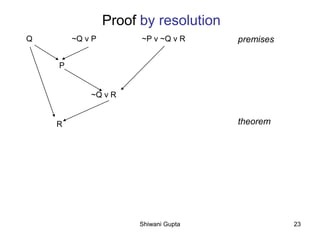
Q ~Q v P ~P v ~Q v R premises
P
~Q v R
R theorem
Proof by resolution
Shiwani Gupta 23
Horn Clauses
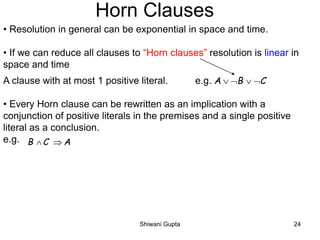
• Resolution in general can be exponential in space and time.
• If we can reduce all clauses to “Horn clauses” resolution is linear in
space and time
A clause with at most 1 positive literal. e.g.
• Every Horn clause can be rewritten as an implication with a
conjunction of positive literals in the premises and a single positive
literal as a conclusion.
e.g.
A B C   
B C A 
Shiwani Gupta 24
Wumpus world in propositional logic
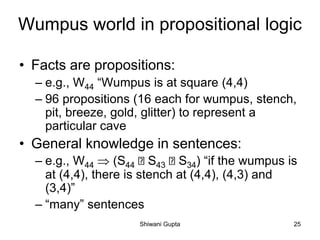
• Facts are propositions:
– e.g., W44 “Wumpus is at square (4,4)
– 96 propositions (16 each for wumpus, stench,
pit, breeze, gold, glitter) to represent a
particular cave
• General knowledge in sentences:
– e.g., W44  (S44 S43 S34) “if the wumpus is
at (4,4), there is stench at (4,4), (4,3) and
(3,4)”
– “many” sentences
Shiwani Gupta 25
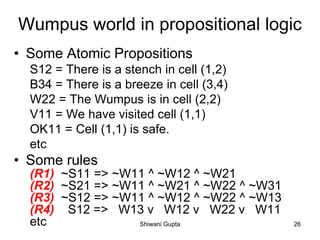
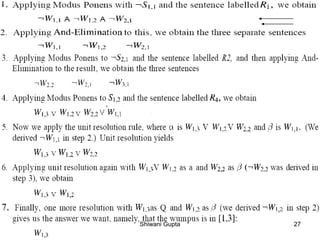
• Some Atomic Propositions
S12 = There is a stench in cell (1,2)
B34 = There is a breeze in cell (3,4)
W22 = The Wumpus is in cell (2,2)
V11 = We have visited cell (1,1)
OK11 = Cell (1,1) is safe.
etc
• Some rules
(R1) ~S11 => ~W11 ^ ~W12 ^ ~W21
(R2) ~S21 => ~W11 ^ ~W21 ^ ~W22 ^ ~W31
(R3) ~S12 => ~W11 ^ ~W12 ^ ~W22 ^ ~W13
(R4) S12 => W13 v W12 v W22 v W11
etc
Wumpus world in propositional logic
Shiwani Gupta 26
Shiwani Gupta 27
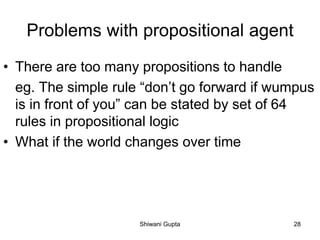
Problems with propositional agent
• There are too many propositions to handle
eg. The simple rule “don’t go forward if wumpus
is in front of you” can be stated by set of 64
rules in propositional logic
• What if the world changes over time
Shiwani Gupta 28
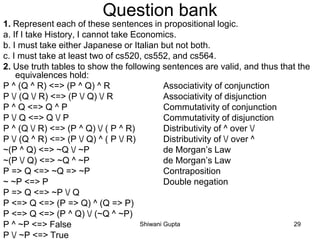
Question bank
1. Represent each of these sentences in propositional logic.
a. If I take History, I cannot take Economics.
b. I must take either Japanese or Italian but not both.
c. I must take at least two of cs520, cs552, and cs564.
2. Use truth tables to show the following sentences are valid, and thus that the
equivalences hold:
P ^ (Q ^ R) <=> (P ^ Q) ^ R Associativity of conjunction
P / (Q / R) <=> (P / Q) / R Associativity of disjunction
P ^ Q <=> Q ^ P Commutativity of conjunction
P / Q <=> Q / P Commutativity of disjunction
P ^ (Q / R) <=> (P ^ Q) / ( P ^ R) Distributivity of ^ over /
P / (Q ^ R) <=> (P / Q) ^ ( P / R) Distributivity of / over ^
~(P ^ Q) <=> ~Q / ~P de Morgan’s Law
~(P / Q) <=> ~Q ^ ~P de Morgan’s Law
P => Q <=> ~Q => ~P Contraposition
~ ~P <=> P Double negation
P => Q <=> ~P / Q
P <=> Q <=> (P => Q) ^ (Q => P)
P <=> Q <=> (P ^ Q) / (~Q ^ ~P)
P ^ ~P <=> False
P / ~P <=> True
Shiwani Gupta 29
Question bank
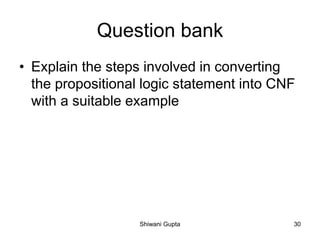
• Explain the steps involved in converting
the propositional logic statement into CNF
with a suitable example
Shiwani Gupta 30
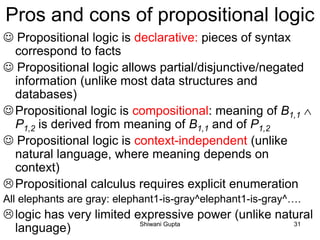
Pros and cons of propositional logic
☺ Propositional logic is declarative: pieces of syntax
correspond to facts
☺ Propositional logic allows partial/disjunctive/negated
information (unlike most data structures and
databases)
☺Propositional logic is compositional: meaning of B1,1 
P1,2 is derived from meaning of B1,1 and of P1,2
☺ Propositional logic is context-independent (unlike
natural language, where meaning depends on
context)
Propositional calculus requires explicit enumeration
All elephants are gray: elephant1-is-gray^elephant1-is-gray^….
logic has very limited expressive power (unlike natural
language) Shiwani Gupta 31
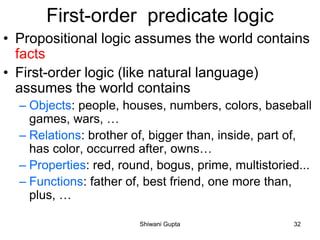
First-order predicate logic
• Propositional logic assumes the world contains
facts
• First-order logic (like natural language)
assumes the world contains
– Objects: people, houses, numbers, colors, baseball
games, wars, …
– Relations: brother of, bigger than, inside, part of,
has color, occurred after, owns…
– Properties: red, round, bogus, prime, multistoried...
– Functions: father of, best friend, one more than,
plus, …
Shiwani Gupta 32
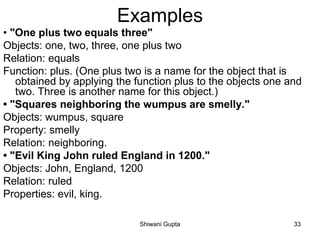
Examples
• "One plus two equals three"
Objects: one, two, three, one plus two
Relation: equals
Function: plus. (One plus two is a name for the object that is
obtained by applying the function plus to the objects one and
two. Three is another name for this object.)
• "Squares neighboring the wumpus are smelly."
Objects: wumpus, square
Property: smelly
Relation: neighboring.
• "Evil King John ruled England in 1200."
Objects: John, England, 1200
Relation: ruled
Properties: evil, king.
Shiwani Gupta 33
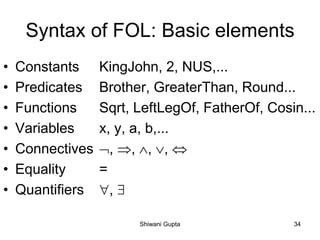
Syntax of FOL: Basic elements
• Constants KingJohn, 2, NUS,...
• Predicates Brother, GreaterThan, Round...
• Functions Sqrt, LeftLegOf, FatherOf, Cosin...
• Variables x, y, a, b,...
• Connectives , , , , 
• Equality =
• Quantifiers , 
Shiwani Gupta 34
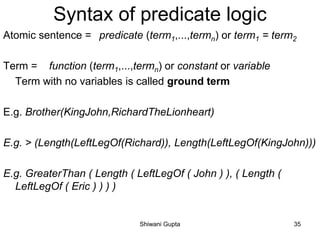
Syntax of predicate logic
Atomic sentence = predicate (term1,...,termn) or term1 = term2
Term = function (term1,...,termn) or constant or variable
Term with no variables is called ground term
E.g. Brother(KingJohn,RichardTheLionheart)
E.g. > (Length(LeftLegOf(Richard)), Length(LeftLegOf(KingJohn)))
E.g. GreaterThan ( Length ( LeftLegOf ( John ) ), ( Length (
LeftLegOf ( Eric ) ) ) )
Shiwani Gupta 35
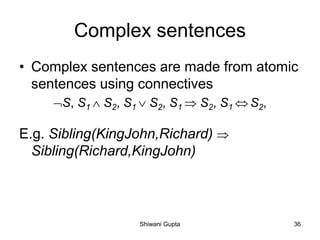
Complex sentences
• Complex sentences are made from atomic
sentences using connectives
S, S1  S2, S1  S2, S1  S2, S1  S2,
E.g. Sibling(KingJohn,Richard) 
Sibling(Richard,KingJohn)
Shiwani Gupta 36
Equality
• term1 = term2 is true under a given interpretation if and
only if term1 and term2 refer to the same object
• e.g., definition of Sibling in terms of Parent:
x,y Sibling(x,y)  [(x = y)  m,f  (m = f) 
Parent(m,x)  Parent(f,x)  Parent(m,y) 
Parent(f,y)]
Shiwani Gupta 37
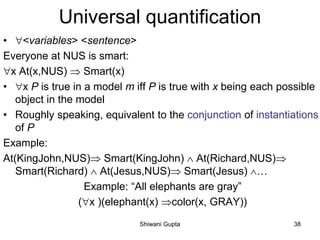
Universal quantification
• <variables> <sentence>
Everyone at NUS is smart:
x At(x,NUS)  Smart(x)
• x P is true in a model m iff P is true with x being each possible
object in the model
• Roughly speaking, equivalent to the conjunction of instantiations
of P
Example:
At(KingJohn,NUS) Smart(KingJohn)  At(Richard,NUS)
Smart(Richard)  At(Jesus,NUS) Smart(Jesus) …
Example: “All elephants are gray”
(x )(elephant(x) color(x, GRAY))
Shiwani Gupta 38
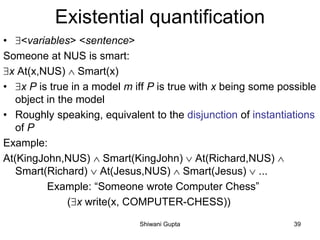
Existential quantification
• <variables> <sentence>
Someone at NUS is smart:
x At(x,NUS)  Smart(x)
• x P is true in a model m iff P is true with x being some possible
object in the model
• Roughly speaking, equivalent to the disjunction of instantiations
of P
Example:
At(KingJohn,NUS)  Smart(KingJohn)  At(Richard,NUS) 
Smart(Richard)  At(Jesus,NUS)  Smart(Jesus)  ...
Example: “Someone wrote Computer Chess”
(x write(x, COMPUTER-CHESS))
Shiwani Gupta 39
Shiwani Gupta 42
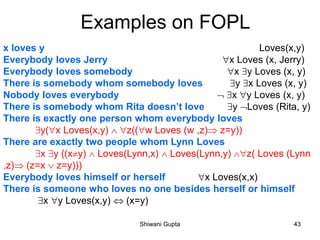
x loves y Loves(x,y)
Everybody loves Jerry x Loves (x, Jerry)
Everybody loves somebody x y Loves (x, y)
There is somebody whom somebody loves y x Loves (x, y)
Nobody loves everybody  x y Loves (x, y)
There is somebody whom Rita doesn’t love y Loves (Rita, y)
There is exactly one person whom everybody loves
y(x Loves(x,y)  z((w Loves (w ,z) z=y))
There are exactly two people whom Lynn Loves
x y ((xy)  Loves(Lynn,x)  Loves(Lynn,y) z( Loves (Lynn
,z) (z=x  z=y)))
Everybody loves himself or herself x Loves(x,x)
There is someone who loves no one besides herself or himself
x y Loves(x,y)  (x=y)
Examples on FOPL
Shiwani Gupta 43
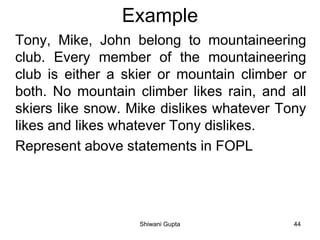
Example
Tony, Mike, John belong to mountaineering
club. Every member of the mountaineering
club is either a skier or mountain climber or
both. No mountain climber likes rain, and all
skiers like snow. Mike dislikes whatever Tony
likes and likes whatever Tony dislikes.
Represent above statements in FOPL
Shiwani Gupta 44
Wumpus world in FOL
• the objects in the environment
– terms: constants, variables, functions
• constants:
– times: 0, 1, 2, ...
– headings: R, L, D, U
– coordinates: 1, 2, 3, 4
– locations: 16 squares
– percepts: Stench, Breeze, Glitter, Bump, Scream, None
– actions: Turn(Left), Turn(Right), Forward, Grab, Shoot
– Agent, Wumpus
• functions:
– Square(x,y) // [x,y]
– Home(Wumpus)
– Perception(s, b, g, h, y)
– Heading(t), Location(t)
Shiwani Gupta 45
Wumpus world in FOL
• predicates: (true or false)
– properties (of one term/object)
• Breezy(t) // agent feeling breeze at time t
• Breeze(s) // breeze blowing on square s
• Pit(s), Gold(s), etc.
• Time(x) // object x is a time
• Coordinate(x), Action(x), Heading(x), etc.
– relations (of multiple terms/objects)
• At(s,t) // agent on square s at time t
• Adjacent (r,s) // squares r and s are adjacent
• Alive(x,t) // x is alive at time t
• Percept(p,t) // perception at time t
• BestAction(a,t) // action a to take at time t
• term = term: (true or false)
– Home(Wumpus) = [3,3]
– Heading(5) = U
Shiwani Gupta 46
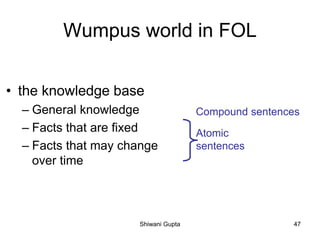
Wumpus world in FOL
• the knowledge base
– General knowledge
– Facts that are fixed
– Facts that may change
over time
Atomic
sentences
Compound sentences
Shiwani Gupta 47
Exploring Wumpus world in FOL
Deciding the best action: Need to reason about the cave conditions
Diagnostic rules (generate hidden causes from observed effects)
∀s Breezy(s) ⇒ ∃r Adjacent(r,s) Pit(r)
Causal rules (some fact causes certain percepts to be generated)
∀r Pit(r) ⇒ [∀s Adjacent(r,s) ⇒ Breezy(s)]
Shiwani Gupta 48
First-Order Logic in Wumpus
World
• Suppose an agent perceives a stench,
breeze, glitter at time t = 5:
– Percept([Stench,Breeze,Glitter,None,None],5)
– [Stench,Breeze, Glitter,None,None] is a list
• Then want to query for an appropriate
action. Find an a (ask the KB):
Query:
∀ a BestAction(a,5)
Sol:
a/Grab Shiwani Gupta 49
Simplifying the percept and
deciding actions
• Simple Reflex Agent
• Agent Keeping Track of the World
• Reflex
)()],,,,,([,,
)()],,,,,([,,
)()],,,,,([,,
tAtGoldtnonenoneGlitterbsPercepttbs
tBreezetnonenonegBreezesPercepttgs
tStenchtnonenonegbStenchPercepttgb



),()( tGrabActiontAtGoldt 
),(),()( tGrabActiontGoldHoldingtAtGoldt 
),()( tGrabBestActiontGlittert  Shiwani Gupta 50
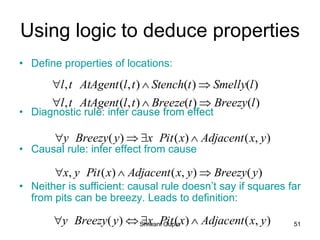
Using logic to deduce properties
• Define properties of locations:
• Diagnostic rule: infer cause from effect
• Causal rule: infer effect from cause
• Neither is sufficient: causal rule doesn’t say if squares far
from pits can be breezy. Leads to definition:
)()(),(,
)()(),(,
lBreezytBreezetlAtAgenttl
lSmellytStenchtlAtAgenttl


),()()( yxAdjacentxPitxyBreezyy 
)(),()(, yBreezyyxAdjacentxPityx 
),()()( yxAdjacentxPitxyBreezyy  Shiwani Gupta 51
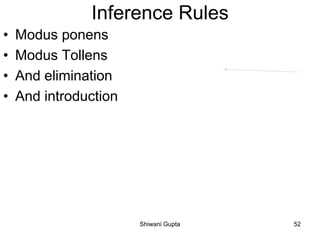
Inference Rules
• Modus ponens
• Modus Tollens
• And elimination
• And introduction
Shiwani Gupta 52
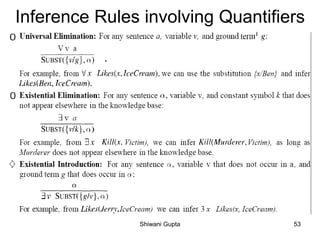
Inference Rules involving Quantifiers
Shiwani Gupta 53
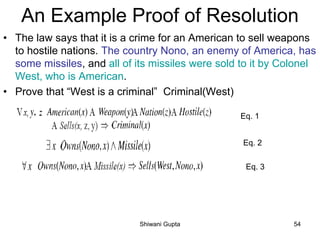
An Example Proof of Resolution
• The law says that it is a crime for an American to sell weapons
to hostile nations. The country Nono, an enemy of America, has
some missiles, and all of its missiles were sold to it by Colonel
West, who is American.
• Prove that “West is a criminal” Criminal(West)
Eq. 1
Eq. 2
Eq. 3
Shiwani Gupta 54
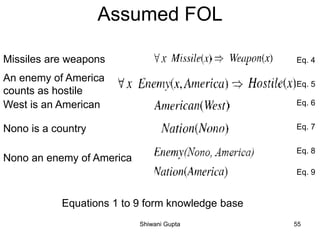
Assumed FOL
Missiles are weapons
An enemy of America
counts as hostile
West is an American
Nono is a country
Nono an enemy of America
Eq. 4
Eq. 5
Eq. 6
Eq. 7
Eq. 9
Eq. 8
Equations 1 to 9 form knowledge base
Shiwani Gupta 55
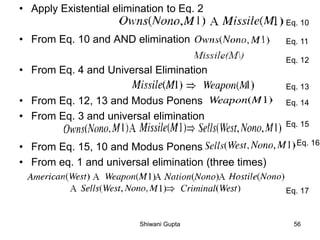
• Apply Existential elimination to Eq. 2
• From Eq. 10 and AND elimination
• From Eq. 4 and Universal Elimination
• From Eq. 12, 13 and Modus Ponens
• From Eq. 3 and universal elimination
• From Eq. 15, 10 and Modus Ponens
• From eq. 1 and universal elimination (three times)
Eq. 10
Eq. 11
Eq. 12
Eq. 13
Eq. 14
Eq. 15
Eq. 16
Eq. 17
Shiwani Gupta 56
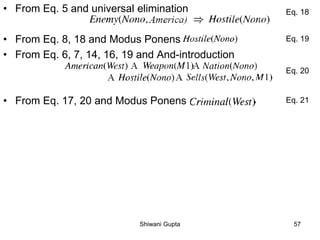
• From Eq. 5 and universal elimination
• From Eq. 8, 18 and Modus Ponens
• From Eq. 6, 7, 14, 16, 19 and And-introduction
• From Eq. 17, 20 and Modus Ponens
Eq. 18
Eq. 19
Eq. 20
Eq. 21
Shiwani Gupta 57
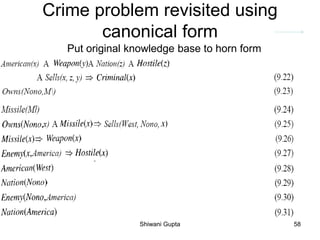
Crime problem revisited using
canonical form
Put original knowledge base to horn form
Shiwani Gupta 58
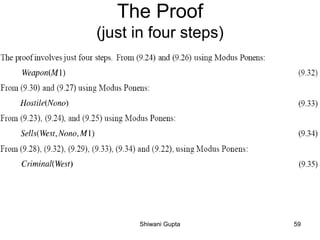
The Proof
(just in four steps)
Shiwani Gupta 59
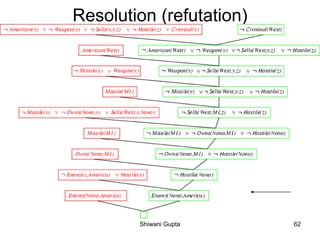
Resolution (refutation)
Shiwani Gupta 62
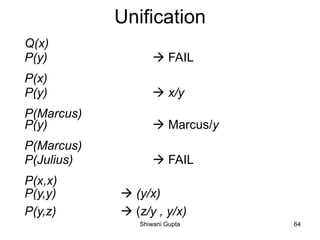
Unification
Q(x)
P(y) → FAIL
P(x)
P(y) → x/y
P(Marcus)
P(y) → Marcus/y
P(Marcus)
P(Julius) → FAIL
P(x,x)
P(y,y) → (y/x)
P(y,z) → (z/y , y/x)
Shiwani Gupta 64
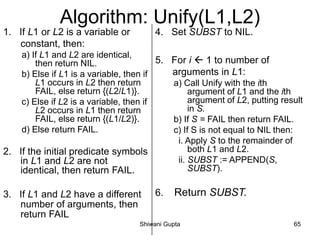
Algorithm: Unify(L1,L2)
1. If L1 or L2 is a variable or
constant, then:
a) If L1 and L2 are identical,
then return NIL.
b) Else if L1 is a variable, then if
L1 occurs in L2 then return
FAIL, else return {(L2/L1)}.
c) Else if L2 is a variable, then if
L2 occurs in L1 then return
FAIL, else return {(L1/L2)}.
d) Else return FAIL.
2. If the initial predicate symbols
in L1 and L2 are not
identical, then return FAIL.
3. If L1 and L2 have a different
number of arguments, then
return FAIL
4. Set SUBST to NIL.
5. For i  1 to number of
arguments in L1:
a) Call Unify with the ith
argument of L1 and the ith
argument of L2, putting result
in S.
b) If S = FAIL then return FAIL.
c) If S is not equal to NIL then:
i. Apply S to the remainder of
both L1 and L2.
ii. SUBST := APPEND(S,
SUBST).
6. Return SUBST.
Shiwani Gupta 65
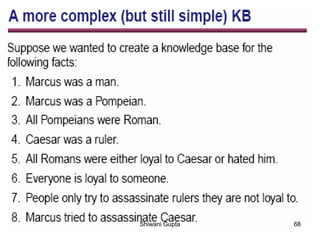
Shiwani Gupta 68
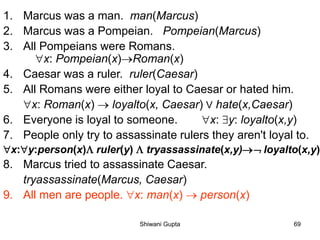
1. Marcus was a man. man(Marcus)
2. Marcus was a Pompeian. Pompeian(Marcus)
3. All Pompeians were Romans.
x: Pompeian(x)→Roman(x)
4. Caesar was a ruler. ruler(Caesar)
5. All Romans were either loyal to Caesar or hated him.
x: Roman(x) → loyalto(x, Caesar) V hate(x,Caesar)
6. Everyone is loyal to someone. x: y: loyalto(x,y)
7. People only try to assassinate rulers they aren't loyal to.
x:y:person(x) ruler(y)  tryassassinate(x,y)→ loyalto(x,y)
8. Marcus tried to assassinate Caesar.
tryassassinate(Marcus, Caesar)
9. All men are people. x: man(x) → person(x)
Shiwani Gupta 69
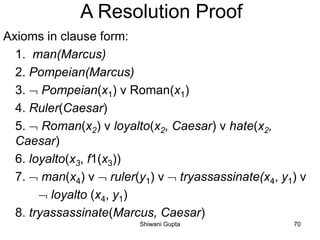
A Resolution Proof
Axioms in clause form:
1. man(Marcus)
2. Pompeian(Marcus)
3.  Pompeian(x1) v Roman(x1)
4. Ruler(Caesar)
5.  Roman(x2) v loyalto(x2, Caesar) v hate(x2,
Caesar)
6. loyalto(x3, f1(x3))
7.  man(x4) v  ruler(y1) v  tryassassinate(x4, y1) v
 loyalto (x4, y1)
8. tryassassinate(Marcus, Caesar)
Shiwani Gupta 70
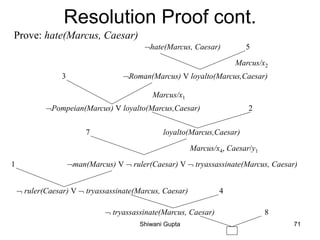
Resolution Proof cont.
Prove: hate(Marcus, Caesar)
hate(Marcus, Caesar)
Roman(Marcus) V loyalto(Marcus,Caesar)
Marcus/x2
5
3
2
7
1
4
8
Marcus/x1
Pompeian(Marcus) V loyalto(Marcus,Caesar)
loyalto(Marcus,Caesar)
Marcus/x4, Caesar/y1
man(Marcus) V  ruler(Caesar) V  tryassassinate(Marcus, Caesar)
 ruler(Caesar) V  tryassassinate(Marcus, Caesar)
 tryassassinate(Marcus, Caesar)
Shiwani Gupta 71
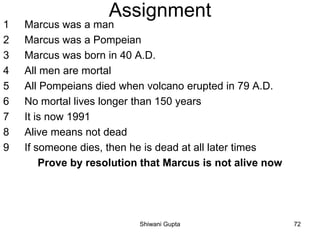
Assignment
1 Marcus was a man
2 Marcus was a Pompeian
3 Marcus was born in 40 A.D.
4 All men are mortal
5 All Pompeians died when volcano erupted in 79 A.D.
6 No mortal lives longer than 150 years
7 It is now 1991
8 Alive means not dead
9 If someone dies, then he is dead at all later times
Prove by resolution that Marcus is not alive now
Shiwani Gupta 72
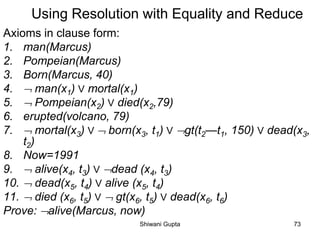
Using Resolution with Equality and Reduce
Axioms in clause form:
1. man(Marcus)
2. Pompeian(Marcus)
3. Born(Marcus, 40)
4.  man(x1) V mortal(x1)
5.  Pompeian(x2) V died(x2,79)
6. erupted(volcano, 79)
7.  mortal(x3) V  born(x3, t1) V gt(t2—t1, 150) V dead(x3,
t2)
8. Now=1991
9.  alive(x4, t3) V dead (x4, t3)
10.  dead(x5, t4) V alive (x5, t4)
11.  died (x6, t5) V  gt(x6, t5) V dead(x6, t6)
Prove: alive(Marcus, now)
Shiwani Gupta 73
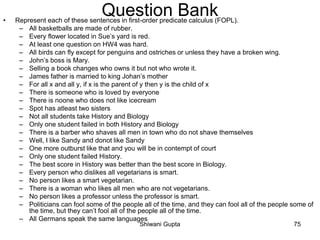
Question Bank• Represent each of these sentences in first-order predicate calculus (FOPL).
– All basketballs are made of rubber.
– Every flower located in Sue’s yard is red.
– At least one question on HW4 was hard.
– All birds can fly except for penguins and ostriches or unless they have a broken wing.
– John’s boss is Mary.
– Selling a book changes who owns it but not who wrote it.
– James father is married to king Johan’s mother
– For all x and all y, if x is the parent of y then y is the child of x
– There is someone who is loved by everyone
– There is noone who does not like icecream
– Spot has atleast two sisters
– Not all students take History and Biology
– Only one student failed in both History and Biology
– There is a barber who shaves all men in town who do not shave themselves
– Well, I like Sandy and donot like Sandy
– One more outburst like that and you will be in contempt of court
– Only one student failed History.
– The best score in History was better than the best score in Biology.
– Every person who dislikes all vegetarians is smart.
– No person likes a smart vegetarian.
– There is a woman who likes all men who are not vegetarians.
– No person likes a professor unless the professor is smart.
– Politicians can fool some of the people all of the time, and they can fool all of the people some of
the time, but they can’t fool all of the people all of the time.
– All Germans speak the same languages
Shiwani Gupta 75
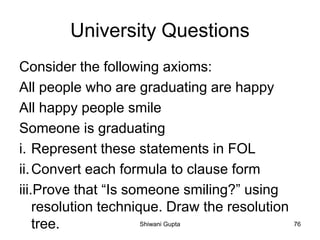
University Questions
Consider the following axioms:
All people who are graduating are happy
All happy people smile
Someone is graduating
i. Represent these statements in FOL
ii.Convert each formula to clause form
iii.Prove that “Is someone smiling?” using
resolution technique. Draw the resolution
tree. Shiwani Gupta 76
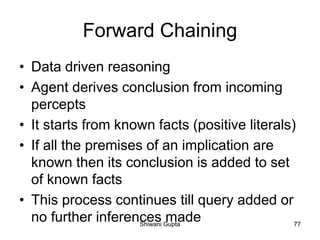
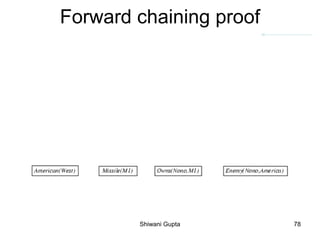
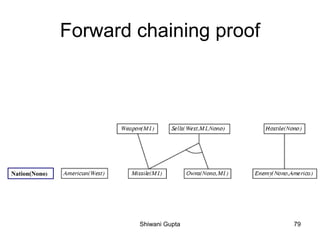
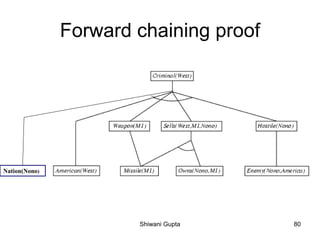
Forward Chaining
• Data driven reasoning
• Agent derives conclusion from incoming
percepts
• It starts from known facts (positive literals)
• If all the premises of an implication are
known then its conclusion is added to set
of known facts
• This process continues till query added or
no further inferences madeShiwani Gupta 77
Forward chaining proof
Shiwani Gupta 78
Forward chaining proof
Nation(Nono)
Shiwani Gupta 79
Forward chaining proof
Nation(Nono)
Shiwani Gupta 80
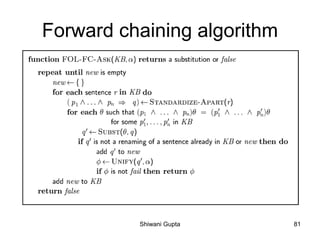
Forward chaining algorithm
Shiwani Gupta 81
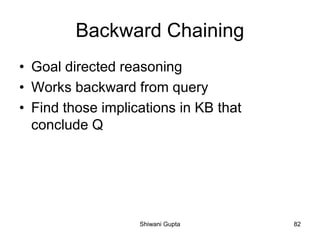
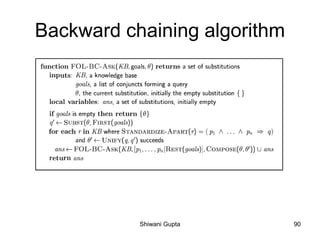
Backward Chaining
• Goal directed reasoning
• Works backward from query
• Find those implications in KB that
conclude Q
Shiwani Gupta 82
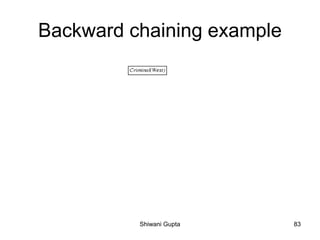
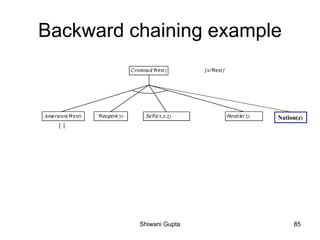
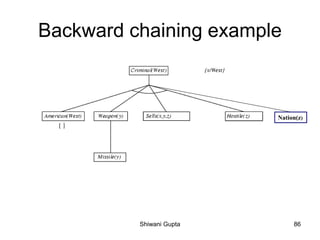
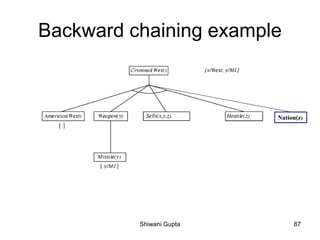
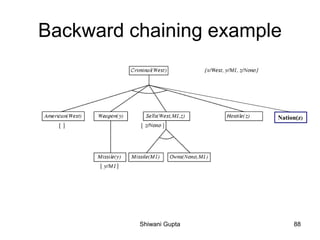
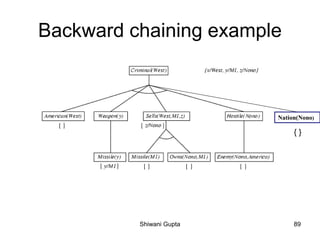
Backward chaining example
Shiwani Gupta 83
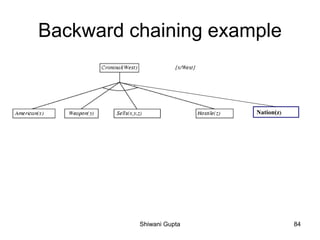
Backward chaining example
Nation(z)
Shiwani Gupta 84
Backward chaining example
Nation(z)
Shiwani Gupta 85
Backward chaining example
Nation(z)
Shiwani Gupta 86
Backward chaining example
Nation(z)
Shiwani Gupta 87
Backward chaining example
Nation(z)
Shiwani Gupta 88
Backward chaining example
Nation(Nono)
{ }
Shiwani Gupta 89
Backward chaining algorithm
Shiwani Gupta 90
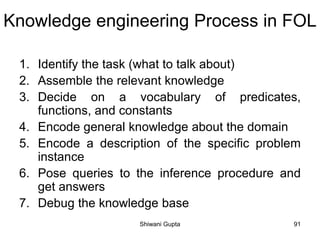
Knowledge engineering Process in FOL
1. Identify the task (what to talk about)
2. Assemble the relevant knowledge
3. Decide on a vocabulary of predicates,
functions, and constants
4. Encode general knowledge about the domain
5. Encode a description of the specific problem
instance
6. Pose queries to the inference procedure and
get answers
7. Debug the knowledge base
Shiwani Gupta 91
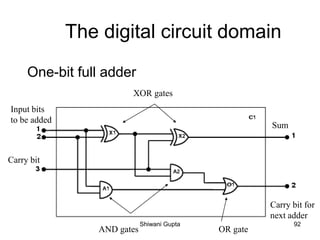
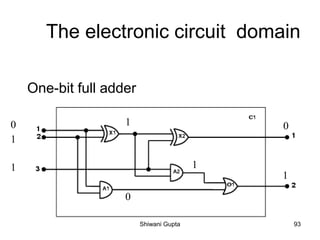
The digital circuit domain
One-bit full adder
Input bits
to be added
Carry bit
XOR gates
AND gates OR gate
Sum
Carry bit for
next adder
Shiwani Gupta 92
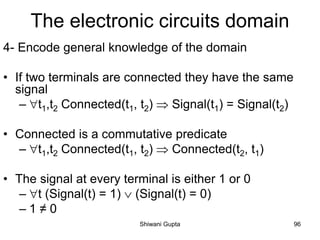
The electronic circuit domain
One-bit full adder
0
1
1
1 0
0
1
1
Shiwani Gupta 93
The electronic circuits domain
1. Identify the task
– Does the circuit actually add properly? (circuit verification)
2. Assemble the relevant knowledge
– Composed of wires and gates; Types of gates (AND, OR,
XOR, NOT)
– Irrelevant: size, shape, color, cost of gates
3. Decide on a vocabulary
– Alternatives:
Type(X1) = XOR
Type(X1, XOR)
XOR(X1)
Shiwani Gupta 94
Gates or circuits can have one or more input terminals and one
or more output terminals.
E.g. the function In(1,X1) denotes the first input terminal for
gate X1.
Connectivity between gates can be represented by a
predicate:
Connected(Out(1,X1),In(1,X2))
Signal has to be on or off –
Signal(t) this function takes terminal as an argument and returns
the signal value for that terminal.
Two constants – 1 and 0.
Shiwani Gupta 95
The electronic circuits domain
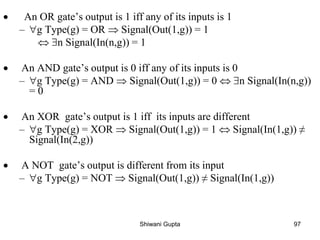
4- Encode general knowledge of the domain
• If two terminals are connected they have the same
signal
– t1,t2 Connected(t1, t2)  Signal(t1) = Signal(t2)
• Connected is a commutative predicate
– t1,t2 Connected(t1, t2)  Connected(t2, t1)
• The signal at every terminal is either 1 or 0
– t (Signal(t) = 1)  (Signal(t) = 0)
– 1 ≠ 0
Shiwani Gupta 96
• An OR gate’s output is 1 iff any of its inputs is 1
– g Type(g) = OR  Signal(Out(1,g)) = 1
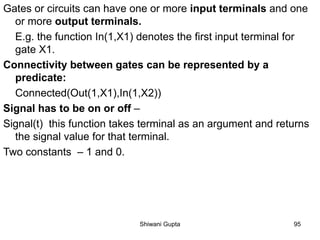
 n Signal(In(n,g)) = 1
• An AND gate’s output is 0 iff any of its inputs is 0
– g Type(g) = AND  Signal(Out(1,g)) = 0  n Signal(In(n,g))
= 0
• An XOR gate’s output is 1 iff its inputs are different
– g Type(g) = XOR  Signal(Out(1,g)) = 1  Signal(In(1,g)) ≠
Signal(In(2,g))
• A NOT gate’s output is different from its input
– g Type(g) = NOT  Signal(Out(1,g)) ≠ Signal(In(1,g))
Shiwani Gupta 97
The electronic circuits domain
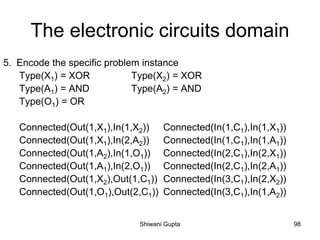
5. Encode the specific problem instance
Type(X1) = XOR Type(X2) = XOR
Type(A1) = AND Type(A2) = AND
Type(O1) = OR
Connected(Out(1,X1),In(1,X2)) Connected(In(1,C1),In(1,X1))
Connected(Out(1,X1),In(2,A2)) Connected(In(1,C1),In(1,A1))
Connected(Out(1,A2),In(1,O1)) Connected(In(2,C1),In(2,X1))
Connected(Out(1,A1),In(2,O1)) Connected(In(2,C1),In(2,A1))
Connected(Out(1,X2),Out(1,C1)) Connected(In(3,C1),In(2,X2))
Connected(Out(1,O1),Out(2,C1)) Connected(In(3,C1),In(1,A2))
Shiwani Gupta 98
The electronic circuits domain
6 - Pose queries to the inference procedure
• What are the possible sets of values of the input of the adder
circuit that lead to a signal of 0 for the sum output bit and a
value of 1 for the carry output terminal?
i1,i2,i3 (Signal(In(1,C1))= i1)  (Signal(In(2,C1)) = i2)
(Signal(In(3,C1)) = i3)  (Signal(Out(1,C1)) = 0 
Signal(Out(2,C1)) = 1)
Answer: (i1 = 1; i2 = 1; i3 = 0) or ((i1 = 1; i2 = 0; i3 = 1) or (i1 = 0;
i2 = 1; i3 = 0)
• What are the possible sets of values of all the terminals of the
adder circuit?
i1,i2,i3,o1,o2 (Signal(In(1,C1)) = i1)  (Signal(In(2,C1)) = i2) 
(Signal(In(3,C1)) = i3)  (Signal(Out(1,C1)) = o1 
Signal(Out(2,C1)) = o2)
7 - Debug the knowledge base
Shiwani Gupta 99

Knowledge based agent

  • 1.
  • 2.
    Knowledge based agent •We design agents that can form representations of the world • Agents that use a process of inference to derive new representations about the world • and agents that use these new representations to deduce what to do • A knowledge-based agent needs to know many things: – the current state of the world – how to infer unseen properties of the world from percepts – how the world evolves over time – what it wants to achieve – what its own actions do in various circumstances Shiwani Gupta 2
  • 3.
    Knowledge Base (set ofrepresentations of facts about the world) • The knowledge level or epistemological level is the most abstract; we can describe the agent by saying what it knows. For example, an automated taxi might be said to know that the Golden Gate Bridge links San Francisco and Marin County. • The logical level is the level at which the knowledge is encoded into sentences. For example, the taxi might be described as having the logical sentence Links(GGBridge, SF, Marin) in its knowledge base. • The implementation level is the level that runs on the agent architecture. It is the level at which there are physical representations of the sentences at the logical level. A sentence such as Links(GGBridge, SF, Marin) could be represented in the KB by the string "Links (GGBridge, SF, Marin)" contained in a list of strings; or by a "1" entry in a three-dimensional table indexed by road links and location pairs; or by a complex set of pointers connecting machine addresses corresponding to the individual symbols. The choice of implementation is very important to the efficient performance of the agent, but it is irrelevant to the logical level and the knowledge level. Shiwani Gupta 3
  • 4.
    4 • The Inferenceengine derives new sentences from the input and KB • The inference mechanism depends on representation in KB • The agent operates as follows: 1. It receives percepts from environment 2. It computes what action it should perform (by IE and KB) 3. It performs the chosen action (some actions are simply inserting inferred new facts into KB). Knowledge Base Inference Engine Input from environment Output (actions) Learning (KB update) Shiwani Gupta
  • 5.
    Example – KnowledgeBased Agent • A classical AI problem • An early computer game • An agent had to explore a cave made of series of interconnected rooms • In one room, there was a Wumpus who would kill agent if it entered the room • Some rooms have pits – agent would die if it entered it • Agent had 1 arrow to kill Wumpus • Goal – Locate gold and return to start without getting killed. Shiwani Gupta 5
  • 6.
  • 7.
    The Wumpus World environment •The Wumpus computer game • The agent explores a cave consisting of rooms connected by passageways. • Lurking somewhere in the cave is the Wumpus, a beast that eats any agent that enters its room. • Some rooms contain bottomless pits that trap any agent that wanders into the room. • It is safe to enter a square with dead Wumpus. • Occasionally, there is a heap of gold in a room. • The goal is: – to collect the gold and – exit the world (climb out of cave) – without being eaten Shiwani Gupta 7
  • 8.
    Wumpus World PEASdescription • Performance measure: – gold +1000, death -10000 – -1 per step, -10 for using the arrow • Environment: – Squares adjacent to wumpus are smelly – Squares adjacent to pit are breezy – Glitter iff gold is in the same square – Shooting kills wumpus if you are facing it, it screams – Shooting uses up the only arrow – Grabbing picks up gold if in same square – Releasing drops the gold in same square – You bump if you walk into a wall • Actuators: Left turn, Right turn, Forward, Grab, Climb, Shoot • Sensors: Stench, Breeze, Glitter, Bump, Scream Shiwani Gupta 8
  • 9.
    Wumpus world characterization •Fully Observable No – only local perception • Deterministic Yes – outcomes exactly specified • Episodic No – since no need to think ahead • Static Yes – Wumpus and Pits do not move • Discrete Yes • Single-agent Yes – Wumpus is essentially a natural feature Shiwani Gupta 9
  • 10.
    The first steptaken by the agent in the wumpus world, (a)The initial situation, after percept [None, None, None, None, None]. (b)After one move, with percept [None, Breeze, None, None, None]. [ stench,  breeze,  glitter,  bump,  scream] [1,1] [stench,  breeze,  glitter,  bump,  scream] [1,2] [ stench, breeze,  glitter,  bump,  scream] [2,1] → Safe cell Shiwani Gupta 10
  • 11.
    Two later stagesin the progress of the agent, (a) After the third move, with percept [Stench, None, None, None, None]. (b) After the fifth move, with percept [Stench, Breeze, Glitter, None, None]. Shiwani Gupta 11
  • 12.
    Propositional logic: Syntax (limitedexpressiveness) • Propositional logic is the simplest logic – illustrates basic ideas • The proposition symbols P1, P2 etc are sentences – If S is a sentence, S is a sentence (negation) – If S1 and S2 are sentences, S1  S2 is a sentence (conjunction) – If S1 and S2 are sentences, S1  S2 is a sentence (disjunction) – If S1 and S2 are sentences, S1  S2 is a sentence (implication) – If S1 and S2 are sentences, S1  S2 is a sentence (biconditional) Shiwani Gupta 12
  • 13.
    Symbols of propositionallogic • Logical constants TRUE and FALSE are sentences • Proposition symbols P and Q are sentences • A, V, , , are logical connectives • parenthesis ( ) Shiwani Gupta 13
  • 14.
    Ambiguity • P AQ V R (P A Q) V R P A (Q V R) • Order of precedence (highest to lowest) Shiwani Gupta 14
  • 15.
    Propositional logic: Semantics Eachmodel specifies true/false for each proposition symbol E.g. P1,2 P2,2 P3,1 false true false With these symbols, 8 possible models, can be enumerated automatically. Rules for evaluating truth with respect to a model m: S is true iff S is false S1  S2 is true iff S1 is true and S2 is true S1  S2 is true iff S1is true or S2 is true S1  S2 is true iff S1 is false or S2 is true i.e., is false iff S1 is true and S2 is false S1  S2 is true iff S1S2 is true and S2S1 is true Simple recursive process evaluates an arbitrary sentence, e.g., P1,2  (P2,2  P3,1) = true  (true  false) = true  true = true Shiwani Gupta 15
  • 16.
    Truth tables forconnectives If P then Q If same then true else false If P then Q and If Q then P Shiwani Gupta 16
  • 17.
  • 18.
    Logical equivalence • Twosentences are logically equivalent iff true in same models: α ≡ ß iff α╞ β and β╞ α Shiwani Gupta 18
  • 19.
  • 20.
    DNF (SOP) toCNF (POS) for resolution refutation Disjunctive Normal Form (P  Q  R) V (X   Y  Z) Conjunctive Normal Form ( P V X)  (P V  Y)  (P V Z)  (…..) Every sentence of propositional logic is logically equivalent to a conjunction of disjuncts of literals Shiwani Gupta 20
  • 21.
    Conversion to CNF •Eliminate α ß to (α  ß )  (ß  α ) • Eliminate α  ß to  α V ß • CNF requires  to appear only with literals For this apply ( α) ≡ α (double-negative elimination)  (α  ß) ≡  α V  ß (de Morgan)  (α V ß) ≡  α   ß (de Morgan) • Now we have a sentence with nested  and V operators applied to literals. Apply distributivity law distributing V over  Shiwani Gupta 21
  • 22.
    Resolution Inference Rulefor CNF ( ) ( ) ( ) A B C A B C    − − − − − − − − − − − −   “If A or B or C is true, but not A, then B or C must be true.” ( ) ( ) ( ) A B C A D E B C D E      − − − − − − − − − − −     “If A is false then B or C must be true, or if A is true then D or E must be true, hence since A is either true or false, B or C or D or E must be true.” ( ) ( ) ( ) A B A B B B B    − − − − − − − −    Simplification Shiwani Gupta 22
  • 23.
    Q ~Q vP ~P v ~Q v R premises P ~Q v R R theorem Proof by resolution Shiwani Gupta 23
  • 24.
    Horn Clauses • Resolutionin general can be exponential in space and time. • If we can reduce all clauses to “Horn clauses” resolution is linear in space and time A clause with at most 1 positive literal. e.g. • Every Horn clause can be rewritten as an implication with a conjunction of positive literals in the premises and a single positive literal as a conclusion. e.g. A B C    B C A  Shiwani Gupta 24
  • 25.
    Wumpus world inpropositional logic • Facts are propositions: – e.g., W44 “Wumpus is at square (4,4) – 96 propositions (16 each for wumpus, stench, pit, breeze, gold, glitter) to represent a particular cave • General knowledge in sentences: – e.g., W44  (S44 S43 S34) “if the wumpus is at (4,4), there is stench at (4,4), (4,3) and (3,4)” – “many” sentences Shiwani Gupta 25
  • 26.
    • Some AtomicPropositions S12 = There is a stench in cell (1,2) B34 = There is a breeze in cell (3,4) W22 = The Wumpus is in cell (2,2) V11 = We have visited cell (1,1) OK11 = Cell (1,1) is safe. etc • Some rules (R1) ~S11 => ~W11 ^ ~W12 ^ ~W21 (R2) ~S21 => ~W11 ^ ~W21 ^ ~W22 ^ ~W31 (R3) ~S12 => ~W11 ^ ~W12 ^ ~W22 ^ ~W13 (R4) S12 => W13 v W12 v W22 v W11 etc Wumpus world in propositional logic Shiwani Gupta 26
  • 27.
  • 28.
    Problems with propositionalagent • There are too many propositions to handle eg. The simple rule “don’t go forward if wumpus is in front of you” can be stated by set of 64 rules in propositional logic • What if the world changes over time Shiwani Gupta 28
  • 29.
    Question bank 1. Representeach of these sentences in propositional logic. a. If I take History, I cannot take Economics. b. I must take either Japanese or Italian but not both. c. I must take at least two of cs520, cs552, and cs564. 2. Use truth tables to show the following sentences are valid, and thus that the equivalences hold: P ^ (Q ^ R) <=> (P ^ Q) ^ R Associativity of conjunction P / (Q / R) <=> (P / Q) / R Associativity of disjunction P ^ Q <=> Q ^ P Commutativity of conjunction P / Q <=> Q / P Commutativity of disjunction P ^ (Q / R) <=> (P ^ Q) / ( P ^ R) Distributivity of ^ over / P / (Q ^ R) <=> (P / Q) ^ ( P / R) Distributivity of / over ^ ~(P ^ Q) <=> ~Q / ~P de Morgan’s Law ~(P / Q) <=> ~Q ^ ~P de Morgan’s Law P => Q <=> ~Q => ~P Contraposition ~ ~P <=> P Double negation P => Q <=> ~P / Q P <=> Q <=> (P => Q) ^ (Q => P) P <=> Q <=> (P ^ Q) / (~Q ^ ~P) P ^ ~P <=> False P / ~P <=> True Shiwani Gupta 29
  • 30.
    Question bank • Explainthe steps involved in converting the propositional logic statement into CNF with a suitable example Shiwani Gupta 30
  • 31.
    Pros and consof propositional logic ☺ Propositional logic is declarative: pieces of syntax correspond to facts ☺ Propositional logic allows partial/disjunctive/negated information (unlike most data structures and databases) ☺Propositional logic is compositional: meaning of B1,1  P1,2 is derived from meaning of B1,1 and of P1,2 ☺ Propositional logic is context-independent (unlike natural language, where meaning depends on context) Propositional calculus requires explicit enumeration All elephants are gray: elephant1-is-gray^elephant1-is-gray^…. logic has very limited expressive power (unlike natural language) Shiwani Gupta 31
  • 32.
    First-order predicate logic •Propositional logic assumes the world contains facts • First-order logic (like natural language) assumes the world contains – Objects: people, houses, numbers, colors, baseball games, wars, … – Relations: brother of, bigger than, inside, part of, has color, occurred after, owns… – Properties: red, round, bogus, prime, multistoried... – Functions: father of, best friend, one more than, plus, … Shiwani Gupta 32
  • 33.
    Examples • "One plustwo equals three" Objects: one, two, three, one plus two Relation: equals Function: plus. (One plus two is a name for the object that is obtained by applying the function plus to the objects one and two. Three is another name for this object.) • "Squares neighboring the wumpus are smelly." Objects: wumpus, square Property: smelly Relation: neighboring. • "Evil King John ruled England in 1200." Objects: John, England, 1200 Relation: ruled Properties: evil, king. Shiwani Gupta 33
  • 34.
    Syntax of FOL:Basic elements • Constants KingJohn, 2, NUS,... • Predicates Brother, GreaterThan, Round... • Functions Sqrt, LeftLegOf, FatherOf, Cosin... • Variables x, y, a, b,... • Connectives , , , ,  • Equality = • Quantifiers ,  Shiwani Gupta 34
  • 35.
    Syntax of predicatelogic Atomic sentence = predicate (term1,...,termn) or term1 = term2 Term = function (term1,...,termn) or constant or variable Term with no variables is called ground term E.g. Brother(KingJohn,RichardTheLionheart) E.g. > (Length(LeftLegOf(Richard)), Length(LeftLegOf(KingJohn))) E.g. GreaterThan ( Length ( LeftLegOf ( John ) ), ( Length ( LeftLegOf ( Eric ) ) ) ) Shiwani Gupta 35
  • 36.
    Complex sentences • Complexsentences are made from atomic sentences using connectives S, S1  S2, S1  S2, S1  S2, S1  S2, E.g. Sibling(KingJohn,Richard)  Sibling(Richard,KingJohn) Shiwani Gupta 36
  • 37.
    Equality • term1 =term2 is true under a given interpretation if and only if term1 and term2 refer to the same object • e.g., definition of Sibling in terms of Parent: x,y Sibling(x,y)  [(x = y)  m,f  (m = f)  Parent(m,x)  Parent(f,x)  Parent(m,y)  Parent(f,y)] Shiwani Gupta 37
  • 38.
    Universal quantification • <variables><sentence> Everyone at NUS is smart: x At(x,NUS)  Smart(x) • x P is true in a model m iff P is true with x being each possible object in the model • Roughly speaking, equivalent to the conjunction of instantiations of P Example: At(KingJohn,NUS) Smart(KingJohn)  At(Richard,NUS) Smart(Richard)  At(Jesus,NUS) Smart(Jesus) … Example: “All elephants are gray” (x )(elephant(x) color(x, GRAY)) Shiwani Gupta 38
  • 39.
    Existential quantification • <variables><sentence> Someone at NUS is smart: x At(x,NUS)  Smart(x) • x P is true in a model m iff P is true with x being some possible object in the model • Roughly speaking, equivalent to the disjunction of instantiations of P Example: At(KingJohn,NUS)  Smart(KingJohn)  At(Richard,NUS)  Smart(Richard)  At(Jesus,NUS)  Smart(Jesus)  ... Example: “Someone wrote Computer Chess” (x write(x, COMPUTER-CHESS)) Shiwani Gupta 39
  • 40.
  • 41.
    x loves yLoves(x,y) Everybody loves Jerry x Loves (x, Jerry) Everybody loves somebody x y Loves (x, y) There is somebody whom somebody loves y x Loves (x, y) Nobody loves everybody  x y Loves (x, y) There is somebody whom Rita doesn’t love y Loves (Rita, y) There is exactly one person whom everybody loves y(x Loves(x,y)  z((w Loves (w ,z) z=y)) There are exactly two people whom Lynn Loves x y ((xy)  Loves(Lynn,x)  Loves(Lynn,y) z( Loves (Lynn ,z) (z=x  z=y))) Everybody loves himself or herself x Loves(x,x) There is someone who loves no one besides herself or himself x y Loves(x,y)  (x=y) Examples on FOPL Shiwani Gupta 43
  • 42.
    Example Tony, Mike, Johnbelong to mountaineering club. Every member of the mountaineering club is either a skier or mountain climber or both. No mountain climber likes rain, and all skiers like snow. Mike dislikes whatever Tony likes and likes whatever Tony dislikes. Represent above statements in FOPL Shiwani Gupta 44
  • 43.
    Wumpus world inFOL • the objects in the environment – terms: constants, variables, functions • constants: – times: 0, 1, 2, ... – headings: R, L, D, U – coordinates: 1, 2, 3, 4 – locations: 16 squares – percepts: Stench, Breeze, Glitter, Bump, Scream, None – actions: Turn(Left), Turn(Right), Forward, Grab, Shoot – Agent, Wumpus • functions: – Square(x,y) // [x,y] – Home(Wumpus) – Perception(s, b, g, h, y) – Heading(t), Location(t) Shiwani Gupta 45
  • 44.
    Wumpus world inFOL • predicates: (true or false) – properties (of one term/object) • Breezy(t) // agent feeling breeze at time t • Breeze(s) // breeze blowing on square s • Pit(s), Gold(s), etc. • Time(x) // object x is a time • Coordinate(x), Action(x), Heading(x), etc. – relations (of multiple terms/objects) • At(s,t) // agent on square s at time t • Adjacent (r,s) // squares r and s are adjacent • Alive(x,t) // x is alive at time t • Percept(p,t) // perception at time t • BestAction(a,t) // action a to take at time t • term = term: (true or false) – Home(Wumpus) = [3,3] – Heading(5) = U Shiwani Gupta 46
  • 45.
    Wumpus world inFOL • the knowledge base – General knowledge – Facts that are fixed – Facts that may change over time Atomic sentences Compound sentences Shiwani Gupta 47
  • 46.
    Exploring Wumpus worldin FOL Deciding the best action: Need to reason about the cave conditions Diagnostic rules (generate hidden causes from observed effects) ∀s Breezy(s) ⇒ ∃r Adjacent(r,s) Pit(r) Causal rules (some fact causes certain percepts to be generated) ∀r Pit(r) ⇒ [∀s Adjacent(r,s) ⇒ Breezy(s)] Shiwani Gupta 48
  • 47.
    First-Order Logic inWumpus World • Suppose an agent perceives a stench, breeze, glitter at time t = 5: – Percept([Stench,Breeze,Glitter,None,None],5) – [Stench,Breeze, Glitter,None,None] is a list • Then want to query for an appropriate action. Find an a (ask the KB): Query: ∀ a BestAction(a,5) Sol: a/Grab Shiwani Gupta 49
  • 48.
    Simplifying the perceptand deciding actions • Simple Reflex Agent • Agent Keeping Track of the World • Reflex )()],,,,,([,, )()],,,,,([,, )()],,,,,([,, tAtGoldtnonenoneGlitterbsPercepttbs tBreezetnonenonegBreezesPercepttgs tStenchtnonenonegbStenchPercepttgb    ),()( tGrabActiontAtGoldt  ),(),()( tGrabActiontGoldHoldingtAtGoldt  ),()( tGrabBestActiontGlittert  Shiwani Gupta 50
  • 49.
    Using logic todeduce properties • Define properties of locations: • Diagnostic rule: infer cause from effect • Causal rule: infer effect from cause • Neither is sufficient: causal rule doesn’t say if squares far from pits can be breezy. Leads to definition: )()(),(, )()(),(, lBreezytBreezetlAtAgenttl lSmellytStenchtlAtAgenttl   ),()()( yxAdjacentxPitxyBreezyy  )(),()(, yBreezyyxAdjacentxPityx  ),()()( yxAdjacentxPitxyBreezyy  Shiwani Gupta 51
  • 50.
    Inference Rules • Modusponens • Modus Tollens • And elimination • And introduction Shiwani Gupta 52
  • 51.
    Inference Rules involvingQuantifiers Shiwani Gupta 53
  • 52.
    An Example Proofof Resolution • The law says that it is a crime for an American to sell weapons to hostile nations. The country Nono, an enemy of America, has some missiles, and all of its missiles were sold to it by Colonel West, who is American. • Prove that “West is a criminal” Criminal(West) Eq. 1 Eq. 2 Eq. 3 Shiwani Gupta 54
  • 53.
    Assumed FOL Missiles areweapons An enemy of America counts as hostile West is an American Nono is a country Nono an enemy of America Eq. 4 Eq. 5 Eq. 6 Eq. 7 Eq. 9 Eq. 8 Equations 1 to 9 form knowledge base Shiwani Gupta 55
  • 54.
    • Apply Existentialelimination to Eq. 2 • From Eq. 10 and AND elimination • From Eq. 4 and Universal Elimination • From Eq. 12, 13 and Modus Ponens • From Eq. 3 and universal elimination • From Eq. 15, 10 and Modus Ponens • From eq. 1 and universal elimination (three times) Eq. 10 Eq. 11 Eq. 12 Eq. 13 Eq. 14 Eq. 15 Eq. 16 Eq. 17 Shiwani Gupta 56
  • 55.
    • From Eq.5 and universal elimination • From Eq. 8, 18 and Modus Ponens • From Eq. 6, 7, 14, 16, 19 and And-introduction • From Eq. 17, 20 and Modus Ponens Eq. 18 Eq. 19 Eq. 20 Eq. 21 Shiwani Gupta 57
  • 56.
    Crime problem revisitedusing canonical form Put original knowledge base to horn form Shiwani Gupta 58
  • 57.
    The Proof (just infour steps) Shiwani Gupta 59
  • 58.
  • 59.
    Unification Q(x) P(y) → FAIL P(x) P(y)→ x/y P(Marcus) P(y) → Marcus/y P(Marcus) P(Julius) → FAIL P(x,x) P(y,y) → (y/x) P(y,z) → (z/y , y/x) Shiwani Gupta 64
  • 60.
    Algorithm: Unify(L1,L2) 1. IfL1 or L2 is a variable or constant, then: a) If L1 and L2 are identical, then return NIL. b) Else if L1 is a variable, then if L1 occurs in L2 then return FAIL, else return {(L2/L1)}. c) Else if L2 is a variable, then if L2 occurs in L1 then return FAIL, else return {(L1/L2)}. d) Else return FAIL. 2. If the initial predicate symbols in L1 and L2 are not identical, then return FAIL. 3. If L1 and L2 have a different number of arguments, then return FAIL 4. Set SUBST to NIL. 5. For i  1 to number of arguments in L1: a) Call Unify with the ith argument of L1 and the ith argument of L2, putting result in S. b) If S = FAIL then return FAIL. c) If S is not equal to NIL then: i. Apply S to the remainder of both L1 and L2. ii. SUBST := APPEND(S, SUBST). 6. Return SUBST. Shiwani Gupta 65
  • 61.
  • 62.
    1. Marcus wasa man. man(Marcus) 2. Marcus was a Pompeian. Pompeian(Marcus) 3. All Pompeians were Romans. x: Pompeian(x)→Roman(x) 4. Caesar was a ruler. ruler(Caesar) 5. All Romans were either loyal to Caesar or hated him. x: Roman(x) → loyalto(x, Caesar) V hate(x,Caesar) 6. Everyone is loyal to someone. x: y: loyalto(x,y) 7. People only try to assassinate rulers they aren't loyal to. x:y:person(x) ruler(y)  tryassassinate(x,y)→ loyalto(x,y) 8. Marcus tried to assassinate Caesar. tryassassinate(Marcus, Caesar) 9. All men are people. x: man(x) → person(x) Shiwani Gupta 69
  • 63.
    A Resolution Proof Axiomsin clause form: 1. man(Marcus) 2. Pompeian(Marcus) 3.  Pompeian(x1) v Roman(x1) 4. Ruler(Caesar) 5.  Roman(x2) v loyalto(x2, Caesar) v hate(x2, Caesar) 6. loyalto(x3, f1(x3)) 7.  man(x4) v  ruler(y1) v  tryassassinate(x4, y1) v  loyalto (x4, y1) 8. tryassassinate(Marcus, Caesar) Shiwani Gupta 70
  • 64.
    Resolution Proof cont. Prove:hate(Marcus, Caesar) hate(Marcus, Caesar) Roman(Marcus) V loyalto(Marcus,Caesar) Marcus/x2 5 3 2 7 1 4 8 Marcus/x1 Pompeian(Marcus) V loyalto(Marcus,Caesar) loyalto(Marcus,Caesar) Marcus/x4, Caesar/y1 man(Marcus) V  ruler(Caesar) V  tryassassinate(Marcus, Caesar)  ruler(Caesar) V  tryassassinate(Marcus, Caesar)  tryassassinate(Marcus, Caesar) Shiwani Gupta 71
  • 65.
    Assignment 1 Marcus wasa man 2 Marcus was a Pompeian 3 Marcus was born in 40 A.D. 4 All men are mortal 5 All Pompeians died when volcano erupted in 79 A.D. 6 No mortal lives longer than 150 years 7 It is now 1991 8 Alive means not dead 9 If someone dies, then he is dead at all later times Prove by resolution that Marcus is not alive now Shiwani Gupta 72
  • 66.
    Using Resolution withEquality and Reduce Axioms in clause form: 1. man(Marcus) 2. Pompeian(Marcus) 3. Born(Marcus, 40) 4.  man(x1) V mortal(x1) 5.  Pompeian(x2) V died(x2,79) 6. erupted(volcano, 79) 7.  mortal(x3) V  born(x3, t1) V gt(t2—t1, 150) V dead(x3, t2) 8. Now=1991 9.  alive(x4, t3) V dead (x4, t3) 10.  dead(x5, t4) V alive (x5, t4) 11.  died (x6, t5) V  gt(x6, t5) V dead(x6, t6) Prove: alive(Marcus, now) Shiwani Gupta 73
  • 67.
    Question Bank• Representeach of these sentences in first-order predicate calculus (FOPL). – All basketballs are made of rubber. – Every flower located in Sue’s yard is red. – At least one question on HW4 was hard. – All birds can fly except for penguins and ostriches or unless they have a broken wing. – John’s boss is Mary. – Selling a book changes who owns it but not who wrote it. – James father is married to king Johan’s mother – For all x and all y, if x is the parent of y then y is the child of x – There is someone who is loved by everyone – There is noone who does not like icecream – Spot has atleast two sisters – Not all students take History and Biology – Only one student failed in both History and Biology – There is a barber who shaves all men in town who do not shave themselves – Well, I like Sandy and donot like Sandy – One more outburst like that and you will be in contempt of court – Only one student failed History. – The best score in History was better than the best score in Biology. – Every person who dislikes all vegetarians is smart. – No person likes a smart vegetarian. – There is a woman who likes all men who are not vegetarians. – No person likes a professor unless the professor is smart. – Politicians can fool some of the people all of the time, and they can fool all of the people some of the time, but they can’t fool all of the people all of the time. – All Germans speak the same languages Shiwani Gupta 75
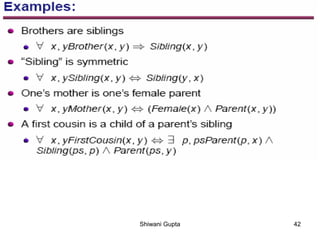
  • 68.
    University Questions Consider thefollowing axioms: All people who are graduating are happy All happy people smile Someone is graduating i. Represent these statements in FOL ii.Convert each formula to clause form iii.Prove that “Is someone smiling?” using resolution technique. Draw the resolution tree. Shiwani Gupta 76
  • 69.
    Forward Chaining • Datadriven reasoning • Agent derives conclusion from incoming percepts • It starts from known facts (positive literals) • If all the premises of an implication are known then its conclusion is added to set of known facts • This process continues till query added or no further inferences madeShiwani Gupta 77
  • 70.
  • 71.
  • 72.
  • 73.
  • 74.
    Backward Chaining • Goaldirected reasoning • Works backward from query • Find those implications in KB that conclude Q Shiwani Gupta 82
  • 75.
  • 76.
  • 77.
  • 78.
  • 79.
  • 80.
  • 81.
  • 82.
  • 83.
    Knowledge engineering Processin FOL 1. Identify the task (what to talk about) 2. Assemble the relevant knowledge 3. Decide on a vocabulary of predicates, functions, and constants 4. Encode general knowledge about the domain 5. Encode a description of the specific problem instance 6. Pose queries to the inference procedure and get answers 7. Debug the knowledge base Shiwani Gupta 91
  • 84.
    The digital circuitdomain One-bit full adder Input bits to be added Carry bit XOR gates AND gates OR gate Sum Carry bit for next adder Shiwani Gupta 92
  • 85.
    The electronic circuitdomain One-bit full adder 0 1 1 1 0 0 1 1 Shiwani Gupta 93
  • 86.
    The electronic circuitsdomain 1. Identify the task – Does the circuit actually add properly? (circuit verification) 2. Assemble the relevant knowledge – Composed of wires and gates; Types of gates (AND, OR, XOR, NOT) – Irrelevant: size, shape, color, cost of gates 3. Decide on a vocabulary – Alternatives: Type(X1) = XOR Type(X1, XOR) XOR(X1) Shiwani Gupta 94
  • 87.
    Gates or circuitscan have one or more input terminals and one or more output terminals. E.g. the function In(1,X1) denotes the first input terminal for gate X1. Connectivity between gates can be represented by a predicate: Connected(Out(1,X1),In(1,X2)) Signal has to be on or off – Signal(t) this function takes terminal as an argument and returns the signal value for that terminal. Two constants – 1 and 0. Shiwani Gupta 95
  • 88.
    The electronic circuitsdomain 4- Encode general knowledge of the domain • If two terminals are connected they have the same signal – t1,t2 Connected(t1, t2)  Signal(t1) = Signal(t2) • Connected is a commutative predicate – t1,t2 Connected(t1, t2)  Connected(t2, t1) • The signal at every terminal is either 1 or 0 – t (Signal(t) = 1)  (Signal(t) = 0) – 1 ≠ 0 Shiwani Gupta 96
  • 89.
    • An ORgate’s output is 1 iff any of its inputs is 1 – g Type(g) = OR  Signal(Out(1,g)) = 1  n Signal(In(n,g)) = 1 • An AND gate’s output is 0 iff any of its inputs is 0 – g Type(g) = AND  Signal(Out(1,g)) = 0  n Signal(In(n,g)) = 0 • An XOR gate’s output is 1 iff its inputs are different – g Type(g) = XOR  Signal(Out(1,g)) = 1  Signal(In(1,g)) ≠ Signal(In(2,g)) • A NOT gate’s output is different from its input – g Type(g) = NOT  Signal(Out(1,g)) ≠ Signal(In(1,g)) Shiwani Gupta 97
  • 90.
    The electronic circuitsdomain 5. Encode the specific problem instance Type(X1) = XOR Type(X2) = XOR Type(A1) = AND Type(A2) = AND Type(O1) = OR Connected(Out(1,X1),In(1,X2)) Connected(In(1,C1),In(1,X1)) Connected(Out(1,X1),In(2,A2)) Connected(In(1,C1),In(1,A1)) Connected(Out(1,A2),In(1,O1)) Connected(In(2,C1),In(2,X1)) Connected(Out(1,A1),In(2,O1)) Connected(In(2,C1),In(2,A1)) Connected(Out(1,X2),Out(1,C1)) Connected(In(3,C1),In(2,X2)) Connected(Out(1,O1),Out(2,C1)) Connected(In(3,C1),In(1,A2)) Shiwani Gupta 98
  • 91.
    The electronic circuitsdomain 6 - Pose queries to the inference procedure • What are the possible sets of values of the input of the adder circuit that lead to a signal of 0 for the sum output bit and a value of 1 for the carry output terminal? i1,i2,i3 (Signal(In(1,C1))= i1)  (Signal(In(2,C1)) = i2) (Signal(In(3,C1)) = i3)  (Signal(Out(1,C1)) = 0  Signal(Out(2,C1)) = 1) Answer: (i1 = 1; i2 = 1; i3 = 0) or ((i1 = 1; i2 = 0; i3 = 1) or (i1 = 0; i2 = 1; i3 = 0) • What are the possible sets of values of all the terminals of the adder circuit? i1,i2,i3,o1,o2 (Signal(In(1,C1)) = i1)  (Signal(In(2,C1)) = i2)  (Signal(In(3,C1)) = i3)  (Signal(Out(1,C1)) = o1  Signal(Out(2,C1)) = o2) 7 - Debug the knowledge base Shiwani Gupta 99