Chapter 44

Management of Patients With
     Renal Disorders


    Copyright © 2010 Wolters Kluwer Health | Lippincott Williams & Wilkins
Renal Disorders
• Fluid and electrolyte imbalances
• Most accurate indicator of fluid loss or gain in an acutely
  ill patient is weight


                Copyright © 2010 Wolters Kluwer Health | Lippincott Williams & Wilkins
Question
Is the following statement True or False?


The most accurate indicator of fluid loss or gain in an
  acutely ill patient is weight.


               Copyright © 2010 Wolters Kluwer Health | Lippincott Williams & Wilkins
Answer
True


The most accurate indicator of fluid loss or gain in an
  acutely ill patient is weight. An accurate daily weight
  must be obtained and recorded. A 1 kg weight gain is
  equal to 1000 mL of retained fluid.


               Copyright © 2010 Wolters Kluwer Health | Lippincott Williams & Wilkins
Causes of Acute Renal Failure
• Hypovolemia
• Hypotension
• Reduced cardiac output and heart failure
• Obstruction of the kidney or lower urinary tract
• Obstruction of renal arteries or veins


                Copyright © 2010 Wolters Kluwer Health | Lippincott Williams & Wilkins
Causes of Chronic Renal Failure
• Diabetes mellitus
• Hypertension
• Chronic glomerulonephritis,
• Pyelonephritis or other infections
• Obstruction of urinary tract
• Hereditary lesions
• Vascular disorders
• Medications or toxic agents
                 Copyright © 2010 Wolters Kluwer Health | Lippincott Williams & Wilkins
Glomerular Diseases
• An inflammation of the glomerular capillaries
• Acute nephritic syndrome
• Chronic glomerulonephritis
• Nephrotic syndrome


               Copyright © 2010 Wolters Kluwer Health | Lippincott Williams & Wilkins
Acute Nephritic Syndrome
• Postinfectious glomerulonephritis, rapidly progressive
  glomerulonephritis, and membranous glomerulonephritis
• Manifestations include hematuria, edema, azotemia,
  proteinuria, and hypertension
• May be mild, or may progress to acute renal failure
• Medical management includes supportive care and
  dietary modifications; treat cause if appropriate—
  antibiotics, corticosteroids, and immunosuppressants


               Copyright © 2010 Wolters Kluwer Health | Lippincott Williams & Wilkins
Nursing Management: Acute Nephritic
Syndrome
• Patient assessment
• Maintain fluid balance
• Fluid and dietary restrictions
• Patient education
• Follow-up care


                Copyright © 2010 Wolters Kluwer Health | Lippincott Williams & Wilkins
Chronic Glomerulonephritis
• Causes include repeated episodes of acute glomerular
  nephritis, hypertensive nephrosclerosis, hyperlipidemia,
  and other causes of glomerular damage.
• Symptoms vary; may be asymptomatic for years, as
  glomerular damage increases, before signs and
  symptoms develop of renal insufficiency/failure.
• Abnormal laboratory tests include urine with fixed
  specific gravity, casts, and proteinuria; and electrolyte
  imbalances and hypoalbuminemia.
• Medical management is determined by symptoms.

                Copyright © 2010 Wolters Kluwer Health | Lippincott Williams & Wilkins
Nursing Management Chronic
Glomerulonephritis
• Assessment
• Potential fluid and electrolyte imbalances
• Cardiac status
• Neurologic status
• Emotional support
• Teaching self-care


               Copyright © 2010 Wolters Kluwer Health | Lippincott Williams & Wilkins
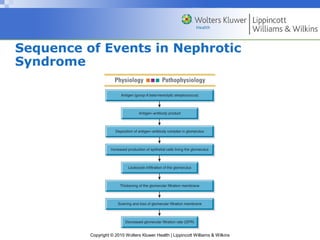
Nephrotic Syndrome
• Any condition that seriously damages the glomerular
  membrane and results in increased permeability to
  plasma proteins
• Results in hypoalbuminemia and edema
• Causes include chronic glomerulonephritis, diabetes
  mellitus with intercapillary glomerulosclerosis,
  amyloidosis, lupus erythmatosus, multiple myeloma, and
  renal vein thrombosis.
• Medical management includes drug and dietary therapy


              Copyright © 2010 Wolters Kluwer Health | Lippincott Williams & Wilkins
Sequence of Events in Nephrotic
Syndrome


          Copyright © 2010 Wolters Kluwer Health | Lippincott Williams & Wilkins
Renal Failure
• Results when the kidneys cannot remove wastes or
  perform regulatory functions
• A systemic disorder that results from many different
  causes
• Acute renal failure is a reversible syndrome that results
  in decreased GFR and oliguria
• Chronic renal failure (ESRD) is a progressive, irreversible
  deterioration of renal function that results in azotemia


               Copyright © 2010 Wolters Kluwer Health | Lippincott Williams & Wilkins
Nursing Process: The Care of the Patient
with Renal Failure—Assessment
• Fluid status
• Nutritional status
• Patient knowledge
• Activity tolerance
• Self-esteem
• Potential complications


                 Copyright © 2010 Wolters Kluwer Health | Lippincott Williams & Wilkins
Nursing Process: The Care of the Patient
with Renal Failure—Diagnoses
• Excess fluid volume
• Imbalanced nutrition
• Deficient knowledge
• Risk for situational low self-esteem


               Copyright © 2010 Wolters Kluwer Health | Lippincott Williams & Wilkins
Collaborative Problems/Potential
Complications
• Hyperkalemia
• Pericarditis
• Pericardial effusion
• Pericardial tamponade
• Hypertension
• Anemia
• Bone disease and metastatic calcifications


                 Copyright © 2010 Wolters Kluwer Health | Lippincott Williams & Wilkins
Nursing Process: The Care of the Patient
with Renal Failure—Planning
• Goals may include maintaining of IBW without excess
  fluid, maintenance of adequate nutritional intake,
  increased knowledge, participation of activity within
  tolerance improved self-esteem, and absence of
  complications.


               Copyright © 2010 Wolters Kluwer Health | Lippincott Williams & Wilkins
Excess Fluid Volume
• Assess for signs and symptoms of fluid volume excess,
  and keep accurate I&O and daily weights
• Limit fluid to prescribe amounts
• Identify sources of fluid
• Explain to patient and family the rationale for the
  restriction
• Assist patient to cope with the fluid restriction
• Provide or encourage frequent oral hygiene


                Copyright © 2010 Wolters Kluwer Health | Lippincott Williams & Wilkins
Imbalanced Nutrition
• Assess nutritional status; weight changes and lab data
• Assess patient nutritional patterns and history; note food
  preferences
• Provide food preferences within restrictions
• Encourage high-quality nutritional foods while
  maintaining nutritional restrictions
• Assess and modify intake related to factors that
  contribute to altered nutritional intake, eg, stomatitis or
  anorexia
• Adjust medication times related to meals

                Copyright © 2010 Wolters Kluwer Health | Lippincott Williams & Wilkins
Risk for Situational Low Self Esteem
• Assess patient and family responses to illness and
  treatment
• Assess relationships and coping patterns
• Encourage open discussion about changes and concerns
• Explore alternate ways of sexual expression
• Discuss role of giving and receiving love, warmth, and
  affection


               Copyright © 2010 Wolters Kluwer Health | Lippincott Williams & Wilkins
Hemodialysis System


         Copyright © 2010 Wolters Kluwer Health | Lippincott Williams & Wilkins
Hemodialysis Catheter


          Copyright © 2010 Wolters Kluwer Health | Lippincott Williams & Wilkins
Internal Arteriovenous Fistula and Graft


          Copyright © 2010 Wolters Kluwer Health | Lippincott Williams & Wilkins
Peritoneal Dialysis


          Copyright © 2010 Wolters Kluwer Health | Lippincott Williams & Wilkins
Peritoneal Dialysis


          Copyright © 2010 Wolters Kluwer Health | Lippincott Williams & Wilkins
Question
Is the following statement True or False?


Failure of the temporary dialysis access accounts for most
  hospital admissions of patients undergoing chronic
  hemodialysis.


               Copyright © 2010 Wolters Kluwer Health | Lippincott Williams & Wilkins
Answer
False


Failure of the permanent, not the temporary, dialysis
  access accounts for most hospital admissions of patients
  undergoing chronic hemodialysis.


               Copyright © 2010 Wolters Kluwer Health | Lippincott Williams & Wilkins
Nursing Management of the Hospitalized
Patient on Dialysis (1 of 2)
• Protection of vascular access; assess site for patency and
  signs of potential infection, and do not use for blood
  pressure or blood draws.
• Monitor fluid balance indicators and monitor IV therapy
  carefully; accurate I&O, IV administration pump.
• Assess for signs and symptoms of uremia and electrolyte
  imbalance; regularly check lab data.
• Monitor cardiac and respiratory status carefully.
• Hypertension: monitor blood pressure,
  antihypertensive agents must be held on dialysis
  days to avoid hypotension.
               Copyright © 2010 Wolters Kluwer Health | Lippincott Williams & Wilkins
Nursing Management of the Hospitalized
Patient on Dialysis (2 of 2)
• Monitor all medications and medication dosages carefully.
  Avoid medications containing potassium and magnesium.
• Address pain and discomfort.
• Stringent infection control measures.
• Dietary considerations: sodium, potassium, protein, and
  fluid; address individual nutritional needs.
• Skin care: pruritis is a common problem; keep skin clean
  and well moisturized, and trim nails and avoid scratching.
• CAPD catheter care.

               Copyright © 2010 Wolters Kluwer Health | Lippincott Williams & Wilkins
Kidney Surgery
• Preoperative considerations
• Perioperative concerns
• Postoperative management
   – Potential hemorrhage and shock
   – Potential abdominal distention and paralytic ileus
   – Potential infection
   – Potential thromboembolism


               Copyright © 2010 Wolters Kluwer Health | Lippincott Williams & Wilkins
Patient Positioning and Incisional
Approaches


          Copyright © 2010 Wolters Kluwer Health | Lippincott Williams & Wilkins
Renal Transplantation


          Copyright © 2010 Wolters Kluwer Health | Lippincott Williams & Wilkins
Postoperative Nursing Management
• Assessment: include all body systems, pain, fluid and
  electrolyte status, and patency and adequacy of urinary
  drainage system
• Diagnoses: ineffective airway clearance, ineffective
  breathing pattern, acute pain, fear and anxiety, impaired
  urinary elimination, and risk for fluid imbalance
• Complications: bleeding , pneumonia, infection, and DVT


               Copyright © 2010 Wolters Kluwer Health | Lippincott Williams & Wilkins
Interventions
• Pain relief measures and analgesic medications
• Promote airway clearance and effective breathing pattern
  by appropriate pain relief, deep breathing coughing
  exercises, and incentive spirometry and positioning
• Monitor UO and maintain potency of urinary drainage
  systems
• Use strict asepsis with catheter and appropriate
  technique in providing all care
• Monitor for signs and symptoms of bleeding
• Encourage leg exercises, early ambulation, and monitor
  for signs of DVT

               Copyright © 2010 Wolters Kluwer Health | Lippincott Williams & Wilkins
Patient Teaching
• Instruct both patient and family
• Drainage system care
• Strategies to prevent complications
• Signs and symptoms
• Follow-up care
• Fluid intake
• Health promotion and health screening


                 Copyright © 2010 Wolters Kluwer Health | Lippincott Williams & Wilkins

MANAGEMENT OF PATIENT WITH RENAL DISORDER

  • 1.
    Chapter 44 Management ofPatients With Renal Disorders Copyright © 2010 Wolters Kluwer Health | Lippincott Williams & Wilkins
  • 2.
    Renal Disorders • Fluidand electrolyte imbalances • Most accurate indicator of fluid loss or gain in an acutely ill patient is weight Copyright © 2010 Wolters Kluwer Health | Lippincott Williams & Wilkins
  • 3.
    Question Is the followingstatement True or False? The most accurate indicator of fluid loss or gain in an acutely ill patient is weight. Copyright © 2010 Wolters Kluwer Health | Lippincott Williams & Wilkins
  • 4.
    Answer True The most accurateindicator of fluid loss or gain in an acutely ill patient is weight. An accurate daily weight must be obtained and recorded. A 1 kg weight gain is equal to 1000 mL of retained fluid. Copyright © 2010 Wolters Kluwer Health | Lippincott Williams & Wilkins
  • 5.
    Causes of AcuteRenal Failure • Hypovolemia • Hypotension • Reduced cardiac output and heart failure • Obstruction of the kidney or lower urinary tract • Obstruction of renal arteries or veins Copyright © 2010 Wolters Kluwer Health | Lippincott Williams & Wilkins
  • 6.
    Causes of ChronicRenal Failure • Diabetes mellitus • Hypertension • Chronic glomerulonephritis, • Pyelonephritis or other infections • Obstruction of urinary tract • Hereditary lesions • Vascular disorders • Medications or toxic agents Copyright © 2010 Wolters Kluwer Health | Lippincott Williams & Wilkins
  • 7.
    Glomerular Diseases • Aninflammation of the glomerular capillaries • Acute nephritic syndrome • Chronic glomerulonephritis • Nephrotic syndrome Copyright © 2010 Wolters Kluwer Health | Lippincott Williams & Wilkins
  • 8.
    Acute Nephritic Syndrome •Postinfectious glomerulonephritis, rapidly progressive glomerulonephritis, and membranous glomerulonephritis • Manifestations include hematuria, edema, azotemia, proteinuria, and hypertension • May be mild, or may progress to acute renal failure • Medical management includes supportive care and dietary modifications; treat cause if appropriate— antibiotics, corticosteroids, and immunosuppressants Copyright © 2010 Wolters Kluwer Health | Lippincott Williams & Wilkins
  • 9.
    Nursing Management: AcuteNephritic Syndrome • Patient assessment • Maintain fluid balance • Fluid and dietary restrictions • Patient education • Follow-up care Copyright © 2010 Wolters Kluwer Health | Lippincott Williams & Wilkins
  • 10.
    Chronic Glomerulonephritis • Causesinclude repeated episodes of acute glomerular nephritis, hypertensive nephrosclerosis, hyperlipidemia, and other causes of glomerular damage. • Symptoms vary; may be asymptomatic for years, as glomerular damage increases, before signs and symptoms develop of renal insufficiency/failure. • Abnormal laboratory tests include urine with fixed specific gravity, casts, and proteinuria; and electrolyte imbalances and hypoalbuminemia. • Medical management is determined by symptoms. Copyright © 2010 Wolters Kluwer Health | Lippincott Williams & Wilkins
  • 11.
    Nursing Management Chronic Glomerulonephritis •Assessment • Potential fluid and electrolyte imbalances • Cardiac status • Neurologic status • Emotional support • Teaching self-care Copyright © 2010 Wolters Kluwer Health | Lippincott Williams & Wilkins
  • 12.
    Nephrotic Syndrome • Anycondition that seriously damages the glomerular membrane and results in increased permeability to plasma proteins • Results in hypoalbuminemia and edema • Causes include chronic glomerulonephritis, diabetes mellitus with intercapillary glomerulosclerosis, amyloidosis, lupus erythmatosus, multiple myeloma, and renal vein thrombosis. • Medical management includes drug and dietary therapy Copyright © 2010 Wolters Kluwer Health | Lippincott Williams & Wilkins
  • 13.
    Sequence of Eventsin Nephrotic Syndrome Copyright © 2010 Wolters Kluwer Health | Lippincott Williams & Wilkins
  • 14.
    Renal Failure • Resultswhen the kidneys cannot remove wastes or perform regulatory functions • A systemic disorder that results from many different causes • Acute renal failure is a reversible syndrome that results in decreased GFR and oliguria • Chronic renal failure (ESRD) is a progressive, irreversible deterioration of renal function that results in azotemia Copyright © 2010 Wolters Kluwer Health | Lippincott Williams & Wilkins
  • 15.
    Nursing Process: TheCare of the Patient with Renal Failure—Assessment • Fluid status • Nutritional status • Patient knowledge • Activity tolerance • Self-esteem • Potential complications Copyright © 2010 Wolters Kluwer Health | Lippincott Williams & Wilkins
  • 16.
    Nursing Process: TheCare of the Patient with Renal Failure—Diagnoses • Excess fluid volume • Imbalanced nutrition • Deficient knowledge • Risk for situational low self-esteem Copyright © 2010 Wolters Kluwer Health | Lippincott Williams & Wilkins
  • 17.
    Collaborative Problems/Potential Complications • Hyperkalemia •Pericarditis • Pericardial effusion • Pericardial tamponade • Hypertension • Anemia • Bone disease and metastatic calcifications Copyright © 2010 Wolters Kluwer Health | Lippincott Williams & Wilkins
  • 18.
    Nursing Process: TheCare of the Patient with Renal Failure—Planning • Goals may include maintaining of IBW without excess fluid, maintenance of adequate nutritional intake, increased knowledge, participation of activity within tolerance improved self-esteem, and absence of complications. Copyright © 2010 Wolters Kluwer Health | Lippincott Williams & Wilkins
  • 19.
    Excess Fluid Volume •Assess for signs and symptoms of fluid volume excess, and keep accurate I&O and daily weights • Limit fluid to prescribe amounts • Identify sources of fluid • Explain to patient and family the rationale for the restriction • Assist patient to cope with the fluid restriction • Provide or encourage frequent oral hygiene Copyright © 2010 Wolters Kluwer Health | Lippincott Williams & Wilkins
  • 20.
    Imbalanced Nutrition • Assessnutritional status; weight changes and lab data • Assess patient nutritional patterns and history; note food preferences • Provide food preferences within restrictions • Encourage high-quality nutritional foods while maintaining nutritional restrictions • Assess and modify intake related to factors that contribute to altered nutritional intake, eg, stomatitis or anorexia • Adjust medication times related to meals Copyright © 2010 Wolters Kluwer Health | Lippincott Williams & Wilkins
  • 21.
    Risk for SituationalLow Self Esteem • Assess patient and family responses to illness and treatment • Assess relationships and coping patterns • Encourage open discussion about changes and concerns • Explore alternate ways of sexual expression • Discuss role of giving and receiving love, warmth, and affection Copyright © 2010 Wolters Kluwer Health | Lippincott Williams & Wilkins
  • 22.
    Hemodialysis System Copyright © 2010 Wolters Kluwer Health | Lippincott Williams & Wilkins
  • 23.
    Hemodialysis Catheter Copyright © 2010 Wolters Kluwer Health | Lippincott Williams & Wilkins
  • 24.
    Internal Arteriovenous Fistulaand Graft Copyright © 2010 Wolters Kluwer Health | Lippincott Williams & Wilkins
  • 25.
    Peritoneal Dialysis Copyright © 2010 Wolters Kluwer Health | Lippincott Williams & Wilkins
  • 26.
    Peritoneal Dialysis Copyright © 2010 Wolters Kluwer Health | Lippincott Williams & Wilkins
  • 27.
    Question Is the followingstatement True or False? Failure of the temporary dialysis access accounts for most hospital admissions of patients undergoing chronic hemodialysis. Copyright © 2010 Wolters Kluwer Health | Lippincott Williams & Wilkins
  • 28.
    Answer False Failure of thepermanent, not the temporary, dialysis access accounts for most hospital admissions of patients undergoing chronic hemodialysis. Copyright © 2010 Wolters Kluwer Health | Lippincott Williams & Wilkins
  • 29.
    Nursing Management ofthe Hospitalized Patient on Dialysis (1 of 2) • Protection of vascular access; assess site for patency and signs of potential infection, and do not use for blood pressure or blood draws. • Monitor fluid balance indicators and monitor IV therapy carefully; accurate I&O, IV administration pump. • Assess for signs and symptoms of uremia and electrolyte imbalance; regularly check lab data. • Monitor cardiac and respiratory status carefully. • Hypertension: monitor blood pressure, antihypertensive agents must be held on dialysis days to avoid hypotension. Copyright © 2010 Wolters Kluwer Health | Lippincott Williams & Wilkins
  • 30.
    Nursing Management ofthe Hospitalized Patient on Dialysis (2 of 2) • Monitor all medications and medication dosages carefully. Avoid medications containing potassium and magnesium. • Address pain and discomfort. • Stringent infection control measures. • Dietary considerations: sodium, potassium, protein, and fluid; address individual nutritional needs. • Skin care: pruritis is a common problem; keep skin clean and well moisturized, and trim nails and avoid scratching. • CAPD catheter care. Copyright © 2010 Wolters Kluwer Health | Lippincott Williams & Wilkins
  • 31.
    Kidney Surgery • Preoperativeconsiderations • Perioperative concerns • Postoperative management – Potential hemorrhage and shock – Potential abdominal distention and paralytic ileus – Potential infection – Potential thromboembolism Copyright © 2010 Wolters Kluwer Health | Lippincott Williams & Wilkins
  • 32.
    Patient Positioning andIncisional Approaches Copyright © 2010 Wolters Kluwer Health | Lippincott Williams & Wilkins
  • 33.
    Renal Transplantation Copyright © 2010 Wolters Kluwer Health | Lippincott Williams & Wilkins
  • 34.
    Postoperative Nursing Management •Assessment: include all body systems, pain, fluid and electrolyte status, and patency and adequacy of urinary drainage system • Diagnoses: ineffective airway clearance, ineffective breathing pattern, acute pain, fear and anxiety, impaired urinary elimination, and risk for fluid imbalance • Complications: bleeding , pneumonia, infection, and DVT Copyright © 2010 Wolters Kluwer Health | Lippincott Williams & Wilkins
  • 35.
    Interventions • Pain reliefmeasures and analgesic medications • Promote airway clearance and effective breathing pattern by appropriate pain relief, deep breathing coughing exercises, and incentive spirometry and positioning • Monitor UO and maintain potency of urinary drainage systems • Use strict asepsis with catheter and appropriate technique in providing all care • Monitor for signs and symptoms of bleeding • Encourage leg exercises, early ambulation, and monitor for signs of DVT Copyright © 2010 Wolters Kluwer Health | Lippincott Williams & Wilkins
  • 36.
    Patient Teaching • Instructboth patient and family • Drainage system care • Strategies to prevent complications • Signs and symptoms • Follow-up care • Fluid intake • Health promotion and health screening Copyright © 2010 Wolters Kluwer Health | Lippincott Williams & Wilkins