Chapter 14 Care of the Patient with Acute Renal Failure
Learning Outcome 1
Prerenal (~60% of cases of ARF) Caused by decreased renal blood flow Decreased cardiac output Severe hypotension Hypovolemia Severe vasoconstriction Renal vascular disease Obstruction of the renal artery
Prerenal (~60% of cases of ARF) (cont.) Nephrons and glomeruli are structurally and functionally normal ↓ GFR is related to  ↓  in renal blood flow
Nursing Management  Assessment Common Causes Hypovolemia from hemorrhage Trauma Hypovolemic shock Inadequate volume replacement prior to surgery Burns Pancreatitis
Nursing Management  Assessment  (cont.) Common Causes Excessive use of diuretics Cardiovascular disorders (heart failure or dysrhythmias) Vasodilation from sepsis or medications (antihypertensives)
Patient Assessment for Hypovolemia Hypotension/orthostatic hypotension Tachycardia Dry mucous membranes Poor skin turgor Flat jugular veins Weight loss Low CVP or PAWP pressures
Patient Assessment For Extreme Vasodilation or Cardiovascular Disease Edema Ascites Weight gain Increased CVP or PAWP pressures
Intrarenal (intrinsic) (~30–40% of cases of ARF) Due to disturbances within the glomerulus or renal tubules Most commonly results from failure to promptly and adequately treat renal hypoperfusion that produces tubular hypoxia with dysfunction, inflammation, and possibly necrosis
Inflammatory Mediators Death of cells  Disrupts renal blood flow  Causes damage to the basement membranes and the renal tubules Tubular dysfunction results in impaired sodium and water reabsorption Can be differentiated from prerenal dysfunction by urinalysis
Postrenal (5–10% of cases of ARF) Due to obstruction of urinary outflow Benign prostatic hypertrophy in older male—most common Tubular obstruction from crystals (uric acid or acyclovir) Bilateral ureteral obstruction Prostatic cancer
Renal Failure Results when obstruction causes an increase in tubular pressure, which results in  ↓  GFR Commonly results in sudden onset of anuria Quickly and accurately identified by renal ultrasound Usually resolves quickly with removal of obstruction
Learning Outcome 2
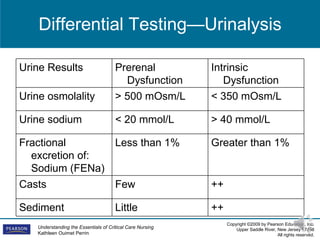
Differential Testing—Urinalysis Urine Results Prerenal Dysfunction Intrinsic Dysfunction Urine osmolality > 500 mOsm/L < 350 mOsm/L Urine sodium < 20 mmol/L > 40 mmol/L Fractional excretion of: Sodium (FENa) Less than 1% Greater than 1% Casts Few ++ Sediment Little ++
Learning Outcome 3
Management of Prerenal Dysfunction Restore normal renal perfusion Reestablish normovolemia Increase cardiac output Relieve renal artery obstruction Reestablish normovolemia NSS challenges until CVP = 12 Assess BP, HR, U/O, and CVP or PAWP Identify and treat signs of fluid overload
Management of Prerenal Dysfunction (cont.) Increase cardiac output MAP of 70 or greater Norepinephrine for BP support if necessary Relieve renal artery obstruction Angioplasty Stent placement
Learning Outcome 4
Prevention of Further Renal Injury During Renal Failure Avoid nephrotoxic agents if possible Administer drugs that must be excreted by the kidneys with caution Monitor peak and trough levels of nephrotoxic drugs Prophylactic acetylcysteine if contrast is necessary Scrupulous aseptic technique
Learning Outcome 5
Management of Electrolyte Imbalance: Dilutional Hyponatremia Fluid restriction Diuretics + saline infusion
Management of Electrolyte Imbalance: Hyperkalemia Limit potassium intake Increase potassium loss via the urine with diuretics IV calcium to patients not on digitalis Shift potassium intracellularly (insulin with dextrose or bicarb) Kayexalate Dialysis
Management of Electrolyte Imbalance: Hypocalcemia Oral supplementation if mild IV replacement if serious
Management of Electrolyte Imbalance: Hyperphosphatemia Adequate hydration Dietary restriction of phosphate Calcium supplementation Phosphate binders
Learning Outcome 6
Fluid Volume Management Fluid volume excess Fluid restriction Renal replacement therapies
Learning Outcome 7
Disadvantages of Peritoneal Dialysis for Treatment of Acute Renal Failure Treatment occurs slowly Dysfunction progresses quickly Ineffective for removal of urea Peritoneal “dwell” fluid impairs respiratory function Poorer patient outcomes than other modalities
Learning Outcome 8
Continuous Renal Replacement Therapies  Advantages Can be used for patients who are hemodynamically unstable. Allows for controlled removal of fluid over 24 hours or more Disadvantages Very time-intensive for the critical care nurse
Hemodialysis Advantages Can be used daily for 1–2 hour sessions
Hemodialysis (cont.) Disadvantages Fluid overload, waste accumulation, and electrolyte imbalances develop between treatments May precipitate hemodynamic instability Difficulties with vascular access Problems with anticoagulation Dialysis membrane incompatibility Dialysis disequilibrium syndrome
Learning Outcome 9
Nursing Management of Patients Requiring Hemodialysis When caring for a patient with an AV fistula or graft, the nurse assesses and maintains the patency of the access by:  Palpating for the thrill or auscultating the bruit over the access Checking the CSM in the access extremity
Nursing Management of Patients Requiring Hemodialysis (cont.) When caring for a patient with an AV fistula or graft, the nurse assesses and maintains the patency of the access by:  Avoiding any obstruction of blood flow in that extremity such as: BP measurement IV placement  Phlebotomy  Positioning the patient so there is pressure on the access
Nursing Measures for a Patient Prior to Hemodialysis The nurse determines if there is a “dry weight” for the patient on record and determines the patient’s current weight  Other measurements of fluid balance the nurse should assess before dialysis include BP, skin turgor, intake and output, breath sounds, and CVP or PAWP if available
Nursing Measures for a Patient Prior to Hemodialysis (cont.) The nurse also reviews the patient’s laboratory results and identifies the goals the nephrologist has established for correction of electrolyte and acid-base abnormalities Care of the critically ill patient during the dialysis session requires specialized knowledge and experience
Nursing Measures for a Patient Prior to Hemodialysis (cont.) The patient’s BP may be measured as frequently as every 2 to 5 minutes at the start of dialysis but may be taken every 15 to 30 minutes after the patient has stabilized The entire dialysis session will usually take between 2 and 4 hours
Nursing Measures for a Patient Prior to Hemodialysis (cont.) The nurse will hold certain medications prior to hemodialysis The doses of medications that may cause hypotension such as beta blockers, angiotensin-converting enzyme (ACE) inhibitors, and calcium channel blockers that are due to be administered 2 to 4 hours prior to dialysis are usually held until dialysis has been completed.
Nursing Measures for a Patient Prior to Hemodialysis (cont.) Medications that are removed from the body by dialysis (a current list is usually available from the dialysis center) are also held until the end of dialysis. Finally, prior to dialysis, the nurse may check the patient’s temperature and should assess the patient’s access.
Nursing Management of Patients Requiring CRRT Vital signs, hemodynamics, and fluid status every  ½  hour Assessment of ultrafiltration rate hourly Administration of replacement fluid Obtain and review lab results every 4–6 hours Maintain the patency of the system

Ch 14 ppt renal

  • 1.
    Chapter 14 Careof the Patient with Acute Renal Failure
  • 2.
  • 3.
    Prerenal (~60% ofcases of ARF) Caused by decreased renal blood flow Decreased cardiac output Severe hypotension Hypovolemia Severe vasoconstriction Renal vascular disease Obstruction of the renal artery
  • 4.
    Prerenal (~60% ofcases of ARF) (cont.) Nephrons and glomeruli are structurally and functionally normal ↓ GFR is related to ↓ in renal blood flow
  • 5.
    Nursing Management Assessment Common Causes Hypovolemia from hemorrhage Trauma Hypovolemic shock Inadequate volume replacement prior to surgery Burns Pancreatitis
  • 6.
    Nursing Management Assessment (cont.) Common Causes Excessive use of diuretics Cardiovascular disorders (heart failure or dysrhythmias) Vasodilation from sepsis or medications (antihypertensives)
  • 7.
    Patient Assessment forHypovolemia Hypotension/orthostatic hypotension Tachycardia Dry mucous membranes Poor skin turgor Flat jugular veins Weight loss Low CVP or PAWP pressures
  • 8.
    Patient Assessment ForExtreme Vasodilation or Cardiovascular Disease Edema Ascites Weight gain Increased CVP or PAWP pressures
  • 9.
    Intrarenal (intrinsic) (~30–40%of cases of ARF) Due to disturbances within the glomerulus or renal tubules Most commonly results from failure to promptly and adequately treat renal hypoperfusion that produces tubular hypoxia with dysfunction, inflammation, and possibly necrosis
  • 10.
    Inflammatory Mediators Deathof cells Disrupts renal blood flow Causes damage to the basement membranes and the renal tubules Tubular dysfunction results in impaired sodium and water reabsorption Can be differentiated from prerenal dysfunction by urinalysis
  • 11.
    Postrenal (5–10% ofcases of ARF) Due to obstruction of urinary outflow Benign prostatic hypertrophy in older male—most common Tubular obstruction from crystals (uric acid or acyclovir) Bilateral ureteral obstruction Prostatic cancer
  • 12.
    Renal Failure Resultswhen obstruction causes an increase in tubular pressure, which results in ↓ GFR Commonly results in sudden onset of anuria Quickly and accurately identified by renal ultrasound Usually resolves quickly with removal of obstruction
  • 13.
  • 14.
    Differential Testing—Urinalysis UrineResults Prerenal Dysfunction Intrinsic Dysfunction Urine osmolality > 500 mOsm/L < 350 mOsm/L Urine sodium < 20 mmol/L > 40 mmol/L Fractional excretion of: Sodium (FENa) Less than 1% Greater than 1% Casts Few ++ Sediment Little ++
  • 15.
  • 16.
    Management of PrerenalDysfunction Restore normal renal perfusion Reestablish normovolemia Increase cardiac output Relieve renal artery obstruction Reestablish normovolemia NSS challenges until CVP = 12 Assess BP, HR, U/O, and CVP or PAWP Identify and treat signs of fluid overload
  • 17.
    Management of PrerenalDysfunction (cont.) Increase cardiac output MAP of 70 or greater Norepinephrine for BP support if necessary Relieve renal artery obstruction Angioplasty Stent placement
  • 18.
  • 19.
    Prevention of FurtherRenal Injury During Renal Failure Avoid nephrotoxic agents if possible Administer drugs that must be excreted by the kidneys with caution Monitor peak and trough levels of nephrotoxic drugs Prophylactic acetylcysteine if contrast is necessary Scrupulous aseptic technique
  • 20.
  • 21.
    Management of ElectrolyteImbalance: Dilutional Hyponatremia Fluid restriction Diuretics + saline infusion
  • 22.
    Management of ElectrolyteImbalance: Hyperkalemia Limit potassium intake Increase potassium loss via the urine with diuretics IV calcium to patients not on digitalis Shift potassium intracellularly (insulin with dextrose or bicarb) Kayexalate Dialysis
  • 23.
    Management of ElectrolyteImbalance: Hypocalcemia Oral supplementation if mild IV replacement if serious
  • 24.
    Management of ElectrolyteImbalance: Hyperphosphatemia Adequate hydration Dietary restriction of phosphate Calcium supplementation Phosphate binders
  • 25.
  • 26.
    Fluid Volume ManagementFluid volume excess Fluid restriction Renal replacement therapies
  • 27.
  • 28.
    Disadvantages of PeritonealDialysis for Treatment of Acute Renal Failure Treatment occurs slowly Dysfunction progresses quickly Ineffective for removal of urea Peritoneal “dwell” fluid impairs respiratory function Poorer patient outcomes than other modalities
  • 29.
  • 30.
    Continuous Renal ReplacementTherapies Advantages Can be used for patients who are hemodynamically unstable. Allows for controlled removal of fluid over 24 hours or more Disadvantages Very time-intensive for the critical care nurse
  • 31.
    Hemodialysis Advantages Canbe used daily for 1–2 hour sessions
  • 32.
    Hemodialysis (cont.) DisadvantagesFluid overload, waste accumulation, and electrolyte imbalances develop between treatments May precipitate hemodynamic instability Difficulties with vascular access Problems with anticoagulation Dialysis membrane incompatibility Dialysis disequilibrium syndrome
  • 33.
  • 34.
    Nursing Management ofPatients Requiring Hemodialysis When caring for a patient with an AV fistula or graft, the nurse assesses and maintains the patency of the access by: Palpating for the thrill or auscultating the bruit over the access Checking the CSM in the access extremity
  • 35.
    Nursing Management ofPatients Requiring Hemodialysis (cont.) When caring for a patient with an AV fistula or graft, the nurse assesses and maintains the patency of the access by: Avoiding any obstruction of blood flow in that extremity such as: BP measurement IV placement Phlebotomy Positioning the patient so there is pressure on the access
  • 36.
    Nursing Measures fora Patient Prior to Hemodialysis The nurse determines if there is a “dry weight” for the patient on record and determines the patient’s current weight Other measurements of fluid balance the nurse should assess before dialysis include BP, skin turgor, intake and output, breath sounds, and CVP or PAWP if available
  • 37.
    Nursing Measures fora Patient Prior to Hemodialysis (cont.) The nurse also reviews the patient’s laboratory results and identifies the goals the nephrologist has established for correction of electrolyte and acid-base abnormalities Care of the critically ill patient during the dialysis session requires specialized knowledge and experience
  • 38.
    Nursing Measures fora Patient Prior to Hemodialysis (cont.) The patient’s BP may be measured as frequently as every 2 to 5 minutes at the start of dialysis but may be taken every 15 to 30 minutes after the patient has stabilized The entire dialysis session will usually take between 2 and 4 hours
  • 39.
    Nursing Measures fora Patient Prior to Hemodialysis (cont.) The nurse will hold certain medications prior to hemodialysis The doses of medications that may cause hypotension such as beta blockers, angiotensin-converting enzyme (ACE) inhibitors, and calcium channel blockers that are due to be administered 2 to 4 hours prior to dialysis are usually held until dialysis has been completed.
  • 40.
    Nursing Measures fora Patient Prior to Hemodialysis (cont.) Medications that are removed from the body by dialysis (a current list is usually available from the dialysis center) are also held until the end of dialysis. Finally, prior to dialysis, the nurse may check the patient’s temperature and should assess the patient’s access.
  • 41.
    Nursing Management ofPatients Requiring CRRT Vital signs, hemodynamics, and fluid status every ½ hour Assessment of ultrafiltration rate hourly Administration of replacement fluid Obtain and review lab results every 4–6 hours Maintain the patency of the system