to
Management
Information
System
Introduction
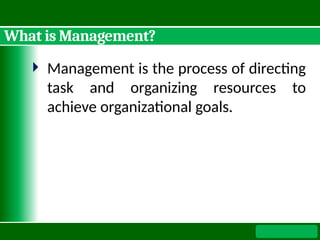
What is Management?
 Management is the process of directing
task and organizing resources to
achieve organizational goals.
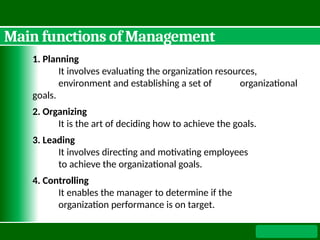
Main functions of Management
1. Planning
It involves evaluating the organization resources,
environment and establishing a set of organizational
goals.
2. Organizing
It is the art of deciding how to achieve the goals.
3. Leading
It involves directing and motivating employees
to achieve the organizational goals.
4. Controlling
It enables the manager to determine if the
organization performance is on target.
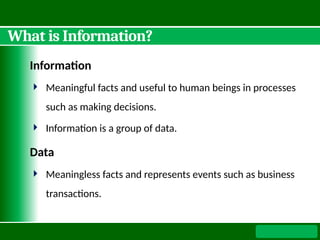
What is Information?
Information
 Meaningful facts and useful to human beings in processes
such as making decisions.
 Information is a group of data.
Data
 Meaningless facts and represents events such as business
transactions.
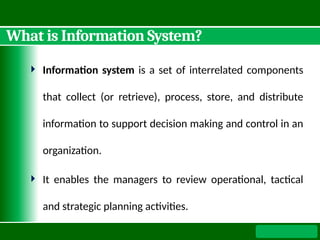
What is Information System?
 Information system is a set of interrelated components
that collect (or retrieve), process, store, and distribute
information to support decision making and control in an
organization.
 It enables the managers to review operational, tactical
and strategic planning activities.
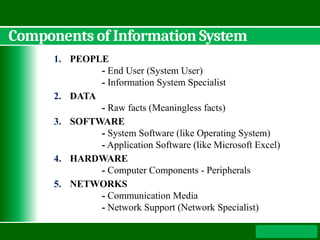
Components of Information System
1. PEOPLE
- End User (System User)
- Information System Specialist
2. DATA
- Raw facts (Meaningless facts)
3. SOFTWARE
- System Software (like Operating System)
- Application Software (like Microsoft Excel)
4. HARDWARE
- Computer Components - Peripherals
5. NETWORKS
- Communication Media
- Network Support (Network Specialist)
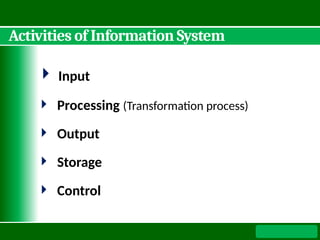
Activities of Information System
 Input
 Processing (Transformation process)
 Output
 Storage
 Control
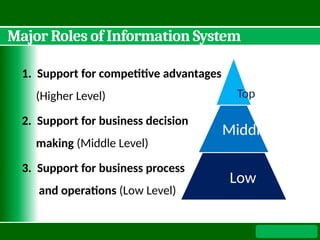
Top
Middle
Low
Major Roles of Information System
1. Support for competitive advantages
(Higher Level)
2. Support for business decision
making (Middle Level)
3. Support for business process
and operations (Low Level)
Types of Information Systems
1. Operational Support System
2. Management Support Systems
3. Other Systems
Operational Support System
1. Transaction Processing System:
a) Batch:
Transaction data accumulate over time,
processed periodically.
b) Real-Time:
Data processed immediately after a
transaction occurs.
2. Process Control System
(Monitor & Control physical processes)
3. Enterprise Collaboration Systems
Management Support Systems
1. Management Information System:
Pre-specified reports & displays to support
decision-making.
2. Decision Support Systems:
Provide interact ad hoc support.
3. Executive Information Systems:
Critical information tailored to the
information needs of executives.
Other Systems
1. Expert Systems (Expert advice)
2. Knowledge Management System:
Supports the creation, organization
and dissemination (spread) of
business knowledge.
Difference between IS and IT
What is Information System?
An Integrated components processing, storing and
disseminating information in an organisation.
What is Information Technology?
Any form of technology used by people to handle
information.
Advantages of Information Systems
âť¶ IS can perform calculations or process paperwork much
faster than people.
âť· IS can help companies learn more about the purchase
patterns and preferences of their customers
❸ The Internet distributes information instantly to millions
of people across the world.
Disadvantages of Information Systems
âť¶ IS may allow organizations to collect personal details
about people that violate their privacy.
âť· Heavy users of information systems may suffer
repetitive stress injury, technostress, and other health
problems.
❸ The Internet can be used to distribute illegal copies of
software, books, articles, and other intellectual
property.
Management Information System
What is Management Information System?
Management Information System (MIS) is the study of
people, technology, organizations and the relationship
among them.
It refers to the study of how individuals, groups, and
organizations utilize (use) systems to generate
information to improve efficiency and effectiveness of
decision making.
Management Information System (Cont…)
MIS deals with behavioral issues as well as technical
issues surrounding the development, use, and impact
of information systems used by managers and
employees in the firm.
Management’s job is to deal with many situations
faced by organizations, make decisions and formulate
action plans to solve organizational problems.
Mr.
Hamze
Mohamed
Abdi
18

Chapter 1Introduction to management information systemMIS.pptx

  • 1.
  • 2.
    What is Management? Management is the process of directing task and organizing resources to achieve organizational goals.
  • 3.
    Main functions ofManagement 1. Planning It involves evaluating the organization resources, environment and establishing a set of organizational goals. 2. Organizing It is the art of deciding how to achieve the goals. 3. Leading It involves directing and motivating employees to achieve the organizational goals. 4. Controlling It enables the manager to determine if the organization performance is on target.
  • 4.
    What is Information? Information Meaningful facts and useful to human beings in processes such as making decisions.  Information is a group of data. Data  Meaningless facts and represents events such as business transactions.
  • 5.
    What is InformationSystem?  Information system is a set of interrelated components that collect (or retrieve), process, store, and distribute information to support decision making and control in an organization.  It enables the managers to review operational, tactical and strategic planning activities.
  • 6.
    Components of InformationSystem 1. PEOPLE - End User (System User) - Information System Specialist 2. DATA - Raw facts (Meaningless facts) 3. SOFTWARE - System Software (like Operating System) - Application Software (like Microsoft Excel) 4. HARDWARE - Computer Components - Peripherals 5. NETWORKS - Communication Media - Network Support (Network Specialist)
  • 7.
    Activities of InformationSystem  Input  Processing (Transformation process)  Output  Storage  Control
  • 8.
    Top Middle Low Major Roles ofInformation System 1. Support for competitive advantages (Higher Level) 2. Support for business decision making (Middle Level) 3. Support for business process and operations (Low Level)
  • 9.
    Types of InformationSystems 1. Operational Support System 2. Management Support Systems 3. Other Systems
  • 10.
    Operational Support System 1.Transaction Processing System: a) Batch: Transaction data accumulate over time, processed periodically. b) Real-Time: Data processed immediately after a transaction occurs. 2. Process Control System (Monitor & Control physical processes) 3. Enterprise Collaboration Systems
  • 11.
    Management Support Systems 1.Management Information System: Pre-specified reports & displays to support decision-making. 2. Decision Support Systems: Provide interact ad hoc support. 3. Executive Information Systems: Critical information tailored to the information needs of executives.
  • 12.
    Other Systems 1. ExpertSystems (Expert advice) 2. Knowledge Management System: Supports the creation, organization and dissemination (spread) of business knowledge.
  • 13.
    Difference between ISand IT What is Information System? An Integrated components processing, storing and disseminating information in an organisation. What is Information Technology? Any form of technology used by people to handle information.
  • 14.
    Advantages of InformationSystems ❶ IS can perform calculations or process paperwork much faster than people. ❷ IS can help companies learn more about the purchase patterns and preferences of their customers ❸ The Internet distributes information instantly to millions of people across the world.
  • 15.
    Disadvantages of InformationSystems ❶ IS may allow organizations to collect personal details about people that violate their privacy. ❷ Heavy users of information systems may suffer repetitive stress injury, technostress, and other health problems. ❸ The Internet can be used to distribute illegal copies of software, books, articles, and other intellectual property.
  • 16.
    Management Information System Whatis Management Information System? Management Information System (MIS) is the study of people, technology, organizations and the relationship among them. It refers to the study of how individuals, groups, and organizations utilize (use) systems to generate information to improve efficiency and effectiveness of decision making.
  • 17.
    Management Information System(Cont…) MIS deals with behavioral issues as well as technical issues surrounding the development, use, and impact of information systems used by managers and employees in the firm. Management’s job is to deal with many situations faced by organizations, make decisions and formulate action plans to solve organizational problems.
  • 18.

Editor's Notes

  • #2 Resources: People, Machine and Money Directing Tasks means telling them what to do and how to do it.
  • #3 Motivation can be financial (Rewards) or Non-financial (Promotion, Appreciation) Performance can be financial (Revenue: Profit/Loss) or Non-financial (Branded)
  • #4 Data: 12 Rice 20 $1 Information: ==================================== ItemNo Item Quantity Price Total ==================================== 12 Rice 20 $1 $20 -------------------------------------------------------------
  • #8 Business processes is a set of logically related tasks and behaviors that organizations develop over time to produce specific business results and the unique manner in which these activities are organized and coordinated. The triangle was invented by Abraham Maslow for Basic Needs of Human.
  • #10 Accumulate = Collected
  • #12 Experts systems are used for consultations. Dissemination = Spread
  • #13 Information Systems: interrelated components working together to collect, process, store, and disseminate information to support decision making, coordination, control, analysis, and visualization in an organization.
  • #16 People can be Manager, Employee, Supplier, Vendor, Customer Technology can be a machine that can process, store and distribute information to different users. Organization can be the rules, regulation, and obligations.
  • #17 Behavioral issues mean how people who work in organizations develop customary ways of working; they gain attachments to existing relationships; and they make arrangements with subordinates and superiors about how work will be done, the amount of work that will be done, and under what conditions work will be done. Most of these arrangements and feelings are not discussed in any formal rulebook. Technical issue focuses on three elements of an organization. Capital and labor are primary production factors provided by the environment. The organization (the firm) transforms these inputs into products and services in a production function. The products and services are consumed by environments in return for supply inputs. encourages us to focus on how inputs are combined to create outputs when technology changes are introduced into the company. The firm is seen as infinitely malleable, with capital and labor substituting for each other quite easily.