Exercises with solutions –
Chapters 1-4
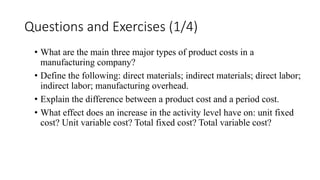
• What are the main three major types of product costs in a
manufacturing company?
• Define the following: direct materials; indirect materials; direct labor;
indirect labor; manufacturing overhead.
• Explain the difference between a product cost and a period cost.
• What effect does an increase in the activity level have on: unit fixed
cost? Unit variable cost? Total fixed cost? Total variable cost?
Questions and Exercises (1/4)
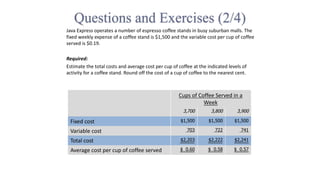
Java Express operates a number of espresso coffee stands in busy suburban malls. The
fixed weekly expense of a coffee stand is $1,500 and the variable cost per cup of coffee
served is $0.19.
Required:
Estimate the total costs and average cost per cup of coffee at the indicated levels of
activity for a coffee stand. Round off the cost of a cup of coffee to the nearest cent.
Cups of Coffee Served in a
Week
Cups of Coffee Served in a
Week
Cups of Coffee Served in a
Week
3,700 3,800 3,900
Fixed cost $1,500 $1,500 $1,500
Variable cost 703 722 741
Total cost $2,203 $2,222 $2,241
Average cost per cup of coffee served $ 0.60 $ 0.58 $ 0.57
Questions and Exercises (2/4)
© McGraw-Hill Education. All rights reserved. Authorized only for instructor use in the classroom. No reproduction or further distribution
permitted without the prior written consent of McGraw-Hill Education.
1-4
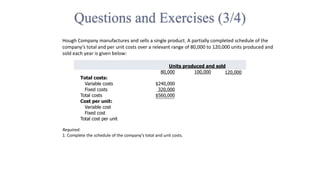
Hough Company manufactures and sells a single product. A partially completed schedule of the
company’s total and per unit costs over a relevant range of 80,000 to 120,000 units produced and
sold each year is given below:
Required:
1. Complete the schedule of the company’s total and unit costs.
Units produced and sold
80,000 100,000 120,000
Total costs:
Variable costs $240,000
Fixed costs 320,000
Total costs $560,000
Cost per unit:
Variable cost
Fixed cost
Total cost per unit
Questions and Exercises (3/4)
1-5
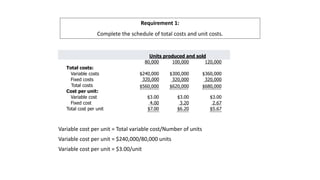
Requirement 1:
Complete the schedule of total costs and unit costs.
Variable cost per unit = Total variable cost/Number of units
Variable cost per unit = $240,000/80,000 units
Variable cost per unit = $3.00/unit
Units produced and sold
80,000 100,000 120,000
Total costs:
Variable costs $240,000 $300,000 $360,000
Fixed costs 320,000 320,000 320,000
Total costs $560,000 $620,000 $680,000
Cost per unit:
Variable cost $3.00 $3.00 $3.00
Fixed cost 4.00 3.20 2.67
Total cost per unit $7.00 $6.20 $5.67
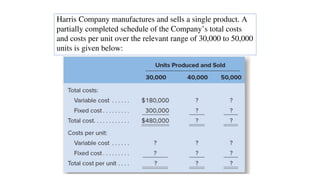
Harris Company manufactures and sells a single product. A
partially completed schedule of the Company’s total costs
and costs per unit over the relevant range of 30,000 to 50,000
units is given below:
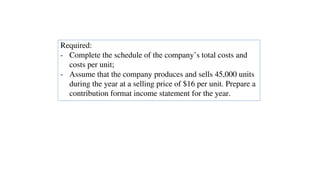
Required:
- Complete the schedule of the company’s total costs and
costs per unit;
- Assume that the company produces and sells 45,000 units
during the year at a selling price of $16 per unit. Prepare a
contribution format income statement for the year.
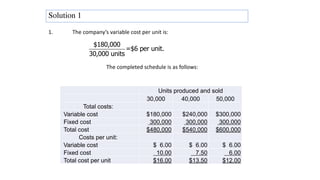
Solution 1
Units produced and sold
30,000 40,000 50,000
Total costs:
Variable cost $180,000 $240,000 $300,000
Fixed cost 300,000 300,000 300,000
Total cost $480,000 $540,000 $600,000
Costs per unit:
Variable cost $ 6.00 $ 6.00 $ 6.00
Fixed cost 10.00 7.50 6.00
Total cost per unit $16.00 $13.50 $12.00
1. The company’s variable cost per unit is:
$180,000
=$6 per unit.
30,000 units
The completed schedule is as follows:
Solution 2
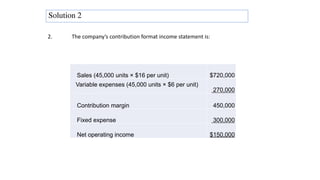
Sales (45,000 units × $16 per unit) $720,000
Variable expenses (45,000 units × $6 per unit)
270,000
Contribution margin 450,000
Fixed expense 300,000
Net operating income $150,000
2. The company’s contribution format income statement is:
Guided Example
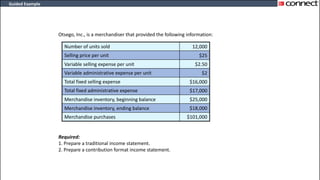
Otsego, Inc., is a merchandiser that provided the following information:
Required:
1. Prepare a traditional income statement.
2. Prepare a contribution format income statement.
Number of units sold 12,000
Selling price per unit $25
Variable selling expense per unit $2.50
Variable administrative expense per unit $2
Total fixed selling expense $16,000
Total fixed administrative expense $17,000
Merchandise inventory, beginning balance $25,000
Merchandise inventory, ending balance $18,000
Merchandise purchases $101,000
Guided Example
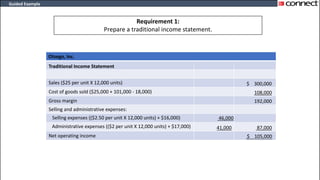
Requirement 1:
Prepare a traditional income statement.
Otsego, Inc.
Traditional Income Statement
Sales ($25 per unit X 12,000 units) $ 300,000
Cost of goods sold ($25,000 + 101,000 - 18,000) 108,000
Gross margin 192,000
Selling and administrative expenses:
Selling expenses (($2.50 per unit X 12,000 units) + $16,000)
Administrative expenses (($2 per unit X 12,000 units) + $17,000) 41,000 87,000
Net operating income $ 105,000
46,000
Guided Example
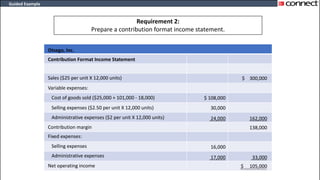
Requirement 2:
Prepare a contribution format income statement.
Otsego, Inc.
Contribution Format Income Statement
Sales ($25 per unit X 12,000 units) $ 300,000
Variable expenses:
Cost of goods sold ($25,000 + 101,000 - 18,000) $ 108,000
Selling expenses ($2.50 per unit X 12,000 units) 30,000
Administrative expenses ($2 per unit X 12,000 units) 24,000 162,000
Contribution margin 138,000
Fixed expenses:
Selling expenses 16,000
Administrative expenses 17,000 33,000
Net operating income $ 105,000
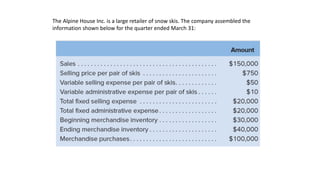
The Alpine House Inc. is a large retailer of snow skis. The company assembled the
information shown below for the quarter ended March 31:
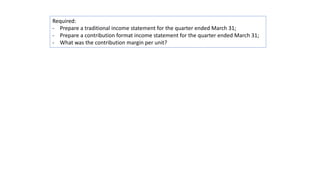
Required:
- Prepare a traditional income statement for the quarter ended March 31;
- Prepare a contribution format income statement for the quarter ended March 31;
- What was the contribution margin per unit?
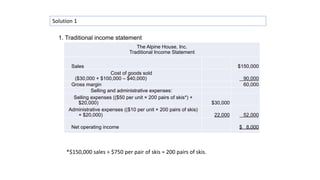
Solution 1
The Alpine House, Inc.
Traditional Income Statement
Sales $150,000
Cost of goods sold
($30,000 + $100,000 – $40,000) 90,000
Gross margin 60,000
Selling and administrative expenses:
Selling expenses (($50 per unit × 200 pairs of skis*) +
$20,000) $30,000
Administrative expenses (($10 per unit × 200 pairs of skis)
+ $20,000) 22,000 52,000
Net operating income $ 8,000
1. Traditional income statement
*$150,000 sales ÷ $750 per pair of skis = 200 pairs of skis.
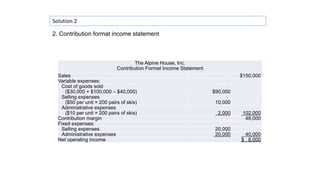
Solution 2
The Alpine House, Inc.
Contribution Format Income Statement
Sales $150,000
Variable expenses:
Cost of goods sold
($30,000 + $100,000 – $40,000) $90,000
Selling expenses
($50 per unit × 200 pairs of skis) 10,000
Administrative expenses
($10 per unit × 200 pairs of skis) 2,000 102,000
Contribution margin 48,000
Fixed expenses:
Selling expenses 20,000
Administrative expenses 20,000 40,000
Net operating income $ 8,000
2. Contribution format income statement
Solution 3
3. Since 200 pairs of skis were sold and the contribution margin totaled
$48,000 for the quarter, the contribution margin per unit was $240
($48,000 ÷ 200 pair of skis = $240 per pair of skis).

Exercises with solutions CHAPTER 0104 (1).pdf

  • 1.
    Exercises with solutions– Chapters 1-4
  • 2.
    • What arethe main three major types of product costs in a manufacturing company? • Define the following: direct materials; indirect materials; direct labor; indirect labor; manufacturing overhead. • Explain the difference between a product cost and a period cost. • What effect does an increase in the activity level have on: unit fixed cost? Unit variable cost? Total fixed cost? Total variable cost? Questions and Exercises (1/4)
  • 3.
    Java Express operatesa number of espresso coffee stands in busy suburban malls. The fixed weekly expense of a coffee stand is $1,500 and the variable cost per cup of coffee served is $0.19. Required: Estimate the total costs and average cost per cup of coffee at the indicated levels of activity for a coffee stand. Round off the cost of a cup of coffee to the nearest cent. Cups of Coffee Served in a Week Cups of Coffee Served in a Week Cups of Coffee Served in a Week 3,700 3,800 3,900 Fixed cost $1,500 $1,500 $1,500 Variable cost 703 722 741 Total cost $2,203 $2,222 $2,241 Average cost per cup of coffee served $ 0.60 $ 0.58 $ 0.57 Questions and Exercises (2/4)
  • 4.
    © McGraw-Hill Education.All rights reserved. Authorized only for instructor use in the classroom. No reproduction or further distribution permitted without the prior written consent of McGraw-Hill Education. 1-4 Hough Company manufactures and sells a single product. A partially completed schedule of the company’s total and per unit costs over a relevant range of 80,000 to 120,000 units produced and sold each year is given below: Required: 1. Complete the schedule of the company’s total and unit costs. Units produced and sold 80,000 100,000 120,000 Total costs: Variable costs $240,000 Fixed costs 320,000 Total costs $560,000 Cost per unit: Variable cost Fixed cost Total cost per unit Questions and Exercises (3/4)
  • 5.
    1-5 Requirement 1: Complete theschedule of total costs and unit costs. Variable cost per unit = Total variable cost/Number of units Variable cost per unit = $240,000/80,000 units Variable cost per unit = $3.00/unit Units produced and sold 80,000 100,000 120,000 Total costs: Variable costs $240,000 $300,000 $360,000 Fixed costs 320,000 320,000 320,000 Total costs $560,000 $620,000 $680,000 Cost per unit: Variable cost $3.00 $3.00 $3.00 Fixed cost 4.00 3.20 2.67 Total cost per unit $7.00 $6.20 $5.67
  • 6.
    Harris Company manufacturesand sells a single product. A partially completed schedule of the Company’s total costs and costs per unit over the relevant range of 30,000 to 50,000 units is given below:
  • 7.
    Required: - Complete theschedule of the company’s total costs and costs per unit; - Assume that the company produces and sells 45,000 units during the year at a selling price of $16 per unit. Prepare a contribution format income statement for the year.
  • 8.
    Solution 1 Units producedand sold 30,000 40,000 50,000 Total costs: Variable cost $180,000 $240,000 $300,000 Fixed cost 300,000 300,000 300,000 Total cost $480,000 $540,000 $600,000 Costs per unit: Variable cost $ 6.00 $ 6.00 $ 6.00 Fixed cost 10.00 7.50 6.00 Total cost per unit $16.00 $13.50 $12.00 1. The company’s variable cost per unit is: $180,000 =$6 per unit. 30,000 units The completed schedule is as follows:
  • 9.
    Solution 2 Sales (45,000units × $16 per unit) $720,000 Variable expenses (45,000 units × $6 per unit) 270,000 Contribution margin 450,000 Fixed expense 300,000 Net operating income $150,000 2. The company’s contribution format income statement is:
  • 10.
    Guided Example Otsego, Inc.,is a merchandiser that provided the following information: Required: 1. Prepare a traditional income statement. 2. Prepare a contribution format income statement. Number of units sold 12,000 Selling price per unit $25 Variable selling expense per unit $2.50 Variable administrative expense per unit $2 Total fixed selling expense $16,000 Total fixed administrative expense $17,000 Merchandise inventory, beginning balance $25,000 Merchandise inventory, ending balance $18,000 Merchandise purchases $101,000
  • 11.
    Guided Example Requirement 1: Preparea traditional income statement. Otsego, Inc. Traditional Income Statement Sales ($25 per unit X 12,000 units) $ 300,000 Cost of goods sold ($25,000 + 101,000 - 18,000) 108,000 Gross margin 192,000 Selling and administrative expenses: Selling expenses (($2.50 per unit X 12,000 units) + $16,000) Administrative expenses (($2 per unit X 12,000 units) + $17,000) 41,000 87,000 Net operating income $ 105,000 46,000
  • 12.
    Guided Example Requirement 2: Preparea contribution format income statement. Otsego, Inc. Contribution Format Income Statement Sales ($25 per unit X 12,000 units) $ 300,000 Variable expenses: Cost of goods sold ($25,000 + 101,000 - 18,000) $ 108,000 Selling expenses ($2.50 per unit X 12,000 units) 30,000 Administrative expenses ($2 per unit X 12,000 units) 24,000 162,000 Contribution margin 138,000 Fixed expenses: Selling expenses 16,000 Administrative expenses 17,000 33,000 Net operating income $ 105,000
  • 13.
    The Alpine HouseInc. is a large retailer of snow skis. The company assembled the information shown below for the quarter ended March 31:
  • 14.
    Required: - Prepare atraditional income statement for the quarter ended March 31; - Prepare a contribution format income statement for the quarter ended March 31; - What was the contribution margin per unit?
  • 15.
    Solution 1 The AlpineHouse, Inc. Traditional Income Statement Sales $150,000 Cost of goods sold ($30,000 + $100,000 – $40,000) 90,000 Gross margin 60,000 Selling and administrative expenses: Selling expenses (($50 per unit × 200 pairs of skis*) + $20,000) $30,000 Administrative expenses (($10 per unit × 200 pairs of skis) + $20,000) 22,000 52,000 Net operating income $ 8,000 1. Traditional income statement *$150,000 sales ÷ $750 per pair of skis = 200 pairs of skis.
  • 16.
    Solution 2 The AlpineHouse, Inc. Contribution Format Income Statement Sales $150,000 Variable expenses: Cost of goods sold ($30,000 + $100,000 – $40,000) $90,000 Selling expenses ($50 per unit × 200 pairs of skis) 10,000 Administrative expenses ($10 per unit × 200 pairs of skis) 2,000 102,000 Contribution margin 48,000 Fixed expenses: Selling expenses 20,000 Administrative expenses 20,000 40,000 Net operating income $ 8,000 2. Contribution format income statement
  • 17.
    Solution 3 3. Since200 pairs of skis were sold and the contribution margin totaled $48,000 for the quarter, the contribution margin per unit was $240 ($48,000 ÷ 200 pair of skis = $240 per pair of skis).