VOID AGREEMENTS
DEFINITION
According to Sec. 2(g), a void agreement is
 one which is not enforceable by law. Such
 an agreement does not give rise to any
 legal consequences & is void ab initio.
Void agreements
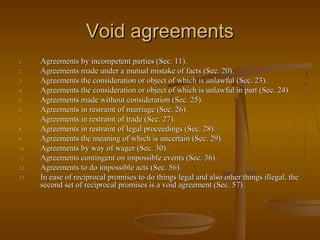
1.    Agreements by incompetent parties (Sec. 11).
2.    Agreements made under a mutual mistake of facts (Sec. 20).
3.    Agreements the consideration or object of which is unlawful (Sec. 23).
4.    Agreements the consideration or object of which is unlawful in part (Sec. 24).
5.    Agreements made without consideration (Sec. 25).
6.    Agreements in restraint of marriage (Sec. 26).
7.    Agreements in restraint of trade (Sec. 27).
8.    Agreements in restraint of legal proceedings (Sec. 28).
9.    Agreements the meaning of which is uncertain (Sec. 29).
10.   Agreements by way of wager (Sec. 30).
11.   Agreements contingent on impossible events (Sec. 36).
12.   Agreements to do impossible acts (Sec. 56).
13.   In ease of reciprocal promises to do things legal and also other things illegal, the
      second set of reciprocal promises is a void agreement (Sec. 57).
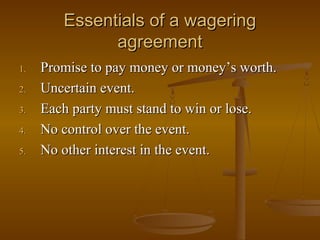
Essentials of a wagering
              agreement
1.   Promise to pay money or money’s worth.
2.   Uncertain event.
3.   Each party must stand to win or lose.
4.   No control over the event.
5.   No other interest in the event.
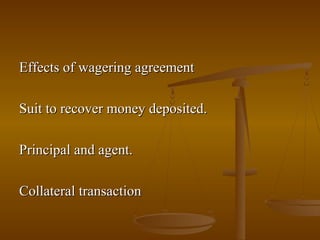
Effects of wagering agreement

Suit to recover money deposited.

Principal and agent.

Collateral transaction
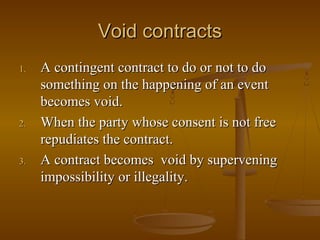
Void contracts
1.   A contingent contract to do or not to do
     something on the happening of an event
     becomes void.
2.   When the party whose consent is not free
     repudiates the contract.
3.   A contract becomes void by supervening
     impossibility or illegality.
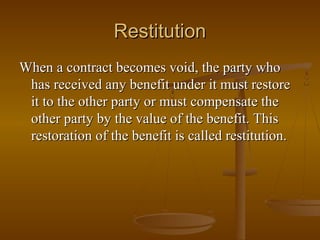
Restitution
When a contract becomes void, the party who
 has received any benefit under it must restore
 it to the other party or must compensate the
 other party by the value of the benefit. This
 restoration of the benefit is called restitution.

Void agreements

  • 1.
  • 2.
    DEFINITION According to Sec.2(g), a void agreement is one which is not enforceable by law. Such an agreement does not give rise to any legal consequences & is void ab initio.
  • 3.
    Void agreements 1. Agreements by incompetent parties (Sec. 11). 2. Agreements made under a mutual mistake of facts (Sec. 20). 3. Agreements the consideration or object of which is unlawful (Sec. 23). 4. Agreements the consideration or object of which is unlawful in part (Sec. 24). 5. Agreements made without consideration (Sec. 25). 6. Agreements in restraint of marriage (Sec. 26). 7. Agreements in restraint of trade (Sec. 27). 8. Agreements in restraint of legal proceedings (Sec. 28). 9. Agreements the meaning of which is uncertain (Sec. 29). 10. Agreements by way of wager (Sec. 30). 11. Agreements contingent on impossible events (Sec. 36). 12. Agreements to do impossible acts (Sec. 56). 13. In ease of reciprocal promises to do things legal and also other things illegal, the second set of reciprocal promises is a void agreement (Sec. 57).
  • 4.
    Essentials of awagering agreement 1. Promise to pay money or money’s worth. 2. Uncertain event. 3. Each party must stand to win or lose. 4. No control over the event. 5. No other interest in the event.
  • 5.
    Effects of wageringagreement Suit to recover money deposited. Principal and agent. Collateral transaction
  • 6.
    Void contracts 1. A contingent contract to do or not to do something on the happening of an event becomes void. 2. When the party whose consent is not free repudiates the contract. 3. A contract becomes void by supervening impossibility or illegality.
  • 7.
    Restitution When a contractbecomes void, the party who has received any benefit under it must restore it to the other party or must compensate the other party by the value of the benefit. This restoration of the benefit is called restitution.