Report of Global Warming Nian Hongen School of Chemical Engineering and Bioengineering
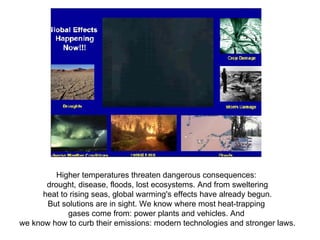
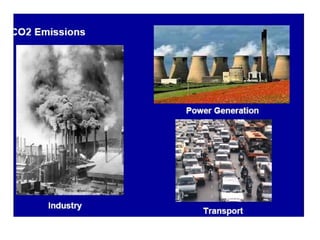
Higher temperatures threaten dangerous consequences:  drought, disease, floods, lost ecosystems. And from sweltering heat to rising seas, global warming's effects have already begun.  But solutions are in sight. We know where most heat-trapping  gases come from: power plants and vehicles. And  we know how to curb their emissions: modern technologies and stronger laws.
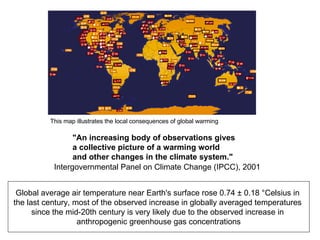
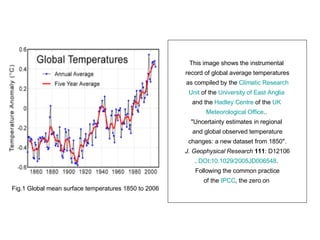
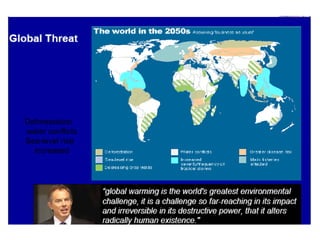
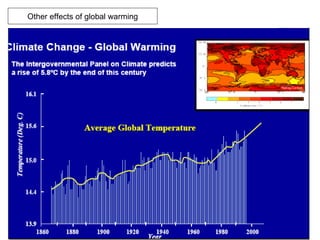
Global average air temperature near Earth's surface rose 0.74 ± 0.18 °Celsius in  the last century, most of the observed increase in globally averaged temperatures  since the mid-20th century is very likely due to the observed increase in  anthropogenic greenhouse gas concentrations "An increasing body of observations gives a collective picture of a warming world and other changes in the climate system." Intergovernmental Panel on Climate Change (IPCC), 2001  This map illustrates the local consequences of global warming
Fig.1 Global mean surface temperatures 1850 to 2006 This image shows the instrumental  record of global average temperatures as compiled by the  Climatic Research  Unit  of the  University of East Anglia   and the  Hadley Centre  of the  UK  Meteorological Office ..  "Uncertainty estimates in regional  and global observed temperature changes: a new dataset from 1850".  J. Geophysical Research   111 : D12106 .  DOI : 10.1029/2005JD006548 .  Following the common practice  of the  IPCC , the zero on
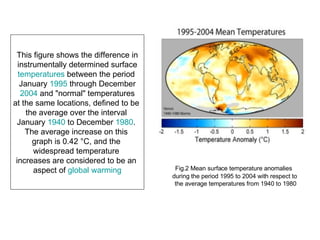
Fig.2 Mean surface temperature anomalies   during the period 1995 to 2004 with respect to the average temperatures from 1940 to 1980 This figure shows the difference in instrumentally determined surface  temperatures  between the period  January  1995  through December 2004  and "normal" temperatures  at the same locations, defined to be  the average over the interval  January  1940  to December  1980 .  The average increase on this  graph is 0.42 °C, and the  widespread temperature  increases are considered to be an  aspect of  global warming
Deforestation  water conflicts Sea-level rise  increased
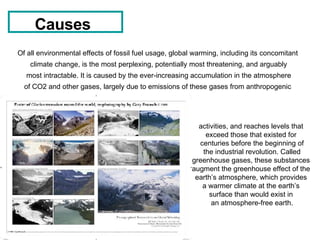
Causes   Of all environmental effects of fossil fuel usage, global warming, including its concomitant  climate change, is the most perplexing, potentially most threatening, and arguably most intractable. It is caused by the ever-increasing accumulation in the atmosphere  of CO2 and other gases, largely due to emissions of these gases from anthropogenic  activities, and reaches levels that  exceed those that existed for  centuries before the beginning of the industrial revolution. Called  greenhouse gases, these substances  augment the greenhouse effect of the  earth’s atmosphere, which provides  a warmer climate at the earth’s  surface than would exist in  an atmosphere-free earth.
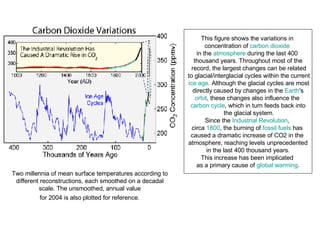
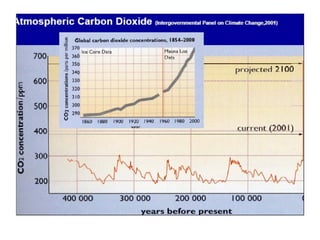
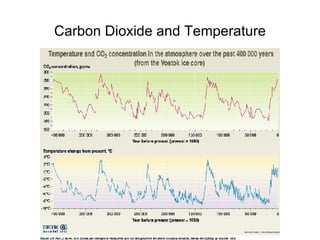
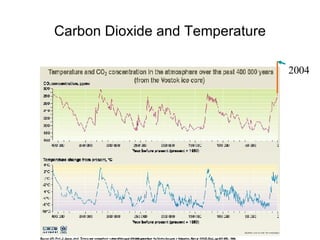
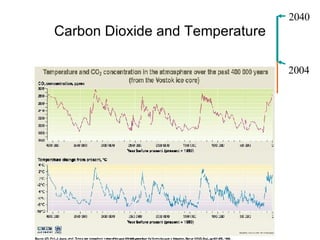
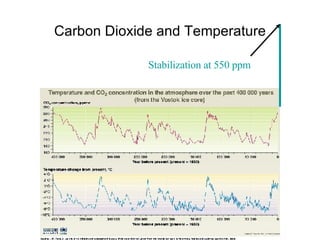
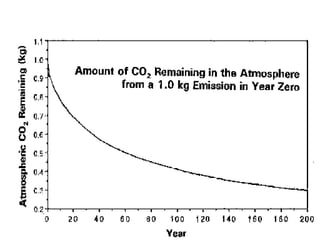
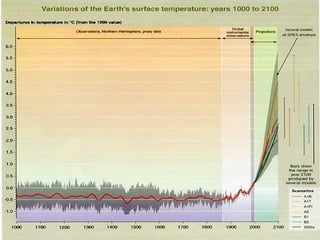
Two millennia of mean surface temperatures according to  different reconstructions, each smoothed on a decadal  scale. The unsmoothed, annual value  for 2004 is also plotted for reference.   This figure shows the variations in  concentration of  carbon dioxide   in the  atmosphere  during the last 400  thousand years. Throughout most of the record, the largest changes can be related to glacial/interglacial cycles within the current ice age . Although the glacial cycles are most directly caused by changes in the  Earth 's  orbit , these changes also influence the  carbon cycle , which in turn feeds back into the glacial system. Since the  Industrial Revolution ,  circa  1800 , the burning of  fossil fuels  has  caused a dramatic increase of CO2 in the  atmosphere, reaching levels unprecedented in the last 400 thousand years.  This increase has been implicated  as a primary cause of  global warming .
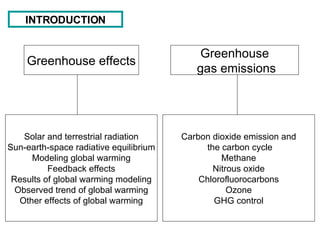
INTRODUCTION Greenhouse effects Greenhouse gas emissions Solar and terrestrial radiation Sun-earth-space radiative equilibrium Modeling global warming Feedback effects Results of global warming modeling Observed trend of global warming Other effects of global warming Carbon dioxide emission and the carbon cycle Methane Nitrous oxide Chlorofluorocarbons Ozone GHG control
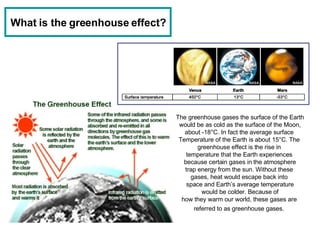
What is the greenhouse effect? The greenhouse gases the surface of the Earth would be as cold as the surface of the Moon,  about -18°C. In fact the average surface  Temperature of the Earth is about 15°C. The  greenhouse effect is the rise in  temperature that the Earth experiences  because certain gases in the atmosphere trap energy from the sun. Without these  gases, heat would escape back into  space and Earth’s average temperature would be colder. Because of  how they warm our world, these gases are  referred to as greenhouse gases.
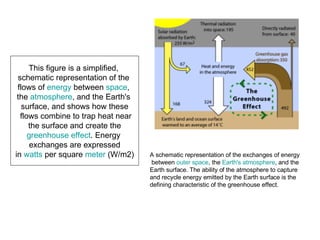
A schematic representation of the exchanges of energy between  outer space , the  Earth's atmosphere , and the  Earth surface. The ability of the atmosphere to capture  and recycle energy emitted by the Earth surface is the  defining characteristic of the greenhouse effect.  This figure is a simplified,  schematic representation of the  flows of  energy  between  space ,  the  atmosphere , and the Earth's  surface, and shows how these flows combine to trap heat near the surface and create the  greenhouse effect . Energy  exchanges are expressed in  watts  per square  meter  (W/m2)
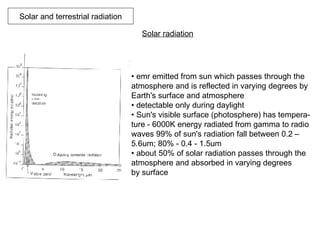
Solar and terrestrial radiation Solar radiation   •  emr emitted from sun which passes through the  atmosphere and is reflected in varying degrees by  Earth's surface and atmosphere  •  detectable only during daylight  •  Sun's visible surface (photosphere) has tempera- ture - 6000K energy radiated from gamma to radio  waves 99% of sun's radiation fall between 0.2 –  5.6um; 80% - 0.4 - 1.5um •  about 50% of solar radiation passes through the  atmosphere and absorbed in varying degrees  by surface
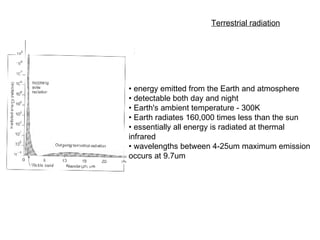
Terrestrial radiation   •  energy emitted from the Earth and atmosphere  •  detectable both day and night  •  Earth's ambient temperature - 300K  •  Earth radiates 160,000 times less than the sun  •  essentially all energy is radiated at thermal  infrared  •  wavelengths between 4-25um maximum emission  occurs at 9.7um
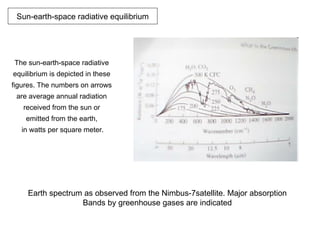
Sun-earth-space radiative equilibrium Earth spectrum as observed from the Nimbus-7satellite. Major absorption Bands by greenhouse gases are indicated The sun-earth-space radiative  equilibrium is depicted in these  figures. The numbers on arrows  are average annual radiation  received from the sun or  emitted from the earth,  in watts per square meter.
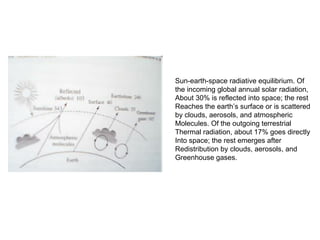
Sun-earth-space radiative equilibrium. Of  the incoming global annual solar radiation, About 30% is reflected into space; the rest Reaches the earth’s surface or is scattered by clouds, aerosols, and atmospheric  Molecules. Of the outgoing terrestrial  Thermal radiation, about 17% goes directly Into space; the rest emerges after  Redistribution by clouds, aerosols, and  Greenhouse gases.
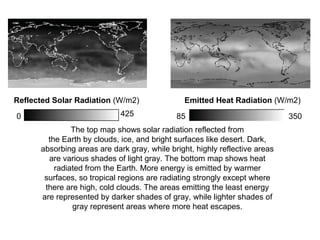
Reflected Solar Radiation  (W/m2) 425 0 Emitted Heat Radiation  (W/m2) 85 350 The top map shows solar radiation reflected from the Earth by clouds, ice, and bright surfaces like desert. Dark, absorbing areas are dark gray, while bright, highly reflective areas are various shades of light gray. The bottom map shows heat radiated from the Earth. More energy is emitted by warmer surfaces, so tropical regions are radiating strongly except where there are high, cold clouds. The areas emitting the least energy are represented by darker shades of gray, while lighter shades of gray represent areas where more heat escapes.
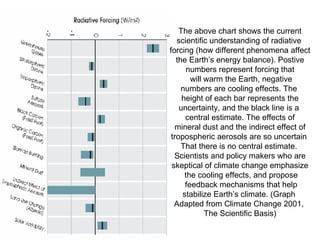
The above chart shows the current scientific understanding of radiative  forcing (how different phenomena affect the Earth’s energy balance). Postive numbers represent forcing that will warm the Earth, negative numbers are cooling effects. The  height of each bar represents the uncertainty, and the black line is a  central estimate. The effects of mineral dust and the indirect effect of tropospheric aerosols are so uncertain  That there is no central estimate.  Scientists and policy makers who are skeptical of climate change emphasize the cooling effects, and propose feedback mechanisms that help stabilize Earth’s climate. (Graph  Adapted from Climate Change 2001,  The Scientific Basis)
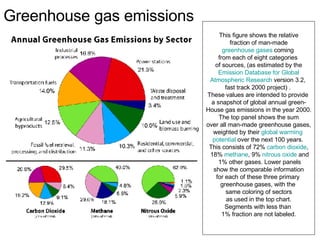
Greenhouse gas emissions This figure shows the relative fraction of man-made  greenhouse gases  coming  from each of eight categories  of sources, (as estimated by the Emission Database for Global  Atmospheric Research  version 3.2,  fast track 2000 project) .  These values are intended to provide  a snapshot of global annual green- House gas emissions in the year 2000. The top panel shows the sum over all man-made greenhouse gases,  weighted by their  global warming  potential  over the next 100 years.  This consists of 72%  carbon dioxide , 18%  methane , 9%  nitrous oxide  and 1% other gases. Lower panels show the comparable information  for each of these three primary  greenhouse gases, with the  same coloring of sectors as used in the top chart.  Segments with less than  1% fraction are not labeled.
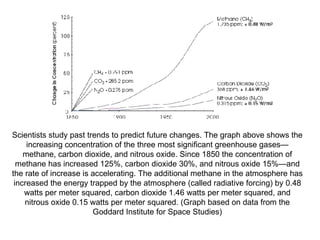
Scientists study past trends to predict future changes. The graph above shows the increasing concentration of the three most significant greenhouse gases—methane, carbon dioxide, and nitrous oxide. Since 1850 the concentration of methane has increased 125%, carbon dioxide 30%, and nitrous oxide 15%—and the rate of increase is accelerating. The additional methane in the atmosphere has increased the energy trapped by the atmosphere (called radiative forcing) by 0.48 watts per meter squared, carbon dioxide 1.46 watts per meter squared, and nitrous oxide 0.15 watts per meter squared. (Graph based on data from the Goddard Institute for Space Studies)
 
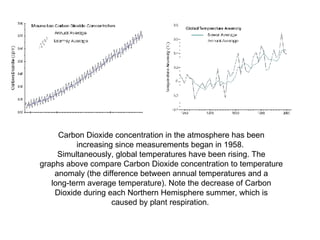
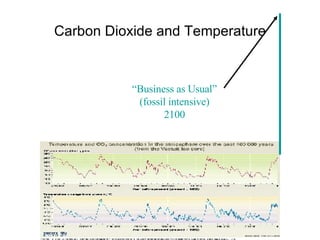
Carbon Dioxide concentration in the atmosphere has been increasing since measurements began in 1958.  Simultaneously, global temperatures have been rising. The graphs above compare Carbon Dioxide concentration to temperature anomaly (the difference between annual temperatures and a long-term average temperature). Note the decrease of Carbon Dioxide during each Northern Hemisphere summer, which is caused by plant respiration.
 
 
Carbon Dioxide and Temperature
2004 Carbon Dioxide and Temperature
Carbon Dioxide and Temperature 2040 2004
Stabilization at 550 ppm Carbon Dioxide and Temperature
“ Business as Usual” (fossil intensive) 2100 Carbon Dioxide and Temperature
 
Other effects of global warming
 
 
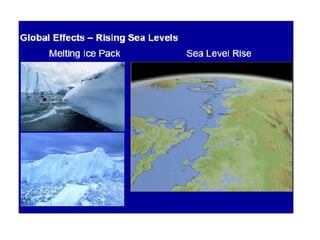
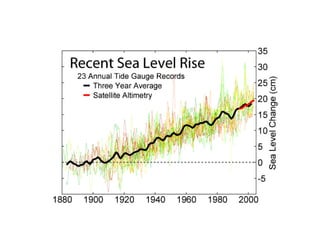
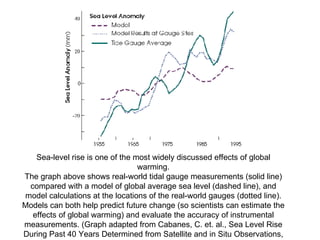
Sea-level rise is one of the most widely discussed effects of global warming. The graph above shows real-world tidal gauge measurements (solid line) compared with a model of global average sea level (dashed line), and model calculations at the locations of the real-world gauges (dotted line). Models can both help predict future change (so scientists can estimate the effects of global warming) and evaluate the accuracy of instrumental measurements. (Graph adapted from Cabanes, C. et. al., Sea Level Rise During Past 40 Years Determined from Satellite and in Situ Observations, Science, October 26, 2001, Vol 294, pp. 840-842.)
 
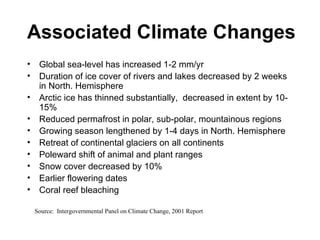
Associated Climate Changes Global sea-level has increased 1-2 mm/yr Duration of ice cover of rivers and lakes decreased by 2 weeks in North. Hemisphere Arctic ice has thinned substantially,  decreased in extent by 10-15% Reduced permafrost in polar, sub-polar, mountainous regions Growing season lengthened by 1-4 days in North. Hemisphere Retreat of continental glaciers on all continents Poleward shift of animal and plant ranges Snow cover decreased by 10% Earlier flowering dates Coral reef bleaching Source:  Intergovernmental Panel on Climate Change, 2001 Report
 
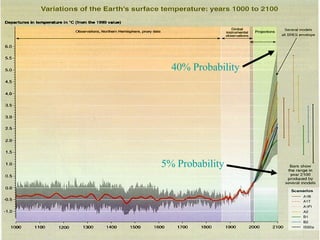
40% Probability 5% Probability
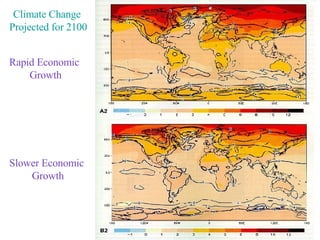
Climate Change  Projected for 2100 Rapid Economic  Growth Slower Economic  Growth
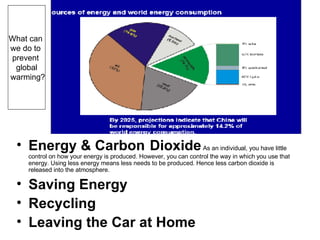
Energy & Carbon   Dioxide   As an individual, you have little control on how your energy is produced. However, you can control the way in which you use that energy. Using less energy means less needs to be produced. Hence less carbon dioxide is released into the atmosphere. Saving Energy Recycling Leaving the Car at Home What can  we do to  prevent  global warming?
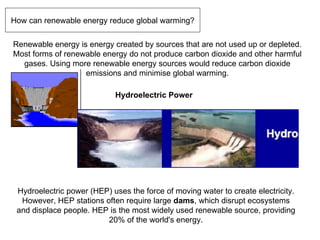
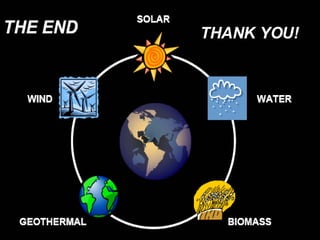
How can renewable energy reduce global warming? Renewable energy is energy created by sources that are not used up or depleted. Most forms of renewable energy do not produce carbon dioxide and other harmful gases. Using more renewable energy sources would reduce carbon dioxide emissions and minimise global warming. Hydroelectric Power Hydroelectric power (HEP) uses the force of moving water to create electricity. However, HEP stations often require large  dams , which disrupt ecosystems and displace people. HEP is the most widely used renewable source, providing 20% of the world's energy.
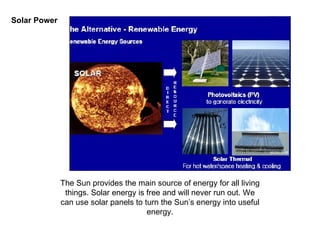
Solar Power The Sun provides the main source of energy for all living things. Solar energy is free and will never run out. We can use solar panels to turn the Sun’s energy into useful energy.
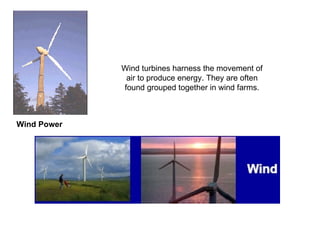
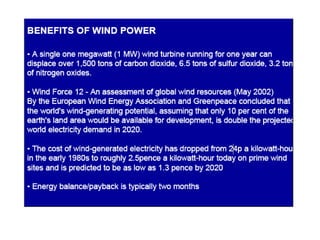
Wind Power Wind turbines harness the movement of air to produce energy. They are often found grouped together in wind farms.
 
 
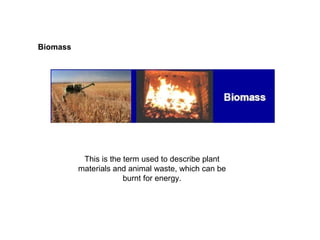
Biomass This is the term used to describe plant materials and animal waste, which can be burnt for energy.
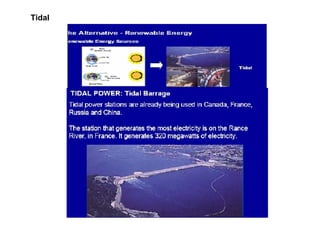
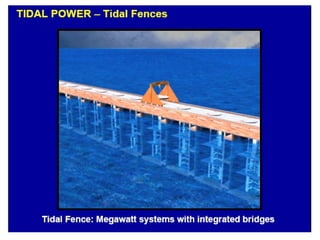
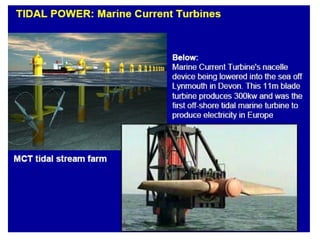
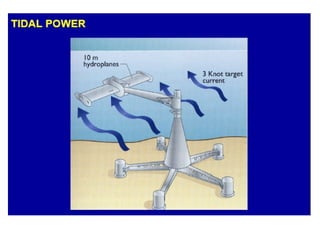
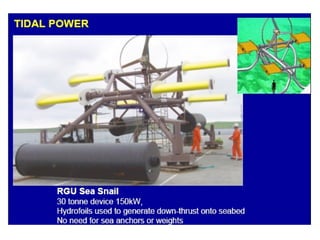
Tidal


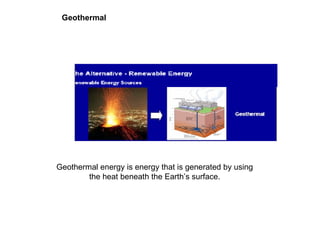
Geothermal energy is energy that is generated by using the heat beneath the Earth’s surface. Geothermal


THANK YOU!
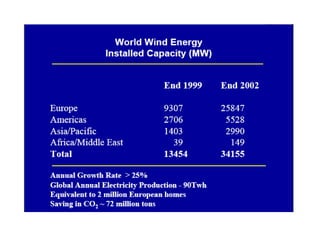
Problems 1. What do the higher temperatures threaten dangerous consequences? 2. What causes the global warming? 3. What is the greenhouse effect? 4. How can renewable energy reduce global warming? 5. What are the benefits of wind power?

Global Warming

  • 1.
    Report of GlobalWarming Nian Hongen School of Chemical Engineering and Bioengineering
  • 2.
    Higher temperatures threatendangerous consequences: drought, disease, floods, lost ecosystems. And from sweltering heat to rising seas, global warming's effects have already begun. But solutions are in sight. We know where most heat-trapping gases come from: power plants and vehicles. And we know how to curb their emissions: modern technologies and stronger laws.
  • 3.
    Global average airtemperature near Earth's surface rose 0.74 ± 0.18 °Celsius in the last century, most of the observed increase in globally averaged temperatures since the mid-20th century is very likely due to the observed increase in anthropogenic greenhouse gas concentrations "An increasing body of observations gives a collective picture of a warming world and other changes in the climate system." Intergovernmental Panel on Climate Change (IPCC), 2001 This map illustrates the local consequences of global warming
  • 4.
    Fig.1 Global meansurface temperatures 1850 to 2006 This image shows the instrumental record of global average temperatures as compiled by the Climatic Research Unit of the University of East Anglia and the Hadley Centre of the UK Meteorological Office .. "Uncertainty estimates in regional and global observed temperature changes: a new dataset from 1850". J. Geophysical Research 111 : D12106 . DOI : 10.1029/2005JD006548 .  Following the common practice of the IPCC , the zero on
  • 5.
    Fig.2 Mean surfacetemperature anomalies during the period 1995 to 2004 with respect to the average temperatures from 1940 to 1980 This figure shows the difference in instrumentally determined surface temperatures between the period January 1995 through December 2004 and "normal" temperatures at the same locations, defined to be the average over the interval January 1940 to December 1980 . The average increase on this graph is 0.42 °C, and the widespread temperature increases are considered to be an aspect of global warming
  • 6.
    Deforestation waterconflicts Sea-level rise increased
  • 7.
    Causes Of all environmental effects of fossil fuel usage, global warming, including its concomitant climate change, is the most perplexing, potentially most threatening, and arguably most intractable. It is caused by the ever-increasing accumulation in the atmosphere of CO2 and other gases, largely due to emissions of these gases from anthropogenic activities, and reaches levels that exceed those that existed for centuries before the beginning of the industrial revolution. Called greenhouse gases, these substances augment the greenhouse effect of the earth’s atmosphere, which provides a warmer climate at the earth’s surface than would exist in an atmosphere-free earth.
  • 8.
    Two millennia ofmean surface temperatures according to different reconstructions, each smoothed on a decadal scale. The unsmoothed, annual value for 2004 is also plotted for reference. This figure shows the variations in concentration of carbon dioxide in the atmosphere during the last 400 thousand years. Throughout most of the record, the largest changes can be related to glacial/interglacial cycles within the current ice age . Although the glacial cycles are most directly caused by changes in the Earth 's orbit , these changes also influence the carbon cycle , which in turn feeds back into the glacial system. Since the Industrial Revolution , circa 1800 , the burning of fossil fuels has caused a dramatic increase of CO2 in the atmosphere, reaching levels unprecedented in the last 400 thousand years. This increase has been implicated as a primary cause of global warming .
  • 9.
    INTRODUCTION Greenhouse effectsGreenhouse gas emissions Solar and terrestrial radiation Sun-earth-space radiative equilibrium Modeling global warming Feedback effects Results of global warming modeling Observed trend of global warming Other effects of global warming Carbon dioxide emission and the carbon cycle Methane Nitrous oxide Chlorofluorocarbons Ozone GHG control
  • 10.
    What is thegreenhouse effect? The greenhouse gases the surface of the Earth would be as cold as the surface of the Moon, about -18°C. In fact the average surface Temperature of the Earth is about 15°C. The greenhouse effect is the rise in temperature that the Earth experiences because certain gases in the atmosphere trap energy from the sun. Without these gases, heat would escape back into space and Earth’s average temperature would be colder. Because of how they warm our world, these gases are referred to as greenhouse gases.
  • 11.
    A schematic representationof the exchanges of energy between outer space , the Earth's atmosphere , and the Earth surface. The ability of the atmosphere to capture and recycle energy emitted by the Earth surface is the defining characteristic of the greenhouse effect. This figure is a simplified, schematic representation of the flows of energy between space , the atmosphere , and the Earth's surface, and shows how these flows combine to trap heat near the surface and create the greenhouse effect . Energy exchanges are expressed in watts per square meter (W/m2)
  • 12.
    Solar and terrestrialradiation Solar radiation • emr emitted from sun which passes through the atmosphere and is reflected in varying degrees by Earth's surface and atmosphere • detectable only during daylight • Sun's visible surface (photosphere) has tempera- ture - 6000K energy radiated from gamma to radio waves 99% of sun's radiation fall between 0.2 – 5.6um; 80% - 0.4 - 1.5um • about 50% of solar radiation passes through the atmosphere and absorbed in varying degrees by surface
  • 13.
    Terrestrial radiation • energy emitted from the Earth and atmosphere • detectable both day and night • Earth's ambient temperature - 300K • Earth radiates 160,000 times less than the sun • essentially all energy is radiated at thermal infrared • wavelengths between 4-25um maximum emission occurs at 9.7um

  • 14.
    Sun-earth-space radiative equilibriumEarth spectrum as observed from the Nimbus-7satellite. Major absorption Bands by greenhouse gases are indicated The sun-earth-space radiative equilibrium is depicted in these figures. The numbers on arrows are average annual radiation received from the sun or emitted from the earth, in watts per square meter.
  • 15.
    Sun-earth-space radiative equilibrium.Of the incoming global annual solar radiation, About 30% is reflected into space; the rest Reaches the earth’s surface or is scattered by clouds, aerosols, and atmospheric Molecules. Of the outgoing terrestrial Thermal radiation, about 17% goes directly Into space; the rest emerges after Redistribution by clouds, aerosols, and Greenhouse gases.
  • 16.
    Reflected Solar Radiation (W/m2) 425 0 Emitted Heat Radiation (W/m2) 85 350 The top map shows solar radiation reflected from the Earth by clouds, ice, and bright surfaces like desert. Dark, absorbing areas are dark gray, while bright, highly reflective areas are various shades of light gray. The bottom map shows heat radiated from the Earth. More energy is emitted by warmer surfaces, so tropical regions are radiating strongly except where there are high, cold clouds. The areas emitting the least energy are represented by darker shades of gray, while lighter shades of gray represent areas where more heat escapes.
  • 17.
    The above chartshows the current scientific understanding of radiative forcing (how different phenomena affect the Earth’s energy balance). Postive numbers represent forcing that will warm the Earth, negative numbers are cooling effects. The height of each bar represents the uncertainty, and the black line is a central estimate. The effects of mineral dust and the indirect effect of tropospheric aerosols are so uncertain That there is no central estimate. Scientists and policy makers who are skeptical of climate change emphasize the cooling effects, and propose feedback mechanisms that help stabilize Earth’s climate. (Graph Adapted from Climate Change 2001, The Scientific Basis)
  • 18.
    Greenhouse gas emissionsThis figure shows the relative fraction of man-made greenhouse gases coming from each of eight categories of sources, (as estimated by the Emission Database for Global Atmospheric Research version 3.2, fast track 2000 project) . These values are intended to provide a snapshot of global annual green- House gas emissions in the year 2000. The top panel shows the sum over all man-made greenhouse gases, weighted by their global warming potential over the next 100 years. This consists of 72% carbon dioxide , 18% methane , 9% nitrous oxide and 1% other gases. Lower panels show the comparable information for each of these three primary greenhouse gases, with the same coloring of sectors as used in the top chart. Segments with less than 1% fraction are not labeled.
  • 19.
    Scientists study pasttrends to predict future changes. The graph above shows the increasing concentration of the three most significant greenhouse gases—methane, carbon dioxide, and nitrous oxide. Since 1850 the concentration of methane has increased 125%, carbon dioxide 30%, and nitrous oxide 15%—and the rate of increase is accelerating. The additional methane in the atmosphere has increased the energy trapped by the atmosphere (called radiative forcing) by 0.48 watts per meter squared, carbon dioxide 1.46 watts per meter squared, and nitrous oxide 0.15 watts per meter squared. (Graph based on data from the Goddard Institute for Space Studies)
  • 20.
  • 21.
    Carbon Dioxide concentrationin the atmosphere has been increasing since measurements began in 1958. Simultaneously, global temperatures have been rising. The graphs above compare Carbon Dioxide concentration to temperature anomaly (the difference between annual temperatures and a long-term average temperature). Note the decrease of Carbon Dioxide during each Northern Hemisphere summer, which is caused by plant respiration.
  • 22.
  • 23.
  • 24.
    Carbon Dioxide andTemperature
  • 25.
    2004 Carbon Dioxideand Temperature
  • 26.
    Carbon Dioxide andTemperature 2040 2004
  • 27.
    Stabilization at 550ppm Carbon Dioxide and Temperature
  • 28.
    “ Business asUsual” (fossil intensive) 2100 Carbon Dioxide and Temperature
  • 29.
  • 30.
    Other effects ofglobal warming
  • 31.
  • 32.
  • 33.
    Sea-level rise isone of the most widely discussed effects of global warming. The graph above shows real-world tidal gauge measurements (solid line) compared with a model of global average sea level (dashed line), and model calculations at the locations of the real-world gauges (dotted line). Models can both help predict future change (so scientists can estimate the effects of global warming) and evaluate the accuracy of instrumental measurements. (Graph adapted from Cabanes, C. et. al., Sea Level Rise During Past 40 Years Determined from Satellite and in Situ Observations, Science, October 26, 2001, Vol 294, pp. 840-842.)
  • 34.
  • 35.
    Associated Climate ChangesGlobal sea-level has increased 1-2 mm/yr Duration of ice cover of rivers and lakes decreased by 2 weeks in North. Hemisphere Arctic ice has thinned substantially, decreased in extent by 10-15% Reduced permafrost in polar, sub-polar, mountainous regions Growing season lengthened by 1-4 days in North. Hemisphere Retreat of continental glaciers on all continents Poleward shift of animal and plant ranges Snow cover decreased by 10% Earlier flowering dates Coral reef bleaching Source: Intergovernmental Panel on Climate Change, 2001 Report
  • 36.
  • 37.
    40% Probability 5%Probability
  • 38.
    Climate Change Projected for 2100 Rapid Economic Growth Slower Economic Growth
  • 39.
    Energy & Carbon Dioxide As an individual, you have little control on how your energy is produced. However, you can control the way in which you use that energy. Using less energy means less needs to be produced. Hence less carbon dioxide is released into the atmosphere. Saving Energy Recycling Leaving the Car at Home What can we do to prevent global warming?
  • 40.
    How can renewableenergy reduce global warming? Renewable energy is energy created by sources that are not used up or depleted. Most forms of renewable energy do not produce carbon dioxide and other harmful gases. Using more renewable energy sources would reduce carbon dioxide emissions and minimise global warming. Hydroelectric Power Hydroelectric power (HEP) uses the force of moving water to create electricity. However, HEP stations often require large dams , which disrupt ecosystems and displace people. HEP is the most widely used renewable source, providing 20% of the world's energy.
  • 41.
    Solar Power TheSun provides the main source of energy for all living things. Solar energy is free and will never run out. We can use solar panels to turn the Sun’s energy into useful energy.
  • 42.
    Wind Power Windturbines harness the movement of air to produce energy. They are often found grouped together in wind farms.
  • 43.
  • 44.
  • 45.
    Biomass This isthe term used to describe plant materials and animal waste, which can be burnt for energy.
  • 46.
  • 47.
  • 48.
  • 49.
  • 50.
  • 51.
  • 52.
    Geothermal energy isenergy that is generated by using the heat beneath the Earth’s surface. Geothermal
  • 53.
  • 54.
  • 55.
  • 56.
  • 57.
  • 58.
  • 59.
    Problems 1. Whatdo the higher temperatures threaten dangerous consequences? 2. What causes the global warming? 3. What is the greenhouse effect? 4. How can renewable energy reduce global warming? 5. What are the benefits of wind power?

Editor's Notes