Chapter 9 How did Singapore achieve Independence?
Terms to Remember Merger – the joining of two countries as one. Federation -  a group of states united with one central government but each state has own states govt to deal with local matters. Pro-Communists – people who support the the Communists and their ideas. Referendum – a direct vote carried out by the people of the country to decide something on which there is a disagreement. Confrontation – Indonesia’s opposition to the formation of Malaysia. Radicals – party members who supported the communists.
Problems in 1950s / 1960s Unemployment Most pressing of the problems faced by the government. Ports near Singapore were developing and Singapore faced stiff competition. Many students educated in Chinese schools but there were not enough jobs for them when they left school.
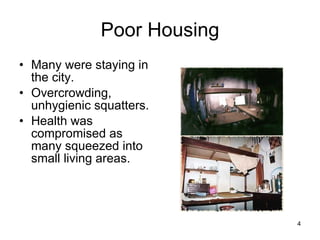
Poor Housing Many were staying in the city. Overcrowding, unhygienic squatters. Health was compromised as many squeezed into small living areas.
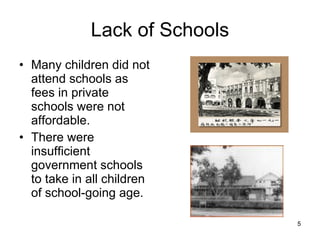
Lack of Schools Many children did not attend schools as fees in private schools were not affordable. There were insufficient government schools to take in all children of school-going age.
Reasons for Merger Solve problem of Unemployment. Jobs and raw materials in Malaya were much needed by Singaporeans. Singapore’s market was too small for our goods. Malaya was the big market we were looking for. Common market so goods could be bought and sold without being taxed. Industries in Spore would grow and more jobs could be created for our people. Complete break from British rule. Merger would resolve the Communist problem and Spore would gain independence.
Why did Malaya wanted a merger? Communists were too strong in Singapore for their comfort. If Singapore fall to the communists, it would be a big threat to the security of Malaya which is so close to Singapore. With a merger, Tunku Abdul Rahman hoped to contain and fight against the communists in Singapore.
Proposal for Merger May 1961 Tunku Abdul Rahman first proposed the idea of merger with Singapore when he visited. British supported the idea. They wanted to grant independence to Singapore, Sabah and Sarawak but felt they could not survive on their own. A merger with Malaya would help these countries fight against Communism.
Singapore’s response Lee Kuan Yew and some PAP leaders supported the idea. The pro-Communists within PAP led by Lim Chin Siong were against the idea. They knew that if Singapore became part of Malaya, the governement in Kuala Lumpur would clamp down on Communist activities and arrest and imprison the pro-Communists. There was a power struggle within PAP.
Split in PAP and Referendum August 1961 Pro-Communists left PAP and formed Barisan Sosialis (Socialist Front) Nov 1961 LKY (Lee Kuan Yew) and TAR (Tunku Abdul Rahman) held talks to discuss terms of merger. 1 Sept 1962 A referendum was held to let Singaporeans decide if they wanted merger. 71% of Singaporeans voted in favour of merger with Malaya.
Responses of other countries Sabah and Sarawak voted to join Malaysia. Brunei was excluded as both Brunei and Malaya could not agree on the terms of merger. Indonesian government was influenced by Communist Party of Indonesia (KPI).  Jan 1963 The Confrontation by Indonesia was launched against Malaysia. Philippines wanted to keep Sabah as part of Philippines but had no proper evidence.
Formation of Malaysia 31 Aug 1963 Scheduled for formation of Malaysia but Philippines and Indonesia strongly opposed so a UN mission was sent to Sabah and Sarawak to check if people there wanted merger. 14 th  Sept 1963 UN mission found out merger was favourable for people there. 16 th  Sept 1963 Singapore, Sabah & Sarawak joined Malaya to form Federation of Malaysia.
Federation of Malaysia The 14 states were Johor Negri Sembilan Perlis Singapore Kedah Pahang Sabah Trengganu Kelantan Penang Sarawak Melaka Perak  Selangor
Central Government  Central government was in Kuala Lumpur and was controlled by the Alliance Party. Tunku Abdul Rahman was the Prime Minister of Malaysia. Singapore had own government and could continue with elections to elect own state government. Singapore gained independence from Britain. Central government controlled armed forces, police & international relations. Singapore would control own education, labour and finance.
Terms of Merger Common Market would be set up in stages. Singapore to provide $150 million loan for development of Sabah and Sarawak. Singapore would collect own revenue and contribute a certain sum of money from its taxes.
Aftermath of Merger Philippines broke off ties with Malaysia. Indonesia broke off ties with Malaysia, raided Sabah and Sarawak and got agents to set off bombs in public places in Singapore to disrupt life of people.
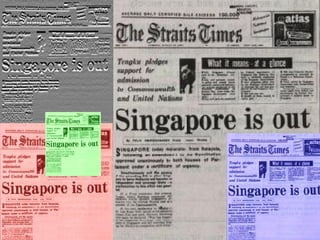
It’s official ! Read all about it!!!!
 
@#%#^&% How come nobody told me about it? SEPARATION FROM MALAYSIA
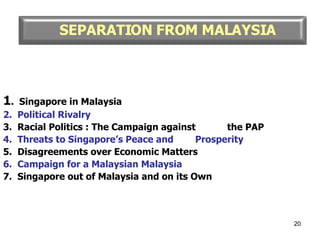
1 .  Singapore in Malaysia 2.  Political Rivalry 3.  Racial Politics : The Campaign against  the PAP 4.  Threats to Singapore’s Peace and  Prosperity 5.  Disagreements over Economic Matters 6.  Campaign for a Malaysian Malaysia 7.  Singapore out of Malaysia and on its Own SEPARATION FROM MALAYSIA
LKY pledged loyalty to the Central Government [CG] Central Government made up of : SINGAPORE IN MALAYSIA
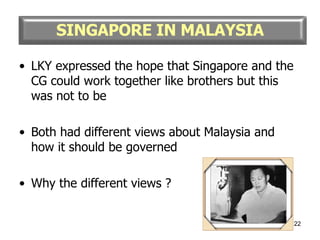
LKY expressed the hope that Singapore and the CG could work together like brothers but this was not to be Both had different views about Malaysia and how it should be governed Why the different views ? SINGAPORE IN MALAYSIA
REASONS : 1. Background of political parties 2. Treatment of different races SINGAPORE IN MALAYSIA
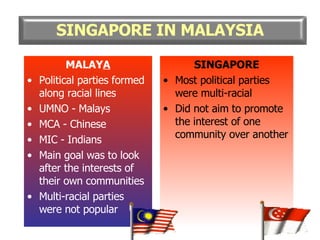
MALAY A Political parties formed along racial lines UMNO - Malays MCA - Chinese MIC - Indians Main goal was to look after the interests of their own communities Multi-racial parties were not popular SINGAPORE Most political parties were multi-racial  Did not aim to promote the interest of one community over another SINGAPORE IN MALAYSIA
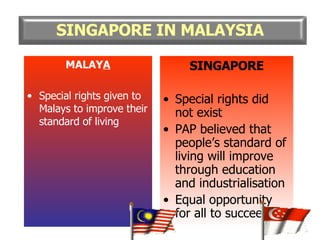
MALAY A Special rights given to Malays to improve their standard of living SINGAPORE Special rights did not exist PAP believed that people’s standard of living will improve through education and industrialisation Equal opportunity for all to succeed SINGAPORE IN MALAYSIA
CG expected Singapore to adapt to the system already in place Singapore wanted Malaysian leaders to stop thinking along racial lines This basic difference created problems between the two governments Strained relationship and eventually led to  separation SINGAPORE IN MALAYSIA
Tell me more! SEPARATION FROM MALAYSIA
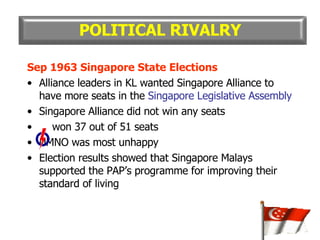
Sep 1963 Singapore State Elections Alliance leaders in KL wanted Singapore Alliance to have more seats in the  Singapore Legislative Assembly Singapore Alliance did not win any seats won 37 out of 51 seats UMNO was most unhappy Election results showed that Singapore Malays supported the PAP’s programme for improving their standard of living POLITICAL RIVALRY
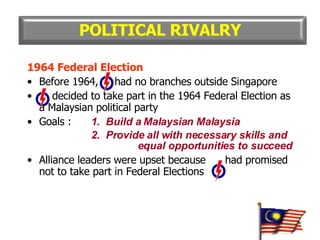
1964 Federal Election Before 1964,  had no branches outside Singapore decided to take part in the 1964 Federal Election as a Malaysian political party Goals : 1.  Build a Malaysian Malaysia 2.  Provide all with necessary skills and    equal opportunities to succeed Alliance leaders were upset because  had promised not to take part in Federal Elections POLITICAL RIVALRY
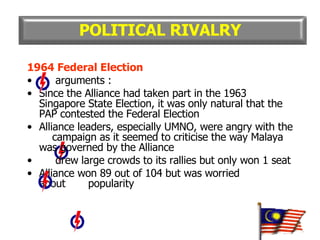
1964 Federal Election arguments : Since the Alliance had taken part in the 1963 Singapore State Election, it was only natural that the PAP contested the Federal Election Alliance leaders, especially UMNO, were angry with the  campaign as it seemed to criticise the way Malaya was governed by the Alliance drew large crowds to its rallies but only won 1 seat Alliance won 89 out of 104 but was worried  about  popularity POLITICAL RIVALRY
After the Fed elections, UMNO wanted to win back Malay votes in Singapore 1. Some UMNO leaders began to criticise the PAP Government for not looking after the interests of the Malays in Singapore 2. An anti-PAP campaign was started through the Malay press, especially the Utusan Melayu (UM) ISSUE Redevelopment in Crawford, Kg Glam and Rochor areas 2,500 families resettled; 200 were Malay families UM claimed that 3,000 Malays were affected RACIAL POLITICS THE CAMPAIGN AGAINST THE PAP
Over time, more misleading articles appeared in the UM To ease growing racial tension, LKY met 900 Malay representatives in July 1964 Govt would do its best to help Malays overcome problems of education, employment and housing UM continued with its anti-PAP campaign In the end, the racial tension in Singapore lead to two race riots. RACIAL POLITICS THE CAMPAIGN AGAINST THE PAP
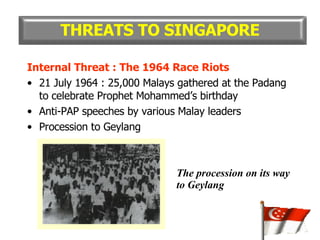
Internal Threat : The 1964 Race Riots 21 July 1964 : 25,000 Malays gathered at the Padang to celebrate Prophet Mohammed’s birthday Anti-PAP speeches by various Malay leaders Procession to Geylang THREATS TO SINGAPORE The procession on its way to Geylang
Internal Threat : The 1964 Race Riots Singapore Government’s version : Small incident sparked off race riots After that, more groups became unruly and attacked Chinese passers-by and spectators Soon, clashes between Malays and Chinese in various parts of Singapore reported Curfew imposed 9.30 pm to 6.00 am Lifted only on 2 Aug 1964 THREATS TO SINGAPORE
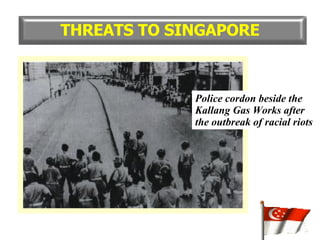
THREATS TO SINGAPORE Police cordon beside the Kallang Gas Works after the outbreak of racial riots
Internal Threat : The 1964 Race Riots Goodwill committees set up Made up of community leaders from various racial groups Help to restore peace and harmony LKY and Tun Razak toured the island to calm things down THREATS TO SINGAPORE
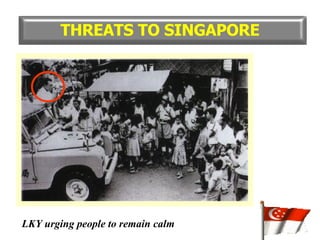
THREATS TO SINGAPORE LKY urging people to remain calm
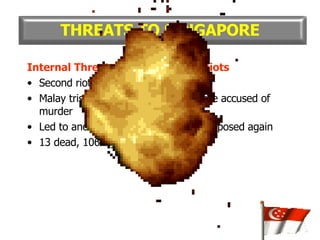
Internal Threat : The 1964 Race Riots Second riot in Sep 1964 Malay trishaw rider murdered; Chinese accused of murder Led to another race riot and curfew imposed again 13 dead, 106 injured THREATS TO SINGAPORE
Significance of race riots Showed how easily peace and harmony in Singapore could be broken Clashes did not get completely out of control because of the curfew and riot troops Also because of goodwill between the Chinese and Malays THREATS TO SINGAPORE
Internal Threat : The Indonesian Confrontation Indonesia broke off relations with Malaysia in Sep 1963 Embargo : Singapore experience a decline in trade and some unemployment Not severe as there was still trade with other countries THREATS TO SINGAPORE
Internal Threat : The Indonesian Confrontation A more serious aspect of Confrontation : Disruptive action by Indonesian agents in Singapore Set off bombs which killed innocent people and damaged property 29 bombs set off by Mar 1965 Most serious : March 1965 Bomb at MacDonald House killed 3 and injured 33 THREATS TO SINGAPORE
Internal Threat : The Indonesian Confrontation Voluntary Vigilante Corps was set up in Apr 1964 to help the police and army defend Singapore More than 10,000 signed up Community Centres serve as bases for their patrols Confrontation ended in Aug 1966 after a new government took over control of Indonesia Confrontation and 1964 racial riots show that we should not take peace and prosperity in Singapore for granted The End THREATS TO SINGAPORE

Chapter 9 Separation & Problems Pap Faced

  • 1.
    Chapter 9 Howdid Singapore achieve Independence?
  • 2.
    Terms to RememberMerger – the joining of two countries as one. Federation - a group of states united with one central government but each state has own states govt to deal with local matters. Pro-Communists – people who support the the Communists and their ideas. Referendum – a direct vote carried out by the people of the country to decide something on which there is a disagreement. Confrontation – Indonesia’s opposition to the formation of Malaysia. Radicals – party members who supported the communists.
  • 3.
    Problems in 1950s/ 1960s Unemployment Most pressing of the problems faced by the government. Ports near Singapore were developing and Singapore faced stiff competition. Many students educated in Chinese schools but there were not enough jobs for them when they left school.
  • 4.
    Poor Housing Manywere staying in the city. Overcrowding, unhygienic squatters. Health was compromised as many squeezed into small living areas.
  • 5.
    Lack of SchoolsMany children did not attend schools as fees in private schools were not affordable. There were insufficient government schools to take in all children of school-going age.
  • 6.
    Reasons for MergerSolve problem of Unemployment. Jobs and raw materials in Malaya were much needed by Singaporeans. Singapore’s market was too small for our goods. Malaya was the big market we were looking for. Common market so goods could be bought and sold without being taxed. Industries in Spore would grow and more jobs could be created for our people. Complete break from British rule. Merger would resolve the Communist problem and Spore would gain independence.
  • 7.
    Why did Malayawanted a merger? Communists were too strong in Singapore for their comfort. If Singapore fall to the communists, it would be a big threat to the security of Malaya which is so close to Singapore. With a merger, Tunku Abdul Rahman hoped to contain and fight against the communists in Singapore.
  • 8.
    Proposal for MergerMay 1961 Tunku Abdul Rahman first proposed the idea of merger with Singapore when he visited. British supported the idea. They wanted to grant independence to Singapore, Sabah and Sarawak but felt they could not survive on their own. A merger with Malaya would help these countries fight against Communism.
  • 9.
    Singapore’s response LeeKuan Yew and some PAP leaders supported the idea. The pro-Communists within PAP led by Lim Chin Siong were against the idea. They knew that if Singapore became part of Malaya, the governement in Kuala Lumpur would clamp down on Communist activities and arrest and imprison the pro-Communists. There was a power struggle within PAP.
  • 10.
    Split in PAPand Referendum August 1961 Pro-Communists left PAP and formed Barisan Sosialis (Socialist Front) Nov 1961 LKY (Lee Kuan Yew) and TAR (Tunku Abdul Rahman) held talks to discuss terms of merger. 1 Sept 1962 A referendum was held to let Singaporeans decide if they wanted merger. 71% of Singaporeans voted in favour of merger with Malaya.
  • 11.
    Responses of othercountries Sabah and Sarawak voted to join Malaysia. Brunei was excluded as both Brunei and Malaya could not agree on the terms of merger. Indonesian government was influenced by Communist Party of Indonesia (KPI). Jan 1963 The Confrontation by Indonesia was launched against Malaysia. Philippines wanted to keep Sabah as part of Philippines but had no proper evidence.
  • 12.
    Formation of Malaysia31 Aug 1963 Scheduled for formation of Malaysia but Philippines and Indonesia strongly opposed so a UN mission was sent to Sabah and Sarawak to check if people there wanted merger. 14 th Sept 1963 UN mission found out merger was favourable for people there. 16 th Sept 1963 Singapore, Sabah & Sarawak joined Malaya to form Federation of Malaysia.
  • 13.
    Federation of MalaysiaThe 14 states were Johor Negri Sembilan Perlis Singapore Kedah Pahang Sabah Trengganu Kelantan Penang Sarawak Melaka Perak Selangor
  • 14.
    Central Government Central government was in Kuala Lumpur and was controlled by the Alliance Party. Tunku Abdul Rahman was the Prime Minister of Malaysia. Singapore had own government and could continue with elections to elect own state government. Singapore gained independence from Britain. Central government controlled armed forces, police & international relations. Singapore would control own education, labour and finance.
  • 15.
    Terms of MergerCommon Market would be set up in stages. Singapore to provide $150 million loan for development of Sabah and Sarawak. Singapore would collect own revenue and contribute a certain sum of money from its taxes.
  • 16.
    Aftermath of MergerPhilippines broke off ties with Malaysia. Indonesia broke off ties with Malaysia, raided Sabah and Sarawak and got agents to set off bombs in public places in Singapore to disrupt life of people.
  • 17.
    It’s official !Read all about it!!!!
  • 18.
  • 19.
    @#%#^&% How comenobody told me about it? SEPARATION FROM MALAYSIA
  • 20.
    1 . Singapore in Malaysia 2. Political Rivalry 3. Racial Politics : The Campaign against the PAP 4. Threats to Singapore’s Peace and Prosperity 5. Disagreements over Economic Matters 6. Campaign for a Malaysian Malaysia 7. Singapore out of Malaysia and on its Own SEPARATION FROM MALAYSIA
  • 21.
    LKY pledged loyaltyto the Central Government [CG] Central Government made up of : SINGAPORE IN MALAYSIA
  • 22.
    LKY expressed thehope that Singapore and the CG could work together like brothers but this was not to be Both had different views about Malaysia and how it should be governed Why the different views ? SINGAPORE IN MALAYSIA
  • 23.
    REASONS : 1.Background of political parties 2. Treatment of different races SINGAPORE IN MALAYSIA
  • 24.
    MALAY A Politicalparties formed along racial lines UMNO - Malays MCA - Chinese MIC - Indians Main goal was to look after the interests of their own communities Multi-racial parties were not popular SINGAPORE Most political parties were multi-racial Did not aim to promote the interest of one community over another SINGAPORE IN MALAYSIA
  • 25.
    MALAY A Specialrights given to Malays to improve their standard of living SINGAPORE Special rights did not exist PAP believed that people’s standard of living will improve through education and industrialisation Equal opportunity for all to succeed SINGAPORE IN MALAYSIA
  • 26.
    CG expected Singaporeto adapt to the system already in place Singapore wanted Malaysian leaders to stop thinking along racial lines This basic difference created problems between the two governments Strained relationship and eventually led to separation SINGAPORE IN MALAYSIA
  • 27.
    Tell me more!SEPARATION FROM MALAYSIA
  • 28.
    Sep 1963 SingaporeState Elections Alliance leaders in KL wanted Singapore Alliance to have more seats in the Singapore Legislative Assembly Singapore Alliance did not win any seats won 37 out of 51 seats UMNO was most unhappy Election results showed that Singapore Malays supported the PAP’s programme for improving their standard of living POLITICAL RIVALRY
  • 29.
    1964 Federal ElectionBefore 1964, had no branches outside Singapore decided to take part in the 1964 Federal Election as a Malaysian political party Goals : 1. Build a Malaysian Malaysia 2. Provide all with necessary skills and equal opportunities to succeed Alliance leaders were upset because had promised not to take part in Federal Elections POLITICAL RIVALRY
  • 30.
    1964 Federal Electionarguments : Since the Alliance had taken part in the 1963 Singapore State Election, it was only natural that the PAP contested the Federal Election Alliance leaders, especially UMNO, were angry with the campaign as it seemed to criticise the way Malaya was governed by the Alliance drew large crowds to its rallies but only won 1 seat Alliance won 89 out of 104 but was worried about popularity POLITICAL RIVALRY
  • 31.
    After the Fedelections, UMNO wanted to win back Malay votes in Singapore 1. Some UMNO leaders began to criticise the PAP Government for not looking after the interests of the Malays in Singapore 2. An anti-PAP campaign was started through the Malay press, especially the Utusan Melayu (UM) ISSUE Redevelopment in Crawford, Kg Glam and Rochor areas 2,500 families resettled; 200 were Malay families UM claimed that 3,000 Malays were affected RACIAL POLITICS THE CAMPAIGN AGAINST THE PAP
  • 32.
    Over time, moremisleading articles appeared in the UM To ease growing racial tension, LKY met 900 Malay representatives in July 1964 Govt would do its best to help Malays overcome problems of education, employment and housing UM continued with its anti-PAP campaign In the end, the racial tension in Singapore lead to two race riots. RACIAL POLITICS THE CAMPAIGN AGAINST THE PAP
  • 33.
    Internal Threat :The 1964 Race Riots 21 July 1964 : 25,000 Malays gathered at the Padang to celebrate Prophet Mohammed’s birthday Anti-PAP speeches by various Malay leaders Procession to Geylang THREATS TO SINGAPORE The procession on its way to Geylang
  • 34.
    Internal Threat :The 1964 Race Riots Singapore Government’s version : Small incident sparked off race riots After that, more groups became unruly and attacked Chinese passers-by and spectators Soon, clashes between Malays and Chinese in various parts of Singapore reported Curfew imposed 9.30 pm to 6.00 am Lifted only on 2 Aug 1964 THREATS TO SINGAPORE
  • 35.
    THREATS TO SINGAPOREPolice cordon beside the Kallang Gas Works after the outbreak of racial riots
  • 36.
    Internal Threat :The 1964 Race Riots Goodwill committees set up Made up of community leaders from various racial groups Help to restore peace and harmony LKY and Tun Razak toured the island to calm things down THREATS TO SINGAPORE
  • 37.
    THREATS TO SINGAPORELKY urging people to remain calm
  • 38.
    Internal Threat :The 1964 Race Riots Second riot in Sep 1964 Malay trishaw rider murdered; Chinese accused of murder Led to another race riot and curfew imposed again 13 dead, 106 injured THREATS TO SINGAPORE
  • 39.
    Significance of raceriots Showed how easily peace and harmony in Singapore could be broken Clashes did not get completely out of control because of the curfew and riot troops Also because of goodwill between the Chinese and Malays THREATS TO SINGAPORE
  • 40.
    Internal Threat :The Indonesian Confrontation Indonesia broke off relations with Malaysia in Sep 1963 Embargo : Singapore experience a decline in trade and some unemployment Not severe as there was still trade with other countries THREATS TO SINGAPORE
  • 41.
    Internal Threat :The Indonesian Confrontation A more serious aspect of Confrontation : Disruptive action by Indonesian agents in Singapore Set off bombs which killed innocent people and damaged property 29 bombs set off by Mar 1965 Most serious : March 1965 Bomb at MacDonald House killed 3 and injured 33 THREATS TO SINGAPORE
  • 42.
    Internal Threat :The Indonesian Confrontation Voluntary Vigilante Corps was set up in Apr 1964 to help the police and army defend Singapore More than 10,000 signed up Community Centres serve as bases for their patrols Confrontation ended in Aug 1966 after a new government took over control of Indonesia Confrontation and 1964 racial riots show that we should not take peace and prosperity in Singapore for granted The End THREATS TO SINGAPORE