Malaysia
UP DILIMAN POLITICAL SCIENCE STUDENTS
Motto: Bersekutu Bertambah
Mutu (Unity is Strength)
Capital: Kuala Lumpur
Largest City: Kuala Lumpur (1.556
million residents)
Official Language: Malay
Religion: Islam
Monetary Unit: Ringgit
Government: Constitutional
Monarchy
Pre-Colonial Malaysia
Malacca Sultanate
(1400-1511)
Parameswara
● Palembang Prince and ruler of
the island of Temasik
● Visited Sening Ujong before
reaching the Bertam River where
it is said he witnessed a mouse
deer outwitting a dog while
resting under a malacca tree.
● -in 1409 he married Pasai
princess Malik ul Salih, and
adopted the title of ‘shah’ .
● Although he did not convert to Islam, the union between him and a
Muslim princess encouraged his subjects to convert to Islam.
● During his reign, Malacca had diplomatic relations with the Ming
Dynasty which gave them protection from attacks coming from Siam
and Majapahit
● Opened trade route between China, india, Middle East, Africa, and
Europe
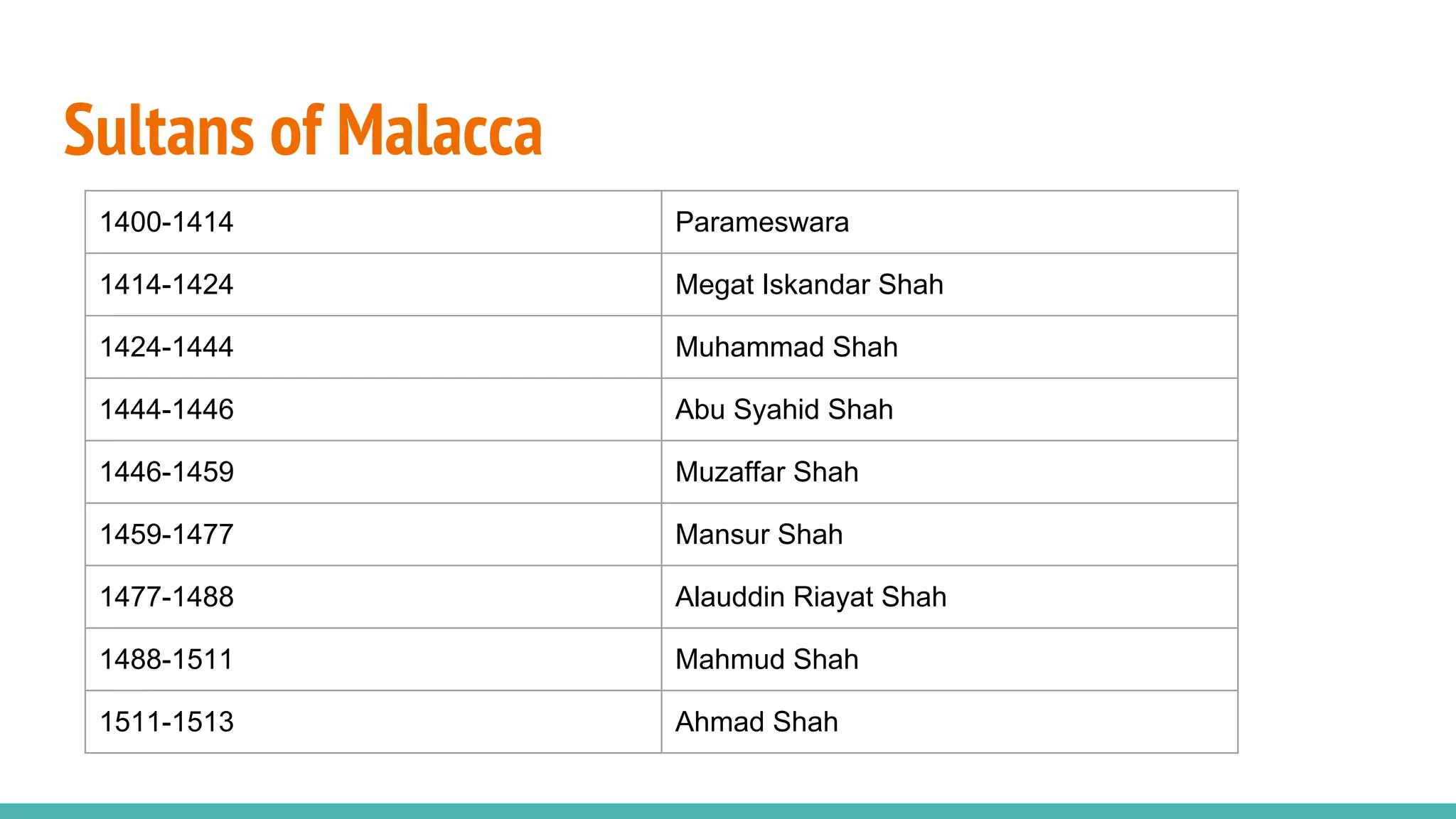
Sultans of Malacca
1400-1414 Parameswara
1414-1424 Megat Iskandar Shah
1424-1444 Muhammad Shah
1444-1446 Abu Syahid Shah
1446-1459 Muzaffar Shah
1459-1477 Mansur Shah
1477-1488 Alauddin Riayat Shah
1488-1511 Mahmud Shah
1511-1513 Ahmad Shah
Sultan Mansur Shah
● The 6th Shah of the Malacca Empire
● Expansionism and security
● Marriage to Princess Hang Li Po
● Used marriage alliances between
princesses of Malacca and rulers of
conquered states to strengthen his
control
● Princess Mahadewi’s marriage to the
King of Siak
Malacca as
Southeast Asia’s
Center of Islam and
Trade
Islam and Trade
● Marriages between princesses and rulers of states helped strengthen
alliances which was factor in the Islamic expansion in Southeast Asia
● Mansur Shah married foreign concubines from India and Pasai, who are
mostly the daughters of merchants.
● Gateway between the Spice islands and Eurasian market
‘He who is lord of Malacca has his hands on the throat of Venice’ - Duarte Barbosa
Factors that contributed to the flourish of the Malacca Sultanate
● Geography
○ Monsoon Winds
○ Strategic geographic location
● Politics
○ Ties with China
○ Relations with the Ottoman empire
● Economic Factors
○ Mansur Shah reduced the taxes on trade
● Socio-Cultural
○ Muslim missionaries were sent by the Sultan to spread Islam in other communities in the
Malay Archipelago
Colonial Period
Portuguese
Colonization
● 1509; Admiral Lopes de Sequeira was sent
to find Malacca
● 1511; Alfonso de Alburquerque set sail from
Goa to Malacca with his troops
● Trading post for spices coming from East
Indies as well as porcelain and silk from
China
Dutch Colonization ● 1641 to 1825
● Controlled the Straits of Malacca and the
spice trade
● Batavia was the economic and
administrative center of the region
● Johor Sultanate became the dominant
local power due to its alliances with the
Dutch which dates back to the early 17th
Century when the Dutch East India
Company began the campaigns against
the Portuguese.
British Colonization ● Anglo-Dutch Treaty of 1824
● Straits Settlements
● Pangkor Agreement
● The British ruled over Malaya til they
were ousted by the Japanese during
World War II
● After the war, the British regained
control, however, the start of the Malaya
resistance to the colonial rule was
becoming stronger
World War II and Japanese Colonization
● Japanese forces attacked Singapore on December 10, 1941 and by
February 15, 1942 the Malay peninsula as well.
● Ethnic tensions between the Malays and Chinese
● The British Malaya was unprepared for the naval attacks by the Japanese
● Regarded the Malays as colonial people liberated from British rule
● Mahatir Mohammed: “ The success of the Japanese invasion convinced us
that there is nothing inherently superior in the Europeans. They could be
defeated, they could be reduced to grovelling before an Asian race, the
Japanese.”
Malayan Union
https://www.expatgo.com/my/2015/09/02/8-maps-for-malaysia/historical-map-2-malayan-union/
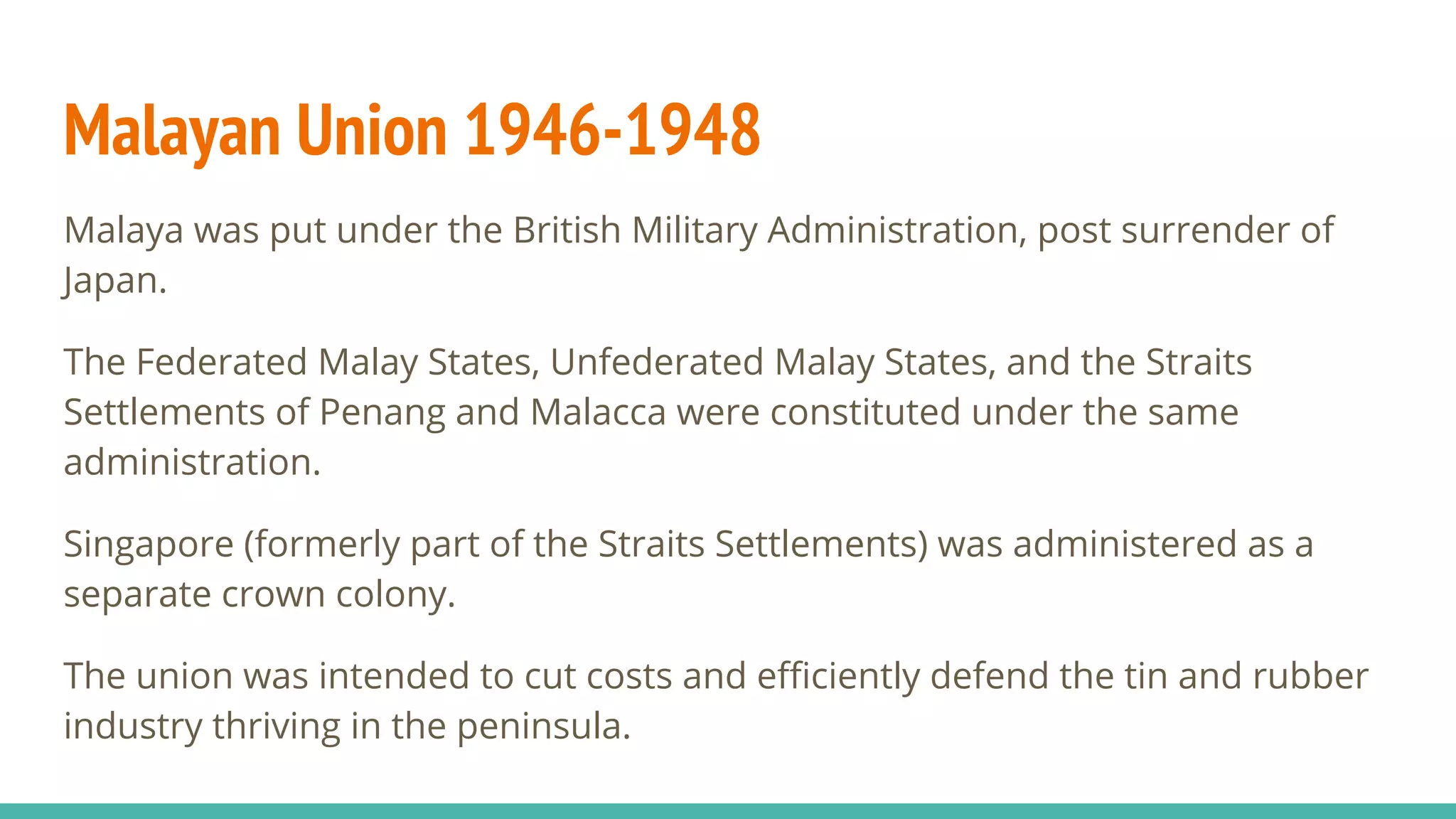
Malayan Union 1946-1948
Malaya was put under the British Military Administration, post surrender of
Japan.
The Federated Malay States, Unfederated Malay States, and the Straits
Settlements of Penang and Malacca were constituted under the same
administration.
Singapore (formerly part of the Straits Settlements) was administered as a
separate crown colony.
The union was intended to cut costs and efficiently defend the tin and rubber
industry thriving in the peninsula.
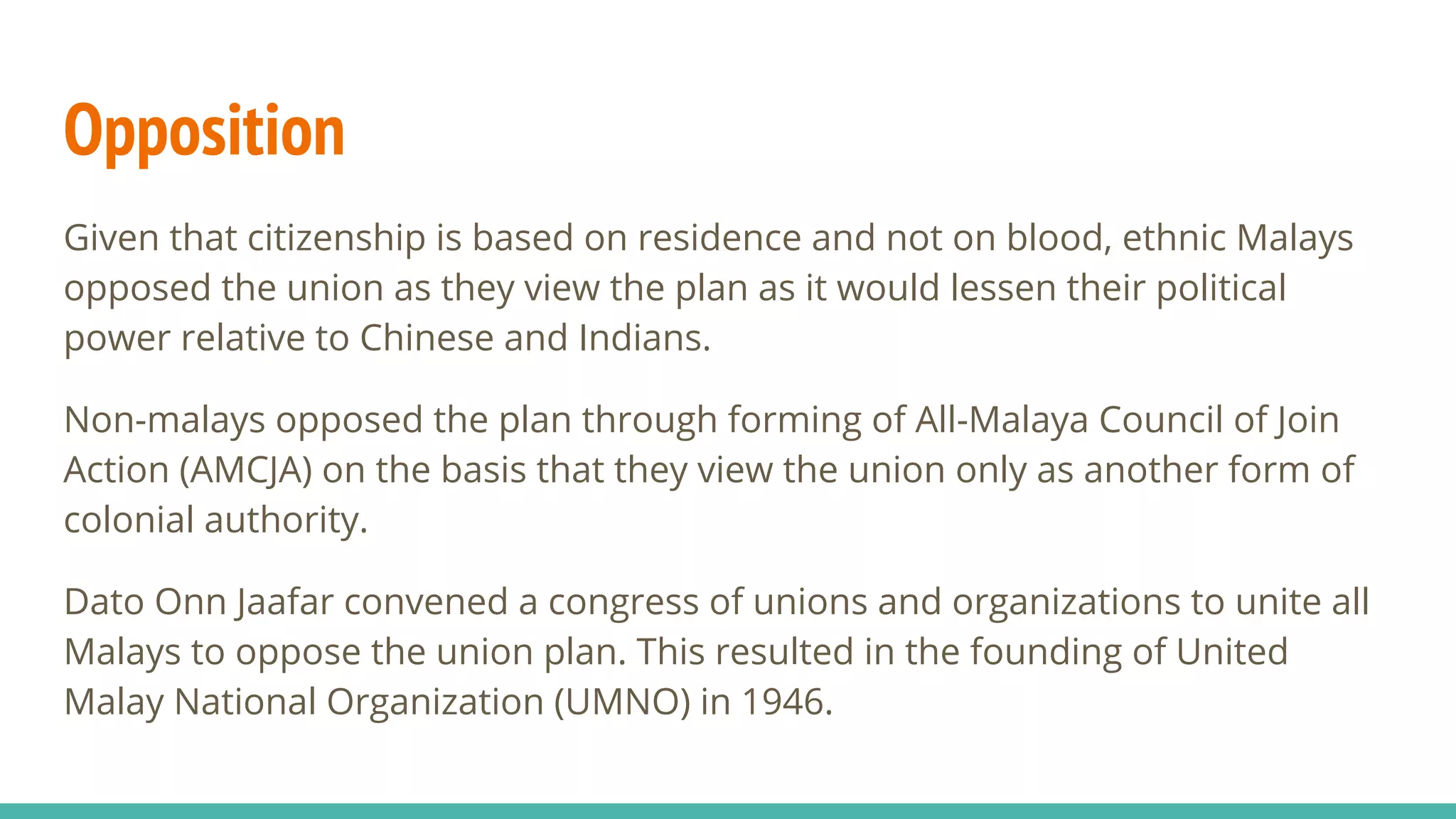
Opposition
Given that citizenship is based on residence and not on blood, ethnic Malays
opposed the union as they view the plan as it would lessen their political
power relative to Chinese and Indians.
Non-malays opposed the plan through forming of All-Malaya Council of Join
Action (AMCJA) on the basis that they view the union only as another form of
colonial authority.
Dato Onn Jaafar convened a congress of unions and organizations to unite all
Malays to oppose the union plan. This resulted in the founding of United
Malay National Organization (UMNO) in 1946.
Federation of Malaya
https://unostamps.nl/country_federation_of_malaya.htm
Constitution of the Federation of Malaya, 1948
Establishment of a Legislative Council composed both by locals and British.
Administration was divided into Federal (led by the British High
Commissioner) and State levels
Sultans remained as head of states
Struggle for Independence
Political parties took active role in the struggle for independence.
1. While some are exclusive of their ethnicities, they unite in the goal of
breaking away from the colonial chains.
2. Some of these are the following:
a. United Malays National Organization (1946)
b. Malayan Chinese Association (1949)
c. Malayan Indian Congress (1947)
d. Malayan Communist Party
e. Islamic Party of Malaya
These three parties later on
formed the Alliance.
Struggle for Independence
First experiences for governance
1. First ever local government elections were held in Georgetown (1951) and
Kuala Lumpur (1952).
2. First ever Federal Legislative Council elections were held in 1955. The
Alliance won 51 out of 52 seats giving them a clear lead in the later
independence negotiations.
Struggle for Independence
Negotiations for Independence
1. In 1956, UMNO President Tunku Abdul Rahman led a delegation to
London that would negotiate independence process in Malaya.
2. An agreement was signed on 8 February 1956. The date of independence
was set on 31 August 1957.
3. The Reid commission was put in place to draft the Constitution.
4. Tunku Abdul Rahman as the first prime minister.
Proclamation of Independence
https://www.nst.com.my/opinion/columnists/2017/08/266008/sixty-years-and-growing
Formation of Malaysia, 1963
Factors
1. Communist threat
2. Independence from the British
3. Economic advantages
4. Racial balance
5. Culture
Process
1. Cobbold Commission (Sabah and Sarawak)
2. Reactions from other stakeholders:
a. Singapore
b. Brunei
c. Britain
3. Oppositions:
a. Philippines
b. Indonesia and the konfrontasi (1963-66)
4. Separation of Singapore, 1965
Konfrontasi: MacDonald House Bombing
https://www.straitstimes.com/singapore/a-bitter-pill
https://26history.files.wordpress.com/2016/07/16c99-singapore-is-out-of-malaysia-st-photo.jpg?
w=648
Malaysia, 1965 - Present
Dominance of the Alliance Party and National Front
Since its win in the first Federal Legislative Council in 1955, the Alliance Party
has won every elections after it.
Tunku Abdul Rahman resigned in 1970. Tun Abdul Razak replaced him.
The Alliance formed the National Front (as a replacement for the Alliance
Party) which extended its membership to 10 more parties. This was response
to the poor performance of the Alliance in the 1969 elections.
First Mahathir Mohamad premiership (1983-2003)
Reformasi
Emerged with the formation of Alternative Front (1998), a coalition of
opposition parties.
Mainly Malay, the Alternative Front rooted expanded influence with the
socio-political condition in Malaysia wherein the Bumiputera segment of
population grew as well as their capital share (2% in 1970 to 20% in 1995).
Triggered with the rift inside the Mohamad administration. Mohamad
removed Anwar Ibrahim as finance minister and deputy prime minister due to
disagreement in overcoming the economic difficulties brought by the Asian
Financial Crisis.
Anwar Ibrahim (left) and Mahathir Mohamad (right). Photo source: Strait Times.
2000s
Reformasi
Najib Rajak and the 1MDB Scandal
MH 370 and MH 17
Rise of Mahathir Mohamad 2.0

Malaysia political history

  • 1.
  • 2.
    Motto: Bersekutu Bertambah Mutu(Unity is Strength) Capital: Kuala Lumpur Largest City: Kuala Lumpur (1.556 million residents) Official Language: Malay Religion: Islam Monetary Unit: Ringgit Government: Constitutional Monarchy
  • 4.
  • 5.
    Parameswara ● Palembang Princeand ruler of the island of Temasik ● Visited Sening Ujong before reaching the Bertam River where it is said he witnessed a mouse deer outwitting a dog while resting under a malacca tree. ● -in 1409 he married Pasai princess Malik ul Salih, and adopted the title of ‘shah’ .
  • 6.
    ● Although hedid not convert to Islam, the union between him and a Muslim princess encouraged his subjects to convert to Islam. ● During his reign, Malacca had diplomatic relations with the Ming Dynasty which gave them protection from attacks coming from Siam and Majapahit ● Opened trade route between China, india, Middle East, Africa, and Europe
  • 7.
    Sultans of Malacca 1400-1414Parameswara 1414-1424 Megat Iskandar Shah 1424-1444 Muhammad Shah 1444-1446 Abu Syahid Shah 1446-1459 Muzaffar Shah 1459-1477 Mansur Shah 1477-1488 Alauddin Riayat Shah 1488-1511 Mahmud Shah 1511-1513 Ahmad Shah
  • 8.
    Sultan Mansur Shah ●The 6th Shah of the Malacca Empire ● Expansionism and security ● Marriage to Princess Hang Li Po ● Used marriage alliances between princesses of Malacca and rulers of conquered states to strengthen his control ● Princess Mahadewi’s marriage to the King of Siak
  • 9.
  • 10.
    Islam and Trade ●Marriages between princesses and rulers of states helped strengthen alliances which was factor in the Islamic expansion in Southeast Asia ● Mansur Shah married foreign concubines from India and Pasai, who are mostly the daughters of merchants. ● Gateway between the Spice islands and Eurasian market ‘He who is lord of Malacca has his hands on the throat of Venice’ - Duarte Barbosa
  • 11.
    Factors that contributedto the flourish of the Malacca Sultanate ● Geography ○ Monsoon Winds ○ Strategic geographic location ● Politics ○ Ties with China ○ Relations with the Ottoman empire ● Economic Factors ○ Mansur Shah reduced the taxes on trade ● Socio-Cultural ○ Muslim missionaries were sent by the Sultan to spread Islam in other communities in the Malay Archipelago
  • 12.
  • 13.
    Portuguese Colonization ● 1509; AdmiralLopes de Sequeira was sent to find Malacca ● 1511; Alfonso de Alburquerque set sail from Goa to Malacca with his troops ● Trading post for spices coming from East Indies as well as porcelain and silk from China
  • 14.
    Dutch Colonization ●1641 to 1825 ● Controlled the Straits of Malacca and the spice trade ● Batavia was the economic and administrative center of the region ● Johor Sultanate became the dominant local power due to its alliances with the Dutch which dates back to the early 17th Century when the Dutch East India Company began the campaigns against the Portuguese.
  • 15.
    British Colonization ●Anglo-Dutch Treaty of 1824 ● Straits Settlements ● Pangkor Agreement ● The British ruled over Malaya til they were ousted by the Japanese during World War II ● After the war, the British regained control, however, the start of the Malaya resistance to the colonial rule was becoming stronger
  • 16.
    World War IIand Japanese Colonization
  • 17.
    ● Japanese forcesattacked Singapore on December 10, 1941 and by February 15, 1942 the Malay peninsula as well. ● Ethnic tensions between the Malays and Chinese ● The British Malaya was unprepared for the naval attacks by the Japanese ● Regarded the Malays as colonial people liberated from British rule ● Mahatir Mohammed: “ The success of the Japanese invasion convinced us that there is nothing inherently superior in the Europeans. They could be defeated, they could be reduced to grovelling before an Asian race, the Japanese.”
  • 18.
  • 19.
  • 20.
    Malayan Union 1946-1948 Malayawas put under the British Military Administration, post surrender of Japan. The Federated Malay States, Unfederated Malay States, and the Straits Settlements of Penang and Malacca were constituted under the same administration. Singapore (formerly part of the Straits Settlements) was administered as a separate crown colony. The union was intended to cut costs and efficiently defend the tin and rubber industry thriving in the peninsula.
  • 21.
    Opposition Given that citizenshipis based on residence and not on blood, ethnic Malays opposed the union as they view the plan as it would lessen their political power relative to Chinese and Indians. Non-malays opposed the plan through forming of All-Malaya Council of Join Action (AMCJA) on the basis that they view the union only as another form of colonial authority. Dato Onn Jaafar convened a congress of unions and organizations to unite all Malays to oppose the union plan. This resulted in the founding of United Malay National Organization (UMNO) in 1946.
  • 22.
  • 23.
  • 24.
    Constitution of theFederation of Malaya, 1948 Establishment of a Legislative Council composed both by locals and British. Administration was divided into Federal (led by the British High Commissioner) and State levels Sultans remained as head of states
  • 25.
    Struggle for Independence Politicalparties took active role in the struggle for independence. 1. While some are exclusive of their ethnicities, they unite in the goal of breaking away from the colonial chains. 2. Some of these are the following: a. United Malays National Organization (1946) b. Malayan Chinese Association (1949) c. Malayan Indian Congress (1947) d. Malayan Communist Party e. Islamic Party of Malaya These three parties later on formed the Alliance.
  • 26.
    Struggle for Independence Firstexperiences for governance 1. First ever local government elections were held in Georgetown (1951) and Kuala Lumpur (1952). 2. First ever Federal Legislative Council elections were held in 1955. The Alliance won 51 out of 52 seats giving them a clear lead in the later independence negotiations.
  • 27.
    Struggle for Independence Negotiationsfor Independence 1. In 1956, UMNO President Tunku Abdul Rahman led a delegation to London that would negotiate independence process in Malaya. 2. An agreement was signed on 8 February 1956. The date of independence was set on 31 August 1957. 3. The Reid commission was put in place to draft the Constitution. 4. Tunku Abdul Rahman as the first prime minister.
  • 28.
  • 29.
  • 30.
    Factors 1. Communist threat 2.Independence from the British 3. Economic advantages 4. Racial balance 5. Culture
  • 31.
    Process 1. Cobbold Commission(Sabah and Sarawak) 2. Reactions from other stakeholders: a. Singapore b. Brunei c. Britain 3. Oppositions: a. Philippines b. Indonesia and the konfrontasi (1963-66) 4. Separation of Singapore, 1965
  • 32.
    Konfrontasi: MacDonald HouseBombing https://www.straitstimes.com/singapore/a-bitter-pill
  • 33.
  • 34.
  • 35.
    Dominance of theAlliance Party and National Front Since its win in the first Federal Legislative Council in 1955, the Alliance Party has won every elections after it. Tunku Abdul Rahman resigned in 1970. Tun Abdul Razak replaced him. The Alliance formed the National Front (as a replacement for the Alliance Party) which extended its membership to 10 more parties. This was response to the poor performance of the Alliance in the 1969 elections. First Mahathir Mohamad premiership (1983-2003)
  • 36.
    Reformasi Emerged with theformation of Alternative Front (1998), a coalition of opposition parties. Mainly Malay, the Alternative Front rooted expanded influence with the socio-political condition in Malaysia wherein the Bumiputera segment of population grew as well as their capital share (2% in 1970 to 20% in 1995). Triggered with the rift inside the Mohamad administration. Mohamad removed Anwar Ibrahim as finance minister and deputy prime minister due to disagreement in overcoming the economic difficulties brought by the Asian Financial Crisis.
  • 37.
    Anwar Ibrahim (left)and Mahathir Mohamad (right). Photo source: Strait Times.
  • 38.
    2000s Reformasi Najib Rajak andthe 1MDB Scandal MH 370 and MH 17 Rise of Mahathir Mohamad 2.0