   What was the chief goal of American
    expansionists?
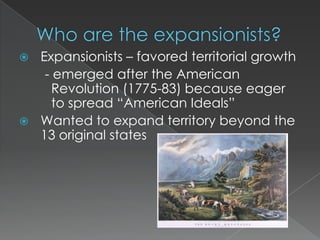
 Expansionists – favored territorial growth
   - emerged after the American
     Revolution (1775-83) because eager
     to spread “American Ideals”
 Wanted to expand territory beyond the
  13 original states
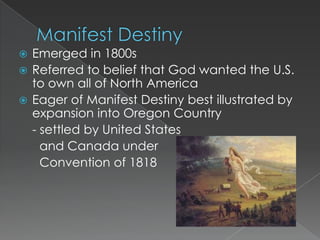
 Emerged in 1800s
 Referred to belief that God wanted the U.S.
  to own all of North America
 Eager of Manifest Destiny best illustrated by
  expansion into Oregon Country
  - settled by United States
    and Canada under
    Convention of 1818
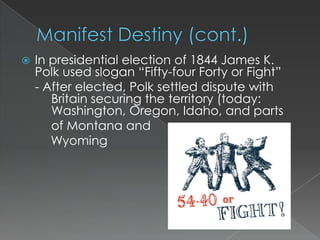
   In presidential election of 1844 James K.
    Polk used slogan “Fifty-four Forty or Fight”
    - After elected, Polk settled dispute with
       Britain securing the territory (today:
       Washington, Oregon, Idaho, and parts
       of Montana and
       Wyoming
   Close to the nineteenth century, U.S. was
    able to acquire outlying territories of
    Alaska, the Hawaiian Islands, Midway
    Islands, the Philippines, Puerto
    Rico, Guam, Wake Island, American
    Samoa, the Panama Canal Zone, and
    the U.S. Virgin Islands
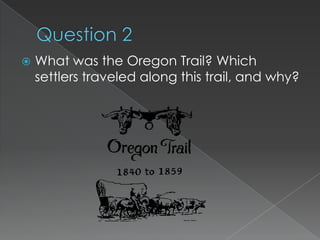
   What was the Oregon Trail? Which
    settlers traveled along this trail, and why?
 Route from Independence, Missouri to
  Oregon City, Oregon
 Made by mountain men of fur trade
  on the 1830s and publicized by 1843
 2000 mile wagon route and emigrant
  trail
 First only passable by foot and horseback
  until 1836 when first migrant wagon
  organized and trail was cleared further
 Ferries and bridges made it faster and safer
 1846-1869 (epoch years) trail were used by
  about 400,000 settlers, farmers, miners, and
  businessmen and their families
 Use of trail declined when first
  transcontinental railroad was completed in
  1869, making the trip westward
  faster, cheaper and safer
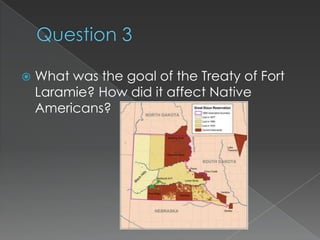
   What was the goal of the Treaty of Fort
    Laramie? How did it affect Native
    Americans?
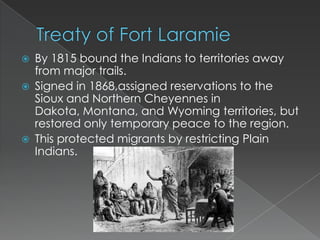
   By 1815 bound the Indians to territories away
    from major trails.
   Signed in 1868,assigned reservations to the
    Sioux and Northern Cheyennes in
    Dakota, Montana, and Wyoming territories, but
    restored only temporary peace to the region.
   This protected migrants by restricting Plain
    Indians.
   Who were Antonio Lόpez de Santa Anna
    and Sam Houston? How were the two
    men linked?
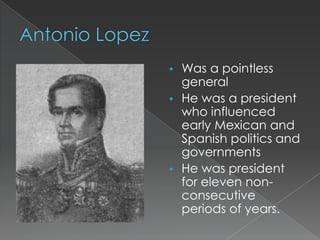
• Was a pointless
  general
• He was a president
  who influenced
  early Mexican and
  Spanish politics and
  governments
• He was president
  for eleven non-
  consecutive
  periods of years.
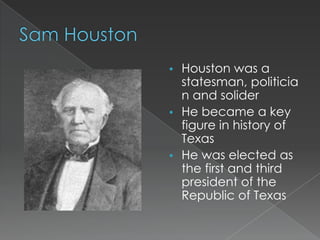
• Houston was a
  statesman, politicia
  n and solider
• He became a key
  figure in history of
  Texas
• He was elected as
  the first and third
  president of the
  Republic of Texas
   How did James K. Polk encourage
    territorial expansion?
 James K. Polk was the 11th President
 He was a Democrat and was Governor
  of Tennessee.
 Was running for presidency against
  Henry Clay.
 Clay- tried to take expansionists issue
  and indirectly take slavery out of the
  campaign by declaring that they were
  opposed to the annexation of Texas.
 Polk- Publicly asserted that Texas should
  be “re-annexed” and all of Oregon re-
  occupied.
   What was the Gadsden Purchase? Why
    did the United States seek this purchase?
 A land purchase where the United States
  obtained 29,640 square miles of land
  including present day New Mexico and
  Southern Arizona from Mexico.
 As a result the U.S used the land to build
  railroads.
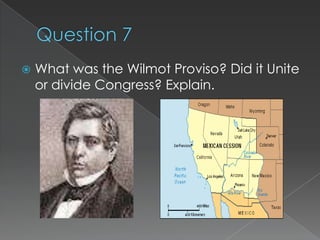
   What was the Wilmot Proviso? Did it Unite
    or divide Congress? Explain.

   It was a proviso created by David Wilmot of the Whig
    party
   It stated that it would ban slavery from any land won
    from Mexico
   This divided the Northern and Southern Whig parties
   IT never passed senate but always passed house of
    representatives for 15 years
   Every time the proviso went into court it caused
    tension between the North and South
   This also led to the antislavery Republican party in
    1854
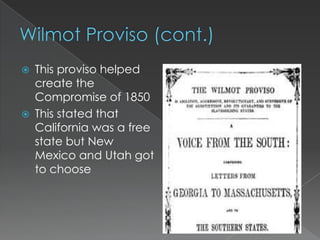
   This proviso helped
    create the
    Compromise of 1850
   This stated that
    California was a free
    state but New
    Mexico and Utah got
    to choose
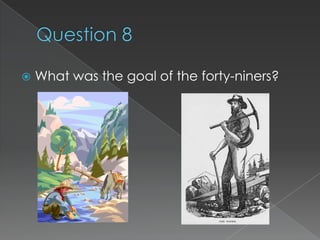
   What was the goal of the forty-niners?
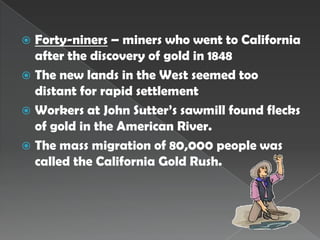
 Forty-niners – miners who went to California
  after the discovery of gold in 1848
 The new lands in the West seemed too
  distant for rapid settlement
 Workers at John Sutter’s sawmill found flecks
  of gold in the American River.
 The mass migration of 80,000 people was
  called the California Gold Rush.
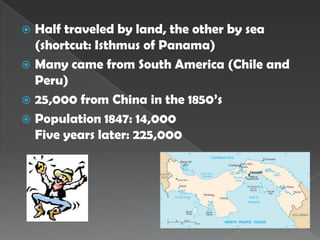
 Half traveled by land, the other by sea
  (shortcut: Isthmus of Panama)
 Many came from South America (Chile and
  Peru)
 25,000 from China in the 1850’s
 Population 1847: 14,000
  Five years later: 225,000
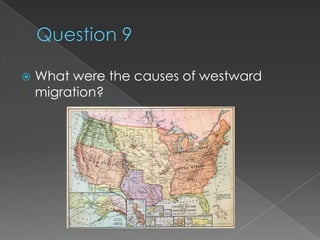
   What were the causes of westward
    migration?
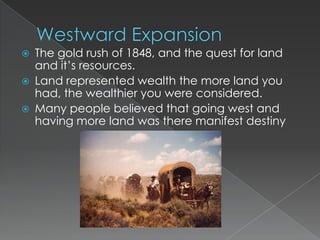
   The gold rush of 1848, and the quest for land
    and it’s resources.
   Land represented wealth the more land you
    had, the wealthier you were considered.
   Many people believed that going west and
    having more land was there manifest destiny
 Homestead act gave an applicant
  ownership at no cost.
 People typically got 160 acres of
  undeveloped land.
 Only counted for land west of the
  Mississippi, to encourage people to
  migrate west.
 Also there was population growth, so
  people wanted to leave the busy cities
  and be able to own their own farm land.
   How did the revolution in Texas lead to
    war with Mexico?
   The US wanted to make the border named the
    Rio Grand but the mexico didn’t want to
   President Polk sent a general with troops down
    to Rio Grand to protect the border
   Polk wanted mexicans to attack so he would
    gain support of the Senate to go to war
   Eventually the mexicans cross the border and
    attack american soldiers and that was the start
    of the mexican american war
   After two years the mexicans agreed to call
    the border the Rio Grand and seeded the
    california territory to the US and Us gave them
    15 million dollars as a gift
   What were the effects of the Mexican-
    American War and the California Gold
    Rush?
   Territorial gains on the
    United States behalf, an
    internal conflict over
    slavery, & downfall of the
    Mexican Government.
   Led to disruptions in
    congress and the build up
    of hatred between the
    North and South.
   Mexico was forced to give
    up the United States
   United States Claimed over
    500,000 square miles of
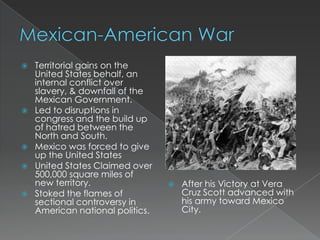
    new territory.                   After his Victory at Vera
   Stoked the flames of              Cruz Scott advanced with
    sectional controversy in          his army toward Mexico
    American national politics.       City.
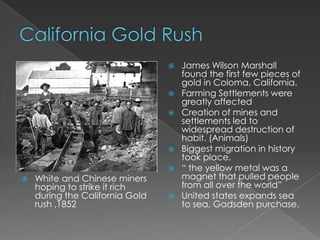
   James Wilson Marshall
                                     found the first few pieces of
                                     gold in Coloma, California.
                                    Farming Settlements were
                                     greatly affected
                                    Creation of mines and
                                     settlements led to
                                     widespread destruction of
                                     habit. (Animals)
                                    Biggest migration in history
                                     took place.
                                    “ the yellow metal was a
   White and Chinese miners         magnet that pulled people
    hoping to strike it rich         from all over the world”
    during the California Gold      United states expands sea
    rush ,1852                       to sea, Gadsden purchase.
   Question 1
    - "Manifest Destiny." Gale Encyclopedia of U.S. Economic History. Ed. Thomas Carson and Mary Bonk.
    Vol. 2. Detroit: Gale, 2000. 598-599. Gale Virtual Reference Library. Web. 17 Sep. 2012.
    - "Expansionists." Gale Encyclopedia of U.S. Economic History. Ed. Thomas Carson and Mary Bonk. Vol.
    1. Detroit: Gale, 1999. 299-300. Gale Virtual Reference Library. Web. 17 Sep. 2012.

Chapter 9 group presentation

  • 2.
    What was the chief goal of American expansionists?
  • 3.
     Expansionists –favored territorial growth - emerged after the American Revolution (1775-83) because eager to spread “American Ideals”  Wanted to expand territory beyond the 13 original states
  • 4.
     Emerged in1800s  Referred to belief that God wanted the U.S. to own all of North America  Eager of Manifest Destiny best illustrated by expansion into Oregon Country - settled by United States and Canada under Convention of 1818
  • 5.
    In presidential election of 1844 James K. Polk used slogan “Fifty-four Forty or Fight” - After elected, Polk settled dispute with Britain securing the territory (today: Washington, Oregon, Idaho, and parts of Montana and Wyoming
  • 6.
    Close to the nineteenth century, U.S. was able to acquire outlying territories of Alaska, the Hawaiian Islands, Midway Islands, the Philippines, Puerto Rico, Guam, Wake Island, American Samoa, the Panama Canal Zone, and the U.S. Virgin Islands
  • 7.
    What was the Oregon Trail? Which settlers traveled along this trail, and why?
  • 8.
     Route fromIndependence, Missouri to Oregon City, Oregon  Made by mountain men of fur trade on the 1830s and publicized by 1843  2000 mile wagon route and emigrant trail
  • 9.
     First onlypassable by foot and horseback until 1836 when first migrant wagon organized and trail was cleared further  Ferries and bridges made it faster and safer
  • 10.
     1846-1869 (epochyears) trail were used by about 400,000 settlers, farmers, miners, and businessmen and their families  Use of trail declined when first transcontinental railroad was completed in 1869, making the trip westward faster, cheaper and safer
  • 11.
    What was the goal of the Treaty of Fort Laramie? How did it affect Native Americans?
  • 12.
    By 1815 bound the Indians to territories away from major trails.  Signed in 1868,assigned reservations to the Sioux and Northern Cheyennes in Dakota, Montana, and Wyoming territories, but restored only temporary peace to the region.  This protected migrants by restricting Plain Indians.
  • 13.
    Who were Antonio Lόpez de Santa Anna and Sam Houston? How were the two men linked?
  • 14.
    • Was apointless general • He was a president who influenced early Mexican and Spanish politics and governments • He was president for eleven non- consecutive periods of years.
  • 15.
    • Houston wasa statesman, politicia n and solider • He became a key figure in history of Texas • He was elected as the first and third president of the Republic of Texas
  • 16.
    How did James K. Polk encourage territorial expansion?
  • 17.
     James K.Polk was the 11th President  He was a Democrat and was Governor of Tennessee.  Was running for presidency against Henry Clay.
  • 18.
     Clay- triedto take expansionists issue and indirectly take slavery out of the campaign by declaring that they were opposed to the annexation of Texas.  Polk- Publicly asserted that Texas should be “re-annexed” and all of Oregon re- occupied.
  • 19.
    What was the Gadsden Purchase? Why did the United States seek this purchase?
  • 20.
     A landpurchase where the United States obtained 29,640 square miles of land including present day New Mexico and Southern Arizona from Mexico.  As a result the U.S used the land to build railroads.
  • 21.
    What was the Wilmot Proviso? Did it Unite or divide Congress? Explain.
  • 22.
    It was a proviso created by David Wilmot of the Whig party  It stated that it would ban slavery from any land won from Mexico  This divided the Northern and Southern Whig parties  IT never passed senate but always passed house of representatives for 15 years  Every time the proviso went into court it caused tension between the North and South  This also led to the antislavery Republican party in 1854
  • 23.
    This proviso helped create the Compromise of 1850  This stated that California was a free state but New Mexico and Utah got to choose
  • 24.
    What was the goal of the forty-niners?
  • 25.
     Forty-niners –miners who went to California after the discovery of gold in 1848  The new lands in the West seemed too distant for rapid settlement  Workers at John Sutter’s sawmill found flecks of gold in the American River.  The mass migration of 80,000 people was called the California Gold Rush.
  • 26.
     Half traveledby land, the other by sea (shortcut: Isthmus of Panama)  Many came from South America (Chile and Peru)  25,000 from China in the 1850’s  Population 1847: 14,000 Five years later: 225,000
  • 27.
    What were the causes of westward migration?
  • 28.
    The gold rush of 1848, and the quest for land and it’s resources.  Land represented wealth the more land you had, the wealthier you were considered.  Many people believed that going west and having more land was there manifest destiny
  • 29.
     Homestead actgave an applicant ownership at no cost.  People typically got 160 acres of undeveloped land.  Only counted for land west of the Mississippi, to encourage people to migrate west.  Also there was population growth, so people wanted to leave the busy cities and be able to own their own farm land.
  • 30.
    How did the revolution in Texas lead to war with Mexico?
  • 31.
    The US wanted to make the border named the Rio Grand but the mexico didn’t want to  President Polk sent a general with troops down to Rio Grand to protect the border  Polk wanted mexicans to attack so he would gain support of the Senate to go to war  Eventually the mexicans cross the border and attack american soldiers and that was the start of the mexican american war  After two years the mexicans agreed to call the border the Rio Grand and seeded the california territory to the US and Us gave them 15 million dollars as a gift
  • 32.
    What were the effects of the Mexican- American War and the California Gold Rush?
  • 33.
    Territorial gains on the United States behalf, an internal conflict over slavery, & downfall of the Mexican Government.  Led to disruptions in congress and the build up of hatred between the North and South.  Mexico was forced to give up the United States  United States Claimed over 500,000 square miles of new territory.  After his Victory at Vera  Stoked the flames of Cruz Scott advanced with sectional controversy in his army toward Mexico American national politics. City.
  • 34.
    James Wilson Marshall found the first few pieces of gold in Coloma, California.  Farming Settlements were greatly affected  Creation of mines and settlements led to widespread destruction of habit. (Animals)  Biggest migration in history took place.  “ the yellow metal was a  White and Chinese miners magnet that pulled people hoping to strike it rich from all over the world” during the California Gold  United states expands sea rush ,1852 to sea, Gadsden purchase.
  • 35.
    Question 1 - "Manifest Destiny." Gale Encyclopedia of U.S. Economic History. Ed. Thomas Carson and Mary Bonk. Vol. 2. Detroit: Gale, 2000. 598-599. Gale Virtual Reference Library. Web. 17 Sep. 2012. - "Expansionists." Gale Encyclopedia of U.S. Economic History. Ed. Thomas Carson and Mary Bonk. Vol. 1. Detroit: Gale, 1999. 299-300. Gale Virtual Reference Library. Web. 17 Sep. 2012.