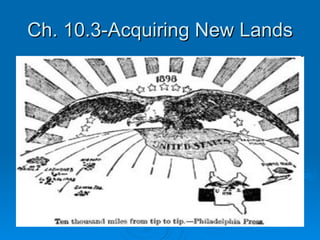
Ch. 10.3-Acquiring New Lands
 
 
Puerto Rico Claimed by the Spanish Crown in 1493 following Columbus' second voyage to the Americas.  In 1898, after 400 years of colonial rule Puerto Rico was ceded to the US as a result of the Spanish-American War.
Puerto Ricans were granted US citizenship in 1917.  Popularly-elected governors have served since 1948.  In 1952, a constitution was enacted providing for internal self government. In plebiscites held in 1967, 1993, and 1998, voters chose to retain commonwealth status.  Three options for the future? http://www.cia.gov/cia/publications/factbook/geos/rq.html
 
In 1898, Spain gave control of Cuba to the United States with the Treaty of Paris.  In 1902, the United States granted Cuba its independence as promised with the Teller Amendment. The US retained the right to intervene to preserve Cuban independence and stability with the Platt Amendment.  The US got control of Guantanamo Bay as well, a naval base we still have control of today. In 1934, the Platt Amendment was repealed.
Guantanamo Bay, Cuba
What do you know about Cuba today?
The Philippines
 
Mckinley’s Dilemma: What to do with the Philippines? “…there was nothing left for us to do but to take them all, and to educate the Filipinos, and uplift and civilize and Christianize them, and by God's grace do the very best we could by them, as our fellow-men for whom Christ also died.”
 
 
Philippines Emilio Aguinaldo declared Philippine independence from Spain on June 12, 1898 After the Spanish-American War, the US took over the islands for $20 million in the 1898 Treaty of Paris
Philippine-American War The Philippine–American War broke out after the Filipinos realized that the US would not give them independence It ended with American control over the islands  12,000-20,000 Filipinos soldiers dead 200,000-1.5 million Filipino civilians die-Some contend US committed genocide 4,165 US soldiers dead
 
 
In 1935, the Philippines was granted Commonwealth status.  Plans for independence over the next decade were interrupted by World War II when the Japanese invaded and took them over Allied troops defeated the Japanese in 1945.  On July 4, 1946, the Philippines attained its independence
China By the late 1800’s, it was looking as if China would be carved up like Africa had been China wanted to prevent this from happening
The Boxer Rebellion
John Hay - Open Door Policy
 
 
Chapter 10.4  America as a World Power
Teddy Roosevelt’s Presidency Assumed Presidency after McKinley was killed Roosevelt the Peacemaker Ended the Russo-Japanese War in 1905 Won the Nobel Peace Prize for his efforts Panama Canal Roosevelt Corollary
 
Russo-Japanese War 1904-1905 Japan shocked the world by defeating Russia Treaty of Portsmouth Japan received Southern half of Sakhalin Island from Russia Japan took over Russian interests in Manchuria and Korea


The Panama Canal A canal across Panama had been desired for a long time. Why? France had started constructing a canal but gave up due to costs and disease In 1903, US buys French company’s route for $40 million Before starting, US had to get permission from Colombia which controlled Panama
 
Panama Canal Colombia refused to allow US entry With support from the US, Panama revolted against Colombia On November 3, 1903, Panama declared independence from Colombia US and Panama then signed canal deal where US would pay $10 million and a annual rent of $250,000 This action greatly upsets Latin America. Why?
Panama Canal Construction One of the biggest engineering undertakings ever Had to fight disease(yellow fever and malaria) Soft, volcanic soil made it difficult to remove Over 43,000 workers helped build canal 5,600 workers dies Cost US $380 million Opened on August 15, 1914
The Roosevelt Corollary It was an addition to the Monroe Doctrine Said that the US would be the police officer between Latin America and Europe The US would use force to protect interests in Latin America
“ Speak Softly and Carry a Big Stick”--Big Stick Diplomacy “Speak softly and carry a big stick” or “Big Stick” diplomacy. What does this mean? Look at examples


The Great White Fleet
 
Dollar Diplomacy-President Taft Using the US government to guarantee loans made to foreign countries by US banks and businesses Economic imperialism US banks were in control of many businesses in Latin America US said it was needed to keep European powers out of Latin America “Substituting dollars for bullets”
 
 
President Woodrow Wilson Practiced “missionary diplomacy” US would not recognize any government that was oppressive, undemocratic and hostile toward the US Mexican government was overthrown by General Victoriano Huerta Wilson refused to recognize “a government of butchers” Wilson practiced “watchful waiting” in dealing with Huerta
 
 
President Woodrow Wilson US took over the Mexican port of Veracruz after Huerta arrested some Americans sailors War was extremely close until Argentina, Brazil and Chile stepped in and tried to settle conflict Huerta rejected the plan but his government collapsed shortly thereafter Venustiano Carranza became President  Wilson recognized his government
Pancho Villa At first was pro-American but soon changed after President Carranza asked US to control Mexican mines Killed dozens of US citizens on two different occasions(once on US soil) President Wilson ordered General John Pershing(and 15,000 troops) to go into Mexico and capture Villa Eventually, the Mexican Army clashed with Pershing’s forces By 1917, both sides backed down(WWI)


Questions How do think Latin American countries viewed the United States at this time? Why? Why did the US intervene in Latin America all the time? Give examples of “big stick diplomacy”, “dollar diplomacy” and “moral diplomacy”.
President McKinley’s Assassination Killed by Leon Czolgosz(Cholgosh) He was an anarchist that wanted all leader to be wiped out Hoped to promote the anarchist movement Last statement: "I killed the President because he was the enemy of the good people-the good working people. I am not sorry for my crime."

Chapter 10.3.4

  • 1.
  • 2.
  • 3.
  • 4.
    Puerto Rico Claimedby the Spanish Crown in 1493 following Columbus' second voyage to the Americas. In 1898, after 400 years of colonial rule Puerto Rico was ceded to the US as a result of the Spanish-American War.
  • 5.
    Puerto Ricans weregranted US citizenship in 1917. Popularly-elected governors have served since 1948. In 1952, a constitution was enacted providing for internal self government. In plebiscites held in 1967, 1993, and 1998, voters chose to retain commonwealth status. Three options for the future? http://www.cia.gov/cia/publications/factbook/geos/rq.html
  • 6.
  • 7.
    In 1898, Spaingave control of Cuba to the United States with the Treaty of Paris. In 1902, the United States granted Cuba its independence as promised with the Teller Amendment. The US retained the right to intervene to preserve Cuban independence and stability with the Platt Amendment. The US got control of Guantanamo Bay as well, a naval base we still have control of today. In 1934, the Platt Amendment was repealed.
  • 8.
  • 9.
    What do youknow about Cuba today?
  • 10.
  • 11.
  • 12.
    Mckinley’s Dilemma: Whatto do with the Philippines? “…there was nothing left for us to do but to take them all, and to educate the Filipinos, and uplift and civilize and Christianize them, and by God's grace do the very best we could by them, as our fellow-men for whom Christ also died.”
  • 13.
  • 14.
  • 15.
    Philippines Emilio Aguinaldodeclared Philippine independence from Spain on June 12, 1898 After the Spanish-American War, the US took over the islands for $20 million in the 1898 Treaty of Paris
  • 16.
    Philippine-American War ThePhilippine–American War broke out after the Filipinos realized that the US would not give them independence It ended with American control over the islands 12,000-20,000 Filipinos soldiers dead 200,000-1.5 million Filipino civilians die-Some contend US committed genocide 4,165 US soldiers dead
  • 17.
  • 18.
  • 19.
    In 1935, thePhilippines was granted Commonwealth status. Plans for independence over the next decade were interrupted by World War II when the Japanese invaded and took them over Allied troops defeated the Japanese in 1945. On July 4, 1946, the Philippines attained its independence
  • 20.
    China By thelate 1800’s, it was looking as if China would be carved up like Africa had been China wanted to prevent this from happening
  • 21.
  • 22.
    John Hay -Open Door Policy
  • 23.
  • 24.
  • 25.
    Chapter 10.4 America as a World Power
  • 26.
    Teddy Roosevelt’s PresidencyAssumed Presidency after McKinley was killed Roosevelt the Peacemaker Ended the Russo-Japanese War in 1905 Won the Nobel Peace Prize for his efforts Panama Canal Roosevelt Corollary
  • 27.
  • 28.
    Russo-Japanese War 1904-1905Japan shocked the world by defeating Russia Treaty of Portsmouth Japan received Southern half of Sakhalin Island from Russia Japan took over Russian interests in Manchuria and Korea
  • 29.
  • 30.
  • 31.
  • 32.
  • 33.
  • 34.
  • 35.
  • 36.
  • 37.
  • 38.
  • 39.
  • 40.
  • 41.
  • 42.
  • 43.
    The Panama CanalA canal across Panama had been desired for a long time. Why? France had started constructing a canal but gave up due to costs and disease In 1903, US buys French company’s route for $40 million Before starting, US had to get permission from Colombia which controlled Panama
  • 44.
  • 45.
    Panama Canal Colombiarefused to allow US entry With support from the US, Panama revolted against Colombia On November 3, 1903, Panama declared independence from Colombia US and Panama then signed canal deal where US would pay $10 million and a annual rent of $250,000 This action greatly upsets Latin America. Why?
  • 46.
    Panama Canal ConstructionOne of the biggest engineering undertakings ever Had to fight disease(yellow fever and malaria) Soft, volcanic soil made it difficult to remove Over 43,000 workers helped build canal 5,600 workers dies Cost US $380 million Opened on August 15, 1914
  • 47.
    The Roosevelt CorollaryIt was an addition to the Monroe Doctrine Said that the US would be the police officer between Latin America and Europe The US would use force to protect interests in Latin America
  • 48.
    “ Speak Softlyand Carry a Big Stick”--Big Stick Diplomacy “Speak softly and carry a big stick” or “Big Stick” diplomacy. What does this mean? Look at examples
  • 49.
  • 50.
  • 51.
  • 52.
  • 53.
  • 54.
  • 55.
    Dollar Diplomacy-President TaftUsing the US government to guarantee loans made to foreign countries by US banks and businesses Economic imperialism US banks were in control of many businesses in Latin America US said it was needed to keep European powers out of Latin America “Substituting dollars for bullets”
  • 56.
  • 57.
  • 58.
    President Woodrow WilsonPracticed “missionary diplomacy” US would not recognize any government that was oppressive, undemocratic and hostile toward the US Mexican government was overthrown by General Victoriano Huerta Wilson refused to recognize “a government of butchers” Wilson practiced “watchful waiting” in dealing with Huerta
  • 59.
  • 60.
  • 61.
    President Woodrow WilsonUS took over the Mexican port of Veracruz after Huerta arrested some Americans sailors War was extremely close until Argentina, Brazil and Chile stepped in and tried to settle conflict Huerta rejected the plan but his government collapsed shortly thereafter Venustiano Carranza became President Wilson recognized his government
  • 62.
    Pancho Villa Atfirst was pro-American but soon changed after President Carranza asked US to control Mexican mines Killed dozens of US citizens on two different occasions(once on US soil) President Wilson ordered General John Pershing(and 15,000 troops) to go into Mexico and capture Villa Eventually, the Mexican Army clashed with Pershing’s forces By 1917, both sides backed down(WWI)
  • 63.
  • 64.
  • 65.
  • 66.
    Questions How dothink Latin American countries viewed the United States at this time? Why? Why did the US intervene in Latin America all the time? Give examples of “big stick diplomacy”, “dollar diplomacy” and “moral diplomacy”.
  • 67.
    President McKinley’s AssassinationKilled by Leon Czolgosz(Cholgosh) He was an anarchist that wanted all leader to be wiped out Hoped to promote the anarchist movement Last statement: "I killed the President because he was the enemy of the good people-the good working people. I am not sorry for my crime."