INSIDE
CRIM INAL
LAW
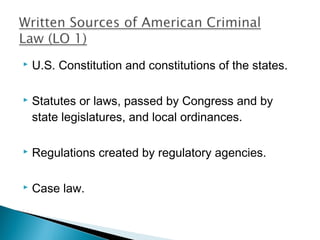
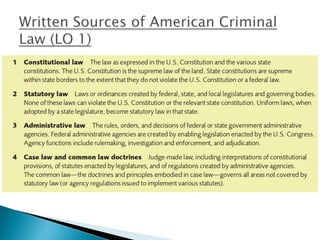
   List the four written sources of American criminal
    law.
   U.S. Constitution and constitutions of the states.

   Statutes or laws, passed by Congress and by
    state legislatures, and local ordinances.

   Regulations created by regulatory agencies.

   Case law.
   Explain the two basic functions of criminal law.
Protect and Punish: The Legal Function of the Law
  Maintain social order by protecting citizens from
   criminal harm
  Includes harms to both individuals and society in
   general

Maintain and Teach: The Social Function of the Law
  Expressing public morality
  Teaching social boundaries
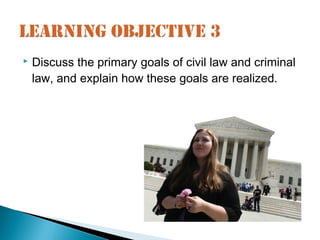
   Discuss the primary goals of civil law and criminal
    law, and explain how these goals are realized.
   Civil Law and Criminal Law

    ◦ Guilt and Responsibility

    ◦ The Burden of Proof
   Felonies and Misdemeanors

    ◦ Degrees of Crime

    ◦ Types of Manslaughter

    ◦ Degrees of Misdemeanor

    ◦ Infractions
   Explain the differences between crimes mala in se
    and mala prohibita.
   Mala in se – a descriptive term for acts that are
    inherently wrong, regardless of whether they are
    prohibited by law.

   Mala prohibita – a descriptive term for acts that
    are made illegal by criminal statute and are not
    necessarily wrong in and of themselves.
   Criminal law normally requires that the corpus
    delicti (the body of the crime) be proved before a
    person can be convicted of wrongdoing.

   Criminal Act - Actus reus
    ◦ Crimes may be acts of commission, or acts of
      omission, or even attempted acts.
   Delineate the elements required to establish mens
    rea (a guilty mental state).
   A wrongful mental state is as necessary as a
    wrongful act in establishing guilt.

   Includes elements of purpose, knowledge,
    negligence, and recklessness.
Questions:

 ◦ What are the requirements of proving a guilty mental
   state?

 ◦ Should the law provide for lesser punishments in cases
   where intent cannot be proven?
◦ Strict Liability – offenses hold the defendant
  guilty even if intent to commit the offense is
  lacking

◦ Accomplice Liability – suspects can be charged
  for crimes they did not actually commit if it can
  be proven they acted as an accomplice

◦ Concurrence – there must be concurrence
  between the guilty act and the guilty intent
◦ Causation - The criminal act must have caused
  the harm suffered.

◦ Attendant Circumstances – facts surrounding an
  event that must be proved for the event to be
  considered a criminal act.

◦ Harm – damages resultant from the criminal act.
  Inchoate offenses are conduct deemed criminal
  without actual harm being done.
   Hate crime laws provide for greater sanctions
    against those who commit crimes motivated by
    bias based on race, ethnicity, religion, gender,
    sexual orientation, disability, or age.
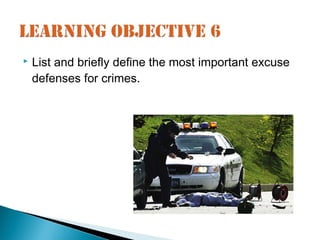
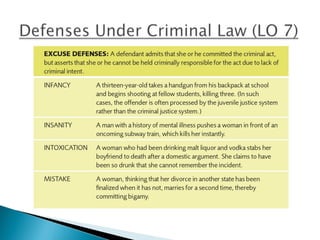
   List and briefly define the most important excuse
    defenses for crimes.
Excuse Defenses:       Justification Defenses:

These defenses apply   These defenses apply
when the actor lacks   when the defendant
the requisite mental   admits to the criminal
condition to form      act, but argues that the
                        act was justified.
intent.
◦ Infancy - Youthful offenders cannot
  understand the consequences of their actions.

◦ Insanity - A person cannot have the state of
  mind to commit the crime if s/he didn’t know
  the act was wrong, or didn’t understand the
  quality of the act.
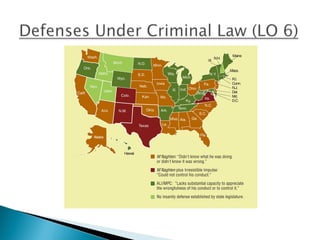
Insanity is determined by:
   M’Naughten Rule
    ◦ A person is insane if they can’t distinguish right from
      wrong
   ALI/MPC Test
    ◦ Also known as the substantial capacity test, the
      defendant must lack the capacity to appreciate the
      wrongfulness of his/her conduct.
   Irresistible Impulse Test
    ◦ A person is insane if some “irresistible impulse” resulting
      from a mental deficiency drove him or her to commit the
      crime
◦   Intoxication - When the defendant claims that
    the taking of intoxicants, either voluntarily or
    involuntarily, rendered him/her unable to form
    the requisite intent to commit a criminal act.

◦    Mistake
     Mistake of Fact
     Mistake of Law
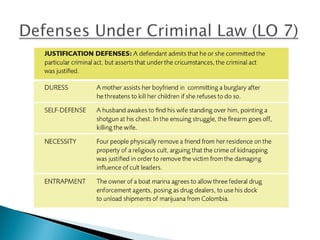
   Describe the four most important justification
    criminal defenses.
◦ Duress - The defendant is threatened with
  seriously bodily harm, which induces him/her to
  commit the crime.

◦ Self-Defense - The legally recognized privilege
  to protect one’s self or property from injury by
  another
   A Reasonable Belief
   Duty to retreat
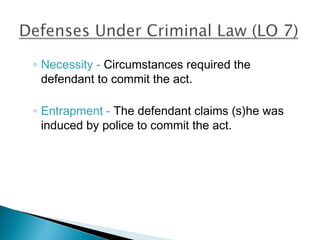
◦ Necessity - Circumstances required the
  defendant to commit the act.

◦ Entrapment - The defendant claims (s)he was
  induced by police to commit the act.
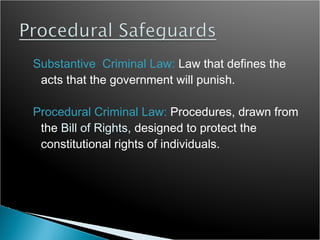
Substantive Criminal Law: Law that defines the
 acts that the government will punish.

Procedural Criminal Law: Procedures, drawn from
 the Bill of Rights, designed to protect the
 constitutional rights of individuals.
The Bill of Rights:

 ◦ The first ten amendments to the U.S. Constitution are
   known as the Bill of Rights.

 ◦ The Bill of Rights was adopted by the states in 1791 -
   since then, 17 more amendments have been added.

 ◦ The Bill of Rights has served as the basis for
   procedural safeguards of the accused in the U.S.
Procedural safeguards in the U.S.
Constitution include:

 ◦ Fourth Amendment - provides protection from unreasonable
   searches and seizures

 ◦ Fifth Amendment - requires that no one can be deprived of
   life, liberty, or property without “due process of the law,”
   including protections against double jeopardy and individuals
   being required to be a witness against himself or herself
◦ Sixth Amendment - guarantees a speedy trial, a trial by
  jury, a public trial, the right to confront witnesses, and
  the right to a lawyer at various stages of criminal
  proceedings

◦ Eighth Amendment - prohibits excessive bails, fines,
  and cruel and unusual punishments

◦ Fourteenth Amendment - provides due process and
  equal protection of the laws
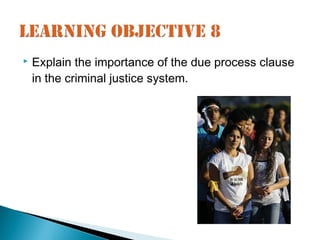
   Explain the importance of the due process clause
    in the criminal justice system.
   Procedural Due Process – the constitutional
    requirement that the law must be carried out in a
    fair and orderly manner.

   Substantive Due Process – the constitutional
    requirement that laws used in accusing and
    convicting persons of crimes must be fair.

Chapter3

  • 1.
  • 2.
    List the four written sources of American criminal law.
  • 3.
    U.S. Constitution and constitutions of the states.  Statutes or laws, passed by Congress and by state legislatures, and local ordinances.  Regulations created by regulatory agencies.  Case law.
  • 5.
    Explain the two basic functions of criminal law.
  • 6.
    Protect and Punish:The Legal Function of the Law  Maintain social order by protecting citizens from criminal harm  Includes harms to both individuals and society in general Maintain and Teach: The Social Function of the Law  Expressing public morality  Teaching social boundaries
  • 7.
    Discuss the primary goals of civil law and criminal law, and explain how these goals are realized.
  • 8.
    Civil Law and Criminal Law ◦ Guilt and Responsibility ◦ The Burden of Proof
  • 9.
    Felonies and Misdemeanors ◦ Degrees of Crime ◦ Types of Manslaughter ◦ Degrees of Misdemeanor ◦ Infractions
  • 10.
    Explain the differences between crimes mala in se and mala prohibita.
  • 11.
    Mala in se – a descriptive term for acts that are inherently wrong, regardless of whether they are prohibited by law.  Mala prohibita – a descriptive term for acts that are made illegal by criminal statute and are not necessarily wrong in and of themselves.
  • 12.
    Criminal law normally requires that the corpus delicti (the body of the crime) be proved before a person can be convicted of wrongdoing.  Criminal Act - Actus reus ◦ Crimes may be acts of commission, or acts of omission, or even attempted acts.
  • 13.
    Delineate the elements required to establish mens rea (a guilty mental state).
  • 14.
    A wrongful mental state is as necessary as a wrongful act in establishing guilt.  Includes elements of purpose, knowledge, negligence, and recklessness.
  • 16.
    Questions: ◦ Whatare the requirements of proving a guilty mental state? ◦ Should the law provide for lesser punishments in cases where intent cannot be proven?
  • 17.
    ◦ Strict Liability– offenses hold the defendant guilty even if intent to commit the offense is lacking ◦ Accomplice Liability – suspects can be charged for crimes they did not actually commit if it can be proven they acted as an accomplice ◦ Concurrence – there must be concurrence between the guilty act and the guilty intent
  • 18.
    ◦ Causation -The criminal act must have caused the harm suffered. ◦ Attendant Circumstances – facts surrounding an event that must be proved for the event to be considered a criminal act. ◦ Harm – damages resultant from the criminal act. Inchoate offenses are conduct deemed criminal without actual harm being done.
  • 19.
    Hate crime laws provide for greater sanctions against those who commit crimes motivated by bias based on race, ethnicity, religion, gender, sexual orientation, disability, or age.
  • 20.
    List and briefly define the most important excuse defenses for crimes.
  • 21.
    Excuse Defenses: Justification Defenses: These defenses apply These defenses apply when the actor lacks when the defendant the requisite mental admits to the criminal condition to form act, but argues that the act was justified. intent.
  • 22.
    ◦ Infancy -Youthful offenders cannot understand the consequences of their actions. ◦ Insanity - A person cannot have the state of mind to commit the crime if s/he didn’t know the act was wrong, or didn’t understand the quality of the act.
  • 23.
    Insanity is determinedby:  M’Naughten Rule ◦ A person is insane if they can’t distinguish right from wrong  ALI/MPC Test ◦ Also known as the substantial capacity test, the defendant must lack the capacity to appreciate the wrongfulness of his/her conduct.  Irresistible Impulse Test ◦ A person is insane if some “irresistible impulse” resulting from a mental deficiency drove him or her to commit the crime
  • 25.
    Intoxication - When the defendant claims that the taking of intoxicants, either voluntarily or involuntarily, rendered him/her unable to form the requisite intent to commit a criminal act. ◦ Mistake  Mistake of Fact  Mistake of Law
  • 26.
    Describe the four most important justification criminal defenses.
  • 27.
    ◦ Duress -The defendant is threatened with seriously bodily harm, which induces him/her to commit the crime. ◦ Self-Defense - The legally recognized privilege to protect one’s self or property from injury by another  A Reasonable Belief  Duty to retreat
  • 28.
    ◦ Necessity -Circumstances required the defendant to commit the act. ◦ Entrapment - The defendant claims (s)he was induced by police to commit the act.
  • 31.
    Substantive Criminal Law:Law that defines the acts that the government will punish. Procedural Criminal Law: Procedures, drawn from the Bill of Rights, designed to protect the constitutional rights of individuals.
  • 32.
    The Bill ofRights: ◦ The first ten amendments to the U.S. Constitution are known as the Bill of Rights. ◦ The Bill of Rights was adopted by the states in 1791 - since then, 17 more amendments have been added. ◦ The Bill of Rights has served as the basis for procedural safeguards of the accused in the U.S.
  • 33.
    Procedural safeguards inthe U.S. Constitution include: ◦ Fourth Amendment - provides protection from unreasonable searches and seizures ◦ Fifth Amendment - requires that no one can be deprived of life, liberty, or property without “due process of the law,” including protections against double jeopardy and individuals being required to be a witness against himself or herself
  • 34.
    ◦ Sixth Amendment- guarantees a speedy trial, a trial by jury, a public trial, the right to confront witnesses, and the right to a lawyer at various stages of criminal proceedings ◦ Eighth Amendment - prohibits excessive bails, fines, and cruel and unusual punishments ◦ Fourteenth Amendment - provides due process and equal protection of the laws
  • 35.
    Explain the importance of the due process clause in the criminal justice system.
  • 36.
    Procedural Due Process – the constitutional requirement that the law must be carried out in a fair and orderly manner.  Substantive Due Process – the constitutional requirement that laws used in accusing and convicting persons of crimes must be fair.