Powered by: shahroze | www.i4info.org 8–1
Strategic ManagementChapter
8
Management
Stephen P. Robbins Mary Coulter
tenth edition
Learning Outcomes
Follow this Learning Outline as you read and study this chapter.
8.1 Strategic Management
• Define strategic management, strategy, and business model.

• Give three reasons why strategic management is important.
8.2 The Strategic Management Process
• Describe the six steps in the strategic management process.
• Define SWOT (strengths, weaknesses, opportunities, and threats).
Learning Outcomes
8.3 Corporate Strategies
• Describe the three major types of
corporate strategies.
• Explain how the BCG matrix and
how it’s used to manage
corporate strategies.
8.4 Competitive Strategies
• Describe the role of competitive
advantage.
• Explain Porter’s five forces model.
• Describe Porter’s three
competitive strategies.
Learning Outcomes
8.5 Current Strategic Management
Issues
• Explain why strategic flexibility is
important.
• Describe e-business strategies.
• Discuss what strategies organizations
might use to become more customer
oriented and to be more innovative.
Strategic Management
• What managers do to develop an organization’s strategies
• Strategies
• The decisions and actions that determine the long-run performance of an organization.
• Business Model
• Is a strategic design for how a company intends to profit from its strategies, work processes, and
work activities.
• Focuses on two things:
• Whether customers will value what the company is providing.
• Whether the company can make any money doing that.
1.It results in higher organizational performance.
2.It requires that managers examine and adapt to business
environment changes.
3.It coordinates diverse organizational units, helping them focus
on organizational goals.
Why Is Strategic Management Important?
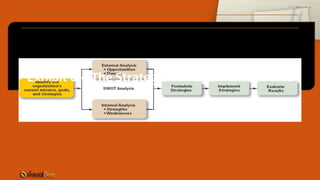
Exhibit 8–1 The Strategic Management Process
Strategic Management Process
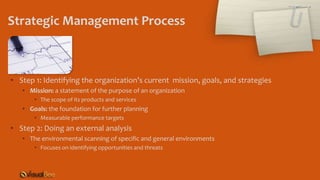
• Step 1: Identifying the organization’s current mission, goals, and strategies
• Mission: a statement of the purpose of an organization
• The scope of its products and services
• Goals: the foundation for further planning
• Measurable performance targets
• Step 2: Doing an external analysis
• The environmental scanning of specific and general environments
• Focuses on identifying opportunities and threats
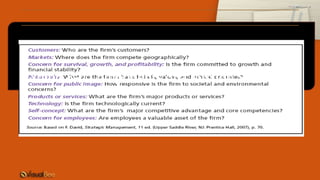
Exhibit 8–2 Components of a Mission Statement
Strategic Management Process
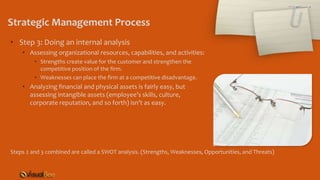
• Step 3: Doing an internal analysis
• Assessing organizational resources, capabilities, and activities:
• Strengths create value for the customer and strengthen the
competitive position of the firm.
• Weaknesses can place the firm at a competitive disadvantage.
• Analyzing financial and physical assets is fairly easy, but
assessing intangible assets (employee’s skills, culture,
corporate reputation, and so forth) isn’t as easy.
Steps 2 and 3 combined are called a SWOT analysis. (Strengths, Weaknesses, Opportunities, and Threats)
Strategic Management Process
• Step 4: Formulating strategies
• Develop and evaluate strategic alternatives
• Select appropriate strategies for all levels in the organization that provide relative advantage over
competitors
• Match organizational strengths to environmental opportunities
• Correct weaknesses and guard against threats
Step 5: Implementing strategies
• Implementation: effectively fitting
organizational structure and activities to
the environment.
• The environment dictates the chosen
strategy; effective strategy
implementation requires an
organizational structure matched to its
requirements.
Step 6: Evaluating results
• How effective have strategies been?
• What adjustments, if any, are necessary?
Strategic Management Process
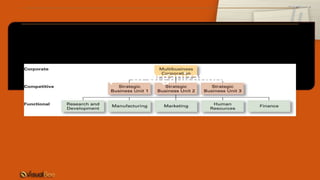
Exhibit 8–3 Types of Organizational Strategies
Types of Organizational Strategies
• Corporate Strategies
• Top management’s overall plan for the entire organization and its strategic business units
• Types of Corporate Strategies
• Growth: expansion into new products and markets
• Stability: maintenance of the status quo
• Renewal: examination of organizational weaknesses that are leading to performance declines
Corporate Strategies
• Growth Strategy
• Seeking to increase the organization’s business by expansion into new products and markets.
• Types of Growth Strategies
• Concentration
• Vertical integration
• Horizontal integration
• Diversification
Corporate Strategies
• Concentration
• Focusing on a primary line of business and increasing the number of products offered or markets
served.
• Vertical Integration
• Backward vertical integration: attempting to gain control of inputs (become a self-supplier).
• Forward vertical integration: attempting to gain control of output through control of the
distribution channel or provide customer service activities (eliminating intermediaries).
Corporate Strategies
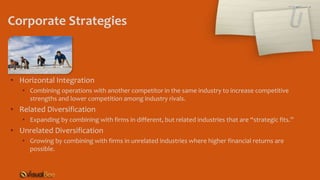
• Horizontal Integration
• Combining operations with another competitor in the same industry to increase competitive
strengths and lower competition among industry rivals.
• Related Diversification
• Expanding by combining with firms in different, but related industries that are “strategic fits.”
• Unrelated Diversification
• Growing by combining with firms in unrelated industries where higher financial returns are
possible.
Corporate Strategies
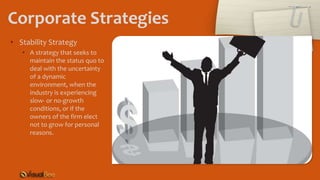
• Stability Strategy
• A strategy that seeks to
maintain the status quo to
deal with the uncertainty
of a dynamic
environment, when the
industry is experiencing
slow- or no-growth
conditions, or if the
owners of the firm elect
not to grow for personal
reasons.
Renewal Strategies
•Developing strategies to counter organization
weaknesses that are leading to performance declines.
•Retrenchment: focusing of eliminating non-critical
weaknesses and restoring strengths to overcome
current performance problems.
•Turnaround: addressing critical long-term
performance problems through the use of strong cost
elimination measures and large-scale organizational
restructuring solutions.
Corporate Strategies
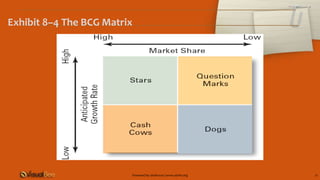
Corporate Portfolio Analysis
• Managers manage portfolio (or collection) of businesses using a corporate portfolio
matrix such as the BCG Matrix.
• BCG Matrix
• Developed by the Boston Consulting Group
• Considers market share and industry growth rate
• Classifies firms as:
• Cash cows: low growth rate, high market share
• Stars: high growth rate, high market share
• Question marks: high growth rate, low market share
• Dogs: low growth rate, low market share
Exhibit 8–4 The BCG Matrix
Powered by: shahroze | www.i4info.org 21
Competitive Strategies
• Competitive Strategy
• A strategy focused on how
an organization will
compete in each of its
SBUs (strategic business
units).
The Role of Competitive Advantage
• Competitive Advantage
• An organization’s distinctive competitive edge.
• Quality as a Competitive Advantage
• Differentiates the firm from its competitors.
• Can create a sustainable competitive advantage.
• Represents the company’s focus on quality management to achieve continuous
improvement and meet customers’ demand for quality.
The Role of Competitive Advantage (cont’d)
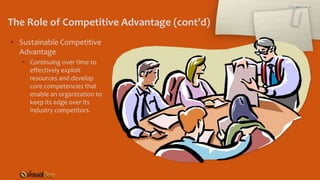
• Sustainable Competitive
Advantage
• Continuing over time to
effectively exploit
resources and develop
core competencies that
enable an organization to
keep its edge over its
industry competitors.
Source: Based on M.E. Porter, Competitive Strategy: Techniques for Analyzing Industries and
Competitors (New York: The Free Press, 1980).
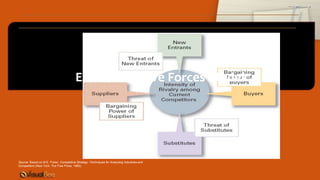
Exhibit 8–5 Five Forces Model
Five Competitive Forces
• Threat of New Entrants
• The ease or difficulty with which new competitors can enter an industry.
• Threat of Substitutes
• The extent to which switching costs and brand loyalty affect the likelihood of customers adopting
substitutes products and services.
• Bargaining Power of Buyers
• The degree to which buyers have the market strength to hold sway over and influence competitors
in an industry.
Five Competitive Forces
• Bargaining Power of Suppliers
• The relative number of buyers to suppliers and threats from substitutes and new entrants affect the buyer-
supplier relationship.
• Current Rivalry
• Intensity among rivals increases when industry growth rates slow, demand falls, and product prices descend.
Types of Competitive Strategies
• Cost Leadership Strategy
• Seeking to attain the lowest total overall costs relative to other industry competitors.
• Differentiation Strategy
• Attempting to create a unique and distinctive product or service for which customers will pay a
premium.
• Focus Strategy
• Using a cost or differentiation advantage to exploit a particular market segment rather a larger
market.
Strategic Flexibility
New Directions in Organizational Strategies
• e-business
• customer service
• innovation
Strategic Management Today
• Know what’s happening with strategies currently being used by monitoring
and measuring results.
• Encourage employees to be open about disclosing and sharing negative
information.
• Get new ideas and perspectives from outside the organization.
• Have multiple alternatives when making strategic decisions.
• Learn from mistakes.
Source: Based on K. Shimizu and M. A. Hitt, “Strategic Flexibility: Organizational Preparedness to Reverse Ineffective Strategic Decisions,” Academy of
Management Executive, November 2004, pp. 44–59.
Exhibit 8–6 Creating Strategic Flexibility
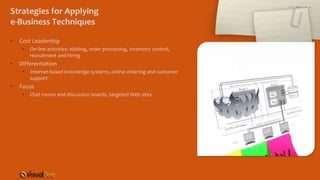
Strategies for Applying
e-Business Techniques
• Cost Leadership
• On-line activities: bidding, order processing, inventory control,
recruitment and hiring
• Differentiation
• Internet-based knowledge systems, online ordering and customer
support
• Focus
• Chat rooms and discussion boards, targeted Web sites
Customer Service Strategies
• Giving the customers what they want.
• Communicating effectively with them.
• Providing employees with customer service training.
Possible Events
• Radical breakthroughs in products.
• Application of existing technology to new
uses.
Strategic Decisions about Innovation
• Basic research
• Product development
• Process innovation
First Mover
• An organization that brings a product
innovation to market or use a new process
innovations
Innovation Strategies
•Advantages
 Reputation for being innovative and
industry leader
 Cost and learning benefits
 Control over scarce resources and
keeping competitors from having access
to them
 Opportunity to begin building customer
relationships and customer loyalty
• Disadvantages
 Uncertainty over exact direction
technology and market will go
 Risk of competitors imitating
innovations
 Financial and strategic risks
 High development costs
Exhibit 8–7 First-Mover Advantages–Disadvantages
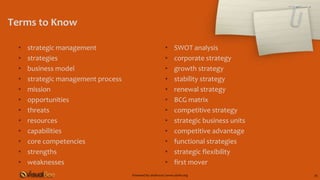
Terms to Know
• strategic management
• strategies
• business model
• strategic management process
• mission
• opportunities
• threats
• resources
• capabilities
• core competencies
• strengths
• weaknesses
• SWOT analysis
• corporate strategy
• growth strategy
• stability strategy
• renewal strategy
• BCG matrix
• competitive strategy
• strategic business units
• competitive advantage
• functional strategies
• strategic flexibility
• first mover
Powered by: shahroze | www.i4info.org 35
All rights reserved. No part of this publication may be reproduced, stored in a retrieval
system, or transmitted, in any form or by any means, electronic, mechanical,
photocopying, recording, or otherwise, without the prior written permission of the
publisher. Printed in the United States of America.
Powered by: shahroze | www.i4info.org 36

Chapter 8management10theditionbyrobbinsandcoulter-130822070036-phpapp02 - visual bee

  • 1.
    Powered by: shahroze| www.i4info.org 8–1 Strategic ManagementChapter 8 Management Stephen P. Robbins Mary Coulter tenth edition
  • 2.
    Learning Outcomes Follow thisLearning Outline as you read and study this chapter. 8.1 Strategic Management • Define strategic management, strategy, and business model. • Give three reasons why strategic management is important. 8.2 The Strategic Management Process • Describe the six steps in the strategic management process. • Define SWOT (strengths, weaknesses, opportunities, and threats).
  • 3.
    Learning Outcomes 8.3 CorporateStrategies • Describe the three major types of corporate strategies. • Explain how the BCG matrix and how it’s used to manage corporate strategies. 8.4 Competitive Strategies • Describe the role of competitive advantage. • Explain Porter’s five forces model. • Describe Porter’s three competitive strategies.
  • 4.
    Learning Outcomes 8.5 CurrentStrategic Management Issues • Explain why strategic flexibility is important. • Describe e-business strategies. • Discuss what strategies organizations might use to become more customer oriented and to be more innovative.
  • 5.
    Strategic Management • Whatmanagers do to develop an organization’s strategies • Strategies • The decisions and actions that determine the long-run performance of an organization. • Business Model • Is a strategic design for how a company intends to profit from its strategies, work processes, and work activities. • Focuses on two things: • Whether customers will value what the company is providing. • Whether the company can make any money doing that.
  • 6.
    1.It results inhigher organizational performance. 2.It requires that managers examine and adapt to business environment changes. 3.It coordinates diverse organizational units, helping them focus on organizational goals. Why Is Strategic Management Important?
  • 7.
    Exhibit 8–1 TheStrategic Management Process
  • 8.
    Strategic Management Process •Step 1: Identifying the organization’s current mission, goals, and strategies • Mission: a statement of the purpose of an organization • The scope of its products and services • Goals: the foundation for further planning • Measurable performance targets • Step 2: Doing an external analysis • The environmental scanning of specific and general environments • Focuses on identifying opportunities and threats
  • 9.
    Exhibit 8–2 Componentsof a Mission Statement
  • 10.
    Strategic Management Process •Step 3: Doing an internal analysis • Assessing organizational resources, capabilities, and activities: • Strengths create value for the customer and strengthen the competitive position of the firm. • Weaknesses can place the firm at a competitive disadvantage. • Analyzing financial and physical assets is fairly easy, but assessing intangible assets (employee’s skills, culture, corporate reputation, and so forth) isn’t as easy. Steps 2 and 3 combined are called a SWOT analysis. (Strengths, Weaknesses, Opportunities, and Threats)
  • 11.
    Strategic Management Process •Step 4: Formulating strategies • Develop and evaluate strategic alternatives • Select appropriate strategies for all levels in the organization that provide relative advantage over competitors • Match organizational strengths to environmental opportunities • Correct weaknesses and guard against threats
  • 12.
    Step 5: Implementingstrategies • Implementation: effectively fitting organizational structure and activities to the environment. • The environment dictates the chosen strategy; effective strategy implementation requires an organizational structure matched to its requirements. Step 6: Evaluating results • How effective have strategies been? • What adjustments, if any, are necessary? Strategic Management Process
  • 13.
    Exhibit 8–3 Typesof Organizational Strategies
  • 14.
    Types of OrganizationalStrategies • Corporate Strategies • Top management’s overall plan for the entire organization and its strategic business units • Types of Corporate Strategies • Growth: expansion into new products and markets • Stability: maintenance of the status quo • Renewal: examination of organizational weaknesses that are leading to performance declines
  • 15.
    Corporate Strategies • GrowthStrategy • Seeking to increase the organization’s business by expansion into new products and markets. • Types of Growth Strategies • Concentration • Vertical integration • Horizontal integration • Diversification
  • 16.
    Corporate Strategies • Concentration •Focusing on a primary line of business and increasing the number of products offered or markets served. • Vertical Integration • Backward vertical integration: attempting to gain control of inputs (become a self-supplier). • Forward vertical integration: attempting to gain control of output through control of the distribution channel or provide customer service activities (eliminating intermediaries).
  • 17.
    Corporate Strategies • HorizontalIntegration • Combining operations with another competitor in the same industry to increase competitive strengths and lower competition among industry rivals. • Related Diversification • Expanding by combining with firms in different, but related industries that are “strategic fits.” • Unrelated Diversification • Growing by combining with firms in unrelated industries where higher financial returns are possible.
  • 18.
    Corporate Strategies • StabilityStrategy • A strategy that seeks to maintain the status quo to deal with the uncertainty of a dynamic environment, when the industry is experiencing slow- or no-growth conditions, or if the owners of the firm elect not to grow for personal reasons.
  • 19.
    Renewal Strategies •Developing strategiesto counter organization weaknesses that are leading to performance declines. •Retrenchment: focusing of eliminating non-critical weaknesses and restoring strengths to overcome current performance problems. •Turnaround: addressing critical long-term performance problems through the use of strong cost elimination measures and large-scale organizational restructuring solutions. Corporate Strategies
  • 20.
    Corporate Portfolio Analysis •Managers manage portfolio (or collection) of businesses using a corporate portfolio matrix such as the BCG Matrix. • BCG Matrix • Developed by the Boston Consulting Group • Considers market share and industry growth rate • Classifies firms as: • Cash cows: low growth rate, high market share • Stars: high growth rate, high market share • Question marks: high growth rate, low market share • Dogs: low growth rate, low market share
  • 21.
    Exhibit 8–4 TheBCG Matrix Powered by: shahroze | www.i4info.org 21
  • 22.
    Competitive Strategies • CompetitiveStrategy • A strategy focused on how an organization will compete in each of its SBUs (strategic business units).
  • 23.
    The Role ofCompetitive Advantage • Competitive Advantage • An organization’s distinctive competitive edge. • Quality as a Competitive Advantage • Differentiates the firm from its competitors. • Can create a sustainable competitive advantage. • Represents the company’s focus on quality management to achieve continuous improvement and meet customers’ demand for quality.
  • 24.
    The Role ofCompetitive Advantage (cont’d) • Sustainable Competitive Advantage • Continuing over time to effectively exploit resources and develop core competencies that enable an organization to keep its edge over its industry competitors.
  • 25.
    Source: Based onM.E. Porter, Competitive Strategy: Techniques for Analyzing Industries and Competitors (New York: The Free Press, 1980). Exhibit 8–5 Five Forces Model
  • 26.
    Five Competitive Forces •Threat of New Entrants • The ease or difficulty with which new competitors can enter an industry. • Threat of Substitutes • The extent to which switching costs and brand loyalty affect the likelihood of customers adopting substitutes products and services. • Bargaining Power of Buyers • The degree to which buyers have the market strength to hold sway over and influence competitors in an industry.
  • 27.
    Five Competitive Forces •Bargaining Power of Suppliers • The relative number of buyers to suppliers and threats from substitutes and new entrants affect the buyer- supplier relationship. • Current Rivalry • Intensity among rivals increases when industry growth rates slow, demand falls, and product prices descend.
  • 28.
    Types of CompetitiveStrategies • Cost Leadership Strategy • Seeking to attain the lowest total overall costs relative to other industry competitors. • Differentiation Strategy • Attempting to create a unique and distinctive product or service for which customers will pay a premium. • Focus Strategy • Using a cost or differentiation advantage to exploit a particular market segment rather a larger market.
  • 29.
    Strategic Flexibility New Directionsin Organizational Strategies • e-business • customer service • innovation Strategic Management Today
  • 30.
    • Know what’shappening with strategies currently being used by monitoring and measuring results. • Encourage employees to be open about disclosing and sharing negative information. • Get new ideas and perspectives from outside the organization. • Have multiple alternatives when making strategic decisions. • Learn from mistakes. Source: Based on K. Shimizu and M. A. Hitt, “Strategic Flexibility: Organizational Preparedness to Reverse Ineffective Strategic Decisions,” Academy of Management Executive, November 2004, pp. 44–59. Exhibit 8–6 Creating Strategic Flexibility
  • 31.
    Strategies for Applying e-BusinessTechniques • Cost Leadership • On-line activities: bidding, order processing, inventory control, recruitment and hiring • Differentiation • Internet-based knowledge systems, online ordering and customer support • Focus • Chat rooms and discussion boards, targeted Web sites
  • 32.
    Customer Service Strategies •Giving the customers what they want. • Communicating effectively with them. • Providing employees with customer service training.
  • 33.
    Possible Events • Radicalbreakthroughs in products. • Application of existing technology to new uses. Strategic Decisions about Innovation • Basic research • Product development • Process innovation First Mover • An organization that brings a product innovation to market or use a new process innovations Innovation Strategies
  • 34.
    •Advantages  Reputation forbeing innovative and industry leader  Cost and learning benefits  Control over scarce resources and keeping competitors from having access to them  Opportunity to begin building customer relationships and customer loyalty • Disadvantages  Uncertainty over exact direction technology and market will go  Risk of competitors imitating innovations  Financial and strategic risks  High development costs Exhibit 8–7 First-Mover Advantages–Disadvantages
  • 35.
    Terms to Know •strategic management • strategies • business model • strategic management process • mission • opportunities • threats • resources • capabilities • core competencies • strengths • weaknesses • SWOT analysis • corporate strategy • growth strategy • stability strategy • renewal strategy • BCG matrix • competitive strategy • strategic business units • competitive advantage • functional strategies • strategic flexibility • first mover Powered by: shahroze | www.i4info.org 35
  • 36.
    All rights reserved.No part of this publication may be reproduced, stored in a retrieval system, or transmitted, in any form or by any means, electronic, mechanical, photocopying, recording, or otherwise, without the prior written permission of the publisher. Printed in the United States of America. Powered by: shahroze | www.i4info.org 36