Chapter:7
REGISTRATION OF SPECIMEN, LABORATORY
RECORD AND REPORTING SYSTEMS
1
Acknowledgment
 Addis Ababa University
 Jimma University
 Hawasa University
 Haromaya University
 University of Gonder
 American Society for clinical pathology
 Center for disease prevention and control - Ethiopia
2
Learning Objectives
 After completion of this chapter, the student will be
able to:
 How to register specimen on log books
 Prepare laboratory request format and log books
 Discuss different reporting systems
 Know daily and monthly reporting formats
3
Out line
7.1. Registration of specimen and patient identification
7.2. Laboratory records and requesting formats
7.3. Patient confidentiality
7.4. Reporting system
7.5. Registration system
4
7.1. Registration of specimen and patient
identification
 Before a sample is taken verify patients name and
identification number.
 Always check whether the request format and the
specimen which arrive in the laboratory are the same.
 Distribute the specimens to appropriate department
with care handle.
5
Registration of …
 Give attention to urgent specimens.
 Give more attention to the precious specimens.
 Register all specimens on the log book with its
laboratory reference number and reporting time as
well as time of arrival.
6
Registration …
Registration includes:
 All specimens must be registered and given number when they
arrive at the laboratory and the results of all investigations must be
recorded. This will:
 avoid the risk of mixed up of specimen
 Make possible to look up a result
 Make the results available for the other staffs
 Promote the public health
 Help to trace the history of the patient
 Help to trace back errors and avoids confusion in
communication.
7
Registration ….
 Numbering/lableing the specimens as soon as it is received.
 Write this number immediately:
 On the request form
 On the specimen container
 On every test tube used for the specimen
 On every microscope slide used for the specimen
8
7.2. Laboratory records and requesting
formats
 Standardization of lab reports contributes to efficiency
of lab service and have a great value when patients
are referred from one to an other.
 A record of all test result must be kept by lab as
carbon copies, work sheet or simple registration book.
 Records of test are also required for preparing work
report and estimating work load of the lab.
9
Laboratory records……
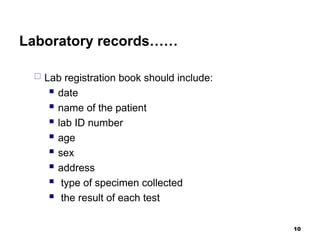
 Lab registration book should include:
 date
 name of the patient
 lab ID number
 age
 sex
 address
 type of specimen collected
 the result of each test
10
Laboratory records……
 Separate lab records can be prepared to record the
results of:
 Hematological
 bacteriological
 clinical chemistry
 urine
 Parasitological tests. etc….
11
Laboratory Request Form
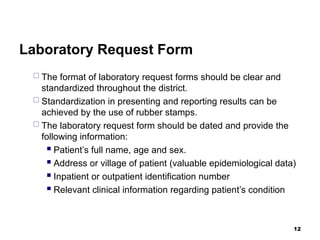
 The format of laboratory request forms should be clear and
standardized throughout the district.
 Standardization in presenting and reporting results can be
achieved by the use of rubber stamps.
 The laboratory request form should be dated and provide the
following information:
 Patient’s full name, age and sex.
 Address or village of patient (valuable epidemiological data)
 Inpatient or outpatient identification number
 Relevant clinical information regarding patient’s condition
12
Request form…..
 Specific test(s) required
 Specimen provided
 Origin of request if from an outreach health center or
maternity unit
 Name of the medical officer, community health worker.
 URGENT TEST: are only those tests should be requested
urgently that are required for the immediate care of a patient
or to manage a serious public health situation.
13
7.3. Patient confidentiality
 Request forms and specimen are received by the
laboratory staff has a responsibility to ensure the
request forms are not read by unauthorized persons.
 Laboratory staff must never disclose any information
they may learn about a patient or a test result to anyone
other than the health personnel caring for the patient.
14
Patient confidentiality ….
 Reports should be delivered in sealed envelopes,
labeled CONFIDENTIAL LABORATORY REPORTS or
in labeled sealed folder which can be returned to the
laboratory for re-use.
 A fully completed request form should accompany
each specimen with the detail mentioned on specimen
collection and processing chapter.
15
7.4. Reporting system
 Standardization in the presentation of lab. results and
use of SI units is important because:
 it helps in the interpretation and comparison of
results.
 Contributes to the efficiency of a lab. service.
 it is of value when patients are referred from one
health unit of hospital to another.
 Reports should be clearly and neatly written
(particularly figures).
16
Reporting system …
 Types of reporting system
 In general, result are reported in three ways:
1. Qualitative
2. Semi- quantitative
3. Quantitative
17
Reporting system ….
1. Qualitative: - qualitative reports give a general
impression without any numerical value.
E.g. Positive or negative (+ or -)
Present or absent (+ or -)
like in cases of:
 HIV test
 HBV test
 Intestinal Parasites
 Any hemo parasite
18
Reporting system…
2. Semi- quantitative
 This kind of report is half way between qualitative and quantitative
reports.
 The actual numerical value is considerably subjective and get the
physician is able to some extent assess the severity of the
situation
 E.g. Negative -
 Doubtful +/-
 Mild + (1+)
 Moderate ++ (2+)
 Severe +++ (3+)
 Grass ++++ (4+)
19
Reporting system…
20
Reporting system…
3. Quantitative
 Results are reported in quantitative terms.
 The units are usually in mg/ 100 ml,
 some are in g /100 ml e.g. protein concentration
 Others are in mmol or mEq/L. Eg. electrolytes
 The clearance rate is expressed in mL/min.
 All quantitative results are compared against a standard
Examples:
 blood glucose levels
 Hemoglobin concentration
 Enzyme levels 21
7.5 Registration system
The lab. Registers
 The registers should be a series of notebooks with
numbered pages and with strong hand covers.
 Each specimen should be numbered and recorded
in the register
Example: Log book (hematology)
22
Date No
patient'
Name
Sex Age Address Requested by Specimen Examn
requested
Results Result
sent
Result
issued by
12/01/04 1. Bekele
H.
M 30 A.A Det. Of
Inter. med
Blood Hb 12.2 gm% 13/01/04 Kebede
23
Log book (hematology)
Registration system …
The Monthly Report
 At the end of every month the lab. should submit its
monthly report to the head of the institute.
• It helps to keep a check on the laboratory activities
• It is useful for public health surveillance.
24
Laboratory------------------------------------------ Hawassa - health center
Month Ending ------------------------------------- Sene 1,2000 through sene 30,2000
Lab. Staff
W/t Ruth Alemayehu ------------------------------------ Lab Technician
Ato Hailu Mitku -------------------------------- Assis. Technician
Lab statistics
No. of persons for whom tests were made ------ 672
No. of specimens received or taken ---------------- 815
No. of examinations carried out ---------------------- 905
No. of specimens sent to the regional lab----------- 27
Communicable Disease----------------------------- Total
Amoebiasis ---------------------------------------------- 28
Ascariasis ------------------------------------------------ 15
Gonorrhea-------------------------------------------------- 21 25
Registration system …
Daily statistics form
 It is a form used in the laboratory to register each days
work.
 It is easier to a raw up the monthly report from a daily
statistics form based in the lab. register at the end of each
days work.
 Here is a sample daily statistics form.
26
Working days in the month
Month = Meskerem 2000 1 2 3 4 … 29 30 Tot al
No. patients 77
No. specimens 80
No. examinations 78
No. of specimens sent to the
regional lab.
2
Comunicable deseases
- Amebiasis
- Ascariasis
- Gonorrhea, etc.
-
-
-
27
Summary question
1. Discuss different reporting systems.
2. Briefly discuss about daily and monthly reporting system
for the specimen.
28
References
1. Linne Jean Jergenson, Basic techniques of medical
laboratory 4th
ed. 2000.
2. WHO, Manual of basic techniques for a health laboratory
2000.
3. Chees brough M.District Laboratory manual for tropical
courtiers, Cambridge Univerity press, 2000 (Vol ).
4. Chees brough M.District Laboratory manual for tropical
courtiers, Cambridge Univerity press, 2000 (Vol II).
5. Seyoum B. Introduction to medical laboratory technology
students lecture note series 2002.
29
End of slide
Next chapter will be :
Introduction to QA
30

Chapter 7 registration and record and report

  • 1.
    Chapter:7 REGISTRATION OF SPECIMEN,LABORATORY RECORD AND REPORTING SYSTEMS 1
  • 2.
    Acknowledgment  Addis AbabaUniversity  Jimma University  Hawasa University  Haromaya University  University of Gonder  American Society for clinical pathology  Center for disease prevention and control - Ethiopia 2
  • 3.
    Learning Objectives  Aftercompletion of this chapter, the student will be able to:  How to register specimen on log books  Prepare laboratory request format and log books  Discuss different reporting systems  Know daily and monthly reporting formats 3
  • 4.
    Out line 7.1. Registrationof specimen and patient identification 7.2. Laboratory records and requesting formats 7.3. Patient confidentiality 7.4. Reporting system 7.5. Registration system 4
  • 5.
    7.1. Registration ofspecimen and patient identification  Before a sample is taken verify patients name and identification number.  Always check whether the request format and the specimen which arrive in the laboratory are the same.  Distribute the specimens to appropriate department with care handle. 5
  • 6.
    Registration of … Give attention to urgent specimens.  Give more attention to the precious specimens.  Register all specimens on the log book with its laboratory reference number and reporting time as well as time of arrival. 6
  • 7.
    Registration … Registration includes: All specimens must be registered and given number when they arrive at the laboratory and the results of all investigations must be recorded. This will:  avoid the risk of mixed up of specimen  Make possible to look up a result  Make the results available for the other staffs  Promote the public health  Help to trace the history of the patient  Help to trace back errors and avoids confusion in communication. 7
  • 8.
    Registration ….  Numbering/lableingthe specimens as soon as it is received.  Write this number immediately:  On the request form  On the specimen container  On every test tube used for the specimen  On every microscope slide used for the specimen 8
  • 9.
    7.2. Laboratory recordsand requesting formats  Standardization of lab reports contributes to efficiency of lab service and have a great value when patients are referred from one to an other.  A record of all test result must be kept by lab as carbon copies, work sheet or simple registration book.  Records of test are also required for preparing work report and estimating work load of the lab. 9
  • 10.
    Laboratory records……  Labregistration book should include:  date  name of the patient  lab ID number  age  sex  address  type of specimen collected  the result of each test 10
  • 11.
    Laboratory records……  Separatelab records can be prepared to record the results of:  Hematological  bacteriological  clinical chemistry  urine  Parasitological tests. etc…. 11
  • 12.
    Laboratory Request Form The format of laboratory request forms should be clear and standardized throughout the district.  Standardization in presenting and reporting results can be achieved by the use of rubber stamps.  The laboratory request form should be dated and provide the following information:  Patient’s full name, age and sex.  Address or village of patient (valuable epidemiological data)  Inpatient or outpatient identification number  Relevant clinical information regarding patient’s condition 12
  • 13.
    Request form…..  Specifictest(s) required  Specimen provided  Origin of request if from an outreach health center or maternity unit  Name of the medical officer, community health worker.  URGENT TEST: are only those tests should be requested urgently that are required for the immediate care of a patient or to manage a serious public health situation. 13
  • 14.
    7.3. Patient confidentiality Request forms and specimen are received by the laboratory staff has a responsibility to ensure the request forms are not read by unauthorized persons.  Laboratory staff must never disclose any information they may learn about a patient or a test result to anyone other than the health personnel caring for the patient. 14
  • 15.
    Patient confidentiality …. Reports should be delivered in sealed envelopes, labeled CONFIDENTIAL LABORATORY REPORTS or in labeled sealed folder which can be returned to the laboratory for re-use.  A fully completed request form should accompany each specimen with the detail mentioned on specimen collection and processing chapter. 15
  • 16.
    7.4. Reporting system Standardization in the presentation of lab. results and use of SI units is important because:  it helps in the interpretation and comparison of results.  Contributes to the efficiency of a lab. service.  it is of value when patients are referred from one health unit of hospital to another.  Reports should be clearly and neatly written (particularly figures). 16
  • 17.
    Reporting system … Types of reporting system  In general, result are reported in three ways: 1. Qualitative 2. Semi- quantitative 3. Quantitative 17
  • 18.
    Reporting system …. 1.Qualitative: - qualitative reports give a general impression without any numerical value. E.g. Positive or negative (+ or -) Present or absent (+ or -) like in cases of:  HIV test  HBV test  Intestinal Parasites  Any hemo parasite 18
  • 19.
    Reporting system… 2. Semi-quantitative  This kind of report is half way between qualitative and quantitative reports.  The actual numerical value is considerably subjective and get the physician is able to some extent assess the severity of the situation  E.g. Negative -  Doubtful +/-  Mild + (1+)  Moderate ++ (2+)  Severe +++ (3+)  Grass ++++ (4+) 19
  • 20.
  • 21.
    Reporting system… 3. Quantitative Results are reported in quantitative terms.  The units are usually in mg/ 100 ml,  some are in g /100 ml e.g. protein concentration  Others are in mmol or mEq/L. Eg. electrolytes  The clearance rate is expressed in mL/min.  All quantitative results are compared against a standard Examples:  blood glucose levels  Hemoglobin concentration  Enzyme levels 21
  • 22.
    7.5 Registration system Thelab. Registers  The registers should be a series of notebooks with numbered pages and with strong hand covers.  Each specimen should be numbered and recorded in the register Example: Log book (hematology) 22
  • 23.
    Date No patient' Name Sex AgeAddress Requested by Specimen Examn requested Results Result sent Result issued by 12/01/04 1. Bekele H. M 30 A.A Det. Of Inter. med Blood Hb 12.2 gm% 13/01/04 Kebede 23 Log book (hematology)
  • 24.
    Registration system … TheMonthly Report  At the end of every month the lab. should submit its monthly report to the head of the institute. • It helps to keep a check on the laboratory activities • It is useful for public health surveillance. 24
  • 25.
    Laboratory------------------------------------------ Hawassa -health center Month Ending ------------------------------------- Sene 1,2000 through sene 30,2000 Lab. Staff W/t Ruth Alemayehu ------------------------------------ Lab Technician Ato Hailu Mitku -------------------------------- Assis. Technician Lab statistics No. of persons for whom tests were made ------ 672 No. of specimens received or taken ---------------- 815 No. of examinations carried out ---------------------- 905 No. of specimens sent to the regional lab----------- 27 Communicable Disease----------------------------- Total Amoebiasis ---------------------------------------------- 28 Ascariasis ------------------------------------------------ 15 Gonorrhea-------------------------------------------------- 21 25
  • 26.
    Registration system … Dailystatistics form  It is a form used in the laboratory to register each days work.  It is easier to a raw up the monthly report from a daily statistics form based in the lab. register at the end of each days work.  Here is a sample daily statistics form. 26
  • 27.
    Working days inthe month Month = Meskerem 2000 1 2 3 4 … 29 30 Tot al No. patients 77 No. specimens 80 No. examinations 78 No. of specimens sent to the regional lab. 2 Comunicable deseases - Amebiasis - Ascariasis - Gonorrhea, etc. - - - 27
  • 28.
    Summary question 1. Discussdifferent reporting systems. 2. Briefly discuss about daily and monthly reporting system for the specimen. 28
  • 29.
    References 1. Linne JeanJergenson, Basic techniques of medical laboratory 4th ed. 2000. 2. WHO, Manual of basic techniques for a health laboratory 2000. 3. Chees brough M.District Laboratory manual for tropical courtiers, Cambridge Univerity press, 2000 (Vol ). 4. Chees brough M.District Laboratory manual for tropical courtiers, Cambridge Univerity press, 2000 (Vol II). 5. Seyoum B. Introduction to medical laboratory technology students lecture note series 2002. 29
  • 30.
    End of slide Nextchapter will be : Introduction to QA 30

Editor's Notes

  • #7 There fore , the lab should have: - examination request forms that accompany the specimen - a register for recording details concerning the specimen and the results obtained - Monthly report forms
  • #24 At the end of every month the laboratory should submit a report to the director of laboratory services at the central level or, if there is none, to the department of public health at both the provincial and the central level. The report is valuable for two main reasons.   Firstly, it helps to keep a check on the laboratory’s activities and is useful for ensuring adequate staffing, for the ordering of supplies by the central stores, and for the preparation of the budget for laboratory services at the national level. Reports based on the number of tests done are the most suitable. Secondly, a monthly report is an aid in public health surveillance of the area covered by the laboratory since it reports the number of positive results obtained for various communicable diseases