Module 7
Recording and Reporting of Blood film
Results
Learning Objectives
At the end of this module, the participant will be able to
– Describe essential elements of recording and reporting
– Describe the quantification scheme for reporting results
– Report microscopy results on the Laboratory Request Form
– Record microscopy results correctly in the Laboratory
Register.
2
Content Outline
– Essential elements of Record Keeping
– Laboratory request and report forms
– Recording and reporting results: Negative and Positive
– Entry of data into the Laboratory Register
3
Essential Elements of Recordkeeping
• Recording means keeping the register up-to-date.
• Proper recording and reporting of patient data used to
– Determine work load
– Planning of resources
– Compile important epidemiological information
for malaria prevention and control program.
4
Accurate recordkeeping is based around four
elements:
– Completeness
– Consistency
– Credibility
– Timeliness
5
Therefore, Laboratory supervisors should
regularly review
– Specimen Request forms
– Laboratory Register
– Reporting of results
6
Laboratory Request and Report Forms
A completed Laboratory Request Form should give the
following information:
– Name of health facility
– Date
– Patient’s name, address, age, and sex
– Type of specimen
– Patient ID/ Specimen ID number (laboratory serial
number)
– Clinical impression
– Signature of person requesting exam
7
Microscopy Report
The microscopy report should include the following
information:
– Specimen ID number
– Date of specimen analysis
– Blood film result (presence of parasite, species, stage and
parasite count/density)
– If necessary (high parasitemia) percentage of infected RBC in
Thin films
– Name and Signature of Laboratory technician
8
The Laboratory Register:
• Is a record book maintained by the laboratory
technician responsible for blood film examination.
The laboratory register should include:
– Laboratory serial number
– Date of specimen testing
– Patient’s name, sex, age, and address
– Type of test
– Test results
– Signature of person responsible for tests
9
Malaria Data report
• Compiled from the laboratory log book on
weekly, monthly, quarterly and yearly basis.
• This will give us evidence on the workload of
health facility laboratory for further planning of
resources.
• Have significant input to show the prevalence of
laboratory confirmed malaria cases in the facility.
10
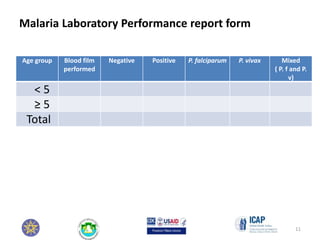
Malaria Laboratory Performance report form
Age group Blood film
performed
Negative Positive P. falciparum P. vivax Mixed
( P. f and P.
v)
< 5
≥ 5
Total
11
Laboratory confirmed malaria case report form
• Done by reviewing the malaria register and counting
the number of blood films reported as positive with
their species name and negative slides.
12
Thank You!!
13

Module 7-Recording and reporting.pptyujx

  • 1.
    Module 7 Recording andReporting of Blood film Results
  • 2.
    Learning Objectives At theend of this module, the participant will be able to – Describe essential elements of recording and reporting – Describe the quantification scheme for reporting results – Report microscopy results on the Laboratory Request Form – Record microscopy results correctly in the Laboratory Register. 2
  • 3.
    Content Outline – Essentialelements of Record Keeping – Laboratory request and report forms – Recording and reporting results: Negative and Positive – Entry of data into the Laboratory Register 3
  • 4.
    Essential Elements ofRecordkeeping • Recording means keeping the register up-to-date. • Proper recording and reporting of patient data used to – Determine work load – Planning of resources – Compile important epidemiological information for malaria prevention and control program. 4
  • 5.
    Accurate recordkeeping isbased around four elements: – Completeness – Consistency – Credibility – Timeliness 5
  • 6.
    Therefore, Laboratory supervisorsshould regularly review – Specimen Request forms – Laboratory Register – Reporting of results 6
  • 7.
    Laboratory Request andReport Forms A completed Laboratory Request Form should give the following information: – Name of health facility – Date – Patient’s name, address, age, and sex – Type of specimen – Patient ID/ Specimen ID number (laboratory serial number) – Clinical impression – Signature of person requesting exam 7
  • 8.
    Microscopy Report The microscopyreport should include the following information: – Specimen ID number – Date of specimen analysis – Blood film result (presence of parasite, species, stage and parasite count/density) – If necessary (high parasitemia) percentage of infected RBC in Thin films – Name and Signature of Laboratory technician 8
  • 9.
    The Laboratory Register: •Is a record book maintained by the laboratory technician responsible for blood film examination. The laboratory register should include: – Laboratory serial number – Date of specimen testing – Patient’s name, sex, age, and address – Type of test – Test results – Signature of person responsible for tests 9
  • 10.
    Malaria Data report •Compiled from the laboratory log book on weekly, monthly, quarterly and yearly basis. • This will give us evidence on the workload of health facility laboratory for further planning of resources. • Have significant input to show the prevalence of laboratory confirmed malaria cases in the facility. 10
  • 11.
    Malaria Laboratory Performancereport form Age group Blood film performed Negative Positive P. falciparum P. vivax Mixed ( P. f and P. v) < 5 ≥ 5 Total 11
  • 12.
    Laboratory confirmed malariacase report form • Done by reviewing the malaria register and counting the number of blood films reported as positive with their species name and negative slides. 12
  • 13.