Milkovich/Newman: Compensation, Ninth EditionMilkovich/Newman: Compensation, Ninth Edition
McGraw-Hill/IrwinMcGraw-Hill/Irwin Copyright © 2008 by The McGraw-Hill Companies, Inc. All rights reserved.Copyright © 2008 by The McGraw-Hill Companies, Inc. All rights reserved.
Chapter 11Chapter 11
PerformancePerformance
AppraisalsAppraisals
11-11-22
Nature of Performance AppraisalsNature of Performance Appraisals
 You can’t manage what you don’t understandYou can’t manage what you don’t understand
 You don’t understand what you don’t measureYou don’t understand what you don’t measure
 What gets measured is what gets doneWhat gets measured is what gets done
 What gets measured is what gets rewardedWhat gets measured is what gets rewarded
 What gets rewarded is what gets repeatedWhat gets rewarded is what gets repeated
11-11-33
The Role of Performance AppraisalsThe Role of Performance Appraisals
in Compensation Decisionsin Compensation Decisions
 Employees often frustrated about the appraisalEmployees often frustrated about the appraisal
processprocess
– Appraisals are too subjectiveAppraisals are too subjective
– Possibility of unfair treatment by a supervisorPossibility of unfair treatment by a supervisor
 Experts argue that rather than throwing out theExperts argue that rather than throwing out the
entire performance appraisal process, total-entire performance appraisal process, total-
quality-management principles should bequality-management principles should be
applied to improving itapplied to improving it
– Recognize part of performance influenced more byRecognize part of performance influenced more by
work environment and systems than by ee behaviorswork environment and systems than by ee behaviors
11-11-44
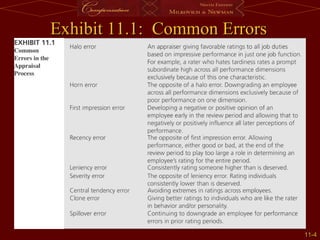
Exhibit 11.1: Common ErrorsExhibit 11.1: Common Errors
in the Appraisal Processin the Appraisal Process
11-11-55
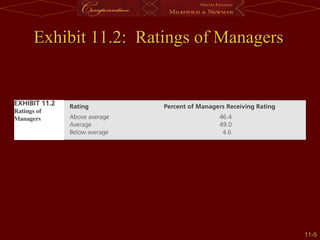
Exhibit 11.2: Ratings of ManagersExhibit 11.2: Ratings of Managers
11-11-66
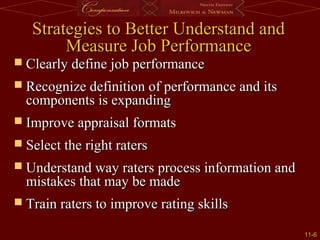
Strategies to Better Understand andStrategies to Better Understand and
Measure Job PerformanceMeasure Job Performance
 Clearly define job performanceClearly define job performance
 Recognize definition of performance and itsRecognize definition of performance and its
components is expandingcomponents is expanding
 Improve appraisal formatsImprove appraisal formats
 Select the right ratersSelect the right raters
 Understand way raters process information andUnderstand way raters process information and
mistakes that may be mademistakes that may be made
 Train raters to improve rating skillsTrain raters to improve rating skills
11-11-77
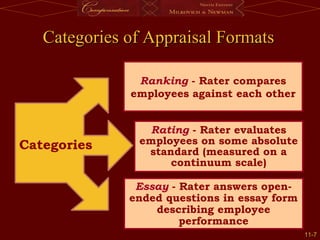
Categories of Appraisal FormatsCategories of Appraisal Formats
Ranking - Rater compares
employees against each other
Rating - Rater evaluates
employees on some absolute
standard (measured on a
continuum scale)
Essay - Rater answers open-
ended questions in essay form
describing employee
performance
Categories
11-11-88
Ranking FormatsRanking Formats
 Straight rankingStraight ranking
 Alternation rankingAlternation ranking
 Paired-comparisonPaired-comparison
rankingranking
 See Ex. 11.3See Ex. 11.3
11-11-99
Rating FormatsRating Formats
 Two common elementsTwo common elements
– Raters evaluate employees on some absoluteRaters evaluate employees on some absolute
standardstandard
– Each standard is measured on a scaleEach standard is measured on a scale
-performance variation is described along a-performance variation is described along a
continuumcontinuum
11-11-1010
Rating Formats (cont.)Rating Formats (cont.)
 Types of descriptorsTypes of descriptors
– AdjectivesAdjectives
 Standard rating scale (Ex. 11.4)Standard rating scale (Ex. 11.4)
– BehaviorsBehaviors
 Behaviorally anchored rating scales (Ex. 11.5)Behaviorally anchored rating scales (Ex. 11.5)
– OutcomesOutcomes
 Management by objectives (Ex. 11.7, 11.8)Management by objectives (Ex. 11.7, 11.8)
11-11-1111
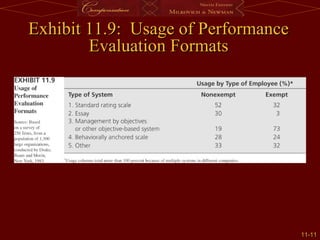
Exhibit 11.9: Usage of PerformanceExhibit 11.9: Usage of Performance
Evaluation FormatsEvaluation Formats
11-11-1212
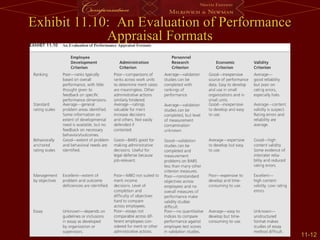
Exhibit 11.10: An Evaluation of PerformanceExhibit 11.10: An Evaluation of Performance
Appraisal FormatsAppraisal Formats
11-11-1313
Training Raters to Rate MoreTraining Raters to Rate More
AccuratelyAccurately
 Rater-error trainingRater-error training
– Goal is to reduce psychometric errors byGoal is to reduce psychometric errors by
familiarizing raters with their existencefamiliarizing raters with their existence
 Performance-dimension trainingPerformance-dimension training
– Exposes supervisors toExposes supervisors to
performance dimensions usedperformance dimensions used
 Performance-standard trainingPerformance-standard training
– Provides raters with a standard orProvides raters with a standard or
frame of reference for making appraisalframe of reference for making appraisal
11-11-1414
Ways to Improve Rater TrainingWays to Improve Rater Training
Straightforward lecturing to ratees is ineffectiveStraightforward lecturing to ratees is ineffective
Individualized or small group discussions moreIndividualized or small group discussions more
effectiveeffective
When sessions are combined with extensiveWhen sessions are combined with extensive
practice and feedback, rating accuracy improvespractice and feedback, rating accuracy improves
Longer training programs are generally moreLonger training programs are generally more
successful than shorter programssuccessful than shorter programs
Performance-dimension and performance-Performance-dimension and performance-
standard training more effective than rater-errorstandard training more effective than rater-error
trainingtraining
Success results from efforts to reduce halo errorsSuccess results from efforts to reduce halo errors
and improve accuracyand improve accuracy
11-11-1515
Putting it All Together: ThePutting it All Together: The
Performance Appraisal ProcessPerformance Appraisal Process
Need a sound basis for establishing performanceNeed a sound basis for establishing performance
appraisal dimensions and scales associated withappraisal dimensions and scales associated with
each dimensioneach dimension
Need to involve employees in every stage ofNeed to involve employees in every stage of
developing performance dimensions anddeveloping performance dimensions and
building scalesbuilding scales
Need to ensure raters are trained in use ofNeed to ensure raters are trained in use of
appraisal system and that all employeesappraisal system and that all employees
understand how system operatesunderstand how system operates
11-11-1616
Putting it All Together: ThePutting it All Together: The
Performance Appraisal Process (cont.)Performance Appraisal Process (cont.)
Need to ensure raters are motivated to rateNeed to ensure raters are motivated to rate
accuratelyaccurately
Raters should maintain a diary of employeeRaters should maintain a diary of employee
performanceperformance
Raters should attempt a performance diagnosisRaters should attempt a performance diagnosis
to determine if performance problems existto determine if performance problems exist
11-11-1717
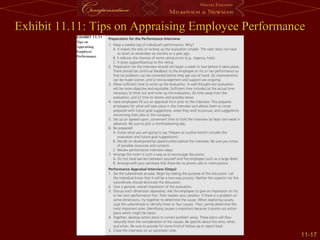
Exhibit 11.11: Tips on Appraising Employee PerformanceExhibit 11.11: Tips on Appraising Employee Performance
11-11-1818
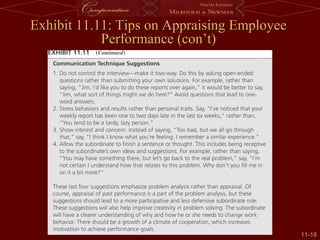
Exhibit 11.11: Tips on Appraising EmployeeExhibit 11.11: Tips on Appraising Employee
Performance (con’t)Performance (con’t)
11-11-1919
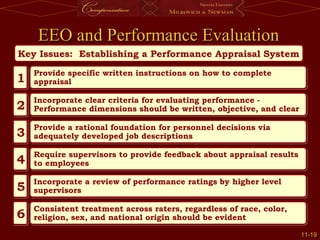
EEO and Performance EvaluationEEO and Performance Evaluation
11 Provide specific written instructions on how to complete
appraisal
Provide specific written instructions on how to complete
appraisal
22
Incorporate clear criteria for evaluating performance -
Performance dimensions should be written, objective, and clear
Incorporate clear criteria for evaluating performance -
Performance dimensions should be written, objective, and clear
33 Provide a rational foundation for personnel decisions via
adequately developed job descriptions
Provide a rational foundation for personnel decisions via
adequately developed job descriptions
44 Require supervisors to provide feedback about appraisal results
to employees
Require supervisors to provide feedback about appraisal results
to employees
55 Incorporate a review of performance ratings by higher level
supervisors
Incorporate a review of performance ratings by higher level
supervisors
66 Consistent treatment across raters, regardless of race, color,
religion, sex, and national origin should be evident
Consistent treatment across raters, regardless of race, color,
religion, sex, and national origin should be evident
Key Issues: Establishing a Performance Appraisal System
11-11-2020
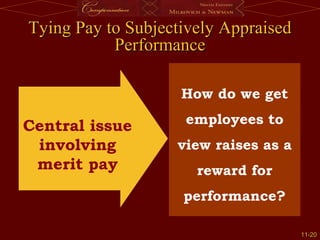
Tying Pay to Subjectively AppraisedTying Pay to Subjectively Appraised
PerformancePerformance
How do we get
employees to
view raises as a
reward for
performance?
Central issue
involving
merit pay
11-11-2121
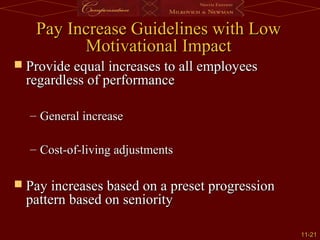
 Provide equal increases to all employeesProvide equal increases to all employees
regardless of performanceregardless of performance
– General increaseGeneral increase
– Cost-of-living adjustmentsCost-of-living adjustments
 Pay increases based on a preset progressionPay increases based on a preset progression
pattern based on senioritypattern based on seniority
Pay Increase Guidelines with LowPay Increase Guidelines with Low
Motivational ImpactMotivational Impact
11-11-2222
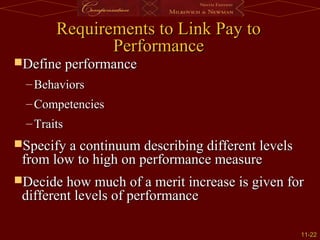
Requirements to Link Pay toRequirements to Link Pay to
PerformancePerformance
Define performanceDefine performance
– BehaviorsBehaviors
– CompetenciesCompetencies
– TraitsTraits
Specify a continuum describing different levelsSpecify a continuum describing different levels
from low to high on performance measurefrom low to high on performance measure
Decide how much of a merit increase is given forDecide how much of a merit increase is given for
different levels of performancedifferent levels of performance
11-11-2323
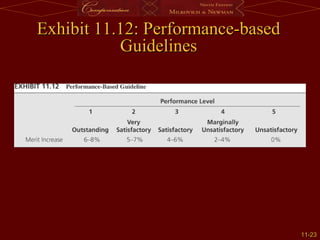
Exhibit 11.12: Performance-basedExhibit 11.12: Performance-based
GuidelinesGuidelines
11-11-2424
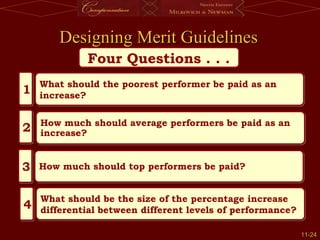
Designing Merit GuidelinesDesigning Merit Guidelines
11 What should the poorest performer be paid as an
increase?
What should the poorest performer be paid as an
increase?
22 How much should average performers be paid as an
increase?
How much should average performers be paid as an
increase?
33 How much should top performers be paid?How much should top performers be paid?
44
What should be the size of the percentage increase
differential between different levels of performance?
What should be the size of the percentage increase
differential between different levels of performance?
Four Questions . . .
11-11-2525
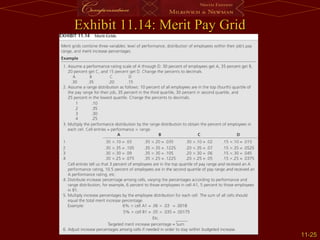
Exhibit 11.14: Merit Pay GridExhibit 11.14: Merit Pay Grid
11-11-2626
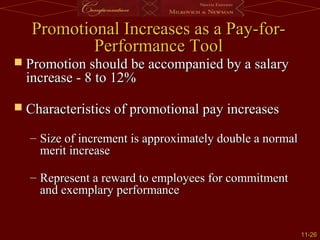
Promotional Increases as a Pay-for-Promotional Increases as a Pay-for-
Performance ToolPerformance Tool
 Promotion should be accompanied by a salaryPromotion should be accompanied by a salary
increase - 8 to 12%increase - 8 to 12%
 Characteristics of promotional pay increasesCharacteristics of promotional pay increases
– Size of increment is approximately double a normalSize of increment is approximately double a normal
merit increasemerit increase
– Represent a reward to employees for commitmentRepresent a reward to employees for commitment
and exemplary performanceand exemplary performance

Chapter 7 performance appraisal

  • 1.
    Milkovich/Newman: Compensation, NinthEditionMilkovich/Newman: Compensation, Ninth Edition McGraw-Hill/IrwinMcGraw-Hill/Irwin Copyright © 2008 by The McGraw-Hill Companies, Inc. All rights reserved.Copyright © 2008 by The McGraw-Hill Companies, Inc. All rights reserved. Chapter 11Chapter 11 PerformancePerformance AppraisalsAppraisals
  • 2.
    11-11-22 Nature of PerformanceAppraisalsNature of Performance Appraisals  You can’t manage what you don’t understandYou can’t manage what you don’t understand  You don’t understand what you don’t measureYou don’t understand what you don’t measure  What gets measured is what gets doneWhat gets measured is what gets done  What gets measured is what gets rewardedWhat gets measured is what gets rewarded  What gets rewarded is what gets repeatedWhat gets rewarded is what gets repeated
  • 3.
    11-11-33 The Role ofPerformance AppraisalsThe Role of Performance Appraisals in Compensation Decisionsin Compensation Decisions  Employees often frustrated about the appraisalEmployees often frustrated about the appraisal processprocess – Appraisals are too subjectiveAppraisals are too subjective – Possibility of unfair treatment by a supervisorPossibility of unfair treatment by a supervisor  Experts argue that rather than throwing out theExperts argue that rather than throwing out the entire performance appraisal process, total-entire performance appraisal process, total- quality-management principles should bequality-management principles should be applied to improving itapplied to improving it – Recognize part of performance influenced more byRecognize part of performance influenced more by work environment and systems than by ee behaviorswork environment and systems than by ee behaviors
  • 4.
    11-11-44 Exhibit 11.1: CommonErrorsExhibit 11.1: Common Errors in the Appraisal Processin the Appraisal Process
  • 5.
    11-11-55 Exhibit 11.2: Ratingsof ManagersExhibit 11.2: Ratings of Managers
  • 6.
    11-11-66 Strategies to BetterUnderstand andStrategies to Better Understand and Measure Job PerformanceMeasure Job Performance  Clearly define job performanceClearly define job performance  Recognize definition of performance and itsRecognize definition of performance and its components is expandingcomponents is expanding  Improve appraisal formatsImprove appraisal formats  Select the right ratersSelect the right raters  Understand way raters process information andUnderstand way raters process information and mistakes that may be mademistakes that may be made  Train raters to improve rating skillsTrain raters to improve rating skills
  • 7.
    11-11-77 Categories of AppraisalFormatsCategories of Appraisal Formats Ranking - Rater compares employees against each other Rating - Rater evaluates employees on some absolute standard (measured on a continuum scale) Essay - Rater answers open- ended questions in essay form describing employee performance Categories
  • 8.
    11-11-88 Ranking FormatsRanking Formats Straight rankingStraight ranking  Alternation rankingAlternation ranking  Paired-comparisonPaired-comparison rankingranking  See Ex. 11.3See Ex. 11.3
  • 9.
    11-11-99 Rating FormatsRating Formats Two common elementsTwo common elements – Raters evaluate employees on some absoluteRaters evaluate employees on some absolute standardstandard – Each standard is measured on a scaleEach standard is measured on a scale -performance variation is described along a-performance variation is described along a continuumcontinuum
  • 10.
    11-11-1010 Rating Formats (cont.)RatingFormats (cont.)  Types of descriptorsTypes of descriptors – AdjectivesAdjectives  Standard rating scale (Ex. 11.4)Standard rating scale (Ex. 11.4) – BehaviorsBehaviors  Behaviorally anchored rating scales (Ex. 11.5)Behaviorally anchored rating scales (Ex. 11.5) – OutcomesOutcomes  Management by objectives (Ex. 11.7, 11.8)Management by objectives (Ex. 11.7, 11.8)
  • 11.
    11-11-1111 Exhibit 11.9: Usageof PerformanceExhibit 11.9: Usage of Performance Evaluation FormatsEvaluation Formats
  • 12.
    11-11-1212 Exhibit 11.10: AnEvaluation of PerformanceExhibit 11.10: An Evaluation of Performance Appraisal FormatsAppraisal Formats
  • 13.
    11-11-1313 Training Raters toRate MoreTraining Raters to Rate More AccuratelyAccurately  Rater-error trainingRater-error training – Goal is to reduce psychometric errors byGoal is to reduce psychometric errors by familiarizing raters with their existencefamiliarizing raters with their existence  Performance-dimension trainingPerformance-dimension training – Exposes supervisors toExposes supervisors to performance dimensions usedperformance dimensions used  Performance-standard trainingPerformance-standard training – Provides raters with a standard orProvides raters with a standard or frame of reference for making appraisalframe of reference for making appraisal
  • 14.
    11-11-1414 Ways to ImproveRater TrainingWays to Improve Rater Training Straightforward lecturing to ratees is ineffectiveStraightforward lecturing to ratees is ineffective Individualized or small group discussions moreIndividualized or small group discussions more effectiveeffective When sessions are combined with extensiveWhen sessions are combined with extensive practice and feedback, rating accuracy improvespractice and feedback, rating accuracy improves Longer training programs are generally moreLonger training programs are generally more successful than shorter programssuccessful than shorter programs Performance-dimension and performance-Performance-dimension and performance- standard training more effective than rater-errorstandard training more effective than rater-error trainingtraining Success results from efforts to reduce halo errorsSuccess results from efforts to reduce halo errors and improve accuracyand improve accuracy
  • 15.
    11-11-1515 Putting it AllTogether: ThePutting it All Together: The Performance Appraisal ProcessPerformance Appraisal Process Need a sound basis for establishing performanceNeed a sound basis for establishing performance appraisal dimensions and scales associated withappraisal dimensions and scales associated with each dimensioneach dimension Need to involve employees in every stage ofNeed to involve employees in every stage of developing performance dimensions anddeveloping performance dimensions and building scalesbuilding scales Need to ensure raters are trained in use ofNeed to ensure raters are trained in use of appraisal system and that all employeesappraisal system and that all employees understand how system operatesunderstand how system operates
  • 16.
    11-11-1616 Putting it AllTogether: ThePutting it All Together: The Performance Appraisal Process (cont.)Performance Appraisal Process (cont.) Need to ensure raters are motivated to rateNeed to ensure raters are motivated to rate accuratelyaccurately Raters should maintain a diary of employeeRaters should maintain a diary of employee performanceperformance Raters should attempt a performance diagnosisRaters should attempt a performance diagnosis to determine if performance problems existto determine if performance problems exist
  • 17.
    11-11-1717 Exhibit 11.11: Tipson Appraising Employee PerformanceExhibit 11.11: Tips on Appraising Employee Performance
  • 18.
    11-11-1818 Exhibit 11.11: Tipson Appraising EmployeeExhibit 11.11: Tips on Appraising Employee Performance (con’t)Performance (con’t)
  • 19.
    11-11-1919 EEO and PerformanceEvaluationEEO and Performance Evaluation 11 Provide specific written instructions on how to complete appraisal Provide specific written instructions on how to complete appraisal 22 Incorporate clear criteria for evaluating performance - Performance dimensions should be written, objective, and clear Incorporate clear criteria for evaluating performance - Performance dimensions should be written, objective, and clear 33 Provide a rational foundation for personnel decisions via adequately developed job descriptions Provide a rational foundation for personnel decisions via adequately developed job descriptions 44 Require supervisors to provide feedback about appraisal results to employees Require supervisors to provide feedback about appraisal results to employees 55 Incorporate a review of performance ratings by higher level supervisors Incorporate a review of performance ratings by higher level supervisors 66 Consistent treatment across raters, regardless of race, color, religion, sex, and national origin should be evident Consistent treatment across raters, regardless of race, color, religion, sex, and national origin should be evident Key Issues: Establishing a Performance Appraisal System
  • 20.
    11-11-2020 Tying Pay toSubjectively AppraisedTying Pay to Subjectively Appraised PerformancePerformance How do we get employees to view raises as a reward for performance? Central issue involving merit pay
  • 21.
    11-11-2121  Provide equalincreases to all employeesProvide equal increases to all employees regardless of performanceregardless of performance – General increaseGeneral increase – Cost-of-living adjustmentsCost-of-living adjustments  Pay increases based on a preset progressionPay increases based on a preset progression pattern based on senioritypattern based on seniority Pay Increase Guidelines with LowPay Increase Guidelines with Low Motivational ImpactMotivational Impact
  • 22.
    11-11-2222 Requirements to LinkPay toRequirements to Link Pay to PerformancePerformance Define performanceDefine performance – BehaviorsBehaviors – CompetenciesCompetencies – TraitsTraits Specify a continuum describing different levelsSpecify a continuum describing different levels from low to high on performance measurefrom low to high on performance measure Decide how much of a merit increase is given forDecide how much of a merit increase is given for different levels of performancedifferent levels of performance
  • 23.
    11-11-2323 Exhibit 11.12: Performance-basedExhibit11.12: Performance-based GuidelinesGuidelines
  • 24.
    11-11-2424 Designing Merit GuidelinesDesigningMerit Guidelines 11 What should the poorest performer be paid as an increase? What should the poorest performer be paid as an increase? 22 How much should average performers be paid as an increase? How much should average performers be paid as an increase? 33 How much should top performers be paid?How much should top performers be paid? 44 What should be the size of the percentage increase differential between different levels of performance? What should be the size of the percentage increase differential between different levels of performance? Four Questions . . .
  • 25.
    11-11-2525 Exhibit 11.14: MeritPay GridExhibit 11.14: Merit Pay Grid
  • 26.
    11-11-2626 Promotional Increases asa Pay-for-Promotional Increases as a Pay-for- Performance ToolPerformance Tool  Promotion should be accompanied by a salaryPromotion should be accompanied by a salary increase - 8 to 12%increase - 8 to 12%  Characteristics of promotional pay increasesCharacteristics of promotional pay increases – Size of increment is approximately double a normalSize of increment is approximately double a normal merit increasemerit increase – Represent a reward to employees for commitmentRepresent a reward to employees for commitment and exemplary performanceand exemplary performance