Performance Appraisal Defined
• Formal system of review and
evaluation of individual or
team task performance
• Often negative, disliked
activity that seems to elude
mastery
Appraisal Data Is Needed For...
• Assessment of current employee performance
– are performance standards being met?
• Training needs
– what does the employee need to learn in order to improve current work
performance?
• Career planning and development
– assessing an employee’s strengths and weaknesses to determine advancement
• Compensation programs
– provides a basis for rational decisions regarding pay adjustments (raises and
bonuses)
• Internal employee relations
– used for decisions in several areas of internal employee relations, including
promotion, demotion, termination, layoff, and transfer (transfers, layoffs,
terminations)
• Recruitment and selection
– generates data to validate selection criteria
• Human resource planning
– assessment data is helpful in building replacement or succession charts
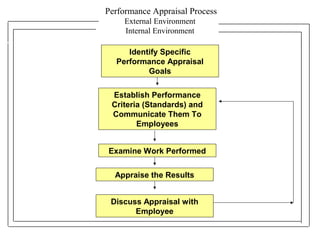
Performance Appraisal Process
External Environment
Internal Environment
Identify Specific
Performance Appraisal
Goals
Establish Performance
Criteria (Standards) and
Communicate Them To
Employees
Examine Work Performed
Appraise the Results
Discuss Appraisal with
Employee
PERFORMANCE APPRAISAL REPONSIBILITY
HUMAN RESOURCE DEPARTMENT
Designs the performance appraisal system
Establishes and monitors a reporting system
Trains managers in how to conduct appraisals
Safeguards performance appraisal records
MANAGERS & SUPERVISORS
Evaluates employee performance
Completes the appraisal documents and forms
Reviews appraisals with employees
WHAT IS THE PURPOSE OF THE
APPRAISAL?
JUDGMENTAL – To make administrative decisions
(To justify rewards given for performance)
DEVELOPMENTAL – To improve performance
(To provide feedback for learning and work improvement)
You cannot accomplish both purposes equally well with a single
appraisal system. Some appraisal tools are better at generating good
feedback than providing a consistent rationale for a judgment.
Similarly, negative feedback generated by judgmental appraisals is
unlikely to motivate the employee to work harder to improve
performance. If both appraisal objectives are important, separate
assessment systems should be created.
HOW OFTEN SHOULD APPRAISALS BE DONE?
• ANNUALLY (Once a year)
• SEMI-ANNUALLY (every 6 months)
• QUARTERLY (every 3 months)
• MONTHLY
• CONTINUOUSLY
WHEN SHOULD APPRAISALS BE DONE?
DO ALL THE APPRAISALS AT ONE TIME
A lot of work to do at one time..overworks the supervisor
All appraisals cover the same time period
DO EACH ONE ON THE EMPLOYEE’S “ANNIVERSARY”
The appraisal process is spread over the whole year
Appraisals are not comparable…they don’t cover the same time period
WHO SHOULD CONDUCT THE APPRAISAL?
• IMMEDIATE SUPERVISOR
• SUBORDINATES
• COWORKERS (Peers)
• OUTSIDERS
– Customers
– Constituents
– Consultants
• SELF-APPRAISAL
• GROUPS or TEAMS
360 degree appraisal – from above & below; insiders & outsiders
720 degree appraisal – a second layer above and below
AN APPRAISER MUST:
• BE AWARE OF THE OBJECTIVES & REQUIREMENTS OF
THE EMPLOYEE’S JOB
• HAVE THE OPPORTUNITY TO FREQUENTLY OBSERVE
THE EMPLOYEE OR HIS/HER WORK
• BE CAPABLE OF EVALUATING AND RECORDING
OBSERVED WORK BEHAVIOR OR PERFORMANCE
• AVOID OR MINIMIZE POTENTIAL APPRAISAL ERRORS
AND BIAS
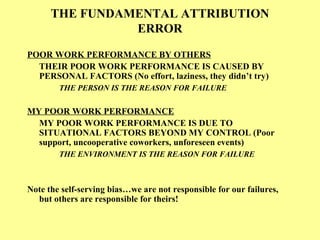
THE FUNDAMENTAL ATTRIBUTION
ERROR
POOR WORK PERFORMANCE BY OTHERS
THEIR POOR WORK PERFORMANCE IS CAUSED BY
PERSONAL FACTORS (No effort, laziness, they didn’t try)
THE PERSON IS THE REASON FOR FAILURE
MY POOR WORK PERFORMANCE
MY POOR WORK PERFORMANCE IS DUE TO
SITUATIONAL FACTORS BEYOND MY CONTROL (Poor
support, uncooperative coworkers, unforeseen events)
THE ENVIRONMENT IS THE REASON FOR FAILURE
Note the self-serving bias…we are not responsible for our failures,
but others are responsible for theirs!
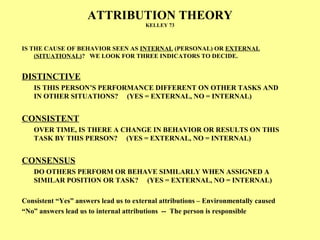
ATTRIBUTION THEORY
KELLEY 73
IS THE CAUSE OF BEHAVIOR SEEN AS INTERNAL (PERSONAL) OR EXTERNAL
(SITUATIONAL)? WE LOOK FOR THREE INDICATORS TO DECIDE.
DISTINCTIVE
IS THIS PERSON’S PERFORMANCE DIFFERENT ON OTHER TASKS AND
IN OTHER SITUATIONS? (YES = EXTERNAL, NO = INTERNAL)
CONSISTENT
OVER TIME, IS THERE A CHANGE IN BEHAVIOR OR RESULTS ON THIS
TASK BY THIS PERSON? (YES = EXTERNAL, NO = INTERNAL)
CONSENSUS
DO OTHERS PERFORM OR BEHAVE SIMILARLY WHEN ASSIGNED A
SIMILAR POSITION OR TASK? (YES = EXTERNAL, NO = INTERNAL)
Consistent “Yes” answers lead us to external attributions – Environmentally caused
“No” answers lead us to internal attributions -- The person is responsible
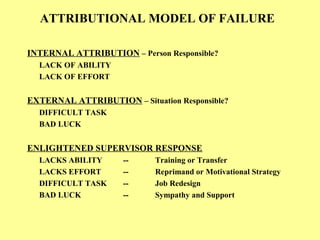
ATTRIBUTIONAL MODEL OF FAILURE
INTERNAL ATTRIBUTION – Person Responsible?
LACK OF ABILITY
LACK OF EFFORT
EXTERNAL ATTRIBUTION – Situation Responsible?
DIFFICULT TASK
BAD LUCK
ENLIGHTENED SUPERVISOR RESPONSE
LACKS ABILITY -- Training or Transfer
LACKS EFFORT -- Reprimand or Motivational Strategy
DIFFICULT TASK -- Job Redesign
BAD LUCK -- Sympathy and Support
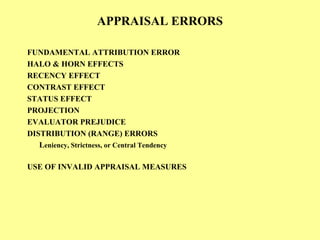
APPRAISAL ERRORS
FUNDAMENTAL ATTRIBUTION ERROR
HALO & HORN EFFECTS
RECENCY EFFECT
CONTRAST EFFECT
STATUS EFFECT
PROJECTION
EVALUATOR PREJUDICE
DISTRIBUTION (RANGE) ERRORS
Leniency, Strictness, or Central Tendency
USE OF INVALID APPRAISAL MEASURES
Problems in Performance Appraisal
• Appraiser discomfort
• Lack of objectivity
• Halo/horn error
• Leniency/strictness
• Central tendency
• Recent behavior bias
• Personal bias
• Manipulating the evaluation
• Employee anxiety
Appraiser Discomfort
• Performance
appraisal process cuts
into manager’s time
• Experience can be
unpleasant when
employee has not
performed well
Lack of Objectivity
• In rating scales method, commonly used
factors such as attitude, appearance, and
personality are difficult to measure
• Factors may have little to do with
employee’s job performance
• Employee appraisal based primarily on
personal characteristics may place
evaluator and company in untenable
positions
Halo/Horn Error
• Halo error - Occurs when manager
generalizes one positive performance
feature or incident to all aspects of
employee performance resulting in higher
rating
• Horn error - Evaluation error occurs when
manager generalizes one negative
performance feature or incident to all
aspects of employee performance resulting
in lower rating
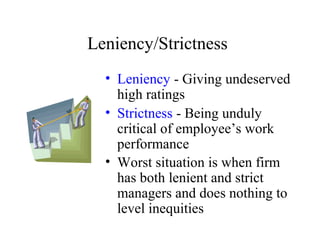
Leniency/Strictness
• Leniency - Giving undeserved
high ratings
• Strictness - Being unduly
critical of employee’s work
performance
• Worst situation is when firm
has both lenient and strict
managers and does nothing to
level inequities
Central Tendency
• Error occurs when employees are
incorrectly rated near average or middle of
scale
• May be encouraged by some rating scale
systems requiring evaluator to justify in
writing extremely high or extremely low
ratings
Recent Behavior Bias
• Employee’s behavior often improves and
productivity tends to rise several days or
weeks before scheduled evaluation
• Only natural for rater to remember recent
behavior more clearly than actions from
more distant past
• Maintaining records of performance
Personal Bias (Stereotyping)
• Managers allow individual differences such
as gender, race or age to affect ratings they
give
• Effects of cultural bias, or stereotyping, can
influence appraisals
• Other factors – Example: mild-mannered
employees may be appraised more harshly
simply because they do not seriously object
to results
Manipulating the Evaluation
• Sometimes, managers control virtually
every aspect of appraisal process and are in
position to manipulate system
• Example: Want to give pay raise to certain
employee. Supervisor may give employee a
undeserved high performance evaluation
Employee Anxiety
• Evaluation process may
create anxiety for
appraised employee
• Opportunities for
promotion, better work
assignments, and increased
compensation may hinge
on results
Reasons for Intentionally Inflating
Ratings
• Believe accurate ratings would damage subordinate’s
motivation and performance.
• Improve employee’s eligibility for merit raises.
• Avoid airing department’s “dirty laundry.”
• Avoid creating negative permanent record that might haunt
employee in future.
• Protect good workers whose performance suffered because of
personal problems.
• Reward employees displaying great effort even when results
were relatively low.
• Avoid confrontation with hard-to-manage employees.
• Promote a poor or disliked employee up and out of
department.
Reasons for Intentionally Lowering
Ratings
• Scare better performance out of employee.
• Punish difficult or rebellious employee.
• Encourage problem employee to quit.
• Create strong record to justify planned firing.
• Minimize amount of merit increase a subordinate
receives.
• Comply with organizational edict that discourages
managers from giving high ratings.
Establishing Performance Criteria
(Standards)
• Traits
• Behaviors
• Competencies
• Goal Achievement
• Improvement Potential
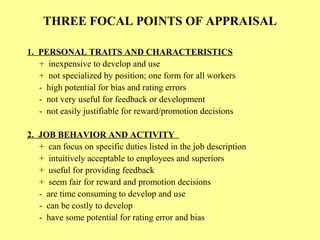
THREE FOCAL POINTS OF APPRAISAL
1. PERSONAL TRAITS AND CHARACTERISTICS
+ inexpensive to develop and use
+ not specialized by position; one form for all workers
- high potential for bias and rating errors
- not very useful for feedback or development
- not easily justifiable for reward/promotion decisions
2. JOB BEHAVIOR AND ACTIVITY
+ can focus on specific duties listed in the job description
+ intuitively acceptable to employees and superiors
+ useful for providing feedback
+ seem fair for reward and promotion decisions
- are time consuming to develop and use
- can be costly to develop
- have some potential for rating error and bias
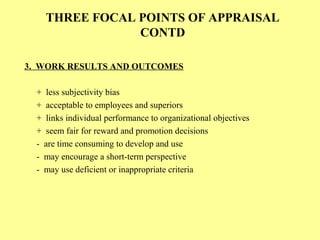
THREE FOCAL POINTS OF APPRAISAL
CONTD
3. WORK RESULTS AND OUTCOMES
+ less subjectivity bias
+ acceptable to employees and superiors
+ links individual performance to organizational objectives
+ seem fair for reward and promotion decisions
- are time consuming to develop and use
- may encourage a short-term perspective
- may use deficient or inappropriate criteria
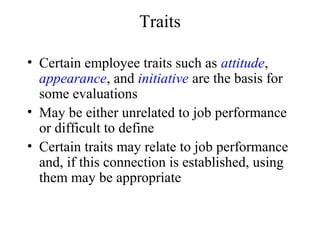
Traits
• Certain employee traits such as attitude,
appearance, and initiative are the basis for
some evaluations
• May be either unrelated to job performance
or difficult to define
• Certain traits may relate to job performance
and, if this connection is established, using
them may be appropriate
Caution on Traits: Wade v. Mississippi
Cooperative Extension Service
• In a performance appraisal system, general
characteristics such as “leadership, public
acceptance, attitude toward people, appearance
and grooming, personal conduct, outlook on life,
ethical habits, resourcefulness, capacity for
growth, mental alertness, loyalty to organization”
are susceptible to partiality and to the personal
taste, whim, or fancy of the evaluator” as well as
“patently subjective in form and obviously
susceptible to completely subjective treatment” by
those conducting the appraisals.
APPRAISAL METHODS
NARRATIVES
ESSAYS
CRITICAL INCIDENTS
RANKING COMPARISONS
ALTERNATION
PAIRED COMPARISONS
CHECKLISTS
SIMPLE
WEIGHTED
RATING SCALES
GRAPHIC RATING SCALES
BEHAVIORALLY ANCHORED RATING SCALES (BARS)
BEHAVIORAL OBSERVATION SCALES (BOS)
OBJECTIVE MEASURES
NATURAL COUNTS (Quantity produced, etc)
GOALSETTING STANDARDS (MBO, etc)
MANAGEMENT BY OBJECTIVES
BENEFITS
A basis for effective organizational planning and control
Improves communication and feedback with the supervisor
Encourages participation and joint decision-making
Facilitates role clarification by revealing assessment criteria
PROBLEMS
Are the really important (key) areas of the job included?
Is the process participative or are goals “set” for the worker?
Can the worker truly control the outcomes s/he achieves?
Overemphasizes quantitative, short-term, individual objectives
GOALSETTING ISSUES
GOAL DIFFICULTY
How challenging should the work objectives be? I want an easy
goal, but the organization wants me to “stretch.”
ACCEPTANCE
Will workers feel committed to work toward objectives that have
been assigned to them, rather than those set participatively?
SPECIFICITY
Precise quantitative indicators may not exist for critical elements
of the job. General, open-ended goals are not easily assessed.
MOTIVATION
Objectives should be challenging, yet reachable. They also need to
be linked to desirable rewards to successfully motivate workers.
Conducting the Performance Review
• A special time should be set for formal
discussion of employee’s performance
• Withholding appraisal results is absurd
• Performance review allows them to detect
any errors or omissions in appraisal, or
employee may simply disagree with
evaluation and want to challenge it
Due Process
• Provide employees
opportunity to appeal
appraisal results
• Must have procedure
for pursuing
grievances and having
them addressed
objectively
Legal Implications
• Employers must prepare for
more discrimination lawsuits
and jury trials related to
performance appraisals
• Unlikely that any appraisal
system will be immune to
legal challenge
Courts Normally Require
• Either absence of adverse impact on members of
protected classes or validation of process.
• System that prevents one manager from directing or
controlling a subordinate’s career.
• Appraisal should be reviewed and approved by
someone or some group in organization.
• Rater, or raters, must have personal knowledge of
employee’s job performance.
• Must use predetermined criteria that limits manager’s
discretion.
The Appraisal Interview
• Achilles’ heel of entire evaluation process
• Scheduling interview
• Interview structure
• Use of praise and criticism
• Employees’ role
• Use of software
• Concluding interview
Interview Structure
• Discuss employee’s performance
• Assist employee in setting goals and
personal development plans for next
appraisal period
• Suggesting means for achieving established
goals, including support from manager and
firm
Conducting Separate Interviews
• There is merit in conducting
separate interviews for
discussing (1) employee
performance and development
and (2) pay
• When the topic of pay emerges
in interview, it tends to dominate
conversation with performance
improvement taking a back seat
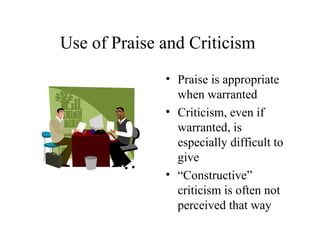
Use of Praise and Criticism
• Praise is appropriate
when warranted
• Criticism, even if
warranted, is
especially difficult to
give
• “Constructive”
criticism is often not
perceived that way
Employees’ Role
• Should go through diary or
files and make notes of
every project worked on,
regardless of whether they
were successful or not
• Information should be on
appraising manager’s desk
well before review
Concluding the Interview
• Ideally, employees will leave interview with
positive feelings about management,
company, job, and themselves
• Cannot change past behavior, future
performance is another matter
• Should end with specific and mutually
agreed upon plans for employee’s
development
SUMMARY GUIDELINES FOR APPRAISALS
1. Appraisal standards are job related -- based on job analysis
2. Standards are clearly communicated to employees in advance
3. Standards are responsive to actual worker behavior or effort
4. Activities performed and results achieved are both appraised
5. Acceptable vs. unacceptable results can clearly be discerned
6. Appraisal criteria are consistently applied
7. Raters are able to consistently observe work performance
8. Raters are trained in appraisal and how to feedback results
9. Developmental feedback is separated from judgmental appraisal
10. An appeal process exists to resolve (judgmental) rating disputes

Performance Apraisal

  • 1.
    Performance Appraisal Defined •Formal system of review and evaluation of individual or team task performance • Often negative, disliked activity that seems to elude mastery
  • 2.
    Appraisal Data IsNeeded For... • Assessment of current employee performance – are performance standards being met? • Training needs – what does the employee need to learn in order to improve current work performance? • Career planning and development – assessing an employee’s strengths and weaknesses to determine advancement • Compensation programs – provides a basis for rational decisions regarding pay adjustments (raises and bonuses) • Internal employee relations – used for decisions in several areas of internal employee relations, including promotion, demotion, termination, layoff, and transfer (transfers, layoffs, terminations) • Recruitment and selection – generates data to validate selection criteria • Human resource planning – assessment data is helpful in building replacement or succession charts
  • 3.
    Performance Appraisal Process ExternalEnvironment Internal Environment Identify Specific Performance Appraisal Goals Establish Performance Criteria (Standards) and Communicate Them To Employees Examine Work Performed Appraise the Results Discuss Appraisal with Employee
  • 4.
    PERFORMANCE APPRAISAL REPONSIBILITY HUMANRESOURCE DEPARTMENT Designs the performance appraisal system Establishes and monitors a reporting system Trains managers in how to conduct appraisals Safeguards performance appraisal records MANAGERS & SUPERVISORS Evaluates employee performance Completes the appraisal documents and forms Reviews appraisals with employees
  • 5.
    WHAT IS THEPURPOSE OF THE APPRAISAL? JUDGMENTAL – To make administrative decisions (To justify rewards given for performance) DEVELOPMENTAL – To improve performance (To provide feedback for learning and work improvement) You cannot accomplish both purposes equally well with a single appraisal system. Some appraisal tools are better at generating good feedback than providing a consistent rationale for a judgment. Similarly, negative feedback generated by judgmental appraisals is unlikely to motivate the employee to work harder to improve performance. If both appraisal objectives are important, separate assessment systems should be created.
  • 6.
    HOW OFTEN SHOULDAPPRAISALS BE DONE? • ANNUALLY (Once a year) • SEMI-ANNUALLY (every 6 months) • QUARTERLY (every 3 months) • MONTHLY • CONTINUOUSLY WHEN SHOULD APPRAISALS BE DONE? DO ALL THE APPRAISALS AT ONE TIME A lot of work to do at one time..overworks the supervisor All appraisals cover the same time period DO EACH ONE ON THE EMPLOYEE’S “ANNIVERSARY” The appraisal process is spread over the whole year Appraisals are not comparable…they don’t cover the same time period
  • 7.
    WHO SHOULD CONDUCTTHE APPRAISAL? • IMMEDIATE SUPERVISOR • SUBORDINATES • COWORKERS (Peers) • OUTSIDERS – Customers – Constituents – Consultants • SELF-APPRAISAL • GROUPS or TEAMS 360 degree appraisal – from above & below; insiders & outsiders 720 degree appraisal – a second layer above and below
  • 8.
    AN APPRAISER MUST: •BE AWARE OF THE OBJECTIVES & REQUIREMENTS OF THE EMPLOYEE’S JOB • HAVE THE OPPORTUNITY TO FREQUENTLY OBSERVE THE EMPLOYEE OR HIS/HER WORK • BE CAPABLE OF EVALUATING AND RECORDING OBSERVED WORK BEHAVIOR OR PERFORMANCE • AVOID OR MINIMIZE POTENTIAL APPRAISAL ERRORS AND BIAS
  • 9.
    THE FUNDAMENTAL ATTRIBUTION ERROR POORWORK PERFORMANCE BY OTHERS THEIR POOR WORK PERFORMANCE IS CAUSED BY PERSONAL FACTORS (No effort, laziness, they didn’t try) THE PERSON IS THE REASON FOR FAILURE MY POOR WORK PERFORMANCE MY POOR WORK PERFORMANCE IS DUE TO SITUATIONAL FACTORS BEYOND MY CONTROL (Poor support, uncooperative coworkers, unforeseen events) THE ENVIRONMENT IS THE REASON FOR FAILURE Note the self-serving bias…we are not responsible for our failures, but others are responsible for theirs!
  • 10.
    ATTRIBUTION THEORY KELLEY 73 ISTHE CAUSE OF BEHAVIOR SEEN AS INTERNAL (PERSONAL) OR EXTERNAL (SITUATIONAL)? WE LOOK FOR THREE INDICATORS TO DECIDE. DISTINCTIVE IS THIS PERSON’S PERFORMANCE DIFFERENT ON OTHER TASKS AND IN OTHER SITUATIONS? (YES = EXTERNAL, NO = INTERNAL) CONSISTENT OVER TIME, IS THERE A CHANGE IN BEHAVIOR OR RESULTS ON THIS TASK BY THIS PERSON? (YES = EXTERNAL, NO = INTERNAL) CONSENSUS DO OTHERS PERFORM OR BEHAVE SIMILARLY WHEN ASSIGNED A SIMILAR POSITION OR TASK? (YES = EXTERNAL, NO = INTERNAL) Consistent “Yes” answers lead us to external attributions – Environmentally caused “No” answers lead us to internal attributions -- The person is responsible
  • 11.
    ATTRIBUTIONAL MODEL OFFAILURE INTERNAL ATTRIBUTION – Person Responsible? LACK OF ABILITY LACK OF EFFORT EXTERNAL ATTRIBUTION – Situation Responsible? DIFFICULT TASK BAD LUCK ENLIGHTENED SUPERVISOR RESPONSE LACKS ABILITY -- Training or Transfer LACKS EFFORT -- Reprimand or Motivational Strategy DIFFICULT TASK -- Job Redesign BAD LUCK -- Sympathy and Support
  • 12.
    APPRAISAL ERRORS FUNDAMENTAL ATTRIBUTIONERROR HALO & HORN EFFECTS RECENCY EFFECT CONTRAST EFFECT STATUS EFFECT PROJECTION EVALUATOR PREJUDICE DISTRIBUTION (RANGE) ERRORS Leniency, Strictness, or Central Tendency USE OF INVALID APPRAISAL MEASURES
  • 13.
    Problems in PerformanceAppraisal • Appraiser discomfort • Lack of objectivity • Halo/horn error • Leniency/strictness • Central tendency • Recent behavior bias • Personal bias • Manipulating the evaluation • Employee anxiety
  • 14.
    Appraiser Discomfort • Performance appraisalprocess cuts into manager’s time • Experience can be unpleasant when employee has not performed well
  • 15.
    Lack of Objectivity •In rating scales method, commonly used factors such as attitude, appearance, and personality are difficult to measure • Factors may have little to do with employee’s job performance • Employee appraisal based primarily on personal characteristics may place evaluator and company in untenable positions
  • 16.
    Halo/Horn Error • Haloerror - Occurs when manager generalizes one positive performance feature or incident to all aspects of employee performance resulting in higher rating • Horn error - Evaluation error occurs when manager generalizes one negative performance feature or incident to all aspects of employee performance resulting in lower rating
  • 17.
    Leniency/Strictness • Leniency -Giving undeserved high ratings • Strictness - Being unduly critical of employee’s work performance • Worst situation is when firm has both lenient and strict managers and does nothing to level inequities
  • 18.
    Central Tendency • Erroroccurs when employees are incorrectly rated near average or middle of scale • May be encouraged by some rating scale systems requiring evaluator to justify in writing extremely high or extremely low ratings
  • 19.
    Recent Behavior Bias •Employee’s behavior often improves and productivity tends to rise several days or weeks before scheduled evaluation • Only natural for rater to remember recent behavior more clearly than actions from more distant past • Maintaining records of performance
  • 20.
    Personal Bias (Stereotyping) •Managers allow individual differences such as gender, race or age to affect ratings they give • Effects of cultural bias, or stereotyping, can influence appraisals • Other factors – Example: mild-mannered employees may be appraised more harshly simply because they do not seriously object to results
  • 21.
    Manipulating the Evaluation •Sometimes, managers control virtually every aspect of appraisal process and are in position to manipulate system • Example: Want to give pay raise to certain employee. Supervisor may give employee a undeserved high performance evaluation
  • 22.
    Employee Anxiety • Evaluationprocess may create anxiety for appraised employee • Opportunities for promotion, better work assignments, and increased compensation may hinge on results
  • 23.
    Reasons for IntentionallyInflating Ratings • Believe accurate ratings would damage subordinate’s motivation and performance. • Improve employee’s eligibility for merit raises. • Avoid airing department’s “dirty laundry.” • Avoid creating negative permanent record that might haunt employee in future. • Protect good workers whose performance suffered because of personal problems. • Reward employees displaying great effort even when results were relatively low. • Avoid confrontation with hard-to-manage employees. • Promote a poor or disliked employee up and out of department.
  • 24.
    Reasons for IntentionallyLowering Ratings • Scare better performance out of employee. • Punish difficult or rebellious employee. • Encourage problem employee to quit. • Create strong record to justify planned firing. • Minimize amount of merit increase a subordinate receives. • Comply with organizational edict that discourages managers from giving high ratings.
  • 25.
    Establishing Performance Criteria (Standards) •Traits • Behaviors • Competencies • Goal Achievement • Improvement Potential
  • 26.
    THREE FOCAL POINTSOF APPRAISAL 1. PERSONAL TRAITS AND CHARACTERISTICS + inexpensive to develop and use + not specialized by position; one form for all workers - high potential for bias and rating errors - not very useful for feedback or development - not easily justifiable for reward/promotion decisions 2. JOB BEHAVIOR AND ACTIVITY + can focus on specific duties listed in the job description + intuitively acceptable to employees and superiors + useful for providing feedback + seem fair for reward and promotion decisions - are time consuming to develop and use - can be costly to develop - have some potential for rating error and bias
  • 27.
    THREE FOCAL POINTSOF APPRAISAL CONTD 3. WORK RESULTS AND OUTCOMES + less subjectivity bias + acceptable to employees and superiors + links individual performance to organizational objectives + seem fair for reward and promotion decisions - are time consuming to develop and use - may encourage a short-term perspective - may use deficient or inappropriate criteria
  • 28.
    Traits • Certain employeetraits such as attitude, appearance, and initiative are the basis for some evaluations • May be either unrelated to job performance or difficult to define • Certain traits may relate to job performance and, if this connection is established, using them may be appropriate
  • 29.
    Caution on Traits:Wade v. Mississippi Cooperative Extension Service • In a performance appraisal system, general characteristics such as “leadership, public acceptance, attitude toward people, appearance and grooming, personal conduct, outlook on life, ethical habits, resourcefulness, capacity for growth, mental alertness, loyalty to organization” are susceptible to partiality and to the personal taste, whim, or fancy of the evaluator” as well as “patently subjective in form and obviously susceptible to completely subjective treatment” by those conducting the appraisals.
  • 30.
    APPRAISAL METHODS NARRATIVES ESSAYS CRITICAL INCIDENTS RANKINGCOMPARISONS ALTERNATION PAIRED COMPARISONS CHECKLISTS SIMPLE WEIGHTED RATING SCALES GRAPHIC RATING SCALES BEHAVIORALLY ANCHORED RATING SCALES (BARS) BEHAVIORAL OBSERVATION SCALES (BOS) OBJECTIVE MEASURES NATURAL COUNTS (Quantity produced, etc) GOALSETTING STANDARDS (MBO, etc)
  • 31.
    MANAGEMENT BY OBJECTIVES BENEFITS Abasis for effective organizational planning and control Improves communication and feedback with the supervisor Encourages participation and joint decision-making Facilitates role clarification by revealing assessment criteria PROBLEMS Are the really important (key) areas of the job included? Is the process participative or are goals “set” for the worker? Can the worker truly control the outcomes s/he achieves? Overemphasizes quantitative, short-term, individual objectives
  • 32.
    GOALSETTING ISSUES GOAL DIFFICULTY Howchallenging should the work objectives be? I want an easy goal, but the organization wants me to “stretch.” ACCEPTANCE Will workers feel committed to work toward objectives that have been assigned to them, rather than those set participatively? SPECIFICITY Precise quantitative indicators may not exist for critical elements of the job. General, open-ended goals are not easily assessed. MOTIVATION Objectives should be challenging, yet reachable. They also need to be linked to desirable rewards to successfully motivate workers.
  • 33.
    Conducting the PerformanceReview • A special time should be set for formal discussion of employee’s performance • Withholding appraisal results is absurd • Performance review allows them to detect any errors or omissions in appraisal, or employee may simply disagree with evaluation and want to challenge it
  • 34.
    Due Process • Provideemployees opportunity to appeal appraisal results • Must have procedure for pursuing grievances and having them addressed objectively
  • 35.
    Legal Implications • Employersmust prepare for more discrimination lawsuits and jury trials related to performance appraisals • Unlikely that any appraisal system will be immune to legal challenge
  • 36.
    Courts Normally Require •Either absence of adverse impact on members of protected classes or validation of process. • System that prevents one manager from directing or controlling a subordinate’s career. • Appraisal should be reviewed and approved by someone or some group in organization. • Rater, or raters, must have personal knowledge of employee’s job performance. • Must use predetermined criteria that limits manager’s discretion.
  • 37.
    The Appraisal Interview •Achilles’ heel of entire evaluation process • Scheduling interview • Interview structure • Use of praise and criticism • Employees’ role • Use of software • Concluding interview
  • 38.
    Interview Structure • Discussemployee’s performance • Assist employee in setting goals and personal development plans for next appraisal period • Suggesting means for achieving established goals, including support from manager and firm
  • 39.
    Conducting Separate Interviews •There is merit in conducting separate interviews for discussing (1) employee performance and development and (2) pay • When the topic of pay emerges in interview, it tends to dominate conversation with performance improvement taking a back seat
  • 40.
    Use of Praiseand Criticism • Praise is appropriate when warranted • Criticism, even if warranted, is especially difficult to give • “Constructive” criticism is often not perceived that way
  • 41.
    Employees’ Role • Shouldgo through diary or files and make notes of every project worked on, regardless of whether they were successful or not • Information should be on appraising manager’s desk well before review
  • 42.
    Concluding the Interview •Ideally, employees will leave interview with positive feelings about management, company, job, and themselves • Cannot change past behavior, future performance is another matter • Should end with specific and mutually agreed upon plans for employee’s development
  • 43.
    SUMMARY GUIDELINES FORAPPRAISALS 1. Appraisal standards are job related -- based on job analysis 2. Standards are clearly communicated to employees in advance 3. Standards are responsive to actual worker behavior or effort 4. Activities performed and results achieved are both appraised 5. Acceptable vs. unacceptable results can clearly be discerned 6. Appraisal criteria are consistently applied 7. Raters are able to consistently observe work performance 8. Raters are trained in appraisal and how to feedback results 9. Developmental feedback is separated from judgmental appraisal 10. An appeal process exists to resolve (judgmental) rating disputes