






Business
Psychology
Recruitment
and Selection
Learning Objectives
 Define: Recruitment and Selection
 Primary Purpose
 Stages of Employment
 Internal and External Recruiting
 Selection Process
 Basic Selection Criteria
 Five Selection Standard
 Techniques for Selection
 Job Analysis
 Assembling Staff
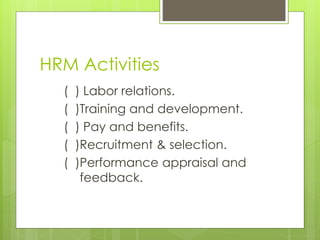
HRM Activities
( ) Labor relations.
( )Training and development.
( ) Pay and benefits.
( )Recruitment & selection.
( )Performance appraisal and
feedback.
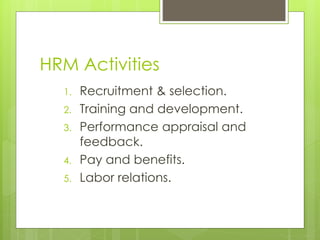
HRM Activities
1. Recruitment & selection.
2. Training and development.
3. Performance appraisal and
feedback.
4. Pay and benefits.
5. Labor relations.
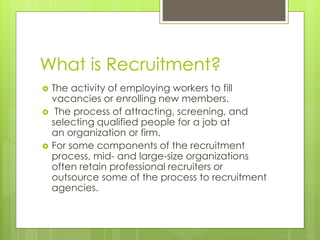
What is Recruitment?
 The activity of employing workers to fill
vacancies or enrolling new members.
 The process of attracting, screening, and
selecting qualified people for a job at
an organization or firm.
 For some components of the recruitment
process, mid- and large-size organizations
often retain professional recruiters or
outsource some of the process to recruitment
agencies.
What is Recruitment?
 The practice or activities carried on by the
organization with the primary purpose of
identifying and attracting potential
employees.
What is Recruitment?
 Is concerned with reaching out and
attracting a supply of people from which
to select qualified candidates for job
vacancies.
 Recruitment a positive function of which
its negative counterpart is known under
the term Selection. Recruitment finds
workers and makes use of those available,
seeks to gather without any
discrimination. Selection on the other
hand, picks and chooses among them
those that are likely to be productive and
therefore able to contribute their worth to
the organization.
Recruitment and Selection
 Recruitment and selection refers to the chain and
sequence of activities pertaining to recruitment
and selection of employable candidates and job
seekers for an organization.
 Every enterprise, business, start-up and
entrepreneurial firm has some well-defined
employment and recruitment policies and hiring
procedures.
 The human resources department of large
organizations, businesses, government offices and
multilateral organizations are generally vested with
the responsibilities of employee recruitment and
selection.
Primary Purpose
 To find the most competent applicants.
 To choose the individuals who are best
qualified for employment.
 To place them in jobs for which their
talents, skills, training and experience best
suit them.
Stages of Employment
Recruitment
 Verifying that a vacancy exists.
 Drawing up a job specification.
 Finding candidates, selecting them by
interviewing and other means such as
conducting a psychometric test.
 Making a job offer.
Recruiting individuals to fill
particular posts within a business
can be done either by:
 Internal Recruiting
 External Recruiting
Methods for internal recruiting
 Job Posting
 Supervisory Recommendation
 Union Halls
Methods for external recruiting
 General Labor Pool
 Referral
 Direct Applicants
What is Selection?
 Consists of the processes involved in
choosing from applicants a suitable
candidate to fill a post.
Selection Process
 Concerned with identifying the best
candidate or candidates for jobs from
among the pool of qualified applicants
developed during the recruiting process.
Selection Process
 Two (2) Selection Errors
 False Positive
 False Negative
Basic Selection Criteria
 Education
 Skills and Abilities
 Experience
Five Selection Standards
 Reliability
 Validity
 Generalizability
 Utility
 Legality
Techniques for Selection
 Studying the Different Jobs in the
Company and Writing the Job Description
and Specification.
Techniques for Selection
 The exact nature of the work in the
vacant position.
 Its duties and responsibilities
 The requirements of the job, such as
mental effort, skill and physical demands.
Techniques for Selection
 Job Description
 A description of the duties and
responsibilities attached to the jobs enables
the employment officer to determine the
special qualifications which an individual
must possess in order to the job successfully.
Techniques for Selection
 Job Specifications
 Amount and type of experience needed to
perform the job, special training on the job
and jobs related to it, special abilities and
aptitudes, age, physical qualifications, and
other requirements.
 Explore the possible services for recruiting
personnel.
Techniques for Selection
 Information Sheet and Personal Data
 To be filled out by an applicant is another aid
to better selection and placement of the new
employees.
 Serves as a beginning by providing a
permanent record of specific data on the
prospective employee as to age, height,
experience, educational qualification etc.
that should be placed in a particular position.
 Today business people recognize the need
for keeping some kind of personnel file of the
employees.
Techniques for Selection
 Psychological Testing
 Business organization employ psychologist whose
job is to conduct psychological tests .Companies
have seen the values of psychological, testing and
have setup some methods of appraising the traits
and abilities of the more promising job applicants.
 Some jobs require traits which can be test the most
readily appraised by the psychological testing
devices for measuring such abilities, mechanical
aptitudes, intelligence, and personality.
Values of Psychological
Testing (Selection Technique)
 It aids in weeding out those individuals not
fit to perform certain jobs.
 It often reveals hidden talent and will
show the range of capacities and
abilities, providing valuable information for
the employee’s permanent file.
 The presence of an active presence of an
active testing center creates respect for
the company, and it may even act as a
pre selection device.
Beach and Clark
 Emphasizes however that if a testing
program is to be effective. The test must
be administered and its results must be
valid and reliable.
 Also, the test must be administered and its
result must be interpreted by someone
professionally trained in that field.
Job Analysis
 Defines the labor needs of an
organization and indicates the problems
of recruitment and selection.
Contents of Job Analysis
a. Job Identification
b. Location of the job
c. Equipment
d. Description of the kind of work the
employee performs and the reason why.
e. Responsibilities for decisions
f. Authorities exercised
g. Physical and mental effort
h. Description of the working environment
i. Identity of employee
j. Name of the Job analyst
Assembling Staff
 A major task of organizing related to the
assembling of a staff to work in the
organization is charged with the
primordial responsibility to carry out the
plans of an enterprise.
Multimedia
Images
Pictures
Recruitment and Selection
Strategies
What is the real cost of a
bad hire?
The End
Chapter 7

Chapter 7 business psychology

  • 1.
  • 2.
  • 3.
    Learning Objectives  Define:Recruitment and Selection  Primary Purpose  Stages of Employment  Internal and External Recruiting  Selection Process  Basic Selection Criteria  Five Selection Standard  Techniques for Selection  Job Analysis  Assembling Staff
  • 4.
    HRM Activities ( )Labor relations. ( )Training and development. ( ) Pay and benefits. ( )Recruitment & selection. ( )Performance appraisal and feedback.
  • 5.
    HRM Activities 1. Recruitment& selection. 2. Training and development. 3. Performance appraisal and feedback. 4. Pay and benefits. 5. Labor relations.
  • 6.
    What is Recruitment? The activity of employing workers to fill vacancies or enrolling new members.  The process of attracting, screening, and selecting qualified people for a job at an organization or firm.  For some components of the recruitment process, mid- and large-size organizations often retain professional recruiters or outsource some of the process to recruitment agencies.
  • 7.
    What is Recruitment? The practice or activities carried on by the organization with the primary purpose of identifying and attracting potential employees.
  • 8.
    What is Recruitment? Is concerned with reaching out and attracting a supply of people from which to select qualified candidates for job vacancies.
  • 9.
     Recruitment apositive function of which its negative counterpart is known under the term Selection. Recruitment finds workers and makes use of those available, seeks to gather without any discrimination. Selection on the other hand, picks and chooses among them those that are likely to be productive and therefore able to contribute their worth to the organization.
  • 10.
    Recruitment and Selection Recruitment and selection refers to the chain and sequence of activities pertaining to recruitment and selection of employable candidates and job seekers for an organization.  Every enterprise, business, start-up and entrepreneurial firm has some well-defined employment and recruitment policies and hiring procedures.  The human resources department of large organizations, businesses, government offices and multilateral organizations are generally vested with the responsibilities of employee recruitment and selection.
  • 11.
    Primary Purpose  Tofind the most competent applicants.  To choose the individuals who are best qualified for employment.  To place them in jobs for which their talents, skills, training and experience best suit them.
  • 12.
    Stages of Employment Recruitment Verifying that a vacancy exists.  Drawing up a job specification.  Finding candidates, selecting them by interviewing and other means such as conducting a psychometric test.  Making a job offer.
  • 13.
    Recruiting individuals tofill particular posts within a business can be done either by:  Internal Recruiting  External Recruiting
  • 14.
    Methods for internalrecruiting  Job Posting  Supervisory Recommendation  Union Halls
  • 15.
    Methods for externalrecruiting  General Labor Pool  Referral  Direct Applicants
  • 16.
    What is Selection? Consists of the processes involved in choosing from applicants a suitable candidate to fill a post.
  • 17.
    Selection Process  Concernedwith identifying the best candidate or candidates for jobs from among the pool of qualified applicants developed during the recruiting process.
  • 18.
    Selection Process  Two(2) Selection Errors  False Positive  False Negative
  • 19.
    Basic Selection Criteria Education  Skills and Abilities  Experience
  • 20.
    Five Selection Standards Reliability  Validity  Generalizability  Utility  Legality
  • 21.
    Techniques for Selection Studying the Different Jobs in the Company and Writing the Job Description and Specification.
  • 22.
    Techniques for Selection The exact nature of the work in the vacant position.  Its duties and responsibilities  The requirements of the job, such as mental effort, skill and physical demands.
  • 23.
    Techniques for Selection Job Description  A description of the duties and responsibilities attached to the jobs enables the employment officer to determine the special qualifications which an individual must possess in order to the job successfully.
  • 24.
    Techniques for Selection Job Specifications  Amount and type of experience needed to perform the job, special training on the job and jobs related to it, special abilities and aptitudes, age, physical qualifications, and other requirements.  Explore the possible services for recruiting personnel.
  • 25.
    Techniques for Selection Information Sheet and Personal Data  To be filled out by an applicant is another aid to better selection and placement of the new employees.  Serves as a beginning by providing a permanent record of specific data on the prospective employee as to age, height, experience, educational qualification etc. that should be placed in a particular position.  Today business people recognize the need for keeping some kind of personnel file of the employees.
  • 26.
    Techniques for Selection Psychological Testing  Business organization employ psychologist whose job is to conduct psychological tests .Companies have seen the values of psychological, testing and have setup some methods of appraising the traits and abilities of the more promising job applicants.  Some jobs require traits which can be test the most readily appraised by the psychological testing devices for measuring such abilities, mechanical aptitudes, intelligence, and personality.
  • 27.
    Values of Psychological Testing(Selection Technique)  It aids in weeding out those individuals not fit to perform certain jobs.  It often reveals hidden talent and will show the range of capacities and abilities, providing valuable information for the employee’s permanent file.  The presence of an active presence of an active testing center creates respect for the company, and it may even act as a pre selection device.
  • 28.
    Beach and Clark Emphasizes however that if a testing program is to be effective. The test must be administered and its results must be valid and reliable.  Also, the test must be administered and its result must be interpreted by someone professionally trained in that field.
  • 29.
    Job Analysis  Definesthe labor needs of an organization and indicates the problems of recruitment and selection.
  • 30.
    Contents of JobAnalysis a. Job Identification b. Location of the job c. Equipment d. Description of the kind of work the employee performs and the reason why. e. Responsibilities for decisions f. Authorities exercised g. Physical and mental effort h. Description of the working environment i. Identity of employee j. Name of the Job analyst
  • 31.
    Assembling Staff  Amajor task of organizing related to the assembling of a staff to work in the organization is charged with the primordial responsibility to carry out the plans of an enterprise.
  • 32.
  • 33.
  • 34.
    What is thereal cost of a bad hire?
  • 35.

Editor's Notes

  • #5 Discussion notes: Let the student arrange in order (1-5) the main activities of Human Resource Management
  • #14 internally -by recruitment within the firm. externally -by recruiting people from outside. Internal recruiting - is the process of looking the organization for existing qualified employees who might be promoted to higher – levels positions. External recruiting -is the process of looking to sources outside the organization for prospective employees.
  • #16 General labor pool- is the local labor market from which a firm hires its employees. Referral- is an individual who is prompted to apply for a position by someone within the organization. Direct applicants- are individuals who apply for a position with the organization without any action on the part of the organization.
  • #19  TWO Selection errors False positive – applicants who are predicted to be successful and hired but who ultimately fail. False negatives - applicants who are predicted to fail and are not hired, but if they had been hired, they would have been successful.
  • #20 education – refers to the formal classroom training an individual has received in public and private schools. experience – is the amount of time the individual has spent working, either in a general capacity or in a particular field of study. Skills and abilities – relate precisely to the specific qualifications and capabilities of an individual to perform a specific jobs.
  • #21 Reliability -refers to the consistency of a particular selection device. Validity – refers to the extent to which a measure or indicator is in fact real reflection of what it is assumed to measure. Generalizability – degree to which the validity of a selection method established in one context extends to other contexts. Utility - degree to which the information provided by selection methods enhances the effectiveness of selecting personnel in real organization. Legality – all selection methods should conform to existing laws and existing legal precedents.
  • #24 Tells what is done on the job, how it is done, why it is done, and the skills involved in doing it.
  • #32 Primordial – primeval - basic