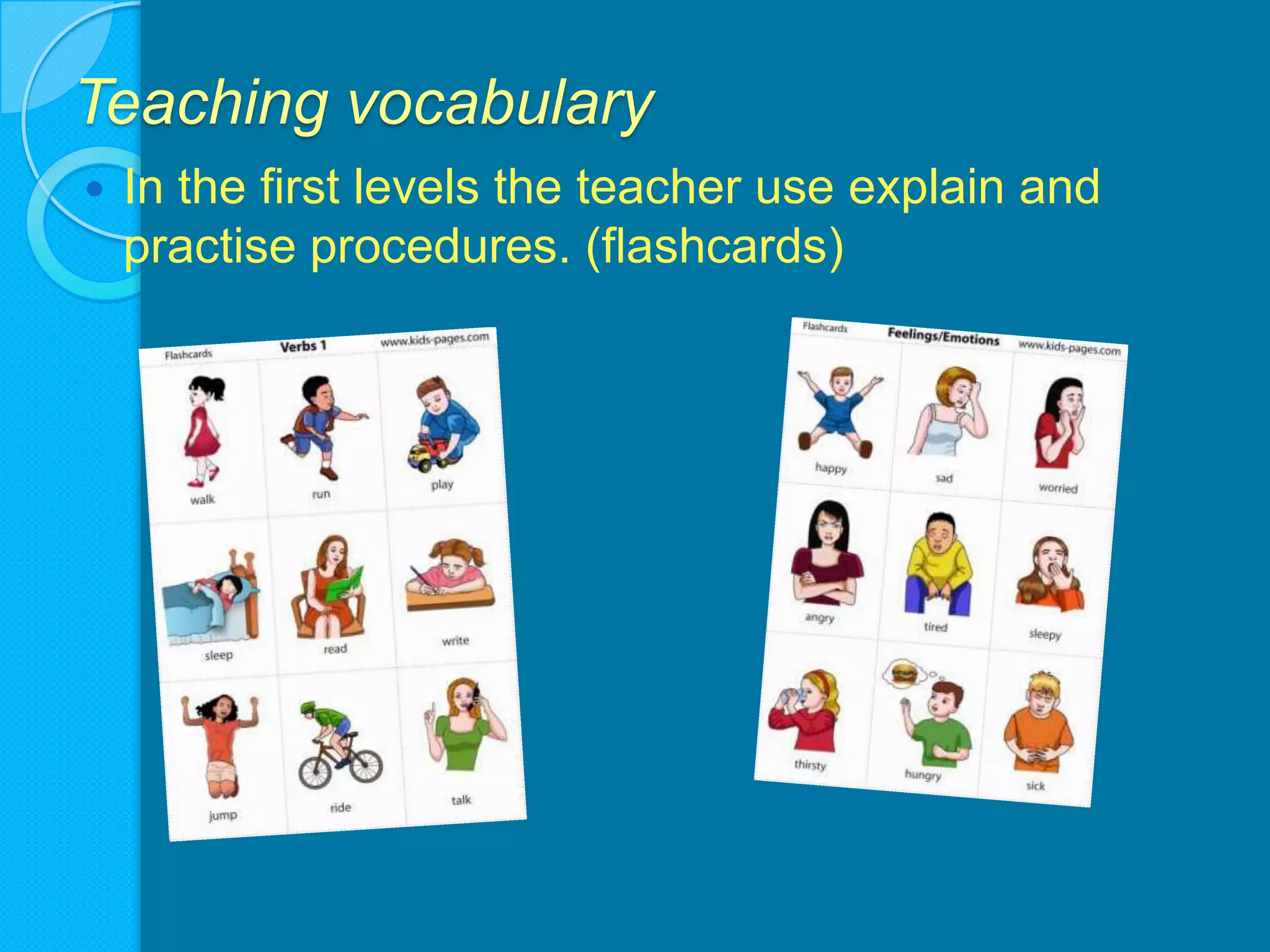
Teaching vocabularyIn the first levels the teacher use explain and practise procedures. (flashcards)
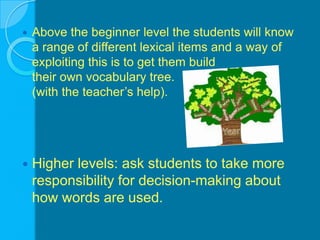
Above the beginner level the students will know a range of different lexical items and a way of exploiting this is to get them build                               their own vocabulary tree.                                                    (with the teacher’s help).Higher levels: ask students to take more responsibility for decision-making about how words are used.
Teaching language functionsBack-chaining: builds up phrases from the end; is useful for longer questions and sentences.Higher levels, we can move towards a                             more discovery-type sequence, and                                 build language activation into the                                     study section of the lesson.
Mistakes, slips, error and attempsSlips: students can correct themselves, once the mistakes has been pointed out to them.Errors: they can’t correct themselves, therefore, need explanation.
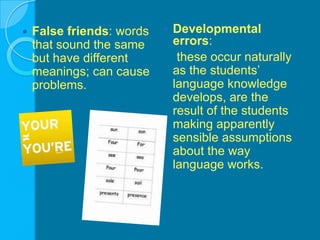
Attempts: they try to say something but don’t yet know how to say it.False friends: words that sound the same but have different meanings; can cause problems.Developmental errors:     these occur naturally as the students’ language knowledge develops, are the result of the students making apparently sensible assumptions about the way language works.
 The teacher has to realize that all students make mistakes as a natural part of the learning process.
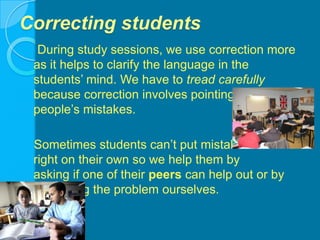
Correcting students    During study sessions, we use correction more as it helps to clarify the language in the students’ mind. We have to tread carefully because correction involves pointing out people’s mistakes.   Sometimes students can’t put mistakes                          right on their own so we help them by                            asking if one of their peers can help out or by explaining the problem ourselves.
When organising practice, teachers need to listen out for mistakes, identify the problem and put it right in the most efficient and tactful way.

Chapter 6 1

  • 1.
    Teaching vocabularyIn thefirst levels the teacher use explain and practise procedures. (flashcards)
  • 2.
    Above the beginnerlevel the students will know a range of different lexical items and a way of exploiting this is to get them build their own vocabulary tree. (with the teacher’s help).Higher levels: ask students to take more responsibility for decision-making about how words are used.
  • 3.
    Teaching language functionsBack-chaining:builds up phrases from the end; is useful for longer questions and sentences.Higher levels, we can move towards a more discovery-type sequence, and build language activation into the study section of the lesson.
  • 4.
    Mistakes, slips, errorand attempsSlips: students can correct themselves, once the mistakes has been pointed out to them.Errors: they can’t correct themselves, therefore, need explanation.
  • 5.
    Attempts: they tryto say something but don’t yet know how to say it.False friends: words that sound the same but have different meanings; can cause problems.Developmental errors: these occur naturally as the students’ language knowledge develops, are the result of the students making apparently sensible assumptions about the way language works.
  • 6.
    The teacherhas to realize that all students make mistakes as a natural part of the learning process.
  • 7.
    Correcting students During study sessions, we use correction more as it helps to clarify the language in the students’ mind. We have to tread carefully because correction involves pointing out people’s mistakes. Sometimes students can’t put mistakes right on their own so we help them by asking if one of their peers can help out or by explaining the problem ourselves.
  • 8.
    When organising practice,teachers need to listen out for mistakes, identify the problem and put it right in the most efficient and tactful way.