Chapter 2
ELEMENTS OF A CRIME
 In general, for an act to be a crime in U.S. criminal
justice systems, four elements must be present:
1. A criminal act
2. A criminal state of mind
3. Concurrence of a criminal act and a criminal stte of
mind
4. Causation
ELEMENTS OF A CRIME
 Wrongful deed that, if combined with other elements of a
crime, may result in the legal arrest, trial, conviction, and
punishment of the accused
 Open to interpretation as to what constitutes as act
 Does not include thoughts without action
 Many reasons as to why
 Most states require a voluntary act or failure to act
ELEMENTS OF A CRIME: A CRIMINAL ACT
(ACTUS REUS)
 The Exclusion of Involuntary Conduct
 Involuntary acts not considered criminal but may result in civil
liability
 Criminal culpability
 Being guilty or at fault
 Exclusion of Status
 General principle a person may not be punished for a status (drug
addicts, etc.)
 Robinson v. California (1962)
ELEMENTS OF A CRIME: A CRIMINAL ACT
(ACTUS REUS)
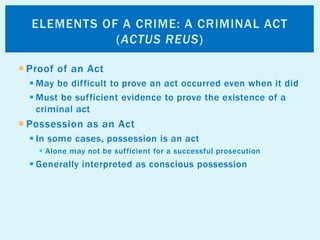
 Proof of an Act
 May be difficult to prove an act occurred even when it did
 Must be sufficient evidence to prove the existence of a
criminal act
 Possession as an Act
 In some cases, possession is an act
 Alone may not be sufficient for a successful prosecution
 Generally interpreted as conscious possession
ELEMENTS OF A CRIME: A CRIMINAL ACT
(ACTUS REUS)
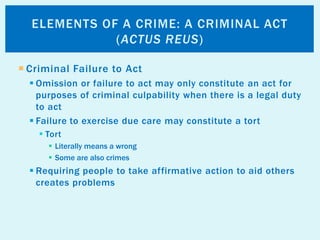
 Criminal Failure to Act
 Omission or failure to act may only constitute an act for
purposes of criminal culpability when there is a legal duty
to act
 Failure to exercise due care may constitute a tort
 Tort
 Literally means a wrong
 Some are also crimes
 Requiring people to take affirmative action to aid others
creates problems
ELEMENTS OF A CRIME: A CRIMINAL ACT
(ACTUS REUS)
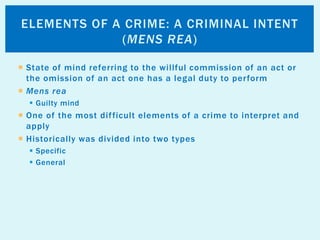
 State of mind referring to the willful commission of an act or
the omission of an act one has a legal duty to perform
 Mens rea
 Guilty mind
 One of the most difficult elements of a crime to interpret and
apply
 Historically was divided into two types
 Specific
 General
ELEMENTS OF A CRIME: A CRIMINAL INTENT
(MENS REA)
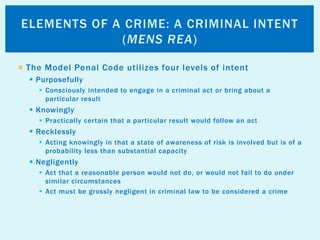
 The Model Penal Code utilizes four levels of intent
 Purposefully
 Consciously intended to engage in a criminal act or bring about a
particular result
 Knowingly
 Practically certain that a particular result would follow an act
 Recklessly
 Acting knowingly in that a state of awareness of risk is involved but is of a
probability less than substantial capacity
 Negligently
 Act that a reasonable person would not do, or would not fail to do under
similar circumstances
 Act must be grossly negligent in criminal law to be considered a crime
ELEMENTS OF A CRIME: A CRIMINAL INTENT
(MENS REA)
 Problems of Interpretation
 Model Penal Code has been widely adopted
 Problems with interpretation of levels of culpability exist
 Important to understand impossibility of stating what is meant by
intent
 Necessary to analyze carefully prior interpretations of a statute
 Necessary to consider intent element in terms of state and federal
constitutional law
ELEMENTS OF A CRIME: A CRIMINAL INTENT
(MENS REA)
 Proving Criminal Intent
 The law permits an inference of intent from relevant facts
 If sufficient circumstantial evidence is presented, jury may be
permitted to infer intent from that evidence
 Intent must be distinguished from motive
 The why of a defendant’s actions
 In general, state not required to prove motive
ELEMENTS OF A CRIME: A CRIMINAL INTENT
(MENS REA)
 General principle that mens rea and actus reus must coincide
 Must be evidence that the criminal act is the result of the
mens rea
ELEMENTS OF A CRIME: THE CONCURRENCE
OF A CRIMINAL ACT AND A CRIMINAL INTENT
 Must be shown that the act caused the injury, death, or
property damage sustained by victim
 Causation is complicated term
 Generally court is looking for legal cause
 Alleged criminal act may not be legal cause
 If criminal act is substantial factor contributing to harm, it may be
judged legal cause
 Intervening act may also be judged legal cause of harm
 Also possible act not caused by offender may combine with
offender’s act(s) to produce harmful result
ELEMENTS OF A CRIME: CAUSATION
 Some crimes have additional element (or elements) that must
be proved
 Attendant circumstances
 Facts surrounding an event
 Criminal act may not be prosecuted as a crime unless
specified circumstances co-exist with act and guilty mind
ATTENDANT CIRCUMSTANCES
 Criminal culpability is imposed in some situations even if no
fault or evil intent can be shown on part of accused
 Categories justified on grounds that:
 In many cases, only minor penalties are applied
 Proof of intent is difficult if not impossible to obtain
 Criminal culpability is essential for compensation of victims as well
as for deterrence of others
 Three types
 Strict liability
 Vicarious liability
 Enterprise liability
LIABILITY WITHOUT FAULT
 Legal concept that holds defendants responsible for
wrongful acts even when they are not guilty of
negligence, fault, or bad faith
 Some crimes include:
 Selling alcohol to minors
 Statutory rape
 Sexual intercourse, or in some jurisdictions, other sexual acts
as well, with an underage person even if that person allegedly
consented
 Use of strict liability for this crime is an exception to rationale
of minor penalties applied
LIABILITY WITHOUT FAULT: STRICT LIABILITY
 Dispenses with the requirement of actus reus and imputes
criminal act of one person to another
 Often used for employer-employee situations
 Whether employer can be held responsible in criminal as well
as civil law is determined by law of jurisdiction in which
employment occurred and specific facts of case
LIABILITY WITHOUT FAULT: VICARIOUS
LIABILITY
 The process of holding an entire business enterprise legally
liable for an event
 Under common law, corporations could not be charged with
crimes
 Rested on argument that corporations had no mind and no body
 No intent, no imprisonment
 As criminal law broke from this position, first penalties were
criminal fines
LIABILITY WITHOUT FAULT: ENTERPRISE
LIABILITY
 Today, most courts rule they can be held criminally culpable
for criminal acts or omissions
 Upheld by U.S. Supreme Court
 New York Central and Hudson River Railroad Co. v. United States (1909)
 Limitations do exist
 Employees must be acting within the scope of their employment
 Cannot be held liable for crimes whose punishments only provide for
death or imprisonment
LIABILITY WITHOUT FAULT: ENTERPRISE
LIABILITY
 A previously successful argument by corporations that they
should be liable only for property crimes has been challenged
 Granite Construction Co. v. Superior Court (5th Dist. 1983)
 Reasonable to expect more prosecutions under this theory of
criminal culpability
LIABILITY WITHOUT FAULT: ENTERPRISE
LIABILITY

ch2.pptx

  • 1.
  • 2.
     In general,for an act to be a crime in U.S. criminal justice systems, four elements must be present: 1. A criminal act 2. A criminal state of mind 3. Concurrence of a criminal act and a criminal stte of mind 4. Causation ELEMENTS OF A CRIME
  • 3.
     Wrongful deedthat, if combined with other elements of a crime, may result in the legal arrest, trial, conviction, and punishment of the accused  Open to interpretation as to what constitutes as act  Does not include thoughts without action  Many reasons as to why  Most states require a voluntary act or failure to act ELEMENTS OF A CRIME: A CRIMINAL ACT (ACTUS REUS)
  • 4.
     The Exclusionof Involuntary Conduct  Involuntary acts not considered criminal but may result in civil liability  Criminal culpability  Being guilty or at fault  Exclusion of Status  General principle a person may not be punished for a status (drug addicts, etc.)  Robinson v. California (1962) ELEMENTS OF A CRIME: A CRIMINAL ACT (ACTUS REUS)
  • 5.
     Proof ofan Act  May be difficult to prove an act occurred even when it did  Must be sufficient evidence to prove the existence of a criminal act  Possession as an Act  In some cases, possession is an act  Alone may not be sufficient for a successful prosecution  Generally interpreted as conscious possession ELEMENTS OF A CRIME: A CRIMINAL ACT (ACTUS REUS)
  • 6.
     Criminal Failureto Act  Omission or failure to act may only constitute an act for purposes of criminal culpability when there is a legal duty to act  Failure to exercise due care may constitute a tort  Tort  Literally means a wrong  Some are also crimes  Requiring people to take affirmative action to aid others creates problems ELEMENTS OF A CRIME: A CRIMINAL ACT (ACTUS REUS)
  • 7.
     State ofmind referring to the willful commission of an act or the omission of an act one has a legal duty to perform  Mens rea  Guilty mind  One of the most difficult elements of a crime to interpret and apply  Historically was divided into two types  Specific  General ELEMENTS OF A CRIME: A CRIMINAL INTENT (MENS REA)
  • 8.
     The ModelPenal Code utilizes four levels of intent  Purposefully  Consciously intended to engage in a criminal act or bring about a particular result  Knowingly  Practically certain that a particular result would follow an act  Recklessly  Acting knowingly in that a state of awareness of risk is involved but is of a probability less than substantial capacity  Negligently  Act that a reasonable person would not do, or would not fail to do under similar circumstances  Act must be grossly negligent in criminal law to be considered a crime ELEMENTS OF A CRIME: A CRIMINAL INTENT (MENS REA)
  • 9.
     Problems ofInterpretation  Model Penal Code has been widely adopted  Problems with interpretation of levels of culpability exist  Important to understand impossibility of stating what is meant by intent  Necessary to analyze carefully prior interpretations of a statute  Necessary to consider intent element in terms of state and federal constitutional law ELEMENTS OF A CRIME: A CRIMINAL INTENT (MENS REA)
  • 10.
     Proving CriminalIntent  The law permits an inference of intent from relevant facts  If sufficient circumstantial evidence is presented, jury may be permitted to infer intent from that evidence  Intent must be distinguished from motive  The why of a defendant’s actions  In general, state not required to prove motive ELEMENTS OF A CRIME: A CRIMINAL INTENT (MENS REA)
  • 11.
     General principlethat mens rea and actus reus must coincide  Must be evidence that the criminal act is the result of the mens rea ELEMENTS OF A CRIME: THE CONCURRENCE OF A CRIMINAL ACT AND A CRIMINAL INTENT
  • 12.
     Must beshown that the act caused the injury, death, or property damage sustained by victim  Causation is complicated term  Generally court is looking for legal cause  Alleged criminal act may not be legal cause  If criminal act is substantial factor contributing to harm, it may be judged legal cause  Intervening act may also be judged legal cause of harm  Also possible act not caused by offender may combine with offender’s act(s) to produce harmful result ELEMENTS OF A CRIME: CAUSATION
  • 13.
     Some crimeshave additional element (or elements) that must be proved  Attendant circumstances  Facts surrounding an event  Criminal act may not be prosecuted as a crime unless specified circumstances co-exist with act and guilty mind ATTENDANT CIRCUMSTANCES
  • 14.
     Criminal culpabilityis imposed in some situations even if no fault or evil intent can be shown on part of accused  Categories justified on grounds that:  In many cases, only minor penalties are applied  Proof of intent is difficult if not impossible to obtain  Criminal culpability is essential for compensation of victims as well as for deterrence of others  Three types  Strict liability  Vicarious liability  Enterprise liability LIABILITY WITHOUT FAULT
  • 15.
     Legal conceptthat holds defendants responsible for wrongful acts even when they are not guilty of negligence, fault, or bad faith  Some crimes include:  Selling alcohol to minors  Statutory rape  Sexual intercourse, or in some jurisdictions, other sexual acts as well, with an underage person even if that person allegedly consented  Use of strict liability for this crime is an exception to rationale of minor penalties applied LIABILITY WITHOUT FAULT: STRICT LIABILITY
  • 16.
     Dispenses withthe requirement of actus reus and imputes criminal act of one person to another  Often used for employer-employee situations  Whether employer can be held responsible in criminal as well as civil law is determined by law of jurisdiction in which employment occurred and specific facts of case LIABILITY WITHOUT FAULT: VICARIOUS LIABILITY
  • 17.
     The processof holding an entire business enterprise legally liable for an event  Under common law, corporations could not be charged with crimes  Rested on argument that corporations had no mind and no body  No intent, no imprisonment  As criminal law broke from this position, first penalties were criminal fines LIABILITY WITHOUT FAULT: ENTERPRISE LIABILITY
  • 18.
     Today, mostcourts rule they can be held criminally culpable for criminal acts or omissions  Upheld by U.S. Supreme Court  New York Central and Hudson River Railroad Co. v. United States (1909)  Limitations do exist  Employees must be acting within the scope of their employment  Cannot be held liable for crimes whose punishments only provide for death or imprisonment LIABILITY WITHOUT FAULT: ENTERPRISE LIABILITY
  • 19.
     A previouslysuccessful argument by corporations that they should be liable only for property crimes has been challenged  Granite Construction Co. v. Superior Court (5th Dist. 1983)  Reasonable to expect more prosecutions under this theory of criminal culpability LIABILITY WITHOUT FAULT: ENTERPRISE LIABILITY