1865-1895 Timeline 
By Sydney Davidson
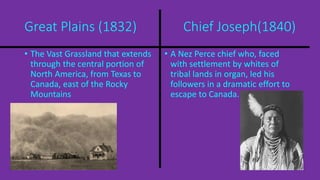
Great Plains (1832) Chief Joseph(1840) 
• The Vast Grassland that extends 
through the central portion of 
North America, from Texas to 
Canada, east of the Rocky 
Mountains 
• A Nez Perce chief who, faced 
with settlement by whites of 
tribal lands in organ, led his 
followers in a dramatic effort to 
escape to Canada.
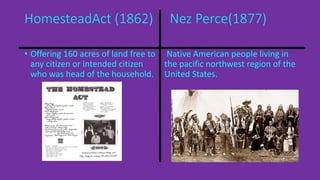
HomesteadAct (1862) Nez Perce(1877) 
• Offering 160 acres of land free to 
any citizen or intended citizen 
who was head of the household. 
Native American people living in 
the pacific northwest region of the 
United States.
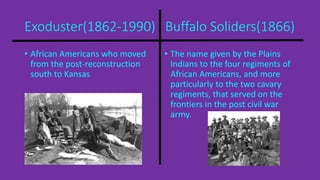
Exoduster(1862-1990) Buffalo Soliders(1866) 
• African Americans who moved 
from the post-reconstruction 
south to Kansas 
• The name given by the Plains 
Indians to the four regiments of 
African Americans, and more 
particularly to the two cavary 
regiments, that served on the 
frontiers in the post civil war 
army.
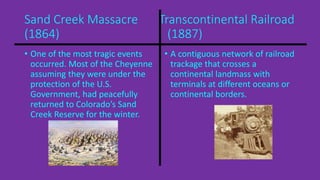
Sand Creek Massacre Transcontinental Railroad 
(1864) (1887) 
• One of the most tragic events 
occurred. Most of the Cheyenne 
assuming they were under the 
protection of the U.S. 
Government, had peacefully 
returned to Colorado’s Sand 
Creek Reserve for the winter. 
• A contiguous network of railroad 
trackage that crosses a 
continental landmass with 
terminals at different oceans or 
continental borders.
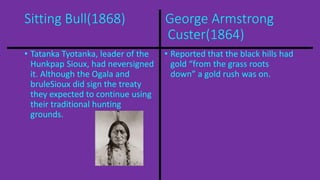
Sitting Bull(1868) George Armstrong 
Custer(1864) 
• Tatanka Tyotanka, leader of the 
Hunkpap Sioux, had neversigned 
it. Although the Ogala and 
bruleSioux did sign the treaty 
they expected to continue using 
their traditional hunting 
grounds. 
• Reported that the black hills had 
gold “from the grass roots 
down” a gold rush was on.
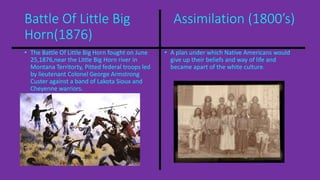
Battle Of Little Big Assimilation (1800’s) 
Horn(1876) 
• The Battle Of Little Big Horn fought on June 
25,1876,near the Little Big Horn river in 
Montana Territorty, Pitted federal troops led 
by lieutenant Colonel George Armstrong 
Custer against a band of Lakota Sioux and 
Cheyenne warriors. 
• A plan under which Native Americans would 
give up their beliefs and way of life and 
became apart of the white culture.
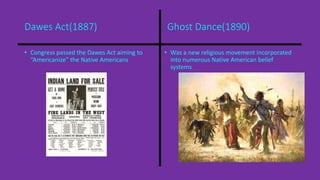
Dawes Act(1887) Ghost Dance(1890) 
• Congress passed the Dawes Act aiming to 
“Americanize” the Native Americans 
• Was a new religious movement incorporated 
into numerous Native American belief 
systems
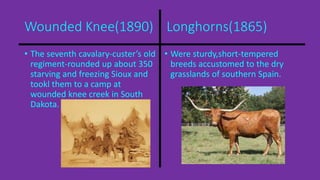
Wounded Knee(1890) Longhorns(1865) 
• The seventh cavalary-custer’s old 
regiment-rounded up about 350 
starving and freezing Sioux and 
tookl them to a camp at 
wounded knee creek in South 
Dakota. 
• Were sturdy,short-tempered 
breeds accustomed to the dry 
grasslands of southern Spain.
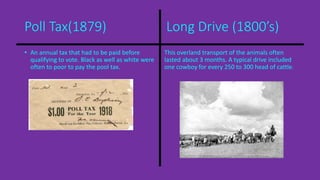
Poll Tax(1879) Long Drive (1800’s) 
• An annual tax that had to be paid before 
qualifying to vote. Black as well as white were 
often to poor to pay the pool tax. 
This overland transport of the animals often 
lasted about 3 months. A typical drive included 
one cowboy for every 250 to 300 head of cattle.
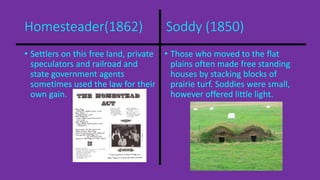
Homesteader(1862) Soddy (1850) 
• Settlers on this free land, private 
speculators and railroad and 
state government agents 
sometimes used the law for their 
own gain. 
• Those who moved to the flat 
plains often made free standing 
houses by stacking blocks of 
prairie turf. Soddies were small, 
however offered little light.
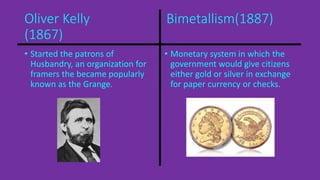
Oliver Kelly Bimetallism(1887) 
(1867) 
• Started the patrons of 
Husbandry, an organization for 
framers the became popularly 
known as the Grange. 
• Monetary system in which the 
government would give citizens 
either gold or silver in exchange 
for paper currency or checks.
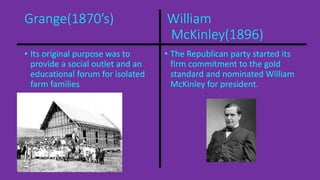
Grange(1870’s) William 
McKinley(1896) 
• Its original purpose was to 
provide a social outlet and an 
educational forum for isolated 
farm families 
• The Republican party started its 
firm commitment to the gold 
standard and nominated William 
McKinley for president.
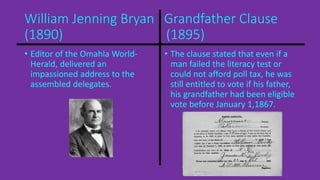
William Jenning Bryan Grandfather Clause 
(1890) (1895) 
• Editor of the Omahla World- 
Herald, delivered an 
impassioned address to the 
assembled delegates. 
• The clause stated that even if a 
man failed the literacy test or 
could not afford poll tax, he was 
still entitled to vote if his father, 
his grandfather had been eligible 
vote before January 1,1867.
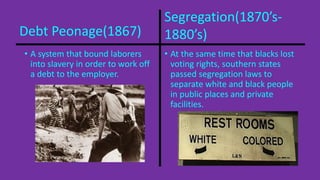
Segregation(1870’s- 
Debt Peonage(1867) 1880’s) 
• A system that bound laborers 
• At the same time that blacks lost 
voting rights, southern states 
passed segregation laws to 
separate white and black people 
in public places and private 
facilities. 
into slavery in order to work off 
a debt to the employer.
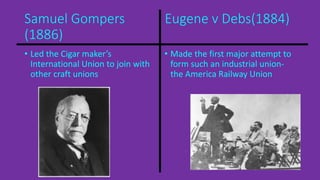
Samuel Gompers Eugene v Debs(1884) 
(1886) 
• Led the Cigar maker’s 
International Union to join with 
other craft unions 
• Made the first major attempt to 
form such an industrial union-the 
America Railway Union
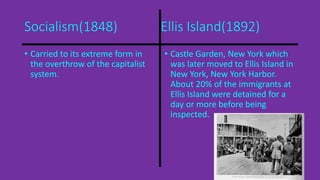
Socialism(1848) Ellis Island(1892) 
• Carried to its extreme form in 
the overthrow of the capitalist 
system. 
• Castle Garden, New York which 
was later moved to Ellis Island in 
New York, New York Harbor. 
About 20% of the immigrants at 
Ellis Island were detained for a 
day or more before being 
inspected.
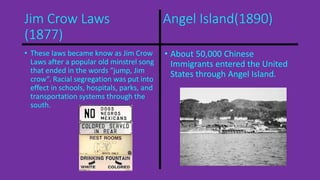
Jim Crow Laws Angel Island(1890) 
(1877) 
• These laws became know as Jim Crow 
Laws after a popular old minstrel song 
that ended in the words “jump, Jim 
crow”. Racial segregation was put into 
effect in schools, hospitals, parks, and 
transportation systems through the 
south. 
• About 50,000 Chinese 
Immigrants entered the United 
States through Angel Island.
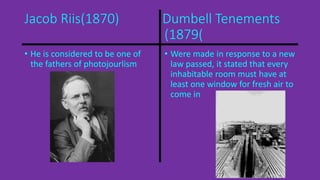
Jacob Riis(1870) Dumbell Tenements 
(1879( 
• He is considered to be one of 
the fathers of photojourlism 
• Were made in response to a new 
law passed, it stated that every 
inhabitable room must have at 
least one window for fresh air to 
come in
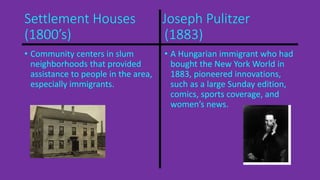
Settlement Houses Joseph Pulitzer 
(1800’s) (1883) 
• Community centers in slum 
neighborhoods that provided 
assistance to people in the area, 
especially immigrants. 
• A Hungarian immigrant who had 
bought the New York World in 
1883, pioneered innovations, 
such as a large Sunday edition, 
comics, sports coverage, and 
women’s news.
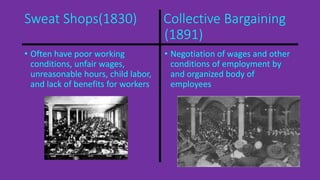
Sweat Shops(1830) Collective Bargaining 
(1891) 
• Often have poor working 
conditions, unfair wages, 
unreasonable hours, child labor, 
and lack of benefits for workers 
• Negotiation of wages and other 
conditions of employment by 
and organized body of 
employees
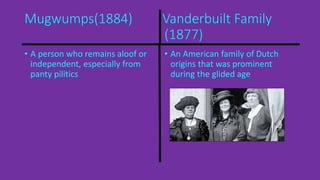
Mugwumps(1884) Vanderbuilt Family 
(1877) 
• A person who remains aloof or 
independent, especially from 
panty pilitics 
• An American family of Dutch 
origins that was prominent 
during the glided age
Culture Shock(1868) “Cross Of Gold 
Speech”(1896) 
• The difficulty people have 
adjusting to a new culture that 
differs from their own 
• Was delivered by William 
Jenning Bryan, a former United 
States Representative from 
Nebraska, at the Democratic 
National Convention
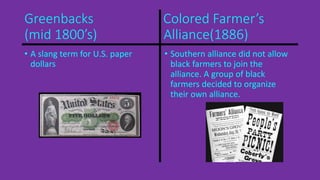
Greenbacks Colored Farmer’s 
(mid 1800’s) Alliance(1886) 
• A slang term for U.S. paper 
dollars 
• Southern alliance did not allow 
black farmers to join the 
alliance. A group of black 
farmers decided to organize 
their own alliance.
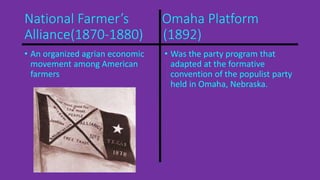
National Farmer’s Omaha Platform 
Alliance(1870-1880) (1892) 
• An organized agrian economic 
movement among American 
farmers 
• Was the party program that 
adapted at the formative 
convention of the populist party 
held in Omaha, Nebraska.
Urbanization(1890) Graft(1878) 
• Growth of cities, mostly in the 
regions of the northwest and 
midwest 
• The illegal use of political 
influence for personal gain
Political Machine Kickback(1857) 
(1875) 
• An organized group that 
controlled the activities of a 
political party in a city. 
• The payment of something of 
value to an individual with the 
goal of persuading or influencing 
his or her decision or 
performance in a certain 
situation.
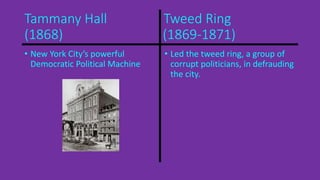
Tammany Hall Tweed Ring 
(1868) (1869-1871) 
• New York City’s powerful 
Democratic Political Machine 
• Led the tweed ring, a group of 
corrupt politicians, in defrauding 
the city.
Patronage(1869) Civil Service(1855) 
• The giving of government jobs to 
people who had helped a 
candidate get elected. 
• Government administration-should 
go to the most qualified 
persons. Reformers believe.
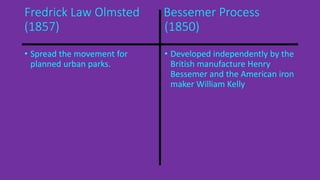
Fredrick Law Olmsted Bessemer Process 
(1857) (1850) 
• Spread the movement for 
planned urban parks. 
• Developed independently by the 
British manufacture Henry 
Bessemer and the American iron 
maker William Kelly
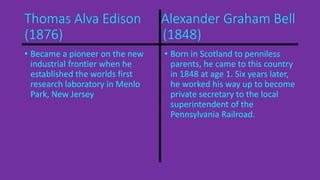
Thomas Alva Edison Alexander Graham Bell 
(1876) (1848) 
• Became a pioneer on the new 
industrial frontier when he 
established the worlds first 
research laboratory in Menlo 
Park, New Jersey 
• Born in Scotland to penniless 
parents, he came to this country 
in 1848 at age 1. Six years later, 
he worked his way up to become 
private secretary to the local 
superintendent of the 
Pennsylvania Railroad.

1865 1895 timeline

  • 1.
    1865-1895 Timeline BySydney Davidson
  • 2.
    Great Plains (1832)Chief Joseph(1840) • The Vast Grassland that extends through the central portion of North America, from Texas to Canada, east of the Rocky Mountains • A Nez Perce chief who, faced with settlement by whites of tribal lands in organ, led his followers in a dramatic effort to escape to Canada.
  • 3.
    HomesteadAct (1862) NezPerce(1877) • Offering 160 acres of land free to any citizen or intended citizen who was head of the household. Native American people living in the pacific northwest region of the United States.
  • 4.
    Exoduster(1862-1990) Buffalo Soliders(1866) • African Americans who moved from the post-reconstruction south to Kansas • The name given by the Plains Indians to the four regiments of African Americans, and more particularly to the two cavary regiments, that served on the frontiers in the post civil war army.
  • 5.
    Sand Creek MassacreTranscontinental Railroad (1864) (1887) • One of the most tragic events occurred. Most of the Cheyenne assuming they were under the protection of the U.S. Government, had peacefully returned to Colorado’s Sand Creek Reserve for the winter. • A contiguous network of railroad trackage that crosses a continental landmass with terminals at different oceans or continental borders.
  • 6.
    Sitting Bull(1868) GeorgeArmstrong Custer(1864) • Tatanka Tyotanka, leader of the Hunkpap Sioux, had neversigned it. Although the Ogala and bruleSioux did sign the treaty they expected to continue using their traditional hunting grounds. • Reported that the black hills had gold “from the grass roots down” a gold rush was on.
  • 7.
    Battle Of LittleBig Assimilation (1800’s) Horn(1876) • The Battle Of Little Big Horn fought on June 25,1876,near the Little Big Horn river in Montana Territorty, Pitted federal troops led by lieutenant Colonel George Armstrong Custer against a band of Lakota Sioux and Cheyenne warriors. • A plan under which Native Americans would give up their beliefs and way of life and became apart of the white culture.
  • 8.
    Dawes Act(1887) GhostDance(1890) • Congress passed the Dawes Act aiming to “Americanize” the Native Americans • Was a new religious movement incorporated into numerous Native American belief systems
  • 9.
    Wounded Knee(1890) Longhorns(1865) • The seventh cavalary-custer’s old regiment-rounded up about 350 starving and freezing Sioux and tookl them to a camp at wounded knee creek in South Dakota. • Were sturdy,short-tempered breeds accustomed to the dry grasslands of southern Spain.
  • 10.
    Poll Tax(1879) LongDrive (1800’s) • An annual tax that had to be paid before qualifying to vote. Black as well as white were often to poor to pay the pool tax. This overland transport of the animals often lasted about 3 months. A typical drive included one cowboy for every 250 to 300 head of cattle.
  • 11.
    Homesteader(1862) Soddy (1850) • Settlers on this free land, private speculators and railroad and state government agents sometimes used the law for their own gain. • Those who moved to the flat plains often made free standing houses by stacking blocks of prairie turf. Soddies were small, however offered little light.
  • 12.
    Oliver Kelly Bimetallism(1887) (1867) • Started the patrons of Husbandry, an organization for framers the became popularly known as the Grange. • Monetary system in which the government would give citizens either gold or silver in exchange for paper currency or checks.
  • 13.
    Grange(1870’s) William McKinley(1896) • Its original purpose was to provide a social outlet and an educational forum for isolated farm families • The Republican party started its firm commitment to the gold standard and nominated William McKinley for president.
  • 14.
    William Jenning BryanGrandfather Clause (1890) (1895) • Editor of the Omahla World- Herald, delivered an impassioned address to the assembled delegates. • The clause stated that even if a man failed the literacy test or could not afford poll tax, he was still entitled to vote if his father, his grandfather had been eligible vote before January 1,1867.
  • 15.
    Segregation(1870’s- Debt Peonage(1867)1880’s) • A system that bound laborers • At the same time that blacks lost voting rights, southern states passed segregation laws to separate white and black people in public places and private facilities. into slavery in order to work off a debt to the employer.
  • 16.
    Samuel Gompers Eugenev Debs(1884) (1886) • Led the Cigar maker’s International Union to join with other craft unions • Made the first major attempt to form such an industrial union-the America Railway Union
  • 17.
    Socialism(1848) Ellis Island(1892) • Carried to its extreme form in the overthrow of the capitalist system. • Castle Garden, New York which was later moved to Ellis Island in New York, New York Harbor. About 20% of the immigrants at Ellis Island were detained for a day or more before being inspected.
  • 18.
    Jim Crow LawsAngel Island(1890) (1877) • These laws became know as Jim Crow Laws after a popular old minstrel song that ended in the words “jump, Jim crow”. Racial segregation was put into effect in schools, hospitals, parks, and transportation systems through the south. • About 50,000 Chinese Immigrants entered the United States through Angel Island.
  • 19.
    Jacob Riis(1870) DumbellTenements (1879( • He is considered to be one of the fathers of photojourlism • Were made in response to a new law passed, it stated that every inhabitable room must have at least one window for fresh air to come in
  • 20.
    Settlement Houses JosephPulitzer (1800’s) (1883) • Community centers in slum neighborhoods that provided assistance to people in the area, especially immigrants. • A Hungarian immigrant who had bought the New York World in 1883, pioneered innovations, such as a large Sunday edition, comics, sports coverage, and women’s news.
  • 21.
    Sweat Shops(1830) CollectiveBargaining (1891) • Often have poor working conditions, unfair wages, unreasonable hours, child labor, and lack of benefits for workers • Negotiation of wages and other conditions of employment by and organized body of employees
  • 22.
    Mugwumps(1884) Vanderbuilt Family (1877) • A person who remains aloof or independent, especially from panty pilitics • An American family of Dutch origins that was prominent during the glided age
  • 23.
    Culture Shock(1868) “CrossOf Gold Speech”(1896) • The difficulty people have adjusting to a new culture that differs from their own • Was delivered by William Jenning Bryan, a former United States Representative from Nebraska, at the Democratic National Convention
  • 24.
    Greenbacks Colored Farmer’s (mid 1800’s) Alliance(1886) • A slang term for U.S. paper dollars • Southern alliance did not allow black farmers to join the alliance. A group of black farmers decided to organize their own alliance.
  • 25.
    National Farmer’s OmahaPlatform Alliance(1870-1880) (1892) • An organized agrian economic movement among American farmers • Was the party program that adapted at the formative convention of the populist party held in Omaha, Nebraska.
  • 26.
    Urbanization(1890) Graft(1878) •Growth of cities, mostly in the regions of the northwest and midwest • The illegal use of political influence for personal gain
  • 27.
    Political Machine Kickback(1857) (1875) • An organized group that controlled the activities of a political party in a city. • The payment of something of value to an individual with the goal of persuading or influencing his or her decision or performance in a certain situation.
  • 28.
    Tammany Hall TweedRing (1868) (1869-1871) • New York City’s powerful Democratic Political Machine • Led the tweed ring, a group of corrupt politicians, in defrauding the city.
  • 29.
    Patronage(1869) Civil Service(1855) • The giving of government jobs to people who had helped a candidate get elected. • Government administration-should go to the most qualified persons. Reformers believe.
  • 30.
    Fredrick Law OlmstedBessemer Process (1857) (1850) • Spread the movement for planned urban parks. • Developed independently by the British manufacture Henry Bessemer and the American iron maker William Kelly
  • 31.
    Thomas Alva EdisonAlexander Graham Bell (1876) (1848) • Became a pioneer on the new industrial frontier when he established the worlds first research laboratory in Menlo Park, New Jersey • Born in Scotland to penniless parents, he came to this country in 1848 at age 1. Six years later, he worked his way up to become private secretary to the local superintendent of the Pennsylvania Railroad.