Wednesday, November 7, 2012Wednesday, November 7, 2012
Agree Disagree 1. A monopoly is Agree DisagreeAgree Disagree 1. A monopoly is Agree Disagree
____ ____ when one____ ____ when one ____ ________ ____
company has control of a productcompany has control of a product
____ ____ 2. Loyalist or ____ _________ ____ 2. Loyalist or ____ _____
Tories supported the coloniesTories supported the colonies
Chapter Four: The American RevolutionChapter Four: The American Revolution
Section Two: The Revolution BeginsSection Two: The Revolution Begins
A.A. Massachusetts defiesMassachusetts defies
BritainBritain
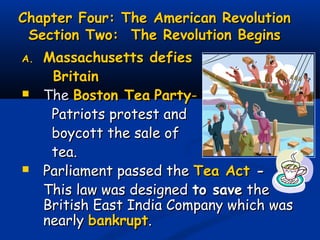
 TheThe Boston TeaBoston Tea PartyParty--
Patriots protest andPatriots protest and
boycott the sale ofboycott the sale of
tea.tea.
 Parliament passed theParliament passed the Tea ActTea Act --
This law was designedThis law was designed to saveto save thethe
British East India Company which wasBritish East India Company which was
nearlynearly bankruptbankrupt..
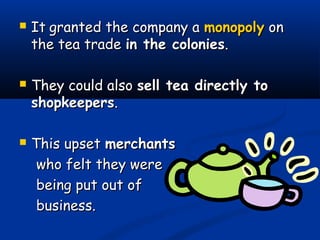
 ItIt granted the company agranted the company a monopolymonopoly onon
the tea tradethe tea trade in the coloniesin the colonies..
 They could alsoThey could also sell tea directly tosell tea directly to
shopkeepersshopkeepers..
 This upsetThis upset merchantsmerchants
who felt they werewho felt they were
being put out ofbeing put out of
business.business.
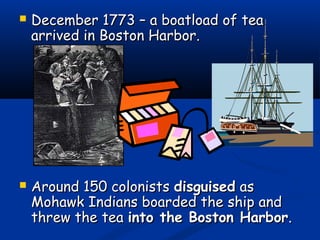
 December 1773 – a boatload of teaDecember 1773 – a boatload of tea
arrived in Boston Harbor.arrived in Boston Harbor.
 Around 150 colonistsAround 150 colonists disguiseddisguised asas
Mohawk Indians boarded the ship andMohawk Indians boarded the ship and
threw the teathrew the tea into the Boston Harborinto the Boston Harbor..
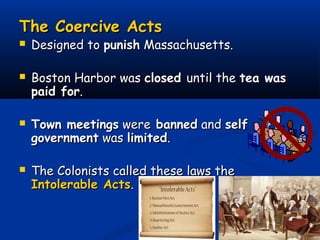
The Coercive ActsThe Coercive Acts
 Designed toDesigned to punishpunish Massachusetts.Massachusetts.
 Boston Harbor wasBoston Harbor was closedclosed until theuntil the tea wastea was
paid forpaid for..
 Town meetingsTown meetings werewere bannedbanned andand selfself
governmentgovernment waswas limitedlimited..
 The Colonists called these laws theThe Colonists called these laws the
Intolerable ActsIntolerable Acts..
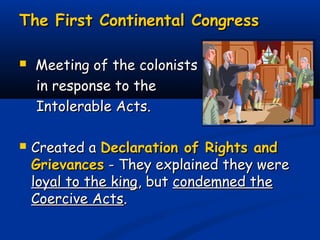
The First Continental CongressThe First Continental Congress
 Meeting of the colonistsMeeting of the colonists
in response to thein response to the
Intolerable Acts.Intolerable Acts.
 Created aCreated a Declaration of Rights andDeclaration of Rights and
GrievancesGrievances - They explained they were- They explained they were
loyal to the kingloyal to the king, but, but condemned thecondemned the
Coercive ActsCoercive Acts..
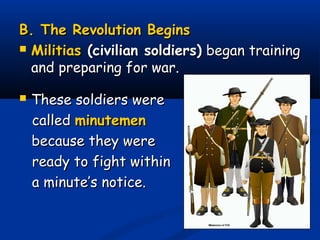
B. The Revolution BeginsB. The Revolution Begins
 MilitiasMilitias (civilian soldiers)(civilian soldiers) began trainingbegan training
and preparing for war.and preparing for war.
 These soldiers wereThese soldiers were
calledcalled minutemenminutemen
because they werebecause they were
ready to fight withinready to fight within
a minute’s notice.a minute’s notice.
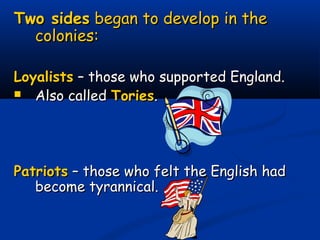
Two sidesTwo sides began to develop in thebegan to develop in the
colonies:colonies:
LoyalistsLoyalists – those who supported England.– those who supported England.
 Also calledAlso called ToriesTories..
PatriotsPatriots – those who felt the English had– those who felt the English had
become tyrannical.become tyrannical.
REVIEWREVIEW
1.1. Why did the colonists meet at theWhy did the colonists meet at the
First Continental Congress?First Continental Congress?
2.2. What was the result of that meeting?What was the result of that meeting?
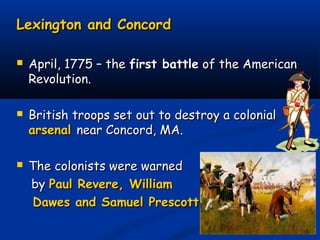
Lexington and ConcordLexington and Concord
 April, 1775 – theApril, 1775 – the first battlefirst battle of the Americanof the American
Revolution.Revolution.
 British troops set out to destroy a colonialBritish troops set out to destroy a colonial
arsenalarsenal near Concord, MA.near Concord, MA.
 The colonists were warnedThe colonists were warned
byby Paul Revere, WilliamPaul Revere, William
Dawes and Samuel Prescott.Dawes and Samuel Prescott.
CHUNK #2CHUNK #2
Pg 130. Study the map.Pg 130. Study the map.
Why do you think Paul Revere andWhy do you think Paul Revere and
William Dawes took differentWilliam Dawes took different
routes on the first leg of theirroutes on the first leg of their
journey?journey?
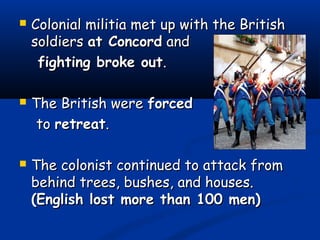
 Colonial militia met up with the BritishColonial militia met up with the British
soldierssoldiers at Concordat Concord andand
fighting broke outfighting broke out..
 The British wereThe British were forcedforced
toto retreatretreat..
 The colonist continued to attack fromThe colonist continued to attack from
behind trees, bushes, and houses.behind trees, bushes, and houses.
(English lost more than 100 men)(English lost more than 100 men)
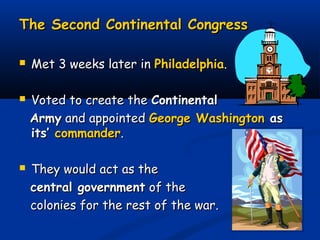
The Second Continental CongressThe Second Continental Congress
 Met 3 weeks later inMet 3 weeks later in PhiladelphiaPhiladelphia..
 Voted to create theVoted to create the ContinentalContinental
ArmyArmy and appointedand appointed George WashingtonGeorge Washington asas
its’its’ commandercommander..
 They would act as theThey would act as the
central governmentcentral government of theof the
colonies for the rest of the war.colonies for the rest of the war.
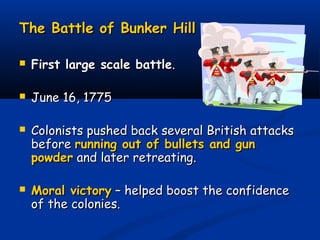
The Battle of Bunker HillThe Battle of Bunker Hill
 First large scale battleFirst large scale battle..
 June 16, 1775June 16, 1775
 Colonists pushed back several British attacksColonists pushed back several British attacks
beforebefore running out of bullets and gunrunning out of bullets and gun
powderpowder and later retreating.and later retreating.
 Moral victoryMoral victory – helped boost the confidence– helped boost the confidence
of the colonies.of the colonies.
ReviewReview
Complete the worksheet on ParliamentaryComplete the worksheet on Parliamentary
Acts placed on the Colonists.Acts placed on the Colonists.

Chapter 4 section 2 pt.1

  • 1.
    Wednesday, November 7,2012Wednesday, November 7, 2012 Agree Disagree 1. A monopoly is Agree DisagreeAgree Disagree 1. A monopoly is Agree Disagree ____ ____ when one____ ____ when one ____ ________ ____ company has control of a productcompany has control of a product ____ ____ 2. Loyalist or ____ _________ ____ 2. Loyalist or ____ _____ Tories supported the coloniesTories supported the colonies
  • 2.
    Chapter Four: TheAmerican RevolutionChapter Four: The American Revolution Section Two: The Revolution BeginsSection Two: The Revolution Begins A.A. Massachusetts defiesMassachusetts defies BritainBritain  TheThe Boston TeaBoston Tea PartyParty-- Patriots protest andPatriots protest and boycott the sale ofboycott the sale of tea.tea.  Parliament passed theParliament passed the Tea ActTea Act -- This law was designedThis law was designed to saveto save thethe British East India Company which wasBritish East India Company which was nearlynearly bankruptbankrupt..
  • 3.
     ItIt grantedthe company agranted the company a monopolymonopoly onon the tea tradethe tea trade in the coloniesin the colonies..  They could alsoThey could also sell tea directly tosell tea directly to shopkeepersshopkeepers..  This upsetThis upset merchantsmerchants who felt they werewho felt they were being put out ofbeing put out of business.business.
  • 4.
     December 1773– a boatload of teaDecember 1773 – a boatload of tea arrived in Boston Harbor.arrived in Boston Harbor.  Around 150 colonistsAround 150 colonists disguiseddisguised asas Mohawk Indians boarded the ship andMohawk Indians boarded the ship and threw the teathrew the tea into the Boston Harborinto the Boston Harbor..
  • 5.
    The Coercive ActsTheCoercive Acts  Designed toDesigned to punishpunish Massachusetts.Massachusetts.  Boston Harbor wasBoston Harbor was closedclosed until theuntil the tea wastea was paid forpaid for..  Town meetingsTown meetings werewere bannedbanned andand selfself governmentgovernment waswas limitedlimited..  The Colonists called these laws theThe Colonists called these laws the Intolerable ActsIntolerable Acts..
  • 6.
    The First ContinentalCongressThe First Continental Congress  Meeting of the colonistsMeeting of the colonists in response to thein response to the Intolerable Acts.Intolerable Acts.  Created aCreated a Declaration of Rights andDeclaration of Rights and GrievancesGrievances - They explained they were- They explained they were loyal to the kingloyal to the king, but, but condemned thecondemned the Coercive ActsCoercive Acts..
  • 7.
    B. The RevolutionBeginsB. The Revolution Begins  MilitiasMilitias (civilian soldiers)(civilian soldiers) began trainingbegan training and preparing for war.and preparing for war.  These soldiers wereThese soldiers were calledcalled minutemenminutemen because they werebecause they were ready to fight withinready to fight within a minute’s notice.a minute’s notice.
  • 8.
    Two sidesTwo sidesbegan to develop in thebegan to develop in the colonies:colonies: LoyalistsLoyalists – those who supported England.– those who supported England.  Also calledAlso called ToriesTories.. PatriotsPatriots – those who felt the English had– those who felt the English had become tyrannical.become tyrannical.
  • 9.
    REVIEWREVIEW 1.1. Why didthe colonists meet at theWhy did the colonists meet at the First Continental Congress?First Continental Congress? 2.2. What was the result of that meeting?What was the result of that meeting?
  • 10.
    Lexington and ConcordLexingtonand Concord  April, 1775 – theApril, 1775 – the first battlefirst battle of the Americanof the American Revolution.Revolution.  British troops set out to destroy a colonialBritish troops set out to destroy a colonial arsenalarsenal near Concord, MA.near Concord, MA.  The colonists were warnedThe colonists were warned byby Paul Revere, WilliamPaul Revere, William Dawes and Samuel Prescott.Dawes and Samuel Prescott.
  • 11.
    CHUNK #2CHUNK #2 Pg130. Study the map.Pg 130. Study the map. Why do you think Paul Revere andWhy do you think Paul Revere and William Dawes took differentWilliam Dawes took different routes on the first leg of theirroutes on the first leg of their journey?journey?
  • 12.
     Colonial militiamet up with the BritishColonial militia met up with the British soldierssoldiers at Concordat Concord andand fighting broke outfighting broke out..  The British wereThe British were forcedforced toto retreatretreat..  The colonist continued to attack fromThe colonist continued to attack from behind trees, bushes, and houses.behind trees, bushes, and houses. (English lost more than 100 men)(English lost more than 100 men)
  • 13.
    The Second ContinentalCongressThe Second Continental Congress  Met 3 weeks later inMet 3 weeks later in PhiladelphiaPhiladelphia..  Voted to create theVoted to create the ContinentalContinental ArmyArmy and appointedand appointed George WashingtonGeorge Washington asas its’its’ commandercommander..  They would act as theThey would act as the central governmentcentral government of theof the colonies for the rest of the war.colonies for the rest of the war.
  • 14.
    The Battle ofBunker HillThe Battle of Bunker Hill  First large scale battleFirst large scale battle..  June 16, 1775June 16, 1775  Colonists pushed back several British attacksColonists pushed back several British attacks beforebefore running out of bullets and gunrunning out of bullets and gun powderpowder and later retreating.and later retreating.  Moral victoryMoral victory – helped boost the confidence– helped boost the confidence of the colonies.of the colonies.
  • 15.
    ReviewReview Complete the worksheeton ParliamentaryComplete the worksheet on Parliamentary Acts placed on the Colonists.Acts placed on the Colonists.