Essential Question : How did American efforts at home help win the war and transform the American economy & society?
“ Over Here ”  The Homefront  During World War I
“Over Here” To win  over there , the U.S. had to effectively mobilize  over here Wilson consolidated federal authority to organize U.S. war production & distribution Wilson began a massive propaganda campaign aimed at winning over the American public to support the war effort
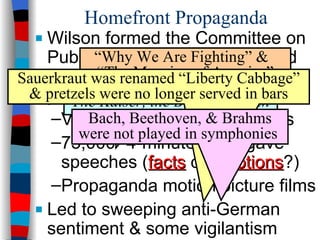
Homefront Propaganda Wilson formed the Committee on Public Information (CPI) & hired muckraker George Creel to publicize the U.S. war effort: Voluntary censorship in press 75,000 “4-minute men” gave speeches ( facts  or  emotions ?) Propaganda motion picture films Led to sweeping anti-German sentiment & some vigilantism  “ Why We Are Fighting” &  “The Meaning of America” The Prussian Cur  &  The Kaiser, the Beast of Berlin Sauerkraut was renamed “Liberty Cabbage” & pretzels were no longer served in bars Bach, Beethoven, & Brahms were not played in symphonies
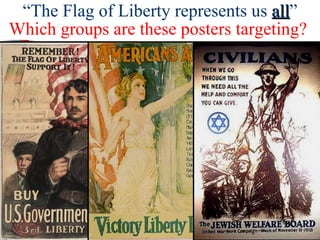
“ The Flag of Liberty represents us  all ” Which groups are these posters targeting?
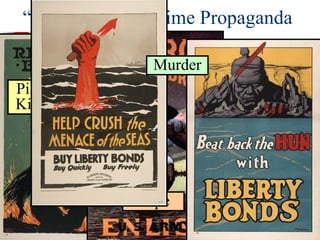
“Emotional” Wartime Propaganda  Pillaging & Kidnapping Rape Murder
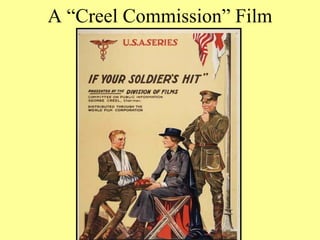
A “Creel Commission” Film
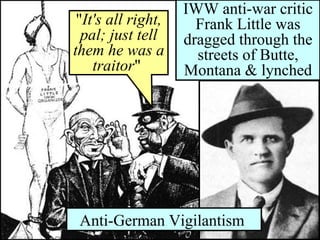
Find image of vigilantism  IWW anti-war critic Frank Little was dragged through the streets of Butte, Montana & lynched Anti-German Vigilantism  " It's all right, pal; just tell them he was a traitor "
Homefront Censorship  Wilson encouraged censorship: Espionage Act —aiding the enemy, obstructing troop recruitment, or encouraging “disloyalty” were declared illegal Trading-with-the-Enemy Act —censored the foreign press Sedition Act —made it illegal to speak “disloyally” towards the U.S. gov’t,   the   flag,   or   U . S .   troops Wilson set out to encourage U.S. unity (like Lincoln during the Civil War, Wilson was willing to use force if needed)
Homefront Censorship First Amendment restrictions were upheld by the Supreme Court: 3 cases were decided in 1919:  Schenk v US ,  Debs v US ,  Abrams v US   that supported gov’t convictions under the Espionage Act of 1917 The gov’t used the wartime climate to undermine radical labor unions (IWW) & socialism  Schenk was sentenced for conspiracy to circulate pamphlets encouraging soldiers to mutiny 1 st  Amendment rights can be restricted when it presents a “clear & present danger” (Like “yelling ‘fire’ in a crowded theater”)  Eugene V. Debs was jailed when his Socialist newsletter  Appeal to Reason  encouraged Americans to resist enlisting in the military to fight a “capitalists’ war” Defendants passed out documents that denounced the sending of U.S. troops to Russia (to resist the Bolshevik Revolution) & that called for a  general strike & other “revolutionary actions”  Socialism in the U.S. never recovered from WWI attacks
Homefront: The Red Scare  A “red scare” hit America as a result of the Russian Revolution Americans feared Lenin’s anti-capitalist revolution & were angry over Russia’s pullout on the Eastern Front  Wilson sent troops to the USSR, refused to recognize the new gov’t, & did not allow Russia to attend the post-war conference
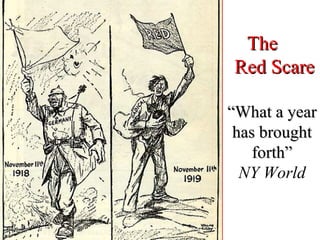
The   Red Scare “ What a year has brought forth” NY World
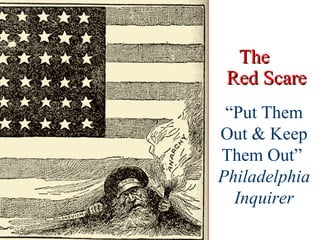
The   Red Scare “ Put Them Out & Keep Them Out”  Philadelphia Inquirer
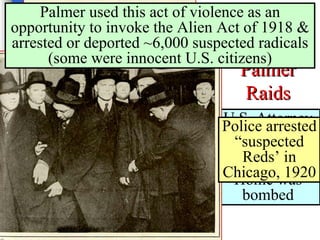
The   Red Scare: Palmer Raids U.S. Attorney General Mitchell Palmer’s Home was bombed Police arrested “suspected Reds’ in Chicago, 1920 Palmer used this act of violence as an opportunity to invoke the Alien Act of 1918 & arrested or deported ~6,000 suspected radicals (some were innocent U.S. citizens)
A Bureaucratic War
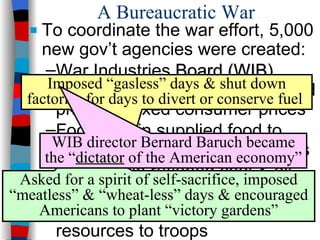
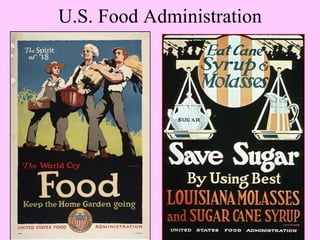
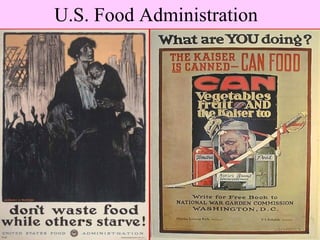
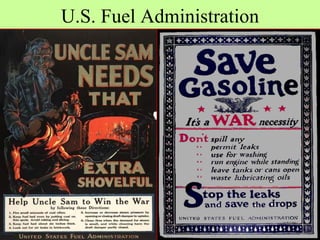
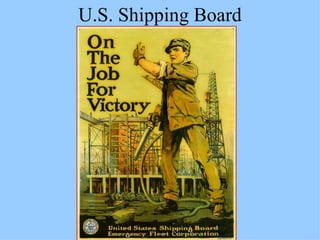
A Bureaucratic War To coordinate the war effort, 5,000 new gov’t agencies were created: War Industries  Board (WIB)  oversaw all factories, determined priorities, fixed consumer prices Food Admin  supplied food to soldiers by appealing to civilians  Fuel Admin  rationed coal & oil RR Admin ,  War Shipping Board ,  &  War Trade Board  helped move resources to troops Imposed “gasless” days & shut down factories for days to divert or conserve fuel  Asked for a spirit of self-sacrifice, imposed “meatless” & “wheat-less” days & encouraged Americans to plant “victory gardens” WIB director Bernard Baruch became the “ dictator  of the American economy”
U.S. Food Administration
U.S. Fuel Administration
U.S. Shipping Board
A Bureaucratic War WWI was expensive, costing the  U.S.   $32   billion,   but   was   paid   for   by Liberty   Bonds   (raised   $23   billion) A boost in personal & corporate income taxes (led to $10 billion) The partnership between business & the gov’t met the war demand & increased business profits 300% An unprecedented alliance
The American War Workforce
Workers in the War WWI led to a new alliance between the gov’t & labor unions: AFL headman Gompers was named to the  Council of Nat’l Defense  to help enlist union support for the war effort War Labor Board (WLB)  was formed to standardize wages & hours, protect union rights, & give equal pay for women
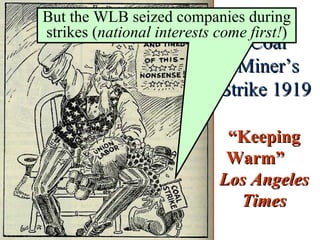
Coal Miner’s Strike 1919   “ Keeping Warm”  Los Angeles Times But the WLB seized companies during strikes ( national interests come first! )
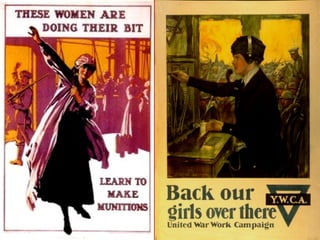
Workers in the War The war called for more laborers: 8 million  women  found new, better-paying jobs in war industry (but few housewives entered the workforce, unlike WW2) 450,000 Southern  blacks  moved north for new industrial jobs & better pay (led to race riots) 100,000  Mexican  laborers worked in SW farms & ranches
 
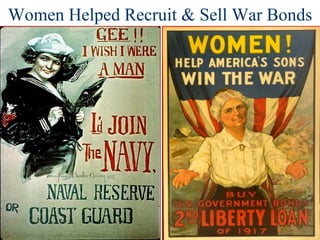
Women Helped Recruit & Sell War Bonds
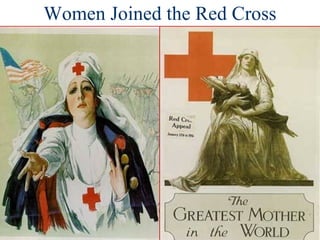
Women Joined the Red Cross
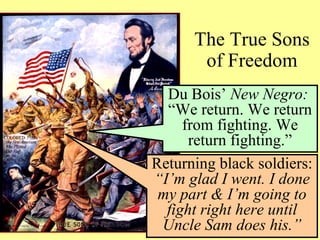
The True Sons of Freedom Returning black soldiers:  “I’m glad I went. I done my part & I’m going to fight right here until Uncle Sam does his.” Du Bois’  New Negro:  “ We return. We return from fighting. We return fighting.”
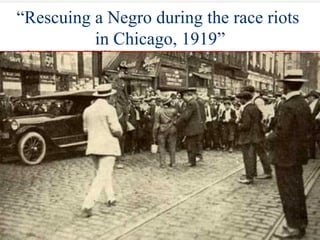
The African American “Migration” Northward, 1910-1920 “ Rescuing a Negro during the race riots  in Chicago, 1919”
Conclusions  World War 1 changed America: The U.S. emerged as the world’s strongest economic power & ushered in the “Roaring 20s” But the U.S. gov’t intervened in American lives as never before: draft, censorship, propaganda, war bonds, partnering with big business & unions At the beginning of the war, the United States owed $3 billion to foreign nations At the end of the war, foreign nations owed the U.S. $13 billion

Ww1 home front5

  • 1.
    Essential Question :How did American efforts at home help win the war and transform the American economy & society?
  • 2.
    “ Over Here” The Homefront During World War I
  • 3.
    “Over Here” Towin over there , the U.S. had to effectively mobilize over here Wilson consolidated federal authority to organize U.S. war production & distribution Wilson began a massive propaganda campaign aimed at winning over the American public to support the war effort
  • 4.
    Homefront Propaganda Wilsonformed the Committee on Public Information (CPI) & hired muckraker George Creel to publicize the U.S. war effort: Voluntary censorship in press 75,000 “4-minute men” gave speeches ( facts or emotions ?) Propaganda motion picture films Led to sweeping anti-German sentiment & some vigilantism “ Why We Are Fighting” & “The Meaning of America” The Prussian Cur & The Kaiser, the Beast of Berlin Sauerkraut was renamed “Liberty Cabbage” & pretzels were no longer served in bars Bach, Beethoven, & Brahms were not played in symphonies
  • 5.
    “ The Flagof Liberty represents us all ” Which groups are these posters targeting?
  • 6.
    “Emotional” Wartime Propaganda Pillaging & Kidnapping Rape Murder
  • 7.
  • 8.
    Find image ofvigilantism IWW anti-war critic Frank Little was dragged through the streets of Butte, Montana & lynched Anti-German Vigilantism " It's all right, pal; just tell them he was a traitor "
  • 9.
    Homefront Censorship Wilson encouraged censorship: Espionage Act —aiding the enemy, obstructing troop recruitment, or encouraging “disloyalty” were declared illegal Trading-with-the-Enemy Act —censored the foreign press Sedition Act —made it illegal to speak “disloyally” towards the U.S. gov’t, the flag, or U . S . troops Wilson set out to encourage U.S. unity (like Lincoln during the Civil War, Wilson was willing to use force if needed)
  • 10.
    Homefront Censorship FirstAmendment restrictions were upheld by the Supreme Court: 3 cases were decided in 1919: Schenk v US , Debs v US , Abrams v US that supported gov’t convictions under the Espionage Act of 1917 The gov’t used the wartime climate to undermine radical labor unions (IWW) & socialism Schenk was sentenced for conspiracy to circulate pamphlets encouraging soldiers to mutiny 1 st Amendment rights can be restricted when it presents a “clear & present danger” (Like “yelling ‘fire’ in a crowded theater”) Eugene V. Debs was jailed when his Socialist newsletter Appeal to Reason encouraged Americans to resist enlisting in the military to fight a “capitalists’ war” Defendants passed out documents that denounced the sending of U.S. troops to Russia (to resist the Bolshevik Revolution) & that called for a general strike & other “revolutionary actions” Socialism in the U.S. never recovered from WWI attacks
  • 11.
    Homefront: The RedScare A “red scare” hit America as a result of the Russian Revolution Americans feared Lenin’s anti-capitalist revolution & were angry over Russia’s pullout on the Eastern Front Wilson sent troops to the USSR, refused to recognize the new gov’t, & did not allow Russia to attend the post-war conference
  • 12.
    The Red Scare “ What a year has brought forth” NY World
  • 13.
    The Red Scare “ Put Them Out & Keep Them Out” Philadelphia Inquirer
  • 14.
    The Red Scare: Palmer Raids U.S. Attorney General Mitchell Palmer’s Home was bombed Police arrested “suspected Reds’ in Chicago, 1920 Palmer used this act of violence as an opportunity to invoke the Alien Act of 1918 & arrested or deported ~6,000 suspected radicals (some were innocent U.S. citizens)
  • 15.
  • 16.
    A Bureaucratic WarTo coordinate the war effort, 5,000 new gov’t agencies were created: War Industries Board (WIB) oversaw all factories, determined priorities, fixed consumer prices Food Admin supplied food to soldiers by appealing to civilians Fuel Admin rationed coal & oil RR Admin , War Shipping Board , & War Trade Board helped move resources to troops Imposed “gasless” days & shut down factories for days to divert or conserve fuel Asked for a spirit of self-sacrifice, imposed “meatless” & “wheat-less” days & encouraged Americans to plant “victory gardens” WIB director Bernard Baruch became the “ dictator of the American economy”
  • 17.
  • 18.
  • 19.
  • 20.
  • 21.
    A Bureaucratic WarWWI was expensive, costing the U.S. $32 billion, but was paid for by Liberty Bonds (raised $23 billion) A boost in personal & corporate income taxes (led to $10 billion) The partnership between business & the gov’t met the war demand & increased business profits 300% An unprecedented alliance
  • 22.
  • 23.
    Workers in theWar WWI led to a new alliance between the gov’t & labor unions: AFL headman Gompers was named to the Council of Nat’l Defense to help enlist union support for the war effort War Labor Board (WLB) was formed to standardize wages & hours, protect union rights, & give equal pay for women
  • 24.
    Coal Miner’s Strike1919 “ Keeping Warm” Los Angeles Times But the WLB seized companies during strikes ( national interests come first! )
  • 25.
    Workers in theWar The war called for more laborers: 8 million women found new, better-paying jobs in war industry (but few housewives entered the workforce, unlike WW2) 450,000 Southern blacks moved north for new industrial jobs & better pay (led to race riots) 100,000 Mexican laborers worked in SW farms & ranches
  • 26.
  • 27.
    Women Helped Recruit& Sell War Bonds
  • 28.
  • 29.
    The True Sonsof Freedom Returning black soldiers: “I’m glad I went. I done my part & I’m going to fight right here until Uncle Sam does his.” Du Bois’ New Negro: “ We return. We return from fighting. We return fighting.”
  • 30.
    The African American“Migration” Northward, 1910-1920 “ Rescuing a Negro during the race riots in Chicago, 1919”
  • 31.
    Conclusions WorldWar 1 changed America: The U.S. emerged as the world’s strongest economic power & ushered in the “Roaring 20s” But the U.S. gov’t intervened in American lives as never before: draft, censorship, propaganda, war bonds, partnering with big business & unions At the beginning of the war, the United States owed $3 billion to foreign nations At the end of the war, foreign nations owed the U.S. $13 billion

Editor's Notes

  • #2 Lesson Plan for Friday, January 23, 2009: RQ 22B, WWI on the homefront notes
  • #5 17
  • #9 Frank Little, outspoken anti-war figure of Industrial Workers of the World union taken, drug through streets of Butte, Montana until his kneecaps fell off, then lynched Robert Prager, German-born American, lynched & murderers acquitted in court
  • #11 Schenck v. United States Citation: 249 U.S. 47 (1919) Concepts: Clear & Present Danger/Free Speech v. Congressional War Powers Facts Charles T. Schenck and Elizabeth Baer, charged with conspiring to print and circulate documents intended to cause insubordination within the military, were convicted of violating the Espionage Act of 1917. The act made it a crime to “willfully cause or attempt to cause insubordination, disloyalty, mutiny, or refusal of duty in the military ... or to willfully obstruct the recruiting service of the United States.” Schenck appealed the conviction to the Supreme Court of the United States, claiming all his actions were protected by the First Amendment. Issue Whether Schenck’s and Baer’s First Amendment right to freedom of speech were violated when they were convicted of conspiring to obstruct the recruitment and enlistment of service. Opinion The Court unanimously upheld the conviction of Schenck, not for violation of the Espionage Act, but rather for conspiracy to violate it. The Court found that the First Amendment did not apply in this case, and that Schenck’s speech was not constitutionally protected because it posed a “clear and present danger” to the country. The nation was involved in World War I, and the Court saw Schenck’s speech and action as counter-productive to the national war effort. The Court reasoned that certain speech could be curtailed, using the example of a situation where one cannot yell “fire” in a crowded theatre.   Debs v. United States Citation: 249 U.S. 211 (1919) Concepts: Free Speech v. Congressional War Powers Facts Eugene V. Debs, a well-known socialist, gave a public speech to an assembly of people in Canton, Ohio. The speech was about the growth of socialism and contained statements which were intended to interfere with recruiting and advocated insubordination, disloyalty, and mutiny in the armed forces. Debs was arrested and charged with violating the Espionage Act of 1917. Issue Whether the United States violated the right of freedom of speech given to Debs in the First Amendment of the United States Constitution. Opinion The Supreme Court of the United States upheld the lower court’s decision in favor of the United States. The Court said that Debs had actually planned to discourage people from enlisting in the Armed Forces. The Court refused to grant him protection under the First Amendment freedom of speech clause, stating that Debs “used words [in his speech] with the purpose of obstructing the recruiting service.” Debs’ conviction under the Espionage Act would stand, because his speech represented a danger to the safety of the United States. Abrams v US Facts of the Case The defendants were convicted on the basis of two leaflets they printed and threw from windows of a building. One leaflet signed "revolutionists" denounced the sending of American troops to Russia. The second leaflet, written in Yiddish, denounced the war and US efforts to impede the Russian Revolution. The defendants were charged and convicted for inciting resistance to the war effort and for urging curtailment of production of essential war material. They were sentenced to 20 years in prison. Question Do the amendments to the Espionage Act or the application of those amendments in this case violate the free speech clause of the First Amendment? Conclusion No and no. The act's amendments are constitutional and the defendants' convictions are affirmed. In Clarke's majority opinion, the leaflets are an appeal to violent revolution, a call for a general strike, and an attempt to curtail production of munitions. The leaflets had a tendency to encourage war resistance and to curtail war production. Holmes and Brandeis dissented on narrow ground: the necessary intent had not been shown. These views were to become a classic libertarian pronouncement.
  • #17 18
  • #24 19
  • #26 20