ENGLISH 10
MISS ROSALYN D. MANDAC
Subject Teacher
Dealing with
Personal
Challenges
Quarter 1 : Module 4
VOCABULARY
WORDS
Quarter 1 : Module 4
VOCABULARY WORDS
1. OBSCURE
not discovered or known
about; uncertain.
VOCABULARY WORDS
2. DISTAFF
a stick or spindle onto which
wool or flax is wound for
spinning.
VOCABULARY WORDS
3. INDIGNANTLY
in a manner indicating anger or
annoyance at something
perceived as unfair.
VOCABULARY WORDS
4. EMBROIDERY
the art or process of forming
decorative designs with hand or
machine needlework.
VOCABULARY WORDS
5. MARVELOUS
causing great wonder;
extraordinary.
VOCABULARY WORDS
6. SHUTTLE
a wooden device with two pointed
ends holding a bobbin, used for
carrying the weft thread between
the warp threads in weaving.
VOCABULARY WORDS
7. DESCENDANTS
a person, plant, or animal that is
descended from a particular
ancestor.
VOCABULARY WORDS
8. SPECTATORS
someone who watches
something, especially a sporting
event.
Whether we like it or not, personal
problems are always there. All we
need to do is to stay calm so that
we can think of good solutions.
The very best thing to do is to know and apply the
different ways to win over challenges and here
they are:
- Admit mistakes
- Make personal adjustments
- Face the conflict
- Emphasize your positive traits
- Use temporary solutions
- Use struggles as opportunities
The text that you are going to read is a myth.
MYTH
A myth is a traditional story that is
rooted in a culture; basically,
religious and explains a belief, a
mysterious natural phenomenon or
a ritual.
MYTH
When you think of myth, you cannot
help but remember that they highlight
significant truths about human
experiences you can rely on for you to
understand yourself better.
MYTH
Remember that they start from the
examples of human desires, intuitions
and motives that make them as reliable,
self-tested guides for people who are
following their destiny and searching for
meaning in life.
Enjoy reading the story and come to think of your
own personal challenges. Try asking yourself these
questions:
➢ What personal challenges do I have?
Enjoy reading the story and come to think of your
own personal challenges. Try asking yourself these
questions:
➢ What personal challenges do I have?
Enjoy reading the story and come to think of your
own personal challenges. Try asking yourself these
questions:
➢ Am I like Arachne, the maiden in the
story?
➢ What personal challenges do I have?
Enjoy reading the story and come to think of your
own personal challenges. Try asking yourself these
questions:
➢ Am I like Arachne, the maiden in the
story?
➢ How do I differ from her?
With these valuable
ideas in mind, read
“Arachne”, a myth from
ancient Greece. As retold
by Olivia Coolidge. Find
out how human desires,
intuitions and motives
lead to dealing with
personal challenges.
READING
TIME
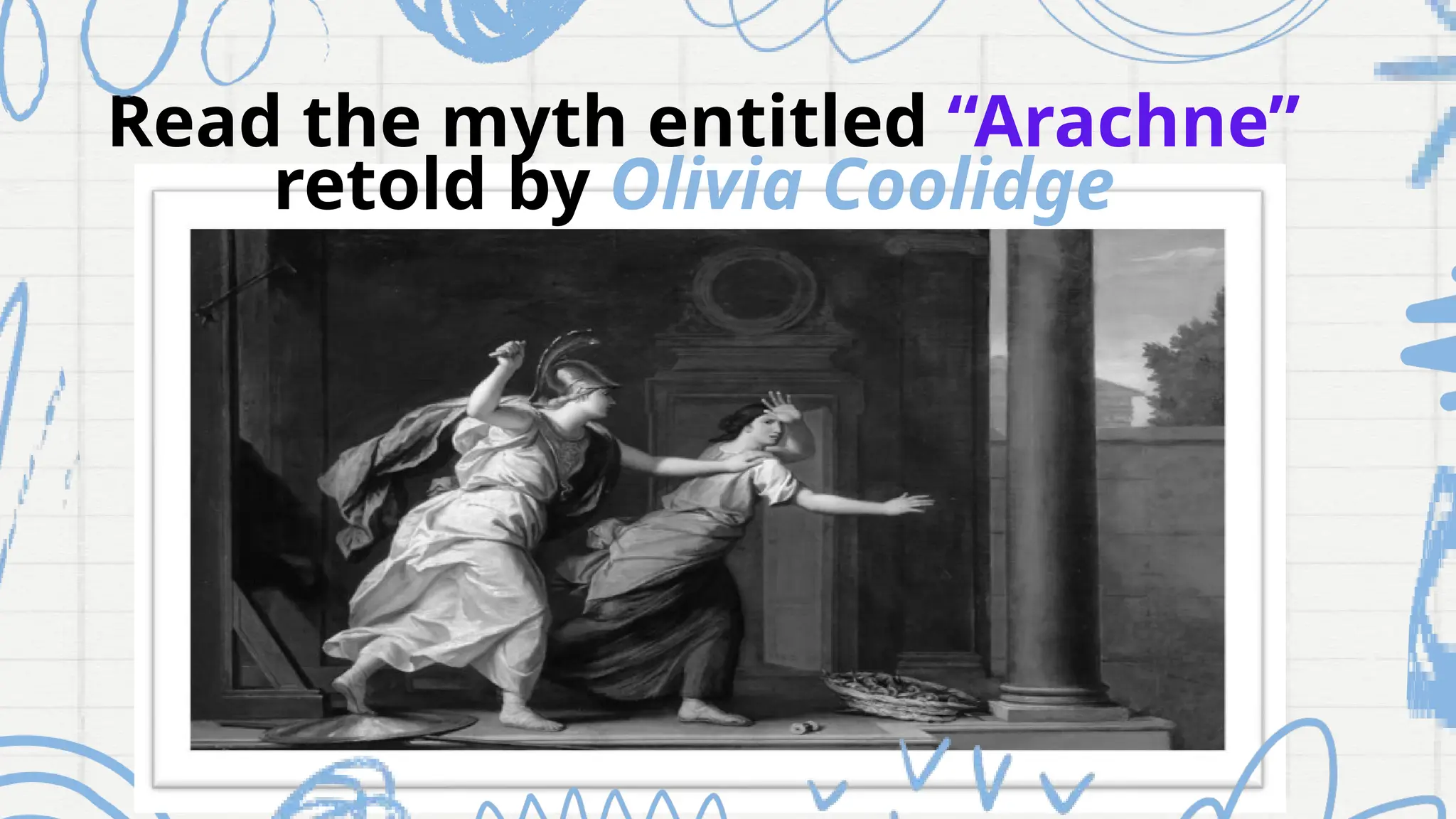
Read the myth entitled “Arachne”
retold by Olivia Coolidge
1. What caused Arachne’s
fear and failure?
QUESTION GUIDE:
2. How did Arachne try to
fight her fear and carry out
the conditions of the
challenge?
QUESTION GUIDE:
3. How did she feel about
her weaving skill?
QUESTION GUIDE:
4. What prevailing mood is
conveyed in “Arachne”?
QUESTION GUIDE:
5. What tone is used in the
selection?
QUESTION GUIDE:
6. Describe how the tone
and the mood contribute to
the total effect of the story?
QUESTION GUIDE:
7. What is the nature of the
conflict in the story?
QUESTION GUIDE:
8. What did Arachne do
that made it difficult for her
to solve her problem?
QUESTION GUIDE:
9. What are some details in
the story that will prove
that Arachne’s pride is the
reason for her downfall?
QUESTION GUIDE:
10. Is the use of poetic justice
(a happy ending where a virtue
is rewarded, and the
wrongdoing is punished) as a
literary device effective in
QUESTION GUIDE:
11. Had Arachne changed her
attitude; do you think the old
woman would have punished
her? Explain.
QUESTION GUIDE:
12. Does the story help you
understand the value of
dealing with challenges?
QUESTION GUIDE:
13. What statement about
human experience does the
story make?
QUESTION GUIDE:
14. Use the Venn diagram to
show the differences and
similarities between Athene
and Arachne.
QUESTION GUIDE:
VENN DIAGRAM
Arachne Athene
Conjunction
is a part is a part of speech that joins or
links words, phrase and clause.
Conjunction
• I like cooking and eating, but I don't
like washing dishes afterward.
Conjunction
• I like cooking and eating, but I don't
like washing dishes afterward.
Conjunction
• I like cooking and eating, but I don't
like washing dishes afterward.
Parenthetical
Expression
is a word or group of words that breaks
the flow of thought but emphasizes a
point, can be set off from the rest of the
words in the sentence by commas.
Parenthetical
Expression
• Tara, although she comes from a hot
climate, hates hot weather.
Parenthetical
Expression
• Tara, although she comes from a hot
climate, hates hot weather.
Parenthetical
Expression
• Tara hates hot weather.
Adverb
is a part of speech that
describes/modifies a verb an adjective
and another adverb.
Adverb
• My friend and I ran quickly to get the
bus.
Adverb
• My friend and I ran quickly to get the
bus.
Adverb
• My friend and I ran quickly to get the
bus.
Conjunctive Adverb
is a conjunction that introduces an
adverbial phrase or clause.
Conjunctive Adverb
• I like you a lot; in fact, I think we
should be best friends.
Conjunctive Adverb
• I like you a lot; in fact, I think we
should be best friends.
COMPREHENSION
CHECK!
Thank you
very much!

ENGLISH 10 - Quarter 1 - Module 4 .pptx