3. Architectural Styles
Software Architecture
• Effective software engineering requires facility in architectural
software design.
• First, it is important to be able to recognize common paradigms so
that high-level relationships among systems can be understood and so
that new systems can be built as variations on old systems.
• Second, getting the right architecture is often crucial to the success of
a software system design; the wrong one can lead to disastrous
results.
• Third, detailed understanding of software architectures allows the
engineer to make principled choices among design alternatives.
• Fourth, an architectural system representation is often essential to the
analysis and description of the high level properties of a complex
system.
• To make sense of the differences between styles, it helps to have a common
framework from which to view them.
• The framework we will adopt is to treat an architecture of a specific system as a
collection of computational.
• components—or simply components-—together with a description of the
interactions between these components—the connectors.
• Graphically speaking, this leads to a view of an abstract architectural
description as a graph in which the nodes represent the components and the
arcs represent the connectors.
• Connectors can represent interactions as varied as procedure call, event
broadcast, database queries, and pipes.
• An architectural style, then, defines a family of such systems in terms of a
pattern of structural organization.
• More specifically, an architectural style determines the vocabulary of
components and connectors that can be used in instances of that style,
together with a set of constraints on how they can be combined.
• These can include topological constraints on architectural descriptions.
Pipes and Filters
• In a pipe and filter style each component has a set of inputs and a set
of outputs.
• A component reads streams of data on its inputs and produces
streams of data on its outputs, delivering a complete instance of the
result in a standard order.
• This is usually accomplished by applying a local transformation to the
input streams and computing incrementally so output begins before
input is consumed. Hence components are termed “filters”.
• The connectors of this style serve as conduits for the streams,
transmitting outputs of one filter to inputs of another. Hence the
connectors are termed “pipes”.
• Among the important invariants of the style, filters must be independent
entities: in particular, they should not share state with other filters.
• Another important invariant is that filters do not know the identity of
their upstream and downstream filters.
• Their specifications might restrict what appears on the input pipes or
make guarantees about what appears on the output pipes, but they may
not identify the components at the ends of those pipes.
• Furthermore, the correctness of the output of a pipe and filter network
should not depend on the order in which the filters perform their
incremental processing—although fair scheduling can be assumed.
• Common specializations of this style include pipelines, which restrict the
topologies to linear sequences of filters; bounded pipes, which restrict
the amount of data that can reside on a pipe; and typed pipes, which
require that the data passed between two filters have a well-defined
type.
• Properties.
1. They allow the designer to understand the overall input/output
behavior of a system as a simple composition of the behaviors of the
individual filters.
2. They support reuse: any two filters can be hooked together, provided
they agree on the data that is being transmitted between them.
3. Systems can be easily maintained and enhanced: new filters can be
added to existing systems and old filters can be replaced by
improved ones.
4. They permit certain kinds of specialized analysis, such as throughput
and deadlock analysis.
5. Finally, they naturally support concurrent execution. Each filter can
be implemented as a separate task and potentially executed in parallel
with other filters.
• Disadvantages:
1. First, pipe and filter systems often lead to a batch organization of
processing. Although filters can process data incrementally, since filters
are inherently independent, the designer is forced to think of each filter
as providing a complete transformation of input data to output data.
2. Because of their transformational character, pipe and filter systems are
typically not good at handling interactive applications. This problem is
most severe when incremental display updates are required, because
the output pattern for incremental updates is radically different from
the pattern for filter output.
3 They may be hampered by having to maintain correspondences between
two separate, but related streams.
4. Third, depending on the implementation, they may force a lowest common
denominator on data transmission, resulting in added work for each filter
to parse and un parse its data. This, in turn, can lead both to loss
of performance and to increased complexity in writing the filters themselves.
Data Abstraction and Object-Oriented Organization
• In this style data representations and their associated primitive
operations are encapsulated in an abstract data type or object.
• The components of this style are the objects—or, if you will, instances of
the abstract data types.
• Objects are examples of a sort of component we call a manager because
it is responsible for preserving the integrity of a resource (here the
representation).
• Objects interact through function and procedure invocations.
• Two important aspects of this style are
– (a) that an object is responsible for preserving the integrity of its representation
(usually by maintaining some invariant over it), and
– (b) that the representation is hidden from other objects.
• Properties
• The use of abstract data types, and increasingly the use of object-
oriented systems, is, of course, widespread.
• There are many variations. For example, some systems allow “objects” to
be concurrent tasks; others allow objects to have multiple interfaces.
• Object-oriented systems have many nice properties, most of which are
well known. Because an object hides its representation from its clients, it
is possible to change the implementation without affecting those clients.
• Additionally, the bundling of a set of accessing routines with the data
they manipulate allows designers to decompose problems into
collections of interacting agents.
• Disadvantages.
• In order for one object to interact with another (via procedure call) it
must know the identity of that other object. This is in contrast, for
example, to pipe and filter systems, where filters do need not know
what other filters are in the system in order to interact with them.
• Whenever the identity of an object changes it is necessary to modify all
other objects that explicitly invoke it.
• In a module oriented language this manifests itself as the need to
change the “import” list of every module that uses the changed module.
• if A uses object B and C also uses B, then C's effects on B look like
unexpected side effects to A, and vice versa.
Event-based, Implicit Invocation
• The idea behind implicit invocation is that instead of invoking a
procedure directly, a component can announce (or broadcast) one
or more events.
• Other components in the system can register an interest in an event by
associating a procedure with the event.
• When the event is announced the system itself invokes all of the
procedures that have been registered for the event.
• Thus an event announcement ``implicitly'' causes the invocation of
procedures in other modules.
• Architecturally speaking, the components in an implicit invocation style are
modules whose interfaces provide both a collection of procedures (as with
abstract data types) and a set of events.
• Procedures may be called in the usual way.
• But in addition, a component can register some of its procedures with events of
the system.
• This will cause these procedures to be invoked when those events are
announced at run time.
• Thus the connectors in an implicit invocation system include traditional
procedure call as well as bindings between event announcements and
procedure calls.
• The main invariant of this style is that announcers of events do not know which
components will be affected by those events.
• Thus components cannot make assumptions about order of processing, or even
about what processing, will occur as a result of their events.
• For this reason, most implicit invocation systems also include explicit invocation
(i.e., normal procedure call) as a complementary form of interaction.
• Benefit:
1. One important benefit of implicit invocation is that it provides strong support
for reuse. Any component can be introduced into a system simply by
registering it for the events of that system.
2. Implicit invocation eases system evolution. Components may be replaced by
other components without affecting the interfaces of other components in
the system.
• In contrast, in a system based on explicit invocation, whenever the identity of
a that provides some system function is changed, all other modules that
import that module must also be changed.
• Disadvantage:
1. Components relinquish control over the computation performed by the
system. When a component announces an event, it has no idea what
other components will respond to it.
Worse, even if it does know what other components are interested in
the events it announces, it cannot rely on the order in which they are invoked.
Nor can it know when they are finished.
2. Another problem concerns exchange of data. Sometimes data can be
passed with the event. But in other situations event systems must rely on
a shared repository for interaction. In these cases global performance
and resource management can become a serious issue.
3. Finally, reasoning about correctness can be problematic, since the meaning of
a procedure that announces events will depend on the context of bindings in
which it is invoked. This is in contrast to traditional reasoning about procedure
calls, which need only consider a procedure’s pre- and post-conditions when
reasoning about an invocation of it.
Layered Systems
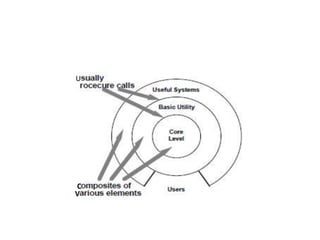
• A layered system is organized hierarchically, each layer providing service to the
layer above it and serving as a client to the layer below.
• In some layered systems inner layers are hidden from all except the adjacent
outer layer, except for certain functions carefully selected for export.
• Thus in these systems the components implement a virtual machine at some
layer in the hierarchy.
• The connectors are defined by the protocols that determine how the layers will
interact.
• Topological constraints include limiting interactions to adjacent layers.
U
C
V
• Properties.
1. They support design based on increasing levels of abstraction. This allows
implementors to partition a complex problem into a sequence of incremental
steps.
2. They support enhancement. Like pipelines, because each layer interacts with
at most the layers below and above, changes to the function of one layer affect
at most two other layers.
3. They support reuse. Like abstract data types, different implementations of the
same layer can be used interchangeably, provided they support the same
interfaces to their adjacent layers. This leads to the possibility of defining
standard layer interfaces to which different implementors can build.
• Disadvantages.
• Not all systems are easily structured in a layered fashion. And even if a system
can logically be structured as layers, considerations of performance may
require closer coupling between logically high-level functions and their lower-
level implementations.
• Additionally, it can be quite difficult to find the right levels of abstraction. This
is particularly true for standardized layered models.
• One notes that the communications community has had some difficulty
mapping existing protocols into the ISO framework: many of those protocols
bridge several layers.
Repositories
• In a repository style there are two quite distinct kinds of components: a central
data structure represents the current state, and a collection of independent
components operate on the central data store.
• Interactions between the repository and its external components can vary
significantly between systems.
• The choice of control discipline leads to major subcategories. If the types of
transactions in an input stream of transactions trigger selection of processes to
execute, the repository can be a traditional database.
• If the current state of the central data structure is the main trigger of selecting
processes to execute, the repository can be a blackboard.
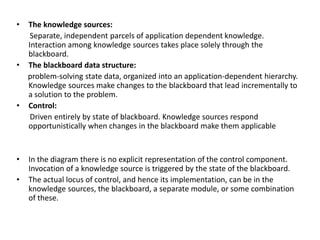
• Figure illustrates a simple view of a blackboard architecture. The blackboard
model is usually presented with three major parts.
• The knowledge sources:
Separate, independent parcels of application dependent knowledge.
Interaction among knowledge sources takes place solely through the
blackboard.
• The blackboard data structure:
problem-solving state data, organized into an application-dependent hierarchy.
Knowledge sources make changes to the blackboard that lead incrementally to
a solution to the problem.
• Control:
Driven entirely by state of blackboard. Knowledge sources respond
opportunistically when changes in the blackboard make them applicable
• In the diagram there is no explicit representation of the control component.
Invocation of a knowledge source is triggered by the state of the blackboard.
• The actual locus of control, and hence its implementation, can be in the
knowledge sources, the blackboard, a separate module, or some combination
of these.
.
D C
• Applications
• Batch sequential systems with global databases are a special case.
• Programming environments are often organized as a collection of tools together
with a shared repository of programs and program fragments .
• Even applications that have been traditionally viewed as pipeline architectures,
may be more accurately interpreted as repository systems.
• For example, while a compiler architecture has traditionally been presented as a
pipeline, the “phases” of most modern compilers operate on a base of shared
information. (symbol tables, abstract syntax tree, etc.).
Interpreters
• In an interpreter organization a virtual machine is produced in software.
• An interpreter includes the pseudo-program being interpreted and the
interpretation engine itself.
• The pseudo-program includes the program itself and the interpreter’s analog
of its execution state (activation record).
• The interpretation engine includes both the definition of the interpreter and
the current state of its execution.
• Thus an interpreter generally has four components: an interpretation engine to
do the work, a memory that contains the pseudo-code to be interpreted, a
representation of the control state of the interpretation engine, and a
representation of the current state of the program being simulated.
• Interpreters are commonly used to build virtual machines that close
the gap between the computing engine expected by the semantics
of the program and the computing engine available in hardware.
• We occasionally speak of a programming language as providing, say,
a “virtual Pascal machine.”
Other Familiar Architectures
 Distributed processes:
• Distributed systems have developed a number of common organizations for
multi-process systems .
• Some can be characterized primarily by their topological features, such as ring
and star organizations.
• Others are better characterized in terms of the kinds of inter-process protocols
that are used for communication (e.g., heartbeat algorithms).
• One common form of distributed system architecture is a “client-server”
organization . In these systems a server represents a process that provides
services to other processes (the clients).
 Main program/subroutine organizations:
• The primary organization of many systems mirrors the programming language
in which the system is written.
• For languages without support for modularization this often results in a
system organized around a main program and a set of subroutines.
• The main program acts as the driver for the subroutines, typically providing a
control loop for sequencing through the subroutines in some order.
 Domain-specific software architectures:
• Recently there has been considerable interest in developing “reference”
architectures for specific domains.
• These architectures provide an organizational structure tailored to a family of
applications, such as avionics, command and control, or vehicle management
systems.
• By specializing the architecture to the domain, it is possible to increase the
descriptive power of structures.
• Indeed, in many cases the architecture is sufficiently constrained that an
executable system can be generated automatically or semi-automatically from
the architectural description itself.
 State transition systems:
• A common organization for many reactive systems is the state transition
system .
• These systems are defined in terms a set of states and a set of named
transitions that move a system from one state to another.
 Process control systems:
• Systems intended to provide dynamic control of a physical environment
are often organized as process control systems.
• These systems are roughly characterized as a feedback loop in which
inputs from sensors are used by the process control system to determine a
set of outputs that will produce a new state of the environment.
Heterogeneous Architectures
• There are different ways in which architectural styles can be combined.
• One way is through hierarchy. A component of a system organized in one
architectural style may have an internal structure that is developed a
completely different style.
• For example, in a Unix pipeline the individual components may be represented
internally using virtually any style— including, of course, another pipe and filter,
system.
• What is perhaps more surprising is that connectors, too, can often be
hierarchically decomposed.
• For example, a pipe connector may be implemented internally as a FIFO queue
accessed by insert and remove operations.
• A second way for styles to be combined is to permit a single component to use
a mixture of architectural connectors.
• For example, a component might access a repository through part of its
interface, but interact through pipes with other components in a system, and
accept control information through another part of its interface. (In fact, Unix
pipe and filter systems do this, the file system playing the role of the repository
and initialization switches playing the role of control.).
• Another example is an “active database”. This is a repository which activates
external components through implicit invocation.
• In this organization external components register interest in portions of the
database.
• The database automatically invokes the appropriate tools based on this
association. (Blackboards are often constructed this way; knowledge sources
are associated with specific kinds of data, and are activated whenever that
kind of data is modified.)
• A third way for styles to be combined is to completely elaborate one level of
architectural description in a completely different architectural style
References
• Software Architecture in Practice. By Len
Bass, Paul Clements, Rick Kazman
• Software Architecture- Perspectives on an
emerging discipline by Mary shaw and David
Garlan
Chapter 3_Architectural Styles.pptx

Chapter 3_Architectural Styles.pptx

  • 1.
  • 2.
    Software Architecture • Effectivesoftware engineering requires facility in architectural software design. • First, it is important to be able to recognize common paradigms so that high-level relationships among systems can be understood and so that new systems can be built as variations on old systems. • Second, getting the right architecture is often crucial to the success of a software system design; the wrong one can lead to disastrous results. • Third, detailed understanding of software architectures allows the engineer to make principled choices among design alternatives. • Fourth, an architectural system representation is often essential to the analysis and description of the high level properties of a complex system.
  • 3.
    • To makesense of the differences between styles, it helps to have a common framework from which to view them. • The framework we will adopt is to treat an architecture of a specific system as a collection of computational. • components—or simply components-—together with a description of the interactions between these components—the connectors. • Graphically speaking, this leads to a view of an abstract architectural description as a graph in which the nodes represent the components and the arcs represent the connectors. • Connectors can represent interactions as varied as procedure call, event broadcast, database queries, and pipes. • An architectural style, then, defines a family of such systems in terms of a pattern of structural organization. • More specifically, an architectural style determines the vocabulary of components and connectors that can be used in instances of that style, together with a set of constraints on how they can be combined. • These can include topological constraints on architectural descriptions.
  • 4.
    Pipes and Filters •In a pipe and filter style each component has a set of inputs and a set of outputs. • A component reads streams of data on its inputs and produces streams of data on its outputs, delivering a complete instance of the result in a standard order. • This is usually accomplished by applying a local transformation to the input streams and computing incrementally so output begins before input is consumed. Hence components are termed “filters”. • The connectors of this style serve as conduits for the streams, transmitting outputs of one filter to inputs of another. Hence the connectors are termed “pipes”.
  • 5.
    • Among theimportant invariants of the style, filters must be independent entities: in particular, they should not share state with other filters. • Another important invariant is that filters do not know the identity of their upstream and downstream filters. • Their specifications might restrict what appears on the input pipes or make guarantees about what appears on the output pipes, but they may not identify the components at the ends of those pipes. • Furthermore, the correctness of the output of a pipe and filter network should not depend on the order in which the filters perform their incremental processing—although fair scheduling can be assumed. • Common specializations of this style include pipelines, which restrict the topologies to linear sequences of filters; bounded pipes, which restrict the amount of data that can reside on a pipe; and typed pipes, which require that the data passed between two filters have a well-defined type.
  • 7.
    • Properties. 1. Theyallow the designer to understand the overall input/output behavior of a system as a simple composition of the behaviors of the individual filters. 2. They support reuse: any two filters can be hooked together, provided they agree on the data that is being transmitted between them. 3. Systems can be easily maintained and enhanced: new filters can be added to existing systems and old filters can be replaced by improved ones. 4. They permit certain kinds of specialized analysis, such as throughput and deadlock analysis. 5. Finally, they naturally support concurrent execution. Each filter can be implemented as a separate task and potentially executed in parallel with other filters.
  • 8.
    • Disadvantages: 1. First,pipe and filter systems often lead to a batch organization of processing. Although filters can process data incrementally, since filters are inherently independent, the designer is forced to think of each filter as providing a complete transformation of input data to output data. 2. Because of their transformational character, pipe and filter systems are typically not good at handling interactive applications. This problem is most severe when incremental display updates are required, because the output pattern for incremental updates is radically different from the pattern for filter output. 3 They may be hampered by having to maintain correspondences between two separate, but related streams. 4. Third, depending on the implementation, they may force a lowest common denominator on data transmission, resulting in added work for each filter to parse and un parse its data. This, in turn, can lead both to loss of performance and to increased complexity in writing the filters themselves.
  • 9.
    Data Abstraction andObject-Oriented Organization • In this style data representations and their associated primitive operations are encapsulated in an abstract data type or object. • The components of this style are the objects—or, if you will, instances of the abstract data types. • Objects are examples of a sort of component we call a manager because it is responsible for preserving the integrity of a resource (here the representation). • Objects interact through function and procedure invocations. • Two important aspects of this style are – (a) that an object is responsible for preserving the integrity of its representation (usually by maintaining some invariant over it), and – (b) that the representation is hidden from other objects.
  • 11.
    • Properties • Theuse of abstract data types, and increasingly the use of object- oriented systems, is, of course, widespread. • There are many variations. For example, some systems allow “objects” to be concurrent tasks; others allow objects to have multiple interfaces. • Object-oriented systems have many nice properties, most of which are well known. Because an object hides its representation from its clients, it is possible to change the implementation without affecting those clients. • Additionally, the bundling of a set of accessing routines with the data they manipulate allows designers to decompose problems into collections of interacting agents.
  • 12.
    • Disadvantages. • Inorder for one object to interact with another (via procedure call) it must know the identity of that other object. This is in contrast, for example, to pipe and filter systems, where filters do need not know what other filters are in the system in order to interact with them. • Whenever the identity of an object changes it is necessary to modify all other objects that explicitly invoke it. • In a module oriented language this manifests itself as the need to change the “import” list of every module that uses the changed module. • if A uses object B and C also uses B, then C's effects on B look like unexpected side effects to A, and vice versa.
  • 13.
    Event-based, Implicit Invocation •The idea behind implicit invocation is that instead of invoking a procedure directly, a component can announce (or broadcast) one or more events. • Other components in the system can register an interest in an event by associating a procedure with the event. • When the event is announced the system itself invokes all of the procedures that have been registered for the event. • Thus an event announcement ``implicitly'' causes the invocation of procedures in other modules.
  • 14.
    • Architecturally speaking,the components in an implicit invocation style are modules whose interfaces provide both a collection of procedures (as with abstract data types) and a set of events. • Procedures may be called in the usual way. • But in addition, a component can register some of its procedures with events of the system. • This will cause these procedures to be invoked when those events are announced at run time. • Thus the connectors in an implicit invocation system include traditional procedure call as well as bindings between event announcements and procedure calls. • The main invariant of this style is that announcers of events do not know which components will be affected by those events. • Thus components cannot make assumptions about order of processing, or even about what processing, will occur as a result of their events. • For this reason, most implicit invocation systems also include explicit invocation (i.e., normal procedure call) as a complementary form of interaction.
  • 15.
    • Benefit: 1. Oneimportant benefit of implicit invocation is that it provides strong support for reuse. Any component can be introduced into a system simply by registering it for the events of that system. 2. Implicit invocation eases system evolution. Components may be replaced by other components without affecting the interfaces of other components in the system. • In contrast, in a system based on explicit invocation, whenever the identity of a that provides some system function is changed, all other modules that import that module must also be changed.
  • 16.
    • Disadvantage: 1. Componentsrelinquish control over the computation performed by the system. When a component announces an event, it has no idea what other components will respond to it. Worse, even if it does know what other components are interested in the events it announces, it cannot rely on the order in which they are invoked. Nor can it know when they are finished. 2. Another problem concerns exchange of data. Sometimes data can be passed with the event. But in other situations event systems must rely on a shared repository for interaction. In these cases global performance and resource management can become a serious issue. 3. Finally, reasoning about correctness can be problematic, since the meaning of a procedure that announces events will depend on the context of bindings in which it is invoked. This is in contrast to traditional reasoning about procedure calls, which need only consider a procedure’s pre- and post-conditions when reasoning about an invocation of it.
  • 17.
    Layered Systems • Alayered system is organized hierarchically, each layer providing service to the layer above it and serving as a client to the layer below. • In some layered systems inner layers are hidden from all except the adjacent outer layer, except for certain functions carefully selected for export. • Thus in these systems the components implement a virtual machine at some layer in the hierarchy. • The connectors are defined by the protocols that determine how the layers will interact. • Topological constraints include limiting interactions to adjacent layers.
  • 18.
  • 19.
    • Properties. 1. Theysupport design based on increasing levels of abstraction. This allows implementors to partition a complex problem into a sequence of incremental steps. 2. They support enhancement. Like pipelines, because each layer interacts with at most the layers below and above, changes to the function of one layer affect at most two other layers. 3. They support reuse. Like abstract data types, different implementations of the same layer can be used interchangeably, provided they support the same interfaces to their adjacent layers. This leads to the possibility of defining standard layer interfaces to which different implementors can build.
  • 20.
    • Disadvantages. • Notall systems are easily structured in a layered fashion. And even if a system can logically be structured as layers, considerations of performance may require closer coupling between logically high-level functions and their lower- level implementations. • Additionally, it can be quite difficult to find the right levels of abstraction. This is particularly true for standardized layered models. • One notes that the communications community has had some difficulty mapping existing protocols into the ISO framework: many of those protocols bridge several layers.
  • 21.
    Repositories • In arepository style there are two quite distinct kinds of components: a central data structure represents the current state, and a collection of independent components operate on the central data store. • Interactions between the repository and its external components can vary significantly between systems. • The choice of control discipline leads to major subcategories. If the types of transactions in an input stream of transactions trigger selection of processes to execute, the repository can be a traditional database. • If the current state of the central data structure is the main trigger of selecting processes to execute, the repository can be a blackboard. • Figure illustrates a simple view of a blackboard architecture. The blackboard model is usually presented with three major parts.
  • 22.
    • The knowledgesources: Separate, independent parcels of application dependent knowledge. Interaction among knowledge sources takes place solely through the blackboard. • The blackboard data structure: problem-solving state data, organized into an application-dependent hierarchy. Knowledge sources make changes to the blackboard that lead incrementally to a solution to the problem. • Control: Driven entirely by state of blackboard. Knowledge sources respond opportunistically when changes in the blackboard make them applicable • In the diagram there is no explicit representation of the control component. Invocation of a knowledge source is triggered by the state of the blackboard. • The actual locus of control, and hence its implementation, can be in the knowledge sources, the blackboard, a separate module, or some combination of these.
  • 23.
  • 24.
    • Applications • Batchsequential systems with global databases are a special case. • Programming environments are often organized as a collection of tools together with a shared repository of programs and program fragments . • Even applications that have been traditionally viewed as pipeline architectures, may be more accurately interpreted as repository systems. • For example, while a compiler architecture has traditionally been presented as a pipeline, the “phases” of most modern compilers operate on a base of shared information. (symbol tables, abstract syntax tree, etc.).
  • 25.
    Interpreters • In aninterpreter organization a virtual machine is produced in software. • An interpreter includes the pseudo-program being interpreted and the interpretation engine itself. • The pseudo-program includes the program itself and the interpreter’s analog of its execution state (activation record). • The interpretation engine includes both the definition of the interpreter and the current state of its execution. • Thus an interpreter generally has four components: an interpretation engine to do the work, a memory that contains the pseudo-code to be interpreted, a representation of the control state of the interpretation engine, and a representation of the current state of the program being simulated.
  • 27.
    • Interpreters arecommonly used to build virtual machines that close the gap between the computing engine expected by the semantics of the program and the computing engine available in hardware. • We occasionally speak of a programming language as providing, say, a “virtual Pascal machine.”
  • 28.
    Other Familiar Architectures Distributed processes: • Distributed systems have developed a number of common organizations for multi-process systems . • Some can be characterized primarily by their topological features, such as ring and star organizations. • Others are better characterized in terms of the kinds of inter-process protocols that are used for communication (e.g., heartbeat algorithms). • One common form of distributed system architecture is a “client-server” organization . In these systems a server represents a process that provides services to other processes (the clients).
  • 29.
     Main program/subroutineorganizations: • The primary organization of many systems mirrors the programming language in which the system is written. • For languages without support for modularization this often results in a system organized around a main program and a set of subroutines. • The main program acts as the driver for the subroutines, typically providing a control loop for sequencing through the subroutines in some order.  Domain-specific software architectures: • Recently there has been considerable interest in developing “reference” architectures for specific domains. • These architectures provide an organizational structure tailored to a family of applications, such as avionics, command and control, or vehicle management systems. • By specializing the architecture to the domain, it is possible to increase the descriptive power of structures. • Indeed, in many cases the architecture is sufficiently constrained that an executable system can be generated automatically or semi-automatically from the architectural description itself.
  • 30.
     State transitionsystems: • A common organization for many reactive systems is the state transition system . • These systems are defined in terms a set of states and a set of named transitions that move a system from one state to another.  Process control systems: • Systems intended to provide dynamic control of a physical environment are often organized as process control systems. • These systems are roughly characterized as a feedback loop in which inputs from sensors are used by the process control system to determine a set of outputs that will produce a new state of the environment.
  • 31.
    Heterogeneous Architectures • Thereare different ways in which architectural styles can be combined. • One way is through hierarchy. A component of a system organized in one architectural style may have an internal structure that is developed a completely different style. • For example, in a Unix pipeline the individual components may be represented internally using virtually any style— including, of course, another pipe and filter, system. • What is perhaps more surprising is that connectors, too, can often be hierarchically decomposed. • For example, a pipe connector may be implemented internally as a FIFO queue accessed by insert and remove operations.
  • 32.
    • A secondway for styles to be combined is to permit a single component to use a mixture of architectural connectors. • For example, a component might access a repository through part of its interface, but interact through pipes with other components in a system, and accept control information through another part of its interface. (In fact, Unix pipe and filter systems do this, the file system playing the role of the repository and initialization switches playing the role of control.). • Another example is an “active database”. This is a repository which activates external components through implicit invocation. • In this organization external components register interest in portions of the database. • The database automatically invokes the appropriate tools based on this association. (Blackboards are often constructed this way; knowledge sources are associated with specific kinds of data, and are activated whenever that kind of data is modified.) • A third way for styles to be combined is to completely elaborate one level of architectural description in a completely different architectural style
  • 33.
    References • Software Architecturein Practice. By Len Bass, Paul Clements, Rick Kazman • Software Architecture- Perspectives on an emerging discipline by Mary shaw and David Garlan