BenefitsI like benefits!American Free Enterprise
Where are we?The per capita income (PPP) of the U.S. is somewhere betweeen 4th and 8th in the world depending on the source.Other countries in front of us, such as Luxembourg, Norway, and Qatar, have a fraction of our land area and population.Norway, for example, has a 149 square miles and 4.8 million people.  The U.S. has 3.7 million square miles and 307 million people.That the United States is able to be so incredibly prosperous despite its size is pretty remarkable… so how’d we get here?
QuestionWho has done more to benefit humanity: Mother Teresa or Bill Gates?What would our good friend Adam Smith say?
Free EnterpriseAmerica has a tradition of free enterprise and entrepreneurship.  Further, the government (ideally) protects the ability for free enterprise to operate.  How so?
Constitutional ProtectionsA lot of U.S. political ideology (as seen in the Declaration of Independence and Constitution) comes out of social contract theory.Hobbes argued the main role of the sovereign (the government) was to protect and enforce contracts and agreements between people.Locke argued the main role was to protect the life, liberty, and property of the people.
Constitutional ProtectionsProperty rightsIt’s hard to imagine that free enterprise can flourish if people don’t think their property is safe from others and from the government.Why excel if you have no assurance that what you earn is safely yours?If the government can take your property at any time or one any whim, is it even really yours?
Constitutional ProtectionsProperty rightsThus, the Constitution has built in protections for your stuff.  See the 5th and 14th amendments.
Constitutional ProtectionsProperty rights5th Amendment: “No person shall be held to answer for a capital, or otherwise infamous crime, unless on a presentment or indictment of a Grand Jury, except in cases arising in the land or naval forces, or in the Militia, when in actual service in time of War or public danger; nor shall any person be subject for the same offence to be twice put in jeopardy of life or limb; nor shall be compelled in any criminal case to be a witness against himself, nor be deprived of life, liberty, or property, without due process of law; nor shall private property be taken for public use, without just compensation.”
Constitutional ProtectionsProperty rights14th Amendment: “Section 1: All persons born or naturalized in the United States, and subject to the jurisdiction thereof, are citizens of the United States and of the State wherein they reside. No State shall make or enforce any law which shall abridge the privileges or immunities of citizens of the United States; nor shall any State deprive any person of life, liberty, or property, without due process of law; nor deny to any person within its jurisdiction the equal protection of the laws.”
Constitutional ProtectionsTaxationStupid taxes.Well, the government, if it’s to do its job, needs money from somewhere (though there’s plenty of debate on how much it gets and what it’s using it for).Article I, section 8, clause 1 of the Constitution gives Congress the power of direct taxation of uniform rates: “To lay and collect Taxes, Duties, Imposts and Excises to pay the Debts and provide for the common Defence and general Welfare of the Unites States; but all Duties, Imposts and Excises, shall be uniform throughout the United States;”
Constitutional ProtectionsTaxationThe 16th amendment allows the federal government to tax income: “The Congress shall have power to lay and collect taxes on incomes, from whatever source derived, without apportionment among the several States, and without regard to any census or enumeration.”
Constitutional ProtectionsProtect those contracts!Article I, section 10, clause 1: “No State shall enter into any Treaty, Alliance, or Confederation; grant Letters of Marque and Reprisal; coin Money; emit Bills of Credit; make any Thing but gold and silver Coin a Tender in Payment of Debts; pass any Bill of Attainder, ex post facto Law, or Law impairing the Obligation of Contracts, or grant any Title of Nobility.”
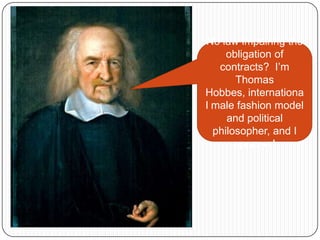
No law impairing the obligation of contracts?  I’m Thomas Hobbes, international male fashion model and political philosopher, and I approve!
Basic Principles of Free EnterpriseProfit MotivePeople and businesses want to make money.This encourages efficiency, productivity, innovation, etc.People can make their own decisions about what’s best for them instead of it being decided for them.
Basic Principles of Free EnterpriseOpen OpportunityThe idea that anyone can compete in the marketplace.Some may certain advantages and others disadvantages, but everybody has the potential for success or failure based on merits.
Basic Principles of Free EnterpriseLegal EqualityEveryone has equal protections and rights under the law.This isn’t just a feel-good measure or good because it’s the right thing.It’s also economically good because then all of an economy’s human capital can be made use of.If, say, women or minorities are legally restricted in the marketplace, this is human capital not being fully used.This is inefficient and is underutilization.
Basic Principles of Free EnterprisePrivate property rightsYour stuff under your control to use and dispose of as you wish.
Basic Principles of Free EnterpriseFree contractYou can decide what contracts you want to enter into.  You can’t be forced into them.
Basic Principles of Free EnterpriseVoluntary ExchangeEntities enter into contracts willingly and in such a way that the parties come out better than they went in.The win-win scenarios.  Nobody is forced into a win-lose scenario and forced into contracts by, say, the government, they don’t like.
Basic Principles of Free EnterpriseQuestion: How well do you think American free enterprise fulfills these principles?  Why?  Porque?  Porquoi?
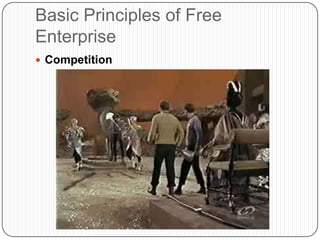
Basic Principles of Free EnterpriseCompetition
The Role of GovernmentSo what’s Uncle Sam doin’ for ya?  Aside from that Constitutional stuff?A big part of it is stability and allowing for consistent expectations.You want to know that the rules of the game don’t change too drastically.
The Role of GovernmentBad Stuff:The government also has a negative effect on things.
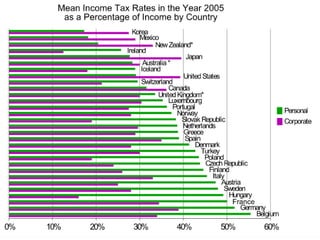
The Role of GovernmentTaxationTaxes are necessary, but there’s the possibility they can be too high.Taxes are monies taken out of the private sector and being put to public use.
The Role of GovernmentTaxationThis is fine for many public services, but the government sometimes gets involved in other endeavors that are usually the handled by the private sector.This creates a possible conflict of interests in the government gaming the system in favor of its entities.It also assumes that the government knows how to spend money better than the private sector.
The Role of GovernmentQuestion: How does this affect us concerning the $800 billion stimulus bill passed in January?John Maynard Keynes argues for government spending during a recession in order to stimulate the economy.  He said it would be stimulating  (tee hee) for the government to pay men to just dig a ditch and fill it back up again.  True or false?
The Role of GovernmentQuestion: Should there be taxes on excess profits made by companies such as on oil companies?Question: Should there be corporate taxes at all?
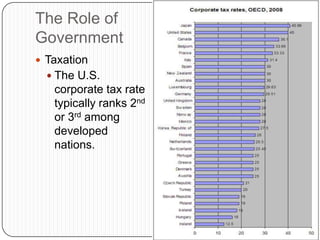
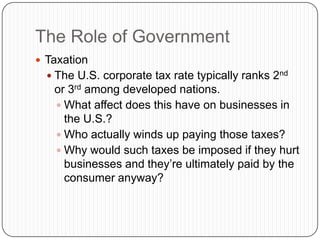
The Role of GovernmentTaxationThe U.S. corporate tax rate typically ranks 2nd or 3rd among developed nations.
The Role of GovernmentTaxationThe U.S. corporate tax rate typically ranks 2nd or 3rd among developed nations.  What affect does this have on businesses in the U.S.?  Who actually winds up paying those taxes?Why would such taxes be imposed if they hurt businesses and they’re ultimately paid by the consumer anyway?

American Free Enterprise

  • 1.
  • 2.
    Where are we?Theper capita income (PPP) of the U.S. is somewhere betweeen 4th and 8th in the world depending on the source.Other countries in front of us, such as Luxembourg, Norway, and Qatar, have a fraction of our land area and population.Norway, for example, has a 149 square miles and 4.8 million people. The U.S. has 3.7 million square miles and 307 million people.That the United States is able to be so incredibly prosperous despite its size is pretty remarkable… so how’d we get here?
  • 3.
    QuestionWho has donemore to benefit humanity: Mother Teresa or Bill Gates?What would our good friend Adam Smith say?
  • 4.
    Free EnterpriseAmerica hasa tradition of free enterprise and entrepreneurship. Further, the government (ideally) protects the ability for free enterprise to operate. How so?
  • 5.
    Constitutional ProtectionsA lotof U.S. political ideology (as seen in the Declaration of Independence and Constitution) comes out of social contract theory.Hobbes argued the main role of the sovereign (the government) was to protect and enforce contracts and agreements between people.Locke argued the main role was to protect the life, liberty, and property of the people.
  • 6.
    Constitutional ProtectionsProperty rightsIt’shard to imagine that free enterprise can flourish if people don’t think their property is safe from others and from the government.Why excel if you have no assurance that what you earn is safely yours?If the government can take your property at any time or one any whim, is it even really yours?
  • 7.
    Constitutional ProtectionsProperty rightsThus,the Constitution has built in protections for your stuff. See the 5th and 14th amendments.
  • 8.
    Constitutional ProtectionsProperty rights5thAmendment: “No person shall be held to answer for a capital, or otherwise infamous crime, unless on a presentment or indictment of a Grand Jury, except in cases arising in the land or naval forces, or in the Militia, when in actual service in time of War or public danger; nor shall any person be subject for the same offence to be twice put in jeopardy of life or limb; nor shall be compelled in any criminal case to be a witness against himself, nor be deprived of life, liberty, or property, without due process of law; nor shall private property be taken for public use, without just compensation.”
  • 9.
    Constitutional ProtectionsProperty rights14thAmendment: “Section 1: All persons born or naturalized in the United States, and subject to the jurisdiction thereof, are citizens of the United States and of the State wherein they reside. No State shall make or enforce any law which shall abridge the privileges or immunities of citizens of the United States; nor shall any State deprive any person of life, liberty, or property, without due process of law; nor deny to any person within its jurisdiction the equal protection of the laws.”
  • 10.
    Constitutional ProtectionsTaxationStupid taxes.Well,the government, if it’s to do its job, needs money from somewhere (though there’s plenty of debate on how much it gets and what it’s using it for).Article I, section 8, clause 1 of the Constitution gives Congress the power of direct taxation of uniform rates: “To lay and collect Taxes, Duties, Imposts and Excises to pay the Debts and provide for the common Defence and general Welfare of the Unites States; but all Duties, Imposts and Excises, shall be uniform throughout the United States;”
  • 11.
    Constitutional ProtectionsTaxationThe 16thamendment allows the federal government to tax income: “The Congress shall have power to lay and collect taxes on incomes, from whatever source derived, without apportionment among the several States, and without regard to any census or enumeration.”
  • 12.
    Constitutional ProtectionsProtect thosecontracts!Article I, section 10, clause 1: “No State shall enter into any Treaty, Alliance, or Confederation; grant Letters of Marque and Reprisal; coin Money; emit Bills of Credit; make any Thing but gold and silver Coin a Tender in Payment of Debts; pass any Bill of Attainder, ex post facto Law, or Law impairing the Obligation of Contracts, or grant any Title of Nobility.”
  • 13.
    No law impairingthe obligation of contracts? I’m Thomas Hobbes, international male fashion model and political philosopher, and I approve!
  • 14.
    Basic Principles ofFree EnterpriseProfit MotivePeople and businesses want to make money.This encourages efficiency, productivity, innovation, etc.People can make their own decisions about what’s best for them instead of it being decided for them.
  • 15.
    Basic Principles ofFree EnterpriseOpen OpportunityThe idea that anyone can compete in the marketplace.Some may certain advantages and others disadvantages, but everybody has the potential for success or failure based on merits.
  • 16.
    Basic Principles ofFree EnterpriseLegal EqualityEveryone has equal protections and rights under the law.This isn’t just a feel-good measure or good because it’s the right thing.It’s also economically good because then all of an economy’s human capital can be made use of.If, say, women or minorities are legally restricted in the marketplace, this is human capital not being fully used.This is inefficient and is underutilization.
  • 17.
    Basic Principles ofFree EnterprisePrivate property rightsYour stuff under your control to use and dispose of as you wish.
  • 18.
    Basic Principles ofFree EnterpriseFree contractYou can decide what contracts you want to enter into. You can’t be forced into them.
  • 19.
    Basic Principles ofFree EnterpriseVoluntary ExchangeEntities enter into contracts willingly and in such a way that the parties come out better than they went in.The win-win scenarios. Nobody is forced into a win-lose scenario and forced into contracts by, say, the government, they don’t like.
  • 20.
    Basic Principles ofFree EnterpriseQuestion: How well do you think American free enterprise fulfills these principles? Why? Porque? Porquoi?
  • 21.
    Basic Principles ofFree EnterpriseCompetition
  • 22.
    The Role ofGovernmentSo what’s Uncle Sam doin’ for ya? Aside from that Constitutional stuff?A big part of it is stability and allowing for consistent expectations.You want to know that the rules of the game don’t change too drastically.
  • 23.
    The Role ofGovernmentBad Stuff:The government also has a negative effect on things.
  • 24.
    The Role ofGovernmentTaxationTaxes are necessary, but there’s the possibility they can be too high.Taxes are monies taken out of the private sector and being put to public use.
  • 25.
    The Role ofGovernmentTaxationThis is fine for many public services, but the government sometimes gets involved in other endeavors that are usually the handled by the private sector.This creates a possible conflict of interests in the government gaming the system in favor of its entities.It also assumes that the government knows how to spend money better than the private sector.
  • 26.
    The Role ofGovernmentQuestion: How does this affect us concerning the $800 billion stimulus bill passed in January?John Maynard Keynes argues for government spending during a recession in order to stimulate the economy. He said it would be stimulating (tee hee) for the government to pay men to just dig a ditch and fill it back up again. True or false?
  • 27.
    The Role ofGovernmentQuestion: Should there be taxes on excess profits made by companies such as on oil companies?Question: Should there be corporate taxes at all?
  • 28.
    The Role ofGovernmentTaxationThe U.S. corporate tax rate typically ranks 2nd or 3rd among developed nations.
  • 30.
    The Role ofGovernmentTaxationThe U.S. corporate tax rate typically ranks 2nd or 3rd among developed nations. What affect does this have on businesses in the U.S.? Who actually winds up paying those taxes?Why would such taxes be imposed if they hurt businesses and they’re ultimately paid by the consumer anyway?