Quiz 1
½ page
1. When an economist is talking
about a “firm”, what is that?
2. Why doesn’t Mr. Klein drive a
sports car? Using economic
language
3. What is your opportunity cost
of being here right now?
4. Why might someone disagree
with the statement “the best
things in life are free”?
5. Why do you think entrepreneurs
are vitally important to our society?
(2 reasons)
Group Activity “Entrepreneurship”
• Groups of 2-3, Design a brand new business
On a single sheet of paper with everyone’s name
answer these ?
On Slates
1. Give an example of a time when you were
forced to do something.
2. Who was the authority figure?
3. Why did they force you to make that
choice?
4. How could they have made you do #1
without force?
4 Economic questions for your
household
1. What to produce?
2. How to produce?
3. How much to produce?
4. How much does each person consume?
4 Economic questions for every
society
1. What to produce?
2. How to produce?
3. How much to produce?
4. How much does each person consume?
Barack Obama
President of USA
Naoto Kan prime minister of JapanMexican President Enrique Pena Neito
What happened in 1776?
• Enlightenment
• Philosophy
• Adam Smith
• Scottish economist
• Wealth of Nations
• clip
• Pages 46-50
• Read for 8 minutes
• Answer 4 economic
questions
• Summarize the 5
parts of “our system”
in your notes
Free Market Economy
• “Invisible hand”
• Government does
as little as possible
• Property rights
• Stays out for
winners and losers
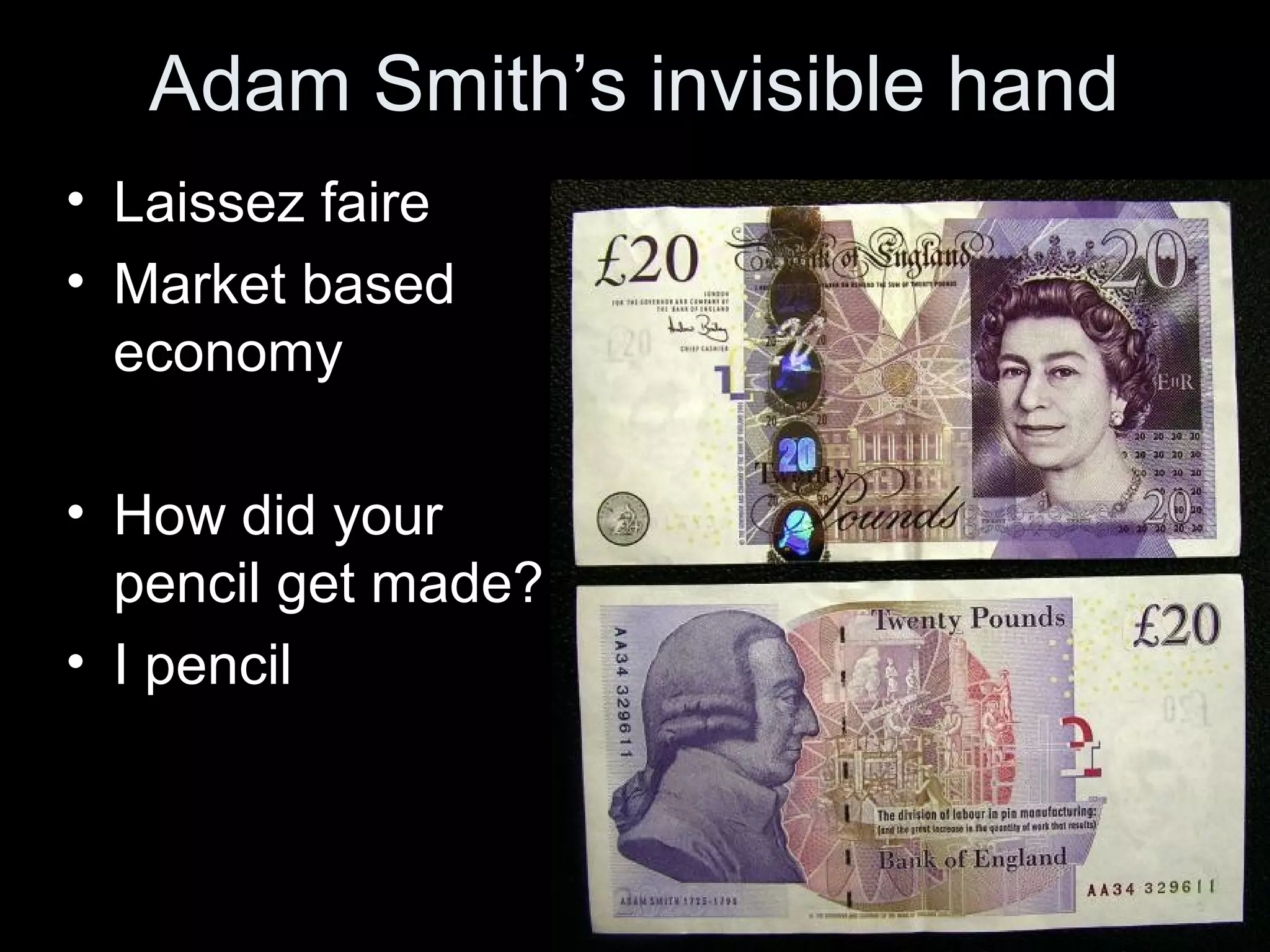
Adam Smith’s invisible hand
• Laissez faire
• Market based
economy
• How did your
pencil get made?
• I pencil
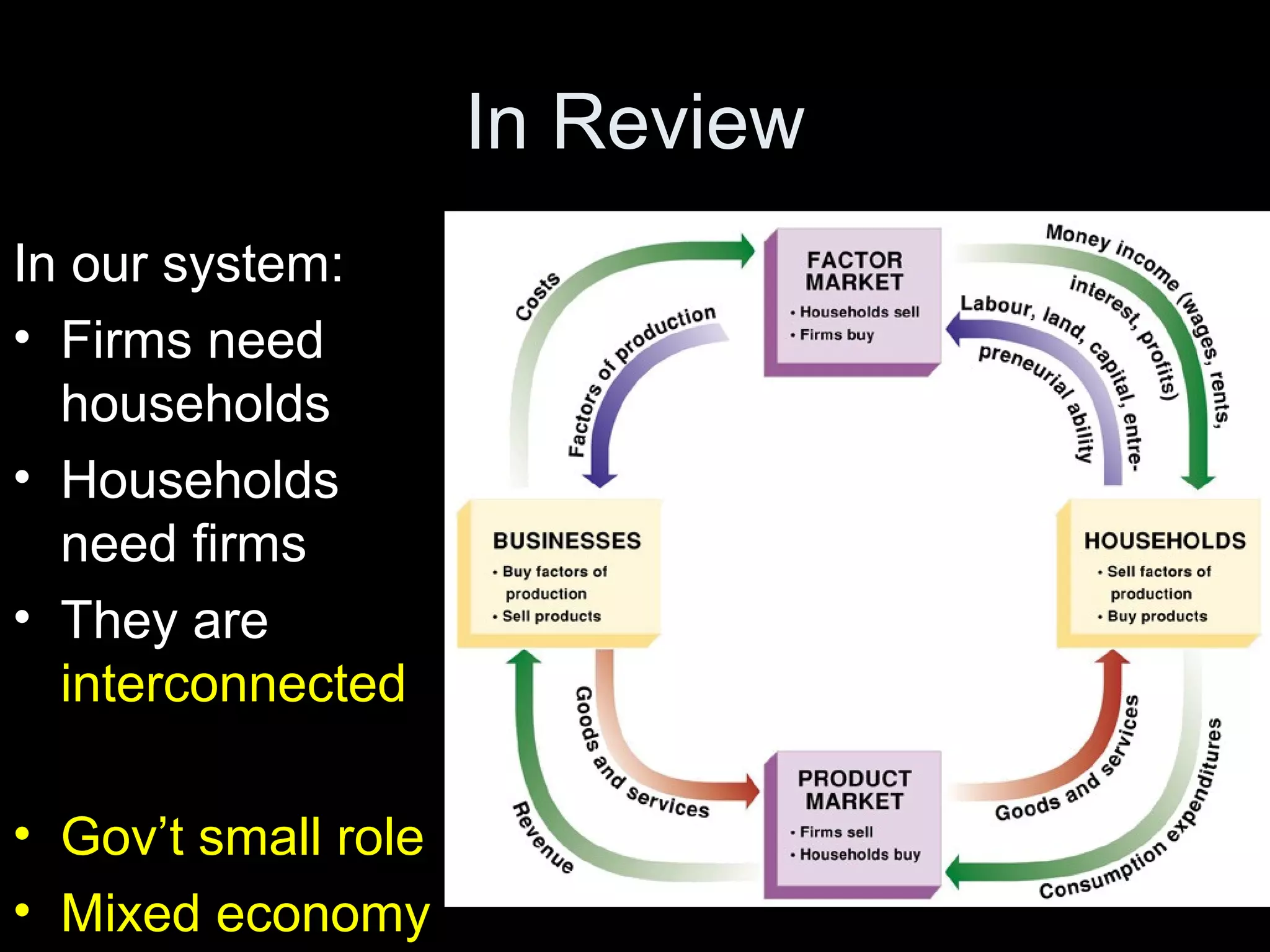
Circular Flow Model
Households Firms
Product Market
Factor Market
Money $$$
Goods/Services
labor
Wages $$
Investments $$
Interconnectivity
Where is the gov’t?
Regulation &
taxation
In Review
In our system:
• Firms need
households
• Households
need firms
• They are
interconnected
• Gov’t small role
• Mixed economy
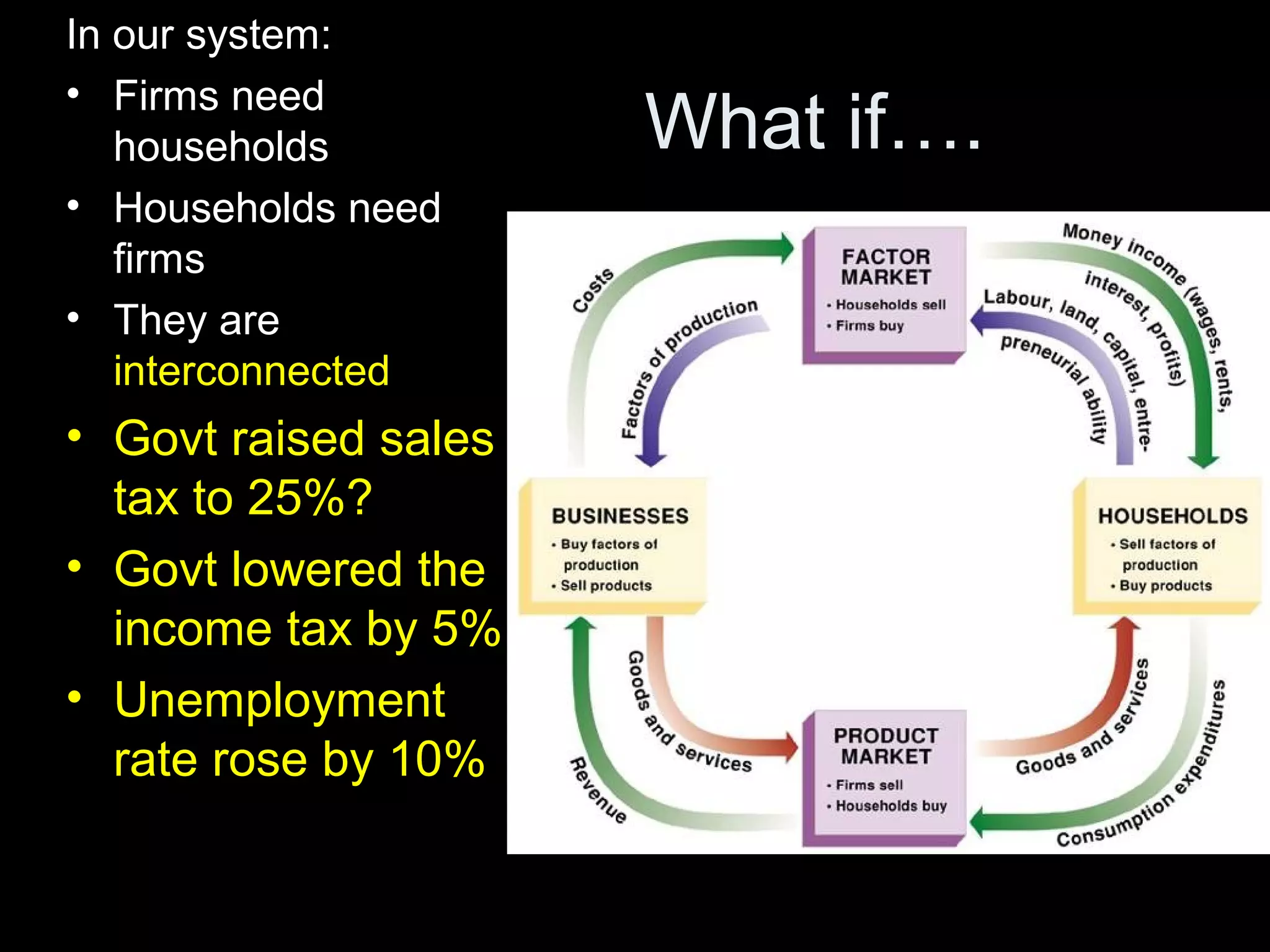
What if….
In our system:
• Firms need
households
• Households need
firms
• They are
interconnected
• Govt raised sales
tax to 25%?
• Govt lowered the
income tax by 5%
• Unemployment
rate rose by 10%
The government role in the economy?
• Like a guide to our economy
• Mixed economy
• Group Assignment: 1 paper
1. Explain your family’s role in the market
economy. (2 ways from circular flow)
2. Using the model, why would a business
want other businesses to succeed?
3. How could the government increase
consumption by households? 2 ways
4. How could the government increase goods
and services created or sold by firms? 2
ways
5. How could the government increase the
number of households who work for firms?
2 ways
6. For 3-5, what is the opportunity cost of that
action?
On your slates
1. Imagine that Flowing Wells High School won
a $15,000 grant to do what ever they want from
Bookman's. How do you think they should
allocate the $15,000?
Original Economic Questions
What to produce?
How to produce?
How much to produce?
How to allocate resources?
Allocation methods
How do families allocate?
Brute force
First come, first serve
Equal Rationing
Rationing by committee
Based on need (poorest)
Contest based
Random lottery
Auction – willing to pay
FW Administration has 2 tickets to this
year’s Final Four basketball games
They are going to allocate the tickets to one student.
They are going to either use: 1. lottery, 2. auction,
3.poorest, 4.first come, first serve, 5.highest GPA,
6.committee of teachers, 7.fastest 1 mile run, 8. most
free throws, 9.winner of singing contest, 10. best
youtube fan video
2. Two reasons your method is best
3. For two of the others, 1 problem
Currently organ donation in the US is done by
donation only, and first come first serve.
4. Write a paragraph
comparing and
contrasting this
allocation method
with an auction for
kidneys where people
on the waiting list
could buy kidneys
from donors. Which
method do you think
is best?
Value, in economic terms
½ sheet of paper
2 ways economists measure
value of a good/service:
1. Price – (How much are you
willing to pay?)
2. Utility (how happy does this
make me?)
Why trade is important?
On this ½ sheet of paper:
1. What is your original good/service?
2. Write what you think the value (in $) your good or service is.
3 Write down the good’s utility for you (1-10)
Round 1, only at your table
Round 2, same gender
Round 3, everyone
Walk around the room for 10 minutes and see if you can trade your good for
something of higher utility
4. How many trades did you make?
5. What is your final good/service?
6. What is its value?
7. What is your new utility?
8. Imagine you had to pay Mr. Klein $10 for each trade, how
would that have impacted this simulation? (this tax is called a
tariff)
Full sheet: Choose an entrepreneurial idea
Landscaping firm
Restaurant
Software firm
Trucking Company
1.Think of at least two places could you raise the
$15,000-$30,000 to start the business?
2. Besides going bankrupt, what bad things or risks
could occur to your business?
3. Would your business do better during good
economic times or could it succeed anytime?
Explain your reasoning.
Sole Proprietorship
• Single person
• Good for: low risk businesses, low entry costs
• Benefits: single person has all control and
keeps all profits
• Drawbacks: single person assumes all risk,
• hard to raise capital
• Examples: small construction firms,
artistic firms, bloggers, import/export
Partnerships
• Two people in business together
• Good for: low risk businesses
• Benefits: low entry costs, shared costs
• Drawbacks: partners assume all risk
• hard to raise capital,
• agreements “like a marriage”
• Examples: law firms, small specialized
firms
What happens
if?
• New
Restaurant!!!
Liability
• If your Sole Proprietorship or Partnership
is sued…
• They can take:
– Your house
– Your car
– Your money in the bank
– Your future money!!!
Corporations
• A legal “person”
• Good for: higher risk businesses
• Benefits: owners protected
• easier to raise capital
• Drawbacks: double taxation
• increased regulation
• Examples: restaurants, LLC’s,
Sports Franchises
Double taxation
• Corporation pays its own taxes: 25-35%
• Corporation pays employees wages/salary
• Employees ALSO pay taxes: 20-38%
• Trade off is liability for risk
General Electric ($26/share)
• Founded by Thomas
Edison (1878)
• Largest producer of
finished goods in world
• Lighting, appliances,
engines, aviation, power,
railroads, healthcare, NBC,
measurement systems
• Revenue: US $146 Billion
(2013)
Non-Profit Organization
• Goal is service, not profit (not part of gov’t)
• Good for: caring or political, service related goals
• Benefits: legally protected, no taxation
• Drawbacks: difficult to keep alive, survives on
donations and grants
• Examples: Churches Salvation Army,
USAID, Amnesty International,
NAACP, PETA,
Judicial Watch, Gates Foundation,
Scholarships
4. Which business organization would you use
for your business and why?
Subway- 1965
http://www.subway.com/subwayroot/about_us/history.aspx
2 types of Corporations
• Privately held – owned by founders or
owners
• Publicly held – owned by shareholders
Publically Held Corporations
• Larger corporations, publically traded
• Good for: higher risk businesses
• Benefits: owners protected,
• MUCH easier to raise capital
• Drawbacks: double taxation
• increased regulation
• owned by shareholders
• Examples: Wal-Mart, Disney,
Starbucks, Apple, Microsoft
Corporate Structure
Shareholders
Election
Board of Directors
Hires/fires
Chief Executive Officer
(CEO)
Hires/fires
Every other employee
1976 – founded as partnership
Steve Jobs, Steve Wozniak
1977 – formed privately held corp
1980 – “went public” to shareholders
Steve Jobs new CEO
1985 – Jobs fired by B of Directors
1996 – Jobs returns as CEO, ipods, imacs
Chapter 3, Corporations
1. Page 58, Rank US business organizations in order of how
common they are
2. Rank business organizations in order of revenue
3. Who actually owns big corporations like Walmart, Disney and
Apple?
4. What would your business need to do to file articles of
incorporation with the state of Arizona?
5. What would you have to do if you wanted to open a Subway
franchise?
6. Compare and contrast the advantages of owning a franchise like a
Subway.
7. What is the opportunity cost of investing in the stock market?
8. What is a merger? Give 3 real world examples, ok to look up on
phone
9. Which market structure would you use if you wanted to start a taco
stand? Support your answer
10. Which market structure would you use if you wanted to start a
company that writes cellphone apps? Support your answer
Circular Flow Model
Households
Firms
Product Market
Factor Market
Money $$$
Goods/Services
labor
Wages $$
Investments $$
Interconnectivity
Mixed Economies
• Modern countries have the government
help some, but mostly it’s the market
• For example….
• Schools
• Roads
• Healthcare
• Child care
• Space Travel
Investing
• One way to save for your future is to
invest
• You can publically invest in hundreds of
companies
Brainstorm a list of 5 companies (or
industries) you think would be a good
investment and a brief “why”.
Investments $$
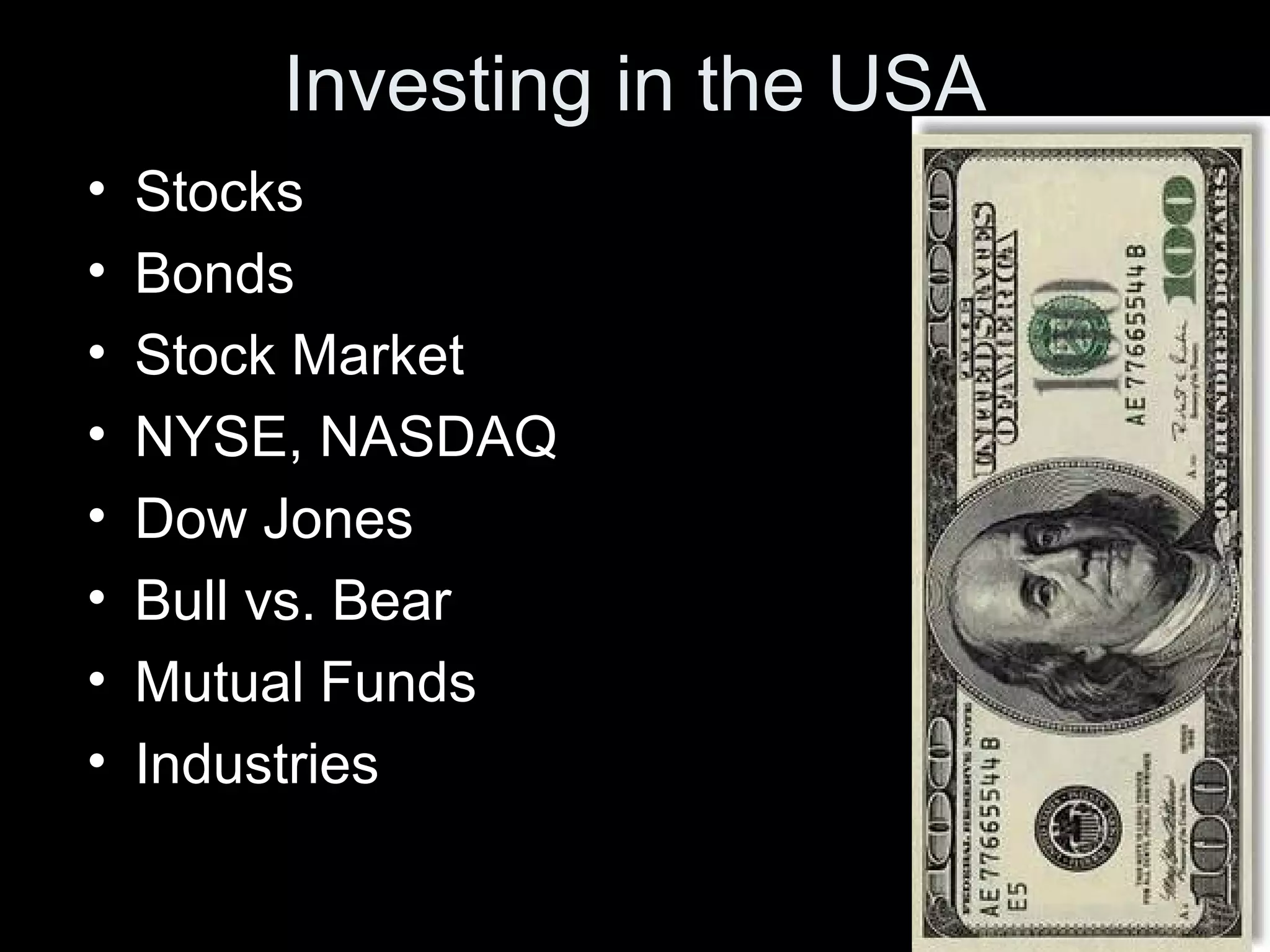
Investing in the USA
• Stocks
• Bonds
• Stock Market
• NYSE, NASDAQ
• Dow Jones
• Bull vs. Bear
• Mutual Funds
• Industries
Savings Accounts
• 0% -
0.5 %
interest
Investing
• Brokerage Account
• Old School – Stock Broker
• Higher fees, but advice
• New School – DIY online
• Lower fees, little to no help
• Show clip
A stock broker at work
• Finance
degree
• Income:
$50,000 and
up
• Commission
per trade
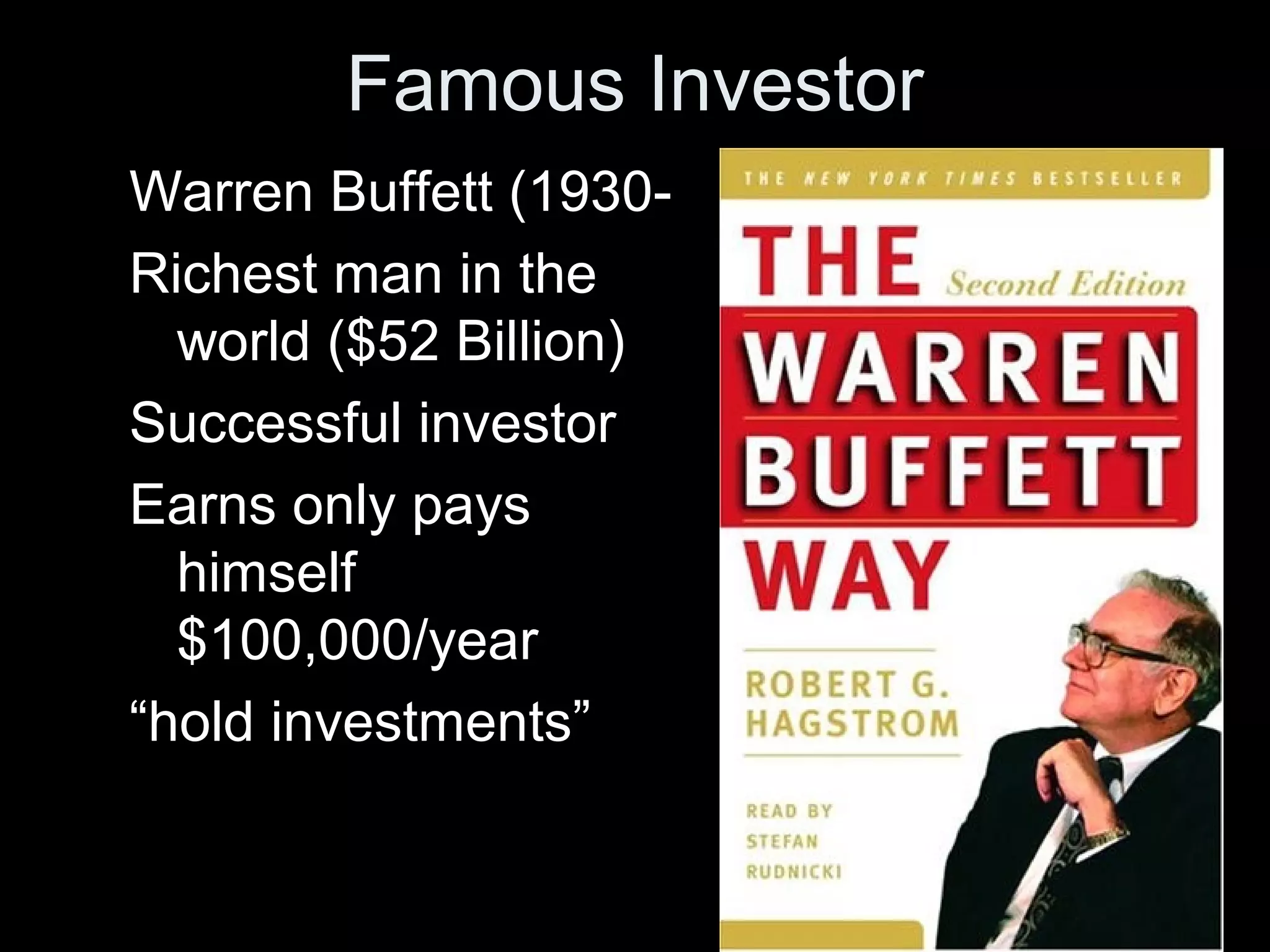
Famous Investor
Warren Buffett (1930-
Richest man in the
world ($52 Billion)
Successful investor
Earns only pays
himself
$100,000/year
“hold investments”
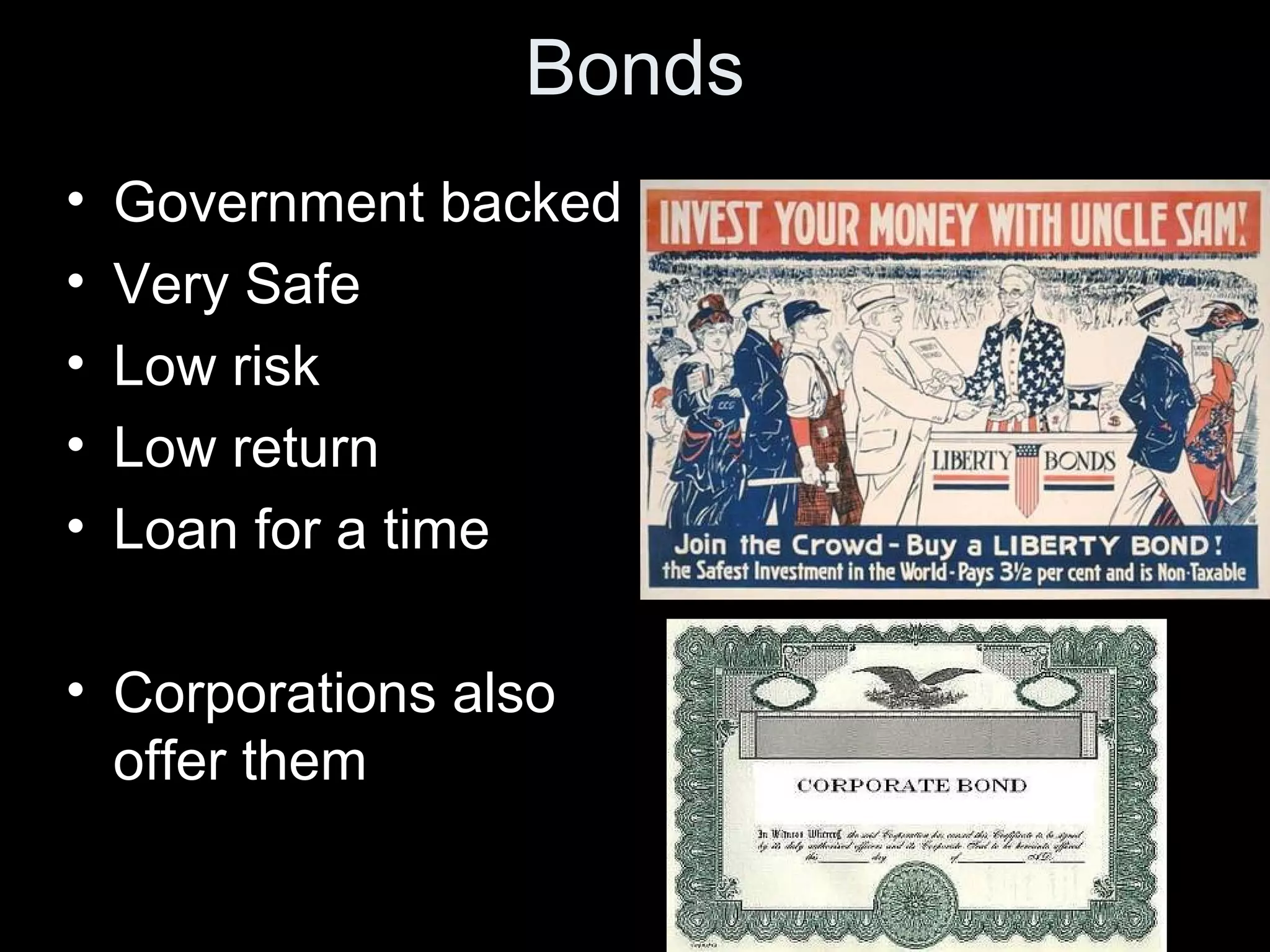
Bonds
• Government backed
• Very Safe
• Low risk
• Low return
• Loan for a time
• Corporations also
offer them
Stocks
• Ownership
in a
publically
traded
company
• Issued to
raise capital
• Some pay
dividends
Stocks
• Stock Calculation:
• $25.90/share
• You have $1000 to
invest in Disney
• $1000 investment
• $25.90 per share
• You can buy 38.6
shares with $1000
• Dividend: $0.35 /year
Investment divided by share price =
shares you can buy
Let’s try one
• $1,000 investment
• Someone name a large company
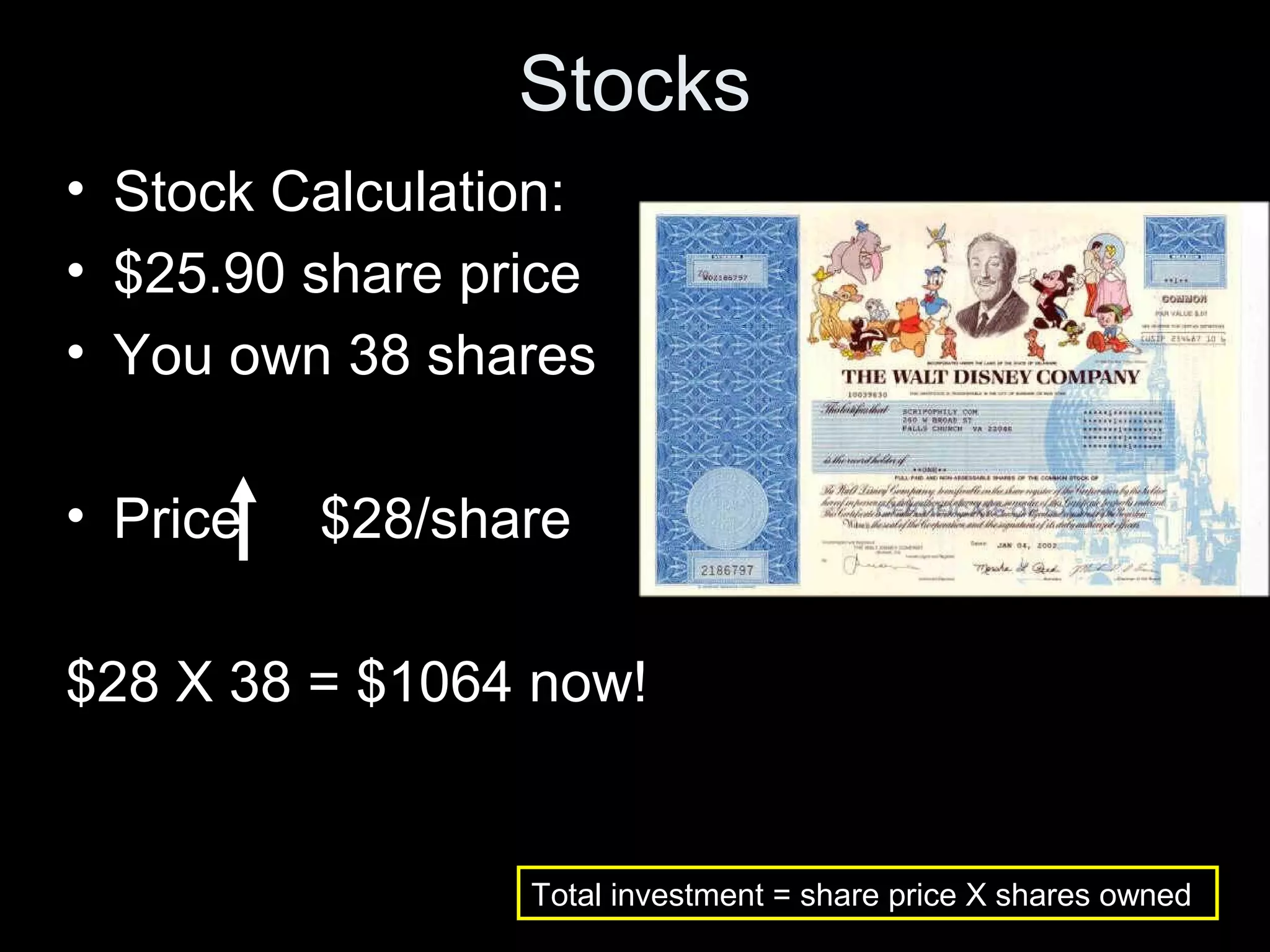
Stocks
• Stock Calculation:
• $25.90 share price
• You own 38 shares
• Price $28/share
$28 X 38 = $1064 now!
Total investment = share price X shares owned
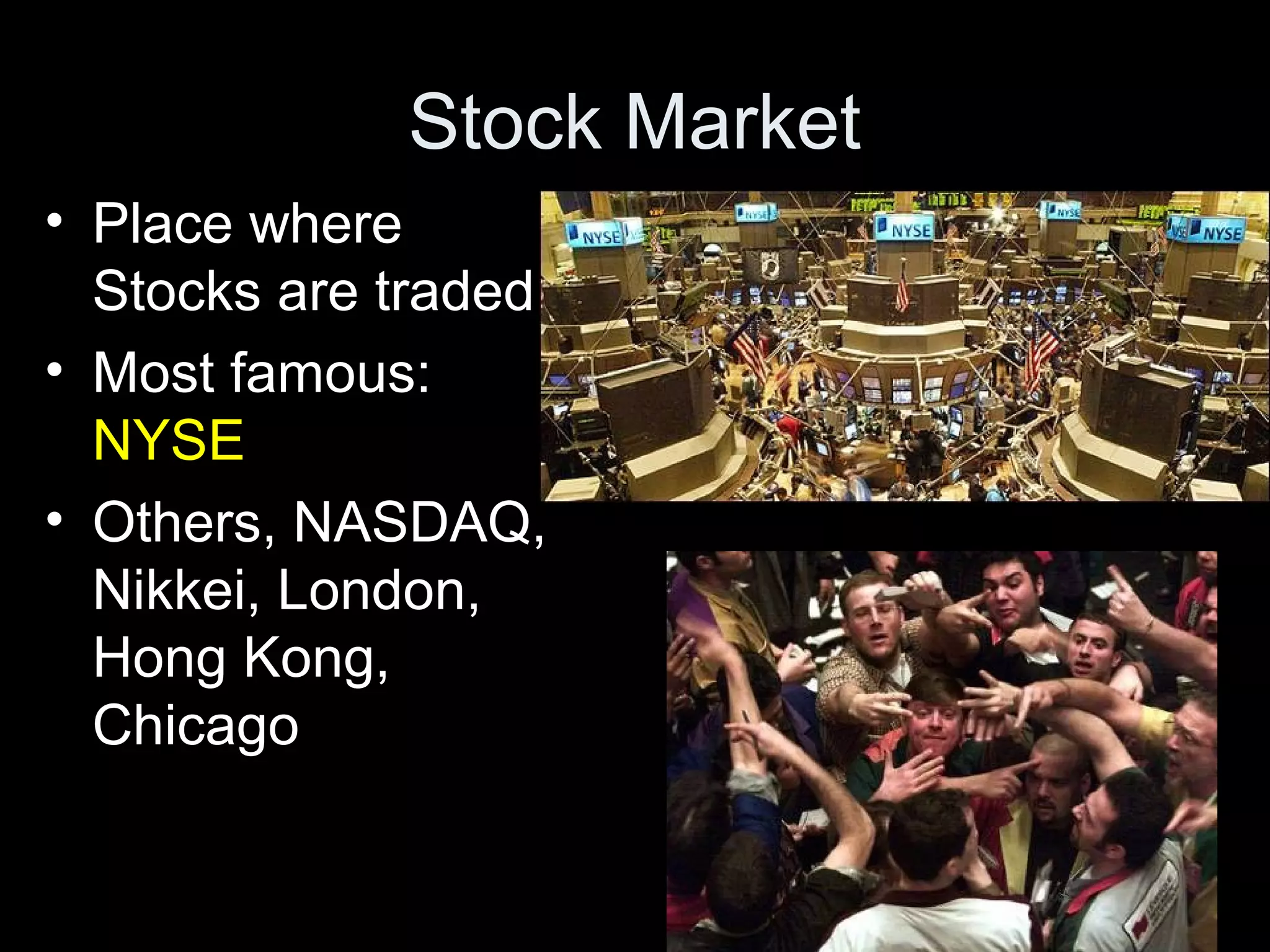
Stock Market
• Place where
Stocks are traded
• Most famous:
NYSE
• Others, NASDAQ,
Nikkei, London,
Hong Kong,
Chicago
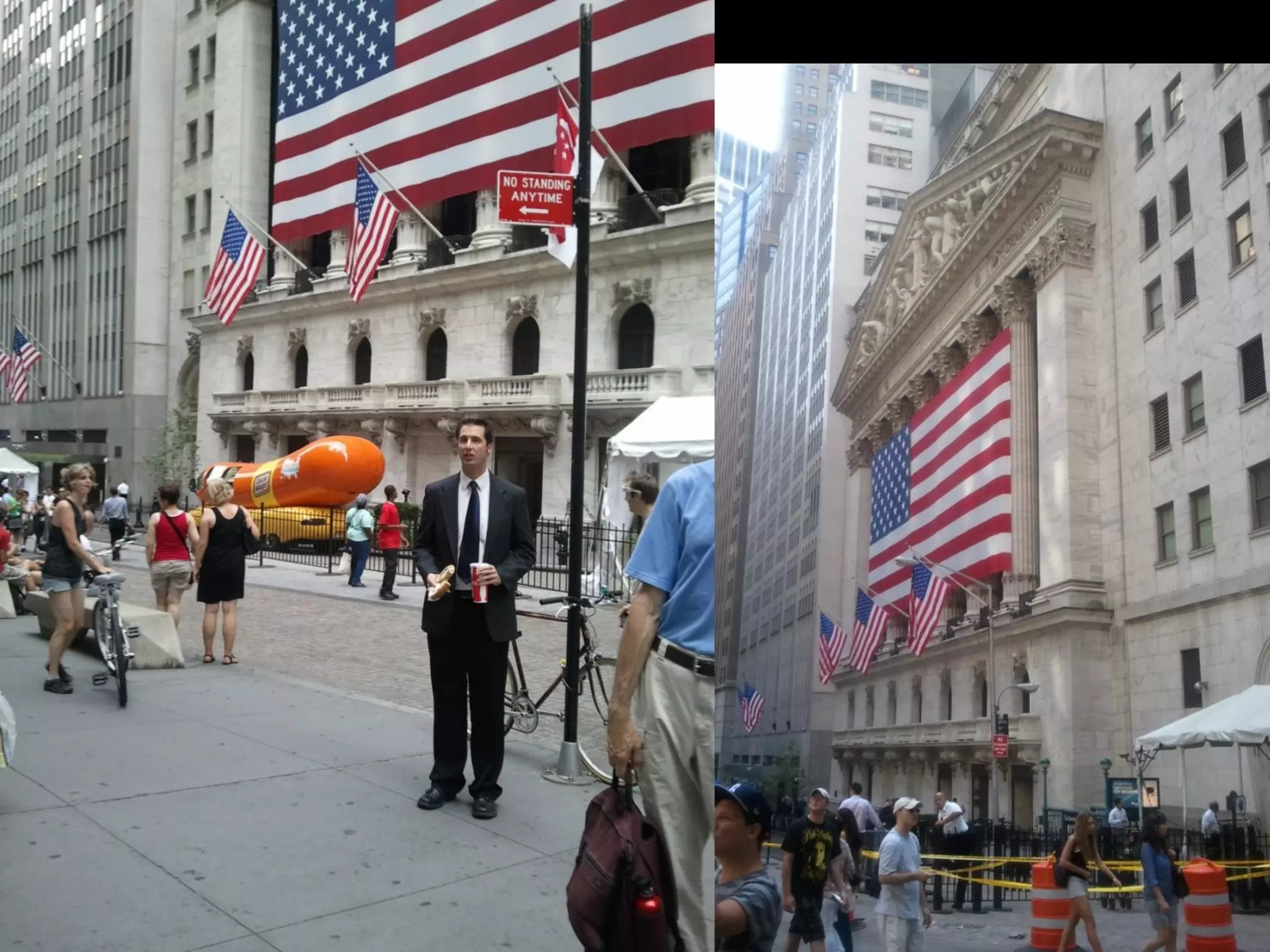
2011 New York Summer
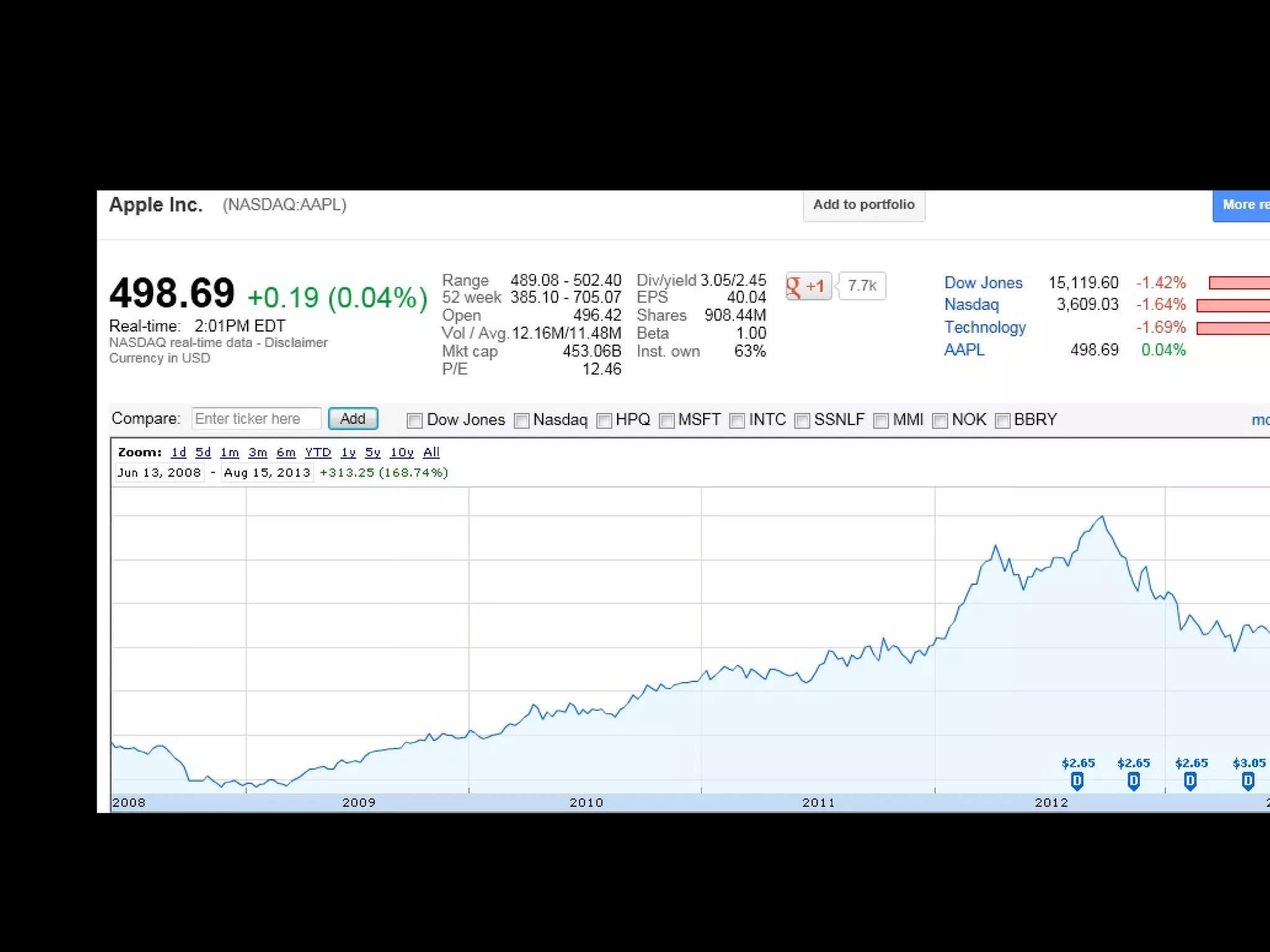
Stock Symbols
• Makes trading
easier
• EX: Disney = DIS
• Use
finance.google.com
to look them up
“Dow Jones”
• Dow Jones” –
average 30 top
companies
• MMM, AA, AXP,
T, BAC, BA, CAT,
CVX, CSCO, KO,
DD, XOM, GE,
HPQ, HD, INTC,
IBM, JNJ, JPM,
KFT, MCD, MRK,
MSFT, PFE, PG,
TRV, UTX, VZ,
WMT, DIS
Bull vs. Bear Markets
• Bull Market
• Bear Market
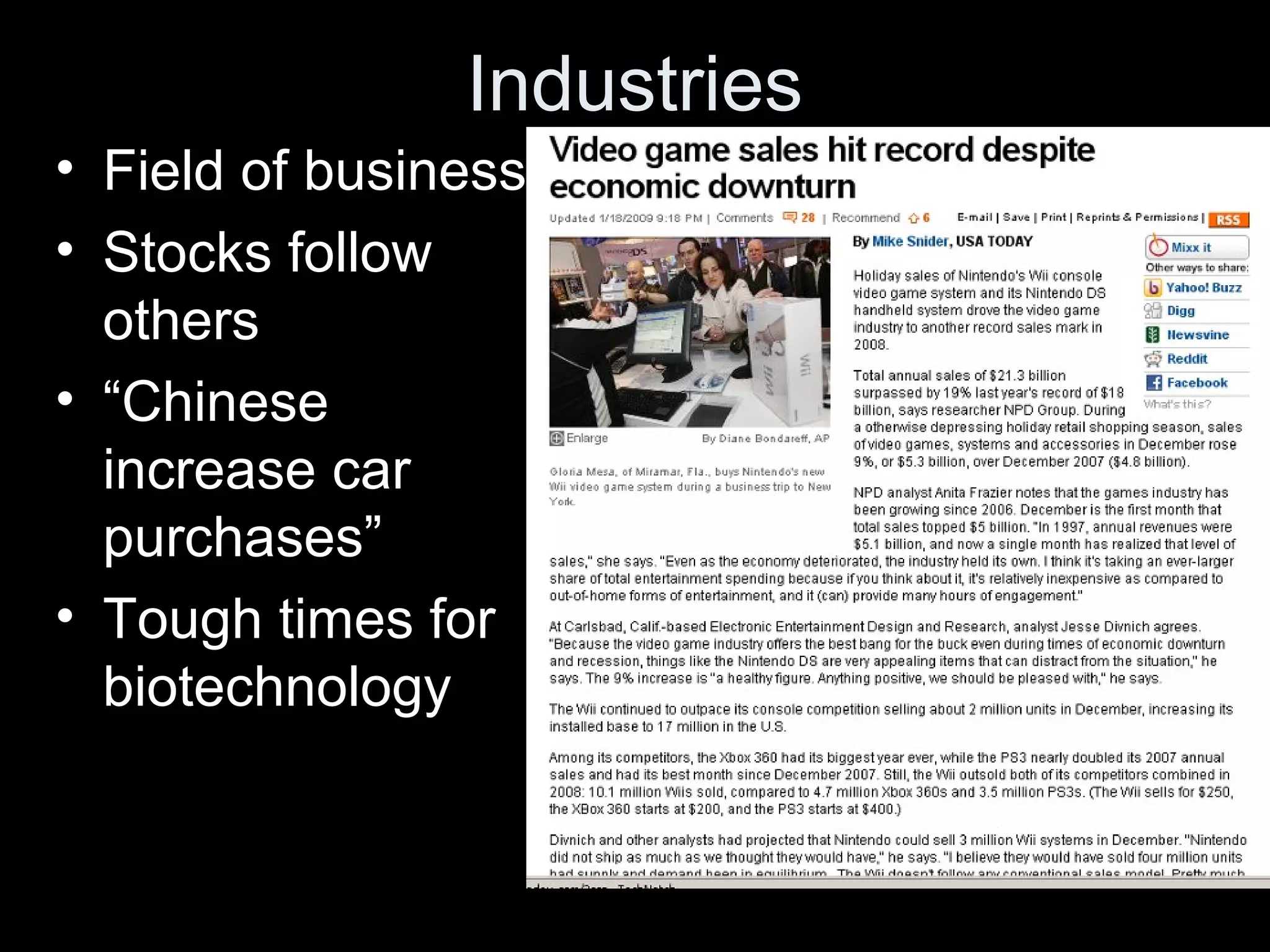
Industries
• Field of business
• Stocks follow
others
• “Chinese
increase car
purchases”
• Tough times for
biotechnology
Stock Market Simulation
Old School Stock Market
Simulation
• Sellers/Buyers
• 3 companies, Ford (F) , Campbell's (CPB),
Adobe (ADBE)
News of the Day
• American businessmen fear US government
debt
• Consumer demand for soup increases by
10%
• Chevy announces new hybrid model
News of the Day
• Mexican tomato growers watch 80% crop
killed
• President Obama announces increase in
income taxes
• Adobe announces record breaking year
News of the Day
• US signs trade deal with Australia, tariffs
on cars eliminated
• Consumer debt at an all time high
• US consumers frustrated with Indian tech
support
News of the Day
• Gas price up to $5/gallon in US
• US computer companies sell 20% more
computers last month
• US consumers get rebate check of $200
News of the Day
• US Unemployment Rate increases to 10%
• US tourism increases for the second
straight month
• Microsoft announces new product to
compete with Acrobat Reader

2015 day 2

  • 1.
    Quiz 1 ½ page 1.When an economist is talking about a “firm”, what is that? 2. Why doesn’t Mr. Klein drive a sports car? Using economic language 3. What is your opportunity cost of being here right now? 4. Why might someone disagree with the statement “the best things in life are free”? 5. Why do you think entrepreneurs are vitally important to our society? (2 reasons)
  • 2.
    Group Activity “Entrepreneurship” •Groups of 2-3, Design a brand new business On a single sheet of paper with everyone’s name answer these ?
  • 3.
    On Slates 1. Givean example of a time when you were forced to do something. 2. Who was the authority figure? 3. Why did they force you to make that choice? 4. How could they have made you do #1 without force?
  • 4.
    4 Economic questionsfor your household 1. What to produce? 2. How to produce? 3. How much to produce? 4. How much does each person consume?
  • 5.
    4 Economic questionsfor every society 1. What to produce? 2. How to produce? 3. How much to produce? 4. How much does each person consume? Barack Obama President of USA Naoto Kan prime minister of JapanMexican President Enrique Pena Neito
  • 6.
    What happened in1776? • Enlightenment • Philosophy • Adam Smith • Scottish economist • Wealth of Nations • clip • Pages 46-50 • Read for 8 minutes • Answer 4 economic questions • Summarize the 5 parts of “our system” in your notes
  • 7.
    Free Market Economy •“Invisible hand” • Government does as little as possible • Property rights • Stays out for winners and losers
  • 8.
    Adam Smith’s invisiblehand • Laissez faire • Market based economy • How did your pencil get made? • I pencil
  • 9.
    Circular Flow Model HouseholdsFirms Product Market Factor Market Money $$$ Goods/Services labor Wages $$ Investments $$ Interconnectivity Where is the gov’t? Regulation & taxation
  • 10.
    In Review In oursystem: • Firms need households • Households need firms • They are interconnected • Gov’t small role • Mixed economy
  • 11.
    What if…. In oursystem: • Firms need households • Households need firms • They are interconnected • Govt raised sales tax to 25%? • Govt lowered the income tax by 5% • Unemployment rate rose by 10%
  • 12.
    The government rolein the economy? • Like a guide to our economy • Mixed economy • Group Assignment: 1 paper 1. Explain your family’s role in the market economy. (2 ways from circular flow) 2. Using the model, why would a business want other businesses to succeed? 3. How could the government increase consumption by households? 2 ways 4. How could the government increase goods and services created or sold by firms? 2 ways 5. How could the government increase the number of households who work for firms? 2 ways 6. For 3-5, what is the opportunity cost of that action?
  • 13.
    On your slates 1.Imagine that Flowing Wells High School won a $15,000 grant to do what ever they want from Bookman's. How do you think they should allocate the $15,000?
  • 14.
    Original Economic Questions Whatto produce? How to produce? How much to produce? How to allocate resources?
  • 15.
    Allocation methods How dofamilies allocate? Brute force First come, first serve Equal Rationing Rationing by committee Based on need (poorest) Contest based Random lottery Auction – willing to pay
  • 16.
    FW Administration has2 tickets to this year’s Final Four basketball games They are going to allocate the tickets to one student. They are going to either use: 1. lottery, 2. auction, 3.poorest, 4.first come, first serve, 5.highest GPA, 6.committee of teachers, 7.fastest 1 mile run, 8. most free throws, 9.winner of singing contest, 10. best youtube fan video 2. Two reasons your method is best 3. For two of the others, 1 problem
  • 17.
    Currently organ donationin the US is done by donation only, and first come first serve. 4. Write a paragraph comparing and contrasting this allocation method with an auction for kidneys where people on the waiting list could buy kidneys from donors. Which method do you think is best?
  • 18.
    Value, in economicterms ½ sheet of paper 2 ways economists measure value of a good/service: 1. Price – (How much are you willing to pay?) 2. Utility (how happy does this make me?)
  • 19.
    Why trade isimportant? On this ½ sheet of paper: 1. What is your original good/service? 2. Write what you think the value (in $) your good or service is. 3 Write down the good’s utility for you (1-10) Round 1, only at your table Round 2, same gender Round 3, everyone Walk around the room for 10 minutes and see if you can trade your good for something of higher utility 4. How many trades did you make? 5. What is your final good/service? 6. What is its value? 7. What is your new utility? 8. Imagine you had to pay Mr. Klein $10 for each trade, how would that have impacted this simulation? (this tax is called a tariff)
  • 20.
    Full sheet: Choosean entrepreneurial idea Landscaping firm Restaurant Software firm Trucking Company 1.Think of at least two places could you raise the $15,000-$30,000 to start the business? 2. Besides going bankrupt, what bad things or risks could occur to your business? 3. Would your business do better during good economic times or could it succeed anytime? Explain your reasoning.
  • 21.
    Sole Proprietorship • Singleperson • Good for: low risk businesses, low entry costs • Benefits: single person has all control and keeps all profits • Drawbacks: single person assumes all risk, • hard to raise capital • Examples: small construction firms, artistic firms, bloggers, import/export
  • 22.
    Partnerships • Two peoplein business together • Good for: low risk businesses • Benefits: low entry costs, shared costs • Drawbacks: partners assume all risk • hard to raise capital, • agreements “like a marriage” • Examples: law firms, small specialized firms
  • 23.
  • 24.
    Liability • If yourSole Proprietorship or Partnership is sued… • They can take: – Your house – Your car – Your money in the bank – Your future money!!!
  • 26.
    Corporations • A legal“person” • Good for: higher risk businesses • Benefits: owners protected • easier to raise capital • Drawbacks: double taxation • increased regulation • Examples: restaurants, LLC’s, Sports Franchises
  • 27.
    Double taxation • Corporationpays its own taxes: 25-35% • Corporation pays employees wages/salary • Employees ALSO pay taxes: 20-38% • Trade off is liability for risk
  • 28.
    General Electric ($26/share) •Founded by Thomas Edison (1878) • Largest producer of finished goods in world • Lighting, appliances, engines, aviation, power, railroads, healthcare, NBC, measurement systems • Revenue: US $146 Billion (2013)
  • 29.
    Non-Profit Organization • Goalis service, not profit (not part of gov’t) • Good for: caring or political, service related goals • Benefits: legally protected, no taxation • Drawbacks: difficult to keep alive, survives on donations and grants • Examples: Churches Salvation Army, USAID, Amnesty International, NAACP, PETA, Judicial Watch, Gates Foundation, Scholarships
  • 30.
    4. Which businessorganization would you use for your business and why?
  • 31.
  • 33.
    2 types ofCorporations • Privately held – owned by founders or owners • Publicly held – owned by shareholders
  • 34.
    Publically Held Corporations •Larger corporations, publically traded • Good for: higher risk businesses • Benefits: owners protected, • MUCH easier to raise capital • Drawbacks: double taxation • increased regulation • owned by shareholders • Examples: Wal-Mart, Disney, Starbucks, Apple, Microsoft
  • 35.
    Corporate Structure Shareholders Election Board ofDirectors Hires/fires Chief Executive Officer (CEO) Hires/fires Every other employee 1976 – founded as partnership Steve Jobs, Steve Wozniak 1977 – formed privately held corp 1980 – “went public” to shareholders Steve Jobs new CEO 1985 – Jobs fired by B of Directors 1996 – Jobs returns as CEO, ipods, imacs
  • 36.
    Chapter 3, Corporations 1.Page 58, Rank US business organizations in order of how common they are 2. Rank business organizations in order of revenue 3. Who actually owns big corporations like Walmart, Disney and Apple? 4. What would your business need to do to file articles of incorporation with the state of Arizona? 5. What would you have to do if you wanted to open a Subway franchise? 6. Compare and contrast the advantages of owning a franchise like a Subway. 7. What is the opportunity cost of investing in the stock market? 8. What is a merger? Give 3 real world examples, ok to look up on phone 9. Which market structure would you use if you wanted to start a taco stand? Support your answer 10. Which market structure would you use if you wanted to start a company that writes cellphone apps? Support your answer
  • 37.
    Circular Flow Model Households Firms ProductMarket Factor Market Money $$$ Goods/Services labor Wages $$ Investments $$ Interconnectivity
  • 38.
    Mixed Economies • Moderncountries have the government help some, but mostly it’s the market • For example…. • Schools • Roads • Healthcare • Child care • Space Travel
  • 39.
    Investing • One wayto save for your future is to invest • You can publically invest in hundreds of companies Brainstorm a list of 5 companies (or industries) you think would be a good investment and a brief “why”. Investments $$
  • 40.
    Investing in theUSA • Stocks • Bonds • Stock Market • NYSE, NASDAQ • Dow Jones • Bull vs. Bear • Mutual Funds • Industries
  • 41.
    Savings Accounts • 0%- 0.5 % interest
  • 42.
    Investing • Brokerage Account •Old School – Stock Broker • Higher fees, but advice • New School – DIY online • Lower fees, little to no help • Show clip
  • 43.
    A stock brokerat work • Finance degree • Income: $50,000 and up • Commission per trade
  • 44.
    Famous Investor Warren Buffett(1930- Richest man in the world ($52 Billion) Successful investor Earns only pays himself $100,000/year “hold investments”
  • 45.
    Bonds • Government backed •Very Safe • Low risk • Low return • Loan for a time • Corporations also offer them
  • 46.
    Stocks • Ownership in a publically traded company •Issued to raise capital • Some pay dividends
  • 47.
    Stocks • Stock Calculation: •$25.90/share • You have $1000 to invest in Disney • $1000 investment • $25.90 per share • You can buy 38.6 shares with $1000 • Dividend: $0.35 /year Investment divided by share price = shares you can buy
  • 48.
    Let’s try one •$1,000 investment • Someone name a large company
  • 49.
    Stocks • Stock Calculation: •$25.90 share price • You own 38 shares • Price $28/share $28 X 38 = $1064 now! Total investment = share price X shares owned
  • 50.
    Stock Market • Placewhere Stocks are traded • Most famous: NYSE • Others, NASDAQ, Nikkei, London, Hong Kong, Chicago
  • 51.
  • 53.
    Stock Symbols • Makestrading easier • EX: Disney = DIS • Use finance.google.com to look them up
  • 60.
    “Dow Jones” • DowJones” – average 30 top companies • MMM, AA, AXP, T, BAC, BA, CAT, CVX, CSCO, KO, DD, XOM, GE, HPQ, HD, INTC, IBM, JNJ, JPM, KFT, MCD, MRK, MSFT, PFE, PG, TRV, UTX, VZ, WMT, DIS
  • 62.
    Bull vs. BearMarkets • Bull Market • Bear Market
  • 64.
    Industries • Field ofbusiness • Stocks follow others • “Chinese increase car purchases” • Tough times for biotechnology
  • 65.
  • 66.
    Old School StockMarket Simulation • Sellers/Buyers • 3 companies, Ford (F) , Campbell's (CPB), Adobe (ADBE)
  • 67.
    News of theDay • American businessmen fear US government debt • Consumer demand for soup increases by 10% • Chevy announces new hybrid model
  • 68.
    News of theDay • Mexican tomato growers watch 80% crop killed • President Obama announces increase in income taxes • Adobe announces record breaking year
  • 69.
    News of theDay • US signs trade deal with Australia, tariffs on cars eliminated • Consumer debt at an all time high • US consumers frustrated with Indian tech support
  • 70.
    News of theDay • Gas price up to $5/gallon in US • US computer companies sell 20% more computers last month • US consumers get rebate check of $200
  • 71.
    News of theDay • US Unemployment Rate increases to 10% • US tourism increases for the second straight month • Microsoft announces new product to compete with Acrobat Reader