1
Chapter 3
Observing Microorganisms Through a
Microscope
2
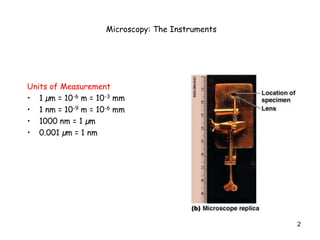
Microscopy: The Instruments
Units of Measurement
• 1 µm = 10-6 m = 10-3 mm
• 1 nm = 10-9 m = 10-6 mm
• 1000 nm = 1 µm
• 0.001 µm = 1 nm
3
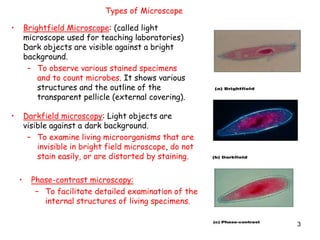
Types of Microscope
• Brightfield Microscope: (called light
microscope used for teaching laboratories)
Dark objects are visible against a bright
background.
– To observe various stained specimens
and to count microbes. It shows various
structures and the outline of the
transparent pellicle (external covering).
• Darkfield microscopy: Light objects are
visible against a dark background.
– To examine living microorganisms that are
invisible in bright field microscope, do not
stain easily, or are distorted by staining.
• Phase-contrast microscopy:
– To facilitate detailed examination of the
internal structures of living specimens.
4
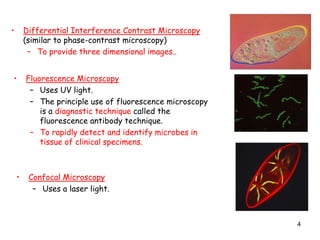
• Differential Interference Contrast Microscopy
(similar to phase-contrast microscopy)
– To provide three dimensional images..
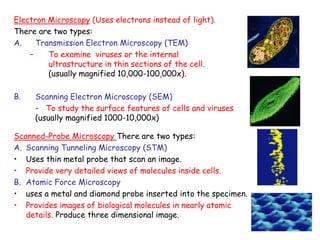
• Fluorescence Microscopy
– Uses UV light.
– The principle use of fluorescence microscopy
is a diagnostic technique called the
fluorescence antibody technique.
– To rapidly detect and identify microbes in
tissue of clinical specimens.
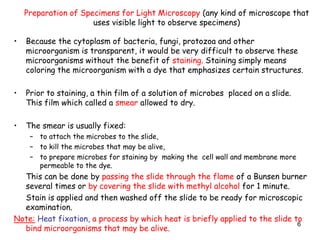
• Confocal Microscopy
– Uses a laser light.
5
Electron Microscopy (Uses electrons instead of light).
There are two types:
A. Transmission Electron Microscopy (TEM)
– To examine viruses or the internal
ultrastructure in thin sections of the cell.
(usually magnified 10,000-100,000x).
B. Scanning Electron Microscopy (SEM)
- To study the surface features of cells and viruses
(usually magnified 1000-10,000x)
Scanned-Probe Microscopy There are two types:
A. Scanning Tunneling Microscopy (STM)
• Uses thin metal probe that scan an image.
• Provide very detailed views of molecules inside cells.
B. Atomic Force Microscopy
• uses a metal and diamond probe inserted into the specimen.
• Provides images of biological molecules in nearly atomic
details. Produce three dimensional image.
6
Preparation of Specimens for Light Microscopy (any kind of microscope that
uses visible light to observe specimens)
• Because the cytoplasm of bacteria, fungi, protozoa and other
microorganism is transparent, it would be very difficult to observe these
microorganisms without the benefit of staining. Staining simply means
coloring the microorganism with a dye that emphasizes certain structures.
• Prior to staining, a thin film of a solution of microbes placed on a slide.
This film which called a smear allowed to dry.
• The smear is usually fixed:
– to attach the microbes to the slide,
– to kill the microbes that may be alive,
– to prepare microbes for staining by making the cell wall and membrane more
permeable to the dye.
This can be done by passing the slide through the flame of a Bunsen burner
several times or by covering the slide with methyl alcohol for 1 minute.
Stain is applied and then washed off the slide to be ready for microscopic
examination.
Note: Heat fixation, a process by which heat is briefly applied to the slide to
bind microorganisms that may be alive.
7
Stains
• Are salts composed of a positive and negative ion. The part of the dye
molecule which is responsible for the color of the dye is called
Chromophore.
• Staining that carry a positive charges are called a basic dye, the
chromophore is a cation. Examples are methylene blue, crytal violet,
safranin, and malachite green.
• Staining that carry a negative charges are called a acidic dye, the
chromophore is an anion. Examples are eosin, acid fuchsin, nigrosin.
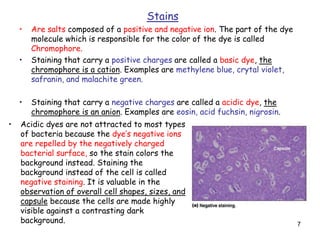
• Acidic dyes are not attracted to most types
of bacteria because the dye’s negative ions
are repelled by the negatively charged
bacterial surface, so the stain colors the
background instead. Staining the
background instead of the cell is called
negative staining. It is valuable in the
observation of overall cell shapes, sizes, and
capsule because the cells are made highly
visible against a contrasting dark
background.
8
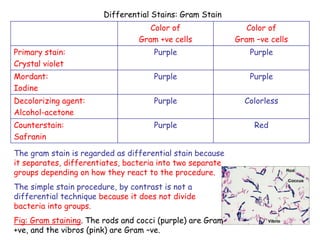
To apply acidic or basic dyes, microbiologist use three kinds of staining
techniques: Simple, differential, and special.
Simple Stains (single step)
– The purpose of a simple stain is to highlight the entire microorganism so
that cellular shape and basic structures are visible.
– Use of a single basic dye such as methylene blue, crystal violet, safranin.
– The stain is applied to the fixed smear for a certain length of time and then
washed off, and the slide is dried and examined. In this way staining thus
takes place.
Note: Negative staining is a single step procedure.
– A chemical called mordant may be used to hold the stain or coat a structure
(such as flagellum) to make thicker and easier to see after it is stained with
a dye.
Differential Stains (Multiple-step)
The differential stains most frequently used for bacteria are the Gram stain
(developed in 1884 by Danish Christian Gram) and the acid-fast stain.
The Gram stain classifies bacteria into gram-positive and gram-negative.
The composition of the cell wall is the base.
G-ve contain alcohol soluble lipid, G+ve lack lipids and therefore retains the
color (crystal violet iodine complex).
9
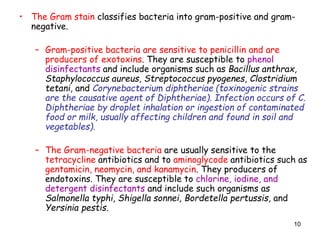
Differential Stains: Gram Stain
Color of
Gram +ve cells
Color of
Gram –ve cells
Primary stain:
Crystal violet
Purple Purple
Mordant:
Iodine
Purple Purple
Decolorizing agent:
Alcohol-acetone
Purple Colorless
Counterstain:
Safranin
Purple Red
The gram stain is regarded as differential stain because
it separates, differentiates, bacteria into two separate
groups depending on how they react to the procedure.
The simple stain procedure, by contrast is not a
differential technique because it does not divide
bacteria into groups.
Fig: Gram staining. The rods and cocci (purple) are Gram
+ve, and the vibros (pink) are Gram –ve.
10
• The Gram stain classifies bacteria into gram-positive and gram-
negative.
– Gram-positive bacteria are sensitive to penicillin and are
producers of exotoxins. They are susceptible to phenol
disinfectants and include organisms such as Bacillus anthrax,
Staphylococcus aureus, Streptococcus pyogenes, Clostridium
tetani, and Corynebacterium diphtheriae (toxinogenic strains
are the causative agent of Diphtheriae). Infection occurs of C.
Diphtheriae by droplet inhalation or ingestion of contaminated
food or milk, usually affecting children and found in soil and
vegetables).
– The Gram-negative bacteria are usually sensitive to the
tetracycline antibiotics and to aminoglycode antibiotics such as
gentamicin, neomycin, and kanamycin. They producers of
endotoxins. They are susceptible to chlorine, iodine, and
detergent disinfectants and include such organisms as
Salmonella typhi, Shigella sonnei, Bordetella pertussis, and
Yersinia pestis.
11
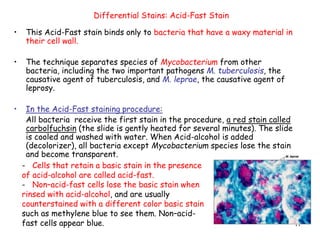
• This Acid-Fast stain binds only to bacteria that have a waxy material in
their cell wall.
• The technique separates species of Mycobacterium from other
bacteria, including the two important pathogens M. tuberculosis, the
causative agent of tuberculosis, and M. leprae, the causative agent of
leprosy.
• In the Acid-Fast staining procedure:
All bacteria receive the first stain in the procedure, a red stain called
carbolfuchsin (the slide is gently heated for several minutes). The slide
is cooled and washed with water. When Acid-alcohol is added
(decolorizer), all bacteria except Mycobacterium species lose the stain
and become transparent.
Differential Stains: Acid-Fast Stain
- Cells that retain a basic stain in the presence
of acid-alcohol are called acid-fast.
- Non–acid-fast cells lose the basic stain when
rinsed with acid-alcohol, and are usually
counterstained with a different color basic stain
such as methylene blue to see them. Non–acid-
fast cells appear blue.
12
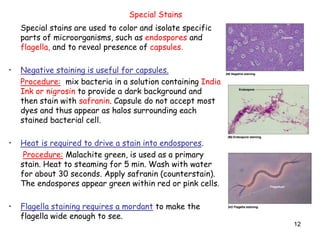
Special stains are used to color and isolate specific
parts of microorganisms, such as endospores and
flagella, and to reveal presence of capsules.
• Negative staining is useful for capsules.
Procedure: mix bacteria in a solution containing India
Ink or nigrosin to provide a dark background and
then stain with safranin. Capsule do not accept most
dyes and thus appear as halos surrounding each
stained bacterial cell.
• Heat is required to drive a stain into endospores.
Procedure: Malachite green, is used as a primary
stain. Heat to steaming for 5 min. Wash with water
for about 30 seconds. Apply safranin (counterstain).
The endospores appear green within red or pink cells.
• Flagella staining requires a mordant to make the
flagella wide enough to see.
Special Stains

Chapter 3 observing microrganisms partial

  • 1.
  • 2.
    2 Microscopy: The Instruments Unitsof Measurement • 1 µm = 10-6 m = 10-3 mm • 1 nm = 10-9 m = 10-6 mm • 1000 nm = 1 µm • 0.001 µm = 1 nm
  • 3.
    3 Types of Microscope •Brightfield Microscope: (called light microscope used for teaching laboratories) Dark objects are visible against a bright background. – To observe various stained specimens and to count microbes. It shows various structures and the outline of the transparent pellicle (external covering). • Darkfield microscopy: Light objects are visible against a dark background. – To examine living microorganisms that are invisible in bright field microscope, do not stain easily, or are distorted by staining. • Phase-contrast microscopy: – To facilitate detailed examination of the internal structures of living specimens.
  • 4.
    4 • Differential InterferenceContrast Microscopy (similar to phase-contrast microscopy) – To provide three dimensional images.. • Fluorescence Microscopy – Uses UV light. – The principle use of fluorescence microscopy is a diagnostic technique called the fluorescence antibody technique. – To rapidly detect and identify microbes in tissue of clinical specimens. • Confocal Microscopy – Uses a laser light.
  • 5.
    5 Electron Microscopy (Useselectrons instead of light). There are two types: A. Transmission Electron Microscopy (TEM) – To examine viruses or the internal ultrastructure in thin sections of the cell. (usually magnified 10,000-100,000x). B. Scanning Electron Microscopy (SEM) - To study the surface features of cells and viruses (usually magnified 1000-10,000x) Scanned-Probe Microscopy There are two types: A. Scanning Tunneling Microscopy (STM) • Uses thin metal probe that scan an image. • Provide very detailed views of molecules inside cells. B. Atomic Force Microscopy • uses a metal and diamond probe inserted into the specimen. • Provides images of biological molecules in nearly atomic details. Produce three dimensional image.
  • 6.
    6 Preparation of Specimensfor Light Microscopy (any kind of microscope that uses visible light to observe specimens) • Because the cytoplasm of bacteria, fungi, protozoa and other microorganism is transparent, it would be very difficult to observe these microorganisms without the benefit of staining. Staining simply means coloring the microorganism with a dye that emphasizes certain structures. • Prior to staining, a thin film of a solution of microbes placed on a slide. This film which called a smear allowed to dry. • The smear is usually fixed: – to attach the microbes to the slide, – to kill the microbes that may be alive, – to prepare microbes for staining by making the cell wall and membrane more permeable to the dye. This can be done by passing the slide through the flame of a Bunsen burner several times or by covering the slide with methyl alcohol for 1 minute. Stain is applied and then washed off the slide to be ready for microscopic examination. Note: Heat fixation, a process by which heat is briefly applied to the slide to bind microorganisms that may be alive.
  • 7.
    7 Stains • Are saltscomposed of a positive and negative ion. The part of the dye molecule which is responsible for the color of the dye is called Chromophore. • Staining that carry a positive charges are called a basic dye, the chromophore is a cation. Examples are methylene blue, crytal violet, safranin, and malachite green. • Staining that carry a negative charges are called a acidic dye, the chromophore is an anion. Examples are eosin, acid fuchsin, nigrosin. • Acidic dyes are not attracted to most types of bacteria because the dye’s negative ions are repelled by the negatively charged bacterial surface, so the stain colors the background instead. Staining the background instead of the cell is called negative staining. It is valuable in the observation of overall cell shapes, sizes, and capsule because the cells are made highly visible against a contrasting dark background.
  • 8.
    8 To apply acidicor basic dyes, microbiologist use three kinds of staining techniques: Simple, differential, and special. Simple Stains (single step) – The purpose of a simple stain is to highlight the entire microorganism so that cellular shape and basic structures are visible. – Use of a single basic dye such as methylene blue, crystal violet, safranin. – The stain is applied to the fixed smear for a certain length of time and then washed off, and the slide is dried and examined. In this way staining thus takes place. Note: Negative staining is a single step procedure. – A chemical called mordant may be used to hold the stain or coat a structure (such as flagellum) to make thicker and easier to see after it is stained with a dye. Differential Stains (Multiple-step) The differential stains most frequently used for bacteria are the Gram stain (developed in 1884 by Danish Christian Gram) and the acid-fast stain. The Gram stain classifies bacteria into gram-positive and gram-negative. The composition of the cell wall is the base. G-ve contain alcohol soluble lipid, G+ve lack lipids and therefore retains the color (crystal violet iodine complex).
  • 9.
    9 Differential Stains: GramStain Color of Gram +ve cells Color of Gram –ve cells Primary stain: Crystal violet Purple Purple Mordant: Iodine Purple Purple Decolorizing agent: Alcohol-acetone Purple Colorless Counterstain: Safranin Purple Red The gram stain is regarded as differential stain because it separates, differentiates, bacteria into two separate groups depending on how they react to the procedure. The simple stain procedure, by contrast is not a differential technique because it does not divide bacteria into groups. Fig: Gram staining. The rods and cocci (purple) are Gram +ve, and the vibros (pink) are Gram –ve.
  • 10.
    10 • The Gramstain classifies bacteria into gram-positive and gram- negative. – Gram-positive bacteria are sensitive to penicillin and are producers of exotoxins. They are susceptible to phenol disinfectants and include organisms such as Bacillus anthrax, Staphylococcus aureus, Streptococcus pyogenes, Clostridium tetani, and Corynebacterium diphtheriae (toxinogenic strains are the causative agent of Diphtheriae). Infection occurs of C. Diphtheriae by droplet inhalation or ingestion of contaminated food or milk, usually affecting children and found in soil and vegetables). – The Gram-negative bacteria are usually sensitive to the tetracycline antibiotics and to aminoglycode antibiotics such as gentamicin, neomycin, and kanamycin. They producers of endotoxins. They are susceptible to chlorine, iodine, and detergent disinfectants and include such organisms as Salmonella typhi, Shigella sonnei, Bordetella pertussis, and Yersinia pestis.
  • 11.
    11 • This Acid-Faststain binds only to bacteria that have a waxy material in their cell wall. • The technique separates species of Mycobacterium from other bacteria, including the two important pathogens M. tuberculosis, the causative agent of tuberculosis, and M. leprae, the causative agent of leprosy. • In the Acid-Fast staining procedure: All bacteria receive the first stain in the procedure, a red stain called carbolfuchsin (the slide is gently heated for several minutes). The slide is cooled and washed with water. When Acid-alcohol is added (decolorizer), all bacteria except Mycobacterium species lose the stain and become transparent. Differential Stains: Acid-Fast Stain - Cells that retain a basic stain in the presence of acid-alcohol are called acid-fast. - Non–acid-fast cells lose the basic stain when rinsed with acid-alcohol, and are usually counterstained with a different color basic stain such as methylene blue to see them. Non–acid- fast cells appear blue.
  • 12.
    12 Special stains areused to color and isolate specific parts of microorganisms, such as endospores and flagella, and to reveal presence of capsules. • Negative staining is useful for capsules. Procedure: mix bacteria in a solution containing India Ink or nigrosin to provide a dark background and then stain with safranin. Capsule do not accept most dyes and thus appear as halos surrounding each stained bacterial cell. • Heat is required to drive a stain into endospores. Procedure: Malachite green, is used as a primary stain. Heat to steaming for 5 min. Wash with water for about 30 seconds. Apply safranin (counterstain). The endospores appear green within red or pink cells. • Flagella staining requires a mordant to make the flagella wide enough to see. Special Stains