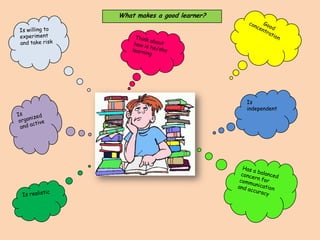
What makes a good learner?


                             Is
                             independent
• How Do We Learn Best?
We arrive at school every day, greet our
  friends, unpack our bags and get ready for a
  day of new learning opportunities.
• Well that’s why we come to school isn’t it?
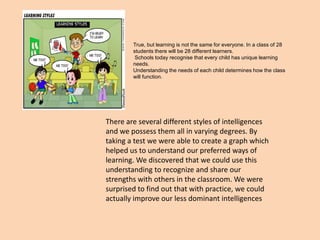
True, but learning is not the same for everyone. In a class of 28
        students there will be 28 different learners.
         Schools today recognise that every child has unique learning
        needs.
        Understanding the needs of each child determines how the class
        will function.


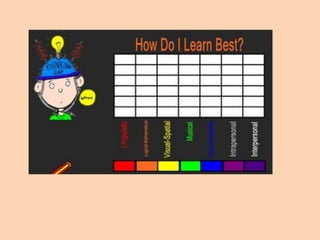
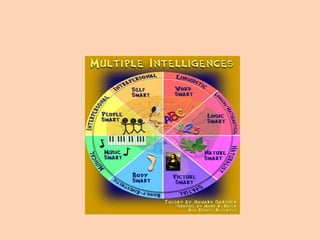
There are several different styles of intelligences
and we possess them all in varying degrees. By
taking a test we were able to create a graph which
helped us to understand our preferred ways of
learning. We discovered that we could use this
understanding to recognize and share our
strengths with others in the classroom. We were
surprised to find out that with practice, we could
actually improve our less dominant intelligences
• Linguistic intelligence involves sensitivity to spoken and written
  language, the ability to learn languages, and the capacity to use
  language to accomplish certain goals. This intelligence includes the
  ability to effectively use language to express oneself rhetorically or
  poetically; and language as a means to remember information. (
  Writers, poets, lawyers and speakers)
• Logical-mathematical intelligence consists of the capacity to
  analyze problems logically, carry out mathematical operations, and
  investigate issues scientifically. In Howard Gardner's words, it
  entails the ability to detect patterns, reason deductively and think
  logically. This intelligence is most often associated with scientific
  and mathematical thinking.
• Musical intelligence involves skill in the performance, composition,
  and appreciation of musical patterns. It encompasses the capacity
  to recognize and compose musical pitches, tones, and rhythms.
  According to Howard Gardner musical intelligence runs in an almost
  structural parallel to linguistic intelligence.
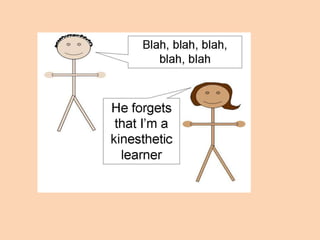
• Bodily-kinesthetic intelligence entails the potential of using one's
  whole body or parts of the body to solve problems. It is the ability
  to use mental abilities to coordinate bodily movements. Howard
  Gardner sees mental and physical activity as related.
• Spatial intelligence involves the potential to recognize and use the
  patterns of wide space and more confined areas.
• Interpersonal intelligence is concerned with the capacity to
  understand the intentions, motivations and desires of other people.
  It allows people to work effectively with others.
  Educators, salespeople, religious and political leaders and
  counsellors all need a well-developed interpersonal intelligence.
• Intrapersonal intelligence entails the capacity to understand
  oneself, to appreciate one's feelings, fears and motivations. In
  Howard Gardner's view it involves having an effective working
  model of ourselves, and to be able to use such information to
  regulate our lives.
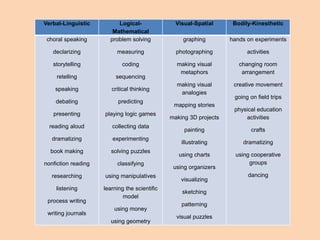
Verbal-Linguistic         Logical-               Visual-Spatial      Bodily-Kinesthetic
                        Mathematical
 choral speaking       problem solving             graphing         hands on experiments

   declarizing            measuring              photographing            activities

   storytelling             coding               making visual         changing room
                                                  metaphors             arrangement
     retelling            sequencing
                                                 making visual       creative movement
    speaking            critical thinking
                                                  analogies
                                                                     going on field trips
    debating               predicting
                                                mapping stories
                                                                     physical education
   presenting        playing logic games
                                               making 3D projects        activities
  reading aloud         collecting data
                                                    painting               crafts
   dramatizing          experimenting
                                                   illustrating         dramatizing
  book making           solving puzzles
                                                  using charts        using cooperative
nonfiction reading        classifying                                      groups
                                                using organizers
   researching       using manipulatives                                  dancing
                                                   visualizing
    listening        learning the scientific
                                                   sketching
                             model
 process writing
                                                   patterning
                         using money
 writing journals
                                                 visual puzzles
                        using geometry
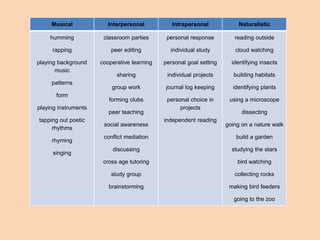
Musical            Interpersonal           Intrapersonal             Naturalistic

    humming            classroom parties      personal response         reading outside

     rapping              peer editing         individual study         cloud watching

playing background    cooperative learning   personal goal setting     identifying insects
       music
                            sharing           individual projects       building habitats
     patterns
                          group work         journal log keeping       identifying plants
       form
                         forming clubs        personal choice in      using a microscope
playing instruments                                projects
                         peer teaching                                     dissecting
tapping out poetic                           independent reading
                       social awareness                              going on a nature walk
     rhythms
                       conflict mediation                                build a garden
     rhyming
                          discussing                                   studying the stars
      singing
                       cross age tutoring                                bird watching

                          study group                                   collecting rocks

                         brainstorming                                making bird feeders

                                                                        going to the zoo
• ACTIVITY.
Bring material in order to start an album with
  multiple intelligence activities.

Clase didactica jueves

  • 2.
    What makes agood learner? Is independent
  • 5.
    • How DoWe Learn Best? We arrive at school every day, greet our friends, unpack our bags and get ready for a day of new learning opportunities. • Well that’s why we come to school isn’t it?
  • 6.
    True, but learningis not the same for everyone. In a class of 28 students there will be 28 different learners. Schools today recognise that every child has unique learning needs. Understanding the needs of each child determines how the class will function. There are several different styles of intelligences and we possess them all in varying degrees. By taking a test we were able to create a graph which helped us to understand our preferred ways of learning. We discovered that we could use this understanding to recognize and share our strengths with others in the classroom. We were surprised to find out that with practice, we could actually improve our less dominant intelligences
  • 8.
    • Linguistic intelligenceinvolves sensitivity to spoken and written language, the ability to learn languages, and the capacity to use language to accomplish certain goals. This intelligence includes the ability to effectively use language to express oneself rhetorically or poetically; and language as a means to remember information. ( Writers, poets, lawyers and speakers) • Logical-mathematical intelligence consists of the capacity to analyze problems logically, carry out mathematical operations, and investigate issues scientifically. In Howard Gardner's words, it entails the ability to detect patterns, reason deductively and think logically. This intelligence is most often associated with scientific and mathematical thinking. • Musical intelligence involves skill in the performance, composition, and appreciation of musical patterns. It encompasses the capacity to recognize and compose musical pitches, tones, and rhythms. According to Howard Gardner musical intelligence runs in an almost structural parallel to linguistic intelligence.
  • 9.
    • Bodily-kinesthetic intelligenceentails the potential of using one's whole body or parts of the body to solve problems. It is the ability to use mental abilities to coordinate bodily movements. Howard Gardner sees mental and physical activity as related. • Spatial intelligence involves the potential to recognize and use the patterns of wide space and more confined areas. • Interpersonal intelligence is concerned with the capacity to understand the intentions, motivations and desires of other people. It allows people to work effectively with others. Educators, salespeople, religious and political leaders and counsellors all need a well-developed interpersonal intelligence. • Intrapersonal intelligence entails the capacity to understand oneself, to appreciate one's feelings, fears and motivations. In Howard Gardner's view it involves having an effective working model of ourselves, and to be able to use such information to regulate our lives.
  • 10.
    Verbal-Linguistic Logical- Visual-Spatial Bodily-Kinesthetic Mathematical choral speaking problem solving graphing hands on experiments declarizing measuring photographing activities storytelling coding making visual changing room metaphors arrangement retelling sequencing making visual creative movement speaking critical thinking analogies going on field trips debating predicting mapping stories physical education presenting playing logic games making 3D projects activities reading aloud collecting data painting crafts dramatizing experimenting illustrating dramatizing book making solving puzzles using charts using cooperative nonfiction reading classifying groups using organizers researching using manipulatives dancing visualizing listening learning the scientific sketching model process writing patterning using money writing journals visual puzzles using geometry
  • 11.
    Musical Interpersonal Intrapersonal Naturalistic humming classroom parties personal response reading outside rapping peer editing individual study cloud watching playing background cooperative learning personal goal setting identifying insects music sharing individual projects building habitats patterns group work journal log keeping identifying plants form forming clubs personal choice in using a microscope playing instruments projects peer teaching dissecting tapping out poetic independent reading social awareness going on a nature walk rhythms conflict mediation build a garden rhyming discussing studying the stars singing cross age tutoring bird watching study group collecting rocks brainstorming making bird feeders going to the zoo
  • 12.
    • ACTIVITY. Bring materialin order to start an album with multiple intelligence activities.