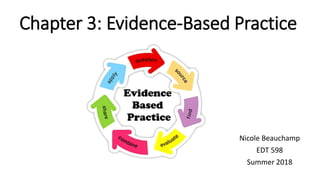
Chapter 3: Evidence-Based Practice
Nicole Beauchamp
EDT 598
Summer 2018
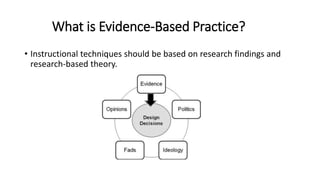
What is Evidence-Based Practice?
• Instructional techniques should be based on research findings and
research-based theory.
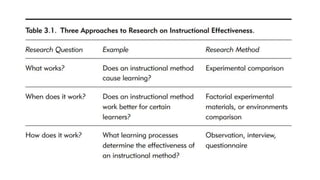
Research Method Choice:
Use what’s appropriate for the research question
WHAT?
• Experimental Comparison: Compare the test performance of people who
learned with or without the instructional feature
WHEN?
• Factorial Experimental Comparison: Compare the test performance of people who
learned with or without the instructional feature but you also vary the type of
learner, the type of learning objective or the type of learning environment for each
instructional feature
HOW?
• Observational Analysis: Carefully observe what the learner does during
learning or ask the learner to tell you about the learning principles
What to look for in Experimental Comparisons
Select studies that…
1. Focus on the instructional method you’re interested in
2. Are based on the same learners, materials and learning
environments as yours
3. Use the appropriate research method
4. Meet the criteria of good research methodology
Good Research Methodology
• Experimental control: only one variable is being tested at a time
• Random assignment: test subjects should be randomly assigned to
groups (or treatment conditions)
• Appropriate measures: the research report should tell you the mean,
standard deviation and sample size for each group on a relevant
measure of learning
How to Interpret No Effect in
Experimental Comparison
Consider the following six factors…
How to Interpret Research Statistics
• Standard deviation tells you how spread out the scores are, or how
much variation there is in the results. Powerful instructional methods
should yield high averages and low standard deviation.
• Statistical Significance: Probability (P)
• P < .05 This means there is less than a 5% chance that you are wrong and
more than a 95% chance that you are right.
• Practical Significance: Effect Size (ES)
• When the ES is less than .2 the practical impact of the experiment treatment
is a bit too small to worry about; an effect size of .5 is moderate and when it’s
.8 or above you have a large effect.
How Can You Identify Relevant Research?
5 questions to consider:
1. How similar are the learners in the research study of your learners?
2. Are the conclusions based on an experimental research design?
3. Are the experimental results replicated?
4. Is learning measured by tests that measure application?
5. Does the data analysis reflect practical significance as well as
statistical significance?
What we Don’t Know About
Evidence-Based Practice
• Meta-analysis comprised of many experiments that all test the
effectiveness of the same instructional method.
• In a meta-analysis you would record the effect size for each study and
compute an average effect size across all the studies.
• Meta-analysis can help pinpoint the conditions under which strong effects are
most likely to occur.
• Continued growth within the e–learning research base is needed for
valid meta-analysis to be conducted.
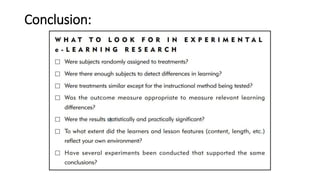
Conclusion:

Chapter 3: Evidence-Based Practice

  • 1.
    Chapter 3: Evidence-BasedPractice Nicole Beauchamp EDT 598 Summer 2018
  • 2.
    What is Evidence-BasedPractice? • Instructional techniques should be based on research findings and research-based theory.
  • 4.
    Research Method Choice: Usewhat’s appropriate for the research question WHAT? • Experimental Comparison: Compare the test performance of people who learned with or without the instructional feature WHEN? • Factorial Experimental Comparison: Compare the test performance of people who learned with or without the instructional feature but you also vary the type of learner, the type of learning objective or the type of learning environment for each instructional feature HOW? • Observational Analysis: Carefully observe what the learner does during learning or ask the learner to tell you about the learning principles
  • 5.
    What to lookfor in Experimental Comparisons Select studies that… 1. Focus on the instructional method you’re interested in 2. Are based on the same learners, materials and learning environments as yours 3. Use the appropriate research method 4. Meet the criteria of good research methodology
  • 6.
    Good Research Methodology •Experimental control: only one variable is being tested at a time • Random assignment: test subjects should be randomly assigned to groups (or treatment conditions) • Appropriate measures: the research report should tell you the mean, standard deviation and sample size for each group on a relevant measure of learning
  • 7.
    How to InterpretNo Effect in Experimental Comparison Consider the following six factors…
  • 8.
    How to InterpretResearch Statistics • Standard deviation tells you how spread out the scores are, or how much variation there is in the results. Powerful instructional methods should yield high averages and low standard deviation. • Statistical Significance: Probability (P) • P < .05 This means there is less than a 5% chance that you are wrong and more than a 95% chance that you are right. • Practical Significance: Effect Size (ES) • When the ES is less than .2 the practical impact of the experiment treatment is a bit too small to worry about; an effect size of .5 is moderate and when it’s .8 or above you have a large effect.
  • 9.
    How Can YouIdentify Relevant Research? 5 questions to consider: 1. How similar are the learners in the research study of your learners? 2. Are the conclusions based on an experimental research design? 3. Are the experimental results replicated? 4. Is learning measured by tests that measure application? 5. Does the data analysis reflect practical significance as well as statistical significance?
  • 10.
    What we Don’tKnow About Evidence-Based Practice • Meta-analysis comprised of many experiments that all test the effectiveness of the same instructional method. • In a meta-analysis you would record the effect size for each study and compute an average effect size across all the studies. • Meta-analysis can help pinpoint the conditions under which strong effects are most likely to occur. • Continued growth within the e–learning research base is needed for valid meta-analysis to be conducted.
  • 11.