Archived Information

Evidence-Based Education (EBE)
     Grover J. (Russ) Whitehurst
         Assistant Secretary
Educational Research and Improvement
United States Department of Education
Three Stories
• The university president
  – Evidence isn’t relevant
• The vendors
  – What constitutes evidence isn’t clear
• Teaching
  – Evidence isn’t available
What is EBE?

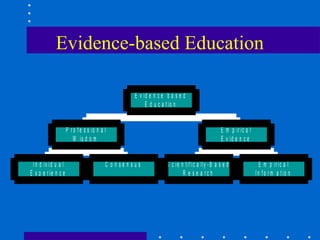
The integration of professional
wisdom with the best available
empirical evidence in making
decisions about how to deliver
instruction
What is professional wisdom?
• The judgment that individuals acquire
  through experience
• Consensus views
• Increased professional wisdom is reflected
  in numerous ways, including the effective
  identification and incorporation of local
  circumstances into instruction
What is empirical evidence?
• Scientifically-based research from fields such
  as psychology, sociology, economics, and
  neuroscience, and especially from research in
  educational settings
• Empirical data on performance used to
  compare, evaluate, and monitor progress
Evidence-based Education

                                                     E v id e n c e b a s e d
                                                          E d u c a t io n


                     P r o f e s s io n a l                                                      E m p ir ic a l
                         W is d o m                                                              E v id e n c e


 I n d iv id u a l                        C o n se n sus            S c ie n t if ic a lly - B a s e d                E m p ir ic a l
E x p e r ie n c e                                                          R e s e a rc h                         I n f o r m a t io n
Why are both needed?
• Without professional wisdom education cannot
  – adapt to local circumstances
  – operate intelligently in the many areas in which
    research evidence is absent or incomplete.
• Without empirical evidence education cannot
  – resolve competing approaches
  – generate cumulative knowledge
  – avoid fad, fancy, and personal bias
Medicine and Ag as Models
• A little history
• Evidence-based medicine
• Examples
  – The Illinois Library
  – The FTC and diet pills
  – The Hormone Replacement Therapy Study
The HRT Study
• Sample: 27,000+ Women, aged 50-79.
• Research Design: Women randomly
  assigned to receive either hormone therapy
  or a placebo; Data collected for 8-12 years.

• Hypothesis: HRT will reduce heart disease
  and fractures without increasing breast
  cancer
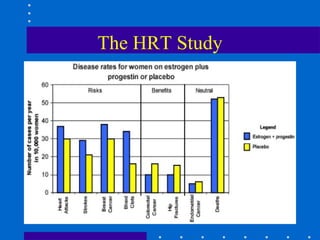
The HRT Study
Social Policy and ED examples
•   Nurse-home visitation
•   DARE
•   High quality preschool
•   National Reading Panel report
Policy Requirements
• Difference in the mix of professional
  judgment, scientific research, and objective
  measures that justifies imposition of
  requirements contrasted with identification as
  good practice
• Reading research vs. math research as example
Scientifically Based Research
“…means research that involves the
 application of rigorous, systematic, and
 objective procedures to obtain reliable and
 valid knowledge relevant to education
 activities and programs”

       (No Child Left Behind Act of 2001)
Scientifically Based Research
• Quality
  – To what degree does the design and
    analysis and logical inference support the
    claims and conclusions?
• Relevance
  – To what degree are the variables and
    circumstances similar across the research
    and the settings in which the research is
    to be applied?
Quality: Levels of evidence
 All evidence is NOT created equal
1.   Randomized trial (true experiment)
2.   Comparison groups (quasi-experiment)
3.   Pre-Post comparison
4.   Correlational studies
5.   Case studies
6.   Anecdotes
Randomized Trials: The gold standard
• Claim about the effects of an educational
  intervention on outcomes
• Two or more conditions that differ in levels
  of exposure to the educational intervention
• Random assignment to conditions
• Tests for differences in outcomes
Why is randomization critical?
• Assures that the participants being compared
  have the same characteristics across the
  conditions
• Rules of chance mean that the smart, motivated,
  experienced, etc. have the same probability of
  being in condition 1 as in condition 2
• Without randomization, differences between two
  conditions may result from pre-existing
  difference in the participants and subtle selection
  biases
Why is randomization critical?
Without randomization, simple associations such as between internet
use and science grades have many different interpretations
   Average science scores by students' reports on use of the Internet at
   home
Relevance
• Does the study involve a similar
  intervention and outcome to those of
  interest?
• Were the participants and settings
  representative of those of interest?
Evidence will not make the decision
• Be skeptical
• Consider other ways of achieving goal
• Consider consequences and local
  circumstances
• Consult with experts who understand
  evidence before making costly decisions
  (This is different from consulting
  authorities who may know the subject area
  but not rules of evidence)
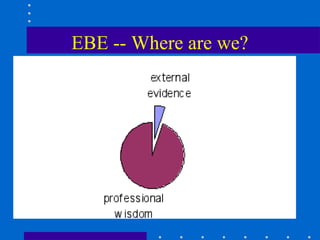
EBE -- Where are we?
What ED will do
• The What Works Clearinghouse (w-w-c.org)
  – interventions linked to evidentiary support
  – systematic reviews
  – standards for providers of evaluations, and list of
    evaluators who have agreed to follow those
    standards
What ED will do
• The National Center for Education
  Evaluation
  – Well designed, timely, & nonpartisan evaluations
    of ED’s own programs
     • Funding streams
     • Specific interventions
  – Funding for development and evaluation of
    interventions in the field
  – Feedback into discretionary grant programs
What ED will do
• Internal review of ED’s own products
• Build capacity in the field
  – Professional training
  – Workshops for major decision makers
• Systematic and long-term research programs
  to fill gaps
Goals
• ED will provide the tools, information,
  research, and training to support the
  development of evidence-based education
• The practice of evidence-based education
  will become routine
• Education across the nation will be
  continuously improved
• Wide variation in performance across
  schools and classrooms will be eliminated

Evidencebased

  • 1.
    Archived Information Evidence-Based Education(EBE) Grover J. (Russ) Whitehurst Assistant Secretary Educational Research and Improvement United States Department of Education
  • 2.
    Three Stories • Theuniversity president – Evidence isn’t relevant • The vendors – What constitutes evidence isn’t clear • Teaching – Evidence isn’t available
  • 3.
    What is EBE? Theintegration of professional wisdom with the best available empirical evidence in making decisions about how to deliver instruction
  • 4.
    What is professionalwisdom? • The judgment that individuals acquire through experience • Consensus views • Increased professional wisdom is reflected in numerous ways, including the effective identification and incorporation of local circumstances into instruction
  • 5.
    What is empiricalevidence? • Scientifically-based research from fields such as psychology, sociology, economics, and neuroscience, and especially from research in educational settings • Empirical data on performance used to compare, evaluate, and monitor progress
  • 6.
    Evidence-based Education E v id e n c e b a s e d E d u c a t io n P r o f e s s io n a l E m p ir ic a l W is d o m E v id e n c e I n d iv id u a l C o n se n sus S c ie n t if ic a lly - B a s e d E m p ir ic a l E x p e r ie n c e R e s e a rc h I n f o r m a t io n
  • 7.
    Why are bothneeded? • Without professional wisdom education cannot – adapt to local circumstances – operate intelligently in the many areas in which research evidence is absent or incomplete. • Without empirical evidence education cannot – resolve competing approaches – generate cumulative knowledge – avoid fad, fancy, and personal bias
  • 8.
    Medicine and Agas Models • A little history • Evidence-based medicine • Examples – The Illinois Library – The FTC and diet pills – The Hormone Replacement Therapy Study
  • 9.
    The HRT Study •Sample: 27,000+ Women, aged 50-79. • Research Design: Women randomly assigned to receive either hormone therapy or a placebo; Data collected for 8-12 years. • Hypothesis: HRT will reduce heart disease and fractures without increasing breast cancer
  • 10.
  • 11.
    Social Policy andED examples • Nurse-home visitation • DARE • High quality preschool • National Reading Panel report
  • 12.
    Policy Requirements • Differencein the mix of professional judgment, scientific research, and objective measures that justifies imposition of requirements contrasted with identification as good practice • Reading research vs. math research as example
  • 13.
    Scientifically Based Research “…meansresearch that involves the application of rigorous, systematic, and objective procedures to obtain reliable and valid knowledge relevant to education activities and programs” (No Child Left Behind Act of 2001)
  • 14.
    Scientifically Based Research •Quality – To what degree does the design and analysis and logical inference support the claims and conclusions? • Relevance – To what degree are the variables and circumstances similar across the research and the settings in which the research is to be applied?
  • 15.
    Quality: Levels ofevidence All evidence is NOT created equal 1. Randomized trial (true experiment) 2. Comparison groups (quasi-experiment) 3. Pre-Post comparison 4. Correlational studies 5. Case studies 6. Anecdotes
  • 16.
    Randomized Trials: Thegold standard • Claim about the effects of an educational intervention on outcomes • Two or more conditions that differ in levels of exposure to the educational intervention • Random assignment to conditions • Tests for differences in outcomes
  • 17.
    Why is randomizationcritical? • Assures that the participants being compared have the same characteristics across the conditions • Rules of chance mean that the smart, motivated, experienced, etc. have the same probability of being in condition 1 as in condition 2 • Without randomization, differences between two conditions may result from pre-existing difference in the participants and subtle selection biases
  • 18.
    Why is randomizationcritical? Without randomization, simple associations such as between internet use and science grades have many different interpretations Average science scores by students' reports on use of the Internet at home
  • 19.
    Relevance • Does thestudy involve a similar intervention and outcome to those of interest? • Were the participants and settings representative of those of interest?
  • 20.
    Evidence will notmake the decision • Be skeptical • Consider other ways of achieving goal • Consider consequences and local circumstances • Consult with experts who understand evidence before making costly decisions (This is different from consulting authorities who may know the subject area but not rules of evidence)
  • 21.
    EBE -- Whereare we?
  • 23.
    What ED willdo • The What Works Clearinghouse (w-w-c.org) – interventions linked to evidentiary support – systematic reviews – standards for providers of evaluations, and list of evaluators who have agreed to follow those standards
  • 24.
    What ED willdo • The National Center for Education Evaluation – Well designed, timely, & nonpartisan evaluations of ED’s own programs • Funding streams • Specific interventions – Funding for development and evaluation of interventions in the field – Feedback into discretionary grant programs
  • 25.
    What ED willdo • Internal review of ED’s own products • Build capacity in the field – Professional training – Workshops for major decision makers • Systematic and long-term research programs to fill gaps
  • 26.
    Goals • ED willprovide the tools, information, research, and training to support the development of evidence-based education • The practice of evidence-based education will become routine • Education across the nation will be continuously improved • Wide variation in performance across schools and classrooms will be eliminated

Editor's Notes

  • #7 This chart outlines the components of evidence-based education previously discussed. Evidence-based education is comprised of professional wisdom and empirical evidence. Professional wisdom includes individual experience and consensus. Empirical evidence includes scientifically-based research and empirical information.
  • #11 This chart reflects disease rates for women on estrogen plus progestin or placebo based on the results of a Hormone Replacement Therapy Study designed to show the number of cases of heart attacks, strokes, breast cancer, blood clots, colorectal cancer, hip fractures, endometrial cancer and deaths per year in 10,000 women. Overall statistics reflect an increase in heart attacks, strokes, and breast cancer for women on estrogen plus progestin for heart ailments.
  • #19 This chart indicates an increase in science scores by students’ reports on use of the Internet at home for grades 4, 8 and 12.
  • #22 The graphic shows a circle indicating external evidence is only a small slice of the pie compared to professional wisdom as related to evidence based education.
  • #23 This chart indicates the total number of articles about randomized field trials in other areas of social science research (criminology, social policy and psychology) has steadily grown over the last 40 years, however the number related to education research has trailed behind.