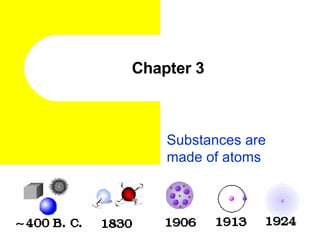
Chapter 3 Substances are made of atoms
Natural Philosophy Heraclitus versus Parmenides Heraclitus – everything is in the process of change Parmenides – Change is impossible
Natural Philosophy In 400 BCE, Democritus stated, All matter consists of tiny particles called átomos, which are not created and cannot be destroyed. This was the beginning of the atomism.
Natural Philosophy The fight wasn’t over.  Plato disagreed. He thought that the beauty of the world had to be caused by more than mere atoms. He proposed a system of changing elements; water, fire, earth, air.
Natural Philosophy Aristotle disagreed with both Democritus and Plato.  He proposed a  system called Hylomorphism. Hylomorphism is a system of ever changing states of matter.
Natural Philosophy Atomism was lost until the 16 th  Century Though it was still not a hard science, it was part of a belief system called alchemy. Thankfully, Robert Boyle put an end to the mess when he wrote  The Skeptical Chemyst.
“ Nature works by means of bodies unseen.” Lucretius
The Elements
 
Atomic Theory Three laws provide supporting evidence of atoms. Law of Definite Proportions Law of Conservation of Mass Law of Multiple Proportions
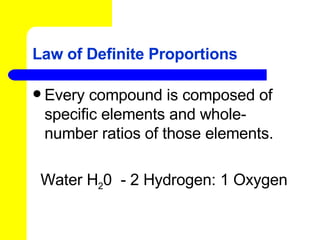
Law of Definite Proportions Every compound is composed of specific elements and whole-number ratios of those elements. Water H 2 0  - 2 Hydrogen: 1 Oxygen
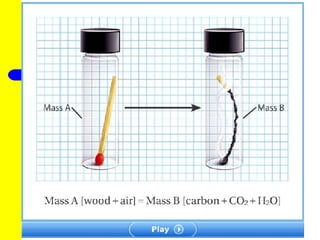
Law of Conservation of Mass Matter cannot be create or destroyed by normal physical or chemical processes i.e.- What goes in, must come out!
 
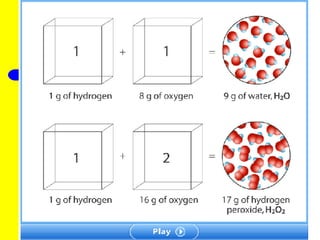
Law of Multiple Proportions The same elements can bond in differing whole-number ratios to form different compounds. Methanol CH 3 O  Ethanol C 2 H 5 O
 
Dalton’s Atomic Theory It contained five principles based on current knowledge of atoms. We have summarized those principles in the following statements:
Dalton’s Atomic Theory All matter is made up of tiny  indestructible  particles called atoms. All atoms of one type (element) have the  same mass  and properties. Atoms of different types (elements) have different masses and properties.
Dalton’s Atomic Theory In Chemical reactions, atoms rearrange, but are not changed, created, or destroyed. When different elements combine, they do so in some ratio of whole numbers.
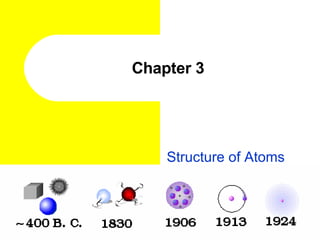
Chapter 3 Structure of Atoms
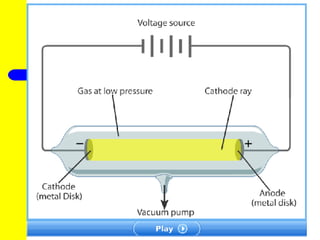
Atomic dessert In 1897 J.J. Thomson was able to control light in a vacuum through the use of magnets. He concluded that the charge of the beam was negative. He also new that the charge was due to movement of something inside atoms He concluded that atoms contain subatomic particles with + and - charges.
 
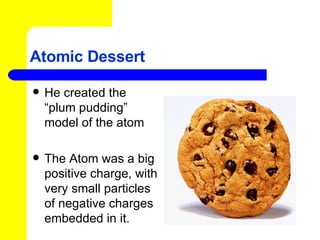
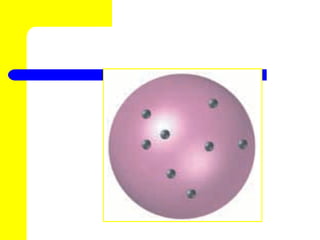
Atomic Dessert He created the “plum pudding” model of the atom The Atom was a big positive charge, with very small particles of negative charges embedded in it.
 
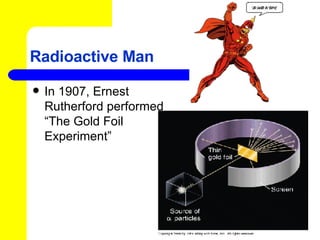
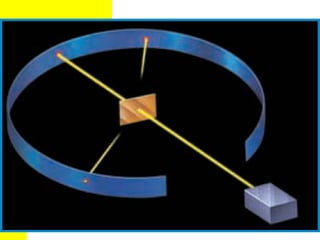
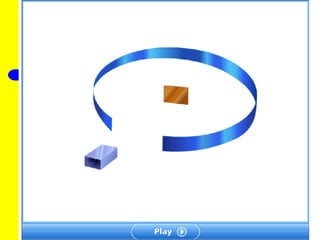
Radioactive Man In 1907, Ernest Rutherford performed “The Gold Foil Experiment”
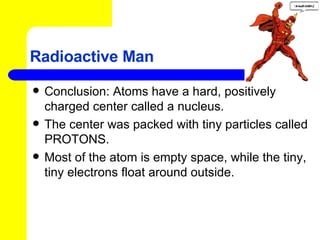
Radioactive Man Conclusion: Atoms have a hard, positively charged center called a nucleus. The center was packed with tiny particles called PROTONS.  Most of the atom is empty space, while the tiny, tiny electrons float around outside.
 
 
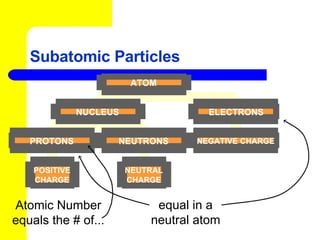
Subatomic Particles NUCLEUS ELECTRONS PROTONS NEUTRONS NEGATIVE CHARGE POSITIVE CHARGE NEUTRAL CHARGE ATOM Atomic Number equals the # of... equal in a neutral atom
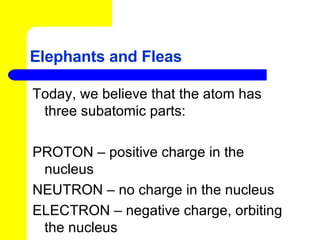
Elephants and Fleas Today, we believe that the atom has three subatomic parts: PROTON – positive charge in the nucleus NEUTRON – no charge in the nucleus ELECTRON – negative charge, orbiting the nucleus
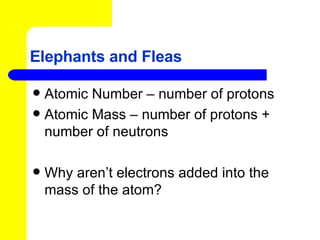
Elephants and Fleas Atomic Number – number of protons Atomic Mass – number of protons + number of neutrons Why aren’t electrons added into the mass of the atom?
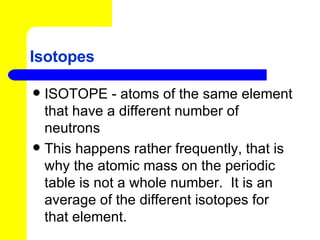
Isotopes ISOTOPE - atoms of the same element that have a different number of neutrons This happens rather frequently, that is why the atomic mass on the periodic table is not a whole number.  It is an average of the different isotopes for that element.
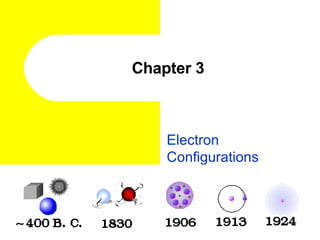
Chapter 3 Electron Configurations
The not so great “greats” Dalton, Thomson, and Rutherford were great men of science, but they had yet to understand the atom. It wasn’t until Niels Bohr began to think about Hydrogen that were started to understand how complex an atom really is.
 
 
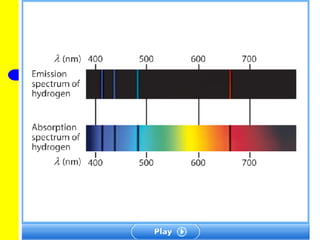
Bohr: What is it good for?! Bohr, using a technique called Line Emission Spectrums, saw that electron didn’t just fly randomly around the nucleus.  In fact, they are in distinct orbits called ENERGY LEVELS.
 
Bohr: What is it good for?! If you put energy into an electron, it will change energy level into an EXCITED STATE.  It will eventually drop back down to it’s GROUND STATE and give off energy in the form of light.
 
The colors of chemistry Electromagnetic Spectrum – radiation moving at the speed of light ranging from low-energy radio waves to high-energy cosmic rays; includes visible light It is often referred to as “light” The spectrum is created by the “jumping” of electrons between orbits
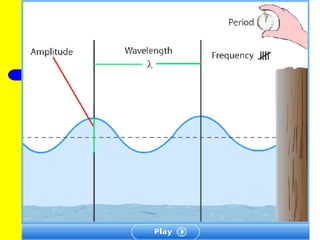
Visible Spectrum The more energy a wave has, the higher the frequency Red has the lowest frequency, therefore it has the lowest energy The most energetic color is violet ROY G BIV
Electrons are wavicles. Bohr model of the atom shows electrons orbiting a nucleus. Electrons are particles When we attempt to observe an electron, it changes position Electrons are waves
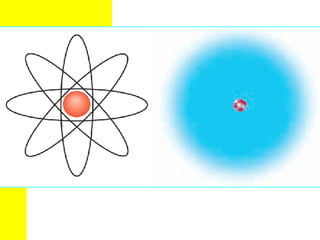
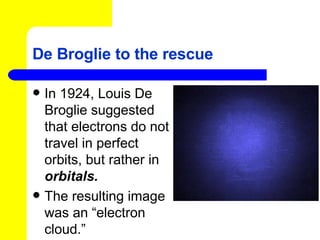
De Broglie to the rescue In 1924, Louis De Broglie suggested that electrons do not travel in perfect orbits, but rather in  orbitals. The resulting image was an “electron cloud.”
 
Electron Configuration Rules Take notes on Hog Hilton and work on board.

Chapter 3

  • 1.
    Chapter 3 Substancesare made of atoms
  • 2.
    Natural Philosophy Heraclitusversus Parmenides Heraclitus – everything is in the process of change Parmenides – Change is impossible
  • 3.
    Natural Philosophy In400 BCE, Democritus stated, All matter consists of tiny particles called átomos, which are not created and cannot be destroyed. This was the beginning of the atomism.
  • 4.
    Natural Philosophy Thefight wasn’t over. Plato disagreed. He thought that the beauty of the world had to be caused by more than mere atoms. He proposed a system of changing elements; water, fire, earth, air.
  • 5.
    Natural Philosophy Aristotledisagreed with both Democritus and Plato. He proposed a system called Hylomorphism. Hylomorphism is a system of ever changing states of matter.
  • 6.
    Natural Philosophy Atomismwas lost until the 16 th Century Though it was still not a hard science, it was part of a belief system called alchemy. Thankfully, Robert Boyle put an end to the mess when he wrote The Skeptical Chemyst.
  • 7.
    “ Nature worksby means of bodies unseen.” Lucretius
  • 8.
  • 9.
  • 10.
    Atomic Theory Threelaws provide supporting evidence of atoms. Law of Definite Proportions Law of Conservation of Mass Law of Multiple Proportions
  • 11.
    Law of DefiniteProportions Every compound is composed of specific elements and whole-number ratios of those elements. Water H 2 0 - 2 Hydrogen: 1 Oxygen
  • 12.
    Law of Conservationof Mass Matter cannot be create or destroyed by normal physical or chemical processes i.e.- What goes in, must come out!
  • 13.
  • 14.
    Law of MultipleProportions The same elements can bond in differing whole-number ratios to form different compounds. Methanol CH 3 O Ethanol C 2 H 5 O
  • 15.
  • 16.
    Dalton’s Atomic TheoryIt contained five principles based on current knowledge of atoms. We have summarized those principles in the following statements:
  • 17.
    Dalton’s Atomic TheoryAll matter is made up of tiny indestructible particles called atoms. All atoms of one type (element) have the same mass and properties. Atoms of different types (elements) have different masses and properties.
  • 18.
    Dalton’s Atomic TheoryIn Chemical reactions, atoms rearrange, but are not changed, created, or destroyed. When different elements combine, they do so in some ratio of whole numbers.
  • 19.
  • 20.
    Atomic dessert In1897 J.J. Thomson was able to control light in a vacuum through the use of magnets. He concluded that the charge of the beam was negative. He also new that the charge was due to movement of something inside atoms He concluded that atoms contain subatomic particles with + and - charges.
  • 21.
  • 22.
    Atomic Dessert Hecreated the “plum pudding” model of the atom The Atom was a big positive charge, with very small particles of negative charges embedded in it.
  • 23.
  • 24.
    Radioactive Man In1907, Ernest Rutherford performed “The Gold Foil Experiment”
  • 25.
    Radioactive Man Conclusion:Atoms have a hard, positively charged center called a nucleus. The center was packed with tiny particles called PROTONS. Most of the atom is empty space, while the tiny, tiny electrons float around outside.
  • 26.
  • 27.
  • 28.
    Subatomic Particles NUCLEUSELECTRONS PROTONS NEUTRONS NEGATIVE CHARGE POSITIVE CHARGE NEUTRAL CHARGE ATOM Atomic Number equals the # of... equal in a neutral atom
  • 29.
    Elephants and FleasToday, we believe that the atom has three subatomic parts: PROTON – positive charge in the nucleus NEUTRON – no charge in the nucleus ELECTRON – negative charge, orbiting the nucleus
  • 30.
    Elephants and FleasAtomic Number – number of protons Atomic Mass – number of protons + number of neutrons Why aren’t electrons added into the mass of the atom?
  • 31.
    Isotopes ISOTOPE -atoms of the same element that have a different number of neutrons This happens rather frequently, that is why the atomic mass on the periodic table is not a whole number. It is an average of the different isotopes for that element.
  • 32.
    Chapter 3 ElectronConfigurations
  • 33.
    The not sogreat “greats” Dalton, Thomson, and Rutherford were great men of science, but they had yet to understand the atom. It wasn’t until Niels Bohr began to think about Hydrogen that were started to understand how complex an atom really is.
  • 34.
  • 35.
  • 36.
    Bohr: What isit good for?! Bohr, using a technique called Line Emission Spectrums, saw that electron didn’t just fly randomly around the nucleus. In fact, they are in distinct orbits called ENERGY LEVELS.
  • 37.
  • 38.
    Bohr: What isit good for?! If you put energy into an electron, it will change energy level into an EXCITED STATE. It will eventually drop back down to it’s GROUND STATE and give off energy in the form of light.
  • 39.
  • 40.
    The colors ofchemistry Electromagnetic Spectrum – radiation moving at the speed of light ranging from low-energy radio waves to high-energy cosmic rays; includes visible light It is often referred to as “light” The spectrum is created by the “jumping” of electrons between orbits
  • 41.
    Visible Spectrum Themore energy a wave has, the higher the frequency Red has the lowest frequency, therefore it has the lowest energy The most energetic color is violet ROY G BIV
  • 42.
    Electrons are wavicles.Bohr model of the atom shows electrons orbiting a nucleus. Electrons are particles When we attempt to observe an electron, it changes position Electrons are waves
  • 43.
    De Broglie tothe rescue In 1924, Louis De Broglie suggested that electrons do not travel in perfect orbits, but rather in orbitals. The resulting image was an “electron cloud.”
  • 44.
  • 45.
    Electron Configuration RulesTake notes on Hog Hilton and work on board.