



14-1
Part Three
                      SOURCES AND
                    COLLECTION OF DATA


 14-2
McGraw-Hill/Irwin           © 2003 The McGraw-Hill Companies, Inc.,All Rights Reserved.
Chapter Fourteen
       EXPERIMENTATION


14-3
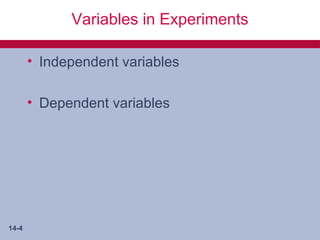
Variables in Experiments

       • Independent variables

       • Dependent variables


14-4
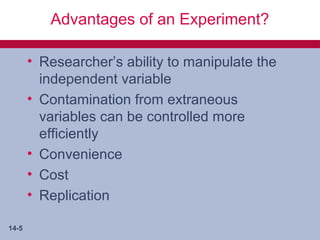
Advantages of an Experiment?

       • Researcher’s ability to manipulate the
         independent variable
       • Contamination from extraneous
         variables can be controlled more
         efficiently
       • Convenience
       • Cost
       • Replication

14-5
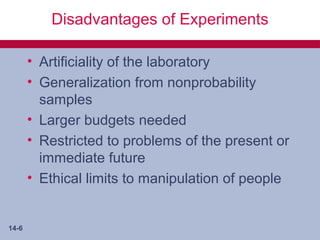
Disadvantages of Experiments

       • Artificiality of the laboratory
       • Generalization from nonprobability
         samples
       • Larger budgets needed
       • Restricted to problems of the present or
         immediate future
       • Ethical limits to manipulation of people


14-6
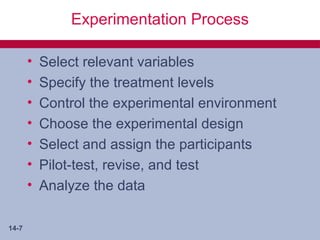
Experimentation Process

       •   Select relevant variables
       •   Specify the treatment levels
       •   Control the experimental environment
       •   Choose the experimental design
       •   Select and assign the participants
       •   Pilot-test, revise, and test
       •   Analyze the data

14-7
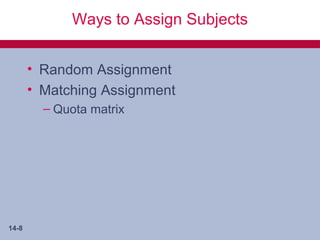
Ways to Assign Subjects


       • Random Assignment
       • Matching Assignment
         – Quota matrix


14-8
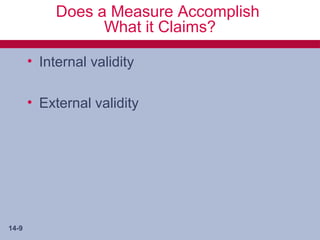
Does a Measure Accomplish
                  What it Claims?

       • Internal validity

       • External validity


14-9
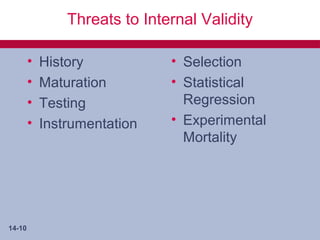
Threats to Internal Validity

        •   History            • Selection
        •   Maturation         • Statistical
        •   Testing              Regression
        •   Instrumentation    • Experimental
                                 Mortality


14-10
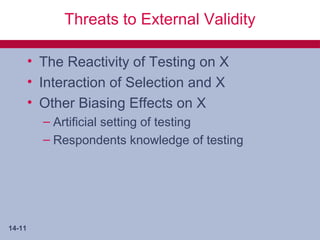
Threats to External Validity

        • The Reactivity of Testing on X
        • Interaction of Selection and X
        • Other Biasing Effects on X
          – Artificial setting of testing
          – Respondents knowledge of testing


14-11
Experimental Designs

        • Preexperimental designs

        • True experimental designs

        • Field experiments


14-12
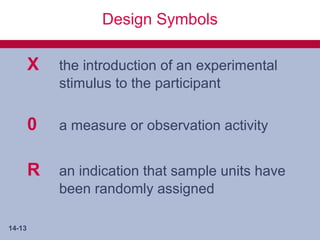
Design Symbols

        X   the introduction of an experimental
            stimulus to the participant

        0   a measure or observation activity


        R   an indication that sample units have
            been randomly assigned

14-13
Preexperimental Designs

        • One-shot case study

        • One-group pretest-posttest design

        • Static group comparison


14-14
True Experimental Designs

        • Pretest-posttest control group design

        • Posttest-only control group design


14-15
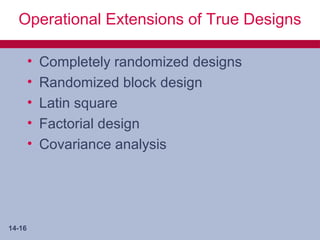
Operational Extensions of True Designs

        •   Completely randomized designs
        •   Randomized block design
        •   Latin square
        •   Factorial design
        •   Covariance analysis


14-16
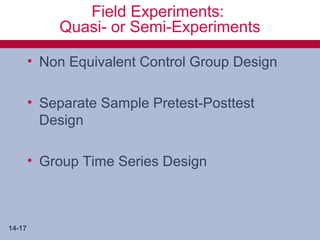
Field Experiments:
            Quasi- or Semi-Experiments

        • Non Equivalent Control Group Design

        • Separate Sample Pretest-Posttest
          Design

        • Group Time Series Design


14-17

Business Research Methods Chap014

  • 1.
  • 2.
    Part Three SOURCES AND COLLECTION OF DATA 14-2 McGraw-Hill/Irwin © 2003 The McGraw-Hill Companies, Inc.,All Rights Reserved.
  • 3.
    Chapter Fourteen EXPERIMENTATION 14-3
  • 4.
    Variables in Experiments • Independent variables • Dependent variables 14-4
  • 5.
    Advantages of anExperiment? • Researcher’s ability to manipulate the independent variable • Contamination from extraneous variables can be controlled more efficiently • Convenience • Cost • Replication 14-5
  • 6.
    Disadvantages of Experiments • Artificiality of the laboratory • Generalization from nonprobability samples • Larger budgets needed • Restricted to problems of the present or immediate future • Ethical limits to manipulation of people 14-6
  • 7.
    Experimentation Process • Select relevant variables • Specify the treatment levels • Control the experimental environment • Choose the experimental design • Select and assign the participants • Pilot-test, revise, and test • Analyze the data 14-7
  • 8.
    Ways to AssignSubjects • Random Assignment • Matching Assignment – Quota matrix 14-8
  • 9.
    Does a MeasureAccomplish What it Claims? • Internal validity • External validity 14-9
  • 10.
    Threats to InternalValidity • History • Selection • Maturation • Statistical • Testing Regression • Instrumentation • Experimental Mortality 14-10
  • 11.
    Threats to ExternalValidity • The Reactivity of Testing on X • Interaction of Selection and X • Other Biasing Effects on X – Artificial setting of testing – Respondents knowledge of testing 14-11
  • 12.
    Experimental Designs • Preexperimental designs • True experimental designs • Field experiments 14-12
  • 13.
    Design Symbols X the introduction of an experimental stimulus to the participant 0 a measure or observation activity R an indication that sample units have been randomly assigned 14-13
  • 14.
    Preexperimental Designs • One-shot case study • One-group pretest-posttest design • Static group comparison 14-14
  • 15.
    True Experimental Designs • Pretest-posttest control group design • Posttest-only control group design 14-15
  • 16.
    Operational Extensions ofTrue Designs • Completely randomized designs • Randomized block design • Latin square • Factorial design • Covariance analysis 14-16
  • 17.
    Field Experiments: Quasi- or Semi-Experiments • Non Equivalent Control Group Design • Separate Sample Pretest-Posttest Design • Group Time Series Design 14-17