BMGT 204: Sales Strategies
and Techniques
Ethics First…Then Customer Relationships
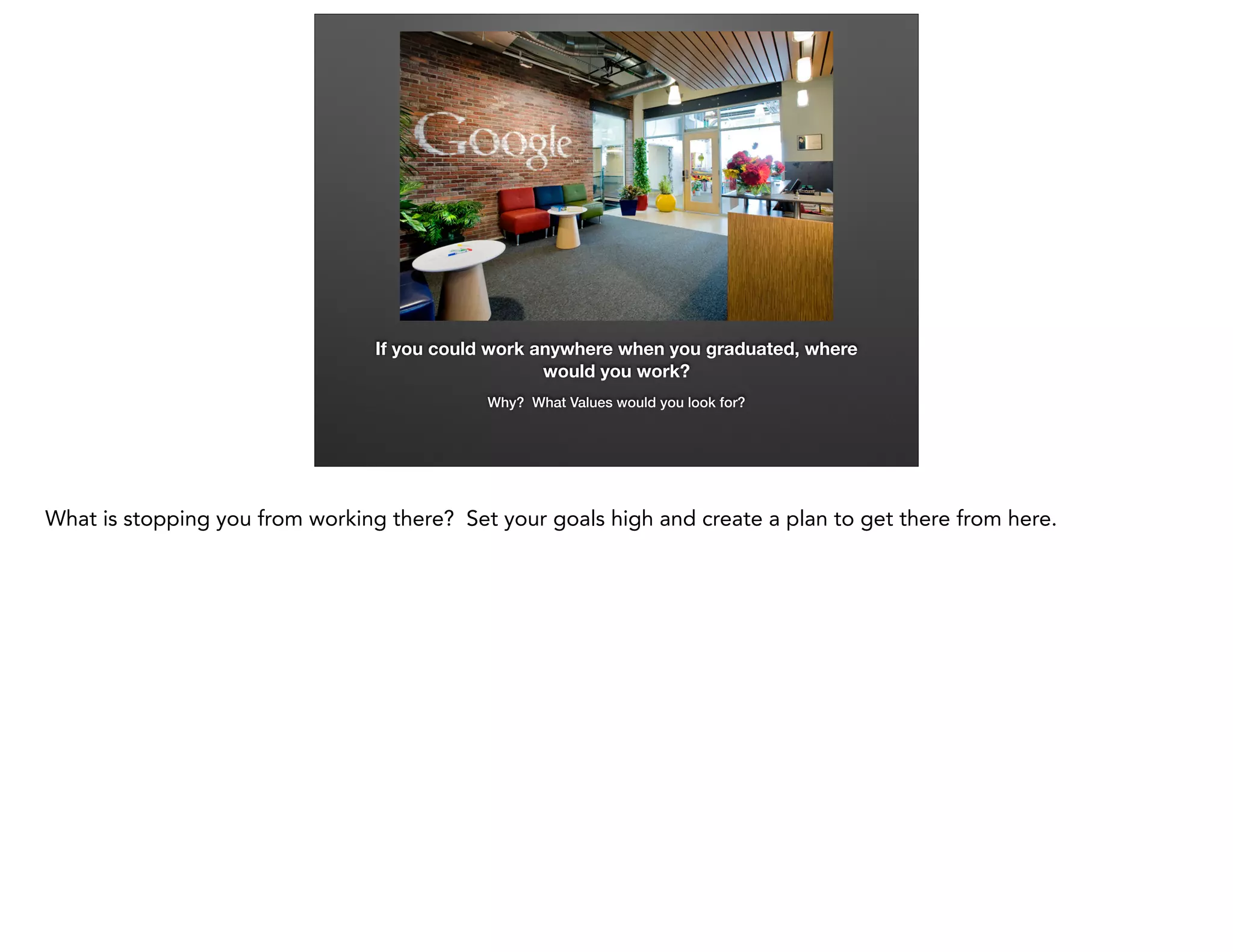
If you could work anywhere when you graduated, where
would you work?
Why? What Values would you look for?

What is stopping you from working there? Set your goals high and create a plan to get there from here.
Helpful Hints to Making
Career Decisions
•

Your employer should provide worthwhile products

•

You should be able to do what is right

•

You do not have to compromise your beliefs

•

People go before anything else

•

Good people are desperately needed in all types of
businesses/organizations

•

Look for a calling, not a job
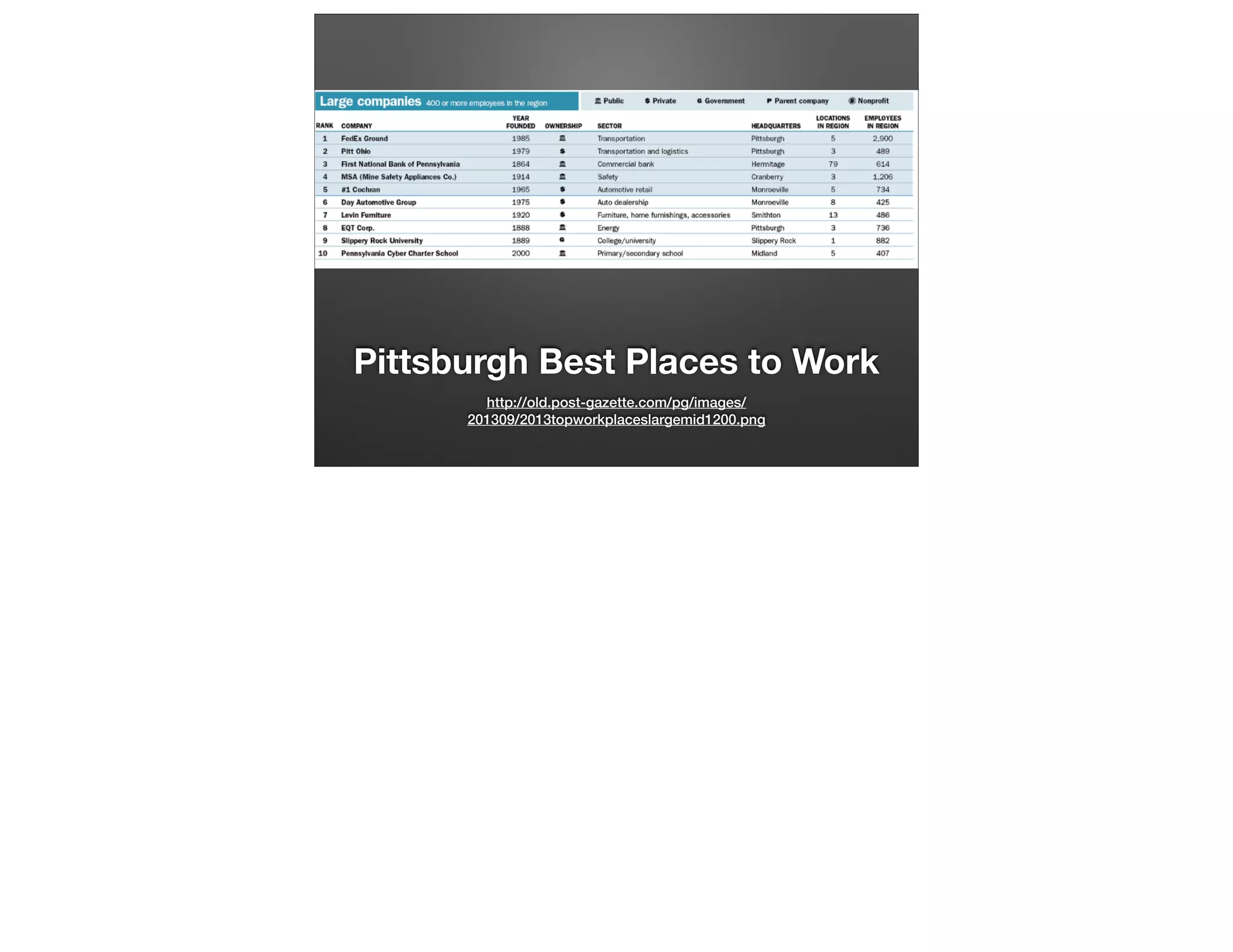
Pittsburgh Best Places to Work
http://old.post-gazette.com/pg/images/
201309/2013topworkplaceslargemid1200.png
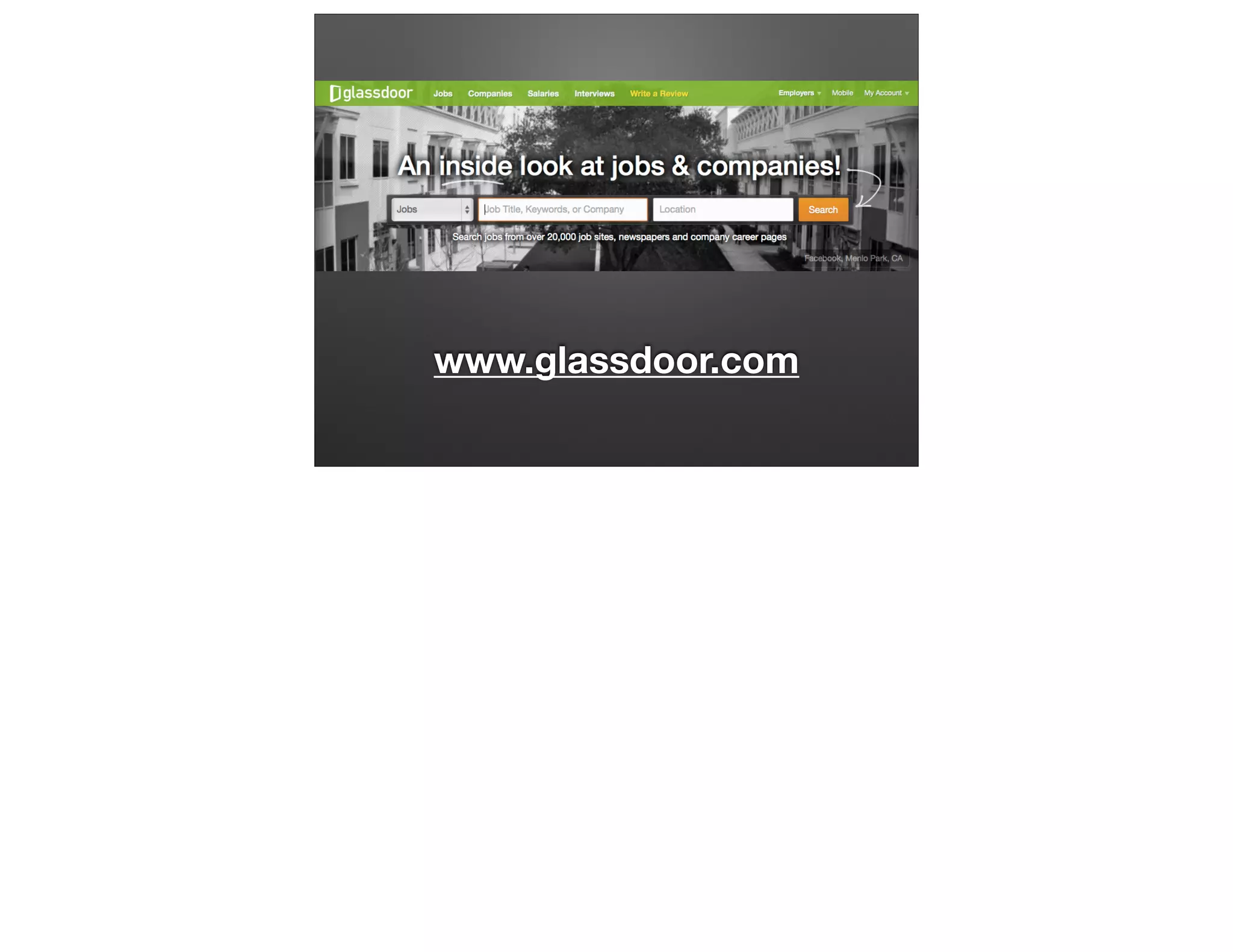
www.glassdoor.com
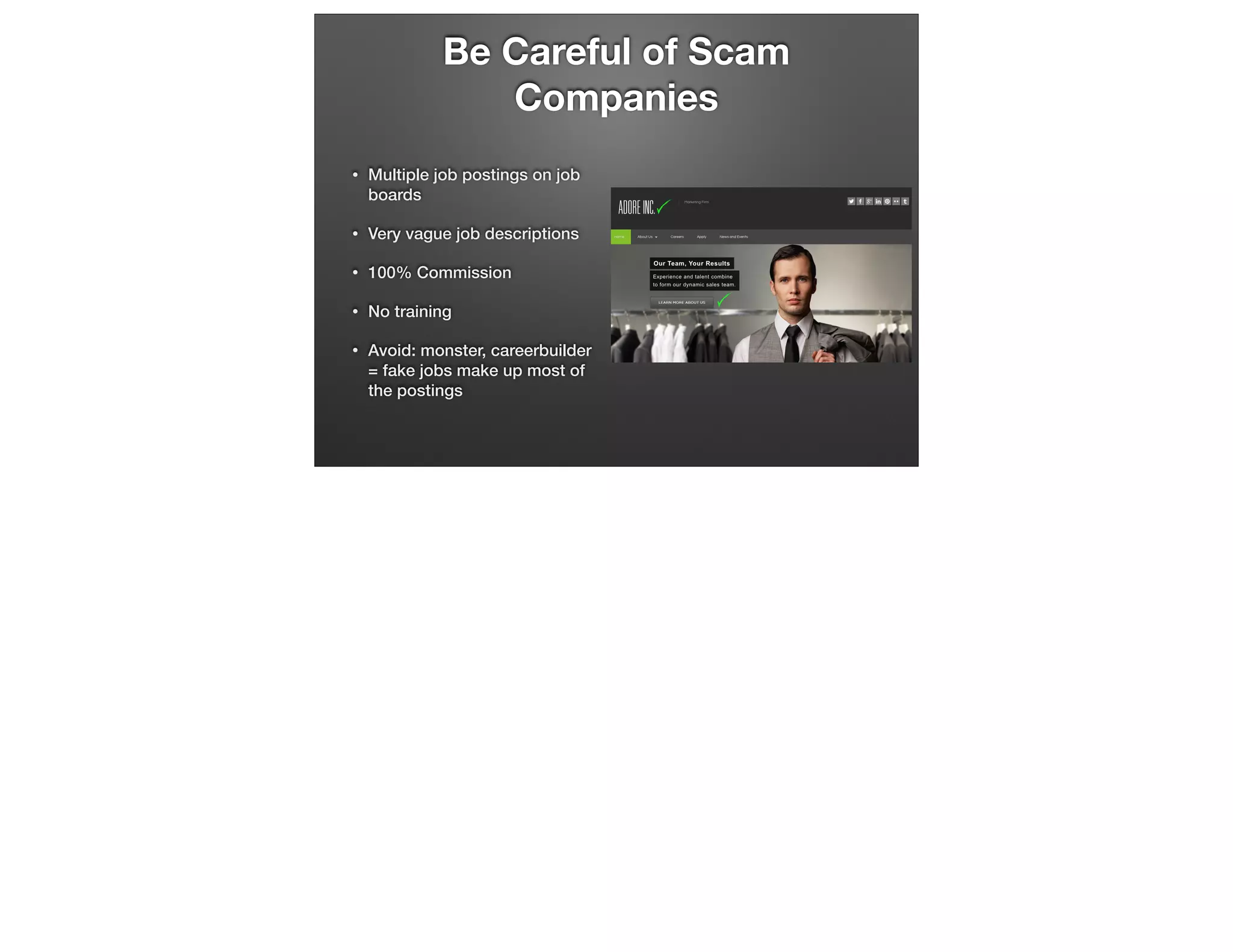
Be Careful of Scam
Companies
•

Multiple job postings on job
boards

•

Very vague job descriptions

•

100% Commission

•

No training

•

Avoid: monster, careerbuilder
= fake jobs make up most of
the postings
What Influences Ethical
Behavior?
•

The Individual’s Role
•

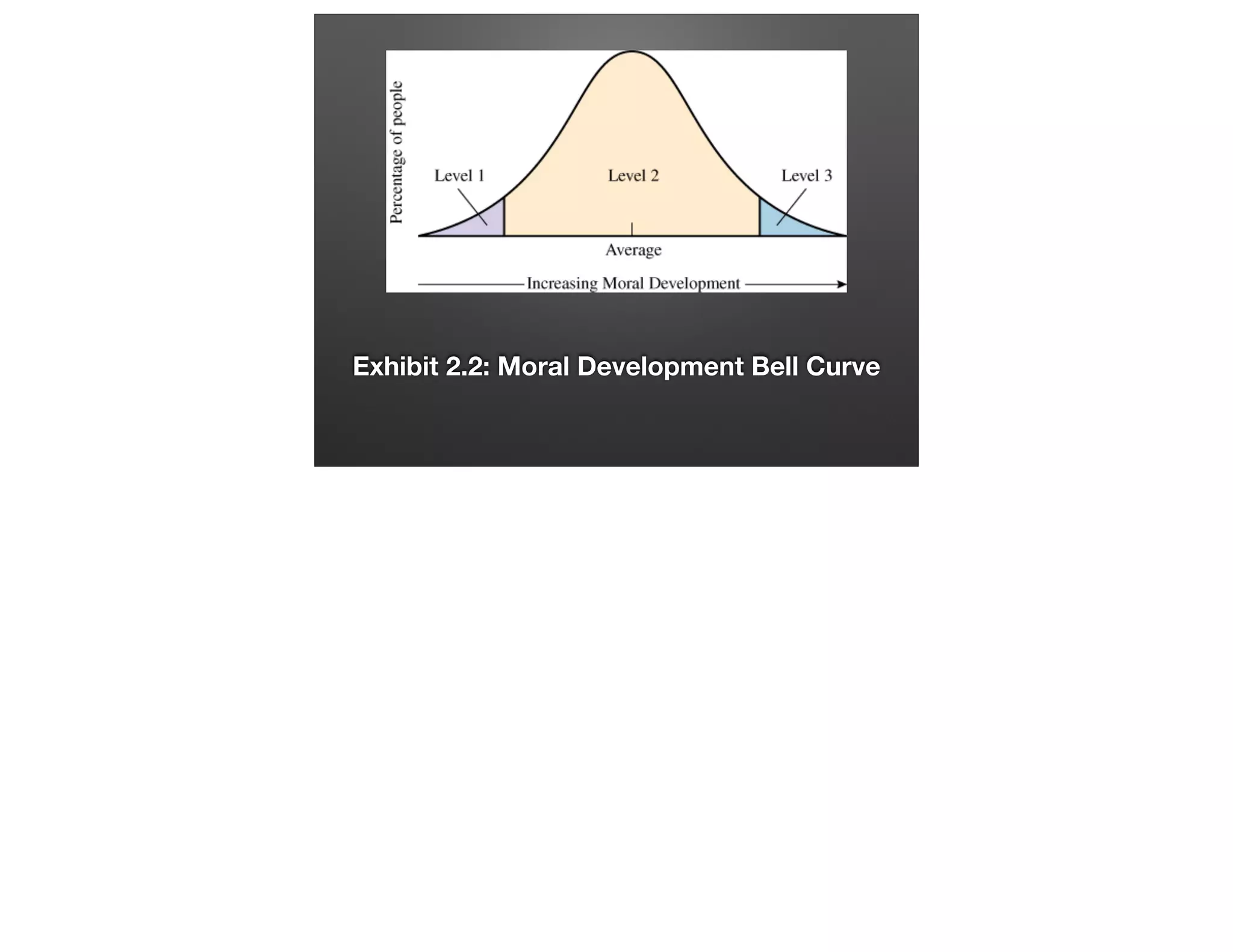
Level one: Preconventional – acts in own best interest
•

•

Level two: Conventional – upholds legal laws
•

•

Most people operate here

Level three: Principled – lives by own code
•

•

A few operate here

Less than 20% reach level three

The Organization’s Role
•

At best, most employees in firm operate at level two

•

How will the situation be handled if no policies and procedures are in place?
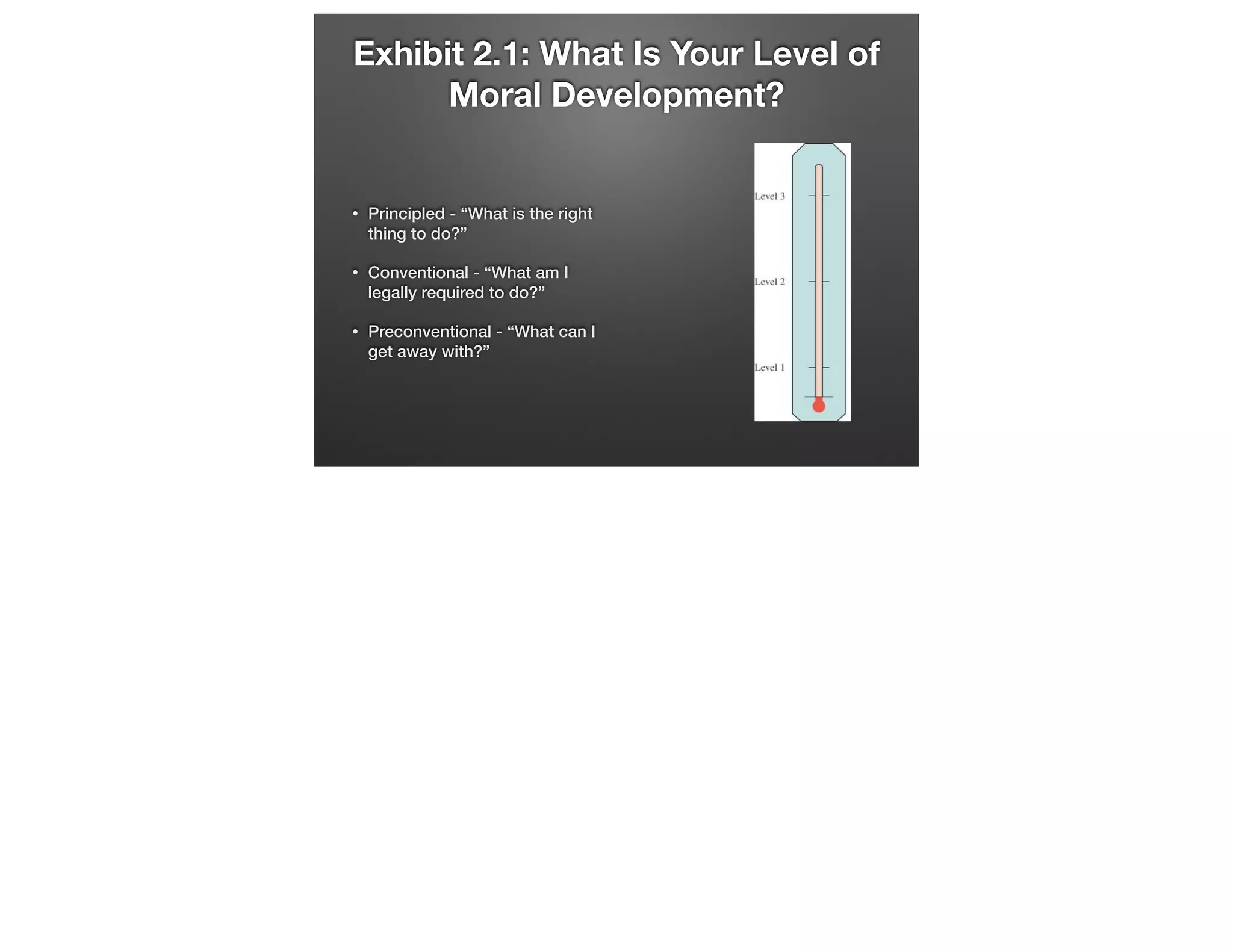
Exhibit 2.1: What Is Your Level of
Moral Development?

•

Principled - “What is the right
thing to do?”

•

Conventional - “What am I
legally required to do?”

•

Preconventional - “What can I
get away with?”
Exhibit 2.2: Moral Development Bell Curve
Management’s Ethical
Responsibilities

•

Ethics is the code of moral principles and values that
govern the behaviors of a person or a group with
respect to what is right or wrong

•

Ethical behavior refers to treating others fairly
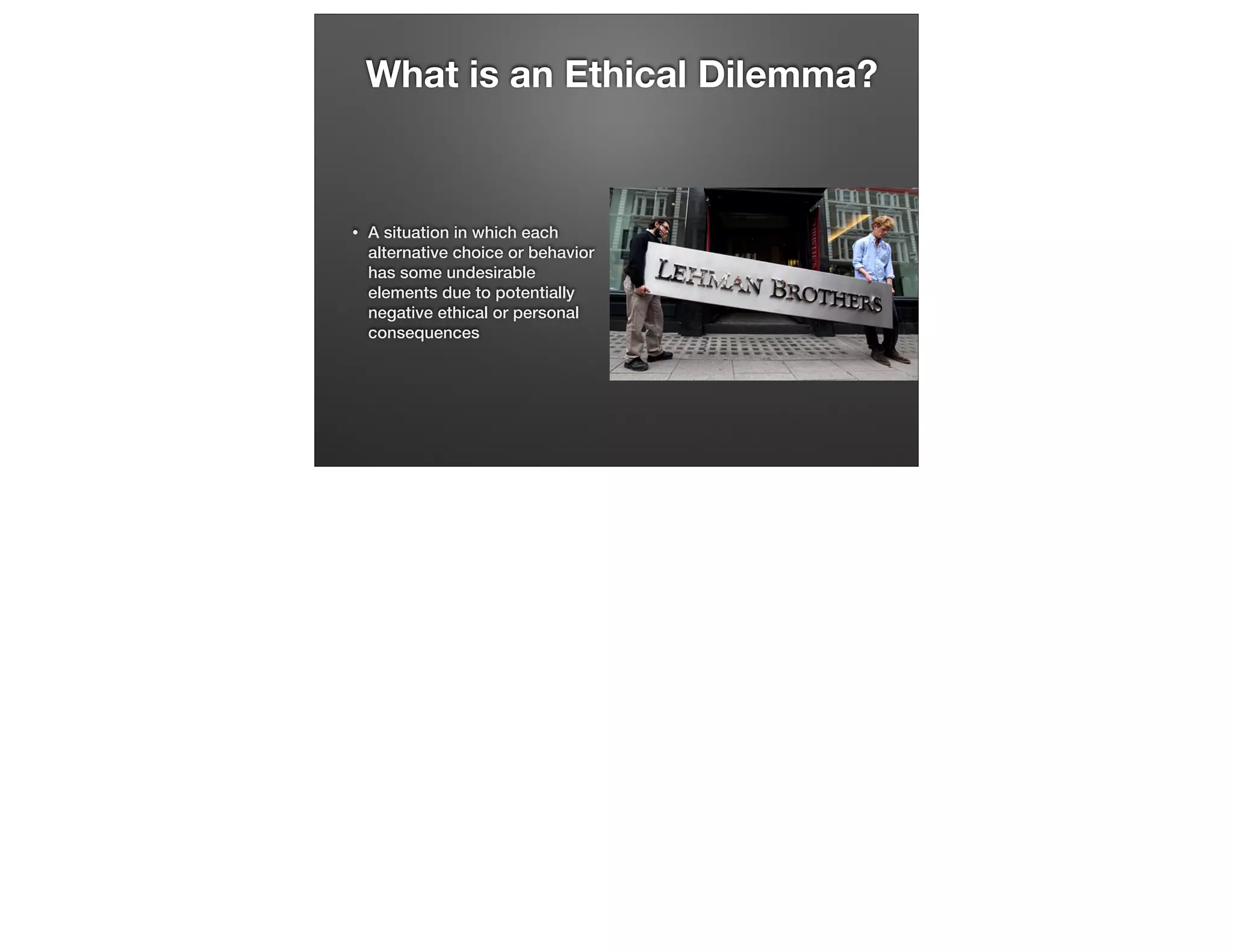
What is an Ethical Dilemma?

•

A situation in which each
alternative choice or behavior
has some undesirable
elements due to potentially
negative ethical or personal
consequences
Managing Sales Ethics
•

Follow the leader

•

Leader selection is important

•

Establish a code of ethics

•

Create ethical structures

•

Encourage whistle-blowing

•

Create an ethical sales climate

•

Establish control systems
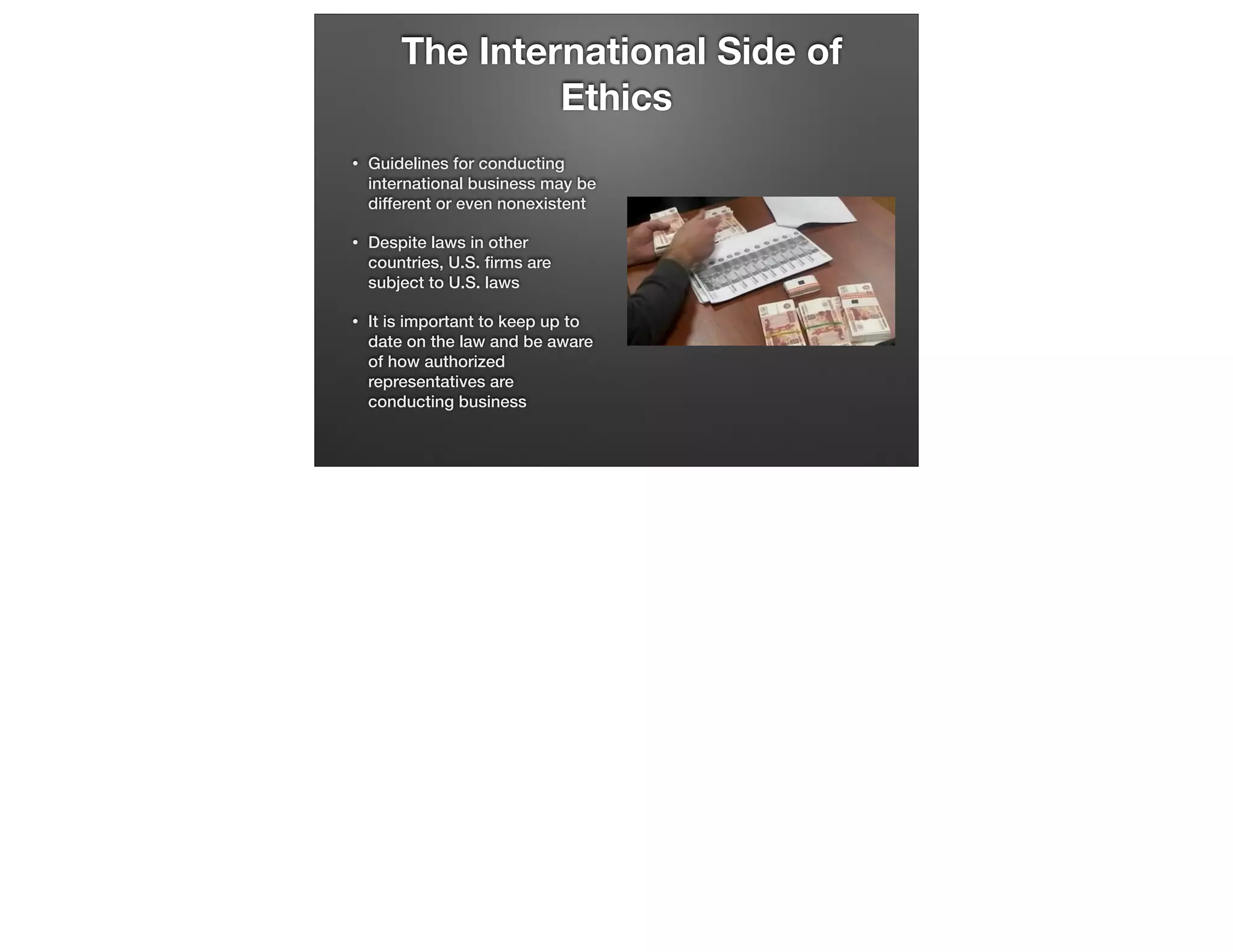
The International Side of
Ethics
•

Guidelines for conducting
international business may be
different or even nonexistent

•

Despite laws in other
countries, U.S. firms are
subject to U.S. laws

•

It is important to keep up to
date on the law and be aware
of how authorized
representatives are
conducting business
Ethics in Dealing with
Salespeople
•

Five ethical considerations faced by sales managers:
•

Level of sales pressure

•

Decisions affecting territory

•

To tell the truth?

•

The ill salesperson

•

Employee rights
•

termination-at-will

•

privacy

•

sexual harassment
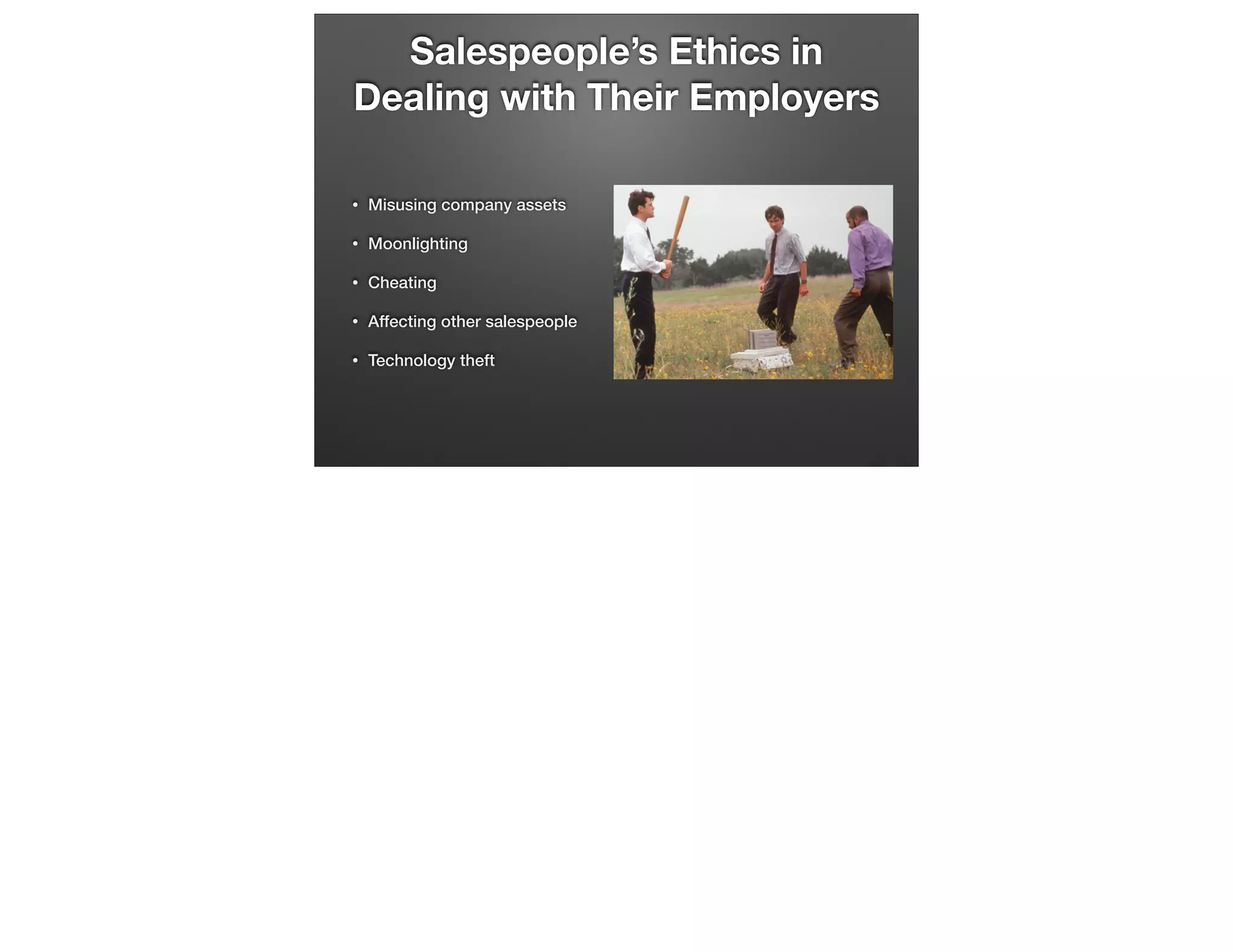
Salespeople’s Ethics in
Dealing with Their Employers
•

Misusing company assets

•

Moonlighting

•

Cheating

•

Affecting other salespeople

•

Technology theft
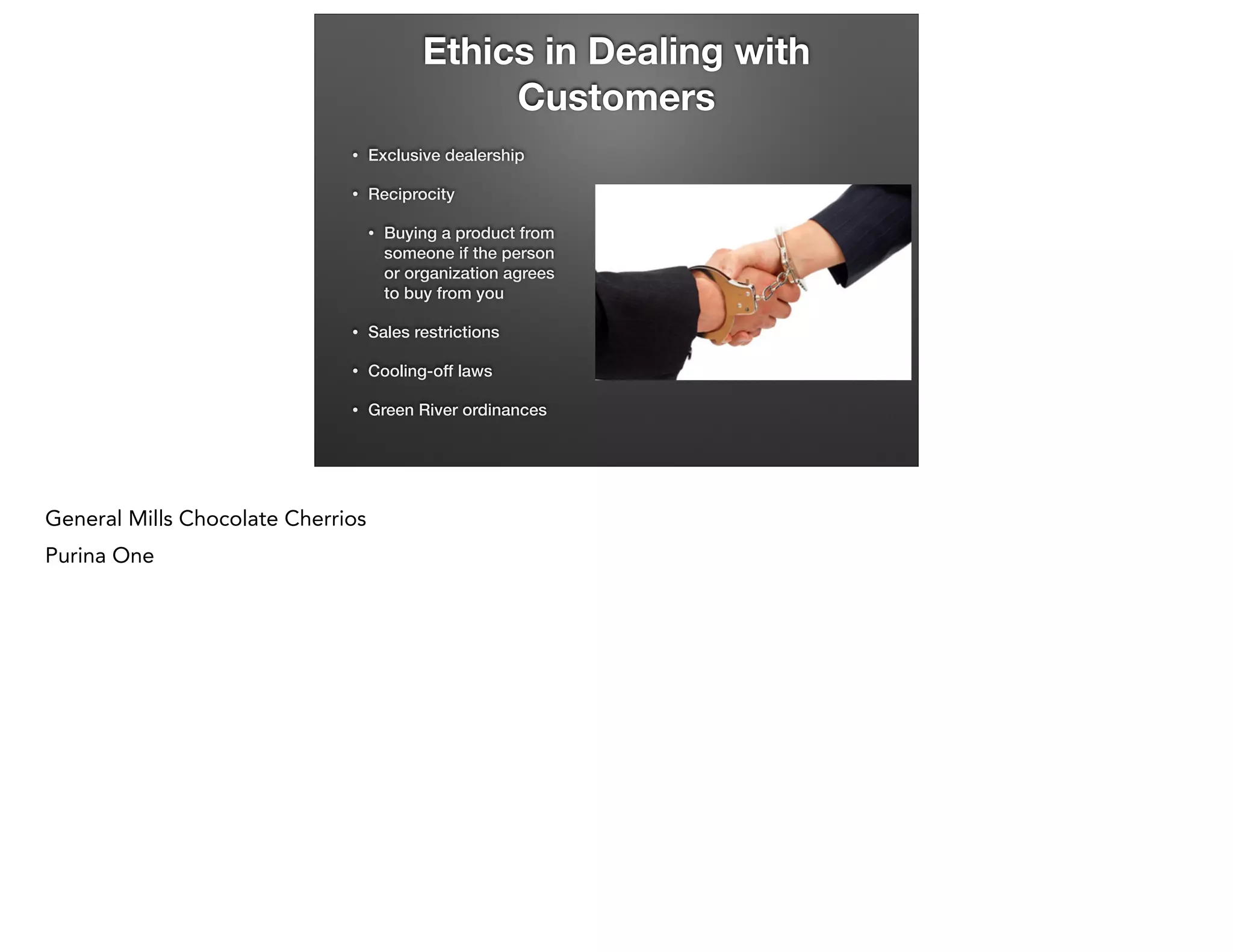
Ethics in Dealing with
Customers
•

Bribes

•

Misrepresentation

•

Price discrimination

•

Robinson-Patman Act
•

•

Tie-in sales
•

•

Selling the same quantity of the same product to different buyers at different
prices

To buy a particular line of merchandise, a buyer may be required to buy other,
unwanted products.

Clayton Act

The Clayton Antitrust Act of 1914 (Pub.L. 63–212, 38 Stat. 730, enacted October 15, 1914, codified at 15
U.S.C. §§ 12–27, 29 U.S.C. §§ 52–53), was enacted in the United States to add further substance to the U.S. antitrust
law regime by seeking to prevent anticompetitive practices in their incipiency. That regime started with the Sherman
Antitrust Act of 1890, the first Federal law outlawing practices considered harmful to consumers (monopolies, cartels,
and trusts). The Clayton Act specified particular prohibited conduct, the three-level enforcement scheme, the
exemptions, and the remedial measures.
Like the Sherman Act, much of the substance of the Clayton Act has been developed and animated by the U.S.
courts, particularly the Supreme Court.
Ethics in Dealing with
Customers
•

Exclusive dealership

•

Reciprocity
•

Buying a product from 

someone if the person 

or organization agrees 

to buy from you

•

Sales restrictions

•

Cooling-off laws

•

Green River ordinances

General Mills Chocolate Cherrios
Purina One
Ethics Final Thoughts
•

Hindu - “Do naught unto others
what you would not have them do
to you.”

•

Confucius - “Do not do to others
what you would not like yourself.”

•

Buddhist - “Hurt not others in
ways that you yourself would find
hurtful.”

•

Rabbi Hillel - “That which is
hateful to you do not do unto your
neighbor.”

•

Jesus Christ - “Do to others as
you would have them do to you.”
A Break Down in Ethics Caused
the Financial Meltdown in 2008
•

(1). Mortgage brokers developed to find borrowers.
Since these brokers were paid on quantity (“How many
mortgages did you bring me today?”), not quality
(“How many good mortgages did you bring me
today?”), and since they weren’t carrying the paper on
their own balance sheets, far too many of the brokers
cared not at all whether the borrowers were engaging
in thoughtful transactions or were being set up for
heartbreak
A Break Down in Ethics Caused
the Financial Meltdown in 2008
•

(2) Banks approved the mortgages after (maybe)
reviewing the applications, but the banks had no
intention of holding onto the paper. Instead, they
needed to build leverage into their balance sheets,
which meant getting this paper off the balance sheet
as quickly as possible.2 (The paper was sold into
mortgage pools that were in turn sold to unsuspecting
investors.)
A Break Down in Ethics Caused
the Financial Meltdown in 2008
•

Did the mortgage brokers care whether their shoddy
practices resulted in lending money to people who
couldn’t possibly pay it back? Did they care they just
sold a house to someone who could not afford it?

•

Did the banks care whether their shoddy practices
resulted in lending money to people who couldn’t
possibly pay it back?

•

Did the banks care what was likely to happen to the
ultimate investors in this paper?
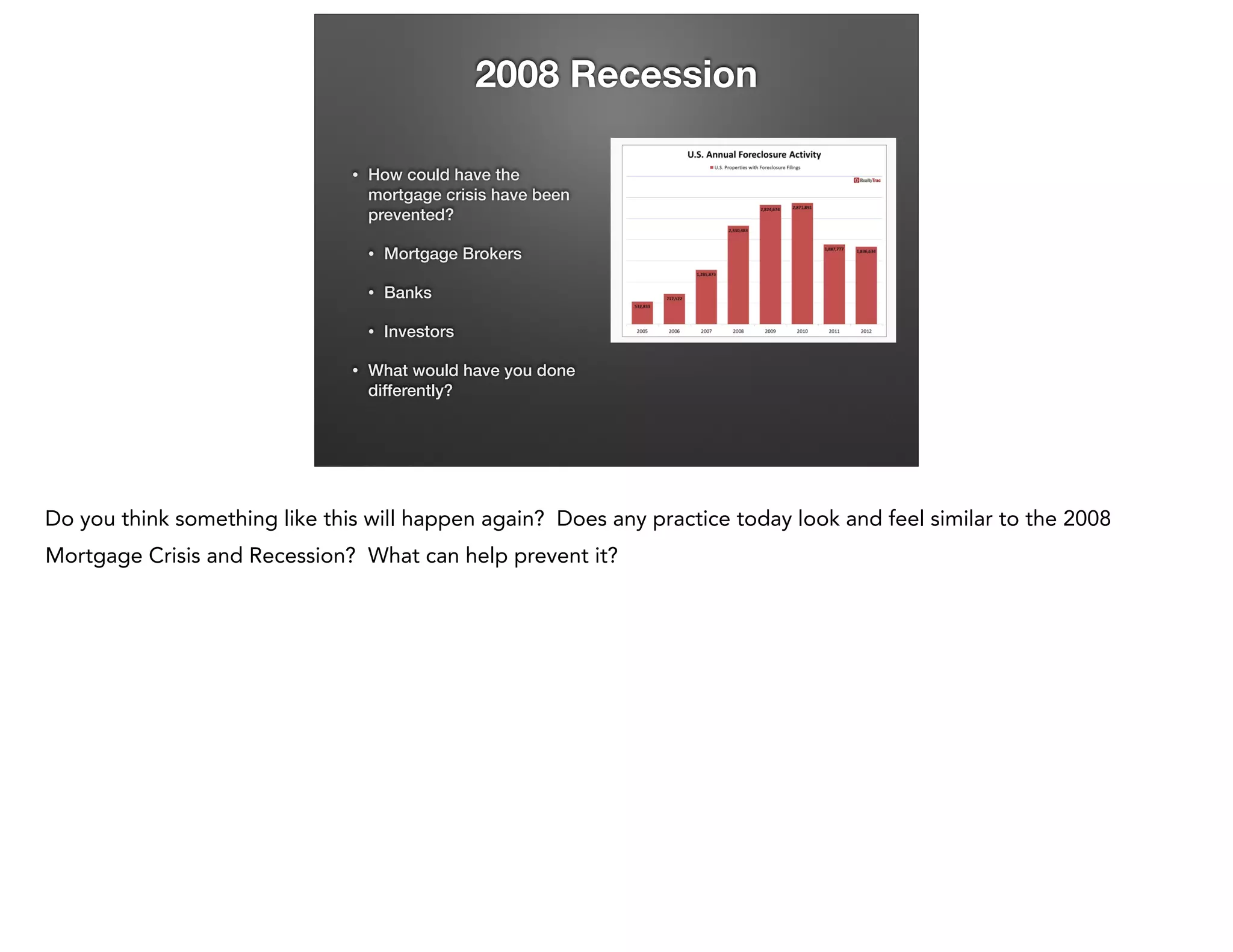
2008 Recession
•

How could have the
mortgage crisis have been
prevented?
•
•

Banks

•
•

Mortgage Brokers

Investors

What would have you done
differently?

Do you think something like this will happen again? Does any practice today look and feel similar to the 2008
Mortgage Crisis and Recession? What can help prevent it?
Assignment #1: Selling
Yourself (25 Points)

•

How many of you have a
LinkedIn Account?

•

How many of you use it?

•

Why is it so important?
http://www.slideshare.net/linkedin/
students-getting-started-on-linkedin?
ref=http://blog.linkedin.com/2013/09/17/
from-campus-to-career/
1. Choose a Professional Photo
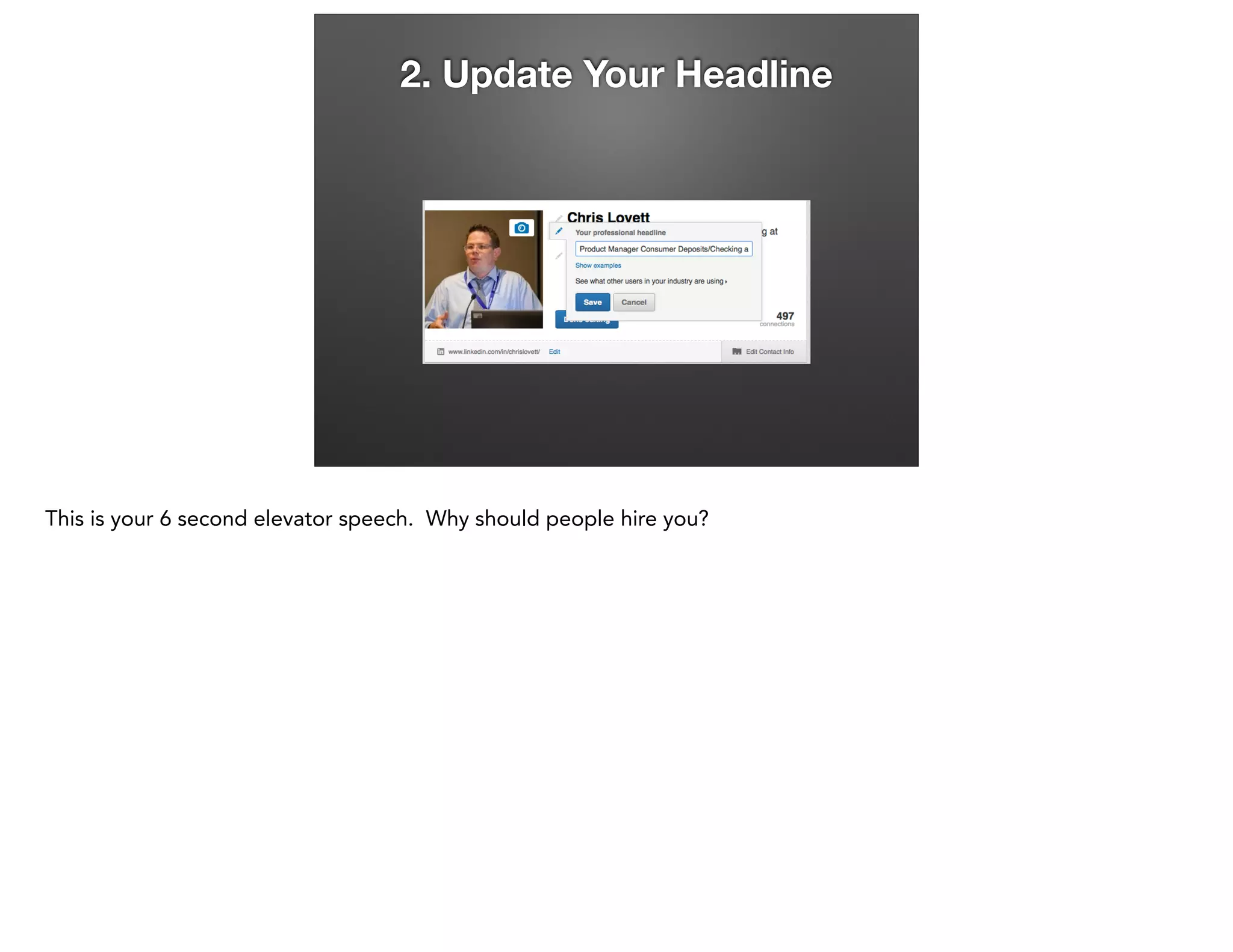
2. Update Your Headline

This is your 6 second elevator speech. Why should people hire you?
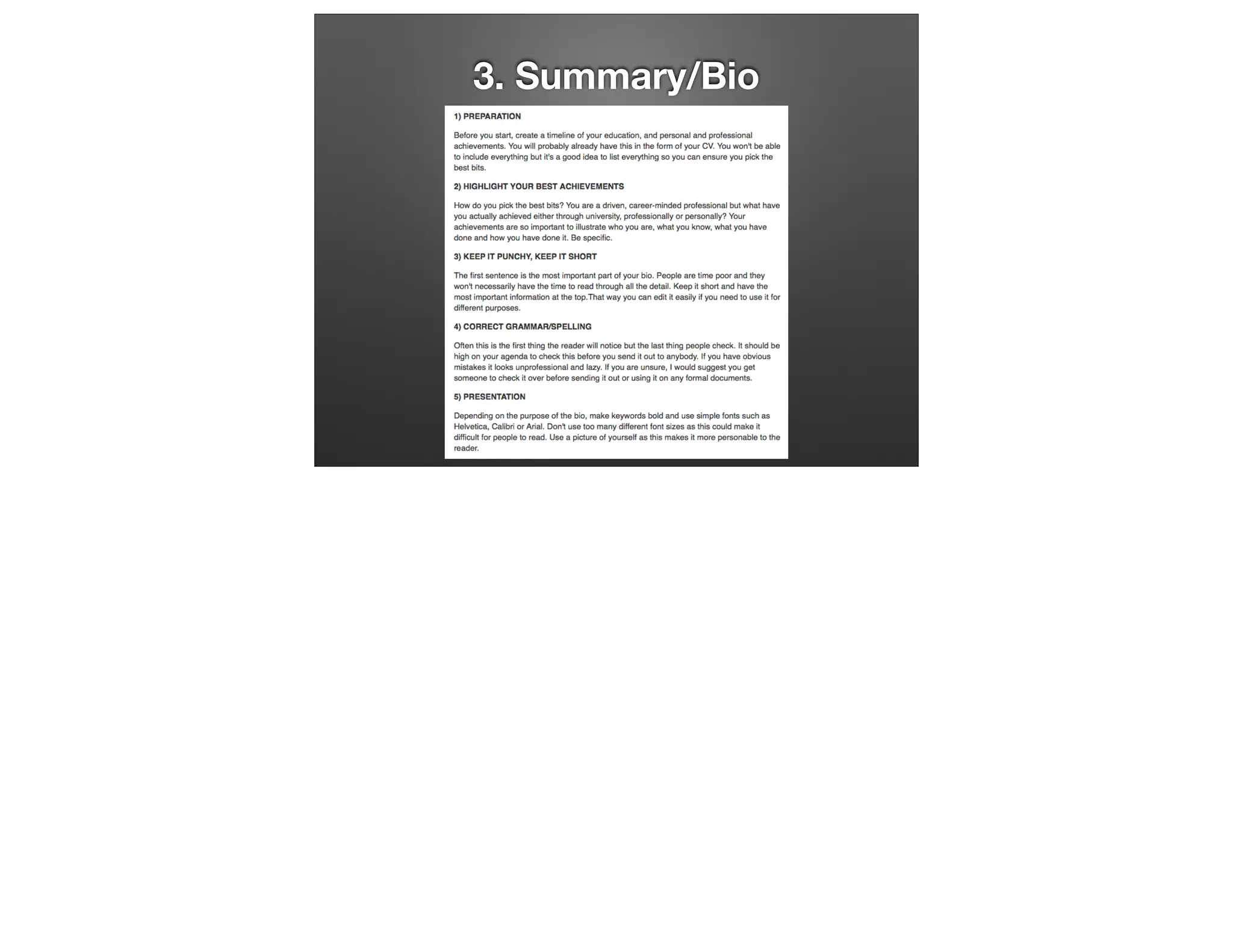
3. Summary/Bio
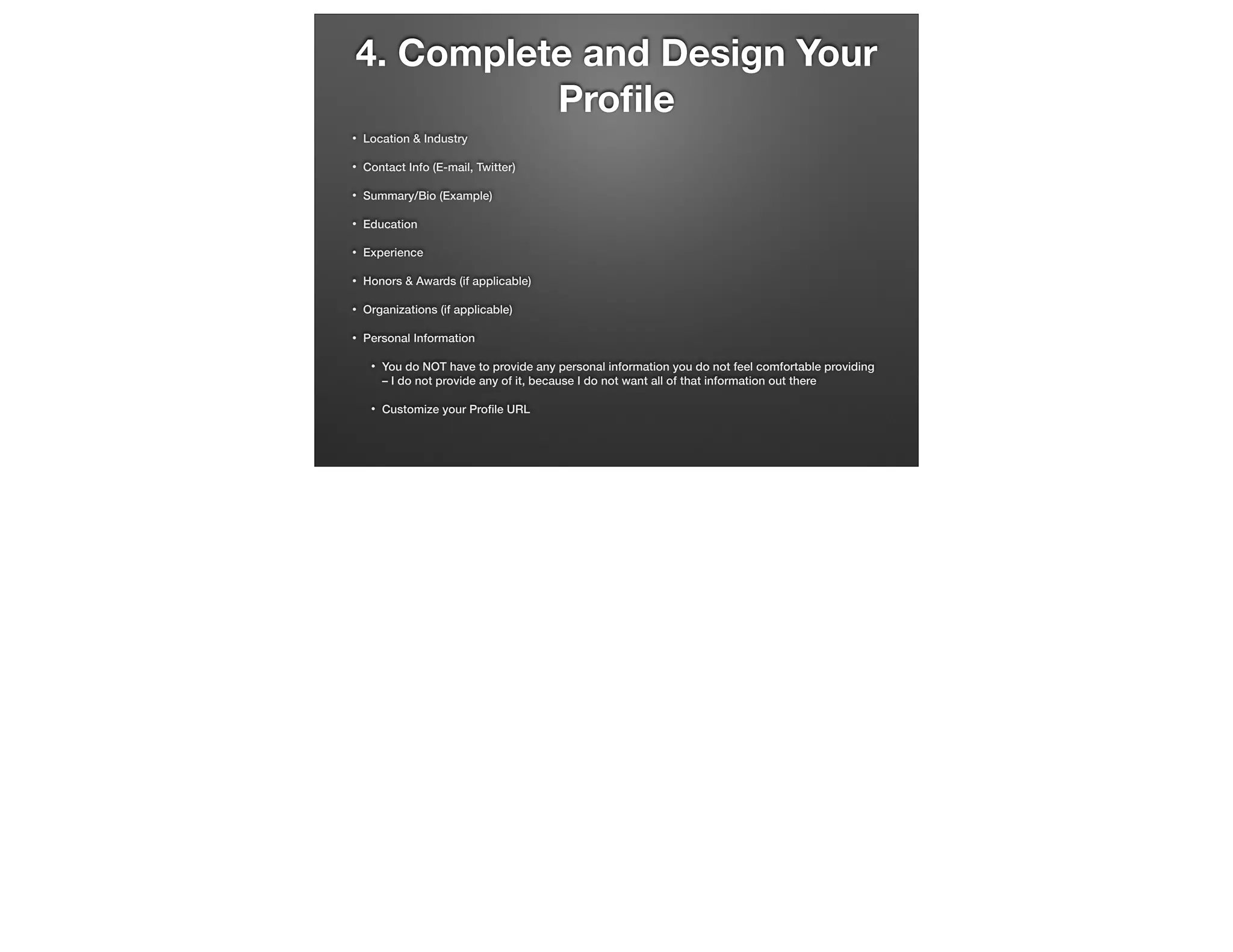
4. Complete and Design Your
Profile
•

Location & Industry

•

Contact Info (E-mail, Twitter)

•

Summary/Bio (Example)

•

Education

•

Experience

•

Honors & Awards (if applicable)

•

Organizations (if applicable)

•

Personal Information
•

You do NOT have to provide any personal information you do not feel comfortable providing
– I do not provide any of it, because I do not want all of that information out there

•

Customize your Profile URL
Assignment #1 is worth 25 points. It is due no later than 8 pm on Sunday 1.26.14. Once you connect with me - I will
assume your assignment is ready to be graded.
Additional Work
•

Find a company - your dream job from earlier in class
and follow them on LinkedIn

•

Look for people that work there in leadership positions
and who you would like to connect with to next class

•

DO NOT invite them to connect unless you have met
them in real life……

Bmgt 204 chapter_2

  • 1.
    BMGT 204: SalesStrategies and Techniques Ethics First…Then Customer Relationships
  • 2.
    If you couldwork anywhere when you graduated, where would you work? Why? What Values would you look for? What is stopping you from working there? Set your goals high and create a plan to get there from here.
  • 3.
    Helpful Hints toMaking Career Decisions • Your employer should provide worthwhile products • You should be able to do what is right • You do not have to compromise your beliefs • People go before anything else • Good people are desperately needed in all types of businesses/organizations • Look for a calling, not a job
  • 4.
    Pittsburgh Best Placesto Work http://old.post-gazette.com/pg/images/ 201309/2013topworkplaceslargemid1200.png
  • 5.
  • 6.
    Be Careful ofScam Companies • Multiple job postings on job boards • Very vague job descriptions • 100% Commission • No training • Avoid: monster, careerbuilder = fake jobs make up most of the postings
  • 7.
    What Influences Ethical Behavior? • TheIndividual’s Role • Level one: Preconventional – acts in own best interest • • Level two: Conventional – upholds legal laws • • Most people operate here Level three: Principled – lives by own code • • A few operate here Less than 20% reach level three The Organization’s Role • At best, most employees in firm operate at level two • How will the situation be handled if no policies and procedures are in place?
  • 8.
    Exhibit 2.1: WhatIs Your Level of Moral Development? • Principled - “What is the right thing to do?” • Conventional - “What am I legally required to do?” • Preconventional - “What can I get away with?”
  • 9.
    Exhibit 2.2: MoralDevelopment Bell Curve
  • 10.
    Management’s Ethical Responsibilities • Ethics isthe code of moral principles and values that govern the behaviors of a person or a group with respect to what is right or wrong • Ethical behavior refers to treating others fairly
  • 11.
    What is anEthical Dilemma? • A situation in which each alternative choice or behavior has some undesirable elements due to potentially negative ethical or personal consequences
  • 12.
    Managing Sales Ethics • Followthe leader • Leader selection is important • Establish a code of ethics • Create ethical structures • Encourage whistle-blowing • Create an ethical sales climate • Establish control systems
  • 13.
    The International Sideof Ethics • Guidelines for conducting international business may be different or even nonexistent • Despite laws in other countries, U.S. firms are subject to U.S. laws • It is important to keep up to date on the law and be aware of how authorized representatives are conducting business
  • 14.
    Ethics in Dealingwith Salespeople • Five ethical considerations faced by sales managers: • Level of sales pressure • Decisions affecting territory • To tell the truth? • The ill salesperson • Employee rights • termination-at-will • privacy • sexual harassment
  • 15.
    Salespeople’s Ethics in Dealingwith Their Employers • Misusing company assets • Moonlighting • Cheating • Affecting other salespeople • Technology theft
  • 16.
    Ethics in Dealingwith Customers • Bribes • Misrepresentation • Price discrimination • Robinson-Patman Act • • Tie-in sales • • Selling the same quantity of the same product to different buyers at different prices To buy a particular line of merchandise, a buyer may be required to buy other, unwanted products. Clayton Act The Clayton Antitrust Act of 1914 (Pub.L. 63–212, 38 Stat. 730, enacted October 15, 1914, codified at 15 U.S.C. §§ 12–27, 29 U.S.C. §§ 52–53), was enacted in the United States to add further substance to the U.S. antitrust law regime by seeking to prevent anticompetitive practices in their incipiency. That regime started with the Sherman Antitrust Act of 1890, the first Federal law outlawing practices considered harmful to consumers (monopolies, cartels, and trusts). The Clayton Act specified particular prohibited conduct, the three-level enforcement scheme, the exemptions, and the remedial measures. Like the Sherman Act, much of the substance of the Clayton Act has been developed and animated by the U.S. courts, particularly the Supreme Court.
  • 17.
    Ethics in Dealingwith Customers • Exclusive dealership • Reciprocity • Buying a product from 
 someone if the person 
 or organization agrees 
 to buy from you • Sales restrictions • Cooling-off laws • Green River ordinances General Mills Chocolate Cherrios Purina One
  • 18.
    Ethics Final Thoughts • Hindu- “Do naught unto others what you would not have them do to you.” • Confucius - “Do not do to others what you would not like yourself.” • Buddhist - “Hurt not others in ways that you yourself would find hurtful.” • Rabbi Hillel - “That which is hateful to you do not do unto your neighbor.” • Jesus Christ - “Do to others as you would have them do to you.”
  • 19.
    A Break Downin Ethics Caused the Financial Meltdown in 2008 • (1). Mortgage brokers developed to find borrowers. Since these brokers were paid on quantity (“How many mortgages did you bring me today?”), not quality (“How many good mortgages did you bring me today?”), and since they weren’t carrying the paper on their own balance sheets, far too many of the brokers cared not at all whether the borrowers were engaging in thoughtful transactions or were being set up for heartbreak
  • 20.
    A Break Downin Ethics Caused the Financial Meltdown in 2008 • (2) Banks approved the mortgages after (maybe) reviewing the applications, but the banks had no intention of holding onto the paper. Instead, they needed to build leverage into their balance sheets, which meant getting this paper off the balance sheet as quickly as possible.2 (The paper was sold into mortgage pools that were in turn sold to unsuspecting investors.)
  • 21.
    A Break Downin Ethics Caused the Financial Meltdown in 2008 • Did the mortgage brokers care whether their shoddy practices resulted in lending money to people who couldn’t possibly pay it back? Did they care they just sold a house to someone who could not afford it? • Did the banks care whether their shoddy practices resulted in lending money to people who couldn’t possibly pay it back? • Did the banks care what was likely to happen to the ultimate investors in this paper?
  • 22.
    2008 Recession • How couldhave the mortgage crisis have been prevented? • • Banks • • Mortgage Brokers Investors What would have you done differently? Do you think something like this will happen again? Does any practice today look and feel similar to the 2008 Mortgage Crisis and Recession? What can help prevent it?
  • 23.
    Assignment #1: Selling Yourself(25 Points) • How many of you have a LinkedIn Account? • How many of you use it? • Why is it so important?
  • 24.
  • 25.
    1. Choose aProfessional Photo
  • 26.
    2. Update YourHeadline This is your 6 second elevator speech. Why should people hire you?
  • 27.
  • 28.
    4. Complete andDesign Your Profile • Location & Industry • Contact Info (E-mail, Twitter) • Summary/Bio (Example) • Education • Experience • Honors & Awards (if applicable) • Organizations (if applicable) • Personal Information • You do NOT have to provide any personal information you do not feel comfortable providing – I do not provide any of it, because I do not want all of that information out there • Customize your Profile URL
  • 29.
    Assignment #1 isworth 25 points. It is due no later than 8 pm on Sunday 1.26.14. Once you connect with me - I will assume your assignment is ready to be graded.
  • 30.
    Additional Work • Find acompany - your dream job from earlier in class and follow them on LinkedIn • Look for people that work there in leadership positions and who you would like to connect with to next class • DO NOT invite them to connect unless you have met them in real life……