Instructor  & Todd Lammle Sybex CCNA 640-802  Chapter 14: Wide Area Networks
Chapter 14 Objectives The CCNA Topics Covered in this chapter include: Introduction to WAN’s HDLC PPP Frame Relay Introduction to VPN’s
Defining WAN Terms Customer Premises Equipment (CPE) Demarcation (demarc) Local loop Central Office (CO) Toll network
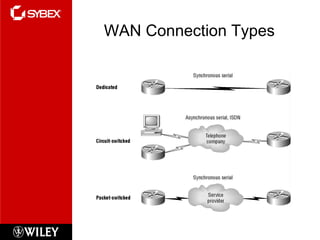
WAN Connection Types
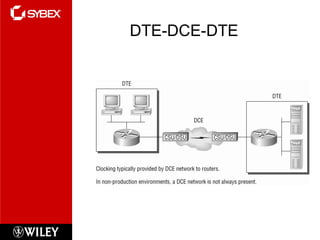
DTE-DCE-DTE
WAN Support Frame Relay ISDN LAPB LAPD HDLC PPP ATM
HDLC Protocol Bit-oriented Data Link layer ISO standard protocol Specifies a data encapsulation method No  authentication can be used
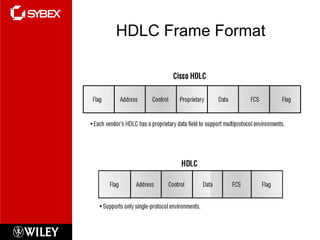
HDLC Frame Format
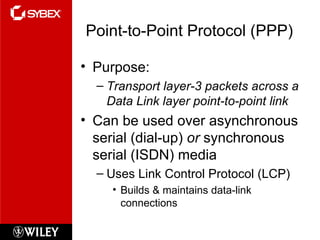
Point-to-Point Protocol (PPP) Purpose: Transport layer-3 packets across a Data Link layer point-to-point link Can be used over asynchronous serial (dial-up)  or  synchronous serial (ISDN) media Uses Link Control Protocol (LCP) Builds & maintains data-link connections
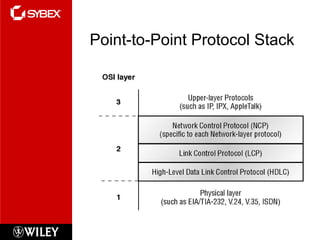
Point-to-Point Protocol Stack
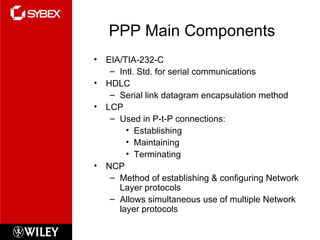
PPP Main Components EIA/TIA-232-C Intl. Std. for serial communications HDLC Serial link datagram encapsulation method LCP Used in P-t-P connections: Establishing Maintaining Terminating NCP Method of establishing & configuring Network Layer protocols Allows simultaneous use of multiple Network layer protocols
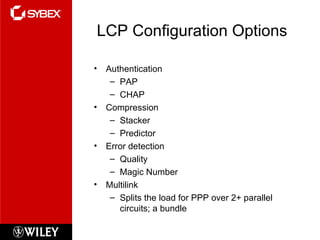
LCP Configuration Options Authentication PAP CHAP Compression Stacker Predictor Error detection Quality Magic Number Multilink Splits the load for PPP over 2+ parallel circuits; a bundle
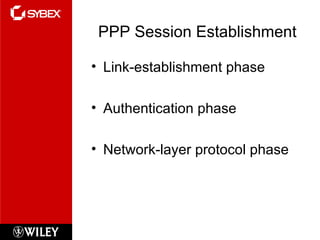
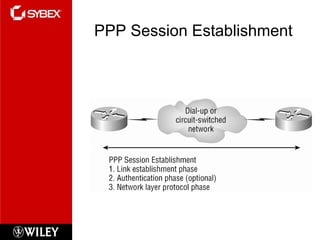
PPP Session Establishment Link-establishment phase Authentication phase Network-layer protocol phase
PPP Session Establishment
PPP Authentication Methods Password Authentication Protocol (PAP) Passwords sent in clear text Remote node returns  username  &  password Challenge Authentication Protocol (CHAP) Done at start-up & periodically Challenge & Reply Remote router sends a one-way hash ~ MD5
Configuring PPP Step #1: Configure PPP on Router A  & Router B : Router__# config t Router__(config)# int s0 Router__(config-if)# encapsulation ppp Router__(config-if)#^ Z Step #2: Define the username & password on  each  router: RouterA: RouterA(config)# username RouterB password cisco RouterB: RouterB(config)# username RouterA password cisco NOTE: (1) Username  maps  to the  remote  router   (2) Passwords must match Step #3: Choose Authentication type for  each  router; CHAP/PAP Router__(Config)# int s0 Router__(config-if)# ppp authentication chap Router__(config-if)# ppp authentication pap Router__(config-if)#^Z
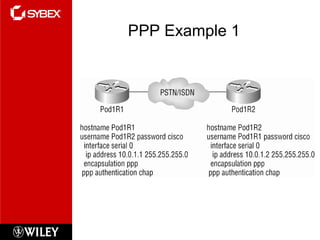
PPP Example 1
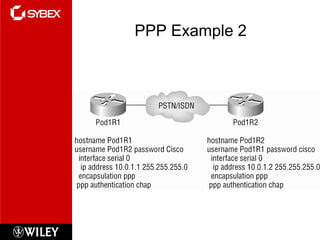
PPP Example 2
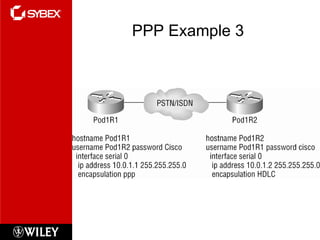
PPP Example 3
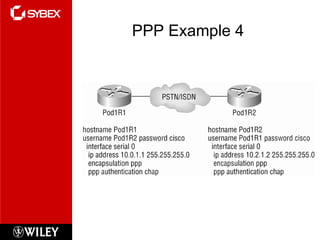
PPP Example 4
Frame Relay Background High-performance WAN encapsulation method OSI Physical & data Link layer Originally designed for use across ISDN Supported Protocols IP, DECnet, AppleTalk, Xerox Network Service (XNS), Novell IPX, Banyan Vines, Transparent Bridging, & ISO
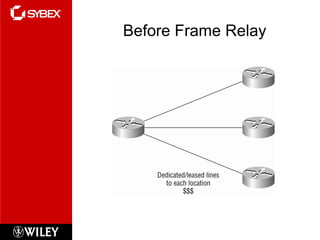
Before Frame Relay
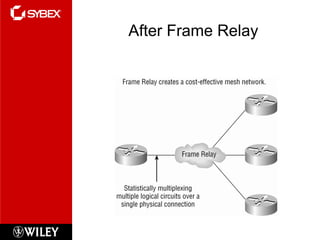
After Frame Relay
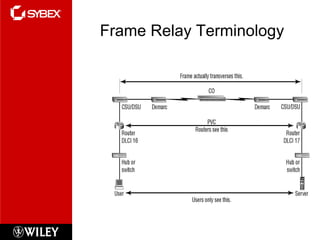
Frame Relay Purpose Provide a communications interface between DTE & DCE equipment Connection-oriented Data Link layer communication Via virtual circuits Provides a complete path from the source to destination before sending the first frame
Frame Relay Terminology
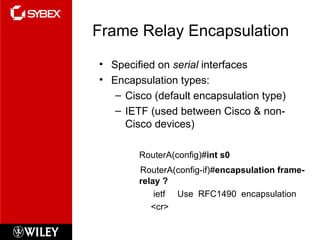
Frame Relay Encapsulation Specified on  serial  interfaces Encapsulation types: Cisco (default encapsulation type) IETF (used between Cisco & non-Cisco devices) RouterA(config)# int s0 RouterA(config-if)# encapsulation frame-relay ? ietf  Use  RFC1490  encapsulation <cr>
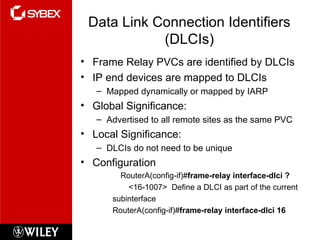
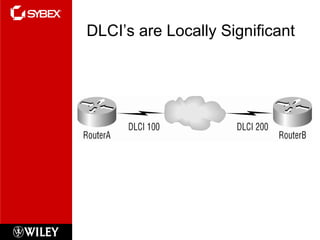
Data Link Connection Identifiers (DLCIs) Frame Relay PVCs are identified by DLCIs IP end devices are mapped to DLCIs Mapped dynamically or mapped by IARP Global Significance:  Advertised to all remote sites as the same PVC Local Significance:  DLCIs do not need to be unique Configuration RouterA(config-if)# frame-relay interface-dlci ? <16-1007>  Define a DLCI as part of the current subinterface RouterA(config-if)# frame-relay interface-dlci 16
DLCI’s are Locally Significant
Local Management Interface (LMI) Background Purpose LMI Messages Keepalives Multicasting Multicast addressing Status of virtual circuits
LMI Types Configuration: RouterA(config-if)# frame-relay lmi-type ? cisco ansi q933a Beginning with IOS ver 11.2+ the LMI type is auto-sensed Default type: cisco Virtual circuit status: Active Inactive Deleted
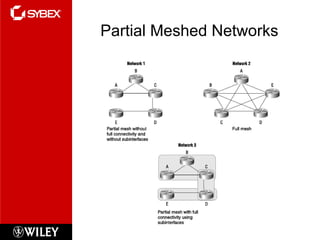
Sub-interfaces Definition Multiple virtual circuits on a single serial interface Enables the assignment of different network-layer characteristics to each sub-interface IP routing on one sub-interface IPX routing on another Mitigates difficulties associated with: Partial meshed Frame Relay networks Split Horizon protocols
Partial Meshed Networks
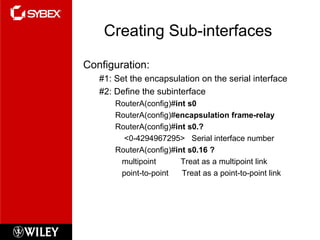
Creating Sub-interfaces Configuration: #1: Set the encapsulation on the serial interface #2: Define the subinterface RouterA(config)# int s0 RouterA(config)# encapsulation frame-relay RouterA(config)# int s0.? <0-4294967295>  Serial interface number RouterA(config)# int s0.16 ? multipoint  Treat as a multipoint link point-to-point  Treat as a point-to-point link
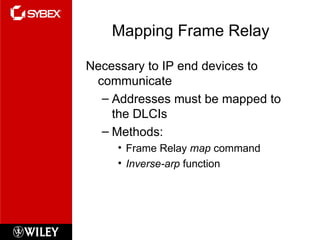
Mapping Frame Relay Necessary to IP end devices to communicate Addresses must be mapped to the DLCIs Methods: Frame Relay  map  command Inverse-arp  function
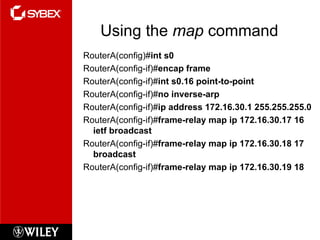
Using the  map  command RouterA(config)# int s0 RouterA(config-if)# encap frame RouterA(config-if)# int s0.16 point-to-point RouterA(config-if)# no inverse-arp RouterA(config-if)# ip address 172.16.30.1 255.255.255.0 RouterA(config-if)# frame-relay map ip 172.16.30.17 16 ietf broadcast RouterA(config-if)# frame-relay map ip 172.16.30.18 17 broadcast RouterA(config-if)# frame-relay map ip 172.16.30.19 18
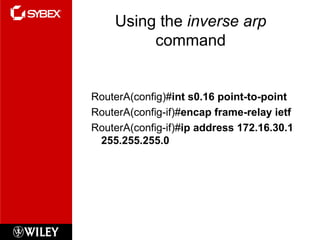
Using the  inverse arp  command RouterA(config)# int s0.16 point-to-point  RouterA(config-if)# encap frame-relay ietf RouterA(config-if)# ip address 172.16.30.1 255.255.255.0
Congestion Control Discard Eligibility (DE) Forward-Explicit Congestion Notification (FECN) Backward-Explicit Congestion Notification (BECN)
Committed Information Rate (CIR) Definition: Provision allowing customers to purchase amounts of bandwidth lower than what they might need Cost savings Good for  bursty  traffic Not good for  constant  amounts of data transmission
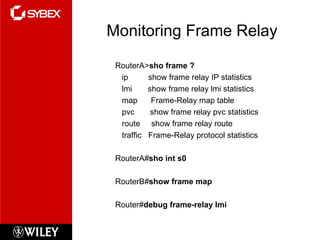
Monitoring Frame Relay RouterA> sho frame ? ip  show frame relay IP statistics lmi  show frame relay lmi statistics map  Frame-Relay map table pvc  show frame relay pvc statistics route  show frame relay route traffic  Frame-Relay protocol statistics RouterA# sho int s0 RouterB# show frame map Router# debug frame-relay lmi
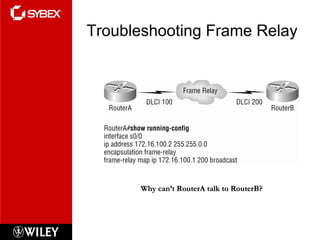
Troubleshooting Frame Relay Why can’t RouterA talk to RouterB?
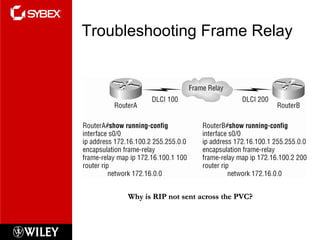
Troubleshooting Frame Relay  Why is RIP not sent across the PVC?
Introduction to VPN’s VPNs are used daily to give remote users and disjointed networks connectivity over a public medium like the Internet instead of using more expensive permanent means.
Types of VPN’s REMOTE ACCESS VPNS Remote access VPNs allow remote users like telecommuters to securely access the corporate network wherever and whenever they need to. SITE-TO-SITE VPNS Site-to-site VPNs, or, intranet VPNs, allow a company to connect its remote sites to the corporate backbone securely over a public medium like the Internet instead of requiring more expensive WAN connections like Frame Relay. EXTRANET VPNS Extranet VPNs allow an organization’s suppliers, partners, and customers to be connected to the corporate network in a limited way for business-to-business (B2B) communications.
Written Labs and Review Questions Open your books and go through all the written labs and the review questions. Review the answers in class.

Chapter14ccna

  • 1.
    Instructor &Todd Lammle Sybex CCNA 640-802 Chapter 14: Wide Area Networks
  • 2.
    Chapter 14 ObjectivesThe CCNA Topics Covered in this chapter include: Introduction to WAN’s HDLC PPP Frame Relay Introduction to VPN’s
  • 3.
    Defining WAN TermsCustomer Premises Equipment (CPE) Demarcation (demarc) Local loop Central Office (CO) Toll network
  • 4.
  • 5.
  • 6.
    WAN Support FrameRelay ISDN LAPB LAPD HDLC PPP ATM
  • 7.
    HDLC Protocol Bit-orientedData Link layer ISO standard protocol Specifies a data encapsulation method No authentication can be used
  • 8.
  • 9.
    Point-to-Point Protocol (PPP)Purpose: Transport layer-3 packets across a Data Link layer point-to-point link Can be used over asynchronous serial (dial-up) or synchronous serial (ISDN) media Uses Link Control Protocol (LCP) Builds & maintains data-link connections
  • 10.
  • 11.
    PPP Main ComponentsEIA/TIA-232-C Intl. Std. for serial communications HDLC Serial link datagram encapsulation method LCP Used in P-t-P connections: Establishing Maintaining Terminating NCP Method of establishing & configuring Network Layer protocols Allows simultaneous use of multiple Network layer protocols
  • 12.
    LCP Configuration OptionsAuthentication PAP CHAP Compression Stacker Predictor Error detection Quality Magic Number Multilink Splits the load for PPP over 2+ parallel circuits; a bundle
  • 13.
    PPP Session EstablishmentLink-establishment phase Authentication phase Network-layer protocol phase
  • 14.
  • 15.
    PPP Authentication MethodsPassword Authentication Protocol (PAP) Passwords sent in clear text Remote node returns username & password Challenge Authentication Protocol (CHAP) Done at start-up & periodically Challenge & Reply Remote router sends a one-way hash ~ MD5
  • 16.
    Configuring PPP Step#1: Configure PPP on Router A & Router B : Router__# config t Router__(config)# int s0 Router__(config-if)# encapsulation ppp Router__(config-if)#^ Z Step #2: Define the username & password on each router: RouterA: RouterA(config)# username RouterB password cisco RouterB: RouterB(config)# username RouterA password cisco NOTE: (1) Username maps to the remote router (2) Passwords must match Step #3: Choose Authentication type for each router; CHAP/PAP Router__(Config)# int s0 Router__(config-if)# ppp authentication chap Router__(config-if)# ppp authentication pap Router__(config-if)#^Z
  • 17.
  • 18.
  • 19.
  • 20.
  • 21.
    Frame Relay BackgroundHigh-performance WAN encapsulation method OSI Physical & data Link layer Originally designed for use across ISDN Supported Protocols IP, DECnet, AppleTalk, Xerox Network Service (XNS), Novell IPX, Banyan Vines, Transparent Bridging, & ISO
  • 22.
  • 23.
  • 24.
    Frame Relay PurposeProvide a communications interface between DTE & DCE equipment Connection-oriented Data Link layer communication Via virtual circuits Provides a complete path from the source to destination before sending the first frame
  • 25.
  • 26.
    Frame Relay EncapsulationSpecified on serial interfaces Encapsulation types: Cisco (default encapsulation type) IETF (used between Cisco & non-Cisco devices) RouterA(config)# int s0 RouterA(config-if)# encapsulation frame-relay ? ietf Use RFC1490 encapsulation <cr>
  • 27.
    Data Link ConnectionIdentifiers (DLCIs) Frame Relay PVCs are identified by DLCIs IP end devices are mapped to DLCIs Mapped dynamically or mapped by IARP Global Significance: Advertised to all remote sites as the same PVC Local Significance: DLCIs do not need to be unique Configuration RouterA(config-if)# frame-relay interface-dlci ? <16-1007> Define a DLCI as part of the current subinterface RouterA(config-if)# frame-relay interface-dlci 16
  • 28.
  • 29.
    Local Management Interface(LMI) Background Purpose LMI Messages Keepalives Multicasting Multicast addressing Status of virtual circuits
  • 30.
    LMI Types Configuration:RouterA(config-if)# frame-relay lmi-type ? cisco ansi q933a Beginning with IOS ver 11.2+ the LMI type is auto-sensed Default type: cisco Virtual circuit status: Active Inactive Deleted
  • 31.
    Sub-interfaces Definition Multiplevirtual circuits on a single serial interface Enables the assignment of different network-layer characteristics to each sub-interface IP routing on one sub-interface IPX routing on another Mitigates difficulties associated with: Partial meshed Frame Relay networks Split Horizon protocols
  • 32.
  • 33.
    Creating Sub-interfaces Configuration:#1: Set the encapsulation on the serial interface #2: Define the subinterface RouterA(config)# int s0 RouterA(config)# encapsulation frame-relay RouterA(config)# int s0.? <0-4294967295> Serial interface number RouterA(config)# int s0.16 ? multipoint Treat as a multipoint link point-to-point Treat as a point-to-point link
  • 34.
    Mapping Frame RelayNecessary to IP end devices to communicate Addresses must be mapped to the DLCIs Methods: Frame Relay map command Inverse-arp function
  • 35.
    Using the map command RouterA(config)# int s0 RouterA(config-if)# encap frame RouterA(config-if)# int s0.16 point-to-point RouterA(config-if)# no inverse-arp RouterA(config-if)# ip address 172.16.30.1 255.255.255.0 RouterA(config-if)# frame-relay map ip 172.16.30.17 16 ietf broadcast RouterA(config-if)# frame-relay map ip 172.16.30.18 17 broadcast RouterA(config-if)# frame-relay map ip 172.16.30.19 18
  • 36.
    Using the inverse arp command RouterA(config)# int s0.16 point-to-point RouterA(config-if)# encap frame-relay ietf RouterA(config-if)# ip address 172.16.30.1 255.255.255.0
  • 37.
    Congestion Control DiscardEligibility (DE) Forward-Explicit Congestion Notification (FECN) Backward-Explicit Congestion Notification (BECN)
  • 38.
    Committed Information Rate(CIR) Definition: Provision allowing customers to purchase amounts of bandwidth lower than what they might need Cost savings Good for bursty traffic Not good for constant amounts of data transmission
  • 39.
    Monitoring Frame RelayRouterA> sho frame ? ip show frame relay IP statistics lmi show frame relay lmi statistics map Frame-Relay map table pvc show frame relay pvc statistics route show frame relay route traffic Frame-Relay protocol statistics RouterA# sho int s0 RouterB# show frame map Router# debug frame-relay lmi
  • 40.
    Troubleshooting Frame RelayWhy can’t RouterA talk to RouterB?
  • 41.
    Troubleshooting Frame Relay Why is RIP not sent across the PVC?
  • 42.
    Introduction to VPN’sVPNs are used daily to give remote users and disjointed networks connectivity over a public medium like the Internet instead of using more expensive permanent means.
  • 43.
    Types of VPN’sREMOTE ACCESS VPNS Remote access VPNs allow remote users like telecommuters to securely access the corporate network wherever and whenever they need to. SITE-TO-SITE VPNS Site-to-site VPNs, or, intranet VPNs, allow a company to connect its remote sites to the corporate backbone securely over a public medium like the Internet instead of requiring more expensive WAN connections like Frame Relay. EXTRANET VPNS Extranet VPNs allow an organization’s suppliers, partners, and customers to be connected to the corporate network in a limited way for business-to-business (B2B) communications.
  • 44.
    Written Labs andReview Questions Open your books and go through all the written labs and the review questions. Review the answers in class.