
Cost of the Money
Concept:
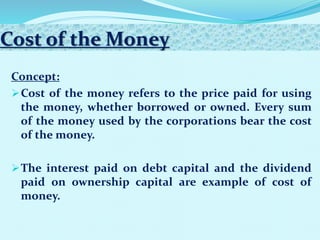
Cost of the money refers to the price paid for using
the money, whether borrowed or owned. Every sum
of the money used by the corporations bear the cost
of the money.
The interest paid on debt capital and the dividend
paid on ownership capital are example of cost of
money.
Factor Affecting cost of Money
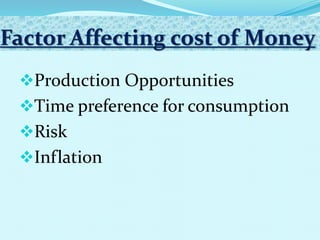
Production Opportunities
Time preference for consumption
Risk
Inflation
Factor Affecting cost of Money
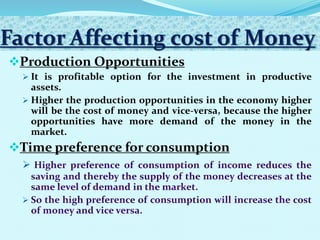
Production Opportunities
 It is profitable option for the investment in productive
assets.
 Higher the production opportunities in the economy higher
will be the cost of money and vice-versa, because the higher
opportunities have more demand of the money in the
market.
Time preference for consumption


Factor Affecting cost of Money
Risk
 Risk is an uncertain outcome or chance of an adverse outcome.
Financially Risk is the chance of the investment wouldn’t produced
the required rate of return.
 Higher the risk in the investment demands the higher return and
there by higher the cost of money supplied to the investment and
vice versa. Hence the cost of money affected by the risk.
Inflation


Determinants of Market Interest Rates
The Real Risk-free rate of Interest.
The Nominal Risk-free Rate of Interest
Default risk Premium
Liquidity Premium
Maturity Risk Premium
Determinants of Market Interest Rates
The Real Risk-free rate of Interest(k*).
 The interest rate resulting from the risk-free financial assets in the
economy which is free from the inflation.
 For eg: Interest rate on Government Treasury Bill and Treasury
bond, Treasury bill has a maturity of 90 days and no inflation. But
Treasury bond is long term security.
 It is denoted by k*.
The Nominal Risk-free Rate of Interest(krf)
 It is the real risk-free rate of interest(k*) plus premium for the
inflation (IP).
 If there is inflation the investor demands the risk-free rate and
premium for the inflation for the invested fund.
 It is denoted as krf =k* + IP
Determinants of Market Interest Rates
Default risk Premium(DRP)
 Default risk is the chance of not getting back the amount of fund
that is invested to the securities.
 It is the premium for risk of default of principal and interest
payment.
 Higher the uncertainty of timely payment of interest and principal,
higher will be the Default Risk Premium and vice-versa.
 So DRP is the determinant of interest rate.
Determinants of Market Interest Rates
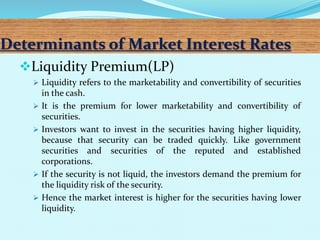
Liquidity Premium(LP)
 Liquidity refers to the marketability and convertibility of securities
in the cash.
 It is the premium for lower marketability and convertibility of
securities.
 Investors want to invest in the securities having higher liquidity,
because that security can be traded quickly. Like government
securities and securities of the reputed and established
corporations.
 If the security is not liquid, the investors demand the premium for
the liquidity risk of the security.
 Hence the market interest is higher for the securities having lower
liquidity.
Determinants of Market Interest Rates
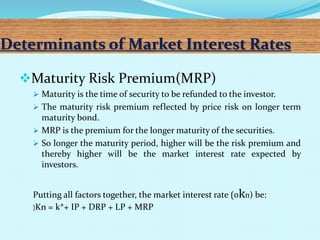
Maturity Risk Premium(MRP)
 Maturity is the time of security to be refunded to the investor.
 The maturity risk premium reflected by price risk on longer term
maturity bond.
 MRP is the premium for the longer maturity of the securities.
 So longer the maturity period, higher will be the risk premium and
thereby higher will be the market interest rate expected by
investors.
Putting all factors together, the market interest rate (okn) be:
)Kn = k*+ IP + DRP + LP + MRP
Chapter 3- Interest Rate/Cost of Money/BBS 4th

Chapter 3- Interest Rate/Cost of Money/BBS 4th

  • 2.
    Cost of theMoney Concept: Cost of the money refers to the price paid for using the money, whether borrowed or owned. Every sum of the money used by the corporations bear the cost of the money. The interest paid on debt capital and the dividend paid on ownership capital are example of cost of money.
  • 3.
    Factor Affecting costof Money Production Opportunities Time preference for consumption Risk Inflation
  • 4.
    Factor Affecting costof Money Production Opportunities  It is profitable option for the investment in productive assets.  Higher the production opportunities in the economy higher will be the cost of money and vice-versa, because the higher opportunities have more demand of the money in the market. Time preference for consumption  
  • 5.
    Factor Affecting costof Money Risk  Risk is an uncertain outcome or chance of an adverse outcome. Financially Risk is the chance of the investment wouldn’t produced the required rate of return.  Higher the risk in the investment demands the higher return and there by higher the cost of money supplied to the investment and vice versa. Hence the cost of money affected by the risk. Inflation  
  • 6.
    Determinants of MarketInterest Rates The Real Risk-free rate of Interest. The Nominal Risk-free Rate of Interest Default risk Premium Liquidity Premium Maturity Risk Premium
  • 7.
    Determinants of MarketInterest Rates The Real Risk-free rate of Interest(k*).  The interest rate resulting from the risk-free financial assets in the economy which is free from the inflation.  For eg: Interest rate on Government Treasury Bill and Treasury bond, Treasury bill has a maturity of 90 days and no inflation. But Treasury bond is long term security.  It is denoted by k*. The Nominal Risk-free Rate of Interest(krf)  It is the real risk-free rate of interest(k*) plus premium for the inflation (IP).  If there is inflation the investor demands the risk-free rate and premium for the inflation for the invested fund.  It is denoted as krf =k* + IP
  • 8.
    Determinants of MarketInterest Rates Default risk Premium(DRP)  Default risk is the chance of not getting back the amount of fund that is invested to the securities.  It is the premium for risk of default of principal and interest payment.  Higher the uncertainty of timely payment of interest and principal, higher will be the Default Risk Premium and vice-versa.  So DRP is the determinant of interest rate.
  • 9.
    Determinants of MarketInterest Rates Liquidity Premium(LP)  Liquidity refers to the marketability and convertibility of securities in the cash.  It is the premium for lower marketability and convertibility of securities.  Investors want to invest in the securities having higher liquidity, because that security can be traded quickly. Like government securities and securities of the reputed and established corporations.  If the security is not liquid, the investors demand the premium for the liquidity risk of the security.  Hence the market interest is higher for the securities having lower liquidity.
  • 10.
    Determinants of MarketInterest Rates Maturity Risk Premium(MRP)  Maturity is the time of security to be refunded to the investor.  The maturity risk premium reflected by price risk on longer term maturity bond.  MRP is the premium for the longer maturity of the securities.  So longer the maturity period, higher will be the risk premium and thereby higher will be the market interest rate expected by investors. Putting all factors together, the market interest rate (okn) be: )Kn = k*+ IP + DRP + LP + MRP