Introduction of
Advanced Network Technology
and Facilities
Computer Network
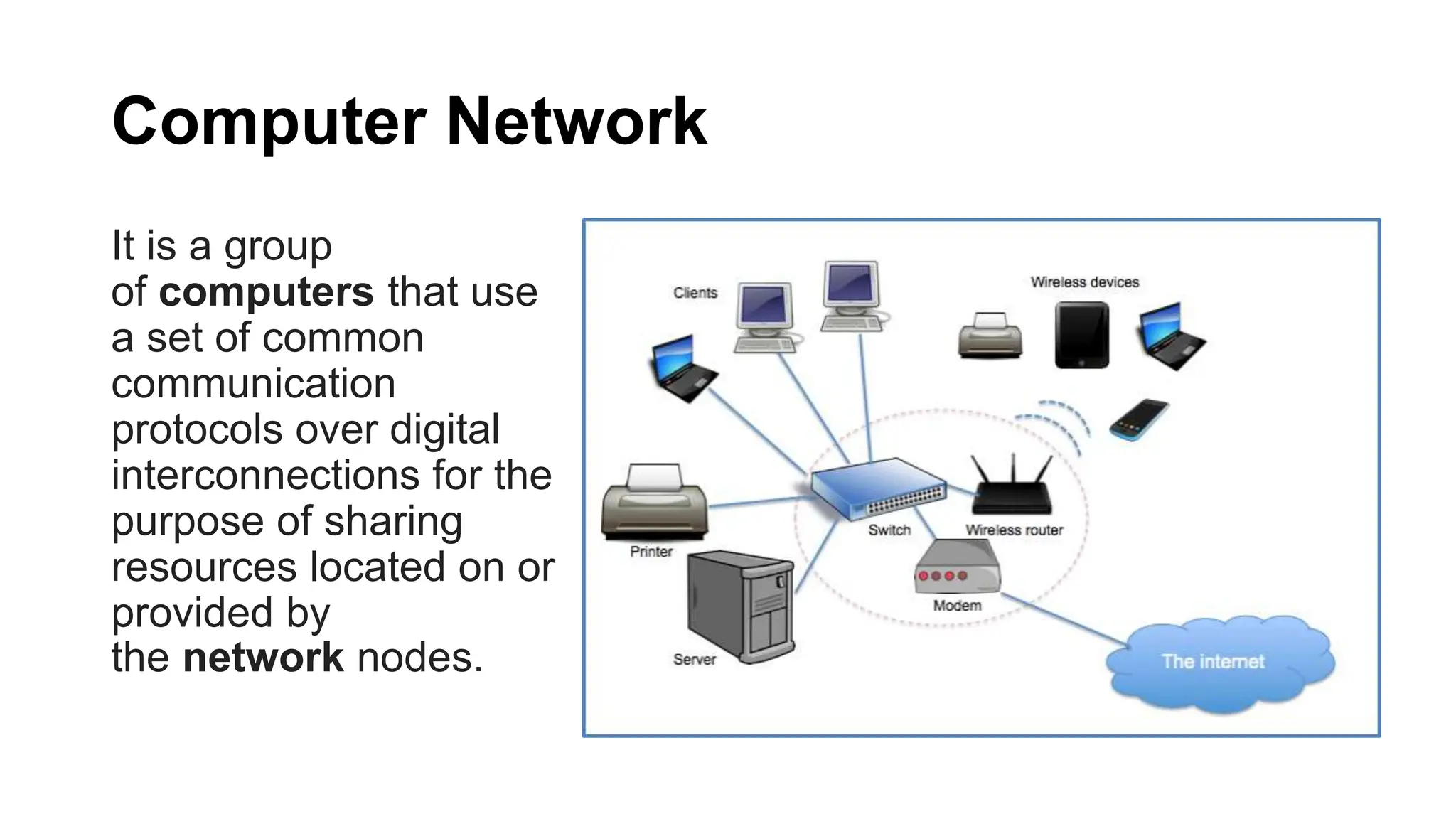
It is a group
of computers that use
a set of common
communication
protocols over digital
interconnections for the
purpose of sharing
resources located on or
provided by
the network nodes.
Advantages of Computer Networking
• It enhances communication and availability of information.
• It allows for more convenient resource sharing.
• It makes file sharing easier.
• It is highly flexible.
• It is an inexpensive system.
• It increases cost efficiency.
• It boosts storage capacity.
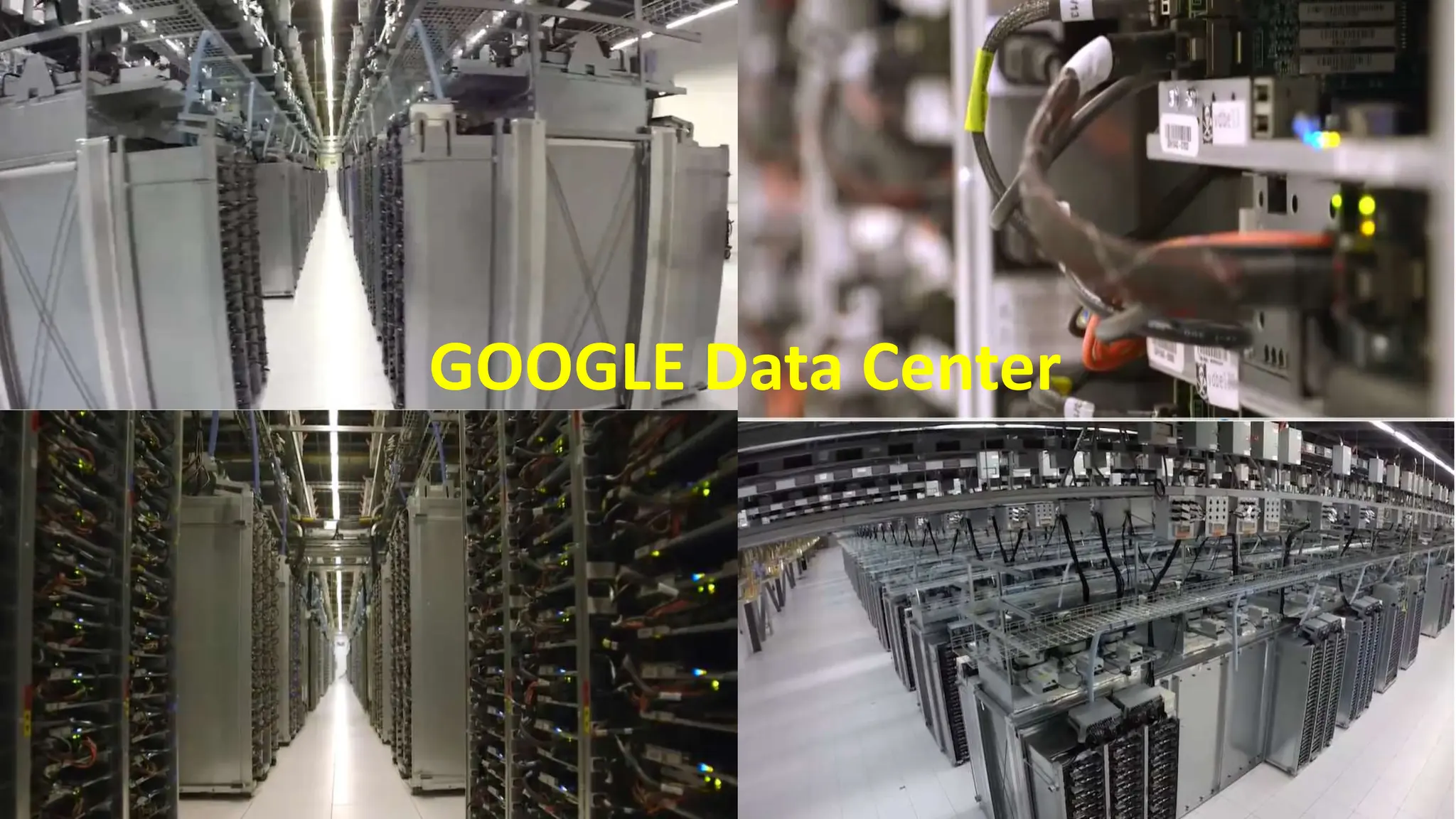
Data Center Set-up
GOOGLE Data Center
Advanced Network Technology Concepts
New trends
in networking are occurring
every day with the use of the
cloud.
Cloud computing is the
delivery of different services
through the Internet. These
resources include tools and
applications like data storage,
servers, databases, networking,
and software
Advanced Network Technology Concepts
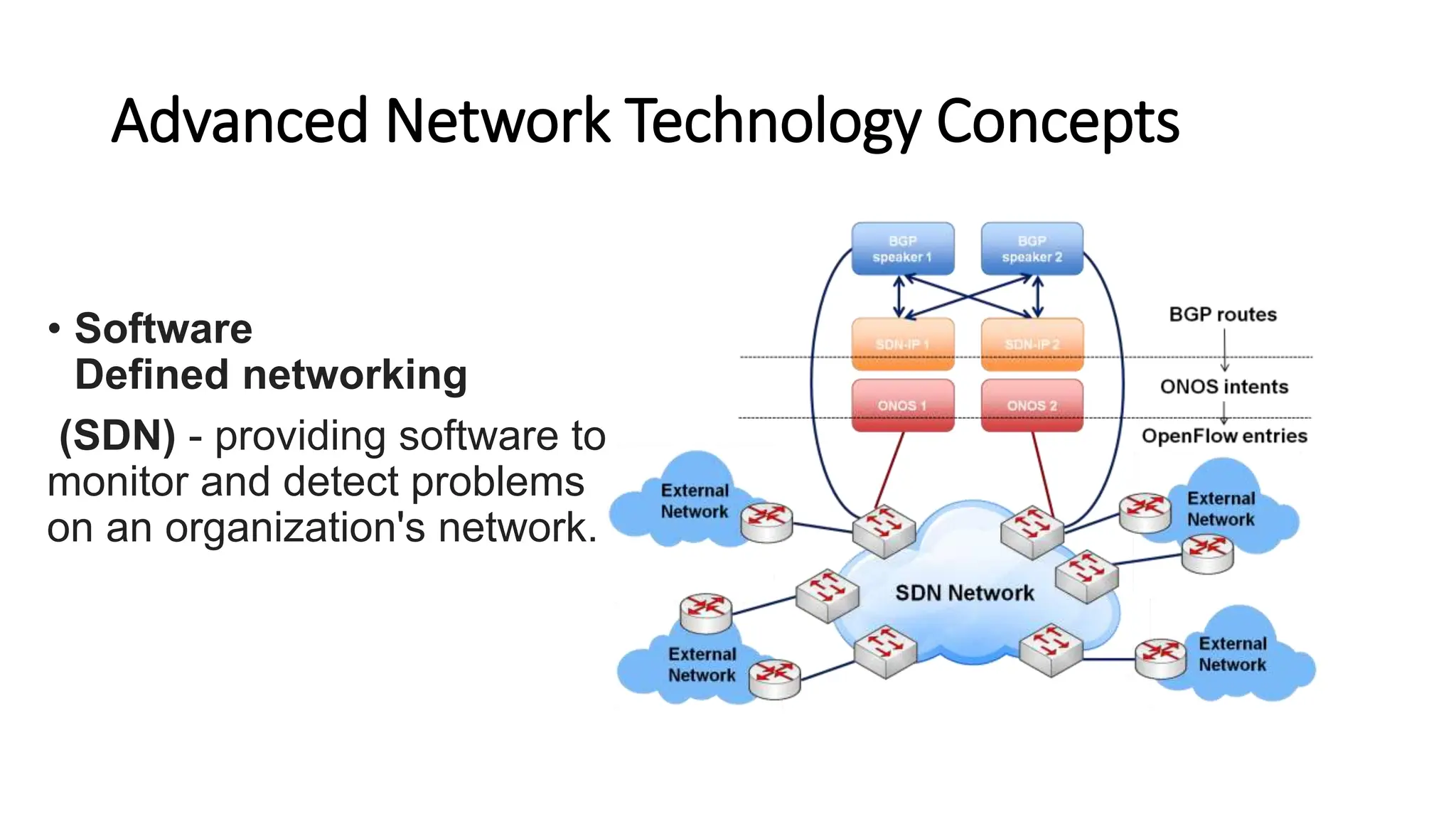
• Software
Defined networking
(SDN) - providing software to
monitor and detect problems
on an organization's network.
Advanced Network Technology Concepts
• 5G or 802.11ac -
increasing speed,
allowing for virtual reality,
wearables, and no-touch
computing.
Advanced Network Technology Concepts
• Wi-Fi6-is the next
generation
standard in WiFi
technology. Wi-Fi
6 also known as
“AX WiFi" or
"802.11ax WiFi”
builds and
improves on the
current 802.11ac
WiFi standard.
Advanced Network Technology Concepts
• IOT- describes the
network of physical
objects—“things”—that
are embedded with
sensors, software, and
other technologies for
the purpose of
connecting and
exchanging data with
other devices and
systems over
the internet
IOT (Internet of Things)
Four common communications models
described by the Internet Architecture
Board include:
• Device-to-Device,
• Device-to-Cloud,
• Device-to-Gateway, and
• Back-End Data-Sharing.
Internet of Things generally refers
to scenarios where network
connectivity and computing
capability extends to objects,
sensors and everyday items not
normally considered computers,
allowing these devices to generate,
exchange and consume data with
minimal human intervention.
IOT (Internet of Things)
An IoT ecosystem consists of web-
enabled smart devices that use
embedded systems, such as
processors, sensors and
communication hardware, to collect,
send and act on data they acquire
from their environments. IoT
devices share the sensor data they
collect by connecting to an IoT
gateway or other edge device where
data is either sent to the cloud to be
analyzed or analyzed locally.
IOT (Internet of Things)
Some of the advantages of IoT
include the following:
• ability to access information from
anywhere at any time on any
device;
• improved communication between
connected electronic devices;
• transferring data packets over a
connected network saving time and
money; and
• automating tasks helping to improve
the quality of a business's services
and reducing the need for human
intervention.
Some disadvantages of IoT include the following:
• As the number of connected devices increases
and more information is shared between
devices, the potential that a hacker could steal
confidential information also increases.
• Enterprises may eventually have to deal with
massive numbers -- maybe even millions -- of
IoT devices, and collecting and managing the
data from all those devices will be challenging.
• If there's a bug in the system, it's likely that
every connected device will become corrupted.
• Since there's no international standard of
compatibility for IoT, it's difficult for devices
from different manufacturers to communicate
with each other.
Different Advanced Network Devices and Technology
Network
automation
• Network automation is the process of
automating the configuring, managing,
testing, deploying, and operating of
physical and virtual devices within a
network. With everyday network tasks
and functions automated and repetitive
processes controlled and managed
automatically, network service
availability improves.
• Any type of network can use network
automation. Hardware- and software-
based solutions enable data centers,
service providers, and enterprises to
implement network automation to
improve efficiency, reduce human error,
and lower operating expenses.
Why automate?
Network Automation Involve?
Different Advanced Network Devices and Technology
5G
• 5G is largely being looked at from
a mobile device connectivity
perspective. While important, the
new wireless technology will also
enhance enterprises from a
branch office perspective. 5G is
designed to do a variety of things
that can transform our lives,
including giving us faster
download speeds, low latency,
and more capacity and
connectivity for billions of
devices—especially in the areas of
virtual reality (VR), the IoT, and
artificial intelligence (AI).
Different Advanced Network Devices and Technology
IoT
• It refers to a system of
interrelated, internet-
connected objects that are
able to collect and transfer
data over a wireless
network without human
intervention. The personal
or business possibilities are
endless.
Different Advanced Network Devices and Technology
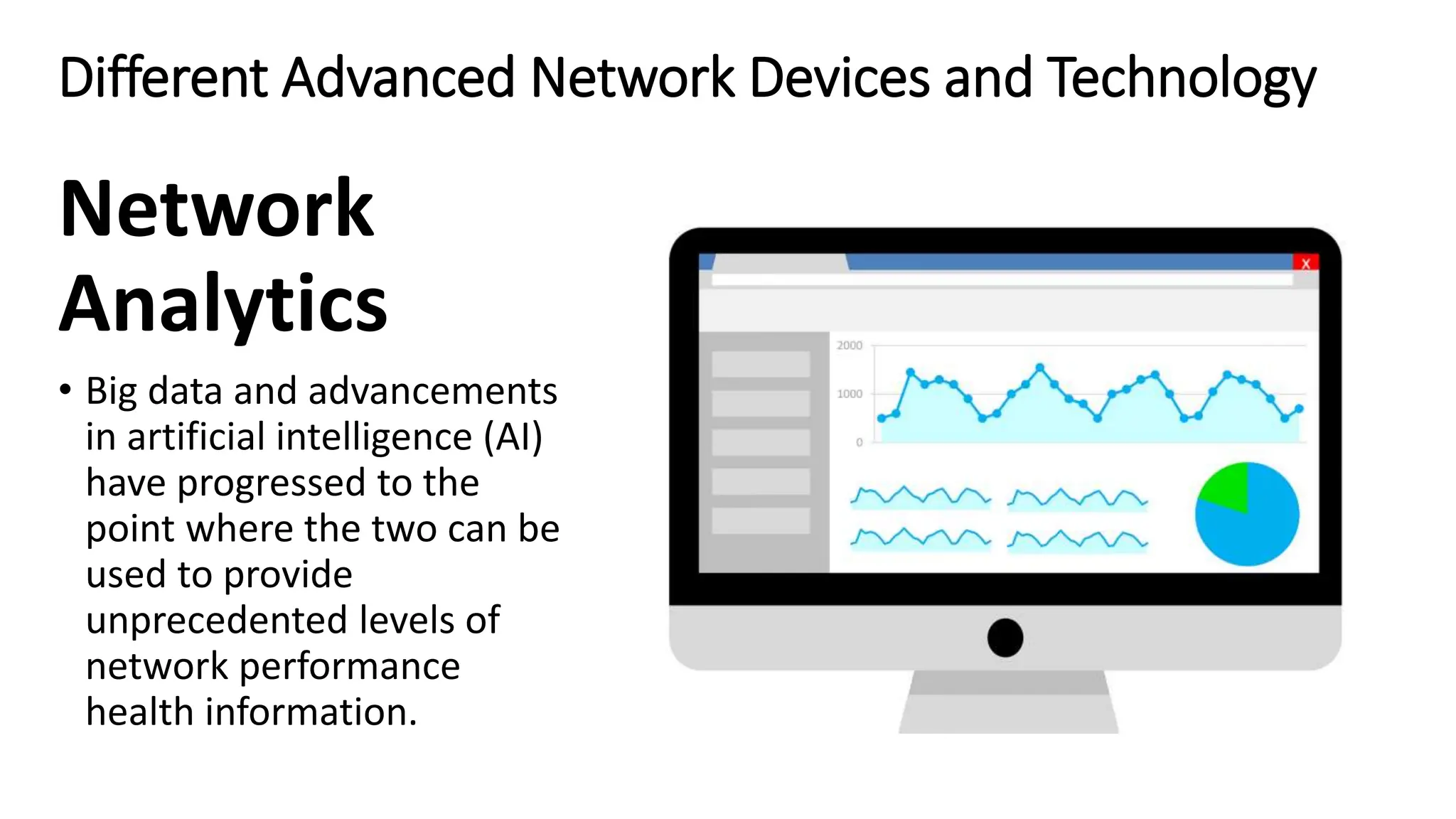
Network
Analytics
• Big data and advancements
in artificial intelligence (AI)
have progressed to the
point where the two can be
used to provide
unprecedented levels of
network performance
health information.
Different Advanced Network Devices and Technology
Edge
computing
optimizes internet devices
and web applications by
bringing computing closer to
the source of the data. This
minimizes the need for long
distance communications
between client and server,
which reduces latency and
bandwidth usage
References:
• https://greengarageblog.org/14-main-advantages-and-disadvantages-of-
computer-networking
• https://www.raconteur.net/technology/4g-vs-5g-mobile-technology
• https://www.internetsociety.org/resources/doc/2015/iot-
overview?gclid=Cj0KCQjwnqH7BRDdARIsACTSAdvPZUe9nsul8Ir06tM121izHvWl2
Ei6E-Qiu1303V2BBr3w-zdPqYYaAtYjEALw_wcB
• https://internetofthingsagenda.techtarget.com/definition/Internet-of-Things-IoT
• https://www.cisco.com/c/en/us/solutions/automation/network-automation.html
• https://www.networkcomputing.com/networking/7-network-trends-you-can-
expect-2020
• https://www.i-scoop.eu/internet-of-things-guide/

CHAPTER 1-Introduction of Advanced Network Technology and Facilities.pptx

  • 1.
    Introduction of Advanced NetworkTechnology and Facilities
  • 2.
    Computer Network It isa group of computers that use a set of common communication protocols over digital interconnections for the purpose of sharing resources located on or provided by the network nodes.
  • 3.
    Advantages of ComputerNetworking • It enhances communication and availability of information. • It allows for more convenient resource sharing. • It makes file sharing easier. • It is highly flexible. • It is an inexpensive system. • It increases cost efficiency. • It boosts storage capacity.
  • 4.
  • 5.
  • 6.
    Advanced Network TechnologyConcepts New trends in networking are occurring every day with the use of the cloud. Cloud computing is the delivery of different services through the Internet. These resources include tools and applications like data storage, servers, databases, networking, and software
  • 7.
    Advanced Network TechnologyConcepts • Software Defined networking (SDN) - providing software to monitor and detect problems on an organization's network.
  • 8.
    Advanced Network TechnologyConcepts • 5G or 802.11ac - increasing speed, allowing for virtual reality, wearables, and no-touch computing.
  • 9.
    Advanced Network TechnologyConcepts • Wi-Fi6-is the next generation standard in WiFi technology. Wi-Fi 6 also known as “AX WiFi" or "802.11ax WiFi” builds and improves on the current 802.11ac WiFi standard.
  • 10.
    Advanced Network TechnologyConcepts • IOT- describes the network of physical objects—“things”—that are embedded with sensors, software, and other technologies for the purpose of connecting and exchanging data with other devices and systems over the internet
  • 11.
    IOT (Internet ofThings) Four common communications models described by the Internet Architecture Board include: • Device-to-Device, • Device-to-Cloud, • Device-to-Gateway, and • Back-End Data-Sharing. Internet of Things generally refers to scenarios where network connectivity and computing capability extends to objects, sensors and everyday items not normally considered computers, allowing these devices to generate, exchange and consume data with minimal human intervention.
  • 14.
    IOT (Internet ofThings) An IoT ecosystem consists of web- enabled smart devices that use embedded systems, such as processors, sensors and communication hardware, to collect, send and act on data they acquire from their environments. IoT devices share the sensor data they collect by connecting to an IoT gateway or other edge device where data is either sent to the cloud to be analyzed or analyzed locally.
  • 15.
    IOT (Internet ofThings) Some of the advantages of IoT include the following: • ability to access information from anywhere at any time on any device; • improved communication between connected electronic devices; • transferring data packets over a connected network saving time and money; and • automating tasks helping to improve the quality of a business's services and reducing the need for human intervention. Some disadvantages of IoT include the following: • As the number of connected devices increases and more information is shared between devices, the potential that a hacker could steal confidential information also increases. • Enterprises may eventually have to deal with massive numbers -- maybe even millions -- of IoT devices, and collecting and managing the data from all those devices will be challenging. • If there's a bug in the system, it's likely that every connected device will become corrupted. • Since there's no international standard of compatibility for IoT, it's difficult for devices from different manufacturers to communicate with each other.
  • 16.
    Different Advanced NetworkDevices and Technology Network automation • Network automation is the process of automating the configuring, managing, testing, deploying, and operating of physical and virtual devices within a network. With everyday network tasks and functions automated and repetitive processes controlled and managed automatically, network service availability improves. • Any type of network can use network automation. Hardware- and software- based solutions enable data centers, service providers, and enterprises to implement network automation to improve efficiency, reduce human error, and lower operating expenses.
  • 17.
  • 18.
  • 19.
  • 20.
    Different Advanced NetworkDevices and Technology 5G • 5G is largely being looked at from a mobile device connectivity perspective. While important, the new wireless technology will also enhance enterprises from a branch office perspective. 5G is designed to do a variety of things that can transform our lives, including giving us faster download speeds, low latency, and more capacity and connectivity for billions of devices—especially in the areas of virtual reality (VR), the IoT, and artificial intelligence (AI).
  • 21.
    Different Advanced NetworkDevices and Technology IoT • It refers to a system of interrelated, internet- connected objects that are able to collect and transfer data over a wireless network without human intervention. The personal or business possibilities are endless.
  • 22.
    Different Advanced NetworkDevices and Technology Network Analytics • Big data and advancements in artificial intelligence (AI) have progressed to the point where the two can be used to provide unprecedented levels of network performance health information.
  • 23.
    Different Advanced NetworkDevices and Technology Edge computing optimizes internet devices and web applications by bringing computing closer to the source of the data. This minimizes the need for long distance communications between client and server, which reduces latency and bandwidth usage
  • 24.
    References: • https://greengarageblog.org/14-main-advantages-and-disadvantages-of- computer-networking • https://www.raconteur.net/technology/4g-vs-5g-mobile-technology •https://www.internetsociety.org/resources/doc/2015/iot- overview?gclid=Cj0KCQjwnqH7BRDdARIsACTSAdvPZUe9nsul8Ir06tM121izHvWl2 Ei6E-Qiu1303V2BBr3w-zdPqYYaAtYjEALw_wcB • https://internetofthingsagenda.techtarget.com/definition/Internet-of-Things-IoT • https://www.cisco.com/c/en/us/solutions/automation/network-automation.html • https://www.networkcomputing.com/networking/7-network-trends-you-can- expect-2020 • https://www.i-scoop.eu/internet-of-things-guide/