Chapter 4
Emerging Technologies
12th Information Technology
Maharashtra Board
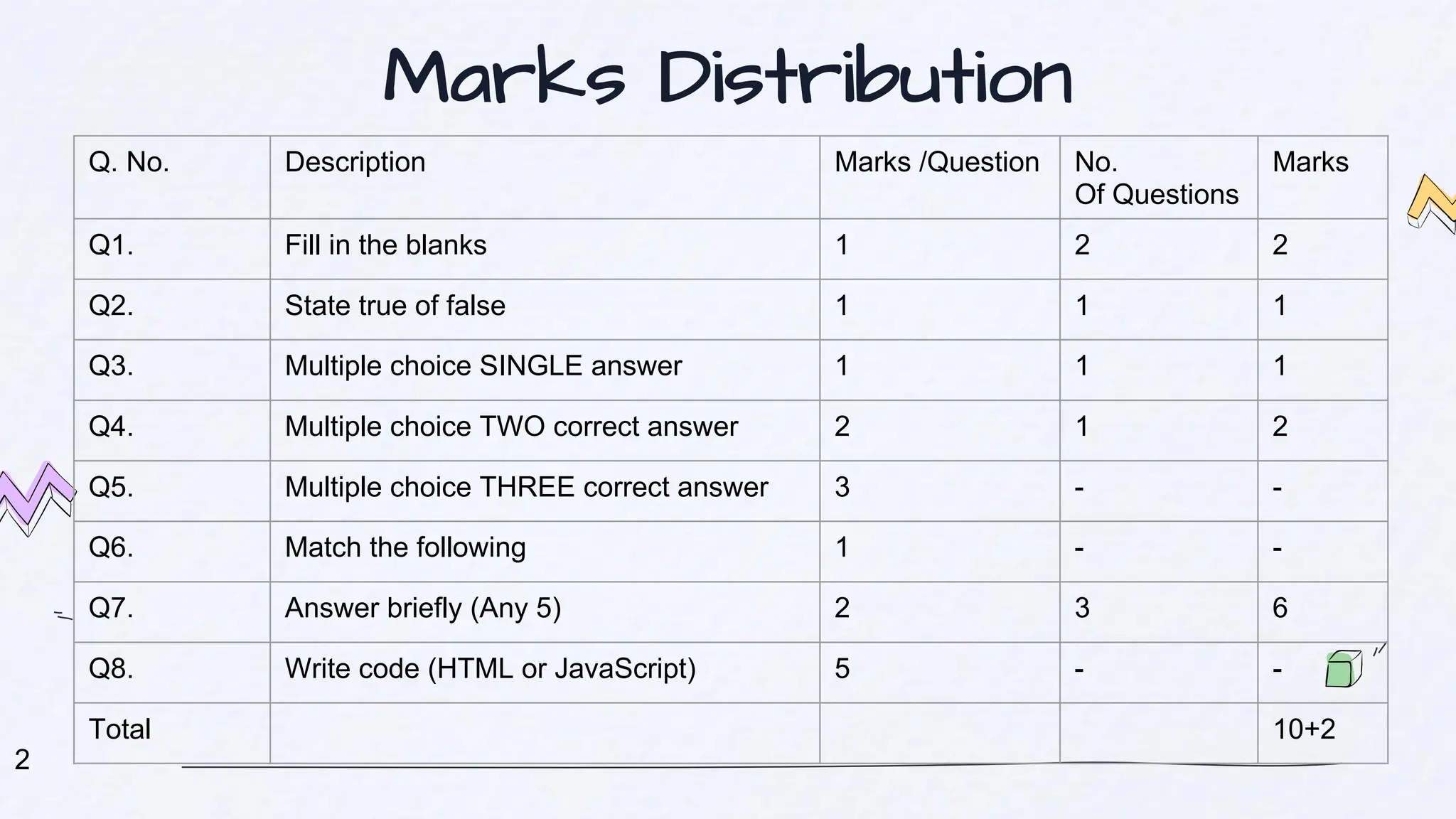
Marks Distribution
2
Q. No. Description Marks /Question No.
Of Questions
Marks
Q1. Fill in the blanks 1 2 2
Q2. State true of false 1 1 1
Q3. Multiple choice SINGLE answer 1 1 1
Q4. Multiple choice TWO correct answer 2 1 2
Q5. Multiple choice THREE correct answer 3 - -
Q6. Match the following 1 - -
Q7. Answer briefly (Any 5) 2 3 6
Q8. Write code (HTML or JavaScript) 5 - -
Total 10+2
IoT (Internet of Things)
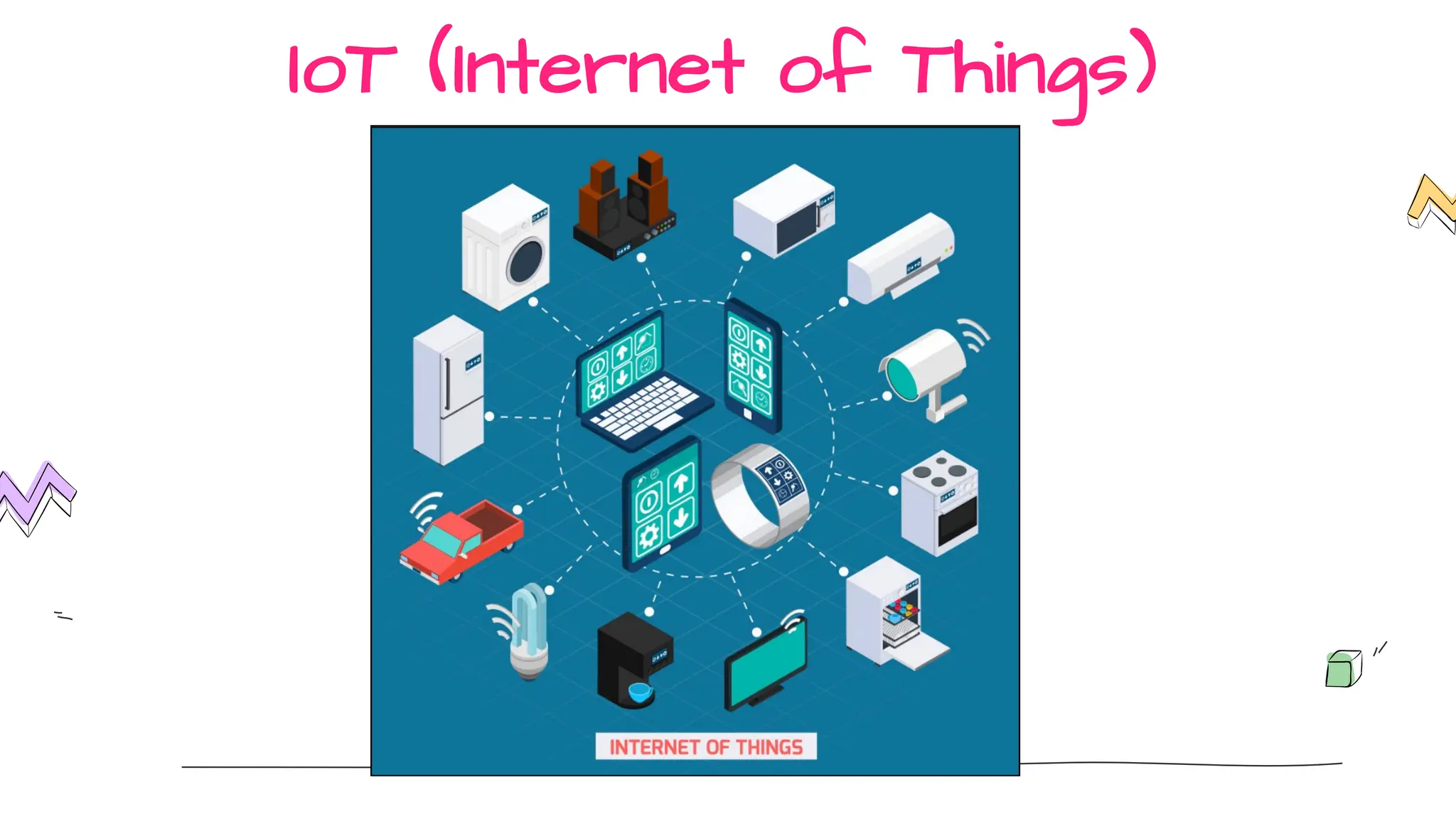
• The Internet of things (IoT) is the network of physical
devices, vehicles, home appliances, and other items
embedded with electronics, software, sensors, actuators, and
connectivity.
• It enables these things to connect, collect and
exchange data, creating opportunities for more direct
integration of the physical world into computer-based
systems
• Resulting in efficiency improvements, economic benefits.
• This reduces human efforts.
IoT (Internet of Things)
• IOT involves extending Internet connectivity beyond
standard devices.
• Such as desktops, laptops, smartphones and tablets to any
range of traditionally dumb or non-internet-enabled
physical devices and everyday objects.
• Embedded with technology, these devices can
communicate and interact over the Internet, and they can
be remotely monitored and controlled.
Advantages
● Efficient resource utilization : If we know the functionality and
the way that how each device works, we definitely increase the
efficient resource utilization as well as monitor natural resources.
● Minimize human effort : As the devices of IoT interact and
communicate with each other and do lot of task for us, then they
minimize the human effort
Advantages
● Time saving : As it reduces the human effort then it definitely
saves out time. Time is the primary factors in automation which
can save through IOT platform.
● Enhance Data Collection : IoT devices can collect data from
environment like weather, sound, pollution etc. This data then can
be used to take decisions.
Advantages
● Improve, security : IoT based security systems can make home or
office environment secure.
Disadvantages
● Privacy : Even without the active participation on the user, the
IoT system provides substantial personal data in maximum detail.
● Complexity : The designing, developing, maintaining and
enabling the large technology to IoT system is quite complicated.
Applications of IoT
● Smart lighting - Illumination of light is controlled on the basis of day
light.
● Smart thermostats - Allows users to schedule, monitor and remotely
control home temperatures.
● Smart locks and garage-door openers - Password based or facial
recognition based doors and locks.
● Smart security cameras – Security cameras that can identify known
and unknown person and raise alarm, in case of security threat.
● Smart traffic signals – Signal that can adjust their timing to
accommodate commutes and holiday traffic and keep cars moving.
Cloud Computing
Cloud Computing
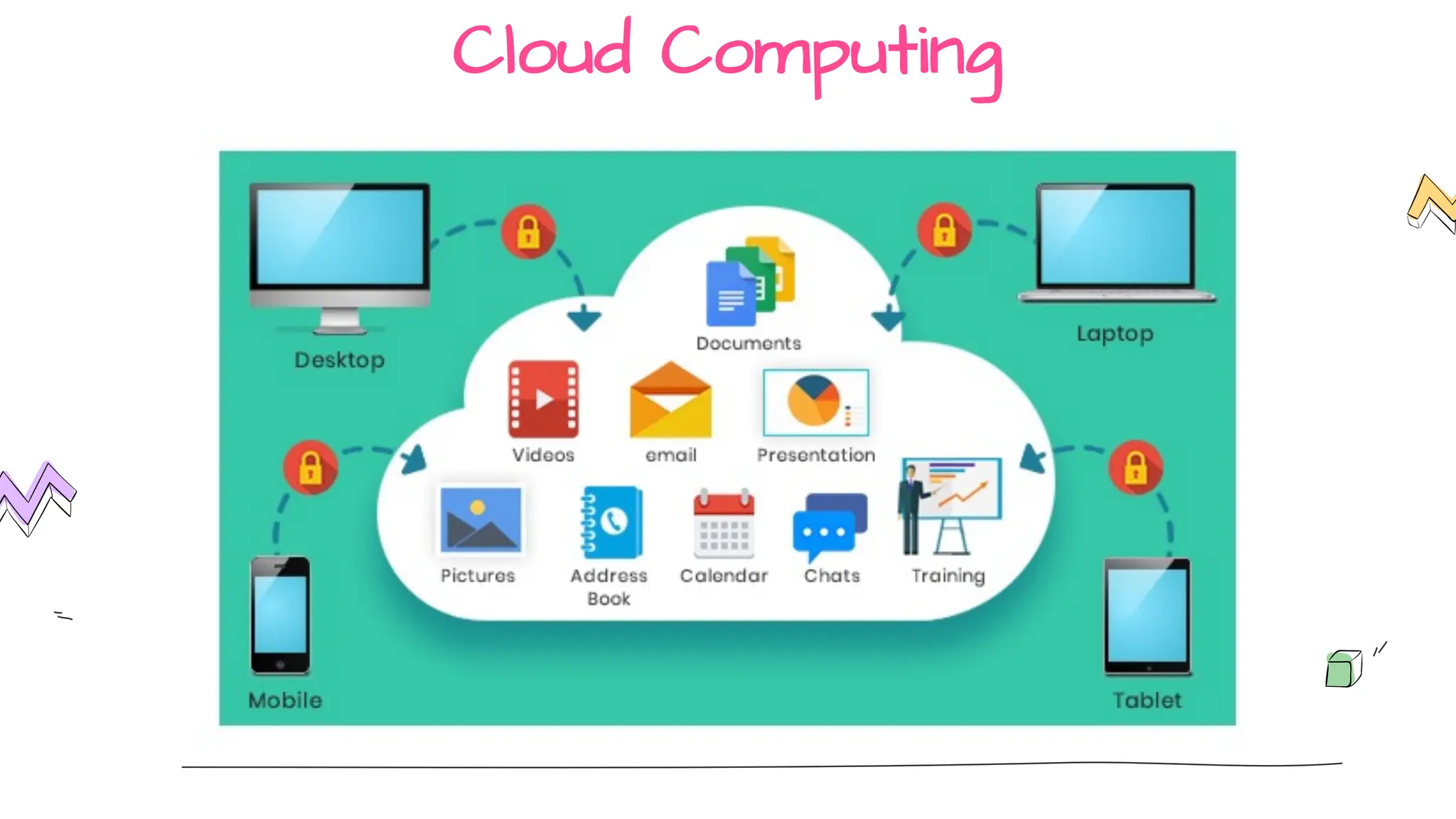
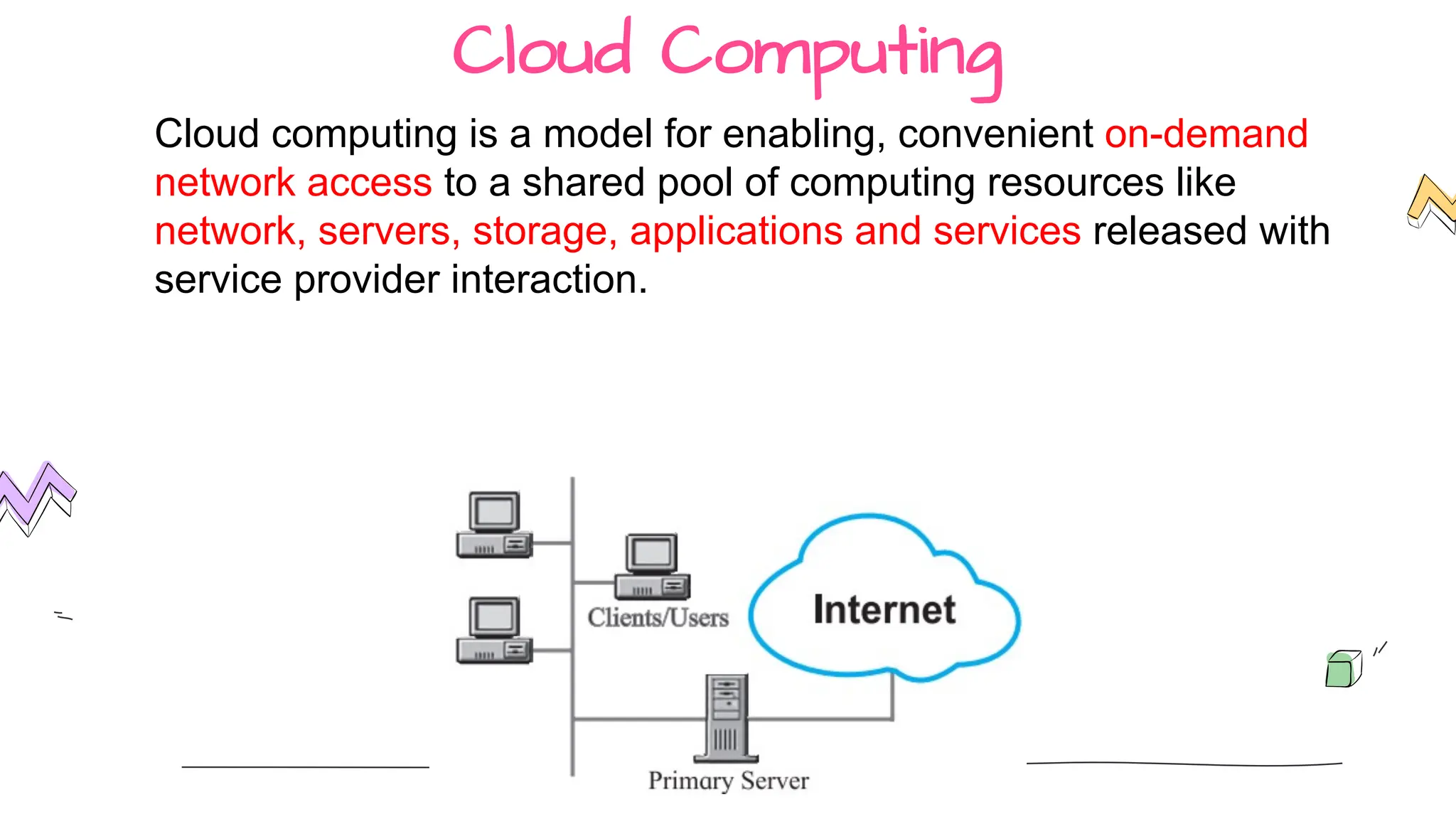
Cloud computing is a model for enabling, convenient on-demand
network access to a shared pool of computing resources like
network, servers, storage, applications and services released with
service provider interaction.
Models of Cloud computing
There are three primary service models of cloud computing that
are
● Infrastructure as a Service (IaaS),
● Platform as a Service (PaaS)
● Software as a Service (SaaS).
Infrastructure as a service (IaaS)
● IaaS gives users access to storage, networking, servers and
other computing resources via the cloud.
● While the user is still responsible for managing their
applications, data, middleware, etc.
● IaaS provides automated and scalable environments that
provide a high degree of control and flexibility for the user.
Key features
● Instead of purchasing hardware outright, users pay for IaaS on
demand.
● Infrastructure is scalable depending on processing and storage
needs.
● Enterprises saves the costs of buying and maintaining their own
hardware.
Examples : Amazon web services (AWS) ec2, Microsoft Azure VM,
Google Compute Engine (GCE)
Platform as a service (PaaS)
● A service provider offers access to a cloud-based environment in
which users can develop, manage and deliver applications.
● In addition to storage and other computing resources, users are
able to use a suite of prebuilt tools to develop, customize and
test their own applications.
Key features
• PaaS provides a platform with tools to test, develop and
host applications in the same environment.
• Enables organizations to focus on development without
having a worry about underlying infrastructure.
• Providers manage security, operating systems, server
software and backups.
• Facilitates collaborative work even if teams work
remotely.
Software as a service (SaaS)
● A service provider delivers software and applications through
the internet.
● Users do not install applications on their local devices.
● Instead, the applications reside on a remote cloud network
accessed through the web or an API.
Key features
● SaaS vendors provide users with software and applications via a
subscription model.
● Users do not have to manage, install or upgrade software;
● SaaS providers manage this.
● Data is secure in the cloud;
● equipment failure does not result in loss of data.
● Use of resources can be scaled depending on service needs.
● Applications are accessible from almost any internet-connected
device, from virtually anywhere in the world.
Examples : Google's G suite, GitHub, SAP, Slack, Dropbox.
Types of Cloud Computing
There are three basic types of deployment of cloud
computing that are Public, Private and Hybrid.
Public Cloud
• Shared across multiple users.
• More efficient and inexpensive
• Examples : Amazon AWS, Microsoft Azure, Google Cloud
Platform.
Private cloud
• Provides services to selected users
• Data is protected behind the firewall.
• Enhanced security and privacy.
Hybrid Cloud
● Combines both Public and Private cloud elements.
● Allows greater flexibility as compared to that of public
and private cloud solutions
Benefits of Cloud Computing
● Cost saving : Cloud computing solutions are inexpensive than the
actual overall Infrastructure set up for the I.T services.
● Reliable : Cloud computing solutions are more reliable than In-
house I.T infrastructure.
● Mobility : Cloud computing solutions are more portable because
user can access data anytime, anywhere as required.
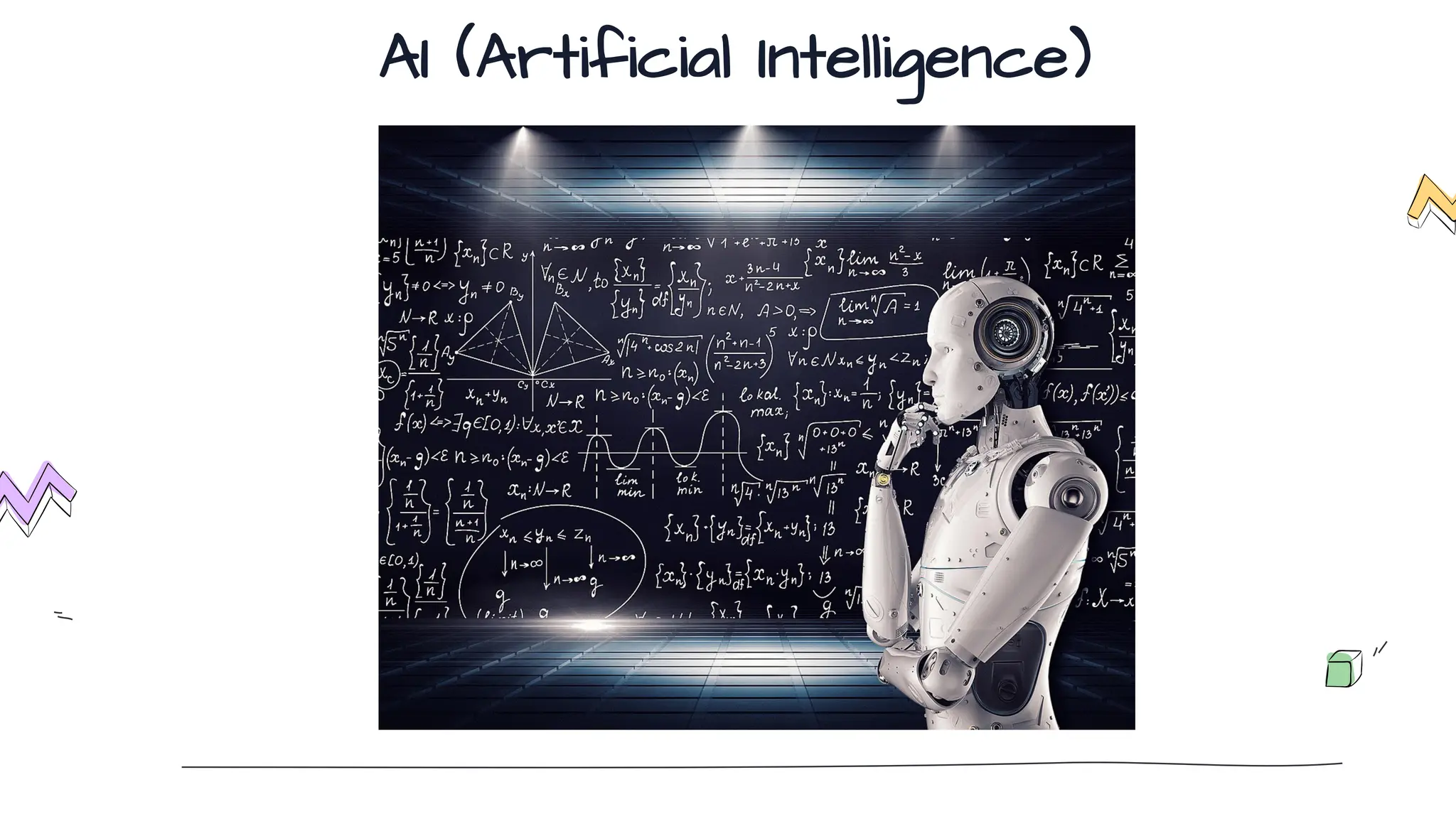
AI (Artificial Intelligence)
● Artificial intelligence (AI) is an area of computer science
that emphasizes on creation of intelligent machines
that work and react like humans.
● AI is different from robotics, but related to some
extent, in which machines sense their environment,
perform calculations and do physical tasks either by
themselves or under the direction of people.
AI has some sub fields like-
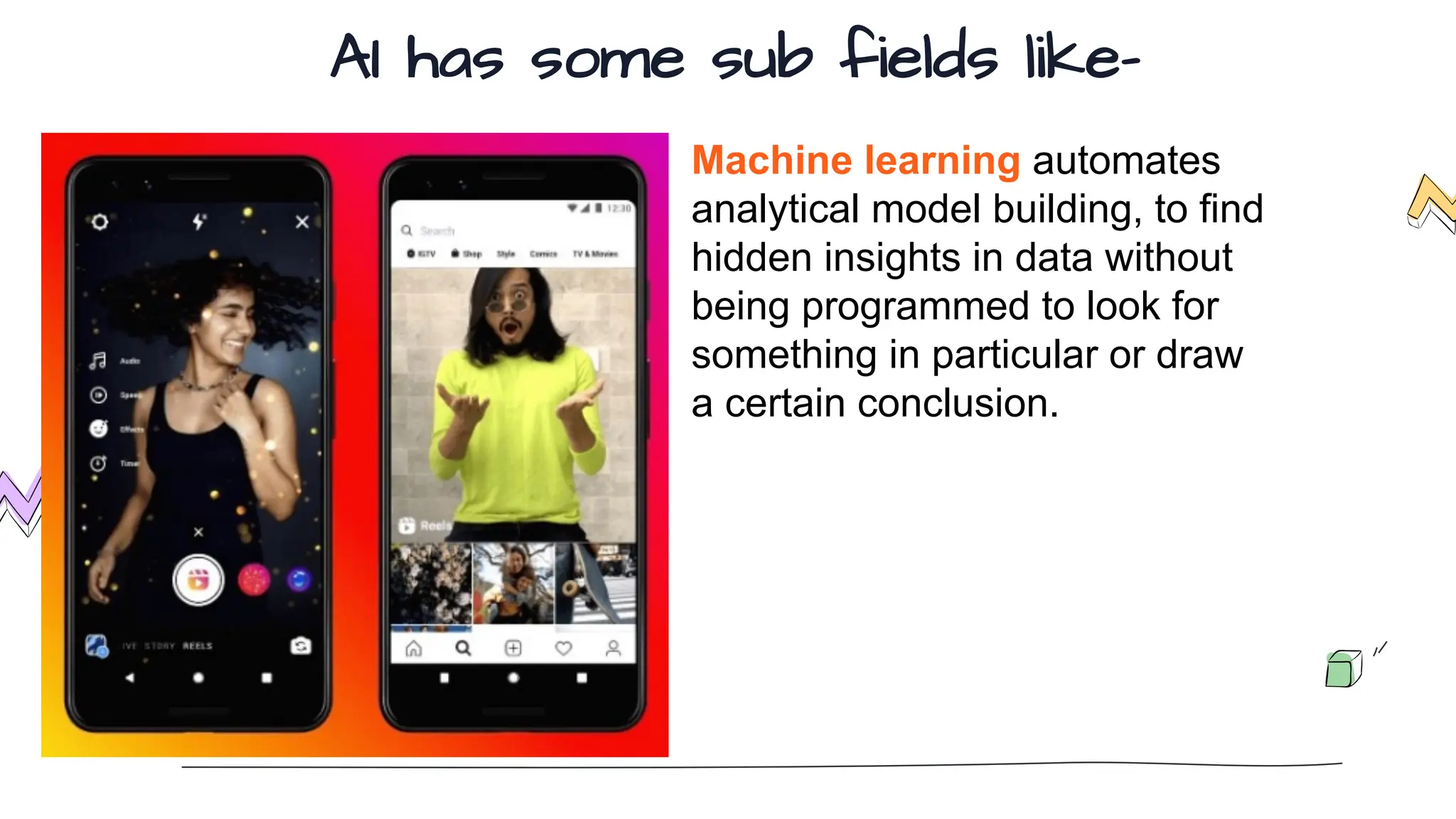
Machine learning automates
analytical model building, to find
hidden insights in data without
being programmed to look for
something in particular or draw
a certain conclusion.
AI has some sub fields like-
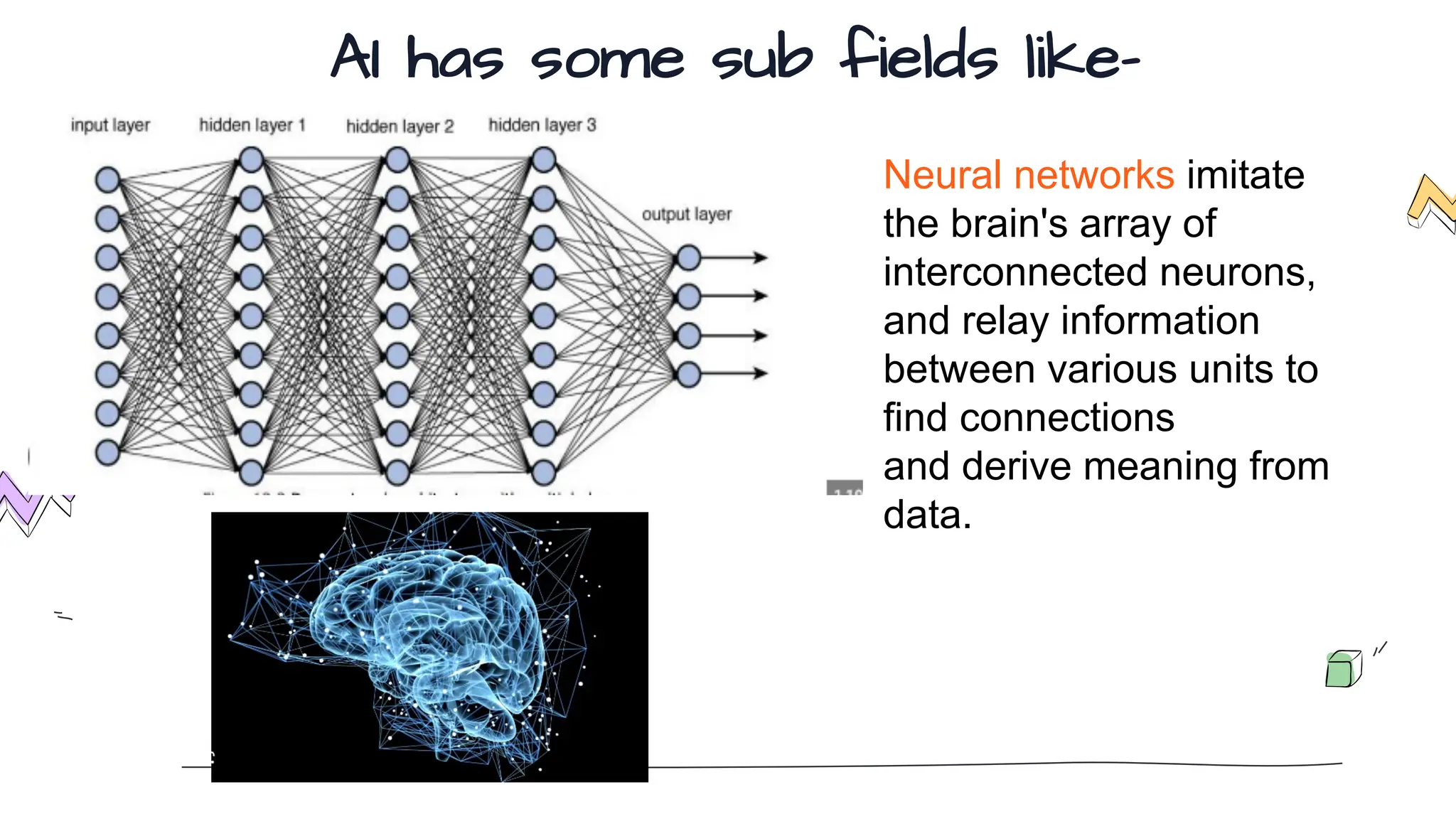
Neural networks imitate
the brain's array of
interconnected neurons,
and relay information
between various units to
find connections
and derive meaning from
data.
AI has some sub fields like-
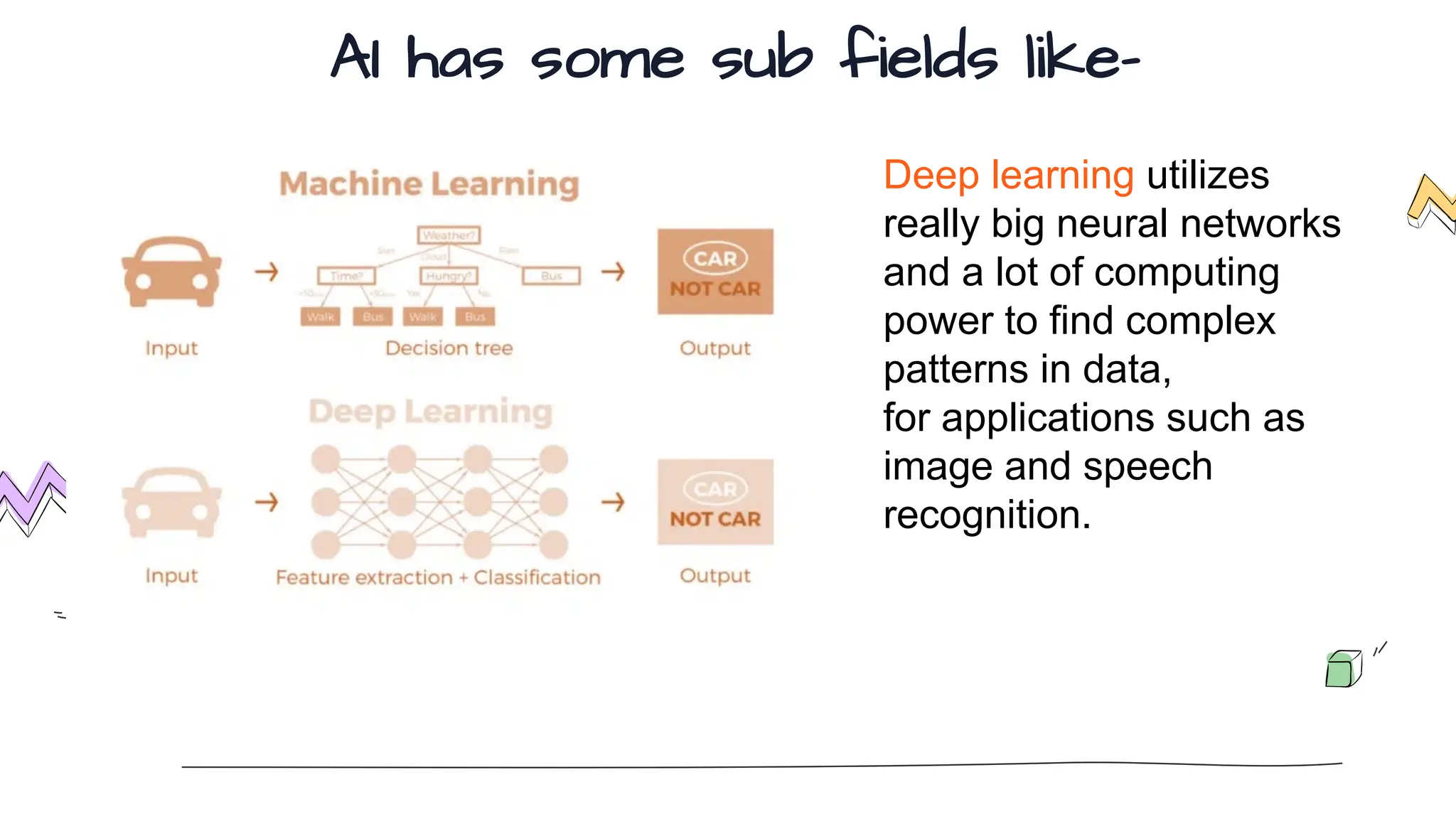
Deep learning utilizes
really big neural networks
and a lot of computing
power to find complex
patterns in data,
for applications such as
image and speech
recognition.
AI has some sub fields like-
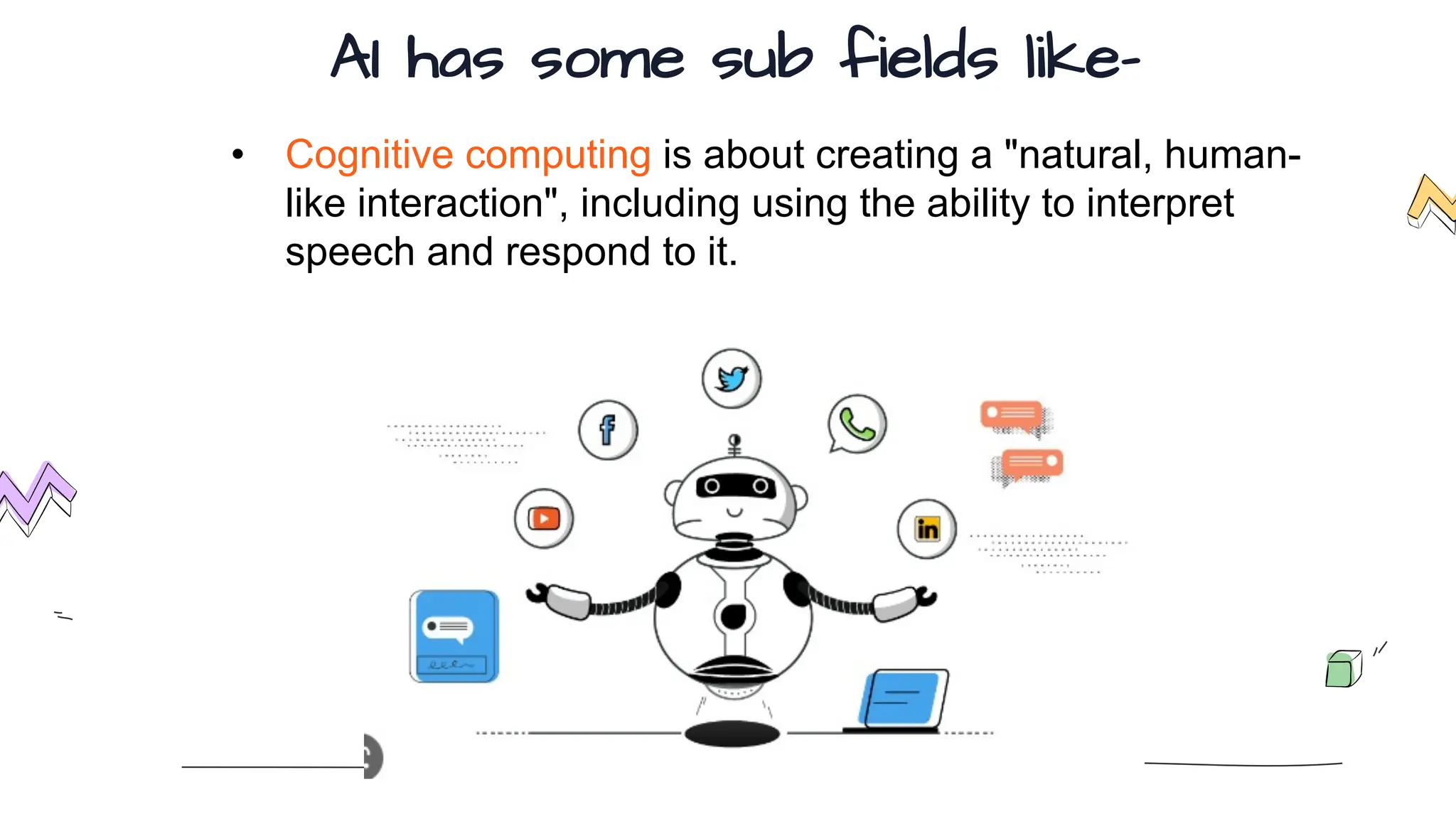
• Cognitive computing is about creating a "natural, human-
like interaction", including using the ability to interpret
speech and respond to it.
AI has some sub fields like-
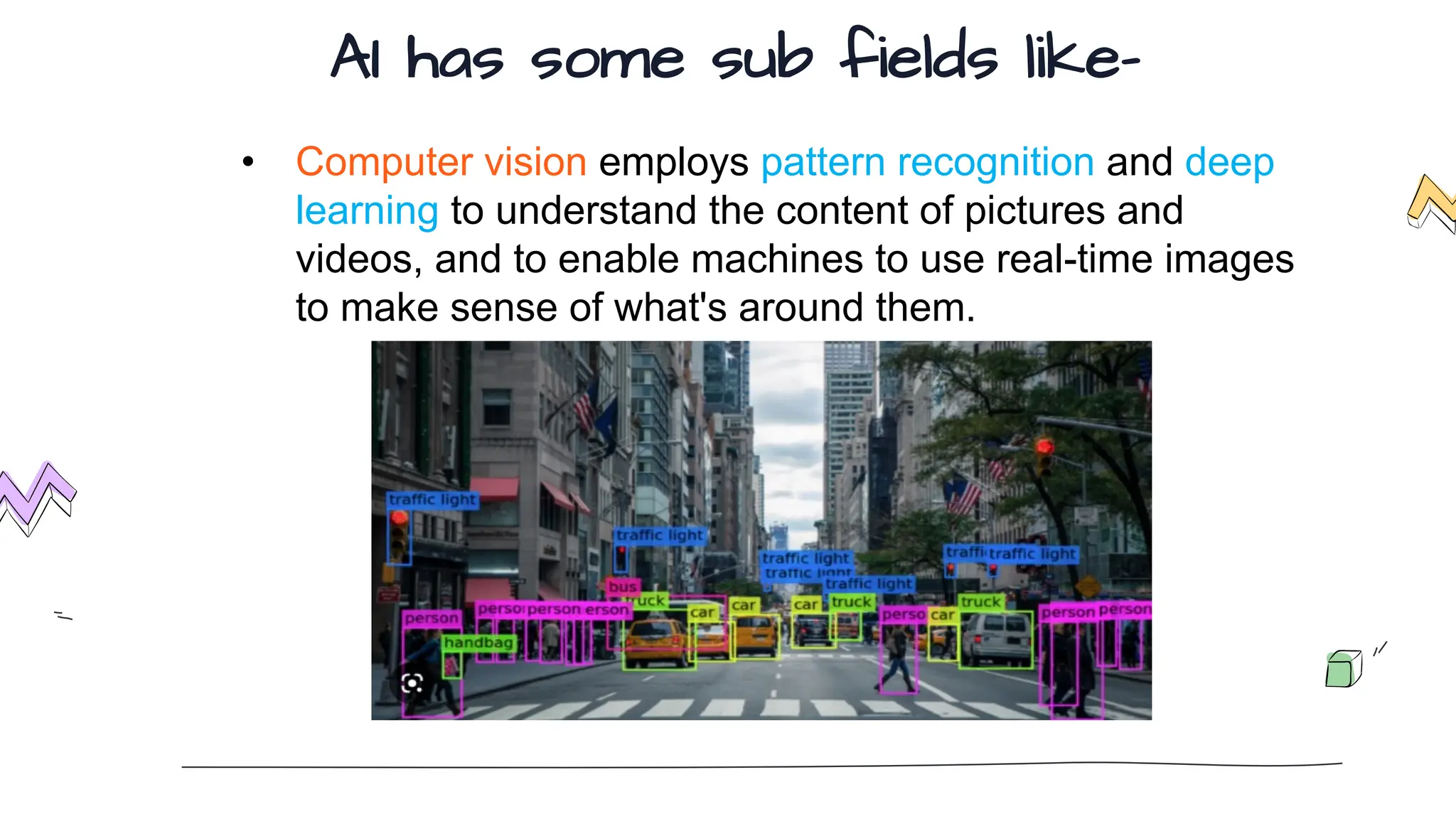
• Computer vision employs pattern recognition and deep
learning to understand the content of pictures and
videos, and to enable machines to use real-time images
to make sense of what's around them.
AI has some sub fields like-
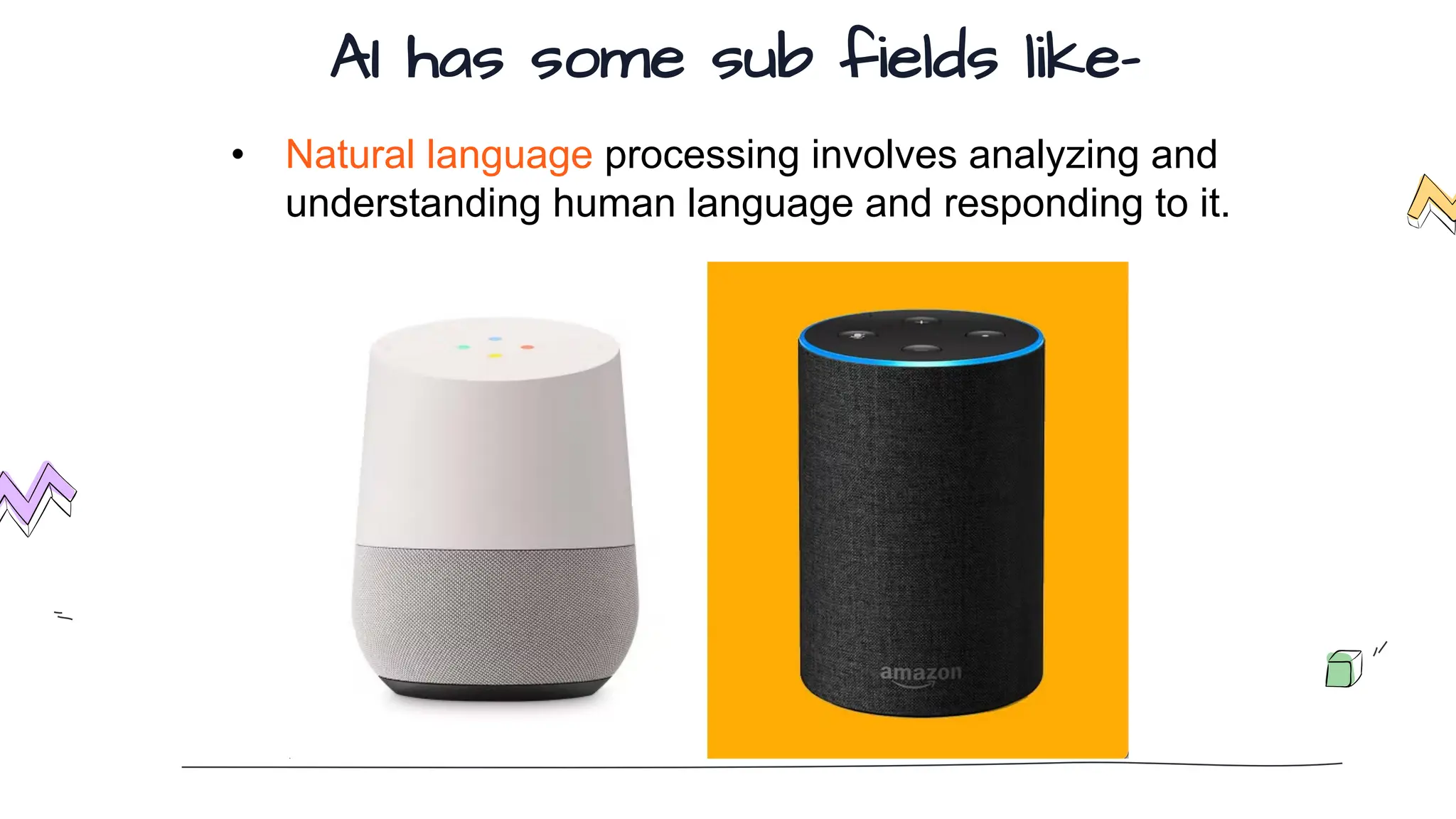
• Natural language processing involves analyzing and
understanding human language and responding to it.
Advantages of Artificial Intelligence
● Reduction in human error : Computers if programmed properly
with artificial Intelligence gives 100% accuracy as compared to
task performed by human as there is always a chance for human
mistakes.
● Digital Assistance : Some of the highly advanced organizations
use digital assistants to interact with users which saves the need
for human resources. Example- chatbot
Advantages of Artificial Intelligence
● Faster Decisions : Using AI alongside other technologies, we can
make machines take decisions faster than a human and carry out
actions quicker.
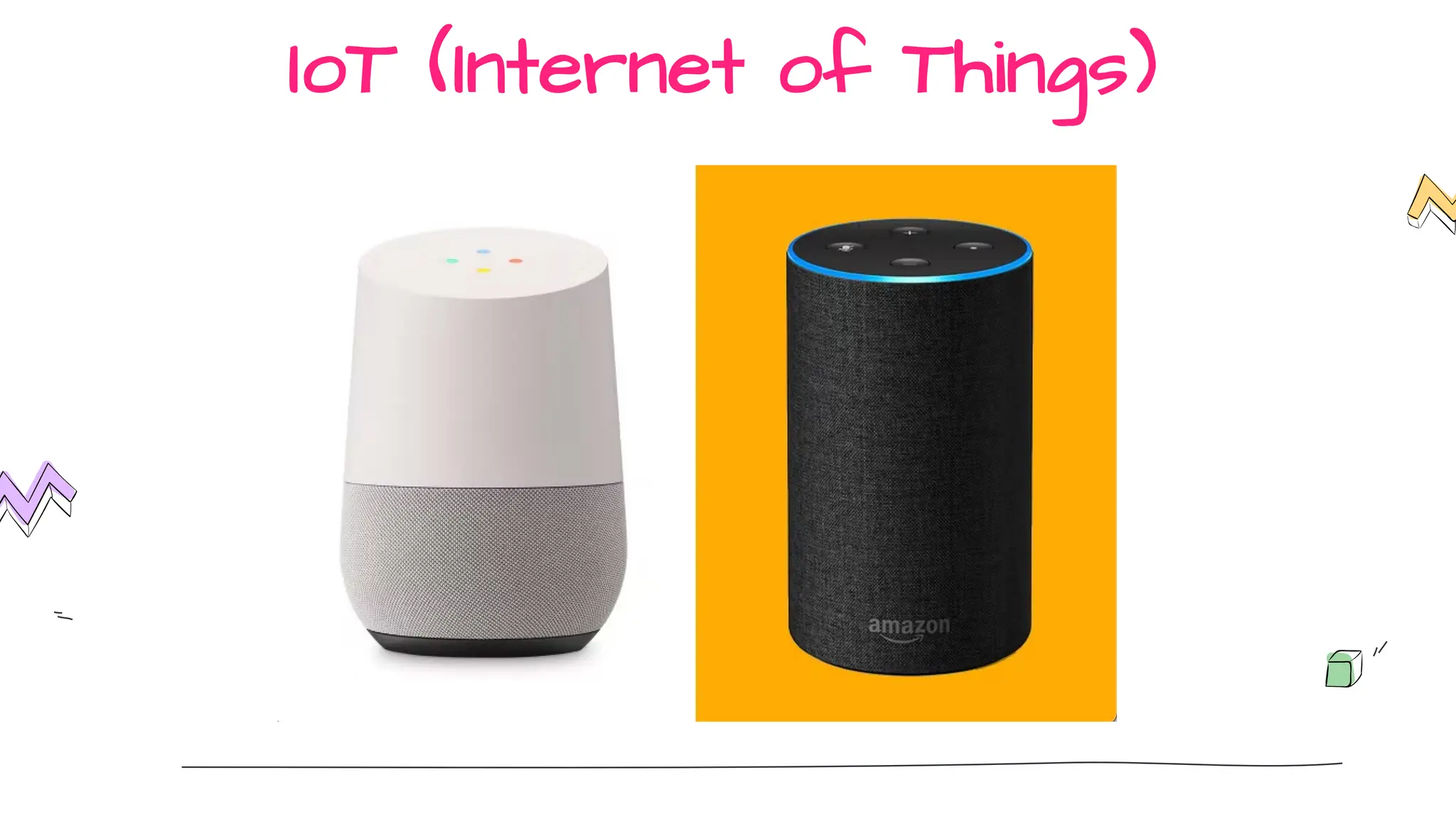
● Daily Applications : Daily applications such as Apple’s Siri,
Window’s Cortana, Google’s OK Google are frequently used in our
daily routine whether it is for searching a location, taking a selfie,
making a phone call, replying to a mail and many more.
Disadvantages of AI
● High Costs of Creation- As the machines used in AI based
environments are very complex and high in price, it increases the
cost for overall set up.
● Unemployment- As AI is replacing the majority of the repetitive
tasks and other works with robots.
● This will reduced human interference but cause a major problems
in the employment standards.
5G
5G
5G
5G
5G
5G
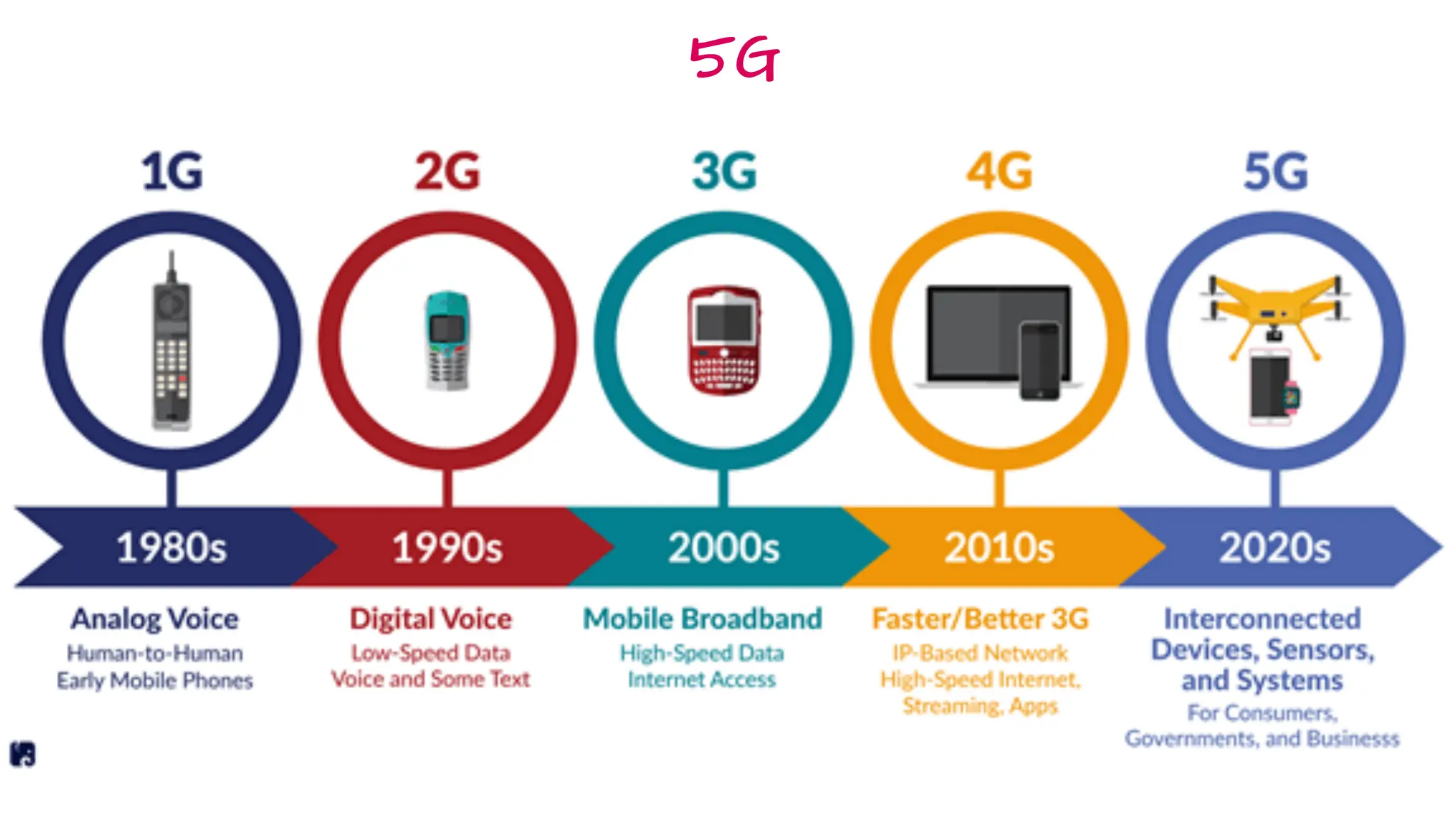
• 5G is the fifth generation of cellular network technology.
• 5G is the next generation of wireless communications.
• It is expected to provide Internet connections that are multiple
times faster than 4G LTE (Long Term Evolution).
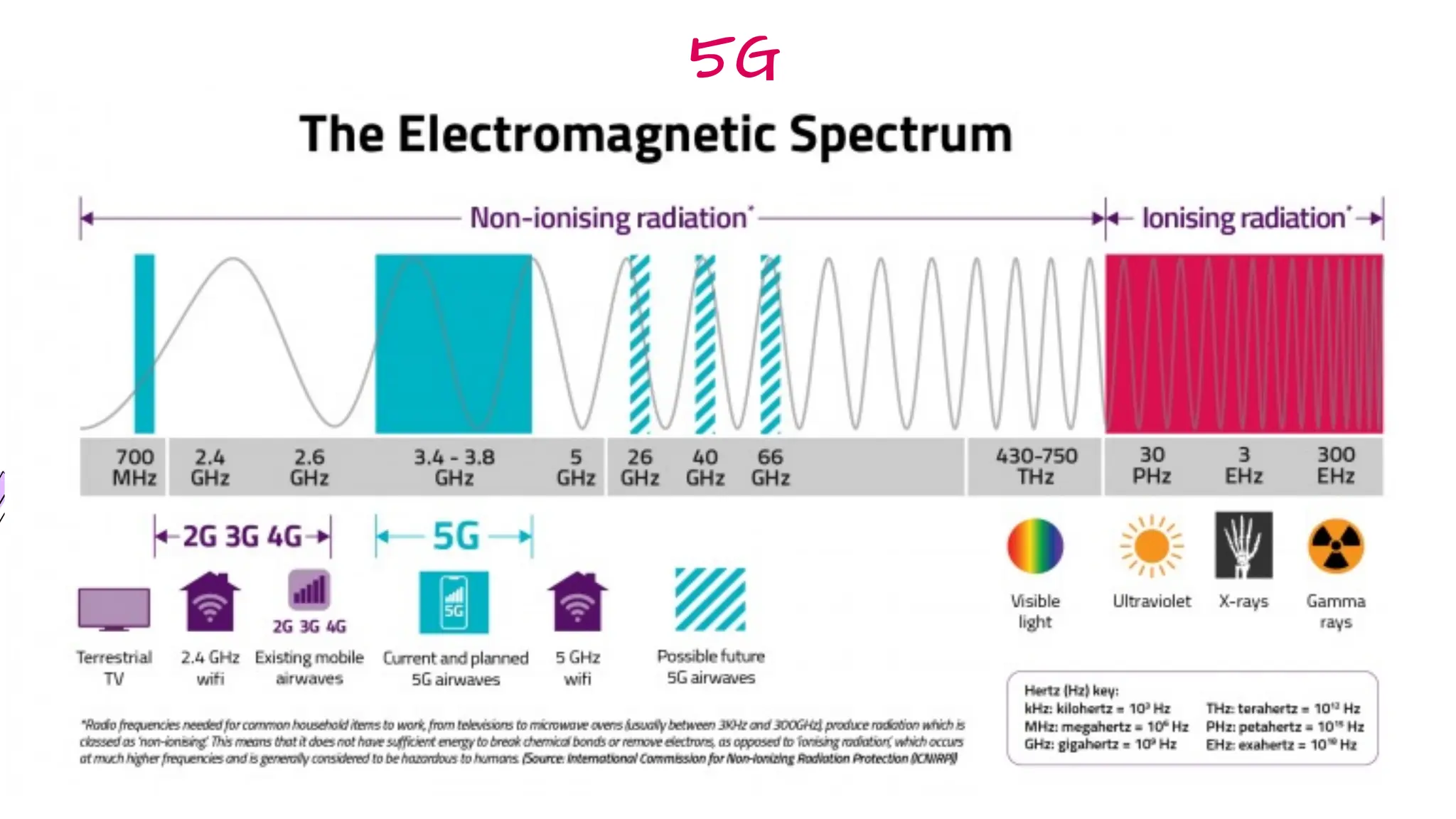
• 5G technology may use a variety of spectrum bands, including
millimeter wave (mmWave) radio spectrum, which can carry
very large amounts of data at a short distance.
• The drawback of the higher frequencies is that they are more
easily obstructed by the walls of buildings, trees and other
foliage, and even changes in the weather.
5G
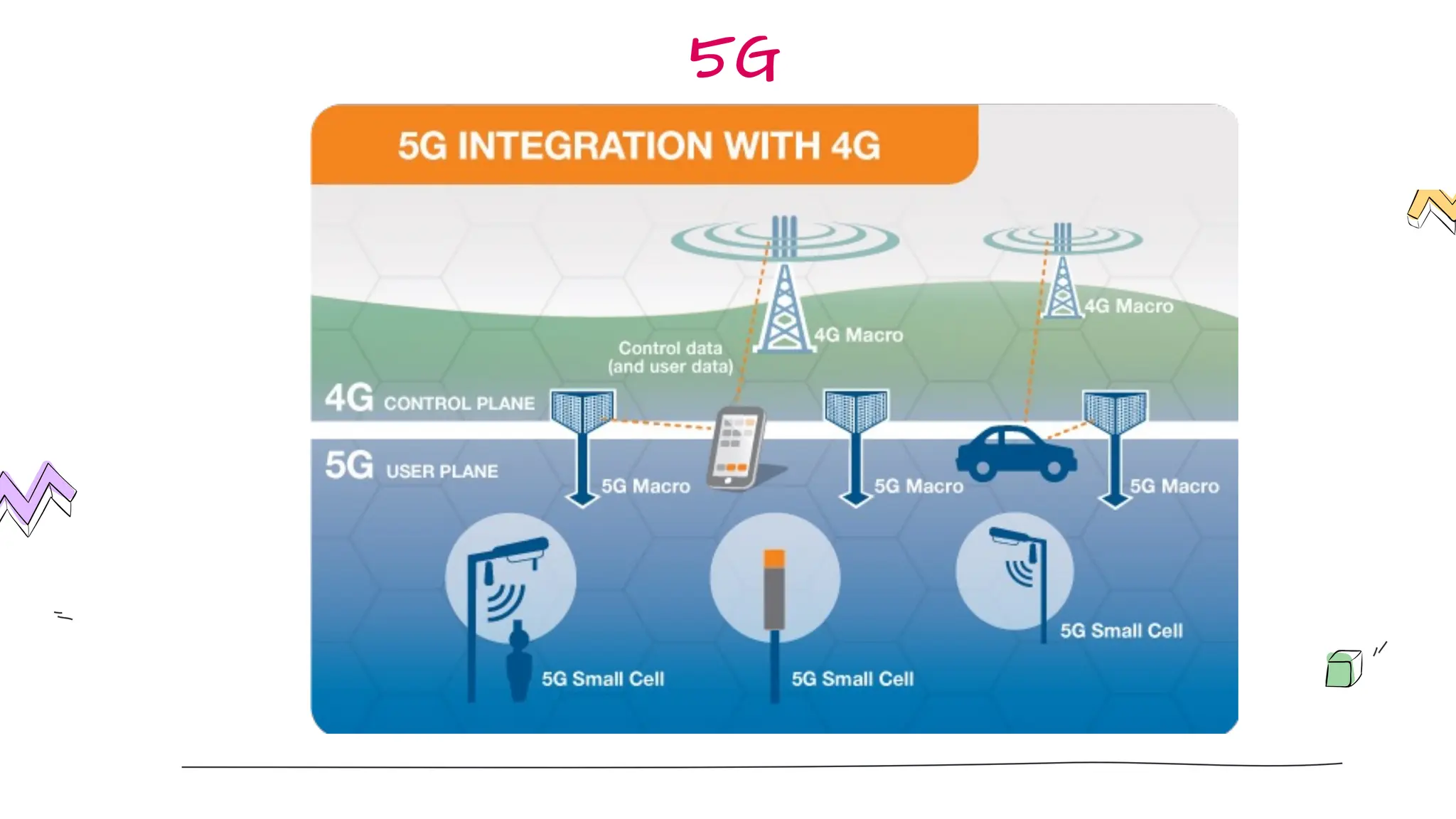
The new 5G networks will be able to transmit very large
amounts of data—but only a few blocks at a time.
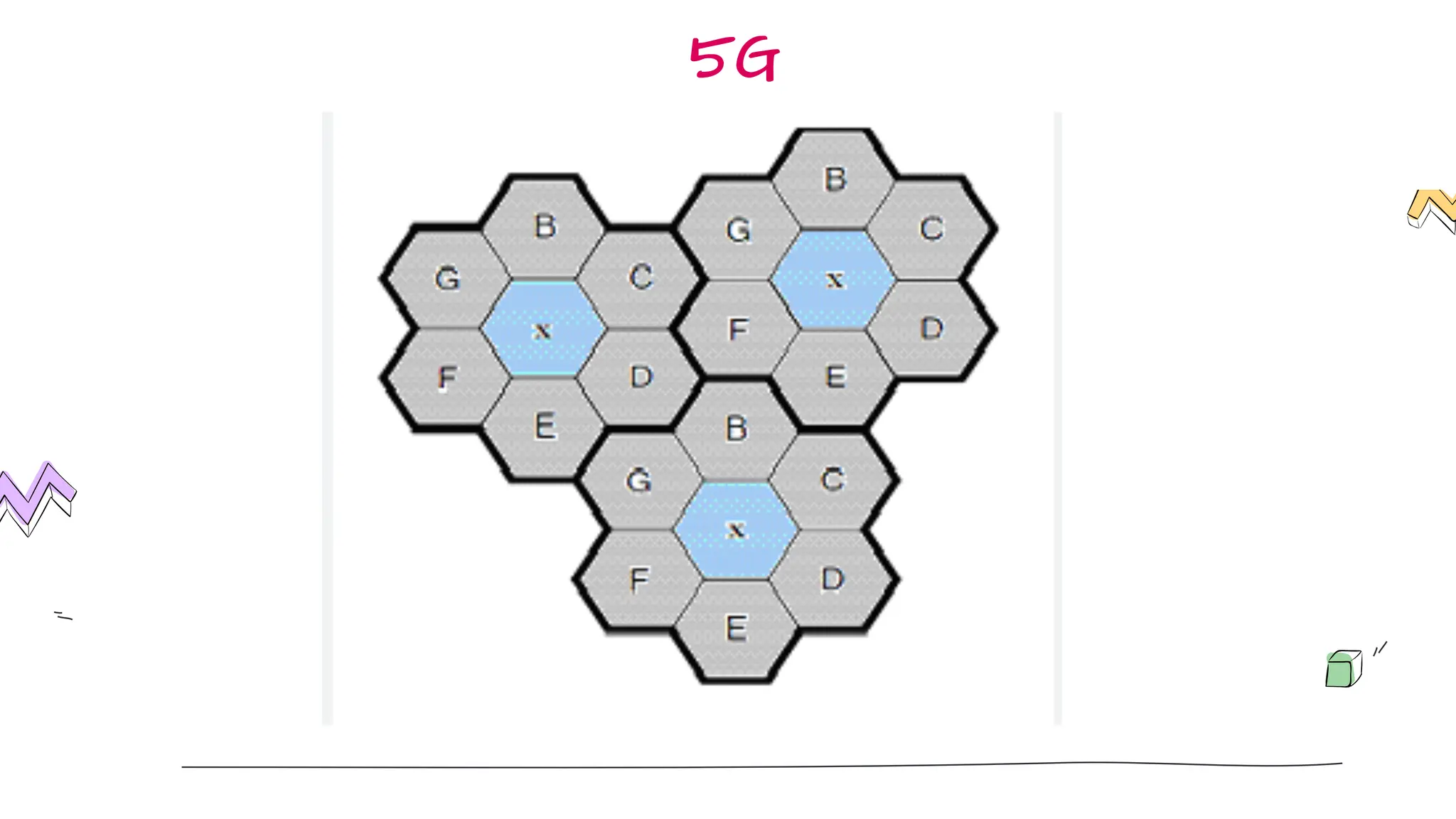
5G networks are digital cellular networks, in which the service
area covered by providers is divided into small geographical
areas called cells.
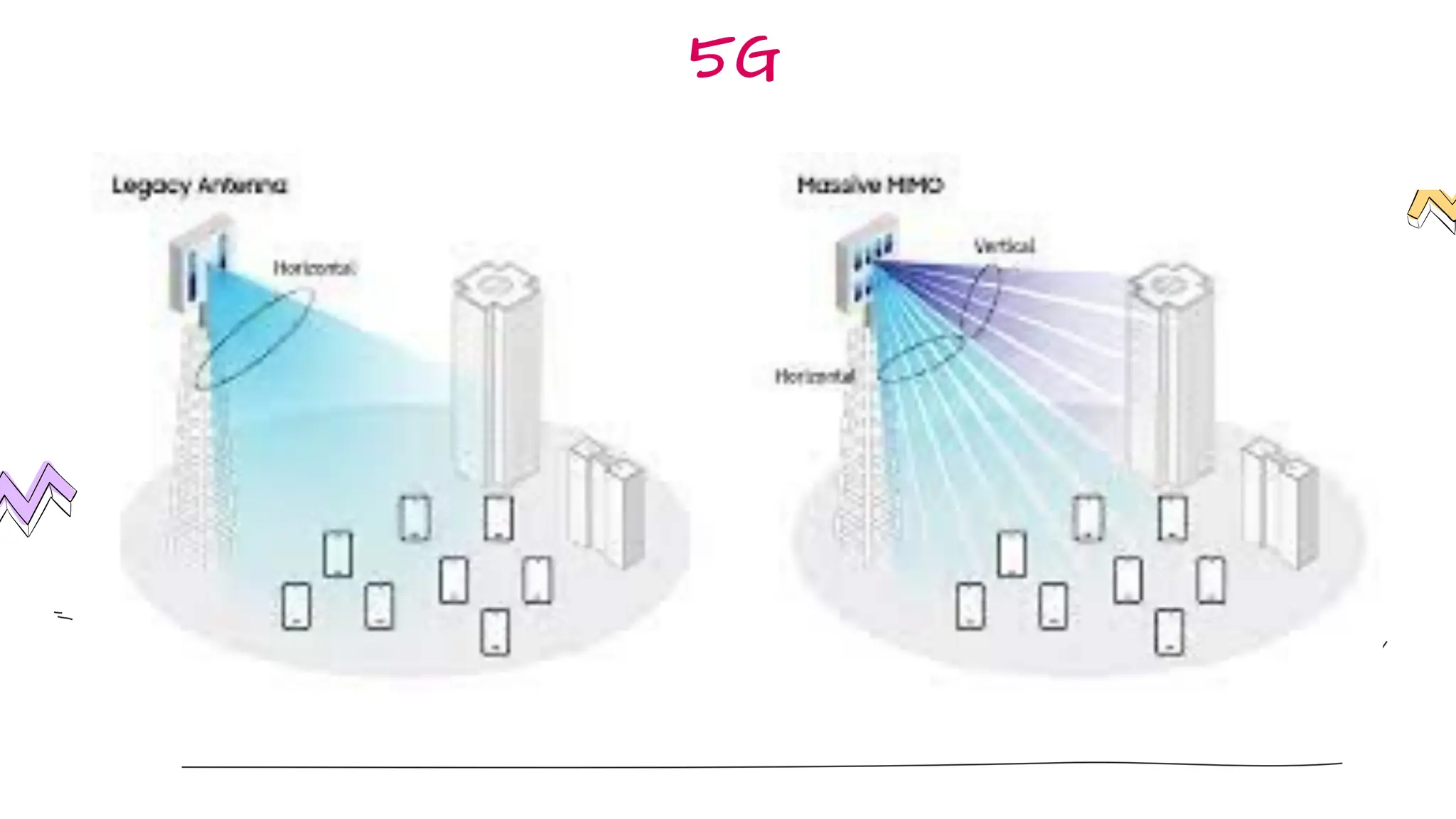
5G can support upto a million devices per square kilometer,
compared to 4G
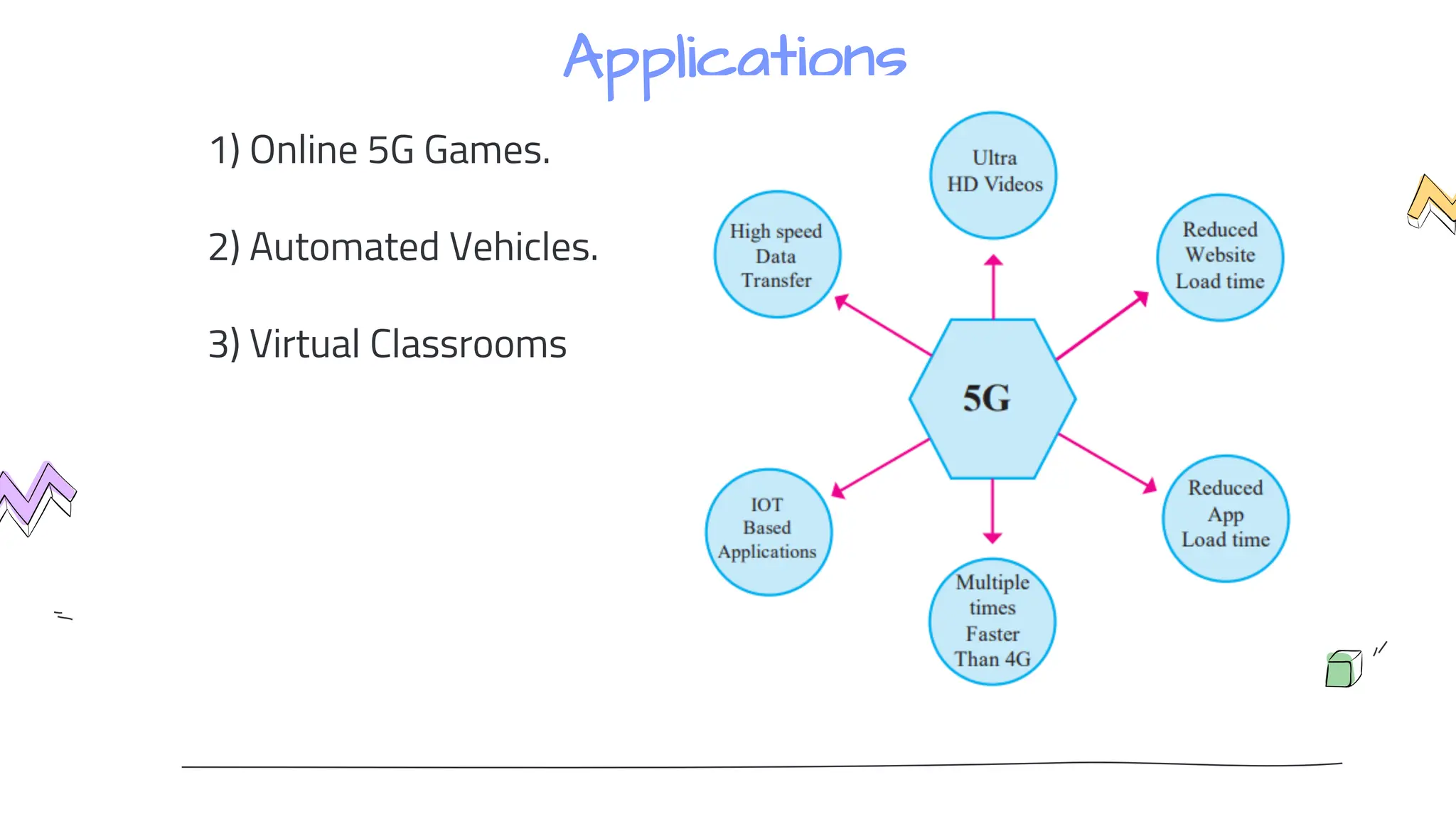
Applications
1) Online 5G Games.
2) Automated Vehicles.
3) Virtual Classrooms

Hac IT 4. Emerging Technologies (1).pdf

  • 1.
    Chapter 4 Emerging Technologies 12thInformation Technology Maharashtra Board
  • 2.
    Marks Distribution 2 Q. No.Description Marks /Question No. Of Questions Marks Q1. Fill in the blanks 1 2 2 Q2. State true of false 1 1 1 Q3. Multiple choice SINGLE answer 1 1 1 Q4. Multiple choice TWO correct answer 2 1 2 Q5. Multiple choice THREE correct answer 3 - - Q6. Match the following 1 - - Q7. Answer briefly (Any 5) 2 3 6 Q8. Write code (HTML or JavaScript) 5 - - Total 10+2
  • 3.
  • 4.
  • 5.
    IoT (Internet ofThings) • The Internet of things (IoT) is the network of physical devices, vehicles, home appliances, and other items embedded with electronics, software, sensors, actuators, and connectivity. • It enables these things to connect, collect and exchange data, creating opportunities for more direct integration of the physical world into computer-based systems • Resulting in efficiency improvements, economic benefits. • This reduces human efforts.
  • 6.
    IoT (Internet ofThings) • IOT involves extending Internet connectivity beyond standard devices. • Such as desktops, laptops, smartphones and tablets to any range of traditionally dumb or non-internet-enabled physical devices and everyday objects. • Embedded with technology, these devices can communicate and interact over the Internet, and they can be remotely monitored and controlled.
  • 7.
    Advantages ● Efficient resourceutilization : If we know the functionality and the way that how each device works, we definitely increase the efficient resource utilization as well as monitor natural resources. ● Minimize human effort : As the devices of IoT interact and communicate with each other and do lot of task for us, then they minimize the human effort
  • 8.
    Advantages ● Time saving: As it reduces the human effort then it definitely saves out time. Time is the primary factors in automation which can save through IOT platform. ● Enhance Data Collection : IoT devices can collect data from environment like weather, sound, pollution etc. This data then can be used to take decisions.
  • 9.
    Advantages ● Improve, security: IoT based security systems can make home or office environment secure.
  • 10.
    Disadvantages ● Privacy :Even without the active participation on the user, the IoT system provides substantial personal data in maximum detail. ● Complexity : The designing, developing, maintaining and enabling the large technology to IoT system is quite complicated.
  • 11.
    Applications of IoT ●Smart lighting - Illumination of light is controlled on the basis of day light. ● Smart thermostats - Allows users to schedule, monitor and remotely control home temperatures. ● Smart locks and garage-door openers - Password based or facial recognition based doors and locks. ● Smart security cameras – Security cameras that can identify known and unknown person and raise alarm, in case of security threat. ● Smart traffic signals – Signal that can adjust their timing to accommodate commutes and holiday traffic and keep cars moving.
  • 12.
  • 13.
    Cloud Computing Cloud computingis a model for enabling, convenient on-demand network access to a shared pool of computing resources like network, servers, storage, applications and services released with service provider interaction.
  • 14.
    Models of Cloudcomputing There are three primary service models of cloud computing that are ● Infrastructure as a Service (IaaS), ● Platform as a Service (PaaS) ● Software as a Service (SaaS).
  • 15.
    Infrastructure as aservice (IaaS) ● IaaS gives users access to storage, networking, servers and other computing resources via the cloud. ● While the user is still responsible for managing their applications, data, middleware, etc. ● IaaS provides automated and scalable environments that provide a high degree of control and flexibility for the user.
  • 16.
    Key features ● Insteadof purchasing hardware outright, users pay for IaaS on demand. ● Infrastructure is scalable depending on processing and storage needs. ● Enterprises saves the costs of buying and maintaining their own hardware. Examples : Amazon web services (AWS) ec2, Microsoft Azure VM, Google Compute Engine (GCE)
  • 17.
    Platform as aservice (PaaS) ● A service provider offers access to a cloud-based environment in which users can develop, manage and deliver applications. ● In addition to storage and other computing resources, users are able to use a suite of prebuilt tools to develop, customize and test their own applications.
  • 18.
    Key features • PaaSprovides a platform with tools to test, develop and host applications in the same environment. • Enables organizations to focus on development without having a worry about underlying infrastructure. • Providers manage security, operating systems, server software and backups. • Facilitates collaborative work even if teams work remotely.
  • 19.
    Software as aservice (SaaS) ● A service provider delivers software and applications through the internet. ● Users do not install applications on their local devices. ● Instead, the applications reside on a remote cloud network accessed through the web or an API.
  • 20.
    Key features ● SaaSvendors provide users with software and applications via a subscription model. ● Users do not have to manage, install or upgrade software; ● SaaS providers manage this. ● Data is secure in the cloud; ● equipment failure does not result in loss of data. ● Use of resources can be scaled depending on service needs. ● Applications are accessible from almost any internet-connected device, from virtually anywhere in the world. Examples : Google's G suite, GitHub, SAP, Slack, Dropbox.
  • 21.
    Types of CloudComputing There are three basic types of deployment of cloud computing that are Public, Private and Hybrid.
  • 22.
    Public Cloud • Sharedacross multiple users. • More efficient and inexpensive • Examples : Amazon AWS, Microsoft Azure, Google Cloud Platform.
  • 23.
    Private cloud • Providesservices to selected users • Data is protected behind the firewall. • Enhanced security and privacy.
  • 24.
    Hybrid Cloud ● Combinesboth Public and Private cloud elements. ● Allows greater flexibility as compared to that of public and private cloud solutions
  • 25.
    Benefits of CloudComputing ● Cost saving : Cloud computing solutions are inexpensive than the actual overall Infrastructure set up for the I.T services. ● Reliable : Cloud computing solutions are more reliable than In- house I.T infrastructure. ● Mobility : Cloud computing solutions are more portable because user can access data anytime, anywhere as required.
  • 26.
  • 27.
    AI (Artificial Intelligence) ●Artificial intelligence (AI) is an area of computer science that emphasizes on creation of intelligent machines that work and react like humans. ● AI is different from robotics, but related to some extent, in which machines sense their environment, perform calculations and do physical tasks either by themselves or under the direction of people.
  • 28.
    AI has somesub fields like- Machine learning automates analytical model building, to find hidden insights in data without being programmed to look for something in particular or draw a certain conclusion.
  • 29.
    AI has somesub fields like- Neural networks imitate the brain's array of interconnected neurons, and relay information between various units to find connections and derive meaning from data.
  • 30.
    AI has somesub fields like- Deep learning utilizes really big neural networks and a lot of computing power to find complex patterns in data, for applications such as image and speech recognition.
  • 31.
    AI has somesub fields like- • Cognitive computing is about creating a "natural, human- like interaction", including using the ability to interpret speech and respond to it.
  • 32.
    AI has somesub fields like- • Computer vision employs pattern recognition and deep learning to understand the content of pictures and videos, and to enable machines to use real-time images to make sense of what's around them.
  • 33.
    AI has somesub fields like- • Natural language processing involves analyzing and understanding human language and responding to it.
  • 34.
    Advantages of ArtificialIntelligence ● Reduction in human error : Computers if programmed properly with artificial Intelligence gives 100% accuracy as compared to task performed by human as there is always a chance for human mistakes. ● Digital Assistance : Some of the highly advanced organizations use digital assistants to interact with users which saves the need for human resources. Example- chatbot
  • 35.
    Advantages of ArtificialIntelligence ● Faster Decisions : Using AI alongside other technologies, we can make machines take decisions faster than a human and carry out actions quicker. ● Daily Applications : Daily applications such as Apple’s Siri, Window’s Cortana, Google’s OK Google are frequently used in our daily routine whether it is for searching a location, taking a selfie, making a phone call, replying to a mail and many more.
  • 36.
    Disadvantages of AI ●High Costs of Creation- As the machines used in AI based environments are very complex and high in price, it increases the cost for overall set up. ● Unemployment- As AI is replacing the majority of the repetitive tasks and other works with robots. ● This will reduced human interference but cause a major problems in the employment standards.
  • 37.
  • 38.
  • 39.
  • 40.
  • 41.
  • 42.
    5G • 5G isthe fifth generation of cellular network technology. • 5G is the next generation of wireless communications. • It is expected to provide Internet connections that are multiple times faster than 4G LTE (Long Term Evolution). • 5G technology may use a variety of spectrum bands, including millimeter wave (mmWave) radio spectrum, which can carry very large amounts of data at a short distance. • The drawback of the higher frequencies is that they are more easily obstructed by the walls of buildings, trees and other foliage, and even changes in the weather.
  • 43.
    5G The new 5Gnetworks will be able to transmit very large amounts of data—but only a few blocks at a time. 5G networks are digital cellular networks, in which the service area covered by providers is divided into small geographical areas called cells. 5G can support upto a million devices per square kilometer, compared to 4G
  • 44.
    Applications 1) Online 5GGames. 2) Automated Vehicles. 3) Virtual Classrooms