Chapter 15

Economic Regulations and Antitrust
Types of Government Regulation
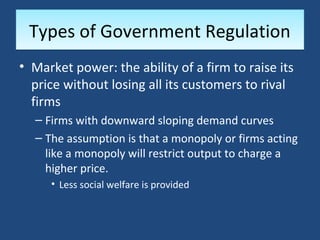
• Market power: the ability of a firm to raise its
  price without losing all its customers to rival
  firms
  – Firms with downward sloping demand curves
  – The assumption is that a monopoly or firms acting
    like a monopoly will restrict output to charge a
    higher price.
     • Less social welfare is provided
Types of Government Regulation
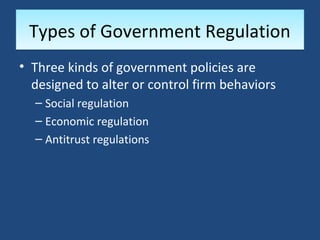
• Three kinds of government policies are
  designed to alter or control firm behaviors
  – Social regulation
  – Economic regulation
  – Antitrust regulations
Social regulation
• Social regulation tries to improve health and
  safety
  – It has economic consequences
  – Improvements in safety of workers
Economic regulation
• It aims to control the price, output, the entry
  of new firms, and the quality of service in
  industries in which monopoly appears
  inevitable or even desirable.
  – Government controls over natural monopolies
     • Phone
     • Electricity
     • Subway Stations
Antitrust regulation
• Antitrust policy outlaws attempts to
  monoplize, or cartelize, markets in which
  competition is desirable.
  – It is pursued in the courts
Regulating a Natural Monopoly
• Unregulated Profit Maximization
  – The price-output combination is inefficient in
    terms of social welfare.
  – Consumers pay a price that is much higher than
    the marginal cost of providing the service.
LO2               Exhibit 1
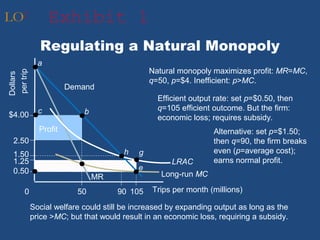
                 Regulating a Natural Monopoly
             a
                                              Natural monopoly maximizes profit: MR=MC,
per trip
Dollars


                                              q=50, p=$4. Inefficient: p>MC.
                      Demand
                                                Efficient output rate: set p=$0.50, then
             c            b                     q=105 efficient outcome. But the firm:
$4.00                                           economic loss; requires subsidy.
             Profit                                             Alternative: set p=$1.50;
  2.50                                                          then q=90, the firm breaks
  1.50                               h    g                     even (p=average cost);
  1.25                                              LRAC        earns normal profit.
             f   Loss                     e
  0.50                                           Long-run MC
                              MR
      0                 50          90 105    Trips per month (millions)

           Social welfare could still be increased by expanding output as long as the
           price >MC; but that would result in an economic loss, requiring a subsidy.
What can the government do?
• They can either operate the monopoly itself,
  or government can regulate a privately owned
  monopoly.
• Government-owned or government-
  regulation monopolies are called public
  utilities.
What are some of these regulations?
• Setting Price Equal to Marginal Cost
  – The monopolist is operating at a loss
  – In the L-R, the monopolist will go out of business
    rather than endure such a loss
• Subsidizing the Natural Monopolist
  – The Government can cover the loss by subsidizing
    the firm to earn a normal profit
     • Amtrak’s $30 billion over the last three decades
What are some of these regulations?
• Setting Price Equal to Average Cost
  – A “fair return”
  – The monopoly can stay in business without a
    subsidy
Why do governments regulate certain
           industries?
• Why not let market forces allocate resources?
• Two views of government regulation:
  – Public interest
  – Special interest of producers
     • Restricting entry into the market
     • Capture theory of regulation: producers’ political
       power and strong stake in the regulatory outcome lead
       them, in effect, to “capture” the regulating agency and
       prevail on it to serve producer interests.
LO3 Airline Regulation and Deregulation
              1938 Civil Aeronautics Board
                 Regulated interstate airlines
Case Study

                 40 years: No new interstate airline
                 Fixed prices among the 10 major airlines
                 Blocked new entry
                 Labor unions
                    Higher wages
                    Pilots worked                  2
                     weeks/month
                 High price
LO3 Airline Regulation and Deregulation
              1978 Deregulation
                 Price competition
Case Study

                 New entry
                 Price: one quarter below regulated price
                 More efficient airlines
                 FAA regulates quality
                  and safety
                    Accident rates               declines by
                     10-45%
                    More people fly                (passenger
                     miles                   tripled)
LO3          Airline Regulation and Deregulation
              Fierce competition
                 Mergers
Case Study

                 Disappeared
                 Bankrupt
              Lower wages
              Lower fares
              More flights
              Saving lives
Origins of Antitrust Policy
• Antitrust is the government’s attempt to
  reduce anticompetitive behavior and promote
  a market structure that leads to greater
  competition.
  – They attempt to promote socially desirable
    market performance
Origins of Antitrust Policy
• Two important developments were:
  – Technological breakthrough that lead to a larger
    optimal plant size in manufacturing and
  – The rise of the railroad from 9,000 miles of track
    in 1850 to 167,000 miles by 1890
     • Economies of scale and cheaper transport costs
       extended the geographical size of markets, so firms
       grew larger to serve this bigger market.
Antitrust
• Before the Civil War, industries were made up
  of small firms and monopoly power was not
  very prevalent at the time.
• After the Civil War, things began to change
  – 1870s and 1880s with many new inventions, such
    as the railroads and the telegraph the country was
    becoming more linked.
  – These technology changes allowed firms to
    expand into national markets
  – They began to form “trust.”
Trust
• A trust is a combination or cartel consisting of
  firms that place their assets in the custody of a
  board of trustees.
  – This allows firms that have not merged to form a
    cartel that will control an industry in order to
    charge monopoly prices and earn higher profits.
     • Today, these guys are no longer legal
     • Examples: Iron Trust, Sugar Trust, Cooper Trust, and
       Steel Trust
Predatory Pricing
• One practice that the trust use to run smaller
  competitors out of the market was known as
  “predatory pricing.”
  – Def: Predatory pricing is the practice of one or
    more firms temporarily reducing prices in order to
    eliminate competition and then raising prices.
The Sherman Act
• So, how should we stop this behavior.
• In the late 1890s, the government and the
  country in general grew tired of this behavior,
  as a result the next 50 years or so would lead to
  several antitrust laws. The most famous and the
  first of these actions is “The Sherman Act."
The Sherman Act
• The Sherman Act of 1890 is the federal
  antitrust law that prohibits monopolization
  and conspiracies to restrain trade.
  – This is still used today as the cornerstone of
    antitrust legislation.
  – Section 1- made trust illegal (i.e. no cartels)
  – Section 2- no monopolization of an industry

  http://www.stolaf.edu/people/becker/antitrust/
The Clayton Act
• The Clayton Act of 1914 is an amendment that
  strengthened the Sherman Act by making it
  illegal for firms to engaged in certain
  anticompetitive business practices.
  – Made these things illegal when they “substantially
    lessen competition or tend to create a monopoly.”
     •   Price discrimination
     •   Exclusive dealing
     •   Tying Contracts
     •   Stock Acquisition of Competing Companies
     •   Interlocking Directories.
The Federal Trade Commission
• The Act established the Federal Trade
  Commission (FTC) to investigate unfair
  competitive practices of firms.
• Today’s concerns:
  – Enforcing consumer protection legislation
  – Prohibiting deceptive advertising
  – Preventing collusion
• How does it work?
The Federal Trade Commission
• This law can block horizontal and vertical
  mergers.
  – Horizontal merger: the merging of firms that
    produce the same product
     • Wells Fargo and Wachovia
  – Vertical merger: the merging of firms where one
    supplies inputs to the other or demands output
    from the other.
     • Coke and a sugar farm
How to enforce them?
• Three ways:
  – Antitrust Division of the Department of Justice
  – FTC
     • Enforces through voluntary understanding or formal
       commission order
  – Private proceedings
     • Lawsuits for damage
Per Se Illegality and the Rule of Reason
• Per Se Illegality: In antitrust law, business
  practices deemed illegal regardless of their
  economic rational or their consequences.
  – The courts examine the firm’s behavior
• Rule of Reason: Before ruling on the legality of
  certain business practices, a court examines
  why they were undertaken and what effect
  they have on competition.
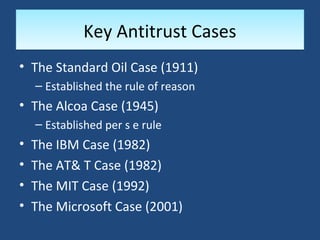
Key Antitrust Cases
• The Standard Oil Case (1911)
    – Established the rule of reason
• The Alcoa Case (1945)
    – Established per s e rule
•   The IBM Case (1982)
•   The AT& T Case (1982)
•   The MIT Case (1992)
•   The Microsoft Case (2001)
Mergers and Public Policy
• In determining possible harmful effects that a
  merger might have on competition, one
  important consideration is its impact on the
  share of sales accounted for by the largest
  firms in the industry.
• A few firms account for a relatively large share
  of sales, the industry is said to be
  “concentrated.”
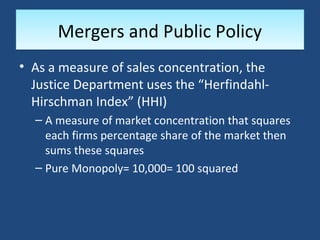
Mergers and Public Policy
• As a measure of sales concentration, the
  Justice Department uses the “Herfindahl-
  Hirschman Index” (HHI)
  – A measure of market concentration that squares
    each firms percentage share of the market then
    sums these squares
  – Pure Monopoly= 10,000= 100 squared
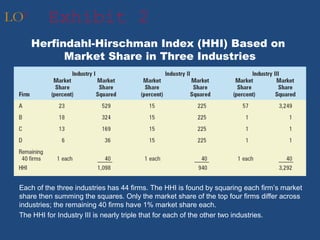
LO5       Exhibit 2
      Herfindahl-Hirschman Index (HHI) Based on
            Market Share in Three Industries


 Each of the three industries has 44 firms. The HHI is found by squaring each firm’s market
 share then summing the squares. Only the market share of the top four firms differ across
 industries; the remaining 40 firms have 1% market share each.
 The HHI for Industry III is nearly triple that for each of the other two industries.
Mergers and Public Policy
• The Justice Department generally challenges
  any merger in an industry that meets two
  conditions:
  – The post merger HHI exceeds 1,800
  – The merger increases the index by more than 100
    points
Merger Waves
• 1887-1904- Horizontal Mergers
• 1916-1929- Vertical Mergers
• 1948-1969- Conglomerate Mergers
  – A merger of firms in different industries
• 1982-present- Horizontal and Vertical Mergers
Competitive Trends in
the US Economy

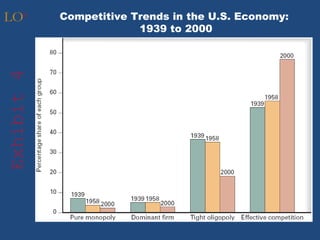
 1. Pure monopoly
    – One firm controls the market
    – Block entry
 2. Dominant firm
    – One firm: more than half market share
    – No close rival


LO6
Competitive Trends in
the U.S. Economy

 3. Tight oligopoly
    – Top 4 firms: more than 60% of market
        output
    – Evidence of cooperation
 4. Effective competition
    – Low concentration
    – Low barriers to entry
    – Little or no collusion

LO6
Competition over Time
• The Growth in competition from 1958 to
  2000:
  – Competition from imports
  – Deregulation
  – Antitrust policy
LO6         Competitive Trends in the U.S. Economy:
                         1939 to 2000
Exhibit 4
Problems with
Antitrust Policy

  Competition may not
   require that many
   firms
  Abuse of antitrust
  Growth of international
   markets
  Bailing Out Trouble
   Industries


LO6

Chapter 15

  • 1.
  • 2.
    Types of GovernmentRegulation • Market power: the ability of a firm to raise its price without losing all its customers to rival firms – Firms with downward sloping demand curves – The assumption is that a monopoly or firms acting like a monopoly will restrict output to charge a higher price. • Less social welfare is provided
  • 3.
    Types of GovernmentRegulation • Three kinds of government policies are designed to alter or control firm behaviors – Social regulation – Economic regulation – Antitrust regulations
  • 4.
    Social regulation • Socialregulation tries to improve health and safety – It has economic consequences – Improvements in safety of workers
  • 5.
    Economic regulation • Itaims to control the price, output, the entry of new firms, and the quality of service in industries in which monopoly appears inevitable or even desirable. – Government controls over natural monopolies • Phone • Electricity • Subway Stations
  • 6.
    Antitrust regulation • Antitrustpolicy outlaws attempts to monoplize, or cartelize, markets in which competition is desirable. – It is pursued in the courts
  • 7.
    Regulating a NaturalMonopoly • Unregulated Profit Maximization – The price-output combination is inefficient in terms of social welfare. – Consumers pay a price that is much higher than the marginal cost of providing the service.
  • 8.
    LO2 Exhibit 1 Regulating a Natural Monopoly a Natural monopoly maximizes profit: MR=MC, per trip Dollars q=50, p=$4. Inefficient: p>MC. Demand Efficient output rate: set p=$0.50, then c b q=105 efficient outcome. But the firm: $4.00 economic loss; requires subsidy. Profit Alternative: set p=$1.50; 2.50 then q=90, the firm breaks 1.50 h g even (p=average cost); 1.25 LRAC earns normal profit. f Loss e 0.50 Long-run MC MR 0 50 90 105 Trips per month (millions) Social welfare could still be increased by expanding output as long as the price >MC; but that would result in an economic loss, requiring a subsidy.
  • 9.
    What can thegovernment do? • They can either operate the monopoly itself, or government can regulate a privately owned monopoly. • Government-owned or government- regulation monopolies are called public utilities.
  • 10.
    What are someof these regulations? • Setting Price Equal to Marginal Cost – The monopolist is operating at a loss – In the L-R, the monopolist will go out of business rather than endure such a loss • Subsidizing the Natural Monopolist – The Government can cover the loss by subsidizing the firm to earn a normal profit • Amtrak’s $30 billion over the last three decades
  • 11.
    What are someof these regulations? • Setting Price Equal to Average Cost – A “fair return” – The monopoly can stay in business without a subsidy
  • 12.
    Why do governmentsregulate certain industries? • Why not let market forces allocate resources? • Two views of government regulation: – Public interest – Special interest of producers • Restricting entry into the market • Capture theory of regulation: producers’ political power and strong stake in the regulatory outcome lead them, in effect, to “capture” the regulating agency and prevail on it to serve producer interests.
  • 13.
    LO3 Airline Regulationand Deregulation  1938 Civil Aeronautics Board  Regulated interstate airlines Case Study  40 years: No new interstate airline  Fixed prices among the 10 major airlines  Blocked new entry  Labor unions  Higher wages  Pilots worked 2 weeks/month  High price
  • 14.
    LO3 Airline Regulationand Deregulation  1978 Deregulation  Price competition Case Study  New entry  Price: one quarter below regulated price  More efficient airlines  FAA regulates quality and safety  Accident rates declines by 10-45%  More people fly (passenger miles tripled)
  • 15.
    LO3 Airline Regulation and Deregulation  Fierce competition  Mergers Case Study  Disappeared  Bankrupt  Lower wages  Lower fares  More flights  Saving lives
  • 16.
    Origins of AntitrustPolicy • Antitrust is the government’s attempt to reduce anticompetitive behavior and promote a market structure that leads to greater competition. – They attempt to promote socially desirable market performance
  • 17.
    Origins of AntitrustPolicy • Two important developments were: – Technological breakthrough that lead to a larger optimal plant size in manufacturing and – The rise of the railroad from 9,000 miles of track in 1850 to 167,000 miles by 1890 • Economies of scale and cheaper transport costs extended the geographical size of markets, so firms grew larger to serve this bigger market.
  • 18.
    Antitrust • Before theCivil War, industries were made up of small firms and monopoly power was not very prevalent at the time. • After the Civil War, things began to change – 1870s and 1880s with many new inventions, such as the railroads and the telegraph the country was becoming more linked. – These technology changes allowed firms to expand into national markets – They began to form “trust.”
  • 19.
    Trust • A trustis a combination or cartel consisting of firms that place their assets in the custody of a board of trustees. – This allows firms that have not merged to form a cartel that will control an industry in order to charge monopoly prices and earn higher profits. • Today, these guys are no longer legal • Examples: Iron Trust, Sugar Trust, Cooper Trust, and Steel Trust
  • 20.
    Predatory Pricing • Onepractice that the trust use to run smaller competitors out of the market was known as “predatory pricing.” – Def: Predatory pricing is the practice of one or more firms temporarily reducing prices in order to eliminate competition and then raising prices.
  • 21.
    The Sherman Act •So, how should we stop this behavior. • In the late 1890s, the government and the country in general grew tired of this behavior, as a result the next 50 years or so would lead to several antitrust laws. The most famous and the first of these actions is “The Sherman Act."
  • 22.
    The Sherman Act •The Sherman Act of 1890 is the federal antitrust law that prohibits monopolization and conspiracies to restrain trade. – This is still used today as the cornerstone of antitrust legislation. – Section 1- made trust illegal (i.e. no cartels) – Section 2- no monopolization of an industry http://www.stolaf.edu/people/becker/antitrust/
  • 23.
    The Clayton Act •The Clayton Act of 1914 is an amendment that strengthened the Sherman Act by making it illegal for firms to engaged in certain anticompetitive business practices. – Made these things illegal when they “substantially lessen competition or tend to create a monopoly.” • Price discrimination • Exclusive dealing • Tying Contracts • Stock Acquisition of Competing Companies • Interlocking Directories.
  • 24.
    The Federal TradeCommission • The Act established the Federal Trade Commission (FTC) to investigate unfair competitive practices of firms. • Today’s concerns: – Enforcing consumer protection legislation – Prohibiting deceptive advertising – Preventing collusion • How does it work?
  • 25.
    The Federal TradeCommission • This law can block horizontal and vertical mergers. – Horizontal merger: the merging of firms that produce the same product • Wells Fargo and Wachovia – Vertical merger: the merging of firms where one supplies inputs to the other or demands output from the other. • Coke and a sugar farm
  • 26.
    How to enforcethem? • Three ways: – Antitrust Division of the Department of Justice – FTC • Enforces through voluntary understanding or formal commission order – Private proceedings • Lawsuits for damage
  • 27.
    Per Se Illegalityand the Rule of Reason • Per Se Illegality: In antitrust law, business practices deemed illegal regardless of their economic rational or their consequences. – The courts examine the firm’s behavior • Rule of Reason: Before ruling on the legality of certain business practices, a court examines why they were undertaken and what effect they have on competition.
  • 28.
    Key Antitrust Cases •The Standard Oil Case (1911) – Established the rule of reason • The Alcoa Case (1945) – Established per s e rule • The IBM Case (1982) • The AT& T Case (1982) • The MIT Case (1992) • The Microsoft Case (2001)
  • 29.
    Mergers and PublicPolicy • In determining possible harmful effects that a merger might have on competition, one important consideration is its impact on the share of sales accounted for by the largest firms in the industry. • A few firms account for a relatively large share of sales, the industry is said to be “concentrated.”
  • 30.
    Mergers and PublicPolicy • As a measure of sales concentration, the Justice Department uses the “Herfindahl- Hirschman Index” (HHI) – A measure of market concentration that squares each firms percentage share of the market then sums these squares – Pure Monopoly= 10,000= 100 squared
  • 31.
    LO5 Exhibit 2 Herfindahl-Hirschman Index (HHI) Based on Market Share in Three Industries Each of the three industries has 44 firms. The HHI is found by squaring each firm’s market share then summing the squares. Only the market share of the top four firms differ across industries; the remaining 40 firms have 1% market share each. The HHI for Industry III is nearly triple that for each of the other two industries.
  • 32.
    Mergers and PublicPolicy • The Justice Department generally challenges any merger in an industry that meets two conditions: – The post merger HHI exceeds 1,800 – The merger increases the index by more than 100 points
  • 33.
    Merger Waves • 1887-1904-Horizontal Mergers • 1916-1929- Vertical Mergers • 1948-1969- Conglomerate Mergers – A merger of firms in different industries • 1982-present- Horizontal and Vertical Mergers
  • 34.
    Competitive Trends in theUS Economy 1. Pure monopoly – One firm controls the market – Block entry 2. Dominant firm – One firm: more than half market share – No close rival LO6
  • 35.
    Competitive Trends in theU.S. Economy 3. Tight oligopoly – Top 4 firms: more than 60% of market output – Evidence of cooperation 4. Effective competition – Low concentration – Low barriers to entry – Little or no collusion LO6
  • 36.
    Competition over Time •The Growth in competition from 1958 to 2000: – Competition from imports – Deregulation – Antitrust policy
  • 37.
    LO6 Competitive Trends in the U.S. Economy: 1939 to 2000 Exhibit 4
  • 38.
    Problems with Antitrust Policy  Competition may not require that many firms  Abuse of antitrust  Growth of international markets  Bailing Out Trouble Industries LO6

Editor's Notes

  • #9 Chapter 15 Economic Regulation and Antitrust Policy
  • #14 Chapter 15 Economic Regulation and Antitrust Policy
  • #15 Chapter 15 Economic Regulation and Antitrust Policy
  • #16 Chapter 15 Economic Regulation and Antitrust Policy
  • #32 Chapter 15 Economic Regulation and Antitrust Policy
  • #35 Chapter 15 Economic Regulation and Antitrust Policy
  • #36 Chapter 15 Economic Regulation and Antitrust Policy
  • #38 Chapter 15 Economic Regulation and Antitrust Policy
  • #39 Chapter 15 Economic Regulation and Antitrust Policy